PRESENTED BY
RITUPARNA GHOSH
APRAJIT JHA
M.Sc BIOSTATISTICS AND DEMOGRAPHY
BASIC PRINCIPLES OF
CONTROL CHARTS
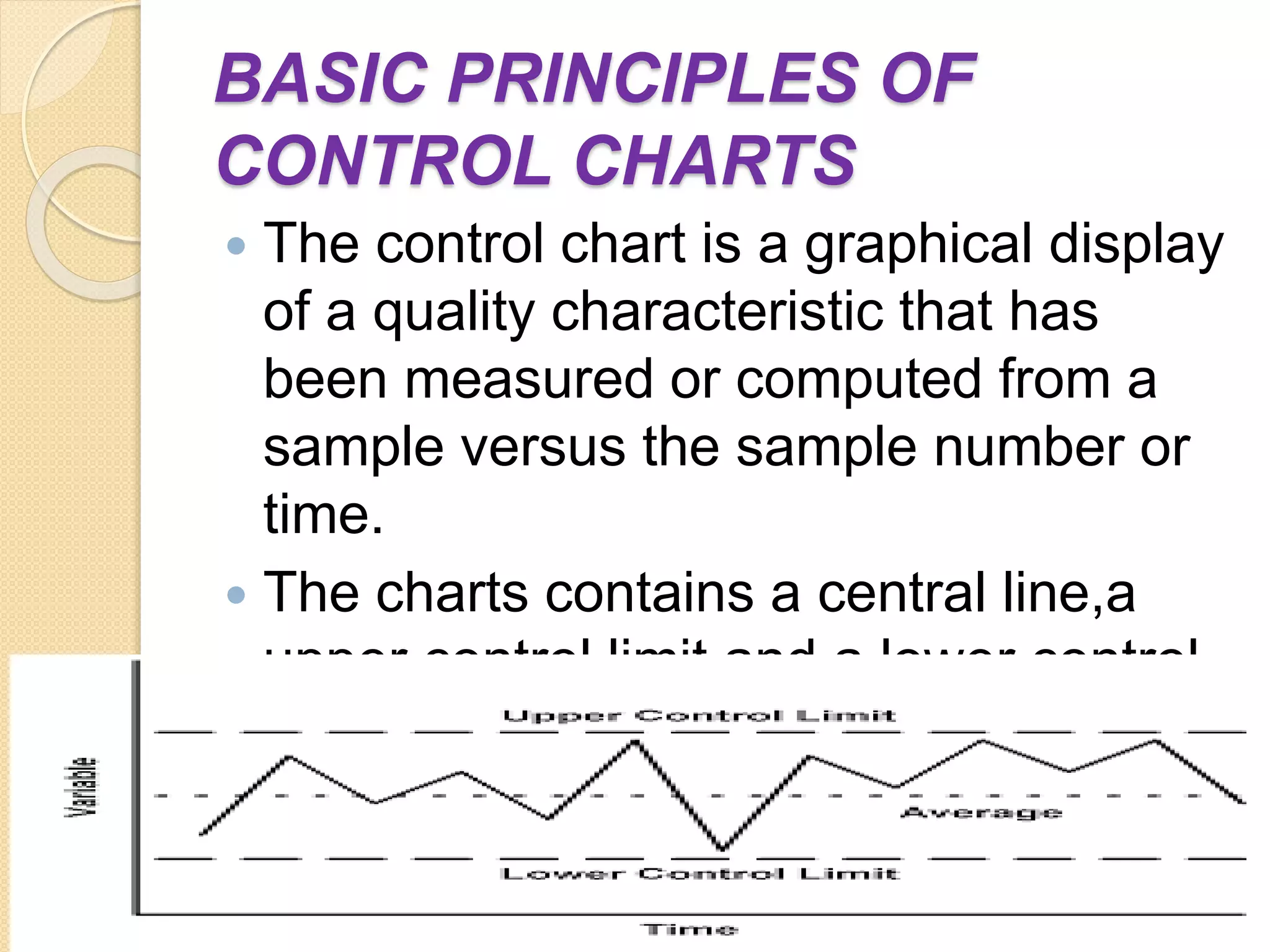
 The control chart is a graphical display
of a quality characteristic that has
been measured or computed from a
sample versus the sample number or
time.
 The charts contains a central line,a
upper control limit and a lower control
limit.
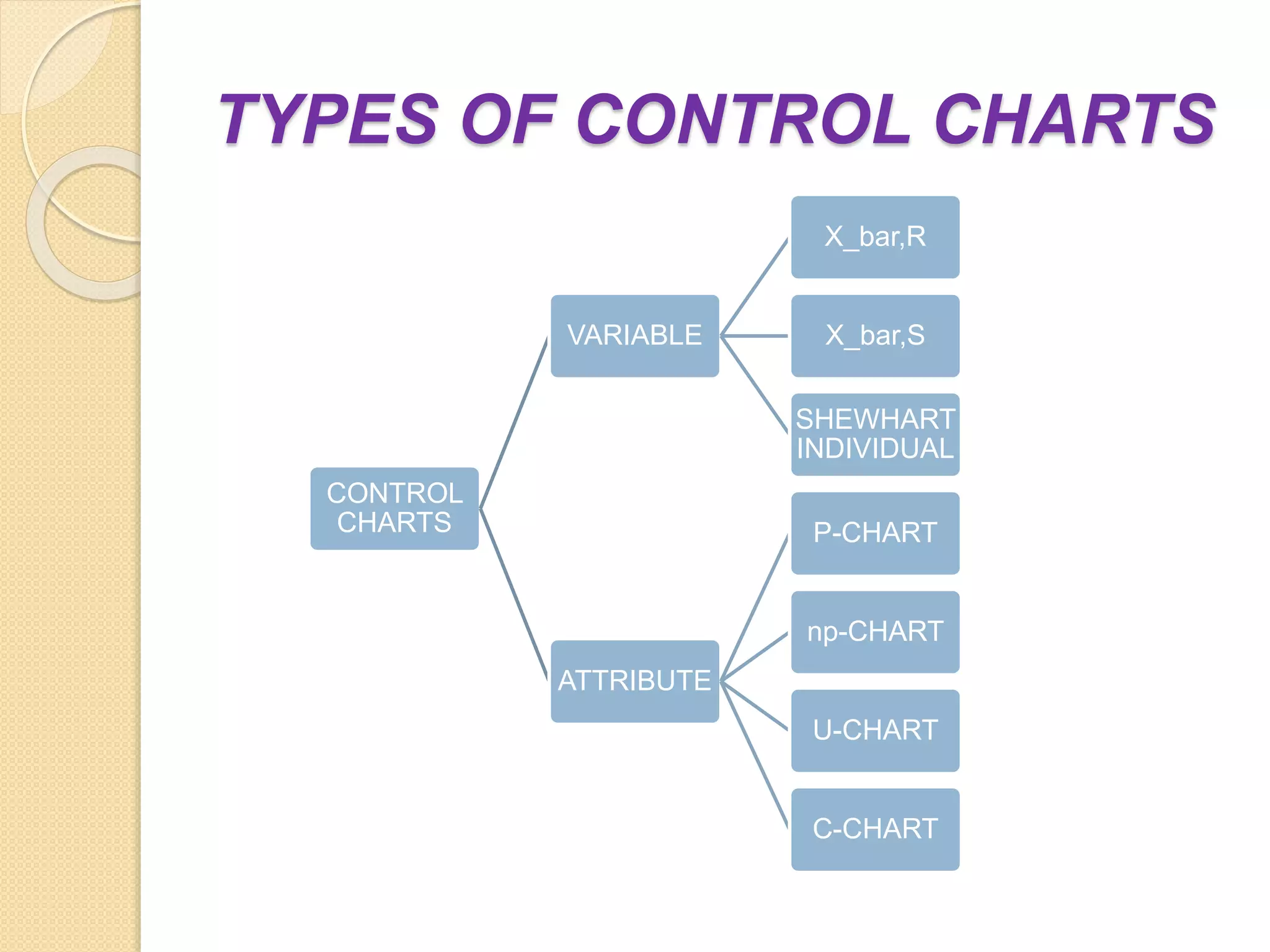
TYPES OF CONTROL CHARTS
CONTROL
CHARTS
VARIABLE
X_bar,R
X_bar,S
SHEWHART
INDIVIDUAL
ATTRIBUTE
P-CHART
np-CHART
U-CHART
C-CHART
HEALTHCARE & CONTROL
CHART
 Control chart
Aid in process understanding
Assess process stability
Identify changes indicating improvement
or
deteoriation in quality
 Used in
Hospital process improvement projects
Accrediting bodies and governmental
agencies
Public health surveillance
CONTROL CHART FOR
NONCONFORMITIES(DEFECT)
 The nonconfirming item is a unit of
product that doesnt satisfy the
specifications for that product.
 Distinction between a defect and
defective is clear
 Defect:-Any instance of the item’s
lack of conformity to specification.
 Defective:-Item that fails to fulfil one
or more of the given specifications
WHAT IS C-CHART?
 Originally proposed by Walter A.
Shewhart.
 It is a control chart for
nonconformities.
 Developed for total number of
nonconformities in a unit.
 Underlying distribution-Poisson
distribution.
 Two cases- 1.Standard given.
2.Standard not given.
C-CHART:STANDARD GIVEN
 UCL =c+3√c.
 Central line= c
 LCL=c-3√c.
NOTE:
where c is the parameter of Poisson
distribution.
If LCL comes negative, take it as 0.
C-CHART:STANDARD NOT
GIVEN
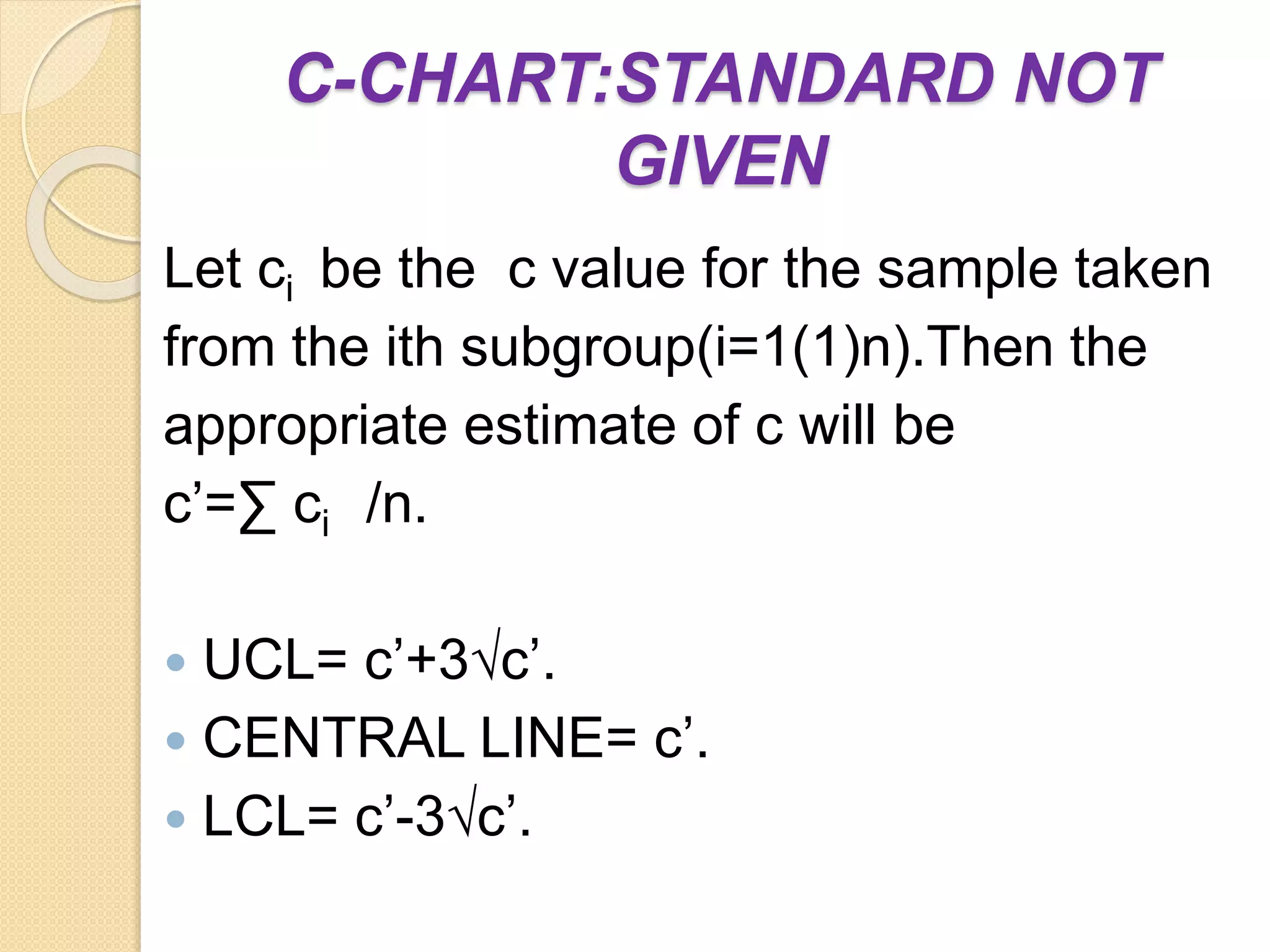
Let ci be the c value for the sample taken
from the ith subgroup(i=1(1)n).Then the
appropriate estimate of c will be
c’=∑ ci /n.
 UCL= c’+3√c’.
 CENTRAL LINE= c’.
 LCL= c’-3√c’.
NOTE:
c’ is the estimated value of the
poisson parameter. c’ may be estimated
as the observed average number of
nonconformities in a preliminary sample
of inspection units.
When no standard is given, the control
limits in equation should be regarded as
trial control limits.
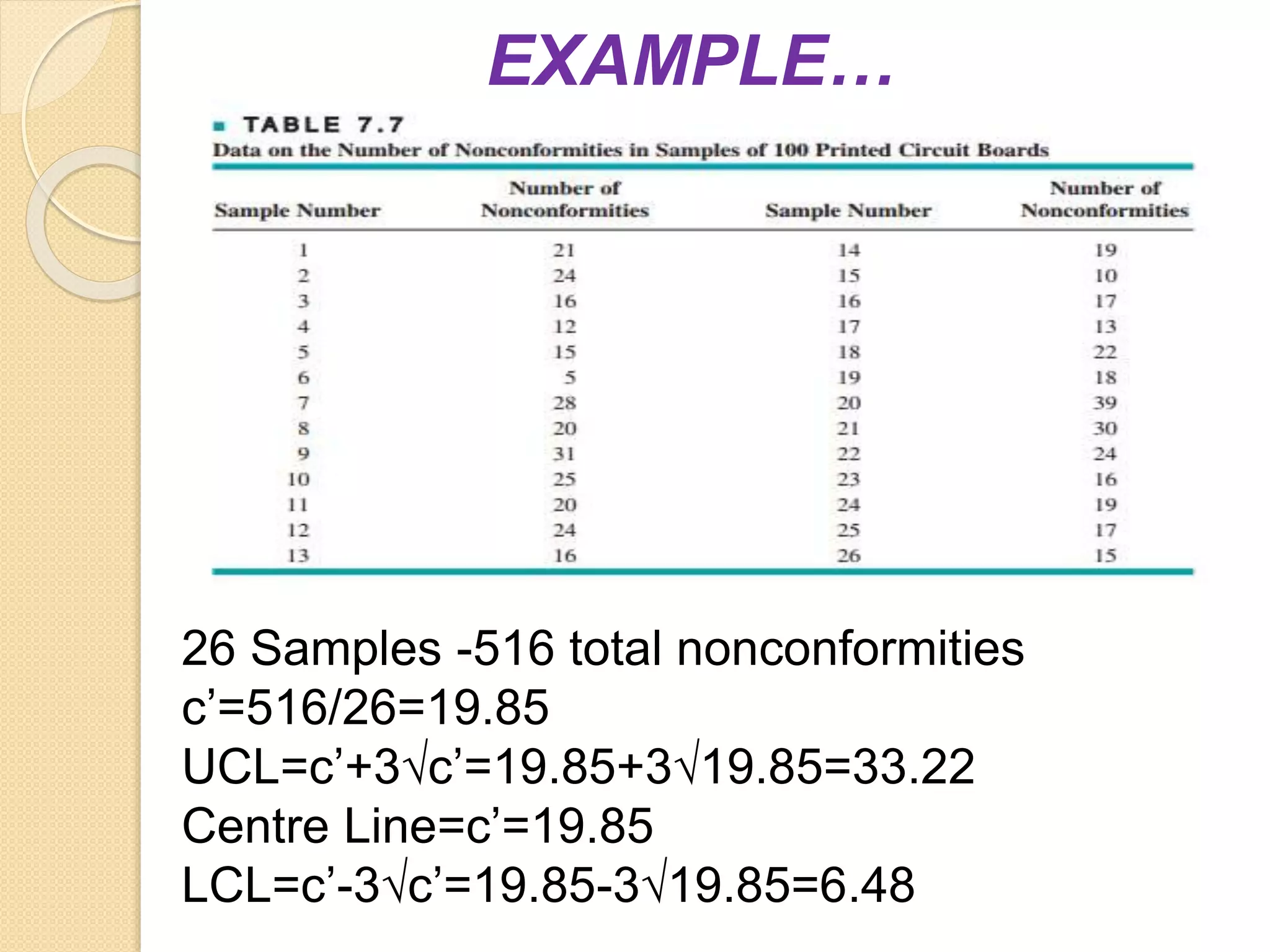
26 Samples -516 total nonconformities
c’=516/26=19.85
UCL=c’+3√c’=19.85+3√19.85=33.22
Centre Line=c’=19.85
LCL=c’-3√c’=19.85-3√19.85=6.48
EXAMPLE…
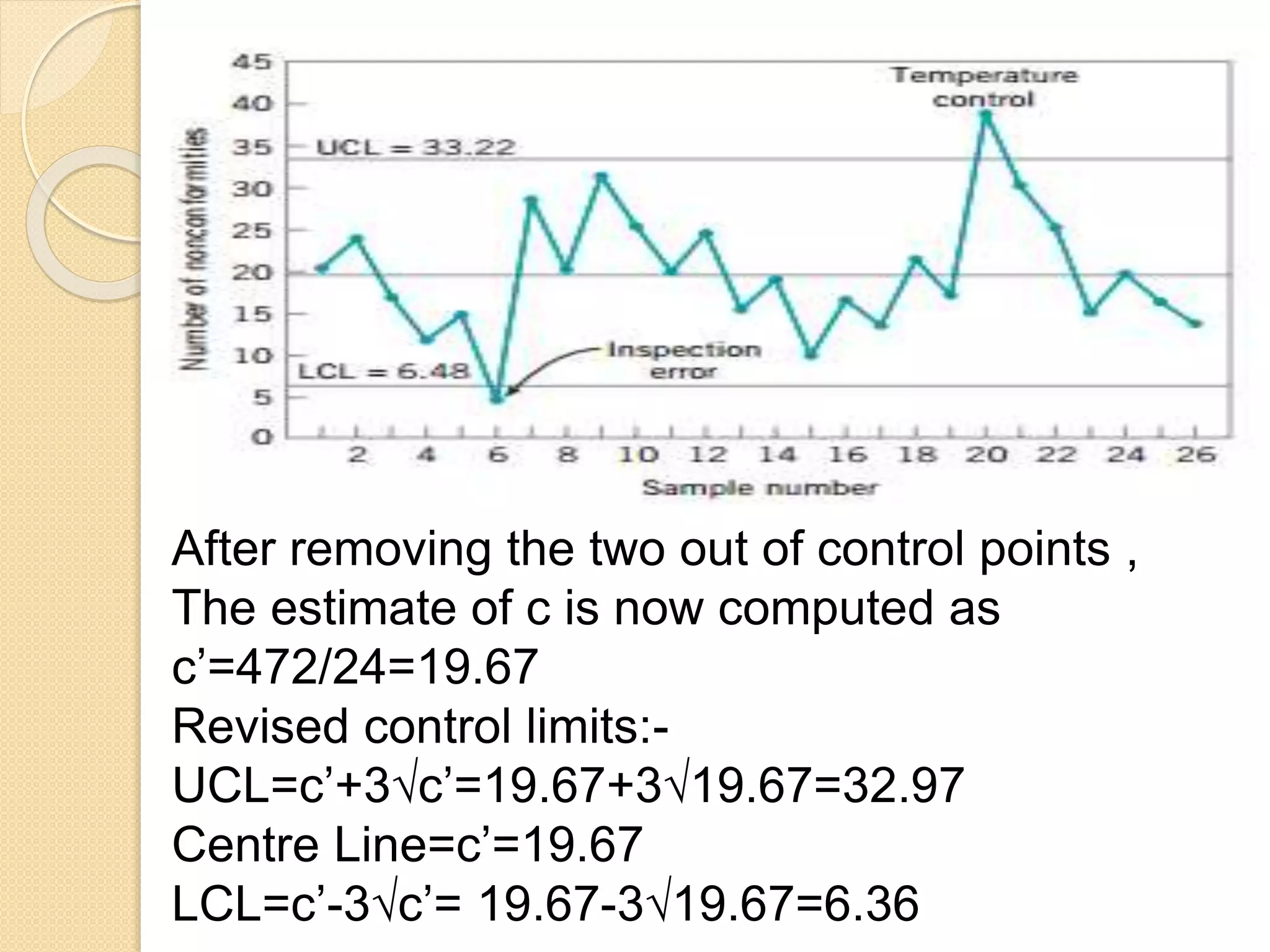
After removing the two out of control points ,
The estimate of c is now computed as
c’=472/24=19.67
Revised control limits:-
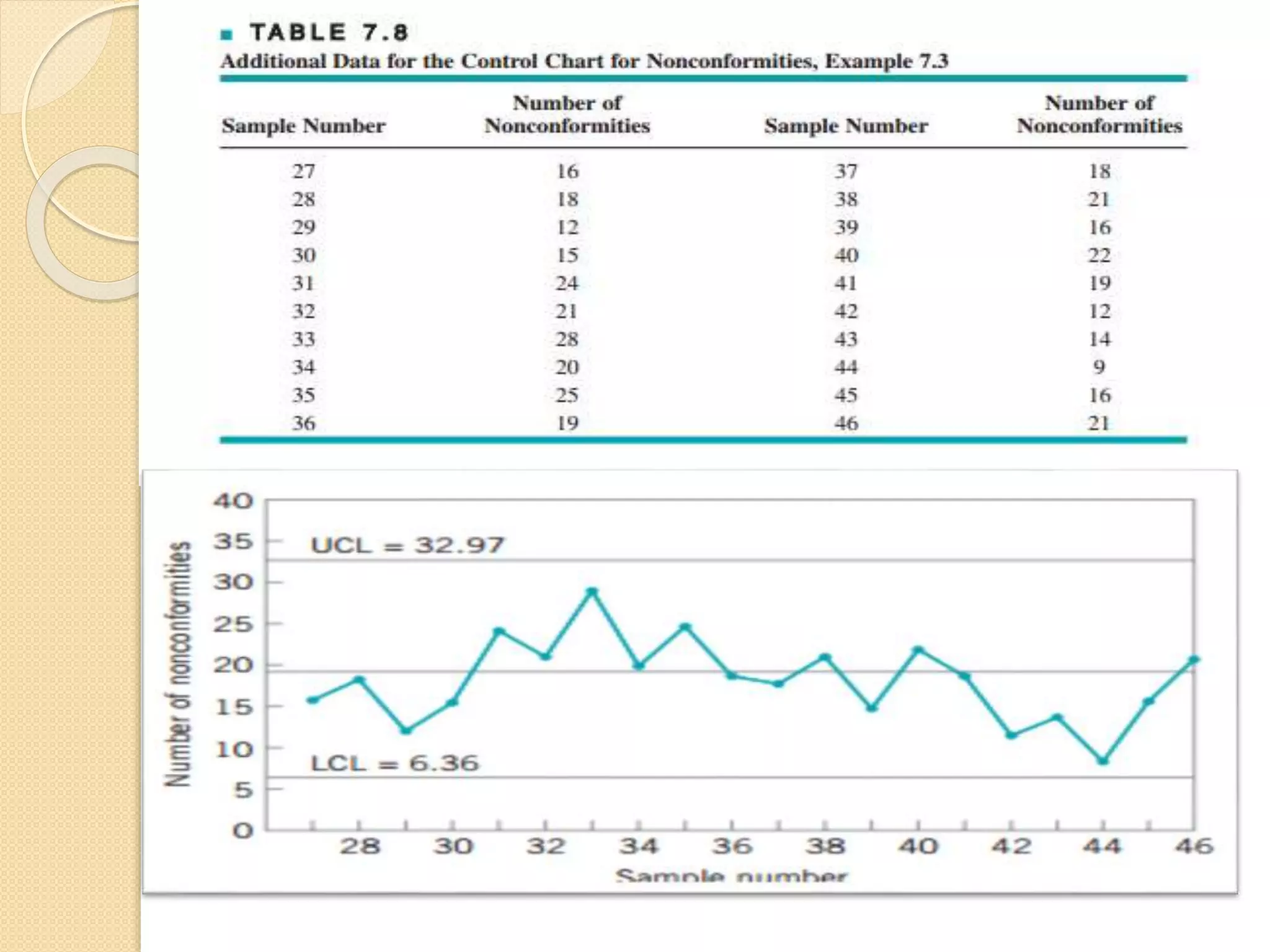
UCL=c’+3√c’=19.67+3√19.67=32.97
Centre Line=c’=19.67
LCL=c’-3√c’= 19.67-3√19.67=6.36
Interpretation
The process is under control.
No lack of control is indicated.
USE OF C-CHART IN HEALTH
CARE
 Attribute data involves-
-counts(no.of falls per day).
--proportions(proportion of patients
receiving right antibiotics).
-rate(the number of falls per 1000
patient-days).
• For counts we use c-chart.
CONCLUSION
 Defect or nonconformity data are always
more informative than fraction
nonconforming,
 Widely used in transactional and service
business applications of statistical
process control.
 The limitation of c chart is that it takes
samples of constant size where in reality
it might not be so.In case of variable
sample size we use the u charts that
gives us the no.of defects per unit i.e
u=c/n.
SOURCES
 “Introduction to StatisticalQualityControl”-Doughlas
C.Montgomery
 “Fundamentalsof StatisticsVol-2”-
A.M.Gun,M.K.Gupta,B.Dasgupta
 support.minitab.com/en-us/minitab/17/topic-
library/quality-tools/control-charts/understanding-
attributes-control-charts/what-is-a-c-chart/
 http://www.coe.neu.edu/healthcare/pdfs/publications
/C13-Use_of_Control_C.pdf.
C chart

C chart

  • 1.
    PRESENTED BY RITUPARNA GHOSH APRAJITJHA M.Sc BIOSTATISTICS AND DEMOGRAPHY
  • 2.
    BASIC PRINCIPLES OF CONTROLCHARTS  The control chart is a graphical display of a quality characteristic that has been measured or computed from a sample versus the sample number or time.  The charts contains a central line,a upper control limit and a lower control limit.
  • 3.
    TYPES OF CONTROLCHARTS CONTROL CHARTS VARIABLE X_bar,R X_bar,S SHEWHART INDIVIDUAL ATTRIBUTE P-CHART np-CHART U-CHART C-CHART
  • 4.
    HEALTHCARE & CONTROL CHART Control chart Aid in process understanding Assess process stability Identify changes indicating improvement or deteoriation in quality  Used in Hospital process improvement projects Accrediting bodies and governmental agencies Public health surveillance
  • 5.
    CONTROL CHART FOR NONCONFORMITIES(DEFECT) The nonconfirming item is a unit of product that doesnt satisfy the specifications for that product.  Distinction between a defect and defective is clear  Defect:-Any instance of the item’s lack of conformity to specification.  Defective:-Item that fails to fulfil one or more of the given specifications
  • 6.
    WHAT IS C-CHART? Originally proposed by Walter A. Shewhart.  It is a control chart for nonconformities.  Developed for total number of nonconformities in a unit.  Underlying distribution-Poisson distribution.  Two cases- 1.Standard given. 2.Standard not given.
  • 7.
    C-CHART:STANDARD GIVEN  UCL=c+3√c.  Central line= c  LCL=c-3√c. NOTE: where c is the parameter of Poisson distribution. If LCL comes negative, take it as 0.
  • 8.
    C-CHART:STANDARD NOT GIVEN Let cibe the c value for the sample taken from the ith subgroup(i=1(1)n).Then the appropriate estimate of c will be c’=∑ ci /n.  UCL= c’+3√c’.  CENTRAL LINE= c’.  LCL= c’-3√c’.
  • 9.
    NOTE: c’ is theestimated value of the poisson parameter. c’ may be estimated as the observed average number of nonconformities in a preliminary sample of inspection units. When no standard is given, the control limits in equation should be regarded as trial control limits.
  • 10.
    26 Samples -516total nonconformities c’=516/26=19.85 UCL=c’+3√c’=19.85+3√19.85=33.22 Centre Line=c’=19.85 LCL=c’-3√c’=19.85-3√19.85=6.48 EXAMPLE…
  • 11.
    After removing thetwo out of control points , The estimate of c is now computed as c’=472/24=19.67 Revised control limits:- UCL=c’+3√c’=19.67+3√19.67=32.97 Centre Line=c’=19.67 LCL=c’-3√c’= 19.67-3√19.67=6.36
  • 13.
    Interpretation The process isunder control. No lack of control is indicated.
  • 14.
    USE OF C-CHARTIN HEALTH CARE  Attribute data involves- -counts(no.of falls per day). --proportions(proportion of patients receiving right antibiotics). -rate(the number of falls per 1000 patient-days). • For counts we use c-chart.
  • 15.
    CONCLUSION  Defect ornonconformity data are always more informative than fraction nonconforming,  Widely used in transactional and service business applications of statistical process control.  The limitation of c chart is that it takes samples of constant size where in reality it might not be so.In case of variable sample size we use the u charts that gives us the no.of defects per unit i.e u=c/n.
  • 16.
    SOURCES  “Introduction toStatisticalQualityControl”-Doughlas C.Montgomery  “Fundamentalsof StatisticsVol-2”- A.M.Gun,M.K.Gupta,B.Dasgupta  support.minitab.com/en-us/minitab/17/topic- library/quality-tools/control-charts/understanding- attributes-control-charts/what-is-a-c-chart/  http://www.coe.neu.edu/healthcare/pdfs/publications /C13-Use_of_Control_C.pdf.

Editor's Notes

  • #16 usually be several different types of nonconformities. By analyzing the nonconformities by type, we can often gain considerable insight into their cause. In effect, we can treat errors in those environments the same as we treat defects or nonconformities in the manufacturing world. To give just a few examples, we can plot errors on engineering drawings, errors on plans and documents, and errors in computer software as c charts.