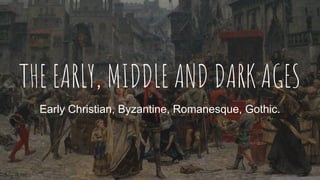
THE EARLY, MIDDLE AND DARK AGES
Early Christian, Byzantine, Romanesque, Gothic.
INTRODUCTION
By the start of 400 CE, the roman empire has
weakened, it was segregated into two empires with
their own capitals and emperors; the eastern empire
and the western empire. The western empire crumbled
under the Northern European Vandals of Scandinavian
lands. Christianity has become the most prevalent and
dominating religion, moving from Palestine, through
Syria, to Rome; all the way to France and England. The
change of society and religion demanded by new rulers
created variations of design and trends throughout the
centuries, starting from Early Christian design, followed
by the Byzantine flourish during the authority of
Constantine, and later on the emergence of
Romanesque era, with a unique form of design that
became known as Carolingian, the term derived from
the new Emperor’s name, Charlemagne.
313 C.E Early Christianity: acceptance of Christianity by Constantine
330 Conquering and claiming Constantinople (Byzantine) as the Capital of Rome by Constantine
330-340 The construction of Basilicas and Christian Churches
410 The fall of the Roman empire to the Scandinavian Goths, Visigoths and the Vandals
537 Hagia Sophia is completed
Mid 11th The start of the Romanesque era
1337 100 years’ war between England and France, and the rise of the Gothic architecture (up to
the 16th century)
1444 German inventor Johannes Gutenberg invents the printing press. This will signal the start of
the Renaissance
1453 The Byzantine Empire falls for the Ottoman rule
Mid
19TH
Gothic revival
Early Christian and Byzantine
300 C.E - 1453 C.E
Earlier home-churches before public churches were allowed in Rome. The disciples of Jesus met
together in the upper room of a house, since Christianity was not allowed in Rome before 313. An
early church father known as Clement of Alexandria documented worshipping in a house, and an
evidence in Dura-Europos, New Syria, was found, claiming that the building was there during the 232
AD.
When Emperor Constantine the Great accepted Christianity in the 313 C.E Christians were no longer meeting in secret
home-churches, liturgical ceremonies were accepted and welcomed, which required new buildings that were able to accommodate the
large numbers of Christians.Constantine began by banning Christians from taking part in the (pagan) state religion – not that
Christians wanted to, but the ban eased tensions over Christian non-participation. Constantine wanted social harmony, and this meant
enforcing religious harmony. He tried to establish conformity between the wildly different forms of contemporary Christian belief,
notably by calling a council of bishops to the eastern city of Nicaea. There the basic principles of Christianity were thrashed out in a
statement known today as the Nicene Creed. This doctrine remains fundamental to Christian liturgies today. By the 3rd century
Christianity became the largest religious community in Rome, with up to 50,000 followers. Earlier temples meant for roman deities,
and Jewish home-synagogues, were not meant for performing mass which included public gatherings.
“With free minds, all are
to worship their Gods”
Tables, vessels for wine and bread, and space for the congregation of worshippers, assistants, and
clergy were all needed. The Christians figured they could exploit some aspects of the temples, such as
the basilica; public courtroom. They built around it according to their requirements, creating a singular
loose configuration for future churches; an altar at the apse to conduct mass and other services; the
sides of the naves provided aisles for accounting worshippers or shrines. The nave itself was left empty
and grand in height, leaving windows to illuminates the space. Walls were usually made of masonry, and
rood of wood, columns would carry lintels or arches, and helped identity and separate the nave from
aisles by height alteration.
1. Propylaeum- the entrance building of a
sacred building
2. Atrium- in early Christian, Byzantine, and
medieval architecture, the open forecourt
3. Narthex- the entrance hall or porch before
the nave
4. Nave- extends from the entrance to the apse
and commonly flanked by side aisles.
5. Side Aisle- one of the corridors running
parallel to the nave separated by a colonnade
6. Crossing- where the transept and the nave
connect
7. Transept- it appears in Early Christian
churches, but become a more common feature
in the Carolingian period.
8. Apse- a hollow in the wall at the end of a
either a Christian church or a Roman basilica.
In a Roman basilica, it would hold a painting of
the emperor and was generally where the
magistrate declared laws, while in a Christian
church, it contained the bishop throne and the
altar.
Christians were inspired by the Romans to use elaboration in their construction and
design; grand spaces; high sophisticated columns; arches and decorative symbolic designs.
• Columns: were based on the roman Corinthian and ionic columns, made of stone or colorful
marble.
• They painted the walls and ceiling above the column’s and lined them with detailed molded
skirtings
• Mosaic used was often illustrating religious themes.
• colored stones in geometric patterns and strong colors were used for the floors.
• Materials: even complete columns with their capitals, were often taken from earlier Roman
temples and other buildings, thereby transferring Roman design into basilica churches in a
most direct manner.
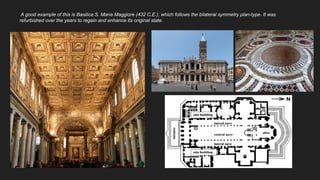
A good example of this is Basilica S. Maria Maggiore (432 C.E.), which follows the bilateral symmetry plan-type. It was
refurbished over the years to regain and enhance its original state.
The second type of Early church plan wasn't as common; the octagonal center plan harbors a baptismal font, tomb, or altar. These are known as
radially symmetrical churches, as in having a central axis like a starfish, an example of this plan is S.Stefano Rotondo. The common type,
introduced previously, bilaterally symmetric plan, which has a strong connection to the altar at the far east, a symbolic significance for facing the
Holy Land, Palestine. Both designs were celebrated with painted decoration and mosaic that illustrated religious events for the illiterate and literate
public to admire.
Byzantine Era
330 C.E. 1453
Emperor Constantine relocated to Byzantine in 330 C.E. and named it Constantinople. Byzantine buildings lacked the detail of roman
architecture, but maintained their skills of vaults and domes. S.Vitale is an example of early Christian churches and Byzantine churches,
for it was a mixture if colorful elegant marbles and mosaic that painted religious stories, a gallery of high windows that created a mystical
atmosphere, painted hollow-pottery domes, and simple carved blocks. It showed both radial and bilateral symmetry.
S. Vitale, Ravenna, Italy, c 532-48.
Hagia Sophia, or Church of the Holy Wisdom, Istanbul, was constructed as a Christian church during 532–537 under the
rule of the Byzantine emperor Justinian I. throughout the centuries it became a mosque, a museum, then a mosque
again.
The most important works of the Byzantine era was the Hagia Sophia. While the romans couldn't figure a solution for creating massive
domes without risking damage, the byzantine builders made The Pendentive, and created a 107-diameter dome made of brick. The
smaller domes and arcades are supported by columns and the spaces in between filled in. This geometric alignment created a
semi-spherical dome cut at the middle to create a square that requires support from all four corners only. The forty windows above the
pendentives ringing the dome create a sense of airiness.
Mehmed the conqueror converted Hagia Sophia to a mosque after the fall of Constantinople and the rise of
the Ottoman Empire in 1453, he added a wooden minaret, a grand chandelier, a mihrab (which indicates
the direction of Mica), and a minbar. Bayezid II, Selim II, and Murad III consecutively took part in
ordering the building and reconstructing of new minarets until four guarded each side of the mosque, most
of which were carried out by Architect Sinan in the 1500s. All the paintings that covered Hagia Sophia
were removed when the church became a mosque, since Islam prohibits creature art within place of
worship.
Mehmed Bayezid II Selim II Murad II
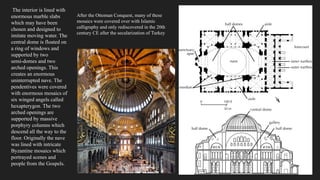
The interior is lined with
enormous marble slabs
which may have been
chosen and designed to
imitate moving water. The
central dome is floated on
a ring of windows and
supported by two
semi-domes and two
arched openings. This
creates an enormous
uninterrupted nave. The
pendentives were covered
with enormous mosaics of
six winged angels called
hexapterygon. The two
arched openings are
supported by massive
porphyry columns which
descend all the way to the
floor. Originally the nave
was lined with intricate
Byzantine mosaics which
portrayed scenes and
people from the Gospels.
After the Ottoman Conquest, many of these
mosaics were covered over with Islamic
calligraphy and only rediscovered in the 20th
century CE after the secularization of Turkey
The Church of S. Marco in
Venice is the best example of
what the interior of Hagia
Sophia would have looked
like before it was marred. It is
built with five domes on
pendentives, covering four
arms of the Greek cross plan.
It has a rich interior of mosaic,
beautiful chancel, and carved
choir screen.
The interior of the church is
decorated with gold mosaics
grounds and inlaid with
marble and glass. The screen
between the choir and nave
shows marble statues, made
by Jacobello and Pier Paolo
dalle.
The Church of S. Marco
San Marco Basilica: altar screen
Its difficult to learn about secular
buildings in the early Christian and
byzantine era because they survived in
limited ruins throughout history, even the
great baths and palaces that the Romans
built during the glory of the Roman
Empire had thinned to “mostly
unidentifiable”. Residential buildings
were reconstructed or destroyed, as well,
but some houses in Venice still withhold,
from the Byzantine Era; a few stories high
with a wide central hall sandwiched
between smaller rooms. Traces of
Byzantine architecture would be found in
other countries aside from Turkey, such as
Greece, Italy, and Russia
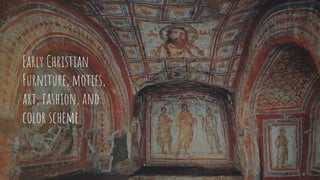
Early Christian
Furniture, motifs,
art, fashion, and
color scheme
Early Christian and Byzantine Furniture
Seating were either throne or chair, which reflected the
architecture of the building it was in. Materials used were
wood, metal, ivory and decorated with precious metals. Silk
velvet upholstery, sometimes animal hide Few had soft
cushions for comfort
Mattress was cord weaved on the bed frame
Engraved designs similar to the architecture
Sometimes it used to be simple mattress on the
ground
Cushioned stool for comfort, covered in velvet Folding stools were
extensively used Legs were designed with gold inlays They used
folding tables so that they could use and move them easily Other
kinds of tables were bulky and heavily engraved with curving
Chests were used by every
level of people Made with
lock and keys Decorated with
the period motifs and
patterns
https://www.slideshare.net/azramaliha22/furniture-characteristics-of-historical-periods
Early Christian Motifs
1.The Christian cross
2. the fish, was a secret symbol that Christians
recognized one another with when Christianity
was prohibited.
3. the dove, lamb, shepherds and their sheep,
representing Christ as the Shepherd.
4. the Greek letters of chi (X) and rho (P),
5. the peacock and grapevines, symbols of
Dionysus, the god of merry and wine.
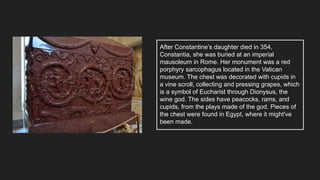
After Constantine’s daughter died in 354,
Constantia, she was buried at an imperial
mausoleum in Rome. Her monument was a red
porphyry sarcophagus located in the Vatican
museum. The chest was decorated with cupids in
a vine scroll, collecting and pressing grapes, which
is a symbol of Eucharist through Dionysus, the
wine god. The sides have peacocks, rams, and
cupids, from the plays made of the god. Pieces of
the chest were found in Egypt, where it might've
been made.
Early Christian art, fashion, and color scheme
Early Christian art and fashion were heavily
dependent on Roman culture. Their fashion was not
elaborate but their fabrics were rich. They used dull
colors, like beige, white, light blue, lilac, and slowly
started using stronger ones, like red, gold, green,
and dark blue.
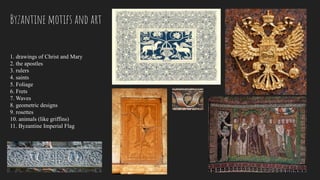
Byzantine motifs and art
1. drawings of Christ and Mary
2. the apostles
3. rulers
4. saints
5. Foliage
6. Frets
7. Waves
8. geometric designs
9. rosettes
10. animals (like griffins)
11. Byzantine Imperial Flag
Byzantine fashion and color scheme
The byzantine era used bolder colors more than dull ones, especially blue, red, and gold. It can be seen in their
fashion and church interiors; for example, in Hagia Sophia and S. Vitale Basilica
The Dark Ages: The Romanesque
Era and the Gothic Era
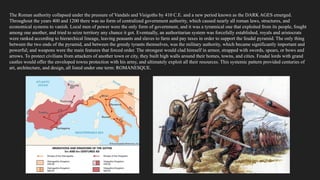
The Roman authority collapsed under the pressure of Vandals and Visigoths by 410 C.E. and a new period known as the DARK AGES emerged.
Throughout the years 400 and 1200 there was no form of centralized government authority, which caused nearly all roman laws, structures, and
economical systems to vanish. Local men of power were the only form of government, and it was a tyrannical one that exploited from its people, fought
among one another, and tried to seize territory any chance it got. Eventually, an authoritarian system was forcefully established, royals and aristocrats
were ranked according to hierarchical lineage, leaving peasants and slaves to farm and pay taxes in order to support the feudal pyramid. The only thing
between the two ends of the pyramid, and between the greedy tyrants themselves, was the military authority, which became significantly important and
powerful; and weapons were the main features that forced order. The strongest would clad himself in armor, strapped with swords, spears, or bows and
arrows. To protect civilians from attackers of another town or city, they built high walls around their homes, towns, and cities. Feudal lords with grand
castles would offer the enveloped towns protection with his army, and ultimately exploit all their resources. This systemic pattern provided centuries of
art, architecture, and design, all listed under one term: ROMANESQUE.
The brutality of the dark ages faded away
when Charlemagne (771-814) took control;
Carolingian era was the kickstart of early
phase of Romanesque art and architecture.
the term Romanesque emerged from the
constant use of roman design aspects,
specifically the semicircular arches,
however, it does not have strong connection
with the roman empire because it was
majorly forgotten in the early middle ages.
Charlemagne’s castle, Aix La Chapelle, in
Aachen, is the greatest example for
Romanesque style. The octagon plan has
eight sides, all vaulted, with surrounding
gateways on both first and second levels, the
barrel vaults and semicircular arches
dominating the design are evidence of
Roman influence. Wood was the most
common material for structures like stone
buildings.
Groin vaulting developed throughout years of
tinkering with vaulting systems. A solution to
hold stone roofs in church naves was found;
Barrel vaults, separated vaulting, or the least
favored option: wooden roofs.
1. semicircular arches for windows, doors, and arcades
2. barrel or groin vaults to support the roof of the nave
3. massive piers and walls, with few windows, to contain the outward thrust of the vaults
4. side aisles with galleries located above them
5. a huge tower over the crossing of nave and transept
6. smaller towers at the church’s western end
1. Church
2. Cloister
3. Infirmary
4. Chapel
5. Novitiate
6. Orchard/Cemetery
7. Carrien
8. Barn
9. Workshops
10. Brewery and bakery
11. Stables
12. Animal pens
13. Hostel
14. Guesthouse
15. School
16. Abbot's house
17. Scriptorium and library
18. Dormitory
19. Refeaory
20. Kitchens
21. Cellars
22. Hospice for the poor
23. Baths and latrines
Romanesque churches characteristics
The monastery of S. Call, Switzerland, c. 820
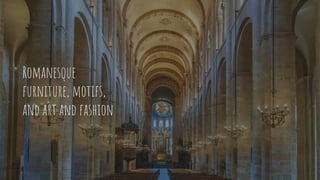
Romanesque
furniture, motifs,
and art and fashion
• Chair legs looked like lion paw
• Made of metal or walnut wood
• animal hide seating
• Cushions were made of silk or velvet
• Usually ornamented and gilded
Romanesque furniture
• made of walnut wood
• they had curved fine decorations on panels of headboard and
footboard
• the legs of the beds were usually Corinthian corbels
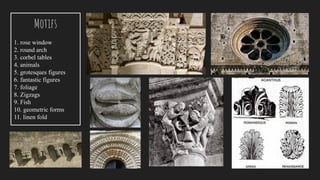
Motifs
1. rose window
2. round arch
3. corbel tables
4. animals
5. grotesques figures
6. fantastic figures
7. foliage
8. Zigzags
9. Fish
10. geometric forms
11. linen fold
Art in the Romanesque era was vigorous and lively. Churches followed with paintings and mosaics of Christ and
scenes from the bible. In manuscripts lavish drawings of the time period were painted colorfully. They used strong
colors that were also used in stained glass. The art frames were tight and the subjects long and slim, out of proportion,
mostly. Drapery, clothing, and hair were more detailed than the other elements in the drawings
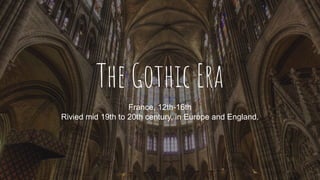
The Gothic Era
France, 12th-16th
Rivied mid 19th to 20th century, in Europe and England.
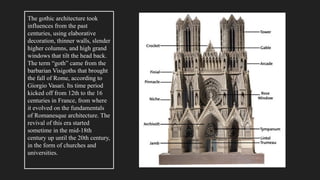
The gothic architecture took
influences from the past
centuries, using elaborative
decoration, thinner walls, slender
higher columns, and high grand
windows that tilt the head back.
The term “goth” came from the
barbarian Visigoths that brought
the fall of Rome, according to
Giorgio Vasari. Its time period
kicked off from 12th to the 16
centuries in France, from where
it evolved on the fundamentals
of Romanesque architecture. The
revival of this era started
sometime in the mid-18th
century up until the 20th century,
in the form of churches and
universities.
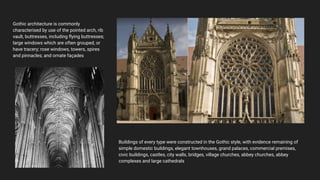
Gothic architecture is commonly
characterised by use of the pointed arch, rib
vault, buttresses, including flying buttresses;
large windows which are often grouped, or
have tracery; rose windows, towers, spires
and pinnacles; and ornate façades
Buildings of every type were constructed in the Gothic style, with evidence remaining of
simple domestic buildings, elegant townhouses, grand palaces, commercial premises,
civic buildings, castles, city walls, bridges, village churches, abbey churches, abbey
complexes and large cathedrals
COMMON CHARACTERISTICS
Spires
Flying buttress
The flying buttress originally helped bring the idea of
open space and light to the cathedrals through stability
and structure, by supporting the clerestory and the
weight of the high roofs.
Gargoyles
The gargoyle (derived from
the French word gargouille,
meaning gargle) is a
sculptural waterspout, placed
to prevent rainwater from
running down masonry
walls.Profusely grouped upon
several cathedrals, it heightens
a sense of allegory and the
fantastic.
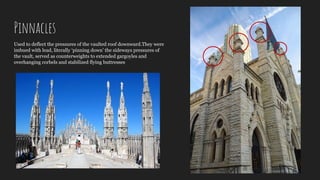
Pinnacles
Used to deflect the pressures of the vaulted roof downward.They were
imbued with lead, literally ‘pinning down’ the sideways pressures of
the vault, served as counterweights to extended gargoyles and
overhanging corbels and stabilized flying buttresses
Pointed arch
Tracery
The oculus and stained glass
The capital of every Ionic column features a characteristic pair of volutes, or spiral scrolls, at the
centre of each of which is an eye, or disk, also known as an oculus. It used to be located in the
dome of the Pantheon. Open to the weather, it allows rain to enter and fall to the floor, where it is
carried away through drains.
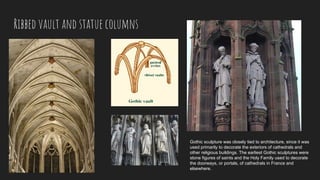
Ribbed vault and statue columns
Gothic sculpture was closely tied to architecture, since it was
used primarily to decorate the exteriors of cathedrals and
other religious buildings. The earliest Gothic sculptures were
stone figures of saints and the Holy Family used to decorate
the doorways, or portals, of cathedrals in France and
elsewhere.
GOTHIC BUILDINGS
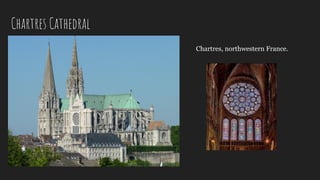
Chartres Cathedral
Chartres, northwestern France.
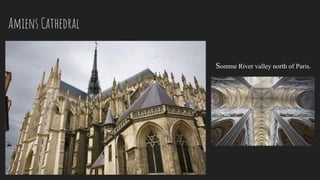
Amiens Cathedral
Somme River valley north of Paris.
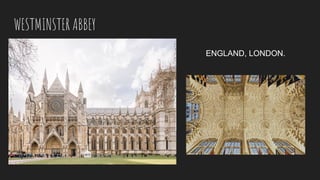
WESTMINSTER ABBEY
ENGLAND, LONDON.
Gothic furniture and details
Gothic furniture
was derived from
gothic art in the
beginning of the
12th century, the
furniture was
simple in the early
stages, painted the
carved, with tracert
as the main
element of design.
The main material
was wood, mainly
oak, chestnut, and
walnut.
● Chairs were designed to look like they belonged to royalty
● rectangular or circular with low backs
● Had a lot of sophisticated oak wood carvings along with some details of animals
● The king’s chairs were heavier and larger with paintings and gold decorations
● chests had lots of intricate designs
● material used was wood
● small low ones served as seats
Chests were made of heavy
intricate designs, material used
was wood Also served as seat,
bed or table because of the
features
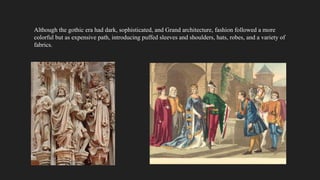
Although the gothic era had dark, sophisticated, and Grand architecture, fashion followed a more
colorful but as expensive path, introducing puffed sleeves and shoulders, hats, robes, and a variety of
fabrics.
Comparison with the past AND
INFLUENCE
The Early, Middle and Dark ages were all fragments of multiple cultures, but mainly, consequently with
the timelines, Egyptian, Greek, Roman, Islamic, and Germanic. Although a few elements of the Roman
culture were left by the end of the gothic area, it can’t be denied that most of the architectural achievements
were inspired by Rome’s fascination and development of Egyptian architecture and design. The Byzantine
era had a great role in remodeling out the Roman factors, especially after the conquering of the Ottomans
and the modifications that occurred to multiple structures, including Hagia Sophia. The influence of the
Eastern culture could be seen in the vibrant fabrics and colorful paintings, while Germanic evidence is
sighted after the Visigoths left England and France in a state of ungoverned society, which helped these
countries actually build their own, unique architectural identity. While the Egyptians and Greeks focused
on grand architecture and solely their Gods, the eras coming after the rise of christian Romans developed a
style that elaborated many elements shared between Roman deities and beliefs, and Christianity, all with
unmatched sophistication.
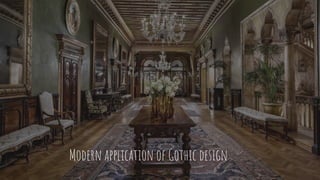
Modern application of Gothic design
This 14th century building has been a hotel since 1822, modernly refurbished into looking like a
grand melting pot of Baroque, Byzantine and Gothic style.
Hotel Danieli, Venice.
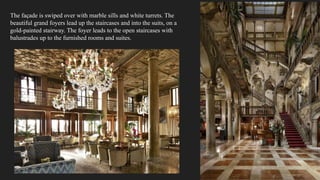
The façade is swiped over with marble sills and white turrets. The
beautiful grand foyers lead up the staircases and into the suits, on a
gold-painted stairway. The foyer leads to the open staircases with
balustrades up to the furnished rooms and suites.
Most of the grand rooms in the hotel have cladded
ceilings, some had stained wood ceilings, others were
painted and decorated with motifs such as flowers and
peacocks. Grand crystal chandeliers were used to
imitate the intricate elegance of the gothic design.
Some suits have furniture dating from the 18th
century, to add a sense of expensive vintage to the
place.
THANK YOU!
BY NOOR AERABE

Middle ages research (3)

  • 1.
    THE EARLY, MIDDLEAND DARK AGES Early Christian, Byzantine, Romanesque, Gothic.
  • 2.
    INTRODUCTION By the startof 400 CE, the roman empire has weakened, it was segregated into two empires with their own capitals and emperors; the eastern empire and the western empire. The western empire crumbled under the Northern European Vandals of Scandinavian lands. Christianity has become the most prevalent and dominating religion, moving from Palestine, through Syria, to Rome; all the way to France and England. The change of society and religion demanded by new rulers created variations of design and trends throughout the centuries, starting from Early Christian design, followed by the Byzantine flourish during the authority of Constantine, and later on the emergence of Romanesque era, with a unique form of design that became known as Carolingian, the term derived from the new Emperor’s name, Charlemagne.
  • 3.
    313 C.E EarlyChristianity: acceptance of Christianity by Constantine 330 Conquering and claiming Constantinople (Byzantine) as the Capital of Rome by Constantine 330-340 The construction of Basilicas and Christian Churches 410 The fall of the Roman empire to the Scandinavian Goths, Visigoths and the Vandals 537 Hagia Sophia is completed Mid 11th The start of the Romanesque era 1337 100 years’ war between England and France, and the rise of the Gothic architecture (up to the 16th century) 1444 German inventor Johannes Gutenberg invents the printing press. This will signal the start of the Renaissance 1453 The Byzantine Empire falls for the Ottoman rule Mid 19TH Gothic revival
  • 4.
    Early Christian andByzantine 300 C.E - 1453 C.E
  • 5.
    Earlier home-churches beforepublic churches were allowed in Rome. The disciples of Jesus met together in the upper room of a house, since Christianity was not allowed in Rome before 313. An early church father known as Clement of Alexandria documented worshipping in a house, and an evidence in Dura-Europos, New Syria, was found, claiming that the building was there during the 232 AD.
  • 6.
    When Emperor Constantinethe Great accepted Christianity in the 313 C.E Christians were no longer meeting in secret home-churches, liturgical ceremonies were accepted and welcomed, which required new buildings that were able to accommodate the large numbers of Christians.Constantine began by banning Christians from taking part in the (pagan) state religion – not that Christians wanted to, but the ban eased tensions over Christian non-participation. Constantine wanted social harmony, and this meant enforcing religious harmony. He tried to establish conformity between the wildly different forms of contemporary Christian belief, notably by calling a council of bishops to the eastern city of Nicaea. There the basic principles of Christianity were thrashed out in a statement known today as the Nicene Creed. This doctrine remains fundamental to Christian liturgies today. By the 3rd century Christianity became the largest religious community in Rome, with up to 50,000 followers. Earlier temples meant for roman deities, and Jewish home-synagogues, were not meant for performing mass which included public gatherings. “With free minds, all are to worship their Gods”
  • 7.
    Tables, vessels forwine and bread, and space for the congregation of worshippers, assistants, and clergy were all needed. The Christians figured they could exploit some aspects of the temples, such as the basilica; public courtroom. They built around it according to their requirements, creating a singular loose configuration for future churches; an altar at the apse to conduct mass and other services; the sides of the naves provided aisles for accounting worshippers or shrines. The nave itself was left empty and grand in height, leaving windows to illuminates the space. Walls were usually made of masonry, and rood of wood, columns would carry lintels or arches, and helped identity and separate the nave from aisles by height alteration.
  • 8.
    1. Propylaeum- theentrance building of a sacred building 2. Atrium- in early Christian, Byzantine, and medieval architecture, the open forecourt 3. Narthex- the entrance hall or porch before the nave 4. Nave- extends from the entrance to the apse and commonly flanked by side aisles. 5. Side Aisle- one of the corridors running parallel to the nave separated by a colonnade 6. Crossing- where the transept and the nave connect 7. Transept- it appears in Early Christian churches, but become a more common feature in the Carolingian period. 8. Apse- a hollow in the wall at the end of a either a Christian church or a Roman basilica. In a Roman basilica, it would hold a painting of the emperor and was generally where the magistrate declared laws, while in a Christian church, it contained the bishop throne and the altar.
  • 9.
    Christians were inspiredby the Romans to use elaboration in their construction and design; grand spaces; high sophisticated columns; arches and decorative symbolic designs. • Columns: were based on the roman Corinthian and ionic columns, made of stone or colorful marble. • They painted the walls and ceiling above the column’s and lined them with detailed molded skirtings • Mosaic used was often illustrating religious themes. • colored stones in geometric patterns and strong colors were used for the floors. • Materials: even complete columns with their capitals, were often taken from earlier Roman temples and other buildings, thereby transferring Roman design into basilica churches in a most direct manner.
  • 10.
    A good exampleof this is Basilica S. Maria Maggiore (432 C.E.), which follows the bilateral symmetry plan-type. It was refurbished over the years to regain and enhance its original state.
  • 11.
    The second typeof Early church plan wasn't as common; the octagonal center plan harbors a baptismal font, tomb, or altar. These are known as radially symmetrical churches, as in having a central axis like a starfish, an example of this plan is S.Stefano Rotondo. The common type, introduced previously, bilaterally symmetric plan, which has a strong connection to the altar at the far east, a symbolic significance for facing the Holy Land, Palestine. Both designs were celebrated with painted decoration and mosaic that illustrated religious events for the illiterate and literate public to admire.
  • 12.
  • 13.
    Emperor Constantine relocatedto Byzantine in 330 C.E. and named it Constantinople. Byzantine buildings lacked the detail of roman architecture, but maintained their skills of vaults and domes. S.Vitale is an example of early Christian churches and Byzantine churches, for it was a mixture if colorful elegant marbles and mosaic that painted religious stories, a gallery of high windows that created a mystical atmosphere, painted hollow-pottery domes, and simple carved blocks. It showed both radial and bilateral symmetry. S. Vitale, Ravenna, Italy, c 532-48.
  • 14.
    Hagia Sophia, orChurch of the Holy Wisdom, Istanbul, was constructed as a Christian church during 532–537 under the rule of the Byzantine emperor Justinian I. throughout the centuries it became a mosque, a museum, then a mosque again.
  • 15.
    The most importantworks of the Byzantine era was the Hagia Sophia. While the romans couldn't figure a solution for creating massive domes without risking damage, the byzantine builders made The Pendentive, and created a 107-diameter dome made of brick. The smaller domes and arcades are supported by columns and the spaces in between filled in. This geometric alignment created a semi-spherical dome cut at the middle to create a square that requires support from all four corners only. The forty windows above the pendentives ringing the dome create a sense of airiness. Mehmed the conqueror converted Hagia Sophia to a mosque after the fall of Constantinople and the rise of the Ottoman Empire in 1453, he added a wooden minaret, a grand chandelier, a mihrab (which indicates the direction of Mica), and a minbar. Bayezid II, Selim II, and Murad III consecutively took part in ordering the building and reconstructing of new minarets until four guarded each side of the mosque, most of which were carried out by Architect Sinan in the 1500s. All the paintings that covered Hagia Sophia were removed when the church became a mosque, since Islam prohibits creature art within place of worship. Mehmed Bayezid II Selim II Murad II
  • 16.
    The interior islined with enormous marble slabs which may have been chosen and designed to imitate moving water. The central dome is floated on a ring of windows and supported by two semi-domes and two arched openings. This creates an enormous uninterrupted nave. The pendentives were covered with enormous mosaics of six winged angels called hexapterygon. The two arched openings are supported by massive porphyry columns which descend all the way to the floor. Originally the nave was lined with intricate Byzantine mosaics which portrayed scenes and people from the Gospels. After the Ottoman Conquest, many of these mosaics were covered over with Islamic calligraphy and only rediscovered in the 20th century CE after the secularization of Turkey
  • 18.
    The Church ofS. Marco in Venice is the best example of what the interior of Hagia Sophia would have looked like before it was marred. It is built with five domes on pendentives, covering four arms of the Greek cross plan. It has a rich interior of mosaic, beautiful chancel, and carved choir screen. The interior of the church is decorated with gold mosaics grounds and inlaid with marble and glass. The screen between the choir and nave shows marble statues, made by Jacobello and Pier Paolo dalle. The Church of S. Marco San Marco Basilica: altar screen
  • 19.
    Its difficult tolearn about secular buildings in the early Christian and byzantine era because they survived in limited ruins throughout history, even the great baths and palaces that the Romans built during the glory of the Roman Empire had thinned to “mostly unidentifiable”. Residential buildings were reconstructed or destroyed, as well, but some houses in Venice still withhold, from the Byzantine Era; a few stories high with a wide central hall sandwiched between smaller rooms. Traces of Byzantine architecture would be found in other countries aside from Turkey, such as Greece, Italy, and Russia
  • 20.
    Early Christian Furniture, motifs, art,fashion, and color scheme
  • 21.
    Early Christian andByzantine Furniture Seating were either throne or chair, which reflected the architecture of the building it was in. Materials used were wood, metal, ivory and decorated with precious metals. Silk velvet upholstery, sometimes animal hide Few had soft cushions for comfort Mattress was cord weaved on the bed frame Engraved designs similar to the architecture Sometimes it used to be simple mattress on the ground Cushioned stool for comfort, covered in velvet Folding stools were extensively used Legs were designed with gold inlays They used folding tables so that they could use and move them easily Other kinds of tables were bulky and heavily engraved with curving Chests were used by every level of people Made with lock and keys Decorated with the period motifs and patterns https://www.slideshare.net/azramaliha22/furniture-characteristics-of-historical-periods
  • 22.
    Early Christian Motifs 1.TheChristian cross 2. the fish, was a secret symbol that Christians recognized one another with when Christianity was prohibited. 3. the dove, lamb, shepherds and their sheep, representing Christ as the Shepherd. 4. the Greek letters of chi (X) and rho (P), 5. the peacock and grapevines, symbols of Dionysus, the god of merry and wine.
  • 23.
    After Constantine’s daughterdied in 354, Constantia, she was buried at an imperial mausoleum in Rome. Her monument was a red porphyry sarcophagus located in the Vatican museum. The chest was decorated with cupids in a vine scroll, collecting and pressing grapes, which is a symbol of Eucharist through Dionysus, the wine god. The sides have peacocks, rams, and cupids, from the plays made of the god. Pieces of the chest were found in Egypt, where it might've been made.
  • 24.
    Early Christian art,fashion, and color scheme Early Christian art and fashion were heavily dependent on Roman culture. Their fashion was not elaborate but their fabrics were rich. They used dull colors, like beige, white, light blue, lilac, and slowly started using stronger ones, like red, gold, green, and dark blue.
  • 25.
    Byzantine motifs andart 1. drawings of Christ and Mary 2. the apostles 3. rulers 4. saints 5. Foliage 6. Frets 7. Waves 8. geometric designs 9. rosettes 10. animals (like griffins) 11. Byzantine Imperial Flag
  • 26.
    Byzantine fashion andcolor scheme The byzantine era used bolder colors more than dull ones, especially blue, red, and gold. It can be seen in their fashion and church interiors; for example, in Hagia Sophia and S. Vitale Basilica
  • 27.
    The Dark Ages:The Romanesque Era and the Gothic Era
  • 28.
    The Roman authoritycollapsed under the pressure of Vandals and Visigoths by 410 C.E. and a new period known as the DARK AGES emerged. Throughout the years 400 and 1200 there was no form of centralized government authority, which caused nearly all roman laws, structures, and economical systems to vanish. Local men of power were the only form of government, and it was a tyrannical one that exploited from its people, fought among one another, and tried to seize territory any chance it got. Eventually, an authoritarian system was forcefully established, royals and aristocrats were ranked according to hierarchical lineage, leaving peasants and slaves to farm and pay taxes in order to support the feudal pyramid. The only thing between the two ends of the pyramid, and between the greedy tyrants themselves, was the military authority, which became significantly important and powerful; and weapons were the main features that forced order. The strongest would clad himself in armor, strapped with swords, spears, or bows and arrows. To protect civilians from attackers of another town or city, they built high walls around their homes, towns, and cities. Feudal lords with grand castles would offer the enveloped towns protection with his army, and ultimately exploit all their resources. This systemic pattern provided centuries of art, architecture, and design, all listed under one term: ROMANESQUE.
  • 29.
    The brutality ofthe dark ages faded away when Charlemagne (771-814) took control; Carolingian era was the kickstart of early phase of Romanesque art and architecture. the term Romanesque emerged from the constant use of roman design aspects, specifically the semicircular arches, however, it does not have strong connection with the roman empire because it was majorly forgotten in the early middle ages. Charlemagne’s castle, Aix La Chapelle, in Aachen, is the greatest example for Romanesque style. The octagon plan has eight sides, all vaulted, with surrounding gateways on both first and second levels, the barrel vaults and semicircular arches dominating the design are evidence of Roman influence. Wood was the most common material for structures like stone buildings.
  • 30.
    Groin vaulting developedthroughout years of tinkering with vaulting systems. A solution to hold stone roofs in church naves was found; Barrel vaults, separated vaulting, or the least favored option: wooden roofs.
  • 31.
    1. semicircular archesfor windows, doors, and arcades 2. barrel or groin vaults to support the roof of the nave 3. massive piers and walls, with few windows, to contain the outward thrust of the vaults 4. side aisles with galleries located above them 5. a huge tower over the crossing of nave and transept 6. smaller towers at the church’s western end 1. Church 2. Cloister 3. Infirmary 4. Chapel 5. Novitiate 6. Orchard/Cemetery 7. Carrien 8. Barn 9. Workshops 10. Brewery and bakery 11. Stables 12. Animal pens 13. Hostel 14. Guesthouse 15. School 16. Abbot's house 17. Scriptorium and library 18. Dormitory 19. Refeaory 20. Kitchens 21. Cellars 22. Hospice for the poor 23. Baths and latrines Romanesque churches characteristics The monastery of S. Call, Switzerland, c. 820
  • 32.
  • 33.
    • Chair legslooked like lion paw • Made of metal or walnut wood • animal hide seating • Cushions were made of silk or velvet • Usually ornamented and gilded Romanesque furniture • made of walnut wood • they had curved fine decorations on panels of headboard and footboard • the legs of the beds were usually Corinthian corbels
  • 34.
    Motifs 1. rose window 2.round arch 3. corbel tables 4. animals 5. grotesques figures 6. fantastic figures 7. foliage 8. Zigzags 9. Fish 10. geometric forms 11. linen fold
  • 35.
    Art in theRomanesque era was vigorous and lively. Churches followed with paintings and mosaics of Christ and scenes from the bible. In manuscripts lavish drawings of the time period were painted colorfully. They used strong colors that were also used in stained glass. The art frames were tight and the subjects long and slim, out of proportion, mostly. Drapery, clothing, and hair were more detailed than the other elements in the drawings
  • 36.
    The Gothic Era France,12th-16th Rivied mid 19th to 20th century, in Europe and England.
  • 37.
    The gothic architecturetook influences from the past centuries, using elaborative decoration, thinner walls, slender higher columns, and high grand windows that tilt the head back. The term “goth” came from the barbarian Visigoths that brought the fall of Rome, according to Giorgio Vasari. Its time period kicked off from 12th to the 16 centuries in France, from where it evolved on the fundamentals of Romanesque architecture. The revival of this era started sometime in the mid-18th century up until the 20th century, in the form of churches and universities.
  • 38.
    Gothic architecture iscommonly characterised by use of the pointed arch, rib vault, buttresses, including flying buttresses; large windows which are often grouped, or have tracery; rose windows, towers, spires and pinnacles; and ornate façades Buildings of every type were constructed in the Gothic style, with evidence remaining of simple domestic buildings, elegant townhouses, grand palaces, commercial premises, civic buildings, castles, city walls, bridges, village churches, abbey churches, abbey complexes and large cathedrals
  • 39.
  • 40.
  • 41.
    Flying buttress The flyingbuttress originally helped bring the idea of open space and light to the cathedrals through stability and structure, by supporting the clerestory and the weight of the high roofs.
  • 42.
    Gargoyles The gargoyle (derivedfrom the French word gargouille, meaning gargle) is a sculptural waterspout, placed to prevent rainwater from running down masonry walls.Profusely grouped upon several cathedrals, it heightens a sense of allegory and the fantastic.
  • 43.
    Pinnacles Used to deflectthe pressures of the vaulted roof downward.They were imbued with lead, literally ‘pinning down’ the sideways pressures of the vault, served as counterweights to extended gargoyles and overhanging corbels and stabilized flying buttresses
  • 44.
  • 45.
  • 46.
    The oculus andstained glass The capital of every Ionic column features a characteristic pair of volutes, or spiral scrolls, at the centre of each of which is an eye, or disk, also known as an oculus. It used to be located in the dome of the Pantheon. Open to the weather, it allows rain to enter and fall to the floor, where it is carried away through drains.
  • 47.
    Ribbed vault andstatue columns Gothic sculpture was closely tied to architecture, since it was used primarily to decorate the exteriors of cathedrals and other religious buildings. The earliest Gothic sculptures were stone figures of saints and the Holy Family used to decorate the doorways, or portals, of cathedrals in France and elsewhere.
  • 48.
  • 49.
  • 50.
    Amiens Cathedral Somme Rivervalley north of Paris.
  • 51.
  • 52.
  • 53.
    Gothic furniture was derivedfrom gothic art in the beginning of the 12th century, the furniture was simple in the early stages, painted the carved, with tracert as the main element of design. The main material was wood, mainly oak, chestnut, and walnut.
  • 54.
    ● Chairs weredesigned to look like they belonged to royalty ● rectangular or circular with low backs ● Had a lot of sophisticated oak wood carvings along with some details of animals ● The king’s chairs were heavier and larger with paintings and gold decorations ● chests had lots of intricate designs ● material used was wood ● small low ones served as seats Chests were made of heavy intricate designs, material used was wood Also served as seat, bed or table because of the features
  • 55.
    Although the gothicera had dark, sophisticated, and Grand architecture, fashion followed a more colorful but as expensive path, introducing puffed sleeves and shoulders, hats, robes, and a variety of fabrics.
  • 56.
    Comparison with thepast AND INFLUENCE
  • 57.
    The Early, Middleand Dark ages were all fragments of multiple cultures, but mainly, consequently with the timelines, Egyptian, Greek, Roman, Islamic, and Germanic. Although a few elements of the Roman culture were left by the end of the gothic area, it can’t be denied that most of the architectural achievements were inspired by Rome’s fascination and development of Egyptian architecture and design. The Byzantine era had a great role in remodeling out the Roman factors, especially after the conquering of the Ottomans and the modifications that occurred to multiple structures, including Hagia Sophia. The influence of the Eastern culture could be seen in the vibrant fabrics and colorful paintings, while Germanic evidence is sighted after the Visigoths left England and France in a state of ungoverned society, which helped these countries actually build their own, unique architectural identity. While the Egyptians and Greeks focused on grand architecture and solely their Gods, the eras coming after the rise of christian Romans developed a style that elaborated many elements shared between Roman deities and beliefs, and Christianity, all with unmatched sophistication.
  • 58.
    Modern application ofGothic design
  • 59.
    This 14th centurybuilding has been a hotel since 1822, modernly refurbished into looking like a grand melting pot of Baroque, Byzantine and Gothic style. Hotel Danieli, Venice.
  • 60.
    The façade isswiped over with marble sills and white turrets. The beautiful grand foyers lead up the staircases and into the suits, on a gold-painted stairway. The foyer leads to the open staircases with balustrades up to the furnished rooms and suites.
  • 61.
    Most of thegrand rooms in the hotel have cladded ceilings, some had stained wood ceilings, others were painted and decorated with motifs such as flowers and peacocks. Grand crystal chandeliers were used to imitate the intricate elegance of the gothic design. Some suits have furniture dating from the 18th century, to add a sense of expensive vintage to the place.
  • 62.