BUSINESS RESEARCH
METHODS
Introduction
The need to do research or an Inquiry is varied. But the
main ones include:
a) Adding to knowledge
b) Evaluation of existing knowledge and explain further
c) Answer Questions
d) Test theories or hypothesis
e) Find solutions to problems
Way of understanding the
World Phenomenon
We can understand how things work in three ways:
 Experience
 Reasoning
 Research
_____________
continue
Experience
 Draw on individual accumulation of body of
knowledge and skills obtained through contact with
facts and events in your environment.
 Consult those with experience (experts)
 Using experience you could come up with hypotheses
and questions about the real world.
Continue
Reasoning:
Type of reasoning
1. Deductive reasoning
2. Inductive reasoning
3. Inductive – deductive reasoning
Deductive Reasoning
Deductive Reasoning (Aristote)
This approach follows logic: For examples
 All human beings walk on two legs
 John is a human being
 Subsequently John walks on two legs.
Continue
 All plants revolve round the Sun and Earth revolves
round the Sun the earth is a planet.
 Thus, we move from general; logically to a particular
case.
 Valid conclusions are deduced from valid premises.
Continue
The deductive reasoning lost its importance because it was noticed that
it was not related to observation and experience. This makes it more
of a mental exercise. In the deductive reasoning empirical evidence
as a basis of proof is superseded by authority or mental reasoning
only. This kind of reasoning had and adverse effect on science.
Observation basis of science
 Francis Bacon (1600c) argued that deductive
reasoning was not objective, but promoted
preconceived ideas and these in turn biased the
conclusion.
Inductive ReasoningInductive Reasoning
 Francis Bacon proposed inductive reasoning
 This kind of reasoning leads to hypotheses formation
and generalization of individual case.
 Collect data and confront it with theory, this will
maintain complete objectivity.
 The inductive reasoning demands empirical evidence
for verification.
Inductive – Deductive
Reasoning
 The Inductive – Deductive approach led to:
1. The suggestion of hypotheses
2. The logical development of these hypotheses
3. The clarification and interpretation of scientific findings
and their synthesis into a conceptual framework.
Research (discovery of Truth)
There are many definition as to what research is.
However, no definition is 100% correct. The most
important thing is to understand the concept and
apply it correctly.
Kerlinger, F.N. (2000) define research as” The systematic,
controlled, empirical and critical investigation of
hypothetical propositions about the presumed
relations among natural phenomena”.
continue
 Others use the concept of research to refer to the
process of using scientific methods to expand
knowledge in a particular field of study.
 The research approach also employs inductive –
deductive approach.
 Research is self correcting
 Uses accepted scientific method
 Can be disapproved by other professions, i.e. Findings.
Incorrect results will be found out and rejected or
corrected.
continue
 Research is a combination of both experience and
reasoning and is the most successful approach to the
discovery of truth.
_________________
Assumptions: Social Reality (Burrel &
Morgan, 1979)
Assumption
1. Ontological Kind – Internal or external to an
individual
2. Epistemological kind – Concern basis of knowledge
its nature & form how it can be acquired and how
communicated to other human beings.
Epistemological assumption – tell us which
knowledge can be acquired or obtained through
experience.
continue
 Knowledge of social behaviour – is either hard or soft –
If hard –need observation (natural science). If soft –
subjective and cannot follow natural science.
 If knowledge is hard it is referred to as positivist and
follow natural science. Soft knowledge is referred to as
anti-positivist.
Continue
3. Concern Human nature (assumption): The relationship
between human beings and their environment.
Human beings are both subject and object of study
(social science).
 Human beings respond mechanically to environment
 Human beings are initiators of their own actions.
continue
 Are human beings controllers of environment or
controlled by environment.
 Determinism - Voluntarism (extremes)
Most social scientist-take the middle road.
These three assumptions lead to choice of methodology.
continue
4. Methodology – All the previous assumptions have
implications for methodology or methodological
concerns of the researcher.
Researchers (hard-objective) follow-experiments, surveys,
positivist approach.
(soft-subjective) follow- anti-positivist approach.
continue
Stages of searching for the truth:
1. Theological stage (primitive to explain behaviour in
terms of spiritual or supernatural terms/entities
2.Metalphysical stage (modification of uses
abstractions or forces/depersonalize beings of earlier
theology
3. Positive stage (observation and reasoning as a
means of understanding behaviour. Scientific
description, observation and experiments.

continue
 “The central belief of the logical positivists is that the
meaning of a statement is, or is given by, the method
of verification – It follows frm this that unverifiable
statements are held to be meaningless, the utterances
of traditional metaphysics and theology being
included this class”
continue
 Methodological procedures of natural science may
be directly applied to the social sciences – positivism
here implies a particular stance concerning the social
scientist as an observer of social reality.
 End results of social scientist can be interpreted just like
that of natural science.
 Positivism-involves a definite view of the social scientist
as analyst or interpreter of his subject matter.
Features of Positivism -
Method
“Assumptions and Nature of Science”
1. Determinism – Events have causes (this link can be
studied – event determined by other circumstances) a
law should be there because of universe has order,
follow them & you will be able to predict & control.
2. Empiricism – That which is variable by observation; and
evidence, data yielding proof or strong confirmation
in probability terms of a theory or hypothesis in a
research setting.
Five steps in the process of
empirical science
a) Experience – starting point of scientific elementary
level
b) Classification – Data arrangement
c) Quantification – analysis using mathematical means
d) Discovery of relationships among phenomenon
e) Approximation to the truth – science proceeds by
gradual approximation to the truth.
What is Science
Static & dynamic view of science:
Static – science is an activity that contributes
systematised information to the world.
Scientist discover new knowledge and add to existing
knowledge. Science is thus seen as an accumulation
of body of findings, the emphasis being chiefly on the
present state of knowledge and adding to it. Dynamic
view – takes the above plus discovery that scientist
make.
continue
 Model implies Theory: Used interchangeably both are
seen as explanatory devices or schemes having a
broadly conceptual framework. Theory is provisional –
does not cover everything – can be modified.
The Tools of Science
 Concepts and the hypothesis:
1. Concepts: Express generalisation from particulars e.g.
Democracy, achievement, etc. Each one is a word
representing an idea or concept. Concepts give
meaning to the real world. Your ability to think and
comprehend the world we live in depends on the
command of concepts.
Continue
2. Hypothesis – cause and effect or educated guess. If

you have a problem form a hypothesis.
Hypotheses & concepts play a crucial part in the
scientific method.
continue
3. Principle of parsimony – Explain in the economic way.
Simple theory is to be preferred to a complex one.
4. Generality – start with observation of particular, the
scientist generalize his findings to world at large.
The Scientific Method
 A scientific approach
involves standards and
procedures for
demonstrating the
empirical way and its
findings. Standards and
procedures are methods.
The Research Process and
Procedure (Start of the process)
1. Definition of concepts method and methodology.
 A method is an instrument, tactic, for collecting
data, solving problems and arriving at new
knowledge information.
 Methodology is a strategy: a term often very loosely
used in business to describe the way in which
professions proceed in their analysis of a problem.
continue
2. Research Process
To follow a certain acceptable research process is
important for your findings to be acceptable or valid.
Accepted procedures should be followed, for
example:
1. The formulation of the problem of study and deciding
on the focus.
Continue
 Before you start doing your research work, you need
to be clear on:
 Subject matter, background information
 What is it that you would like to do i.e. Focus.
 State the problem clearly. A clear and precise
formulation of the problem will assist you in later
phases of the investigation.
Continue
 Degree of clarity in formulating a problem depends
on:
i. Complexity of the problem
ii. Amount of information already known about the
problem.
Continue
2. Choice of Units and variables to be analyzed and
confronted with data.
a. Unit of Analysis
b. Variable of analysis
Example:
Problem of analysis “Income distribution among workers
in the agricultural sector.
Continue
 We are interested in “workers in the agricultural
sector”. Hence object of investigation is “workers in
the agricultural sector” is the Unit of analysis.
 ‘Income distribution’ is the particular characteristic
that we are interested in. Hence: the variable of our
analysis.
 Workers (Fixed). Income received- variable.
Continue
 The focal point of the study is always the unit of
analysis.
3. Objective(s) or aim(s) of the study.
Having stated the problem – the objectives of your
research should be clearly stated, should be
achievable and not too many.
continue
4. Significance of the study to the society
 Explain how your subject is useful or why it is important
that this subject should be studied.
 Who has an interest in your research results
 What do we know already about the topic.
 How will this research add to practice, policy and
knowledge.
Continue
5. Research Questions, Hypothesis
Hypothesis statement:
Hypothesis is a statement indicating a relationship or its
absence, between two or more of the chosen
variables and stated in a way as to carry clear
implication for testing. There are two types of
hypotheses : a) Null hypothesis and Alternate. Null
implies no relationship and this is what you are testing.
continue
Some ideas on the formulation of questions or hypothesis:
(1) It is important to choose an area that you know or are
familiar with.
(2) Widen your experience (reading widely on your
chosen subject to start with.
For example: If you are interested in agricultural finance
of small farmers, also read about the large
commercial farmers.
continue
 This will help in improving your questions/hypotheses.
(3) Brainstorm – to start with (i.e. How your questions or
hypothesis should be stated)
(4) Do not allow a method/technique to lead you into
deciding on your question(s)/hypotheses.
Continue
5. The hypotheses should assist in choosing of an
appropriate research strategy and method for your
research.
6. Put emphasis on the statistical hypotheses, the Null
form
7. Whatever, hypothesis you formulate, should be
testable statistically. So be sure about the form of
causality, positive or negative relationship of variables.
Continue
8. Hypothesis should be brief and clear as to what is it to
be tasted.
Continue
9. Your hypothesis should clearly
state the relationship between
two or more variables that you
intend to analyse.
10. You should have a reason
based on general theory, why
the hypothesis should be
tested.
Continue
11. On the basis of the research findings or evidence, the
hypothesis is accepted or rejected, then link it with
original problem objectives and questions.
12. Literature review , theory/previous studies.
_______________
Methodology (what strategy)
and methods of data collection
 Research strategy refers to the general approach that you choose
for your research.
 The traditional strategies used in collection of data include:
1. Case study
2. Survey
3. Experiments
Characteristics of a case
study
 All case studies involve undertaking some applied
Analysis
 Most case studies involve fieldwork
 In most cases the material from a case study is original
Characteristics of a Survey
 Surveys involve selection of samples and collection of
data from a defined or known population. The format
in surveys is standard.
 Surveys obtain data at a given point in time (cross-
section), and the reasons for collecting data, vary,
depending on the requirements of the investigation.
Characteristics of
Experiments
The main features of experimental research strategy is
that the researcher/or investigators changes or
controls one variable and then observe the effect of
the changes or controls one variable and then
observe the effect of the changes on another variable
of interest.
Continue
 Example, take a sample from a known population and
carry out the experiment by controlling certain
variables and observe the reaction on the chosen
sample.
Given a function: Y = Y(x); a change in value of ‘x’ and
observe the effects of the change in value of ‘Y’.
Continue
Call ‘x’ independent variable and ‘Y’ the dependent
variable.
Response stimulus
Dependent variable Independent
variable
At this stage of the research process mention the
(instrument(s) to be used to collect data.
Collection of dataCollection of data
Data is collected from a known population
a) ‘Censuses survey’ collect population data
b) ‘Sample survey’ collect sample data
The data is of two types the secondary data which is
already collected and documented and the primary
data, which is a new data that the investigator
collects
continue
 Recall the generality assumption, from the sample
survey we generalise to the population from which the
sample is drawn.
____________________
Types of data
 Qualitative type: This kind of data or information is
non-numerical. It assist the researcher in explaining the
numerical data
 Quantitative data: This kind of data is in numerical
form and can be used in statistical analysis.
Data Processing
The data collected need to be processed. There are
many ways of processing data such as:
 Classification of observations
 Coding of observations – coding is the process of
assigning code values E.G. 385 -9, 311 to the various
alternative answers to survey questions either when
constructing the questionnaire (pre-coding) or after
data collection (post-coding).
Discussion Issues
 Are assumptions necessary in Research? Discuss.
 Discuss the significance of all steps in a research
process.
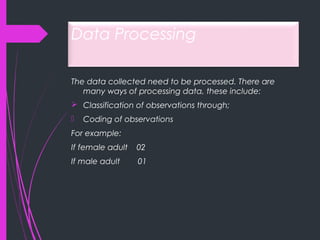
Data Processing
The data collected need to be processed. There are
many ways of processing data, these include:
 Classification of observations through;
 Coding of observations
For example:
If female adult 02
If male adult 01
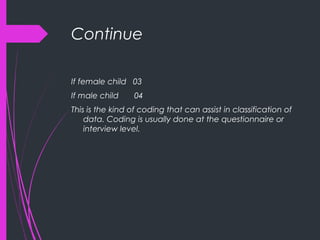
Continue
If female child 03
If male child 04
This is the kind of coding that can assist in classification of
data. Coding is usually done at the questionnaire or
interview level.
Continue
The researcher after fieldwork make notes or rearranges
the data in a way that will be easy to analyse. The
investigator may need to expand on the information
collected, for example, data tape recorded need to
be processed.
Analysis of data
The process of data analysis entail three activities:
 Data reduction (coding, etc)
 Data display, i.e., display data in graphic formats such
as matrices, charts, figures, graphs and tables.
 Conclusion drawing/ verification
Dealing with data
 Scatter diagrams
 Correlation Analysis
 Regression Analysis (linear relationships)
 Other statistical tests of hypotheses.
Data Interpretation
This stage of research process can be combined with
data analysis. Data interpretation links the real world
phenomena with the theory. It brings out the
significance of the data
Statistical methods such as regression analysis using
correlation are used.
Continue
Regression analysis and significance of the relationship,
should be supported (backed) by relationship derived
from tables, simple two-way graphs. This will show if
relationships are consistent with the theory.
Writing of Research Report
A good well presented report will be acceptable to
examiners than a poorly presented one, but with good
material.
 Use of your report:
1) A project/ dissertation can be submitted for you
degree
2) Part of it can be sent to professional journal
3) You could produce a book
Continue
4) Any other group that might be interested in your work
could ask you to present or publish your work
_____
Some of the things to note in your final report.
In your final report mention the problems experienced
and the possible causes.
Continue
 Review other surveys or finished and published reports
 The report should state the objectives of the project
and the whole research process leading to the final
conclusion
 Indicate your contribution to the subject or discipline.
What is the importance of your results to the policy
maker.
Conclusion (end of research process)
The conclusion sums up the research work touches on the
main points and make the final statement about your
research. It makes the reader to understand the
purpose of the research. The conclusion should be
brief and to the point.
Historical Research
Historical research deals with ex post information.
Literature review in a scientific research could be
viewed as historical.
Cohen & Manion (1990) define historical research as the
systematic, and objective location, evaluation of
evidence in order to establish facts and draw
conclusions about past events.
Continue
 In business and industrial sectors it is, perhaps,
important to understand, the industrial history of a
people. How did the present industrial set up come
about. Historical research brings benefit to the sector
and assist in solving some problems of historical nature.
Helps in understanding between, for example, politics
and industrial production or for example, the lack of
factor of production such as capital.
Development Research
 Development research deals with descriptive research
as opposed to experimental research. Descriptive
research deals with what has occurred, while
experimental research make things to happen. Most
of the research and investigation in business and
economics describes what has already happened.
Continue
 The objective being to examine behaviour and
choice of individuals, groups and institutions. In doing
so the researcher describes contrast, classifies,
analyses and interpret the events.
Three Types of Descriptive
Research
1) Longitudinal
2) Cross – Sectional
3) Trend or prediction
4) The three types of research described present
relationships among variables and changes in
relationships overtime.
Terminology of
Developmental Research
Longitudinal – describe studies done overtime and deal
with human development.
Example: From development economics
a. Traditional
b. Transitional
c. Take – off
d. Maturity
e. High Mass Consumption
continue
Another example: In marketing – Product life Cycle: Sales
over Time
a) Development stage
b) Introduction stage
c) Growth stage
d) Maturity stage
e) Decline stage
Continue
In agriculture: Agricultural Development
1. Traditional
2. Feudal
3. Commercial
Cross - Sectional
Different respondents are studied at the same time. There
could be a series of these cross –sectional studies if the
researcher wishes to compare. A cross –sectional
study produces a Snapshot of a population at a
chosen time, for example, national census of a group
of enterprises.
Trend Study
Where selected factors are studied continuously, i.e.,
weekly, monthly or yearly, the term trend study is often
used.
________
SURVEYS
Surveys gather cross – sectional data, i.e. Data is
obtained at a particular point in time with a view of:
a) Describing the nature of existing conditions
b) Identifying standards against which existing conditions
can be compared.
c) Determining the relationships that exist between
specific events
Continue
Large – scale or small – scale surveys all use similar data
collection techniques. For example, structured or semi
– structured interviews, self – completing or postal
questionnaires. There are no limits to cases covered by
surveys.
Survey Preliminary studies (Plan)
The planning of survey is a combination of technical and
organizational decision.
Questions to ask
 What population coverage to aim at?
 What information to seek?
 How to go about collecting this information?
 How to process and interpret results?
Continue
Sample design (methodology) decided in the light of:
 What is practically feasible
 What is theoretically desirable
 Accuracy of results
 Cost, time and labour involved
 Type of sampling
 Type of data collection
 Methods of tabulation
 Miscellaneous items
Preliminary plan of a survey
1. Statement on: Objective(s) or purpose of the
enquiry.
 Clear statement in detail
 Methods to be used
 Why the survey, what questions it will cover or answer
 What results expected
 How the information will be used.
continue
2. Population
 Define population targeted
 Geographical, etc
 Covered fully or partially
 Method of selecting respondents
 Sample in a statistical sense
 Sample frame list
continue
Sample frame: A listing that should include all those in the
population to be sampled and exclude all those who
are not in the population.
 How will you deal with non-response
 Follow up approach
Collection of Data
 The collection of data will depend on the size of
survey
Questionnaires
Plan how to structure and phrase your questionnaires.
Errors
Every stage of survey can lead to errors or errors are
made.
Continue
For example:
 Sampling error
 Interviewing
 Questions
 Editing
 Coding
 Tabulation
Anticipate likely sources of error and size.
Fieldwork
 Central stage of survey and will depend on the quality
of interviews.
Processing & Analysis
 Questionnaire – check on : Omissions
 Statistical Calculation
 Editing scheme is necessary
 Tabulation plan
 Method of analysis
Continue
Timing & Cost
 Timing of investigation
 No holidays etc.
 When are the results needed
 Estimate Cost
Pre-test and Pilot Survey
 To find out the re-action of people to your
questionnaires or interviews
 Pilot survey – a small scale replica of the main survey
Pilot Study Provides:
1) Adequacy of the sampling frame
2) Variability within the population to be surveyed
3) Non-response rate to be expected
4) Suitability of data collection methods
5) Are the questions adequate: ease of questions,
layout, similarities, clarity, do the answers meet your
objectives.
continue
6) Are instruments clear
7) Codes – for pre- coded questions are they clear to
you.
8) Cost and time spent – and how well are you organized
in the field.
9) Approach to the respondents
10)After pilot – Improve on your plan.
Survey Sampling Design
Type of sample Design
Bias is one of the sampling problem that an investigator
may encounter.
 For a given sample design, the estimator is the
method of estimating the population parameter from
the sample.
Estimator: Is the sample arithmetic mean
Continue
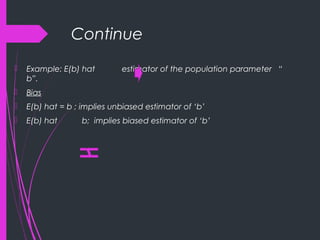
 Example: E(b) hat estimator of the population parameter “
b”.
 Bias
 E(b) hat = b ; implies unbiased estimator of ‘b’
 E(b) hat b; implies biased estimator of ‘b’
Continue
 For any sample design if the expected value of the
estimator is equal to the population parameter then
estimator is unbiased if not equal to population
parameter, it is biased.
 The difference between the expected value and the
true population value is termed the bias.
Continue
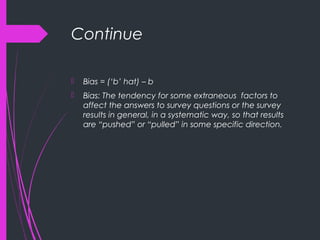
 Bias = (‘b’ hat) – b
 Bias: The tendency for some extraneous factors to
affect the answers to survey questions or the survey
results in general, in a systematic way, so that results
are “pushed” or “pulled” in some specific direction.
Decision Errors
 Generally the purpose of statistical inference is to
make an educated guess about what exists in the
population when only a small subset of cases from the
population has been studied. Since the decision is a
guess, it might be wrong.
Continue
 Type 1 error occurs when a null hypothesis is rejected
when it is in fact true.
 Type 11 error occurs when the null hypothesis is
accepted when it is, in fact false.
 Given the validity of the null hypothesis, the probability
that it is erroneously rejected by these procedures
equals, α , the significance level.
Causes of Bias
Three factor that might cause bias include:
1) Non – random method(s) used to select a sample, in
such cases there is a likelihood of subjectivity.
2) Incomplete or inaccurate sampling Frame from
which a sample is selected.
3) Non – response of those included in the sample –
which mean the sample will not be representative of
the population.
Continue
 Bias through sampling method can be avoided by
using random method
 A good sampling design should use a random
method. Note that there are two main types of
sampling: random or probability sampling and non-
probability sampling.
Continue
 In general, a random or probability method of
choosing a sample is defined as that which allow
each of the members of the targeted population a
calculable probability of being included in the
sample.
Continue
a) Unrestricted Random Sampling: Give an equal
chance to every member of the population of being
selected. However, in unrestricted random sampling
the investigator has to replace the members
selected. Hence, unrestricted random sampling, is
sampling with replacement. It is therefore, likely that
a member may be selected more than once.
Simple Random Probability
Sampling
Simple Random Probability
Sampling
 The simple random sampling is done without
replacement. Subsequently, no member can be
selected more than once in any given sample. In a
simple random probability sampling each member of
the population has a chance of being included in the
sample.
Continue
Examples of Simple
Random Sampling
1) Tickets mixed in a basket pick one this represent a
simple random sampling.
2) Pick every nth member of the population, this
represents a simple random sampling
Methods of Ensuring
Randomness in Selection of
Survey Samples
Methods of Ensuring
Randomness in Selection of
Survey Samples
1) Lottery Method:
Number the population and
represent it with marked
balls: 1 to n
Place the balls in a wheel or
something that mixes- then
select required sample.
Continue
2) Use random numbers (table):
Population numbered: 1 to Z; then sample members are
selected from the table in a systematic fashion.
Continue
 In practice use random numbers:
Example. Handout (tables) Random table
Draw a sample of size 10 from 100 small scale businesses.
Get a list of Business you want to investigate
Continue
1. Set the three digit numbers:
001, 002, 003, 004, .......010, 099-100
2. Go to Random tables
3. Along the column choose a number in digits of three
below 101 until you get your sample
4. Jump the repeat numbers.
SYSTEMATIC SAMPLINGSYSTEMATIC SAMPLING
Another method of sampling: Suppose you have 6000
small scale businesses and you want a sample of 300
300/6000 = 1/20
1 – 20 pick any number at random between 1 – 20 and
then every firm after 20th
is picked.
 This is not a simple random sampling because
originally the 6000 were not randomly picked and 1 –
20 is not randomly picked.
Continue
 The difference between the simple random sampling
and systematic sampling is that in the systematic
sampling the members are not given equal chance of
being included in the sample. Once you pick the first
number the others are picked systematically or follow.
STRATISFIED RANDOM
SAMPLING
In a stratified random sampling the population is divided
into groups or strata.
For example:
 Small scale firms (Businesses)
 Middle scale firms (Businesses)
 Large scale firms (Businesses)
The random sampling then take place
Continue
Within the stratum.
 Stratified random sampling with a uniform sampling
fraction tends to have greater precision than simple
random sampling. Because of the small size of the
stratum.
Proportionate stratified
Sample Design
Proportionate stratified
Sample Design
 In stratified sampling we do not require that the
sampling fraction be the same or uniform for each
stratum. But whenever the sampling fraction is the
same for each stratum, we refer to this as a
proportionate stratified sampling.
Cluster SamplingCluster Sampling
The cluster Sampling is ideal when the population is large
and widely dispersed. The researcher avoids long
distance and at the same time affords adequate
information in order to generalize to the rest on the
population.
In a cluster sampling the population is divided into cluster
or groups. The cluster units are chosen at a random.
Continue
Multi-Stage Sampling
 the use of multi-stage cuts down on cost.
 Studies of very large population, such as a whole
country, usually involve multi-stage sampling. Multi-
stage sampling are an extension of cluster sampling.
The samples are selected in stages. It implies taking
samples from samples. The sampling is done at
random.
Continue
Example 1.
Stage 1 10 Industrial Areas
Stage 2 100 Firms from the areas
Stage 3 10 specific Firms
Example 2.
Provinces ͢ Districts ͢ villages or towns ͢
individuals
Continue
Example 3.
No of Schools ͢ No of classes ͢ No of pupils
Non-Probability Sampling
Non-probability sampling it is frequently used in practice
in spite of its limitations.
 Convenience and lower costs per case are its chief
advantages
 Common statistical techniques which assume a
random sample should not be used in non-probability
samples
Continue
The main types of non-probability sampling are:
1. Convenience or Accidental, 2. Quota, 3. Purposive, 4.
Dimensional, 5. Snow ball sampling
Convenience SamplingConvenience Sampling
This kind of sampling chooses individuals who are near
and these then constitute the respondents. For
example, firms near to the researcher can be chosen
and form the required sample.
Quota SamplingQuota Sampling
It is similar to stratified sampling. But in Quota sampling
respondents are not randomly chosen. In a Quota
sampling, a population is divided into a Quota which
in the case of firms it could be small-scale and large –
scale firms a quota for each group could then be
chosen
Purposive SamplingPurposive Sampling
The researcher picks the respondents to be included in
the sample, using his/her judgement as to which
respondents to be included.
Dimensional SamplingDimensional Sampling
This is an extension of Quota sampling it involves studying
the population and knowing the composition of the
population. The researcher then includes in the
sample all factors of the population. Within a group
you might want to know certain attributes and
attitudes. It is the differences within the group.
Snowball SamplingSnowball Sampling
The researcher knows the characteristics required. On a
small group the researcher then use this group as a
representative and to help the researcher to get or
identify others to be included in the sample, in turn,
these people lead the researcher to others, until the
required sample is obtained.
Tutorial QuestionTutorial Question
 Discuss the advantages and disadvantages of
random probability sampling and non-probability
sampling for each sampling method discussed in class.
CASE STUDY
Case studies are based on observation of the
characteristics of the phenomenon or individual unit
to be studied or researched. For example, a firm, a
specific project, a community. These cases are not
chosen through a formal sampling process, but by
judgemental and a typical relevant case is chosen.
The aim of a case study is to do an in-depth analysis of
the unit. From the study of the unit generalization is
established for the population from which the unit is
drawn.
Types of observation: case
study
 Participant observation: In a participant observation
the researcher (observer) takes part in the activity
required to be observed.
 For example, join the business for one year or work in a
project that you wish to study. Join the community or
firm in order to get an insight of the organization.
Continue
 Although observation is the main methodological
strategy, various research instruments or methods of
collecting information or data are used, depending
on whichever is appropriate, for example; interviews,
questionnaires.

BUSINESS RESEARCH METHODS

  • 1.
  • 2.
    Introduction The need todo research or an Inquiry is varied. But the main ones include: a) Adding to knowledge b) Evaluation of existing knowledge and explain further c) Answer Questions d) Test theories or hypothesis e) Find solutions to problems
  • 3.
    Way of understandingthe World Phenomenon We can understand how things work in three ways:  Experience  Reasoning  Research _____________
  • 4.
    continue Experience  Draw onindividual accumulation of body of knowledge and skills obtained through contact with facts and events in your environment.  Consult those with experience (experts)  Using experience you could come up with hypotheses and questions about the real world.
  • 5.
    Continue Reasoning: Type of reasoning 1.Deductive reasoning 2. Inductive reasoning 3. Inductive – deductive reasoning
  • 6.
    Deductive Reasoning Deductive Reasoning(Aristote) This approach follows logic: For examples  All human beings walk on two legs  John is a human being  Subsequently John walks on two legs.
  • 7.
    Continue  All plantsrevolve round the Sun and Earth revolves round the Sun the earth is a planet.  Thus, we move from general; logically to a particular case.  Valid conclusions are deduced from valid premises.
  • 8.
    Continue The deductive reasoninglost its importance because it was noticed that it was not related to observation and experience. This makes it more of a mental exercise. In the deductive reasoning empirical evidence as a basis of proof is superseded by authority or mental reasoning only. This kind of reasoning had and adverse effect on science.
  • 9.
    Observation basis ofscience  Francis Bacon (1600c) argued that deductive reasoning was not objective, but promoted preconceived ideas and these in turn biased the conclusion.
  • 10.
    Inductive ReasoningInductive Reasoning Francis Bacon proposed inductive reasoning  This kind of reasoning leads to hypotheses formation and generalization of individual case.  Collect data and confront it with theory, this will maintain complete objectivity.  The inductive reasoning demands empirical evidence for verification.
  • 11.
    Inductive – Deductive Reasoning The Inductive – Deductive approach led to: 1. The suggestion of hypotheses 2. The logical development of these hypotheses 3. The clarification and interpretation of scientific findings and their synthesis into a conceptual framework.
  • 12.
    Research (discovery ofTruth) There are many definition as to what research is. However, no definition is 100% correct. The most important thing is to understand the concept and apply it correctly. Kerlinger, F.N. (2000) define research as” The systematic, controlled, empirical and critical investigation of hypothetical propositions about the presumed relations among natural phenomena”.
  • 13.
    continue  Others usethe concept of research to refer to the process of using scientific methods to expand knowledge in a particular field of study.  The research approach also employs inductive – deductive approach.  Research is self correcting  Uses accepted scientific method  Can be disapproved by other professions, i.e. Findings. Incorrect results will be found out and rejected or corrected.
  • 14.
    continue  Research isa combination of both experience and reasoning and is the most successful approach to the discovery of truth. _________________
  • 15.
    Assumptions: Social Reality(Burrel & Morgan, 1979) Assumption 1. Ontological Kind – Internal or external to an individual 2. Epistemological kind – Concern basis of knowledge its nature & form how it can be acquired and how communicated to other human beings. Epistemological assumption – tell us which knowledge can be acquired or obtained through experience.
  • 16.
    continue  Knowledge ofsocial behaviour – is either hard or soft – If hard –need observation (natural science). If soft – subjective and cannot follow natural science.  If knowledge is hard it is referred to as positivist and follow natural science. Soft knowledge is referred to as anti-positivist.
  • 17.
    Continue 3. Concern Humannature (assumption): The relationship between human beings and their environment. Human beings are both subject and object of study (social science).  Human beings respond mechanically to environment  Human beings are initiators of their own actions.
  • 18.
    continue  Are humanbeings controllers of environment or controlled by environment.  Determinism - Voluntarism (extremes) Most social scientist-take the middle road. These three assumptions lead to choice of methodology.
  • 19.
    continue 4. Methodology –All the previous assumptions have implications for methodology or methodological concerns of the researcher. Researchers (hard-objective) follow-experiments, surveys, positivist approach. (soft-subjective) follow- anti-positivist approach.
  • 20.
    continue Stages of searchingfor the truth: 1. Theological stage (primitive to explain behaviour in terms of spiritual or supernatural terms/entities 2.Metalphysical stage (modification of uses abstractions or forces/depersonalize beings of earlier theology 3. Positive stage (observation and reasoning as a means of understanding behaviour. Scientific description, observation and experiments.
  • 21.
    continue  “The centralbelief of the logical positivists is that the meaning of a statement is, or is given by, the method of verification – It follows frm this that unverifiable statements are held to be meaningless, the utterances of traditional metaphysics and theology being included this class”
  • 22.
    continue  Methodological proceduresof natural science may be directly applied to the social sciences – positivism here implies a particular stance concerning the social scientist as an observer of social reality.  End results of social scientist can be interpreted just like that of natural science.  Positivism-involves a definite view of the social scientist as analyst or interpreter of his subject matter.
  • 23.
    Features of Positivism- Method “Assumptions and Nature of Science” 1. Determinism – Events have causes (this link can be studied – event determined by other circumstances) a law should be there because of universe has order, follow them & you will be able to predict & control. 2. Empiricism – That which is variable by observation; and evidence, data yielding proof or strong confirmation in probability terms of a theory or hypothesis in a research setting.
  • 24.
    Five steps inthe process of empirical science a) Experience – starting point of scientific elementary level b) Classification – Data arrangement c) Quantification – analysis using mathematical means d) Discovery of relationships among phenomenon e) Approximation to the truth – science proceeds by gradual approximation to the truth.
  • 25.
    What is Science Static& dynamic view of science: Static – science is an activity that contributes systematised information to the world. Scientist discover new knowledge and add to existing knowledge. Science is thus seen as an accumulation of body of findings, the emphasis being chiefly on the present state of knowledge and adding to it. Dynamic view – takes the above plus discovery that scientist make.
  • 26.
    continue  Model impliesTheory: Used interchangeably both are seen as explanatory devices or schemes having a broadly conceptual framework. Theory is provisional – does not cover everything – can be modified.
  • 27.
    The Tools ofScience  Concepts and the hypothesis: 1. Concepts: Express generalisation from particulars e.g. Democracy, achievement, etc. Each one is a word representing an idea or concept. Concepts give meaning to the real world. Your ability to think and comprehend the world we live in depends on the command of concepts.
  • 28.
    Continue 2. Hypothesis –cause and effect or educated guess. If you have a problem form a hypothesis. Hypotheses & concepts play a crucial part in the scientific method.
  • 29.
    continue 3. Principle ofparsimony – Explain in the economic way. Simple theory is to be preferred to a complex one. 4. Generality – start with observation of particular, the scientist generalize his findings to world at large.
  • 30.
    The Scientific Method A scientific approach involves standards and procedures for demonstrating the empirical way and its findings. Standards and procedures are methods.
  • 31.
    The Research Processand Procedure (Start of the process) 1. Definition of concepts method and methodology.  A method is an instrument, tactic, for collecting data, solving problems and arriving at new knowledge information.  Methodology is a strategy: a term often very loosely used in business to describe the way in which professions proceed in their analysis of a problem.
  • 32.
    continue 2. Research Process Tofollow a certain acceptable research process is important for your findings to be acceptable or valid. Accepted procedures should be followed, for example: 1. The formulation of the problem of study and deciding on the focus.
  • 33.
    Continue  Before youstart doing your research work, you need to be clear on:  Subject matter, background information  What is it that you would like to do i.e. Focus.  State the problem clearly. A clear and precise formulation of the problem will assist you in later phases of the investigation.
  • 34.
    Continue  Degree ofclarity in formulating a problem depends on: i. Complexity of the problem ii. Amount of information already known about the problem.
  • 35.
    Continue 2. Choice ofUnits and variables to be analyzed and confronted with data. a. Unit of Analysis b. Variable of analysis Example: Problem of analysis “Income distribution among workers in the agricultural sector.
  • 36.
    Continue  We areinterested in “workers in the agricultural sector”. Hence object of investigation is “workers in the agricultural sector” is the Unit of analysis.  ‘Income distribution’ is the particular characteristic that we are interested in. Hence: the variable of our analysis.  Workers (Fixed). Income received- variable.
  • 37.
    Continue  The focalpoint of the study is always the unit of analysis. 3. Objective(s) or aim(s) of the study. Having stated the problem – the objectives of your research should be clearly stated, should be achievable and not too many.
  • 38.
    continue 4. Significance ofthe study to the society  Explain how your subject is useful or why it is important that this subject should be studied.  Who has an interest in your research results  What do we know already about the topic.  How will this research add to practice, policy and knowledge.
  • 39.
    Continue 5. Research Questions,Hypothesis Hypothesis statement: Hypothesis is a statement indicating a relationship or its absence, between two or more of the chosen variables and stated in a way as to carry clear implication for testing. There are two types of hypotheses : a) Null hypothesis and Alternate. Null implies no relationship and this is what you are testing.
  • 40.
    continue Some ideas onthe formulation of questions or hypothesis: (1) It is important to choose an area that you know or are familiar with. (2) Widen your experience (reading widely on your chosen subject to start with. For example: If you are interested in agricultural finance of small farmers, also read about the large commercial farmers.
  • 41.
    continue  This willhelp in improving your questions/hypotheses. (3) Brainstorm – to start with (i.e. How your questions or hypothesis should be stated) (4) Do not allow a method/technique to lead you into deciding on your question(s)/hypotheses.
  • 42.
    Continue 5. The hypothesesshould assist in choosing of an appropriate research strategy and method for your research. 6. Put emphasis on the statistical hypotheses, the Null form 7. Whatever, hypothesis you formulate, should be testable statistically. So be sure about the form of causality, positive or negative relationship of variables.
  • 43.
    Continue 8. Hypothesis shouldbe brief and clear as to what is it to be tasted.
  • 44.
    Continue 9. Your hypothesisshould clearly state the relationship between two or more variables that you intend to analyse. 10. You should have a reason based on general theory, why the hypothesis should be tested.
  • 45.
    Continue 11. On thebasis of the research findings or evidence, the hypothesis is accepted or rejected, then link it with original problem objectives and questions. 12. Literature review , theory/previous studies. _______________
  • 46.
    Methodology (what strategy) andmethods of data collection  Research strategy refers to the general approach that you choose for your research.  The traditional strategies used in collection of data include: 1. Case study 2. Survey 3. Experiments
  • 47.
    Characteristics of acase study  All case studies involve undertaking some applied Analysis  Most case studies involve fieldwork  In most cases the material from a case study is original
  • 48.
    Characteristics of aSurvey  Surveys involve selection of samples and collection of data from a defined or known population. The format in surveys is standard.  Surveys obtain data at a given point in time (cross- section), and the reasons for collecting data, vary, depending on the requirements of the investigation.
  • 49.
    Characteristics of Experiments The mainfeatures of experimental research strategy is that the researcher/or investigators changes or controls one variable and then observe the effect of the changes or controls one variable and then observe the effect of the changes on another variable of interest.
  • 50.
    Continue  Example, takea sample from a known population and carry out the experiment by controlling certain variables and observe the reaction on the chosen sample. Given a function: Y = Y(x); a change in value of ‘x’ and observe the effects of the change in value of ‘Y’.
  • 51.
    Continue Call ‘x’ independentvariable and ‘Y’ the dependent variable. Response stimulus Dependent variable Independent variable At this stage of the research process mention the (instrument(s) to be used to collect data.
  • 52.
    Collection of dataCollectionof data Data is collected from a known population a) ‘Censuses survey’ collect population data b) ‘Sample survey’ collect sample data The data is of two types the secondary data which is already collected and documented and the primary data, which is a new data that the investigator collects
  • 53.
    continue  Recall thegenerality assumption, from the sample survey we generalise to the population from which the sample is drawn. ____________________
  • 54.
    Types of data Qualitative type: This kind of data or information is non-numerical. It assist the researcher in explaining the numerical data  Quantitative data: This kind of data is in numerical form and can be used in statistical analysis.
  • 55.
    Data Processing The datacollected need to be processed. There are many ways of processing data such as:  Classification of observations  Coding of observations – coding is the process of assigning code values E.G. 385 -9, 311 to the various alternative answers to survey questions either when constructing the questionnaire (pre-coding) or after data collection (post-coding).
  • 56.
    Discussion Issues  Areassumptions necessary in Research? Discuss.  Discuss the significance of all steps in a research process.
  • 57.
    Data Processing The datacollected need to be processed. There are many ways of processing data, these include:  Classification of observations through;  Coding of observations For example: If female adult 02 If male adult 01
  • 58.
    Continue If female child03 If male child 04 This is the kind of coding that can assist in classification of data. Coding is usually done at the questionnaire or interview level.
  • 59.
    Continue The researcher afterfieldwork make notes or rearranges the data in a way that will be easy to analyse. The investigator may need to expand on the information collected, for example, data tape recorded need to be processed.
  • 60.
    Analysis of data Theprocess of data analysis entail three activities:  Data reduction (coding, etc)  Data display, i.e., display data in graphic formats such as matrices, charts, figures, graphs and tables.  Conclusion drawing/ verification
  • 61.
    Dealing with data Scatter diagrams  Correlation Analysis  Regression Analysis (linear relationships)  Other statistical tests of hypotheses.
  • 62.
    Data Interpretation This stageof research process can be combined with data analysis. Data interpretation links the real world phenomena with the theory. It brings out the significance of the data Statistical methods such as regression analysis using correlation are used.
  • 63.
    Continue Regression analysis andsignificance of the relationship, should be supported (backed) by relationship derived from tables, simple two-way graphs. This will show if relationships are consistent with the theory.
  • 64.
    Writing of ResearchReport A good well presented report will be acceptable to examiners than a poorly presented one, but with good material.  Use of your report: 1) A project/ dissertation can be submitted for you degree 2) Part of it can be sent to professional journal 3) You could produce a book
  • 65.
    Continue 4) Any othergroup that might be interested in your work could ask you to present or publish your work _____ Some of the things to note in your final report. In your final report mention the problems experienced and the possible causes.
  • 66.
    Continue  Review othersurveys or finished and published reports  The report should state the objectives of the project and the whole research process leading to the final conclusion  Indicate your contribution to the subject or discipline. What is the importance of your results to the policy maker.
  • 67.
    Conclusion (end ofresearch process) The conclusion sums up the research work touches on the main points and make the final statement about your research. It makes the reader to understand the purpose of the research. The conclusion should be brief and to the point.
  • 68.
    Historical Research Historical researchdeals with ex post information. Literature review in a scientific research could be viewed as historical. Cohen & Manion (1990) define historical research as the systematic, and objective location, evaluation of evidence in order to establish facts and draw conclusions about past events.
  • 69.
    Continue  In businessand industrial sectors it is, perhaps, important to understand, the industrial history of a people. How did the present industrial set up come about. Historical research brings benefit to the sector and assist in solving some problems of historical nature. Helps in understanding between, for example, politics and industrial production or for example, the lack of factor of production such as capital.
  • 70.
    Development Research  Developmentresearch deals with descriptive research as opposed to experimental research. Descriptive research deals with what has occurred, while experimental research make things to happen. Most of the research and investigation in business and economics describes what has already happened.
  • 71.
    Continue  The objectivebeing to examine behaviour and choice of individuals, groups and institutions. In doing so the researcher describes contrast, classifies, analyses and interpret the events.
  • 72.
    Three Types ofDescriptive Research 1) Longitudinal 2) Cross – Sectional 3) Trend or prediction 4) The three types of research described present relationships among variables and changes in relationships overtime.
  • 73.
    Terminology of Developmental Research Longitudinal– describe studies done overtime and deal with human development. Example: From development economics a. Traditional b. Transitional c. Take – off d. Maturity e. High Mass Consumption
  • 74.
    continue Another example: Inmarketing – Product life Cycle: Sales over Time a) Development stage b) Introduction stage c) Growth stage d) Maturity stage e) Decline stage
  • 75.
    Continue In agriculture: AgriculturalDevelopment 1. Traditional 2. Feudal 3. Commercial
  • 76.
    Cross - Sectional Differentrespondents are studied at the same time. There could be a series of these cross –sectional studies if the researcher wishes to compare. A cross –sectional study produces a Snapshot of a population at a chosen time, for example, national census of a group of enterprises.
  • 77.
    Trend Study Where selectedfactors are studied continuously, i.e., weekly, monthly or yearly, the term trend study is often used. ________
  • 78.
    SURVEYS Surveys gather cross– sectional data, i.e. Data is obtained at a particular point in time with a view of: a) Describing the nature of existing conditions b) Identifying standards against which existing conditions can be compared. c) Determining the relationships that exist between specific events
  • 79.
    Continue Large – scaleor small – scale surveys all use similar data collection techniques. For example, structured or semi – structured interviews, self – completing or postal questionnaires. There are no limits to cases covered by surveys.
  • 80.
    Survey Preliminary studies(Plan) The planning of survey is a combination of technical and organizational decision. Questions to ask  What population coverage to aim at?  What information to seek?  How to go about collecting this information?  How to process and interpret results?
  • 81.
    Continue Sample design (methodology)decided in the light of:  What is practically feasible  What is theoretically desirable  Accuracy of results  Cost, time and labour involved  Type of sampling  Type of data collection  Methods of tabulation  Miscellaneous items
  • 82.
    Preliminary plan ofa survey 1. Statement on: Objective(s) or purpose of the enquiry.  Clear statement in detail  Methods to be used  Why the survey, what questions it will cover or answer  What results expected  How the information will be used.
  • 83.
    continue 2. Population  Definepopulation targeted  Geographical, etc  Covered fully or partially  Method of selecting respondents  Sample in a statistical sense  Sample frame list
  • 84.
    continue Sample frame: Alisting that should include all those in the population to be sampled and exclude all those who are not in the population.  How will you deal with non-response  Follow up approach
  • 85.
    Collection of Data The collection of data will depend on the size of survey Questionnaires Plan how to structure and phrase your questionnaires. Errors Every stage of survey can lead to errors or errors are made.
  • 86.
    Continue For example:  Samplingerror  Interviewing  Questions  Editing  Coding  Tabulation Anticipate likely sources of error and size.
  • 87.
    Fieldwork  Central stageof survey and will depend on the quality of interviews. Processing & Analysis  Questionnaire – check on : Omissions  Statistical Calculation  Editing scheme is necessary  Tabulation plan  Method of analysis
  • 88.
    Continue Timing & Cost Timing of investigation  No holidays etc.  When are the results needed  Estimate Cost
  • 89.
    Pre-test and PilotSurvey  To find out the re-action of people to your questionnaires or interviews  Pilot survey – a small scale replica of the main survey
  • 90.
    Pilot Study Provides: 1)Adequacy of the sampling frame 2) Variability within the population to be surveyed 3) Non-response rate to be expected 4) Suitability of data collection methods 5) Are the questions adequate: ease of questions, layout, similarities, clarity, do the answers meet your objectives.
  • 91.
    continue 6) Are instrumentsclear 7) Codes – for pre- coded questions are they clear to you. 8) Cost and time spent – and how well are you organized in the field. 9) Approach to the respondents 10)After pilot – Improve on your plan.
  • 92.
    Survey Sampling Design Typeof sample Design Bias is one of the sampling problem that an investigator may encounter.  For a given sample design, the estimator is the method of estimating the population parameter from the sample. Estimator: Is the sample arithmetic mean
  • 93.
    Continue  Example: E(b)hat estimator of the population parameter “ b”.  Bias  E(b) hat = b ; implies unbiased estimator of ‘b’  E(b) hat b; implies biased estimator of ‘b’
  • 94.
    Continue  For anysample design if the expected value of the estimator is equal to the population parameter then estimator is unbiased if not equal to population parameter, it is biased.  The difference between the expected value and the true population value is termed the bias.
  • 95.
    Continue  Bias =(‘b’ hat) – b  Bias: The tendency for some extraneous factors to affect the answers to survey questions or the survey results in general, in a systematic way, so that results are “pushed” or “pulled” in some specific direction.
  • 96.
    Decision Errors  Generallythe purpose of statistical inference is to make an educated guess about what exists in the population when only a small subset of cases from the population has been studied. Since the decision is a guess, it might be wrong.
  • 97.
    Continue  Type 1error occurs when a null hypothesis is rejected when it is in fact true.  Type 11 error occurs when the null hypothesis is accepted when it is, in fact false.  Given the validity of the null hypothesis, the probability that it is erroneously rejected by these procedures equals, α , the significance level.
  • 98.
    Causes of Bias Threefactor that might cause bias include: 1) Non – random method(s) used to select a sample, in such cases there is a likelihood of subjectivity. 2) Incomplete or inaccurate sampling Frame from which a sample is selected. 3) Non – response of those included in the sample – which mean the sample will not be representative of the population.
  • 99.
    Continue  Bias throughsampling method can be avoided by using random method  A good sampling design should use a random method. Note that there are two main types of sampling: random or probability sampling and non- probability sampling.
  • 100.
    Continue  In general,a random or probability method of choosing a sample is defined as that which allow each of the members of the targeted population a calculable probability of being included in the sample.
  • 101.
    Continue a) Unrestricted RandomSampling: Give an equal chance to every member of the population of being selected. However, in unrestricted random sampling the investigator has to replace the members selected. Hence, unrestricted random sampling, is sampling with replacement. It is therefore, likely that a member may be selected more than once.
  • 102.
    Simple Random Probability Sampling SimpleRandom Probability Sampling  The simple random sampling is done without replacement. Subsequently, no member can be selected more than once in any given sample. In a simple random probability sampling each member of the population has a chance of being included in the sample.
  • 103.
    Continue Examples of Simple RandomSampling 1) Tickets mixed in a basket pick one this represent a simple random sampling. 2) Pick every nth member of the population, this represents a simple random sampling
  • 104.
    Methods of Ensuring Randomnessin Selection of Survey Samples Methods of Ensuring Randomness in Selection of Survey Samples 1) Lottery Method: Number the population and represent it with marked balls: 1 to n Place the balls in a wheel or something that mixes- then select required sample.
  • 105.
    Continue 2) Use randomnumbers (table): Population numbered: 1 to Z; then sample members are selected from the table in a systematic fashion.
  • 106.
    Continue  In practiceuse random numbers: Example. Handout (tables) Random table Draw a sample of size 10 from 100 small scale businesses. Get a list of Business you want to investigate
  • 107.
    Continue 1. Set thethree digit numbers: 001, 002, 003, 004, .......010, 099-100 2. Go to Random tables 3. Along the column choose a number in digits of three below 101 until you get your sample 4. Jump the repeat numbers.
  • 108.
    SYSTEMATIC SAMPLINGSYSTEMATIC SAMPLING Anothermethod of sampling: Suppose you have 6000 small scale businesses and you want a sample of 300 300/6000 = 1/20 1 – 20 pick any number at random between 1 – 20 and then every firm after 20th is picked.  This is not a simple random sampling because originally the 6000 were not randomly picked and 1 – 20 is not randomly picked.
  • 109.
    Continue  The differencebetween the simple random sampling and systematic sampling is that in the systematic sampling the members are not given equal chance of being included in the sample. Once you pick the first number the others are picked systematically or follow.
  • 110.
    STRATISFIED RANDOM SAMPLING In astratified random sampling the population is divided into groups or strata. For example:  Small scale firms (Businesses)  Middle scale firms (Businesses)  Large scale firms (Businesses) The random sampling then take place
  • 111.
    Continue Within the stratum. Stratified random sampling with a uniform sampling fraction tends to have greater precision than simple random sampling. Because of the small size of the stratum.
  • 112.
    Proportionate stratified Sample Design Proportionatestratified Sample Design  In stratified sampling we do not require that the sampling fraction be the same or uniform for each stratum. But whenever the sampling fraction is the same for each stratum, we refer to this as a proportionate stratified sampling.
  • 113.
    Cluster SamplingCluster Sampling Thecluster Sampling is ideal when the population is large and widely dispersed. The researcher avoids long distance and at the same time affords adequate information in order to generalize to the rest on the population. In a cluster sampling the population is divided into cluster or groups. The cluster units are chosen at a random.
  • 114.
    Continue Multi-Stage Sampling  theuse of multi-stage cuts down on cost.  Studies of very large population, such as a whole country, usually involve multi-stage sampling. Multi- stage sampling are an extension of cluster sampling. The samples are selected in stages. It implies taking samples from samples. The sampling is done at random.
  • 115.
    Continue Example 1. Stage 110 Industrial Areas Stage 2 100 Firms from the areas Stage 3 10 specific Firms Example 2. Provinces ͢ Districts ͢ villages or towns ͢ individuals
  • 116.
    Continue Example 3. No ofSchools ͢ No of classes ͢ No of pupils
  • 117.
    Non-Probability Sampling Non-probability samplingit is frequently used in practice in spite of its limitations.  Convenience and lower costs per case are its chief advantages  Common statistical techniques which assume a random sample should not be used in non-probability samples
  • 118.
    Continue The main typesof non-probability sampling are: 1. Convenience or Accidental, 2. Quota, 3. Purposive, 4. Dimensional, 5. Snow ball sampling
  • 119.
    Convenience SamplingConvenience Sampling Thiskind of sampling chooses individuals who are near and these then constitute the respondents. For example, firms near to the researcher can be chosen and form the required sample.
  • 120.
    Quota SamplingQuota Sampling Itis similar to stratified sampling. But in Quota sampling respondents are not randomly chosen. In a Quota sampling, a population is divided into a Quota which in the case of firms it could be small-scale and large – scale firms a quota for each group could then be chosen
  • 121.
    Purposive SamplingPurposive Sampling Theresearcher picks the respondents to be included in the sample, using his/her judgement as to which respondents to be included.
  • 122.
    Dimensional SamplingDimensional Sampling Thisis an extension of Quota sampling it involves studying the population and knowing the composition of the population. The researcher then includes in the sample all factors of the population. Within a group you might want to know certain attributes and attitudes. It is the differences within the group.
  • 123.
    Snowball SamplingSnowball Sampling Theresearcher knows the characteristics required. On a small group the researcher then use this group as a representative and to help the researcher to get or identify others to be included in the sample, in turn, these people lead the researcher to others, until the required sample is obtained.
  • 124.
    Tutorial QuestionTutorial Question Discuss the advantages and disadvantages of random probability sampling and non-probability sampling for each sampling method discussed in class.
  • 125.
    CASE STUDY Case studiesare based on observation of the characteristics of the phenomenon or individual unit to be studied or researched. For example, a firm, a specific project, a community. These cases are not chosen through a formal sampling process, but by judgemental and a typical relevant case is chosen. The aim of a case study is to do an in-depth analysis of the unit. From the study of the unit generalization is established for the population from which the unit is drawn.
  • 126.
    Types of observation:case study  Participant observation: In a participant observation the researcher (observer) takes part in the activity required to be observed.  For example, join the business for one year or work in a project that you wish to study. Join the community or firm in order to get an insight of the organization.
  • 127.
    Continue  Although observationis the main methodological strategy, various research instruments or methods of collecting information or data are used, depending on whichever is appropriate, for example; interviews, questionnaires.