INTRODUCTION TO 
RESEARCH 
CHAPTER 1
Objectives 
• Describe what research is and how it is defined 
• Distinguish between applied and basic research, giving 
examples, and discussing why they fall into one or the 
other of the two categories 
• Explain why managers should know about research 
• Discuss what managers should or should not do in 
order to interact most effectively with researchers 
• Identify and fully discuss specific situations in which a 
manager would be better off using an internal research 
team, and when an external research team would be 
more advisable, giving reasons for the decision
Definition - Research 
A Process 
• Formal, systematic, intensive process of scientific 
method 
• Careful inquiry or examination 
• Systematic, controlled, empirical and critical 
investigation 
• Unusually stubborn and persisting effort to think straight 
(“Research without important ideas is busy work”) 
• The process of finding solutions to a problem after a 
thorough study and analysis of the situational factors.
Definition – Research 
Aims of Research 
• Discover new information or relationships; to expand 
and to verify existing knowledge 
• Gathers new knowledge; discovery of general principles 
• Provide new knowledge 
• Investigation of hypothetical propositions about the 
presumed relations among natural phenomena. End 
sought by science (research) is theory 
• To solve problems and for decision making purposes 
(business research)
Definition – Research 
Aims of Research 
• Gage: 
- Increase our power to understand, predict, control 
outcomes 
- Predict an event by relating it empirically to 
antecedents in time 
- Control an event by manipulating the independent 
variables to which it is functionally related
Definition – Research 
How of research 
• Define the problem areas 
• Identify specifically the problems which need to be 
studied and resolved 
• Gather information, analyze data and determine the 
factors associated with the problem 
• Solve the problem by taking the necessary corrective 
measures
Definition – Business Research 
Business research as an 
“organized, systematic, data-based, critical, objective, 
scientific inquiry or investigation into a specific 
problem”, 
undertaken with the 
“purpose of find answers or solutions.”
Definition – Business Research 
Quantitative Research 
“structured questions usually questionnaires based on 
certain scale and analyzed statistically” 
Qualitative Research 
“open ended questions in a questionnaire, interviews, 
observation, or information gathered from various 
sources.”
Definition – Business Research 
Basic Research, Fundamental or Pure Research 
“for the purpose of contributing to existing body of 
knowledge” 
Applied Research 
“to solve a current problem.”
What are some typical examples of 
research areas? 
In Accounting? 
In Finance? 
In Management 
In Marketing?
Managers & Research 
• Identify and effectively solve minor problems in the work 
setting 
• Know how to discriminate good from bad research 
• Appreciate and be constantly aware of the multiple 
influences and multiple effects of factors impinging on a 
situation 
• Take calculated risk in decision making, knowing full 
well the probabilities associated with the different 
possible outcomes 
• Prevent possible vested interests from exercising their 
influence in a situation.
Managers & Research 
• Relate to hiring researchers and consultants more 
effectively 
• Combine experience with scientific knowledge while 
making decisions
Internal vs. External /Consultants 
Research 
Discuss the advantages /disadvantages of using/hiring 
internal /external consultants to conduct company’s 
research
Ethics and Business Research 
Code of conduct and societal norm of behavior 
• Data collection 
• Data analysis 
• Reporting 
• Dissemination of information on the Internet 
Business Ethics 
Journal of Business Ethics 
Business Ethics Quartery
SCIENTIFIC 
INVESTIGATION 
Chapter 2
Objectives 
• Explain what is meant by scientific investigation, giving 
examples of both scientific and non scientific 
investigations 
• Explain the eight hallmarks of science 
• Briefly explain why research in the organizational 
behavior and management areas cannot be completely 
scientific 
• Describe the building blocks of science 
• Discuss the seven steps of the hypothethico-deductive 
method, using an example of your own 
• Describe the processes of induction and deduction 
• Appreciate the advantages of knowledge about 
scientific investigation
Scientific vs. Non scientific 
Investigation 
• Scientific Investigations – more objective rather than 
subjective, for effective problem solving, purposive, 
rigorous, state their findings with accuracy and 
confidence 
• Non scientific research – hunches, experience, and 
intuition
Scientific Research 
• Purposiveness 
definite aim or purpose 
• Rigor 
good theoretical base and a carefully thought-out 
methodology, carefulness, scrupulousness and the 
degree of exactitude in research investigations 
• Testability 
Testing logically developed hypotheses / the data 
support the educated conjectures or hypotheses that 
are developed. 
• Replicability 
Can be repeated with the same results
Scientific Research 
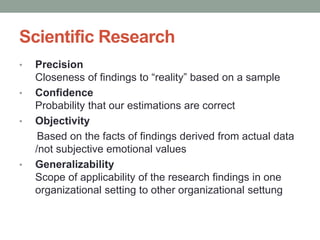
• Precision 
Closeness of findings to “reality” based on a sample 
• Confidence 
Probability that our estimations are correct 
• Objectivity 
Based on the facts of findings derived from actual data 
/not subjective emotional values 
• Generalizability 
Scope of applicability of the research findings in one 
organizational setting to other organizational settung
Scientific Research 
• Parsimony 
The most relevant, manageable factors should be 
considered when conducting research
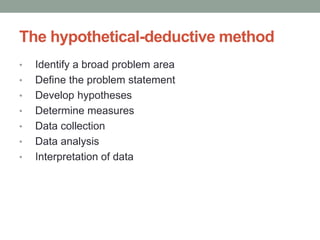
The hypothetical-deductive method 
• Identify a broad problem area 
• Define the problem statement 
• Develop hypotheses 
• Determine measures 
• Data collection 
• Data analysis 
• Interpretation of data
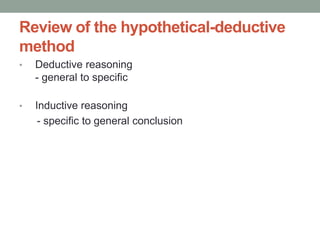
Review of the hypothetical-deductive 
method 
• Deductive reasoning 
- general to specific 
• Inductive reasoning 
- specific to general conclusion
Other types of research 
• Case studies 
- Purpose is to explore and to describe, for problem 
solving purposes 
- Usually qualitative rather than quantitative, analysis 
of documented case studies, interviews, observation 
• Action research 
- Immediate application type of research to solve 
current problems