Introduction to Business Research
Prepared by: mahrukh pervaiz
1-2
•Business research is defined as the
systematic and objective process of
generating information for aid in
making business decisions.
•Including financial research,
operational research, Marketing
research
Business Research
1-3
Scope of business research
 Business research helps decision makers shift
from intuitive information gathering to
systematic and objective investigation.
 While researchers in different functional areas
may investigate different phenomena, they are
comparable to one another because they use
similar research methods.
 The scope of business research is limited by
one’s definition of “business”.
 A broader definition of business includes not-
for-profit organization.
 The term “Business Research” is utilized because
all its techniques are applicable to business
settings.
1-4
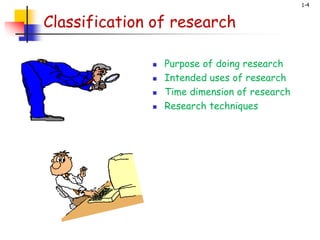
Classification of research
 Purpose of doing research
 Intended uses of research
 Time dimension of research
 Research techniques
1-5
Basic research
Applied research
Purpose of doing research
1-6
Basic Research
 Basic (Pure) Research attempts to
expand the limits of knowledge.
 It is not directly involved in the
solution to a pragmatic problem.
 The findings generally cannot be
immediately implemented.
 Basic research is conducted to verify
the acceptability of a given theory or
to know more about a certain
concept.
1-7
Applied Research
 Conducted when a decision must be
made about a specific real-life
problem
 They want to answer a policy
question or solve a pressing social ,
and economic problem
 Types of applied research:
Action research
Impact assessment research
Evaluation research
1-8
Time dimension in research
 Cross sectional research:
In cross sectional research , researchers
observe at one point in time
 Longitudinal research:
Researcher using longitudinal research
examine feature of people or other units at
more then one time
1-9
Research techniques
 Every researcher collect data using one or more techniques:
1.Quantitative
Collecting data in the form of numbers
Main techniques:
experiment
survey
content analysis
using existing statistic
2.Qualitative
Collecting data in the form of words or picture
Main technique:
field research
case study
focus group
1-10
Scientific Method
 The analysis and interpretation of empirical
evidence (facts from observation or
experimentation) to confirm or disprove prior
conceptions.
1-11
Managerial value of business
research
The Decision-making Process Associated with the Development
and Implementation of a Strategy
 Identifying problems and opportunities
 Diagnosis and assessment
 Selecting and implementing a course of action
 Evaluating the course of action
1-12
Evaluation Research
 Evaluation research is the formal, objective measurement and
appraisal of the extent to which a given activity, project, or
program has achieved its objectives.
Performance-monitoring Research
 Research that regularly provides feedback for evaluation and
control
 Indicates things are or are not going as planned
 Research may be required to explain why something “went
wrong”
1-13
Determining When to Conduct Business
Research
 Time constraints
 Availability of data
 Nature of the decision
 Benefits versus costs
 Value versus Costs
Potential Value of a Business Research Effort
Should Exceed Its Estimated Costs
1-14
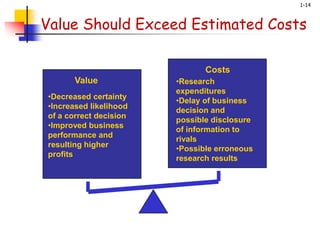
Value
•Decreased certainty
•Increased likelihood
of a correct decision
•Improved business
performance and
resulting higher
profits
Costs
•Research
expenditures
•Delay of business
decision and
possible disclosure
of information to
rivals
•Possible erroneous
research results
Value Should Exceed Estimated Costs
1-15
Major Topics for Research in Business
 General Business Conditions and
Corporate Research
 Financial and Accounting Research
 Management and Organizational
Behavior Research
 Sales and Marketing Research
 Information Systems Research
 Corporate Responsibility Research
1-16

Business research

  • 1.
    Introduction to BusinessResearch Prepared by: mahrukh pervaiz
  • 2.
    1-2 •Business research isdefined as the systematic and objective process of generating information for aid in making business decisions. •Including financial research, operational research, Marketing research Business Research
  • 3.
    1-3 Scope of businessresearch  Business research helps decision makers shift from intuitive information gathering to systematic and objective investigation.  While researchers in different functional areas may investigate different phenomena, they are comparable to one another because they use similar research methods.  The scope of business research is limited by one’s definition of “business”.  A broader definition of business includes not- for-profit organization.  The term “Business Research” is utilized because all its techniques are applicable to business settings.
  • 4.
    1-4 Classification of research Purpose of doing research  Intended uses of research  Time dimension of research  Research techniques
  • 5.
  • 6.
    1-6 Basic Research  Basic(Pure) Research attempts to expand the limits of knowledge.  It is not directly involved in the solution to a pragmatic problem.  The findings generally cannot be immediately implemented.  Basic research is conducted to verify the acceptability of a given theory or to know more about a certain concept.
  • 7.
    1-7 Applied Research  Conductedwhen a decision must be made about a specific real-life problem  They want to answer a policy question or solve a pressing social , and economic problem  Types of applied research: Action research Impact assessment research Evaluation research
  • 8.
    1-8 Time dimension inresearch  Cross sectional research: In cross sectional research , researchers observe at one point in time  Longitudinal research: Researcher using longitudinal research examine feature of people or other units at more then one time
  • 9.
    1-9 Research techniques  Everyresearcher collect data using one or more techniques: 1.Quantitative Collecting data in the form of numbers Main techniques: experiment survey content analysis using existing statistic 2.Qualitative Collecting data in the form of words or picture Main technique: field research case study focus group
  • 10.
    1-10 Scientific Method  Theanalysis and interpretation of empirical evidence (facts from observation or experimentation) to confirm or disprove prior conceptions.
  • 11.
    1-11 Managerial value ofbusiness research The Decision-making Process Associated with the Development and Implementation of a Strategy  Identifying problems and opportunities  Diagnosis and assessment  Selecting and implementing a course of action  Evaluating the course of action
  • 12.
    1-12 Evaluation Research  Evaluationresearch is the formal, objective measurement and appraisal of the extent to which a given activity, project, or program has achieved its objectives. Performance-monitoring Research  Research that regularly provides feedback for evaluation and control  Indicates things are or are not going as planned  Research may be required to explain why something “went wrong”
  • 13.
    1-13 Determining When toConduct Business Research  Time constraints  Availability of data  Nature of the decision  Benefits versus costs  Value versus Costs Potential Value of a Business Research Effort Should Exceed Its Estimated Costs
  • 14.
    1-14 Value •Decreased certainty •Increased likelihood ofa correct decision •Improved business performance and resulting higher profits Costs •Research expenditures •Delay of business decision and possible disclosure of information to rivals •Possible erroneous research results Value Should Exceed Estimated Costs
  • 15.
    1-15 Major Topics forResearch in Business  General Business Conditions and Corporate Research  Financial and Accounting Research  Management and Organizational Behavior Research  Sales and Marketing Research  Information Systems Research  Corporate Responsibility Research
  • 16.