BCM5B08
BUSINESS RESEARCH METHODS
Module 1
5th Semester
B. Com Finance
University of Calicut
Prepared By:
Ms. Leena K P
Don Bosco College, Mannuthy
Objective
• To enable students for acquiring
basic knowledge in business research
methods and to develop basic skills
in them to conduct survey researches
and case studies
Syllabus
• MODULE 1: Business Research : Definition
and Significance – Features of business
research – The research process – Variable –
Proposition – Types of research – Exploratory
and Causal research – Theoretical and
empirical research – Basic and applied
research – Descriptive research – Phases of
business research – Research Hypothesis –
Characteristics – Research in an
evolutionary perspective – Role of theory in
research – Theory building – Induction and
Deduction Theory.
• (10 Hours, 15 Marks)
• “All Progress is born of inquiry. Doubt is often better than
overconfidence, for it leads to inquiry and inquiry leads to
invention” - Hudson Maxim
What is Research?
• A systematic search to acquire knowledge
• A systematic method of finding solutions to problems “Re” and
“Search”, i.e., Search and search again
• A careful study to discover correct information or a way of collecting
information to facilitate problem solving
• It refers to the systematic method consisting of enunciating the problems,
formulating hypothesis, collecting facts or data,analysing them and reaching
certain conclusions either in the formof
• Solution or certain generalisations for some theoretical formulation
Research - Definitions:
• “A careful critical enquiry or examination in seeking facts or
principles; diligent investigation in order to ascertain something” –
Webster’s International Dictionary
• “Research is essentially an investigation, a recording and an
analysis of evidence for the purpose of gaining knowledge.” –
Robert Ross
• “The systematic and objective analysis and recording of
controlled observations that may lead to the developments of
generalizations, principles or theories, resulting in prediction and
possible ultimate control of events. “
Features of
Research
• Discovery of new knowledge
• An investigation
• Related with solution of a problem
• For predicting future occurrences
• Based on observation or experimental
evidences
• Demands accurate observation or
experimentation
• Involves collection of data  used for
new purpose
• Requires expertise
• Patience
• Carefully recorded and reported
Research - Definitions:
• “A careful critical enquiry or examination in seeking facts or
principles; diligent investigation in order to ascertain something” –
Webster’s International Dictionary
• “Research is essentially an investigation, a recording and an
analysis of evidence for the purpose of gaining knowledge.” –
Robert Ross
• “The systematic and objective analysis and recording of
controlled observations that may lead to the developments of
generalizations, principles or theories, resulting in prediction and
possible ultimate control of events. “
Business Research
• ➔ An important sub-sector o f research
• ➔ Undertaken to resolve issues in the areas o f accounting, finance, marketing and
management
• ➔ Always customer oriented
• ➔ Research is needed to identify the strength and weakness o f business
• ➔ Business research is any type o f research used toidentify investment opportunities
or start a business or succeeding improvement.
• ➔ It is done at the time o f starting or running o f any kind o f business
• ➔ Mission o f business research –Generate precise information fordecision making
Business Research- Definition
•“ Business Research is the planning, collection and
analysis O f data relevant to business decision making
and Communication of the results of this analysis to
management”
• McDanial and Gates
Business Research
• The application of the scientific method in searching for the
truth about business phenomena.
• These activities include defining business opportunities and
problems, generating and evaluating ideas, monitoring
performance, and understanding the business process.
• This process includes idea and theory development, problem
definition, searching for and collecting information, analyzing
data, and communicating the findings and their implications.
• Business research is a process of acquiring detailed information of
all the areas of business and using such information in maximizing
the sales and profit of the business. Such a study helps companies
determine which product/service is most profitable or in demand. In
simple words, it can be stated as the acquisition of information or
knowledge for professional or commercial purpose to determine
opportunities and goals for a business.
• Business research is a field of practical study in which a company
obtains data and analyzes the same to manage the company better.
Executives and managers who use business research methods can
better understand their company, the position it holds in the market,
and how to improve that position.
Definitions
• “Business research is the application of scientific method in searching
for the truth about business phenomena.” – Zikmund W. G
• “Business research as systematic and objective analysis of controlled
observations that may use to the development of organisational,
principles and possibility of ultimate control of events” – John W. Best
• “Business research is a systematic inquiry that provides information to
guide management decisions. It is the process of planning, acquiring,
analysing and disseminating relevant data, information and insights to
decision makers in way that mobilise the organisation to take
appropriate action that in turn maximise performance “ - Cooperet
Features of Business research
1. Systematic and objective process
2. Business research has a clear objective purpose
3. Business research is multi disciplinary
4. Covers all the region in which the business operates, locally and
internationally
5. Judging local problems of the environment
6. Accurately determines the cost or profitability of a business
7. Flexibility
8. Use of internet
9. Focused on demand
10. Discovery of new knowledge
11. Time constraints …
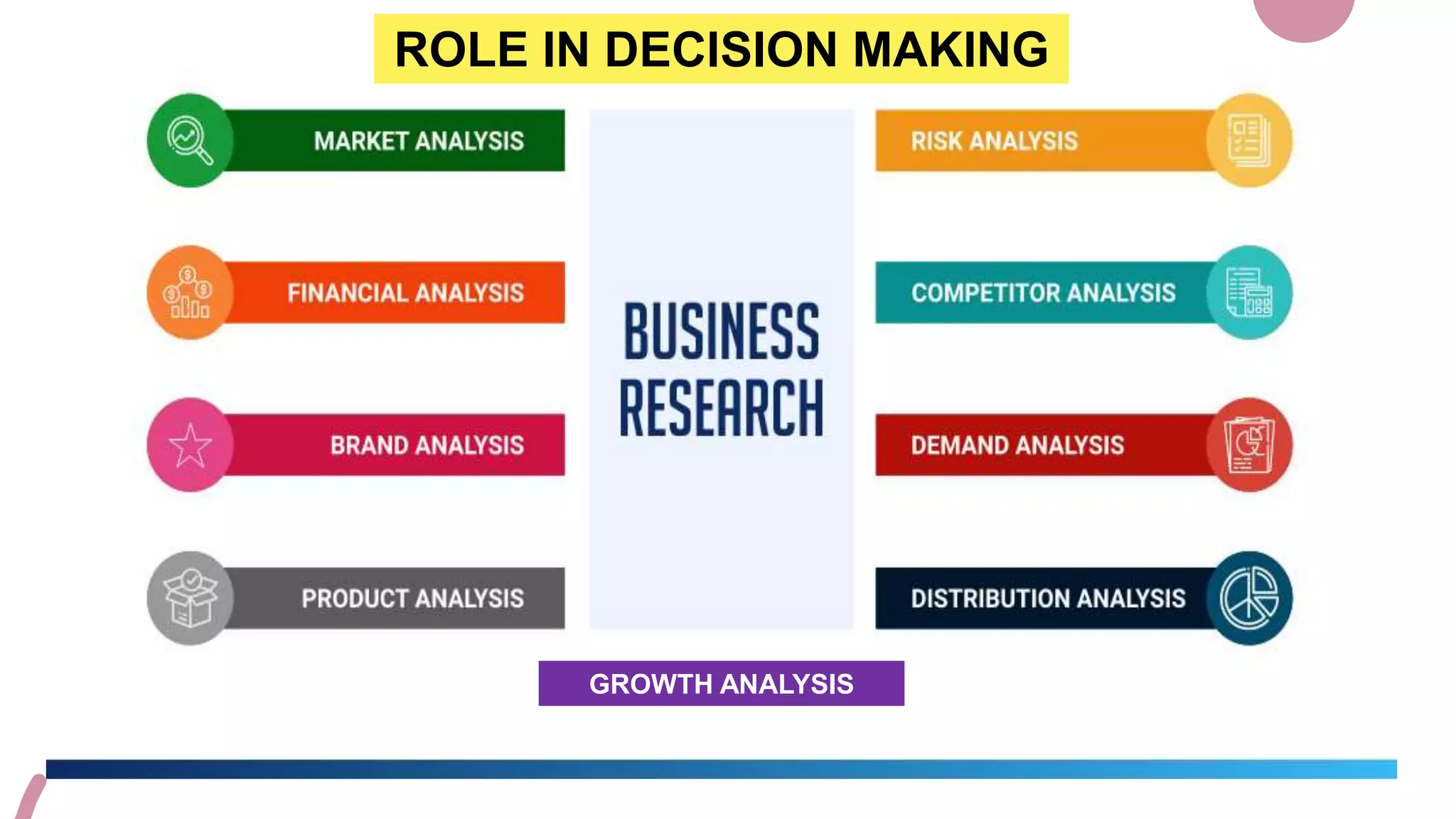
GROWTH ANALYSIS
ROLE IN DECISION MAKING
1. To promote business in an economically sound manner
2. To ensure future success
3. Gather relevant information for smooth conduct of business
4. To determine the players in the market
5. Helps the management to identify and solve smallproblems
6. To save time and cost
7. Facilitate managerial decision making process
Purpose/Objectives of Business
Research
Business Research Methods-Meaning
• Business Research methods may differ according to size of
company and type of information required
• A business research method is a vigilant and diligent study of
a market an industry or a particular company’s business
operations, using investigative techniques to discover facts,
examine theories or develop an action plan based on
discovered facts.
Important Business Research Methods
1.Operational Research
• ➔ A study o f a firm’s operational systems identifies each production step
• ➔ This type o f research helps a firm to reduce waste, inefficiency and poor performance by examining
procedures on a step-by-step basis
2. Case Studies
• ➔ Cases studies allow investigation o f industries ,companies and business situations.
• ➔ This type o f research can uncover business trends and strategies
3. Statistical Data
• ➔ Examination o f information and statistical data is another method o f research
• ➔ Financial data helps to evaluate performance and predict trends
• ➔ Industry data and competitor analysis help to determine when the products and services o f a company will
penetratea market
4. Interview Design
➔ Consumers are directly asked to answer a series of questions
that express their level of satisfaction
5. Listening
This is an important method of business research if personnel
are trained Properly to understand what customers are saying
and properly relay that to management
6. Questionnaire and Questioning
➔ Through this way also, data can be collected from consumers.
➔ The questions should be easy to read, understand and answer.
7. Surveys and Focus groups
Importance of Conducting Business Research
1. Job Seekers
Conduct business research to know more about the company, its status, payment
done etc 2. Investors
Need information to ensure safety of their investments
3. B2B Providers
They use research to formulate marketing strategy
4. Philanthropic Organisations
Before making huge donations , the philanthropist will conduct research about the
charitable organisations to which they donate funds and in-kind resources
5. Companies
They conduct business research for many reasons:
Testing New Products, Ensuring Adequate Distribution, Measuring Advertising
Effectiveness, Studying the Competition
Functions of Business Research
• To find out things about business in a systematic way
• To generate new ideas and concepts
• All time
• Every employee has potential
• Should be a part of business
1. Management tool  Descriptive, Diagnostic, Predictive Function
2. Source of information  Internal or external
3. Redefining perceptions  By assessment
4. Risk management Provide parameters to flourish business and
manage risk
5. Shape strategies Competitor, consumer analysis
Benefits
• To know economy better
• Problem solving
• Decision making
• Meet future demand and supply needs
• Budgeting
• Market analysis
• Forecasting
• Policy making of Governement
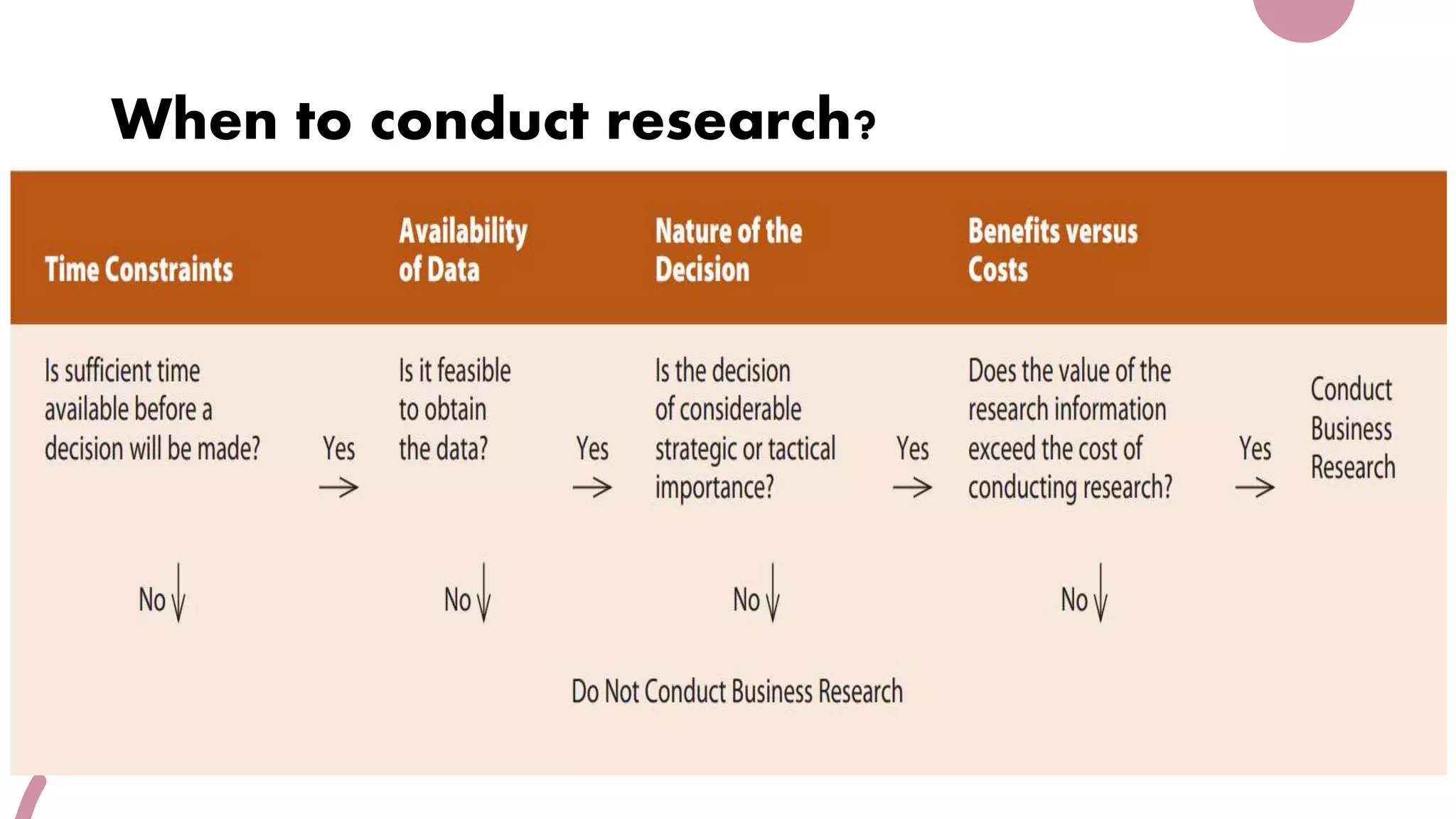
When to conduct research?
Research Process
1. Tentative or temporary selection of the research problem
2. Initial survey of literature
3. Finalising or selecting the research problem
4. Extensive literature survey
5. Developing the hypothesis
6. Preparation of research design
7. Determination of sample design
8. Collecting data
9. Execution of the project
10. Analysis of data
11. Testing of hypothesis
12. Generalisations and interpretations
13. Preparation of report and presentation of results
Types of Research
1. Descriptive research(Ex post facto research)
• Includes surveys and fact-finding enquiries of different kinds.
• The researcher has no control over the variables; he can only
report what has happened or what is happening
• Include attempts by researchers to discover causes
• Example: Frequency of shopping, preferences of people  Survey
methods
2. Analytical research The researcher has to use facts or
information already available, and analyze these to make a critical
evaluation of the material.
3. Applied research (Action) aims at finding a solution for an immediate
problem facing a society or an industrial/business organization.
Example: Research to identify social, economic or political trends that
may affect a particular institution or research to find out whether certain
communications will be read and understood or the marketing research
or evaluation research
4. Fundamental research (Basic/Pure) is mainly concerned with
generalisations and with the formulation of a theory.
Directed towards finding information that has a broad base of applications
and thus, adds to the already existing organized body of scientific
knowledge
“Gathering knowledge for knowledge’s sake”
Example Research concerning some natural phenomenon or relating
to pure mathematics
5. Quantitative research is based on the measurement of quantity or
amount. It is applicable to phenomena that can be expressed in terms
of quantity.
6. Qualitative research, on the other hand, is concerned with
qualitative phenomenon, i.e., phenomena relating to or involving quality
or kind. For instance, when we are interested in investigating the
reasons for human behaviour.
7. Conceptual research is that related to some abstract idea(s) or
theory. It is generally used by philosophers and thinkers to develop new
concepts or to reinterpret existing ones.
8. Empirical research relies on experience or observation alone, often
without due regard for system and theory. It is data-based research,
coming up with conclusions which are capable of being verified by
observation or experiment. Empirical research is appropriate when
proof is sought that certain variables affect other variables in some way.
9. one-time research  The research is confined to a single time-
period
10. Longitudinal research The research is carried on over several
time-periods.
11. Clinical or Diagnostic research Such research follow case-
study methods or indepth approaches to reach the basic causal
relations. Such studies usually go deep into the causes of things or
events that interest us, using very small samples and very deep probing
data gathering devices.
12. The objective of exploratory research is the development of
hypotheses rather than their testing
13. Formalized research studies are those with substantial structure
and with specific hypotheses to be tested.
14. Historical research is that which utilizes historical sources like
documents, remains, etc. to study events or ideas of the past, including
the philosophy of persons and groups at any remote point of time.
15. Field-setting research or Laboratory research or Simulation
research, depending upon the environment in which it is to be carried
out.
16. Conclusion oriented research, a researcher is free to pick up a
problem, redesign the enquiry as he proceeds and is prepared to
conceptualize as he wishes.
17. Decision-oriented research is always for the need of a decision
maker and the researcher in this case is not free to embark upon
research according to his own inclination. Operations research is an
example.
Phases of
Business
Research
1. Problem Definition
2. Development of an approach to
the problem
3. Research Design formulation
4. Data Collection
5. Data Preparation and analysis
6. Report preparation and
presentation
1. Identifying and defining the
problem/opportunity
• There will be problems in every field of business like accounting,
finance, marketing etc.
• Broader to specific  what is to be researched
• Precedes problem definition stage
• Definition is done by management
• Problem/opportunity?  Early identification by manager
• To define problem properly
1) Determine the nature of research Causal, experimental, Applied etc.
2) Preliminary Analysis using:
a) Situation Analysis: Circumstances under which research is
taken up
b) Informal investigation: Discussion with selected customers,
dealers, others parties concerned
Problem definition  Consists of discussion with decision makers,
interview with experts, analysis of secondary data etc.
Gives direction to research, optimum utilization of resources, helps
collect relevant information
2. Development of an Approach to the
problem
A) Formulating research objectives
• Precise
• Act as guidelines in every step in research process
• Brief and specific
• Limit the no. of objectives
• Comprise the research question/s and the hypothesis
B) Developing theoretical framework
• It demonstrates an understanding of theories and concepts that
are relevant to the topic of research
• The researcher can determine which variable to study
C) Analytical Models  Is a set of variables and their
interrelationships designed to represent , in whole or in part, some
real system or process.
• Provide a representation of the relationships between variables
• Act as a guide for formulating research design
• Analytical models can be :
1) Verbal- Prose
2) Graphical- Visual
3) Mathematical model- Equation
D) Research Questions
• Refined statements of the specific components of a problem
• A question that a research project sets out to answer
E) Developing Hypothesis
• Research questions are further refined to hypothesis
• Hypothesis suggests which variables are to be included in the
research design
3) Research design Formulation/Planning
• Blueprint for fulfilling the objectives and answering questions
• Master pan  Specify the methods, procedures for collecting
and analysing the required information by considering the time,
staffs, techniques of data analysis etc.
• Experienced researcher has greater advantages
• Firm foundation of research study
4. Data Collection
• Called field work
• Observation, Survey, experiment
• Questionnaires, standardised tests, observational forms 
Devices
Two phases
1. Pretesting  With small sub sample
2. Main study
5. Data Preparation and Analysis
• Reducing the data to a manageable size
• Expert assistance required
• FOUR Stages
1.Editing
2.Coding
3.Classification
4.Tabulation
6. Report Preparation and Presentation
• Functions:
1.Organised/systematic and permanent form of report  future research
2.Know quality of work done
3.Helps policy makers
• Importance:
1.Communication
2.Evaluation of success
3.Reveals researcher’ ability
4.Policy and decision making
Variable
• Meaning Changing, changeable
• An entity that can take on different values
• It can take on different values
• Ex: Sales, Profit
• Attribute Constant  Names, Telephone numbers  Specific
value on a variable: Gender : Male, Female, Others
Types of Variable:
1. Dependent variable
2. Independent variable
3. Intervening variable
4. Moderate variable
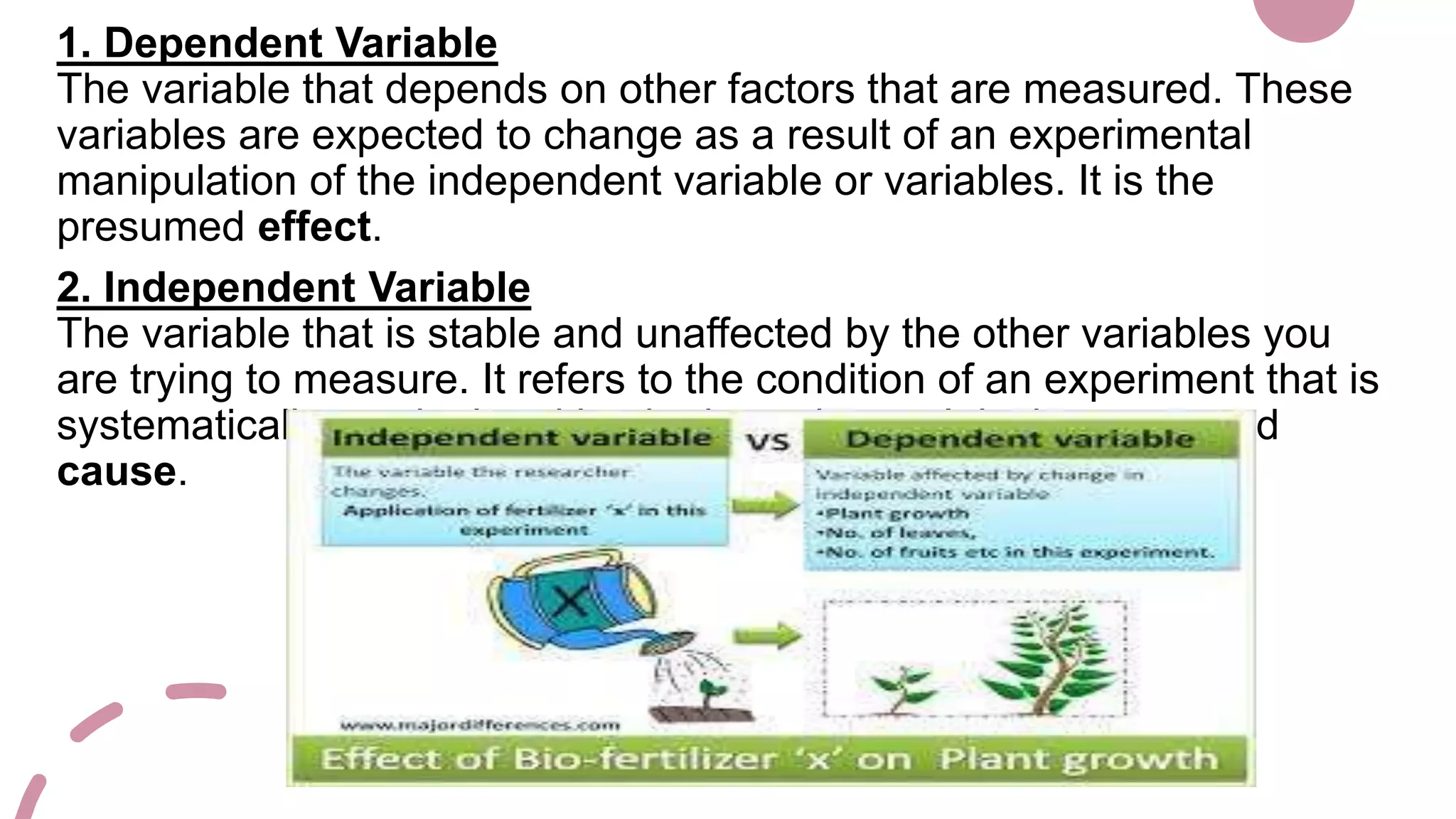
1. Dependent Variable
The variable that depends on other factors that are measured. These
variables are expected to change as a result of an experimental
manipulation of the independent variable or variables. It is the
presumed effect.
2. Independent Variable
The variable that is stable and unaffected by the other variables you
are trying to measure. It refers to the condition of an experiment that is
systematically manipulated by the investigator. It is the presumed
cause.
3. Intervening Variable
An intervening variable is a hypothetical variable used to explain causal
links between other variable. Intervening variables cannot be observed in an
experiment (that’s why they are hypothetical). For example, there is an
association between being poor and having a shorter life span. Just because
someone is poor doesn’t mean that will lead to an early death, so other
hypothetical variables are used to explain the phenomenon. These
intervening variables could include: lack of access to healthcare or poor
nutrition.
4. Moderating Variable
The term moderating variable refers to a variable that can
strengthen, diminish, negate, or otherwise alter the association
between independent and dependent variables.
Moderating variables are useful because they help explain the links
between the independent and dependent variables. Also sometimes
referred to as simply moderators, these moderating variables
provide additional information regarding the association between
two variables in quantitative research by explaining what features
can make that association stronger, weaker, or even disappear.
Hypothesis
• Hypothesis is considered as an intelligent guess or prediction, that
gives directional to the researcher to answer the research question.
• Hypothesis or Hypotheses are defined as the formal statement of the
tentative or expected prediction or explanation of the relationship
between two or more variables in a specified population.
• A hypothesis is a formal tentative statement of the expected
relationship between two or more variables under study.
• A hypothesis helps to translate the research problem and objective
into a clear explanation or prediction of the expected results or
outcomes of the study.
• Hypothesis is derived from the research problems, literature review
and conceptual framework.
Types
1. Descriptive Hypothesis
2. Relational Hypothesis
3. Working Hypothesis
4. Null Hypothesis
5. Analytical Hypothesis
6. Statistical Hypothesis
7. Common-sense Hypothesis
Characteristics of hypothesis: Hypothesis must possess the
following characteristics:
(i) Hypothesis should be clear and precise.
(ii) Hypothesis should be capable of being tested.
(iii) Hypothesis should state relationship between variables, if it happens
to be a relational hypothesis.
(iv) Hypothesis should be limited in scope and must be specific
(v) Hypothesis should be stated as far as possible in most simple terms so
that the same is easily understandable by all concerned
(vi) Hypothesis should be consistent with most known facts i.e., it must be
consistent with a substantial body of established facts
(vii) Hypothesis should be amenable to testing within a reasonable time
(viii) Hypothesis must explain the facts that gave rise to the need for
explanation. It must actually explain what it claims to explain; it should
have empirical reference.
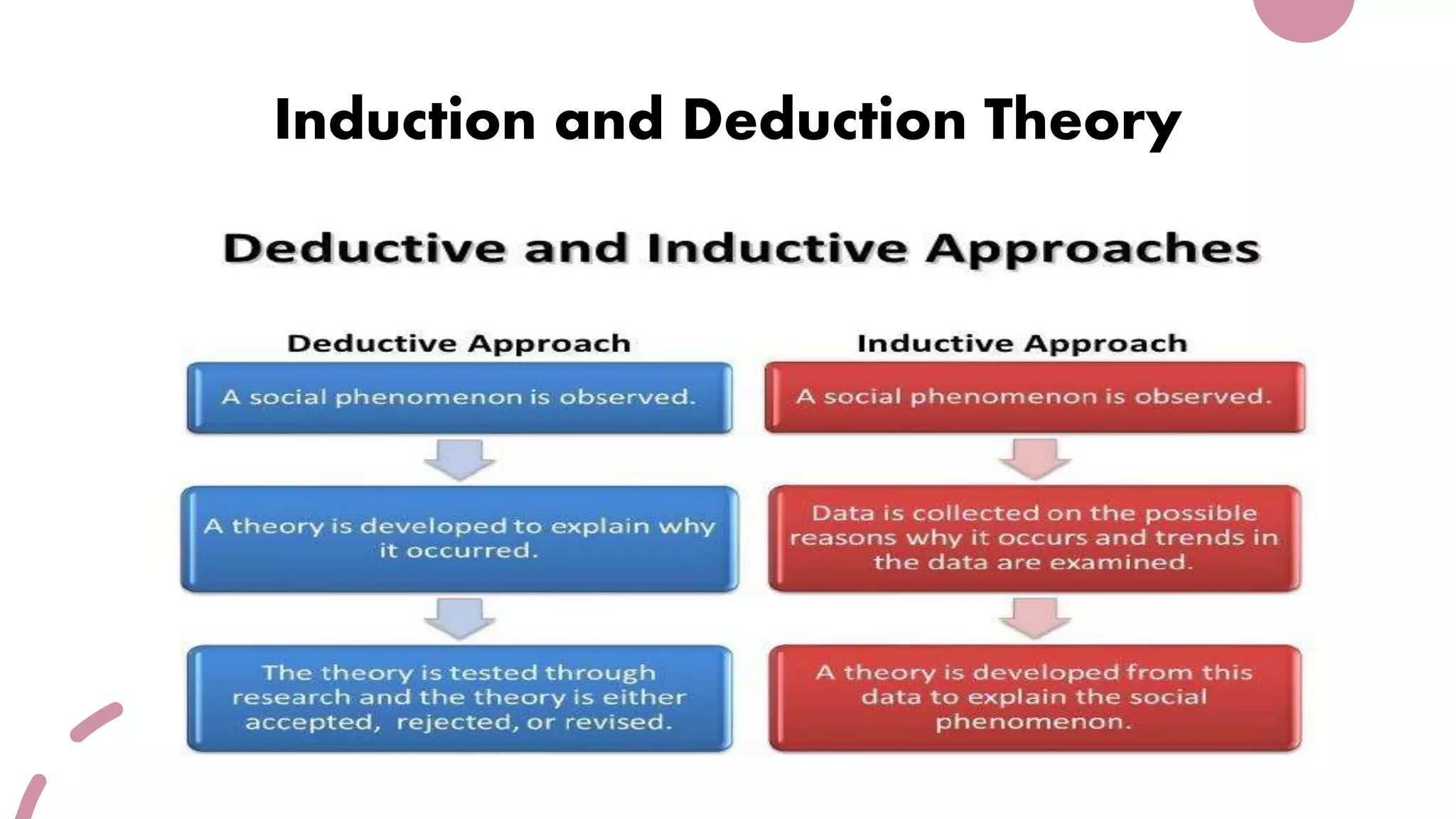
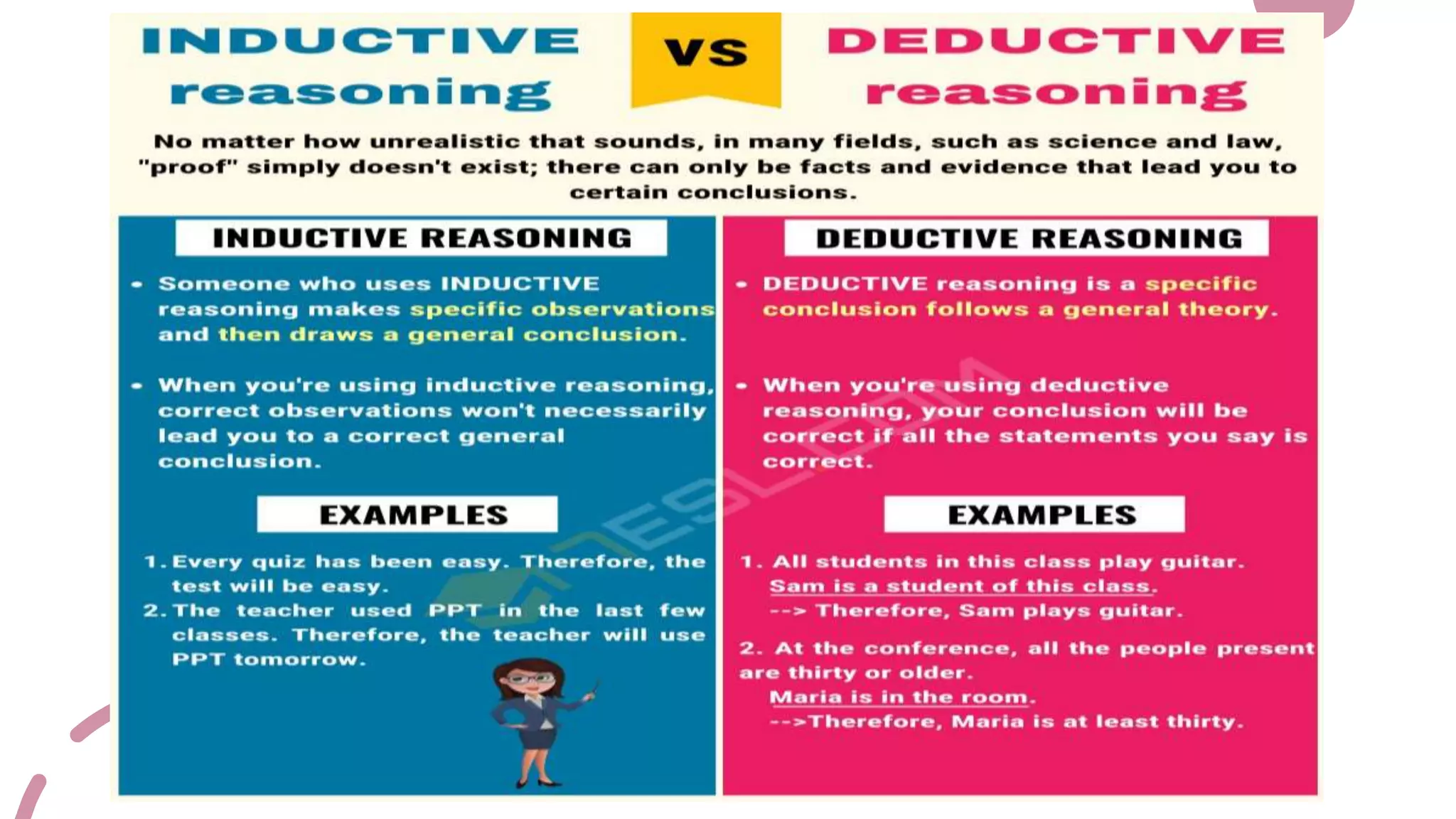
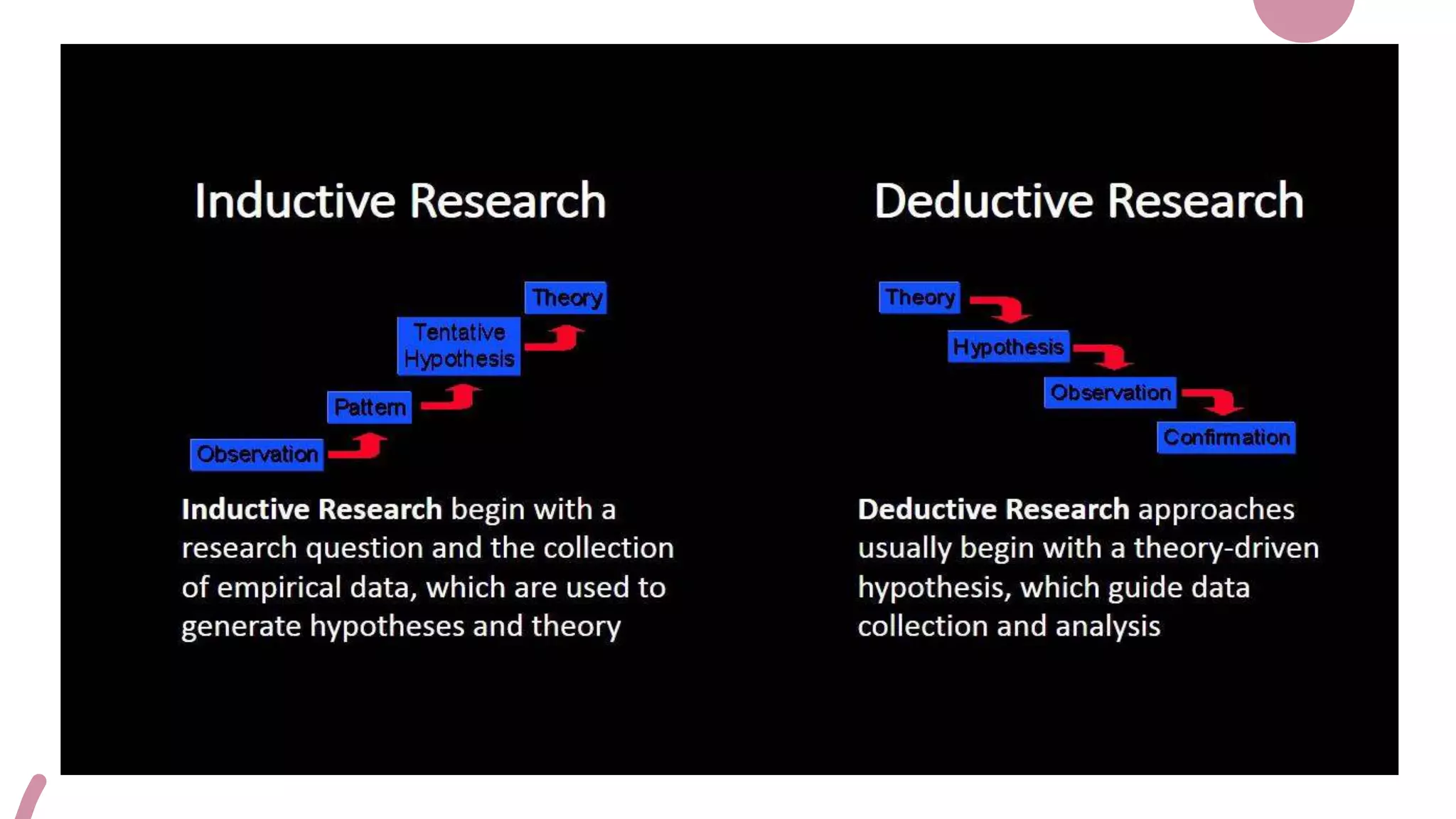
Induction and Deduction Theory
1.1 business research  methods

1.1 business research methods

  • 1.
    BCM5B08 BUSINESS RESEARCH METHODS Module1 5th Semester B. Com Finance University of Calicut Prepared By: Ms. Leena K P Don Bosco College, Mannuthy
  • 2.
    Objective • To enablestudents for acquiring basic knowledge in business research methods and to develop basic skills in them to conduct survey researches and case studies
  • 3.
    Syllabus • MODULE 1:Business Research : Definition and Significance – Features of business research – The research process – Variable – Proposition – Types of research – Exploratory and Causal research – Theoretical and empirical research – Basic and applied research – Descriptive research – Phases of business research – Research Hypothesis – Characteristics – Research in an evolutionary perspective – Role of theory in research – Theory building – Induction and Deduction Theory. • (10 Hours, 15 Marks)
  • 5.
    • “All Progressis born of inquiry. Doubt is often better than overconfidence, for it leads to inquiry and inquiry leads to invention” - Hudson Maxim
  • 6.
    What is Research? •A systematic search to acquire knowledge • A systematic method of finding solutions to problems “Re” and “Search”, i.e., Search and search again • A careful study to discover correct information or a way of collecting information to facilitate problem solving • It refers to the systematic method consisting of enunciating the problems, formulating hypothesis, collecting facts or data,analysing them and reaching certain conclusions either in the formof • Solution or certain generalisations for some theoretical formulation
  • 7.
    Research - Definitions: •“A careful critical enquiry or examination in seeking facts or principles; diligent investigation in order to ascertain something” – Webster’s International Dictionary • “Research is essentially an investigation, a recording and an analysis of evidence for the purpose of gaining knowledge.” – Robert Ross • “The systematic and objective analysis and recording of controlled observations that may lead to the developments of generalizations, principles or theories, resulting in prediction and possible ultimate control of events. “
  • 8.
    Features of Research • Discoveryof new knowledge • An investigation • Related with solution of a problem • For predicting future occurrences • Based on observation or experimental evidences • Demands accurate observation or experimentation • Involves collection of data  used for new purpose • Requires expertise • Patience • Carefully recorded and reported
  • 9.
    Research - Definitions: •“A careful critical enquiry or examination in seeking facts or principles; diligent investigation in order to ascertain something” – Webster’s International Dictionary • “Research is essentially an investigation, a recording and an analysis of evidence for the purpose of gaining knowledge.” – Robert Ross • “The systematic and objective analysis and recording of controlled observations that may lead to the developments of generalizations, principles or theories, resulting in prediction and possible ultimate control of events. “
  • 10.
    Business Research • ➔An important sub-sector o f research • ➔ Undertaken to resolve issues in the areas o f accounting, finance, marketing and management • ➔ Always customer oriented • ➔ Research is needed to identify the strength and weakness o f business • ➔ Business research is any type o f research used toidentify investment opportunities or start a business or succeeding improvement. • ➔ It is done at the time o f starting or running o f any kind o f business • ➔ Mission o f business research –Generate precise information fordecision making
  • 11.
    Business Research- Definition •“Business Research is the planning, collection and analysis O f data relevant to business decision making and Communication of the results of this analysis to management” • McDanial and Gates
  • 12.
    Business Research • Theapplication of the scientific method in searching for the truth about business phenomena. • These activities include defining business opportunities and problems, generating and evaluating ideas, monitoring performance, and understanding the business process. • This process includes idea and theory development, problem definition, searching for and collecting information, analyzing data, and communicating the findings and their implications.
  • 14.
    • Business researchis a process of acquiring detailed information of all the areas of business and using such information in maximizing the sales and profit of the business. Such a study helps companies determine which product/service is most profitable or in demand. In simple words, it can be stated as the acquisition of information or knowledge for professional or commercial purpose to determine opportunities and goals for a business. • Business research is a field of practical study in which a company obtains data and analyzes the same to manage the company better. Executives and managers who use business research methods can better understand their company, the position it holds in the market, and how to improve that position.
  • 15.
    Definitions • “Business researchis the application of scientific method in searching for the truth about business phenomena.” – Zikmund W. G • “Business research as systematic and objective analysis of controlled observations that may use to the development of organisational, principles and possibility of ultimate control of events” – John W. Best • “Business research is a systematic inquiry that provides information to guide management decisions. It is the process of planning, acquiring, analysing and disseminating relevant data, information and insights to decision makers in way that mobilise the organisation to take appropriate action that in turn maximise performance “ - Cooperet
  • 17.
    Features of Businessresearch 1. Systematic and objective process 2. Business research has a clear objective purpose 3. Business research is multi disciplinary 4. Covers all the region in which the business operates, locally and internationally 5. Judging local problems of the environment 6. Accurately determines the cost or profitability of a business 7. Flexibility 8. Use of internet 9. Focused on demand 10. Discovery of new knowledge 11. Time constraints …
  • 18.
    GROWTH ANALYSIS ROLE INDECISION MAKING
  • 19.
    1. To promotebusiness in an economically sound manner 2. To ensure future success 3. Gather relevant information for smooth conduct of business 4. To determine the players in the market 5. Helps the management to identify and solve smallproblems 6. To save time and cost 7. Facilitate managerial decision making process Purpose/Objectives of Business Research
  • 20.
    Business Research Methods-Meaning •Business Research methods may differ according to size of company and type of information required • A business research method is a vigilant and diligent study of a market an industry or a particular company’s business operations, using investigative techniques to discover facts, examine theories or develop an action plan based on discovered facts.
  • 21.
    Important Business ResearchMethods 1.Operational Research • ➔ A study o f a firm’s operational systems identifies each production step • ➔ This type o f research helps a firm to reduce waste, inefficiency and poor performance by examining procedures on a step-by-step basis 2. Case Studies • ➔ Cases studies allow investigation o f industries ,companies and business situations. • ➔ This type o f research can uncover business trends and strategies 3. Statistical Data • ➔ Examination o f information and statistical data is another method o f research • ➔ Financial data helps to evaluate performance and predict trends • ➔ Industry data and competitor analysis help to determine when the products and services o f a company will penetratea market
  • 22.
    4. Interview Design ➔Consumers are directly asked to answer a series of questions that express their level of satisfaction 5. Listening This is an important method of business research if personnel are trained Properly to understand what customers are saying and properly relay that to management 6. Questionnaire and Questioning ➔ Through this way also, data can be collected from consumers. ➔ The questions should be easy to read, understand and answer. 7. Surveys and Focus groups
  • 23.
    Importance of ConductingBusiness Research 1. Job Seekers Conduct business research to know more about the company, its status, payment done etc 2. Investors Need information to ensure safety of their investments 3. B2B Providers They use research to formulate marketing strategy 4. Philanthropic Organisations Before making huge donations , the philanthropist will conduct research about the charitable organisations to which they donate funds and in-kind resources 5. Companies They conduct business research for many reasons: Testing New Products, Ensuring Adequate Distribution, Measuring Advertising Effectiveness, Studying the Competition
  • 24.
    Functions of BusinessResearch • To find out things about business in a systematic way • To generate new ideas and concepts • All time • Every employee has potential • Should be a part of business 1. Management tool  Descriptive, Diagnostic, Predictive Function 2. Source of information  Internal or external 3. Redefining perceptions  By assessment 4. Risk management Provide parameters to flourish business and manage risk 5. Shape strategies Competitor, consumer analysis
  • 25.
    Benefits • To knoweconomy better • Problem solving • Decision making • Meet future demand and supply needs • Budgeting • Market analysis • Forecasting • Policy making of Governement
  • 26.
    When to conductresearch?
  • 27.
    Research Process 1. Tentativeor temporary selection of the research problem 2. Initial survey of literature 3. Finalising or selecting the research problem 4. Extensive literature survey 5. Developing the hypothesis 6. Preparation of research design 7. Determination of sample design 8. Collecting data 9. Execution of the project 10. Analysis of data 11. Testing of hypothesis 12. Generalisations and interpretations 13. Preparation of report and presentation of results
  • 28.
    Types of Research 1.Descriptive research(Ex post facto research) • Includes surveys and fact-finding enquiries of different kinds. • The researcher has no control over the variables; he can only report what has happened or what is happening • Include attempts by researchers to discover causes • Example: Frequency of shopping, preferences of people  Survey methods 2. Analytical research The researcher has to use facts or information already available, and analyze these to make a critical evaluation of the material.
  • 29.
    3. Applied research(Action) aims at finding a solution for an immediate problem facing a society or an industrial/business organization. Example: Research to identify social, economic or political trends that may affect a particular institution or research to find out whether certain communications will be read and understood or the marketing research or evaluation research 4. Fundamental research (Basic/Pure) is mainly concerned with generalisations and with the formulation of a theory. Directed towards finding information that has a broad base of applications and thus, adds to the already existing organized body of scientific knowledge “Gathering knowledge for knowledge’s sake” Example Research concerning some natural phenomenon or relating to pure mathematics
  • 30.
    5. Quantitative researchis based on the measurement of quantity or amount. It is applicable to phenomena that can be expressed in terms of quantity. 6. Qualitative research, on the other hand, is concerned with qualitative phenomenon, i.e., phenomena relating to or involving quality or kind. For instance, when we are interested in investigating the reasons for human behaviour. 7. Conceptual research is that related to some abstract idea(s) or theory. It is generally used by philosophers and thinkers to develop new concepts or to reinterpret existing ones. 8. Empirical research relies on experience or observation alone, often without due regard for system and theory. It is data-based research, coming up with conclusions which are capable of being verified by observation or experiment. Empirical research is appropriate when proof is sought that certain variables affect other variables in some way.
  • 31.
    9. one-time research The research is confined to a single time- period 10. Longitudinal research The research is carried on over several time-periods. 11. Clinical or Diagnostic research Such research follow case- study methods or indepth approaches to reach the basic causal relations. Such studies usually go deep into the causes of things or events that interest us, using very small samples and very deep probing data gathering devices. 12. The objective of exploratory research is the development of hypotheses rather than their testing 13. Formalized research studies are those with substantial structure and with specific hypotheses to be tested.
  • 32.
    14. Historical researchis that which utilizes historical sources like documents, remains, etc. to study events or ideas of the past, including the philosophy of persons and groups at any remote point of time. 15. Field-setting research or Laboratory research or Simulation research, depending upon the environment in which it is to be carried out. 16. Conclusion oriented research, a researcher is free to pick up a problem, redesign the enquiry as he proceeds and is prepared to conceptualize as he wishes. 17. Decision-oriented research is always for the need of a decision maker and the researcher in this case is not free to embark upon research according to his own inclination. Operations research is an example.
  • 33.
    Phases of Business Research 1. ProblemDefinition 2. Development of an approach to the problem 3. Research Design formulation 4. Data Collection 5. Data Preparation and analysis 6. Report preparation and presentation
  • 34.
    1. Identifying anddefining the problem/opportunity • There will be problems in every field of business like accounting, finance, marketing etc. • Broader to specific  what is to be researched • Precedes problem definition stage • Definition is done by management • Problem/opportunity?  Early identification by manager • To define problem properly 1) Determine the nature of research Causal, experimental, Applied etc.
  • 35.
    2) Preliminary Analysisusing: a) Situation Analysis: Circumstances under which research is taken up b) Informal investigation: Discussion with selected customers, dealers, others parties concerned Problem definition  Consists of discussion with decision makers, interview with experts, analysis of secondary data etc. Gives direction to research, optimum utilization of resources, helps collect relevant information
  • 36.
    2. Development ofan Approach to the problem A) Formulating research objectives • Precise • Act as guidelines in every step in research process • Brief and specific • Limit the no. of objectives • Comprise the research question/s and the hypothesis B) Developing theoretical framework • It demonstrates an understanding of theories and concepts that are relevant to the topic of research • The researcher can determine which variable to study
  • 37.
    C) Analytical Models Is a set of variables and their interrelationships designed to represent , in whole or in part, some real system or process. • Provide a representation of the relationships between variables • Act as a guide for formulating research design • Analytical models can be : 1) Verbal- Prose 2) Graphical- Visual 3) Mathematical model- Equation D) Research Questions • Refined statements of the specific components of a problem • A question that a research project sets out to answer
  • 38.
    E) Developing Hypothesis •Research questions are further refined to hypothesis • Hypothesis suggests which variables are to be included in the research design
  • 39.
    3) Research designFormulation/Planning • Blueprint for fulfilling the objectives and answering questions • Master pan  Specify the methods, procedures for collecting and analysing the required information by considering the time, staffs, techniques of data analysis etc. • Experienced researcher has greater advantages • Firm foundation of research study
  • 40.
    4. Data Collection •Called field work • Observation, Survey, experiment • Questionnaires, standardised tests, observational forms  Devices Two phases 1. Pretesting  With small sub sample 2. Main study
  • 41.
    5. Data Preparationand Analysis • Reducing the data to a manageable size • Expert assistance required • FOUR Stages 1.Editing 2.Coding 3.Classification 4.Tabulation
  • 42.
    6. Report Preparationand Presentation • Functions: 1.Organised/systematic and permanent form of report  future research 2.Know quality of work done 3.Helps policy makers • Importance: 1.Communication 2.Evaluation of success 3.Reveals researcher’ ability 4.Policy and decision making
  • 43.
    Variable • Meaning Changing,changeable • An entity that can take on different values • It can take on different values • Ex: Sales, Profit • Attribute Constant  Names, Telephone numbers  Specific value on a variable: Gender : Male, Female, Others Types of Variable: 1. Dependent variable 2. Independent variable 3. Intervening variable 4. Moderate variable
  • 44.
    1. Dependent Variable Thevariable that depends on other factors that are measured. These variables are expected to change as a result of an experimental manipulation of the independent variable or variables. It is the presumed effect. 2. Independent Variable The variable that is stable and unaffected by the other variables you are trying to measure. It refers to the condition of an experiment that is systematically manipulated by the investigator. It is the presumed cause.
  • 45.
    3. Intervening Variable Anintervening variable is a hypothetical variable used to explain causal links between other variable. Intervening variables cannot be observed in an experiment (that’s why they are hypothetical). For example, there is an association between being poor and having a shorter life span. Just because someone is poor doesn’t mean that will lead to an early death, so other hypothetical variables are used to explain the phenomenon. These intervening variables could include: lack of access to healthcare or poor nutrition.
  • 46.
    4. Moderating Variable Theterm moderating variable refers to a variable that can strengthen, diminish, negate, or otherwise alter the association between independent and dependent variables. Moderating variables are useful because they help explain the links between the independent and dependent variables. Also sometimes referred to as simply moderators, these moderating variables provide additional information regarding the association between two variables in quantitative research by explaining what features can make that association stronger, weaker, or even disappear.
  • 47.
    Hypothesis • Hypothesis isconsidered as an intelligent guess or prediction, that gives directional to the researcher to answer the research question. • Hypothesis or Hypotheses are defined as the formal statement of the tentative or expected prediction or explanation of the relationship between two or more variables in a specified population. • A hypothesis is a formal tentative statement of the expected relationship between two or more variables under study. • A hypothesis helps to translate the research problem and objective into a clear explanation or prediction of the expected results or outcomes of the study. • Hypothesis is derived from the research problems, literature review and conceptual framework.
  • 48.
    Types 1. Descriptive Hypothesis 2.Relational Hypothesis 3. Working Hypothesis 4. Null Hypothesis 5. Analytical Hypothesis 6. Statistical Hypothesis 7. Common-sense Hypothesis
  • 49.
    Characteristics of hypothesis:Hypothesis must possess the following characteristics: (i) Hypothesis should be clear and precise. (ii) Hypothesis should be capable of being tested. (iii) Hypothesis should state relationship between variables, if it happens to be a relational hypothesis. (iv) Hypothesis should be limited in scope and must be specific (v) Hypothesis should be stated as far as possible in most simple terms so that the same is easily understandable by all concerned (vi) Hypothesis should be consistent with most known facts i.e., it must be consistent with a substantial body of established facts (vii) Hypothesis should be amenable to testing within a reasonable time (viii) Hypothesis must explain the facts that gave rise to the need for explanation. It must actually explain what it claims to explain; it should have empirical reference.
  • 50.