Business ResearchBusiness Research
MethodsMethods
Instructor: Prof. Soofia WaleedInstructor: Prof. Soofia Waleed
Chapter1Chapter1
Introduction To ResearchIntroduction To Research
After completing this chapter youAfter completing this chapter you
would be able to understand:would be able to understand:
 What is researchWhat is research
 What is business researchWhat is business research
 Types of business researchTypes of business research
 Importance of research for a managerImportance of research for a manager
 Relationship of the manager and the researcher-Relationship of the manager and the researcher-
consultantconsultant
 Internal Versus External ResearcherInternal Versus External Researcher
 Knowledge about research and managerial effectivenessKnowledge about research and managerial effectiveness
 Ethics and business researchEthics and business research
What managers do?What managers do?
 Make several decisionsMake several decisions
 Solve problemsSolve problems
What would help you to make right decisions?What would help you to make right decisions?
Will it be your experience on the job?Will it be your experience on the job?
Or hunch?Or hunch?
Or you just hope for good luck?Or you just hope for good luck?
Experience, Hunch or Hope?Experience, Hunch or Hope?
 All of these will play a part after you haveAll of these will play a part after you have
thoroughly investigated the problem situationthoroughly investigated the problem situation
and generated some alternative solutions toand generated some alternative solutions to
choose from.choose from.
 Whether or not managers realize it they areWhether or not managers realize it they are
constantly engaged in research as they try toconstantly engaged in research as they try to
find solutions to the day-to-day problems; big orfind solutions to the day-to-day problems; big or
small, that confront them at work.small, that confront them at work.
ResearchResearch
It is a process of finding solutions toIt is a process of finding solutions to
a problem after a thorough studya problem after a thorough study
and analysis to the situationaland analysis to the situational
factorsfactors
 Sometimes managers make goodSometimes managers make good
decisionsdecisions
 Sometimes managers make bad decisionsSometimes managers make bad decisions
 The difference lies in how managers goThe difference lies in how managers go
about the decision making processabout the decision making process
Good Decision Making fetchesGood Decision Making fetches YESYES
to the following questionsto the following questions
 Do managers identify where exactly the problem lies?Do managers identify where exactly the problem lies?
 Do they correctly recognize the relevant factors?Do they correctly recognize the relevant factors?
 Do they know what type of information to be gatheredDo they know what type of information to be gathered
and how?and how?
 Do they know how to make use of the informationDo they know how to make use of the information
collected and draw appropriate conclusions to make thecollected and draw appropriate conclusions to make the
right decisions?right decisions?
 Do they know how to implement the results of thisDo they know how to implement the results of this
process to solve the problem?process to solve the problem?
Business ResearchBusiness Research
Business Research is an organized,Business Research is an organized,
systematic, data based, critical, objective,systematic, data based, critical, objective,
scientific enquiry or investigation into ascientific enquiry or investigation into a
specific problem, undertaken with aspecific problem, undertaken with a
purpose of finding answers or solutions topurpose of finding answers or solutions to
it.it.
Examples of Business ProblemsExamples of Business Problems
 AccountingAccounting
Budgets control systems, inventory costingBudgets control systems, inventory costing
methods, accelerated depreciation taxationmethods, accelerated depreciation taxation
methods are some areas that are researched.methods are some areas that are researched.
 ManagementManagement
Study of employee attitude and behavior,Study of employee attitude and behavior,
HRM, POM, strategy formulation.HRM, POM, strategy formulation.
Examples cont.Examples cont.
 FinanceFinance
Financial Ratios, mergers and acquisitions,Financial Ratios, mergers and acquisitions,
mortgages, operations of financialmortgages, operations of financial
institutionsinstitutions
 MarketingMarketing
Product image, Advertising, Sales promotion,Product image, Advertising, Sales promotion,
packaging, pricing, after sale service, newpackaging, pricing, after sale service, new
product development etc.product development etc.
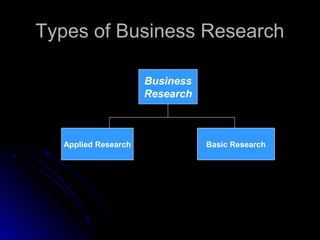
Types of Business ResearchTypes of Business Research
Business
Research
Applied Research Basic Research
Applied ResearchApplied Research
Research done with the intention ofResearch done with the intention of
applying the results of the findings to solveapplying the results of the findings to solve
specific problems currently beingspecific problems currently being
experienced in the organization is calledexperienced in the organization is called
Applied ResearchApplied Research
Basic ResearchBasic Research
 Research done chiefly to enhance theResearch done chiefly to enhance the
understanding of certain problems that commonlyunderstanding of certain problems that commonly
occur in organizational settings, and seek methodsoccur in organizational settings, and seek methods
of solving them is called basic or fundamentalof solving them is called basic or fundamental
research.research.
 It is also known as pure research.It is also known as pure research.
 Such knowledge generated is usually later appliedSuch knowledge generated is usually later applied
in organizational setting for problem solving.in organizational setting for problem solving.
Examples of AppliedExamples of Applied
andand
Basic ResearchBasic Research
How is it helpful for you?How is it helpful for you?
1.Identify and effectively solve minor problems in1.Identify and effectively solve minor problems in
the work setting.the work setting.
2. Know how to determine good from bad2. Know how to determine good from bad
research.research.
3. Appreciate and be constantly aware of the3. Appreciate and be constantly aware of the
multiple influences and multiple effects of factorsmultiple influences and multiple effects of factors
impinging on a situation.impinging on a situation.
4. Take calculated risks in decision making,4. Take calculated risks in decision making,
knowing full well the probabilities associated withknowing full well the probabilities associated with
the different possible outcomes.the different possible outcomes.
5. Prevent possible vested interests from5. Prevent possible vested interests from
exercising their interests in a situation.exercising their interests in a situation.
6. Relate to hire researchers and consultants more6. Relate to hire researchers and consultants more
effectively.effectively.
7. Combine experience with scientific knowledge7. Combine experience with scientific knowledge
while making decisions.while making decisions.
Managers and ResearchManagers and Research
 Managers with knowledge of research have anManagers with knowledge of research have an
advantage over those without.advantage over those without.
 Though you yourself may not be doing any majorThough you yourself may not be doing any major
research as a manager, you have to understand, predict,research as a manager, you have to understand, predict,
and control events that are dysfunctional to theand control events that are dysfunctional to the
organizationorganization
 Due to complexity of modern organizations and theDue to complexity of modern organizations and the
uncertainty of environment they face, the managementuncertainty of environment they face, the management
has become one of constant trouble shooting inhas become one of constant trouble shooting in
workplaceworkplace
 This “Research” will help managers sense, spot, andThis “Research” will help managers sense, spot, and
deal with problems before they get out of hand.deal with problems before they get out of hand.
How to locate and Select aHow to locate and Select a
Researcher?Researcher?
 Through telephone directories.Through telephone directories.
 The consulting firms will provide lists ofThe consulting firms will provide lists of
individuals that have expertise in specific areas.individuals that have expertise in specific areas.
 Other organizations that have used theirOther organizations that have used their
services can also be contacted to ascertain theservices can also be contacted to ascertain the
merits and effectiveness of the individuals andmerits and effectiveness of the individuals and
the reputation of the firm.the reputation of the firm.
The Manager ResearcherThe Manager Researcher
RelationshipRelationship
 When the manager is knowledgeableWhen the manager is knowledgeable
about research, then the interactionsabout research, then the interactions
between the manager and researcherbetween the manager and researcher
become more meaningful purposeful andbecome more meaningful purposeful and
beneficial to both organization and thebeneficial to both organization and the
researcher.researcher.
 Managers provide information.Managers provide information.
 What records will not be made available.What records will not be made available.
To summarize, the manager shouldTo summarize, the manager should
make sure while hiring researchers ormake sure while hiring researchers or
consultants that:consultants that:
 The roles and expectations of both parties areThe roles and expectations of both parties are
made explicit.made explicit.
 Relevant philosophies and value systems of theRelevant philosophies and value systems of the
organization are clearly stated, and constraints,organization are clearly stated, and constraints,
if any, communicated.if any, communicated.
 A good rapport is established with theA good rapport is established with the
researchers, and between the researchers andresearchers, and between the researchers and
the employees in the organization, enabling thethe employees in the organization, enabling the
full co-operation of the later.full co-operation of the later.
Internal Versus ExternalInternal Versus External
Consultants-ResearcherConsultants-Researcher
Internal Consultants/ResearchersInternal Consultants/Researchers
Some organizations have their own consultingSome organizations have their own consulting
or research department, which might beor research department, which might be
called the Management Services Department,called the Management Services Department,
the Organization and method departmentthe Organization and method department
Advantages of Internal ResearcherAdvantages of Internal Researcher
 The internal team is readily accepted by theThe internal team is readily accepted by the
employees where research is to be done.employees where research is to be done.
 The team requires much less time inThe team requires much less time in
understanding the structure.understanding the structure.
 They would be available for implementation afterThey would be available for implementation after
the research findings are accepted, if bugsthe research findings are accepted, if bugs
appear it would be removed with their help.appear it would be removed with their help.
 Cost is less as compare to external team.Cost is less as compare to external team.
Disadvantages of InternalDisadvantages of Internal
ResearchersResearchers
 They may fall into stereotype way of looking atThey may fall into stereotype way of looking at
the organization and its problems.the organization and its problems.
 There is scope of certain powerful coalitions inThere is scope of certain powerful coalitions in
the organizations to influence the internal teamthe organizations to influence the internal team
to conceal, distort or misrepresent certain facts.to conceal, distort or misrepresent certain facts.
 They might not be perceived as experts by theThey might not be perceived as experts by the
staff and management.staff and management.
 Certain organization biases of the internalCertain organization biases of the internal
research team might in some instances makeresearch team might in some instances make
the findings less objective and less scientific.the findings less objective and less scientific.
Advantages of ExternalAdvantages of External
Researcher/ConsultantResearcher/Consultant
 The external team has a wealth of experience asThe external team has a wealth of experience as
they have worked with various organizations.they have worked with various organizations.
They would think divergently and convergentlyThey would think divergently and convergently
rather than hurry to an instant solution on therather than hurry to an instant solution on the
basis of apparent facts in the situation.basis of apparent facts in the situation.
 They have periodic training programs. ExternalThey have periodic training programs. External
research institutions ensure that their membersresearch institutions ensure that their members
are current on the latest innovations throughare current on the latest innovations through
periodic organized training programs.periodic organized training programs.
Disadvantages of ExternalDisadvantages of External
Researcher/ConsultantResearcher/Consultant
 The cost of hiring External Researcher is usuallyThe cost of hiring External Researcher is usually
high.high.
 They seldom get a warm welcome, nor areThey seldom get a warm welcome, nor are
accepted by employees.accepted by employees.
 The external team also charges additional feesThe external team also charges additional fees
for their assistance in the implementation andfor their assistance in the implementation and
evaluation phases.evaluation phases.
Ethics in Business ResearchEthics in Business Research
Ethics in business research refers to a code ofEthics in business research refers to a code of
conduct or expected societal norm of behaviorconduct or expected societal norm of behavior
while conducting researchwhile conducting research
Ethical conduct applies toEthical conduct applies to
1.1. OrganizationOrganization
2.2. Members sponsoring the researchMembers sponsoring the research
3.3. The researchers who undertake the researchThe researchers who undertake the research
4.4. The respondents who provide them with the relevantThe respondents who provide them with the relevant
datadata
Ethics of Business ResearchEthics of Business Research
 The person instituting the research should do soThe person instituting the research should do so
in good faith.in good faith.
 Pay attention to what the results indicate.Pay attention to what the results indicate.
 Surrender the ego.Surrender the ego.
 Pursue organizational rather than self interest.Pursue organizational rather than self interest.
 Ethical conduct should be reflected in theEthical conduct should be reflected in the
behavior of the researchers, participants whobehavior of the researchers, participants who
provide the data, analyst who provide the resultprovide the data, analyst who provide the result
and the entire research team who provide theand the entire research team who provide the
interpretation and suggests alternative solutions.interpretation and suggests alternative solutions.
Ethics cont.Ethics cont.
 Ethical behavior pervades each step of theEthical behavior pervades each step of the
research process—data collection, dataresearch process—data collection, data
analysis, reporting and dissemination ofanalysis, reporting and dissemination of
information on the internet, if such an activity isinformation on the internet, if such an activity is
undertaken.undertaken.
 How the subjects are treated and howHow the subjects are treated and how
confidential information is safeguarded are allconfidential information is safeguarded are all
guided by business ethics.guided by business ethics.

Business reserach methods chpt1

  • 1.
    Business ResearchBusiness Research MethodsMethods Instructor:Prof. Soofia WaleedInstructor: Prof. Soofia Waleed
  • 2.
  • 3.
    After completing thischapter youAfter completing this chapter you would be able to understand:would be able to understand:  What is researchWhat is research  What is business researchWhat is business research  Types of business researchTypes of business research  Importance of research for a managerImportance of research for a manager  Relationship of the manager and the researcher-Relationship of the manager and the researcher- consultantconsultant  Internal Versus External ResearcherInternal Versus External Researcher  Knowledge about research and managerial effectivenessKnowledge about research and managerial effectiveness  Ethics and business researchEthics and business research
  • 4.
    What managers do?Whatmanagers do?  Make several decisionsMake several decisions  Solve problemsSolve problems What would help you to make right decisions?What would help you to make right decisions? Will it be your experience on the job?Will it be your experience on the job? Or hunch?Or hunch? Or you just hope for good luck?Or you just hope for good luck?
  • 5.
    Experience, Hunch orHope?Experience, Hunch or Hope?  All of these will play a part after you haveAll of these will play a part after you have thoroughly investigated the problem situationthoroughly investigated the problem situation and generated some alternative solutions toand generated some alternative solutions to choose from.choose from.  Whether or not managers realize it they areWhether or not managers realize it they are constantly engaged in research as they try toconstantly engaged in research as they try to find solutions to the day-to-day problems; big orfind solutions to the day-to-day problems; big or small, that confront them at work.small, that confront them at work.
  • 6.
    ResearchResearch It is aprocess of finding solutions toIt is a process of finding solutions to a problem after a thorough studya problem after a thorough study and analysis to the situationaland analysis to the situational factorsfactors
  • 7.
     Sometimes managersmake goodSometimes managers make good decisionsdecisions  Sometimes managers make bad decisionsSometimes managers make bad decisions  The difference lies in how managers goThe difference lies in how managers go about the decision making processabout the decision making process
  • 8.
    Good Decision MakingfetchesGood Decision Making fetches YESYES to the following questionsto the following questions  Do managers identify where exactly the problem lies?Do managers identify where exactly the problem lies?  Do they correctly recognize the relevant factors?Do they correctly recognize the relevant factors?  Do they know what type of information to be gatheredDo they know what type of information to be gathered and how?and how?  Do they know how to make use of the informationDo they know how to make use of the information collected and draw appropriate conclusions to make thecollected and draw appropriate conclusions to make the right decisions?right decisions?  Do they know how to implement the results of thisDo they know how to implement the results of this process to solve the problem?process to solve the problem?
  • 9.
    Business ResearchBusiness Research BusinessResearch is an organized,Business Research is an organized, systematic, data based, critical, objective,systematic, data based, critical, objective, scientific enquiry or investigation into ascientific enquiry or investigation into a specific problem, undertaken with aspecific problem, undertaken with a purpose of finding answers or solutions topurpose of finding answers or solutions to it.it.
  • 10.
    Examples of BusinessProblemsExamples of Business Problems  AccountingAccounting Budgets control systems, inventory costingBudgets control systems, inventory costing methods, accelerated depreciation taxationmethods, accelerated depreciation taxation methods are some areas that are researched.methods are some areas that are researched.  ManagementManagement Study of employee attitude and behavior,Study of employee attitude and behavior, HRM, POM, strategy formulation.HRM, POM, strategy formulation.
  • 11.
    Examples cont.Examples cont. FinanceFinance Financial Ratios, mergers and acquisitions,Financial Ratios, mergers and acquisitions, mortgages, operations of financialmortgages, operations of financial institutionsinstitutions  MarketingMarketing Product image, Advertising, Sales promotion,Product image, Advertising, Sales promotion, packaging, pricing, after sale service, newpackaging, pricing, after sale service, new product development etc.product development etc.
  • 12.
    Types of BusinessResearchTypes of Business Research Business Research Applied Research Basic Research
  • 13.
    Applied ResearchApplied Research Researchdone with the intention ofResearch done with the intention of applying the results of the findings to solveapplying the results of the findings to solve specific problems currently beingspecific problems currently being experienced in the organization is calledexperienced in the organization is called Applied ResearchApplied Research
  • 14.
    Basic ResearchBasic Research Research done chiefly to enhance theResearch done chiefly to enhance the understanding of certain problems that commonlyunderstanding of certain problems that commonly occur in organizational settings, and seek methodsoccur in organizational settings, and seek methods of solving them is called basic or fundamentalof solving them is called basic or fundamental research.research.  It is also known as pure research.It is also known as pure research.  Such knowledge generated is usually later appliedSuch knowledge generated is usually later applied in organizational setting for problem solving.in organizational setting for problem solving.
  • 15.
    Examples of AppliedExamplesof Applied andand Basic ResearchBasic Research
  • 16.
    How is ithelpful for you?How is it helpful for you? 1.Identify and effectively solve minor problems in1.Identify and effectively solve minor problems in the work setting.the work setting. 2. Know how to determine good from bad2. Know how to determine good from bad research.research. 3. Appreciate and be constantly aware of the3. Appreciate and be constantly aware of the multiple influences and multiple effects of factorsmultiple influences and multiple effects of factors impinging on a situation.impinging on a situation. 4. Take calculated risks in decision making,4. Take calculated risks in decision making, knowing full well the probabilities associated withknowing full well the probabilities associated with the different possible outcomes.the different possible outcomes.
  • 17.
    5. Prevent possiblevested interests from5. Prevent possible vested interests from exercising their interests in a situation.exercising their interests in a situation. 6. Relate to hire researchers and consultants more6. Relate to hire researchers and consultants more effectively.effectively. 7. Combine experience with scientific knowledge7. Combine experience with scientific knowledge while making decisions.while making decisions.
  • 18.
    Managers and ResearchManagersand Research  Managers with knowledge of research have anManagers with knowledge of research have an advantage over those without.advantage over those without.  Though you yourself may not be doing any majorThough you yourself may not be doing any major research as a manager, you have to understand, predict,research as a manager, you have to understand, predict, and control events that are dysfunctional to theand control events that are dysfunctional to the organizationorganization  Due to complexity of modern organizations and theDue to complexity of modern organizations and the uncertainty of environment they face, the managementuncertainty of environment they face, the management has become one of constant trouble shooting inhas become one of constant trouble shooting in workplaceworkplace  This “Research” will help managers sense, spot, andThis “Research” will help managers sense, spot, and deal with problems before they get out of hand.deal with problems before they get out of hand.
  • 19.
    How to locateand Select aHow to locate and Select a Researcher?Researcher?  Through telephone directories.Through telephone directories.  The consulting firms will provide lists ofThe consulting firms will provide lists of individuals that have expertise in specific areas.individuals that have expertise in specific areas.  Other organizations that have used theirOther organizations that have used their services can also be contacted to ascertain theservices can also be contacted to ascertain the merits and effectiveness of the individuals andmerits and effectiveness of the individuals and the reputation of the firm.the reputation of the firm.
  • 20.
    The Manager ResearcherTheManager Researcher RelationshipRelationship  When the manager is knowledgeableWhen the manager is knowledgeable about research, then the interactionsabout research, then the interactions between the manager and researcherbetween the manager and researcher become more meaningful purposeful andbecome more meaningful purposeful and beneficial to both organization and thebeneficial to both organization and the researcher.researcher.  Managers provide information.Managers provide information.  What records will not be made available.What records will not be made available.
  • 21.
    To summarize, themanager shouldTo summarize, the manager should make sure while hiring researchers ormake sure while hiring researchers or consultants that:consultants that:  The roles and expectations of both parties areThe roles and expectations of both parties are made explicit.made explicit.  Relevant philosophies and value systems of theRelevant philosophies and value systems of the organization are clearly stated, and constraints,organization are clearly stated, and constraints, if any, communicated.if any, communicated.  A good rapport is established with theA good rapport is established with the researchers, and between the researchers andresearchers, and between the researchers and the employees in the organization, enabling thethe employees in the organization, enabling the full co-operation of the later.full co-operation of the later.
  • 22.
    Internal Versus ExternalInternalVersus External Consultants-ResearcherConsultants-Researcher Internal Consultants/ResearchersInternal Consultants/Researchers Some organizations have their own consultingSome organizations have their own consulting or research department, which might beor research department, which might be called the Management Services Department,called the Management Services Department, the Organization and method departmentthe Organization and method department
  • 23.
    Advantages of InternalResearcherAdvantages of Internal Researcher  The internal team is readily accepted by theThe internal team is readily accepted by the employees where research is to be done.employees where research is to be done.  The team requires much less time inThe team requires much less time in understanding the structure.understanding the structure.  They would be available for implementation afterThey would be available for implementation after the research findings are accepted, if bugsthe research findings are accepted, if bugs appear it would be removed with their help.appear it would be removed with their help.  Cost is less as compare to external team.Cost is less as compare to external team.
  • 24.
    Disadvantages of InternalDisadvantagesof Internal ResearchersResearchers  They may fall into stereotype way of looking atThey may fall into stereotype way of looking at the organization and its problems.the organization and its problems.  There is scope of certain powerful coalitions inThere is scope of certain powerful coalitions in the organizations to influence the internal teamthe organizations to influence the internal team to conceal, distort or misrepresent certain facts.to conceal, distort or misrepresent certain facts.  They might not be perceived as experts by theThey might not be perceived as experts by the staff and management.staff and management.  Certain organization biases of the internalCertain organization biases of the internal research team might in some instances makeresearch team might in some instances make the findings less objective and less scientific.the findings less objective and less scientific.
  • 25.
    Advantages of ExternalAdvantagesof External Researcher/ConsultantResearcher/Consultant  The external team has a wealth of experience asThe external team has a wealth of experience as they have worked with various organizations.they have worked with various organizations. They would think divergently and convergentlyThey would think divergently and convergently rather than hurry to an instant solution on therather than hurry to an instant solution on the basis of apparent facts in the situation.basis of apparent facts in the situation.  They have periodic training programs. ExternalThey have periodic training programs. External research institutions ensure that their membersresearch institutions ensure that their members are current on the latest innovations throughare current on the latest innovations through periodic organized training programs.periodic organized training programs.
  • 26.
    Disadvantages of ExternalDisadvantagesof External Researcher/ConsultantResearcher/Consultant  The cost of hiring External Researcher is usuallyThe cost of hiring External Researcher is usually high.high.  They seldom get a warm welcome, nor areThey seldom get a warm welcome, nor are accepted by employees.accepted by employees.  The external team also charges additional feesThe external team also charges additional fees for their assistance in the implementation andfor their assistance in the implementation and evaluation phases.evaluation phases.
  • 27.
    Ethics in BusinessResearchEthics in Business Research Ethics in business research refers to a code ofEthics in business research refers to a code of conduct or expected societal norm of behaviorconduct or expected societal norm of behavior while conducting researchwhile conducting research Ethical conduct applies toEthical conduct applies to 1.1. OrganizationOrganization 2.2. Members sponsoring the researchMembers sponsoring the research 3.3. The researchers who undertake the researchThe researchers who undertake the research 4.4. The respondents who provide them with the relevantThe respondents who provide them with the relevant datadata
  • 28.
    Ethics of BusinessResearchEthics of Business Research  The person instituting the research should do soThe person instituting the research should do so in good faith.in good faith.  Pay attention to what the results indicate.Pay attention to what the results indicate.  Surrender the ego.Surrender the ego.  Pursue organizational rather than self interest.Pursue organizational rather than self interest.  Ethical conduct should be reflected in theEthical conduct should be reflected in the behavior of the researchers, participants whobehavior of the researchers, participants who provide the data, analyst who provide the resultprovide the data, analyst who provide the result and the entire research team who provide theand the entire research team who provide the interpretation and suggests alternative solutions.interpretation and suggests alternative solutions.
  • 29.
    Ethics cont.Ethics cont. Ethical behavior pervades each step of theEthical behavior pervades each step of the research process—data collection, dataresearch process—data collection, data analysis, reporting and dissemination ofanalysis, reporting and dissemination of information on the internet, if such an activity isinformation on the internet, if such an activity is undertaken.undertaken.  How the subjects are treated and howHow the subjects are treated and how confidential information is safeguarded are allconfidential information is safeguarded are all guided by business ethics.guided by business ethics.