+

Business Activity
Unit 2: Classification of business
+

Learning outcomes
 To

develop knowledge of the three sectors of industry

 To

understand how business activity is classed as primary,
secondary or tertiary

 To

be able to identify how businesses in each sector are
interdependent *

 To

demonstrate knowledge of why the types of business
activity undertaken in a country are a key element in that
country’s national economy

*

Interdependent - relating to two or more people or things
dependent on each other

2
+

Classification of business


Everything you buy starts out as either:



A metal or mineral deposit in the earth



A growing plant



An animal living on land, in the air, or in a river, or in a sea



Changing it into a useful product and selling it can be a long
and complex process that involves businesses in different
industrial sectors.

3
+

Industrial Sectors


Businesses are classified into three sectors depending on the type of
activity they carry out:



Primary Sector –




Secondary Sector –




extraction of raw materials from the earth – mining, quarrying,
fishing, agriculture, forestry, farming
Processing of raw materials into finished or semi-finished products
– manufacturing, refining and processing minerals, engineering,
textiles, footwear, clothing, food and drink processing, construction

Tertiary Sector –


Service industries – leisure, transport, finance, distribution,
retailing, wholesaling, communications, insurance, education,
public services, health services, tourism

4
+

Primary sector


Primary production: this involves acquiring raw materials.
For example, metals and coal have to be mined, oil drilled
from the ground, rubber tapped from trees, foodstuffs farmed
and fish trawled. This is sometimes known as extractive
production.

5
+

Secondary sector


Secondary production: this is the manufacturing and
assembly process. It involves converting raw materials into
components, for example, making plastics from oil. It also
involves assembling the product, eg building houses, bridges
and roads.

6
+

Tertiary sector


Tertiary production: this refers to the commercial services
that support the production and distribution process, eg
insurance, transport, advertising, warehousing and other
services such as teaching and health care.

7
+

Activity 2 and 2.1
 See

worksheet

8
+

Putting the three sectors together:
chains of production


Making a product and supplying it to customers usually
involves businesses in all three industry sectors. For example,
producing a loaf of bread involves:

1. A farmer who grows wheat (primary)
2. A miller who turns the wheat into flour (secondary)
3. A baker who makes the flour into bread (secondary)
4. A baker’s shop that sells the bread to customers (tertiary)
5. Transport to get wheat from the farmer to the miller, the flour
from the miller to the baker, and the bread from the baker to
the bakery (tertiary)

9
+

Chain of production


Each business forms part of a chain production. The chain
begins with the raw materials and ends with getting the
finished product to the customer.

10
+

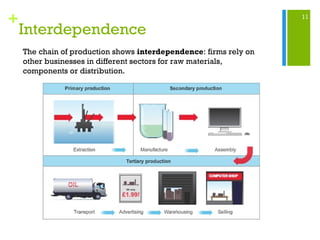
Interdependence
The chain of production shows interdependence: firms rely on
other businesses in different sectors for raw materials,
components or distribution.

11
+

Interdependence


You might think that the British School of Guangzhou which is in the
tertiary sector, has very little connection with either primary or
secondary production. Its purpose is to provide education for its
students. BSG does not:



Grow anything



Manufacture goods



However, it does depends on other people or firms who do. Firms in the
secondary sector have made the paper, the desks, the interactive white
board, the books and all the other goods we use.



Without electricity the lights and computers wouldn’t work. For this BSG
relies on mines that produce coal for electricity to be generated.



BSG is also dependent on other firms in tertiary production from the bus
company who transports students to the window cleaners.

12
+

Business in context


In unit 1 you read about Kuwait Petroleum Corporation. The Kuwait
Petroleum Corporation is one of the world’s largest oil companies
and makes petrol and diesel from crude oil.



Extracting crude oil from the earth is a primary sector activity.



The oil is then pumped through a pipeline to an oil refinery. Refining
the oil and turning it into petrol and diesel is a secondary sector
activity.



Road tankers then take the petrol and diesel to garages, which sell it
to the final customers. Road transport and garages are both services
in the tertiary sector.



Although the process of producing petrol and getting it to garages
uses business activities in all three sectors, often the oil rig, refinery,
road tankers and garages are all owned by one single company.

13
+

What determines how countries are
organised?


The mix of businesses in each sector is different in different
countries.



Primary sectors thrive in countries that are rich in raw
materials such as Zimbawe, Qatar and the United Arab
Emirates,



Other countries may have a larger labour force like China
where manufacturing (secondary) is the predominant sector



Countries like Singapore have a large tertiary sectorproviding services to other countries. This could be because
of the lack of natural resources of because of the skills and
expertise developed in certain services.

14
+

Activity 2.2 & 2.3
 See

worksheet

15
+

Summary of unit
1. Businesses owned by private individuals or groups are in
the private sector.
2. Businesses owned by the state are in the public sector.
3. All products go through many stages of production.
4. The different stages of production of a product are linked in
a ‘chain of production’.
5. Businesses may be in the primary sector, secondary sector
or tertiary sector, depending on where they are in the chain
of production.

16
+

Key terms


Chain of production – the stages of production a product
goes through from raw materials to finally being sold to the
customer



Primary sector – the sector of industry that produces
unrefined* raw materials



Secondary sector – the sector of industry that produced
finished or part-finished goods



Tertiary sector – the sector of industry that provides services
to businesses and individuals



*Unrefined – not processed/not usable

17

Business activity unit_2

  • 1.
    + Business Activity Unit 2:Classification of business
  • 2.
    + Learning outcomes  To developknowledge of the three sectors of industry  To understand how business activity is classed as primary, secondary or tertiary  To be able to identify how businesses in each sector are interdependent *  To demonstrate knowledge of why the types of business activity undertaken in a country are a key element in that country’s national economy * Interdependent - relating to two or more people or things dependent on each other 2
  • 3.
    + Classification of business  Everythingyou buy starts out as either:  A metal or mineral deposit in the earth  A growing plant  An animal living on land, in the air, or in a river, or in a sea  Changing it into a useful product and selling it can be a long and complex process that involves businesses in different industrial sectors. 3
  • 4.
    + Industrial Sectors  Businesses areclassified into three sectors depending on the type of activity they carry out:  Primary Sector –   Secondary Sector –   extraction of raw materials from the earth – mining, quarrying, fishing, agriculture, forestry, farming Processing of raw materials into finished or semi-finished products – manufacturing, refining and processing minerals, engineering, textiles, footwear, clothing, food and drink processing, construction Tertiary Sector –  Service industries – leisure, transport, finance, distribution, retailing, wholesaling, communications, insurance, education, public services, health services, tourism 4
  • 5.
    + Primary sector  Primary production:this involves acquiring raw materials. For example, metals and coal have to be mined, oil drilled from the ground, rubber tapped from trees, foodstuffs farmed and fish trawled. This is sometimes known as extractive production. 5
  • 6.
    + Secondary sector  Secondary production:this is the manufacturing and assembly process. It involves converting raw materials into components, for example, making plastics from oil. It also involves assembling the product, eg building houses, bridges and roads. 6
  • 7.
    + Tertiary sector  Tertiary production:this refers to the commercial services that support the production and distribution process, eg insurance, transport, advertising, warehousing and other services such as teaching and health care. 7
  • 8.
    + Activity 2 and2.1  See worksheet 8
  • 9.
    + Putting the threesectors together: chains of production  Making a product and supplying it to customers usually involves businesses in all three industry sectors. For example, producing a loaf of bread involves: 1. A farmer who grows wheat (primary) 2. A miller who turns the wheat into flour (secondary) 3. A baker who makes the flour into bread (secondary) 4. A baker’s shop that sells the bread to customers (tertiary) 5. Transport to get wheat from the farmer to the miller, the flour from the miller to the baker, and the bread from the baker to the bakery (tertiary) 9
  • 10.
    + Chain of production  Eachbusiness forms part of a chain production. The chain begins with the raw materials and ends with getting the finished product to the customer. 10
  • 11.
    + Interdependence The chain ofproduction shows interdependence: firms rely on other businesses in different sectors for raw materials, components or distribution. 11
  • 12.
    + Interdependence  You might thinkthat the British School of Guangzhou which is in the tertiary sector, has very little connection with either primary or secondary production. Its purpose is to provide education for its students. BSG does not:  Grow anything  Manufacture goods  However, it does depends on other people or firms who do. Firms in the secondary sector have made the paper, the desks, the interactive white board, the books and all the other goods we use.  Without electricity the lights and computers wouldn’t work. For this BSG relies on mines that produce coal for electricity to be generated.  BSG is also dependent on other firms in tertiary production from the bus company who transports students to the window cleaners. 12
  • 13.
    + Business in context  Inunit 1 you read about Kuwait Petroleum Corporation. The Kuwait Petroleum Corporation is one of the world’s largest oil companies and makes petrol and diesel from crude oil.  Extracting crude oil from the earth is a primary sector activity.  The oil is then pumped through a pipeline to an oil refinery. Refining the oil and turning it into petrol and diesel is a secondary sector activity.  Road tankers then take the petrol and diesel to garages, which sell it to the final customers. Road transport and garages are both services in the tertiary sector.  Although the process of producing petrol and getting it to garages uses business activities in all three sectors, often the oil rig, refinery, road tankers and garages are all owned by one single company. 13
  • 14.
    + What determines howcountries are organised?  The mix of businesses in each sector is different in different countries.  Primary sectors thrive in countries that are rich in raw materials such as Zimbawe, Qatar and the United Arab Emirates,  Other countries may have a larger labour force like China where manufacturing (secondary) is the predominant sector  Countries like Singapore have a large tertiary sectorproviding services to other countries. This could be because of the lack of natural resources of because of the skills and expertise developed in certain services. 14
  • 15.
    + Activity 2.2 &2.3  See worksheet 15
  • 16.
    + Summary of unit 1.Businesses owned by private individuals or groups are in the private sector. 2. Businesses owned by the state are in the public sector. 3. All products go through many stages of production. 4. The different stages of production of a product are linked in a ‘chain of production’. 5. Businesses may be in the primary sector, secondary sector or tertiary sector, depending on where they are in the chain of production. 16
  • 17.
    + Key terms  Chain ofproduction – the stages of production a product goes through from raw materials to finally being sold to the customer  Primary sector – the sector of industry that produces unrefined* raw materials  Secondary sector – the sector of industry that produced finished or part-finished goods  Tertiary sector – the sector of industry that provides services to businesses and individuals  *Unrefined – not processed/not usable 17