Industry Revision
Definition The work people do for a living (profit) is called  industry .
Classification of industry (1) Primary Industry  – extractive industries which produce raw materials such as farming, mining and fishing.
Classification of industry (2) Secondary Industry  –  manufacturing industries  (where raw materials are processed into finished products such as steel making and brewing). Assembling industries  (where components are put together such as car and computer assembly). Power producing industries  such as where fuel from oil and coal is used to generate electricity.
Classification of industry (3) Tertiary Industry  – service industries which involve no finished product. But provide personal services to the community, such as teaching and the police force.
Classification of industry (4) Quaternary Industry  – Information and office based industries such as finance, insurance, computer software and internet services.
Industrial Location (1) Primary Industries Found at the source of the raw material, for example, where there are minerals to be mined, fish to be caught or land to be farmed.
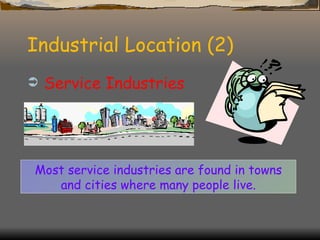
Industrial Location (2) Service Industries Most service industries are found in towns and cities where many people live.
Industrial Location (3) Quaternary Industries Most quaternary industries are found in towns and cities where many people live. But some quaternary industries can be located wherever there is a computer modem.
Location of the manufacturing industry (1) Deciding on the location of the manufacturing industry is more difficult. Many important fact, called  factors , must be taken into account
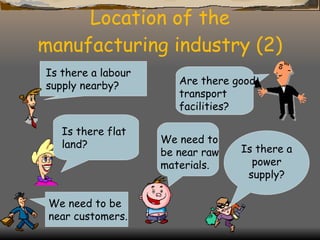
Location of the manufacturing industry (2) Is there a labour supply nearby? Is there flat land? Is there a power supply? Are there good transport facilities? We need to be near raw materials. We need to be near customers.
Heavy Industry The heavy industry is a manufacturing industry that uses heavy or bulky raw materials to make heavy or bulky goods. Can you think of any?
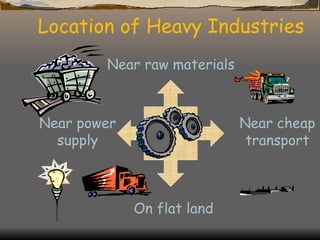
Location of Heavy Industries Near raw materials Near power supply Near cheap transport On flat land
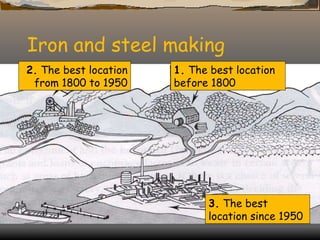
Iron and steel making 1.  The best location before 1800 2.  The best location from 1800 to 1950 3.  The best location since 1950
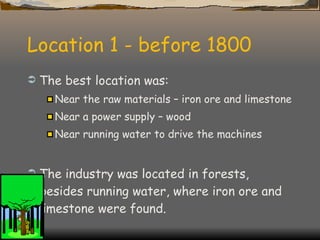
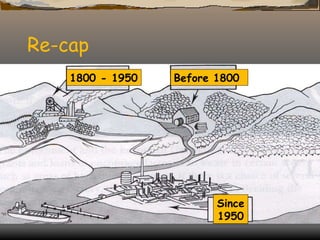
Location 1 - before 1800 The best location was: Near the raw materials – iron ore and limestone Near a power supply – wood Near running water to drive the machines The industry was located in forests, besides running water, where iron ore and limestone were found.
Location 2 – after 1800 Coal replaced wood as the fule to heat the iron and drive the machines. There was cheap transport now in the form of canals and railways, So the industry was sited on or near coalfields, and located beside canals and railways.
Location 3 – after 1950 Iron ore had to be imported from abroad, and steelworks had become very large. They were sited on very large areas of flat land located near coastal ports.
Re-cap  1800 - 1950 Before 1800 Since 1950
Definition A  Light industry  is a manufacturing industry that uses light, raw materials in small amount to produce light or small goods. Eg:  watches or television sets.
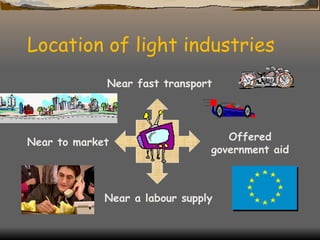
Location of light industries Near fast transport Near to market Near a labour supply Offered government aid
Industrial estates Many light industries are located on  industrial estates  or  business parks . These are planned areas in towns and cities where only factories and offices can be built.
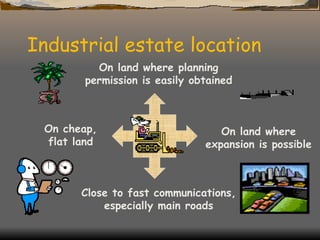
Industrial estate location Close to fast communications, especially main roads On cheap, flat land On land where expansion is possible On land where planning permission is easily obtained
Assisted areas A assisted areas are areas helped by the government to improve unemployment and attract industry. How do you think the government could do this?
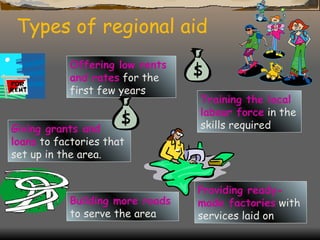
Types of regional aid Giving grants and loans  to factories that set up in the area. Building more roads  to serve the area Training the local labour force  in the skills required Offering low rents and rates  for the first few years Providing ready-made factories  with services laid on
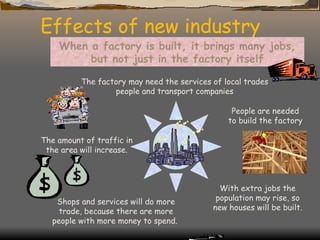
Effects of new industry When a factory is built, it brings many jobs, but not just in the factory itself People are needed to build the factory The factory may need the services of local trades people and transport companies With extra jobs the population may rise, so new houses will be built. Shops and services will do more trade, because there are more people with more money to spend.  The amount of traffic in the area will increase.
Effects of factories closing When any company closes down, people become unemployed. But is a large factory that employs most of the people in the area shuts the effects on the community can be very severe.
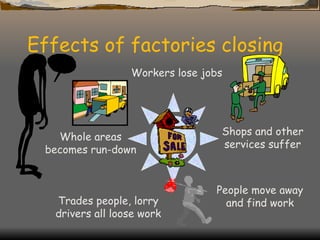
Effects of factories closing Workers lose jobs Trades people, lorry drivers all loose work People move away and find work Shops and other services suffer Whole areas becomes run-down
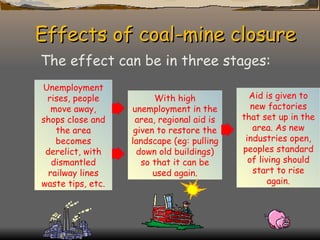
Effects of coal-mine closure The effect can be in three stages: Unemployment rises, people move away, shops close and the area becomes derelict, with dismantled railway lines waste tips, etc. With high unemployment in the area, regional aid is given to restore the landscape (eg: pulling down old buildings) so that it can be used again. Aid is given to new factories that set up in the area. As new industries open, peoples standard of living should start to rise again.

Industry

  • 1.
  • 2.
    Definition The workpeople do for a living (profit) is called industry .
  • 3.
    Classification of industry(1) Primary Industry – extractive industries which produce raw materials such as farming, mining and fishing.
  • 4.
    Classification of industry(2) Secondary Industry – manufacturing industries (where raw materials are processed into finished products such as steel making and brewing). Assembling industries (where components are put together such as car and computer assembly). Power producing industries such as where fuel from oil and coal is used to generate electricity.
  • 5.
    Classification of industry(3) Tertiary Industry – service industries which involve no finished product. But provide personal services to the community, such as teaching and the police force.
  • 6.
    Classification of industry(4) Quaternary Industry – Information and office based industries such as finance, insurance, computer software and internet services.
  • 7.
    Industrial Location (1)Primary Industries Found at the source of the raw material, for example, where there are minerals to be mined, fish to be caught or land to be farmed.
  • 8.
    Industrial Location (2)Service Industries Most service industries are found in towns and cities where many people live.
  • 9.
    Industrial Location (3)Quaternary Industries Most quaternary industries are found in towns and cities where many people live. But some quaternary industries can be located wherever there is a computer modem.
  • 10.
    Location of themanufacturing industry (1) Deciding on the location of the manufacturing industry is more difficult. Many important fact, called factors , must be taken into account
  • 11.
    Location of themanufacturing industry (2) Is there a labour supply nearby? Is there flat land? Is there a power supply? Are there good transport facilities? We need to be near raw materials. We need to be near customers.
  • 12.
    Heavy Industry Theheavy industry is a manufacturing industry that uses heavy or bulky raw materials to make heavy or bulky goods. Can you think of any?
  • 13.
    Location of HeavyIndustries Near raw materials Near power supply Near cheap transport On flat land
  • 14.
    Iron and steelmaking 1. The best location before 1800 2. The best location from 1800 to 1950 3. The best location since 1950
  • 15.
    Location 1 -before 1800 The best location was: Near the raw materials – iron ore and limestone Near a power supply – wood Near running water to drive the machines The industry was located in forests, besides running water, where iron ore and limestone were found.
  • 16.
    Location 2 –after 1800 Coal replaced wood as the fule to heat the iron and drive the machines. There was cheap transport now in the form of canals and railways, So the industry was sited on or near coalfields, and located beside canals and railways.
  • 17.
    Location 3 –after 1950 Iron ore had to be imported from abroad, and steelworks had become very large. They were sited on very large areas of flat land located near coastal ports.
  • 18.
    Re-cap 1800- 1950 Before 1800 Since 1950
  • 19.
    Definition A Light industry is a manufacturing industry that uses light, raw materials in small amount to produce light or small goods. Eg: watches or television sets.
  • 20.
    Location of lightindustries Near fast transport Near to market Near a labour supply Offered government aid
  • 21.
    Industrial estates Manylight industries are located on industrial estates or business parks . These are planned areas in towns and cities where only factories and offices can be built.
  • 22.
    Industrial estate locationClose to fast communications, especially main roads On cheap, flat land On land where expansion is possible On land where planning permission is easily obtained
  • 23.
    Assisted areas Aassisted areas are areas helped by the government to improve unemployment and attract industry. How do you think the government could do this?
  • 24.
    Types of regionalaid Giving grants and loans to factories that set up in the area. Building more roads to serve the area Training the local labour force in the skills required Offering low rents and rates for the first few years Providing ready-made factories with services laid on
  • 25.
    Effects of newindustry When a factory is built, it brings many jobs, but not just in the factory itself People are needed to build the factory The factory may need the services of local trades people and transport companies With extra jobs the population may rise, so new houses will be built. Shops and services will do more trade, because there are more people with more money to spend. The amount of traffic in the area will increase.
  • 26.
    Effects of factoriesclosing When any company closes down, people become unemployed. But is a large factory that employs most of the people in the area shuts the effects on the community can be very severe.
  • 27.
    Effects of factoriesclosing Workers lose jobs Trades people, lorry drivers all loose work People move away and find work Shops and other services suffer Whole areas becomes run-down
  • 28.
    Effects of coal-mineclosure The effect can be in three stages: Unemployment rises, people move away, shops close and the area becomes derelict, with dismantled railway lines waste tips, etc. With high unemployment in the area, regional aid is given to restore the landscape (eg: pulling down old buildings) so that it can be used again. Aid is given to new factories that set up in the area. As new industries open, peoples standard of living should start to rise again.