Classification of Business Activity
• All businesses whether they are product based
or service based are categorised into sectors
consisting of Primary, Secondary or Tertiary
• Business sources goods or a service (Primary),
prepare goods or a service (Secondary) , or
sells goods or services (Tertiary).
Primary Sector
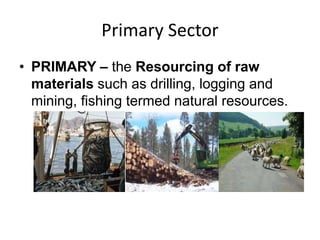
• PRIMARY – the Resourcing of raw
materials such as drilling, logging and
mining, fishing termed natural resources.
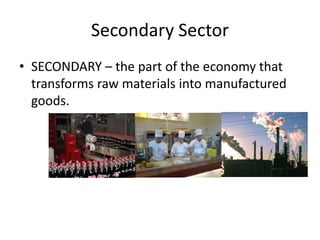
Secondary Sector
• SECONDARY – the part of the economy that
transforms raw materials into manufactured
goods.
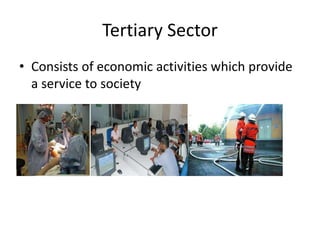
Tertiary Sector
• Consists of economic activities which provide
a service to society
Importance of Sectors
• In many african countries, the primary sector is
more dominant than the secondary and tertiary
sectors. This is because africa has many natural
resources and few countries are developed
• In the u.k, there has been a decline in the primary
and secondary sectors and an increase in the
tertiary sector. Many of their raw materials are
now imported and many manufacturing
companies have relocated overseas due to
cheaper costs.
• The growth in the tertiary sector has occurred for a
number of reasons:
• Increases in disposable income
• Many tertiary businesses in the developing world sell
their services abroad as well as at home.
• The tertiary sector has less scope for automation than
the primary and secondary sectors, so workers cannot
be as easily replaced by machines.
• Increased manufacturing processes in the primary and
secondary have given the population more leisure
time.
Mixed Economy- Private and Public
Sector
• Private Sector – These are businesses which
are not owned by the government but by
individuals
• They will make decisions about what they
produce, how to go about producing it and
what price they will charge for the goods.
• aim to run at a profit, but there are likely to
some form of government control in place to
restrict business practices.
Public Sector
• Public Sector – these are government or state
owned businesses
• the government makes decisions about what
to produce and how much to charge
customers.
• Some are provided free of charge such as
health and education. The money for these
comes from the public and the taxpayer.
• Public Sector – In many countries the
government control the following important
industries or activities:
•Health
•Education
•Defence
•Public Transport
•Water and Electric Supplies
• Mixed Economy changes – In recent years, many
Governments have changed the boundary between
Public and Private by selling some Public Sector
businesses to the Private sector.
• This is called Privatisation
• This is because the Private Sector businesses are more
cost effective at running these services due to their
profit objective
• The downside is that Private Sectors can cut the
number of workers to be more profitable and are less
likely to focus on social obligations like the
environment or safety laws.

Classification of business activity

  • 1.
  • 2.
    • All businesseswhether they are product based or service based are categorised into sectors consisting of Primary, Secondary or Tertiary • Business sources goods or a service (Primary), prepare goods or a service (Secondary) , or sells goods or services (Tertiary).
  • 3.
    Primary Sector • PRIMARY– the Resourcing of raw materials such as drilling, logging and mining, fishing termed natural resources.
  • 4.
    Secondary Sector • SECONDARY– the part of the economy that transforms raw materials into manufactured goods.
  • 5.
    Tertiary Sector • Consistsof economic activities which provide a service to society
  • 6.
    Importance of Sectors •In many african countries, the primary sector is more dominant than the secondary and tertiary sectors. This is because africa has many natural resources and few countries are developed • In the u.k, there has been a decline in the primary and secondary sectors and an increase in the tertiary sector. Many of their raw materials are now imported and many manufacturing companies have relocated overseas due to cheaper costs.
  • 7.
    • The growthin the tertiary sector has occurred for a number of reasons: • Increases in disposable income • Many tertiary businesses in the developing world sell their services abroad as well as at home. • The tertiary sector has less scope for automation than the primary and secondary sectors, so workers cannot be as easily replaced by machines. • Increased manufacturing processes in the primary and secondary have given the population more leisure time.
  • 8.
    Mixed Economy- Privateand Public Sector • Private Sector – These are businesses which are not owned by the government but by individuals • They will make decisions about what they produce, how to go about producing it and what price they will charge for the goods. • aim to run at a profit, but there are likely to some form of government control in place to restrict business practices.
  • 9.
    Public Sector • PublicSector – these are government or state owned businesses • the government makes decisions about what to produce and how much to charge customers. • Some are provided free of charge such as health and education. The money for these comes from the public and the taxpayer.
  • 10.
    • Public Sector– In many countries the government control the following important industries or activities: •Health •Education •Defence •Public Transport •Water and Electric Supplies
  • 11.
    • Mixed Economychanges – In recent years, many Governments have changed the boundary between Public and Private by selling some Public Sector businesses to the Private sector. • This is called Privatisation • This is because the Private Sector businesses are more cost effective at running these services due to their profit objective • The downside is that Private Sectors can cut the number of workers to be more profitable and are less likely to focus on social obligations like the environment or safety laws.