EFFICIENCY
Business Studies
Introduction
 Efficiency, Productivity and competitiveness
are linked. Better productivity means
increased efficiency which results in a higher
level of competitiveness.
Efficiency is about making the best possible use of
resources. Efficient firms maximise outputs from given
inputs, and so minimise their costs. By improving efficiency,
a business can reduce its costs and improve its
competitiveness.
 There is a difference between production and productivity.

Production is the total amount made by a business in a
given time period. Productivity measures how much each
employee makes over a period of time. It is calculated by
dividing total output by the number of workers. If a factory
employing 50 staff produces 1000 tables a day, than the
productivity of each worker is:
 1,000 tables/50 staff = 20 tables

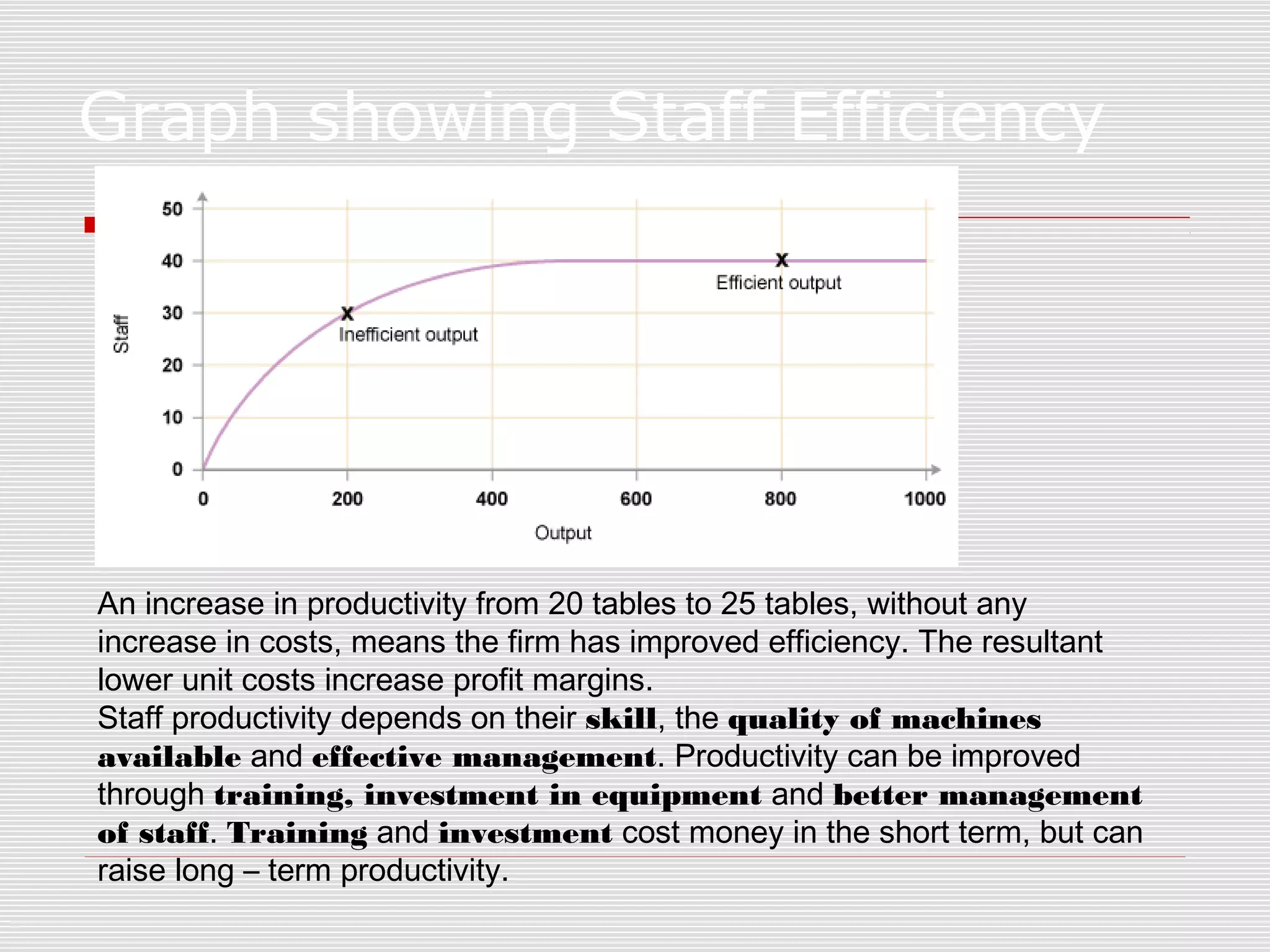
Graph showing Staff Efficiency

An increase in productivity from 20 tables to 25 tables, without any
increase in costs, means the firm has improved efficiency. The resultant
lower unit costs increase profit margins.
Staff productivity depends on their skill, the quality of machines
available and effective management. Productivity can be improved
through training, investment in equipment and better management
of staff. Training and investment cost money in the short term, but can
raise long – term productivity.
Other methods of Cutting Costs
•
•
•
•
•
•

As well as improving productivity, a business can cut
costs by:
Reducing overheads such as administration, e.g.
making some support staff redundant. Customer service
may suffer as a result of this.
Relocation to countries where staff with appropriate
skills can be hired at lower wages.
Improving management so staff are motivated to
work harder, or are better used.
Redesigning the product so an item is easier and
cheaper to make.
Lean Production is set of measures that aim to reduce
waist during production. Waste reduction methods, such
as just in time of ordering the stock, will increase
efficiency.
Ways to measure employee
performance efficiency
Labour Productivity, Labour Turnover, Absenteeism and
Health and Safety
At the end of todays lesson you will be able to:
• Measure Employee Performance/Productivity
• Calculate and measure absenteeism
• Calculate and describe Labour Turnover
• Describe Health and Safety Measure and analyse time
lost through accidents at work.
• Managers need to assess the impact of any changes
they may make.
• It is no good implementing workforce planning,
rewards systems, appraisals etc if the impact of these
changes cannot be measured.
• There are many ways in which employee
performance can be assessed/measured. These are
called ‘Key Performance Indicators’.
Key Performance Indicators
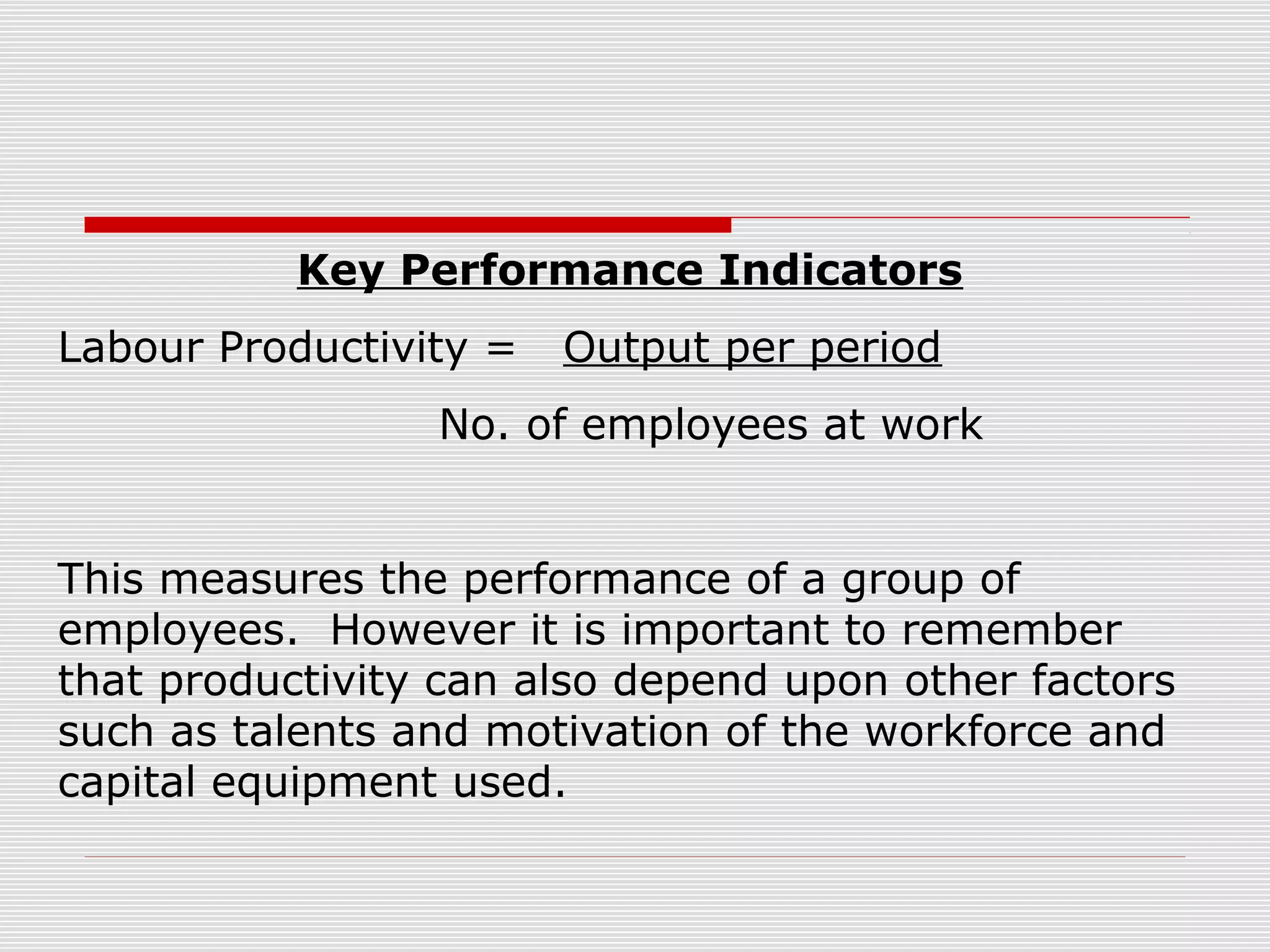
Labour Productivity =

Output per period

No. of employees at work
This measures the performance of a group of
employees. However it is important to remember
that productivity can also depend upon other factors
such as talents and motivation of the workforce and
capital equipment used.
Key Performance Indicators

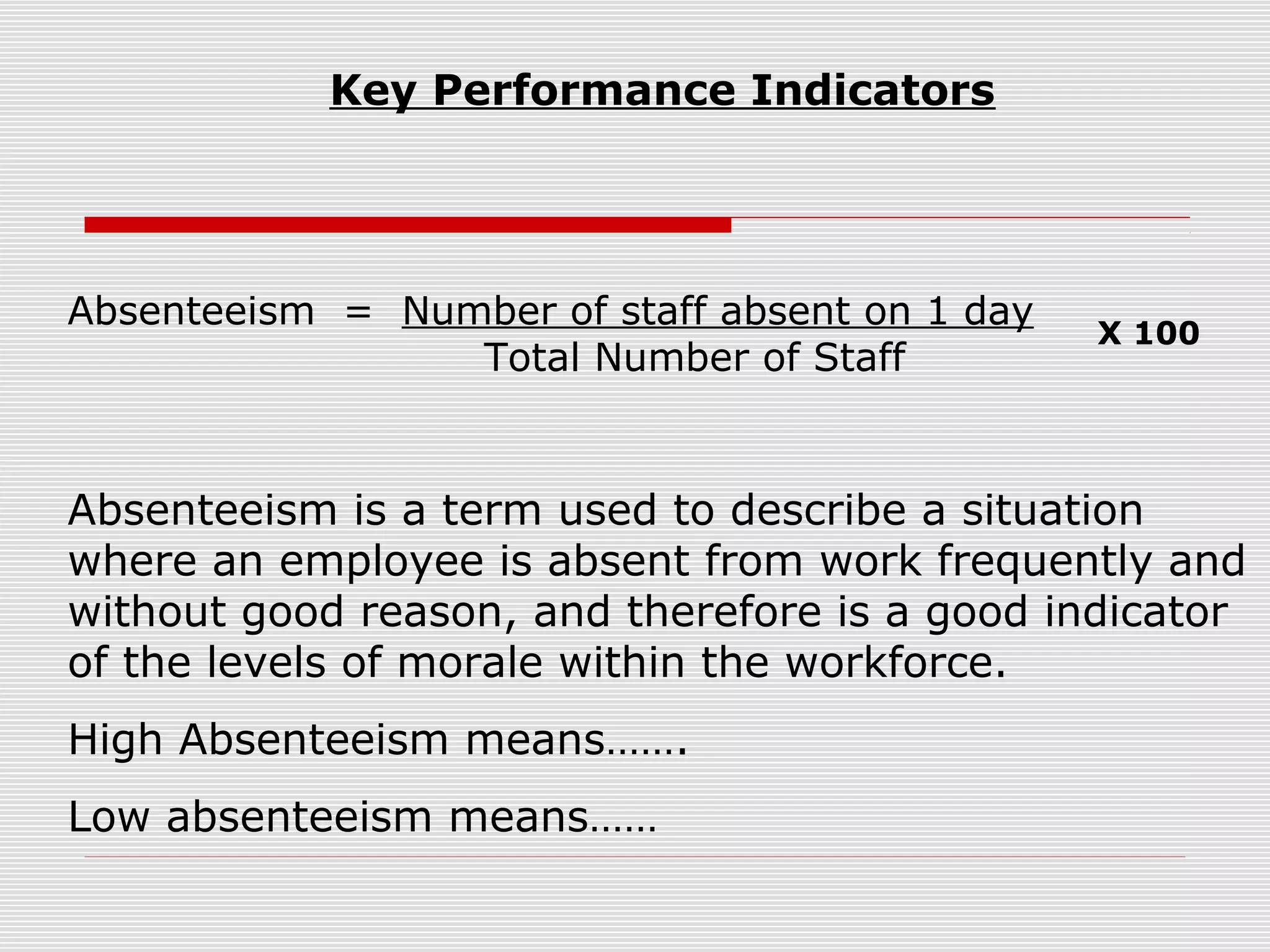
Absenteeism = Number of staff absent on 1 day
Total Number of Staff

X 100

Absenteeism is a term used to describe a situation
where an employee is absent from work frequently and
without good reason, and therefore is a good indicator
of the levels of morale within the workforce.
High Absenteeism means…….
Low absenteeism means……
Key Performance Indicators

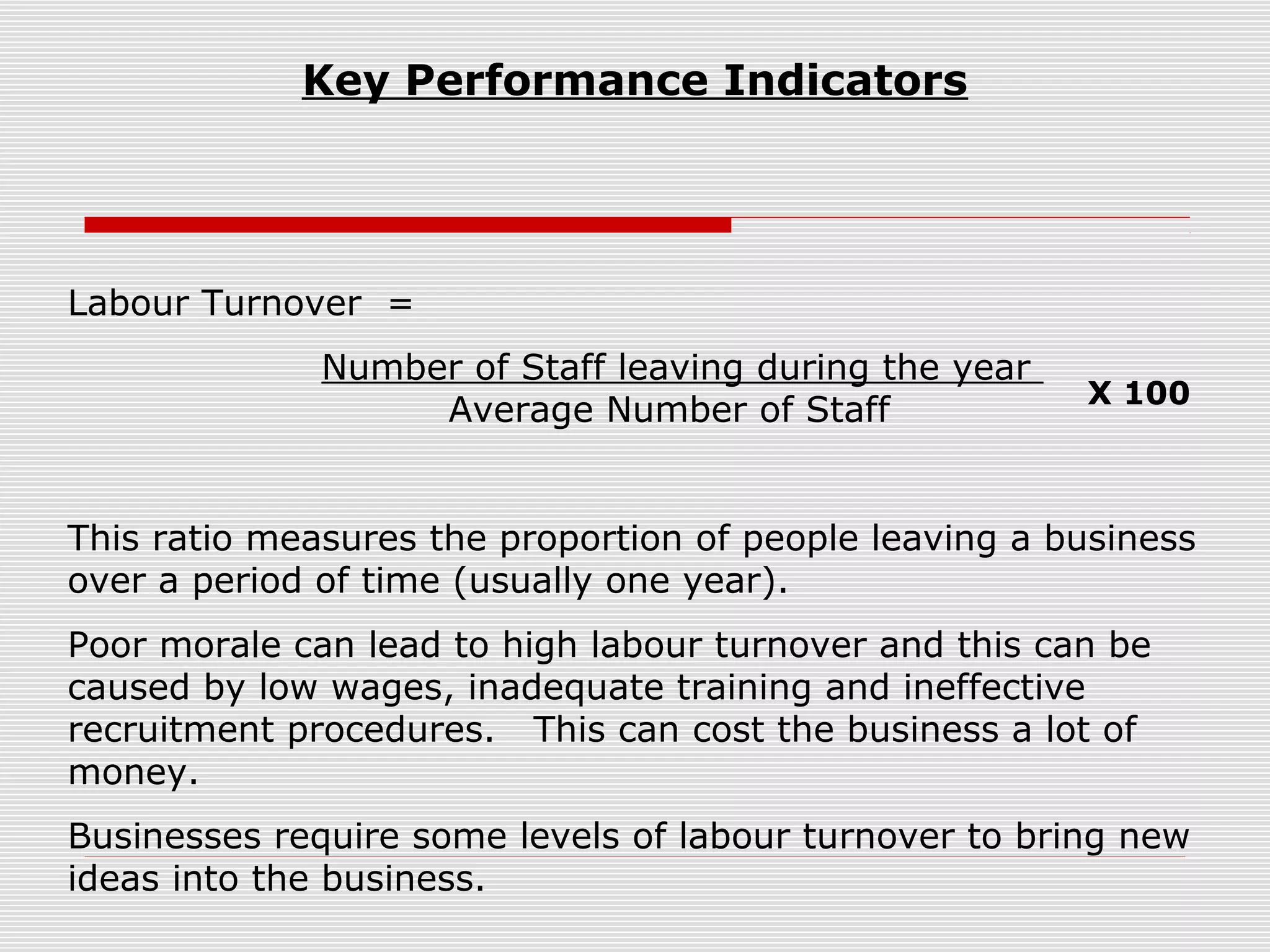
Labour Turnover =
Number of Staff leaving during the year
Average Number of Staff

X 100

This ratio measures the proportion of people leaving a business
over a period of time (usually one year).
Poor morale can lead to high labour turnover and this can be
caused by low wages, inadequate training and ineffective
recruitment procedures. This can cost the business a lot of
money.
Businesses require some levels of labour turnover to bring new
ideas into the business.
Operations Management
26th March 2010
Learning Objectives
 To identify and define the key terminology
required for the topic
 To describe the purpose of operations
managements within business
 To explain the utilisation of capacity
 To differentiate between economies and
diseconomies of scale
 To assess the 4 methods of production
 To explain the purpose of lean production
and the impact on effectiveness
Operations Management

The purpose of operations
management is to ensure
that the business provides
the right goods, at the right
time, at the right cost and of
the right quality. Thus
improving competitiveness.
Capacity






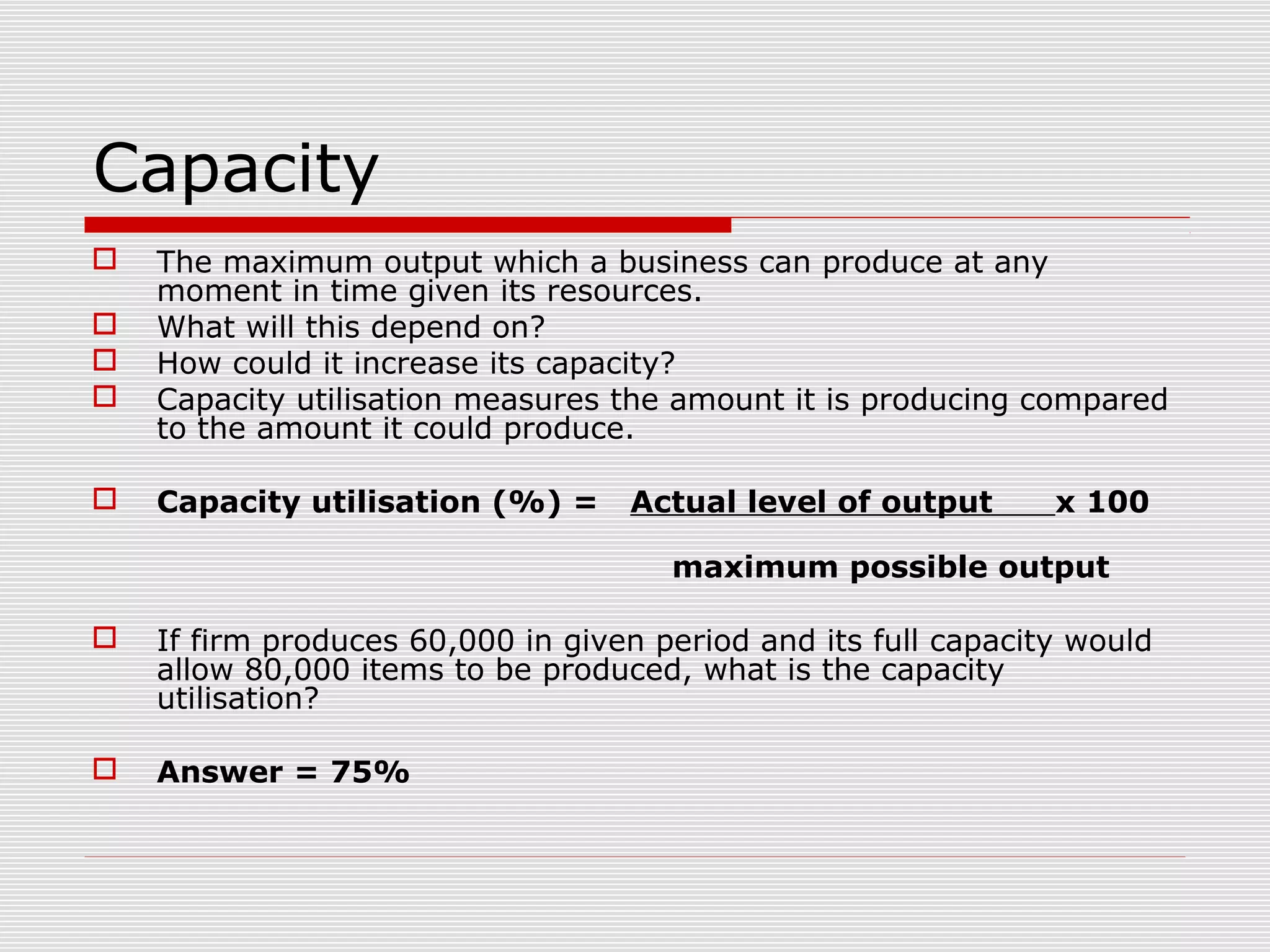
The maximum output which a business can produce at any
moment in time given its resources.
What will this depend on?
How could it increase its capacity?
Capacity utilisation measures the amount it is producing compared
to the amount it could produce.
Capacity utilisation (%) =

Actual level of output

x 100

maximum possible output


If firm produces 60,000 in given period and its full capacity would
allow 80,000 items to be produced, what is the capacity
utilisation?



Answer = 75%
Capacity….
 why might firms have to produce less
than the maximum capacity level?
 How could a firm increase its
capacity?
 What problems could be encountered
if over producing?
Economies of Scale
 EoS occur when the cost of producing a
unit falls as output increases.
 DoS occur when a business increases its
output and the cost per unit increases too.
 Why might diseconomies of scale occur?
 What is the difference between internal and
external economies of scale?
Production
When talking about production, it can
be labour intensive or capital intensive.
Refer back to your match it cards and
decide whether the following would be
LI or CI:
 Wedding dress maker
 Oil refinery
 Hotel
 Factory making crisps
Activity - Methods of Production
 Job
 Batch
 Flow

–
–
–

Ramy, Tamara, johny
Abdulwahab, Khadija
Sarah, Mariyah, Khalid

Activity
Each pair must create a revision sheet for a specific
method, explaining what it is and the advantages and
disadvantages associated with using the particular
Method.
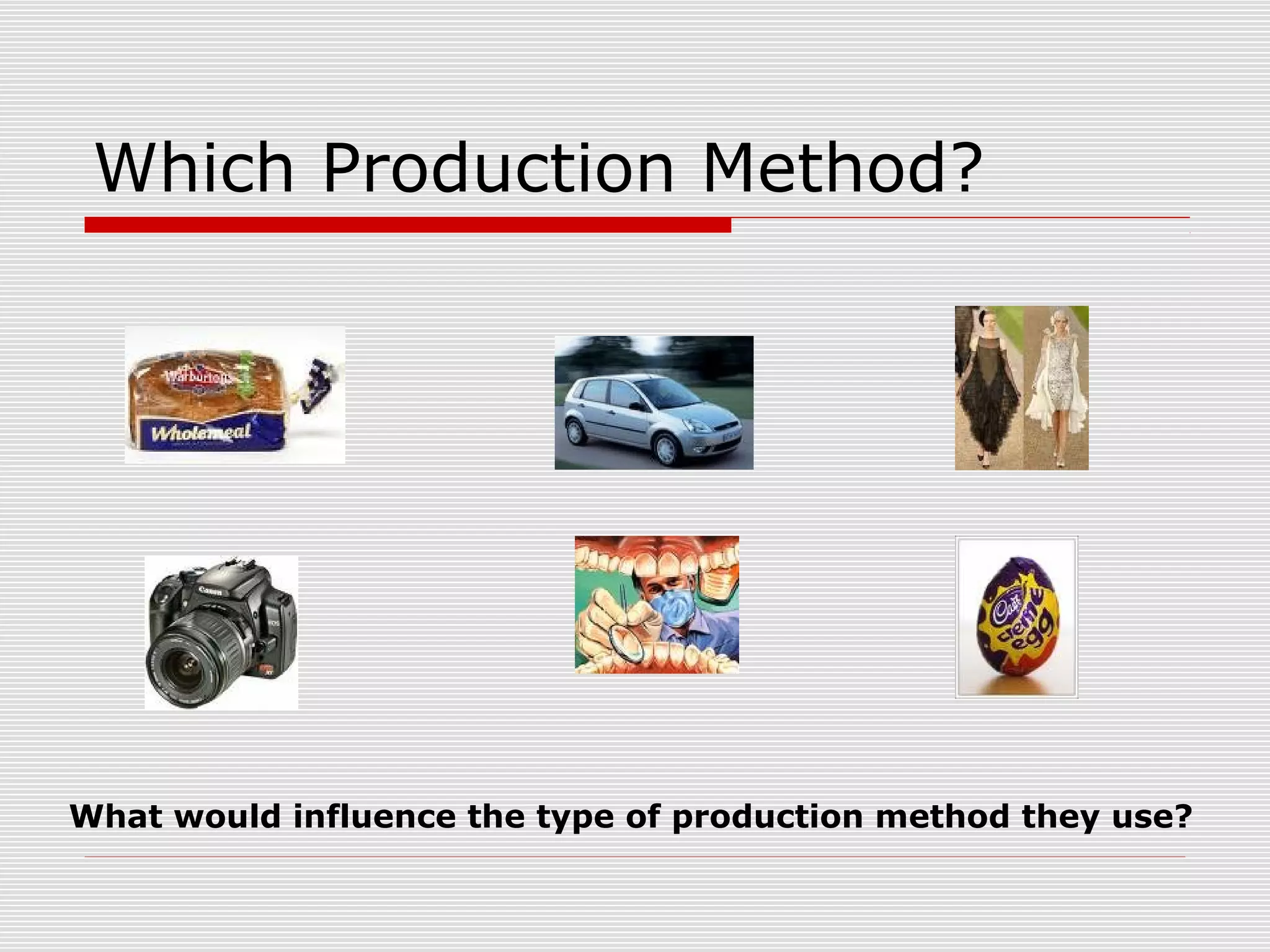
Which Production Method?

What would influence the type of production method they use?
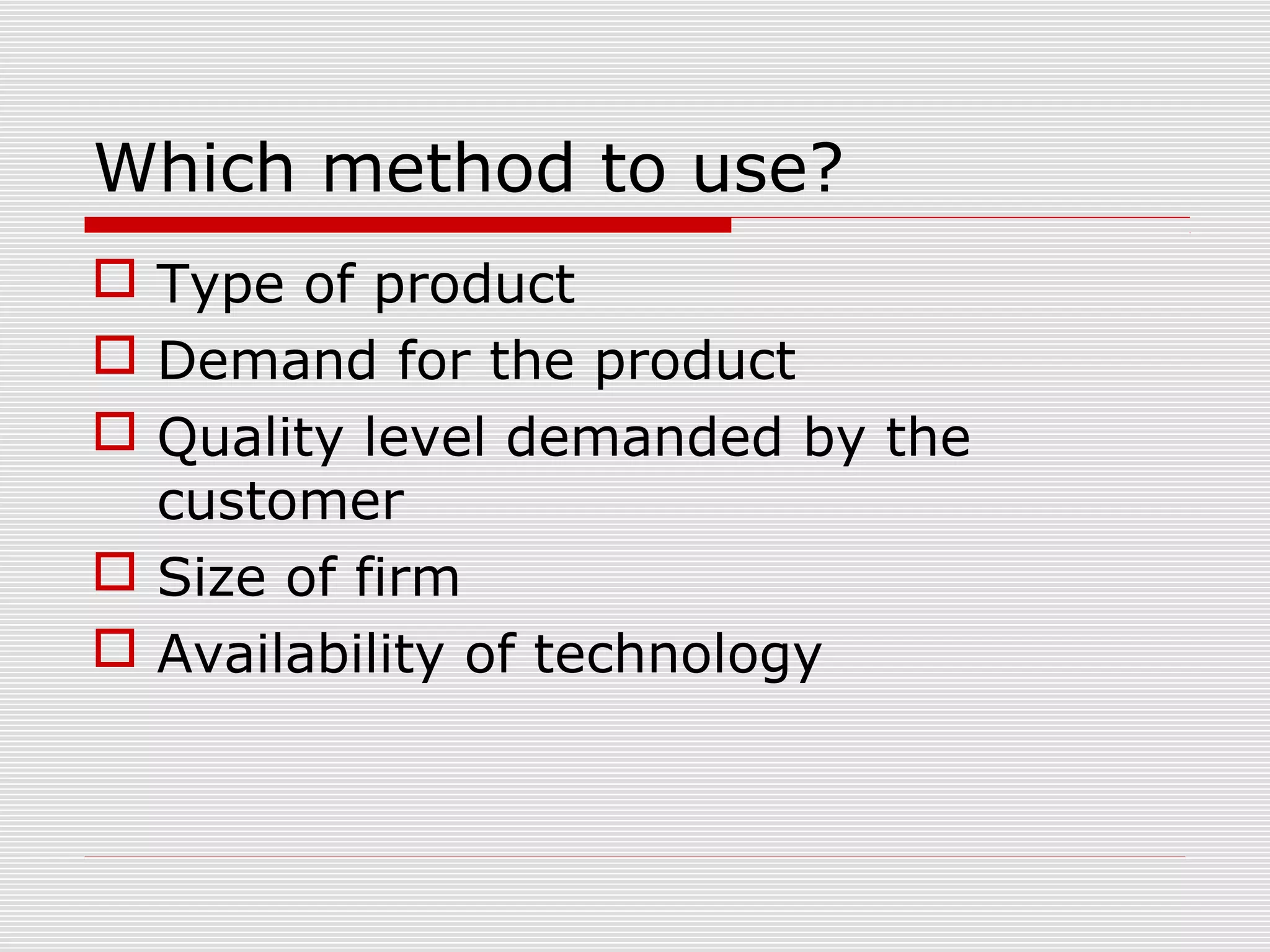
Which method to use?
 Type of product
 Demand for the product
 Quality level demanded by the
customer
 Size of firm
 Availability of technology
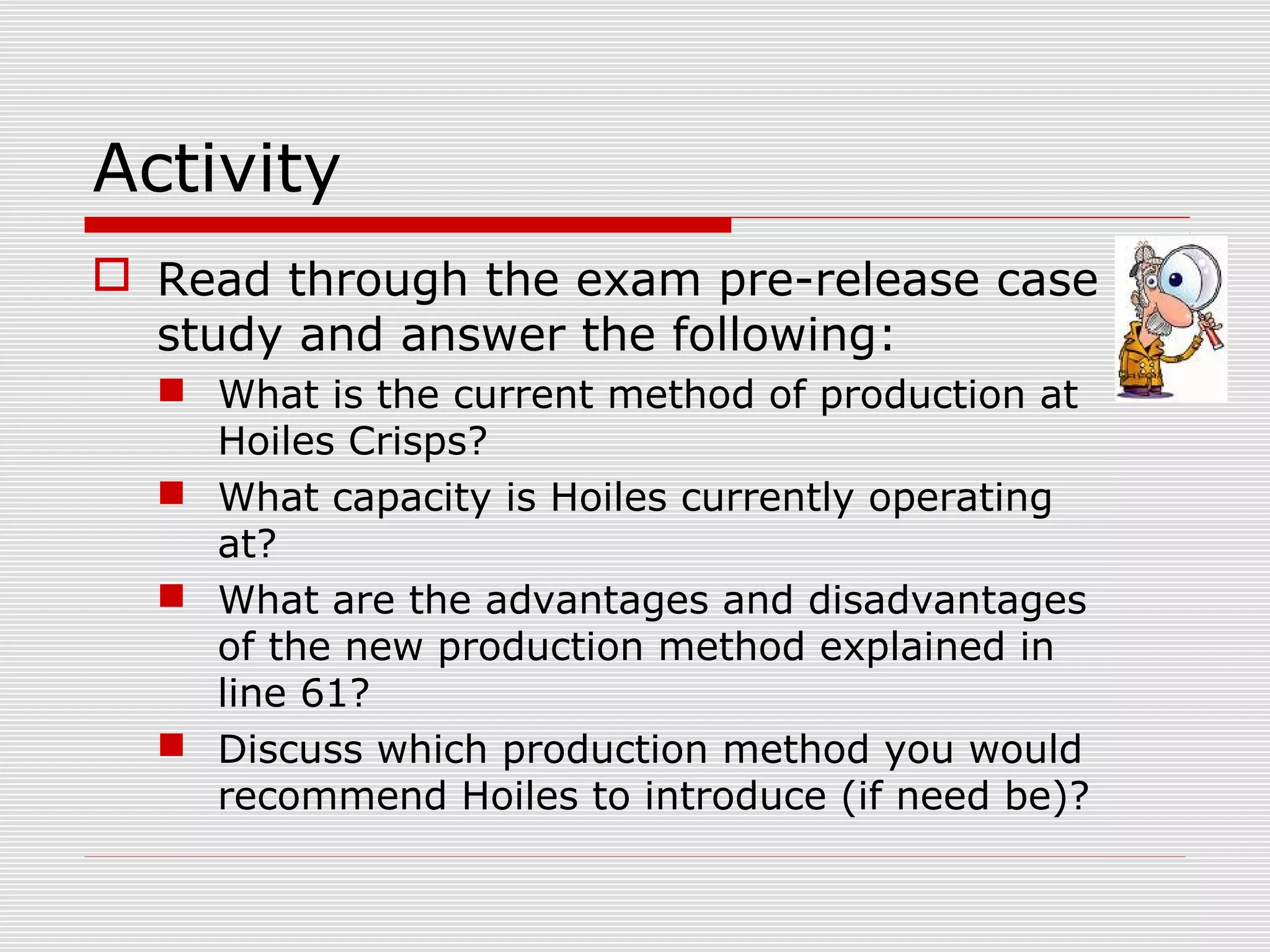
Activity
 Read through the exam pre-release case
study and answer the following:
 What is the current method of production at
Hoiles Crisps?
 What capacity is Hoiles currently operating
at?
 What are the advantages and disadvantages
of the new production method explained in
line 61?
 Discuss which production method you would
recommend Hoiles to introduce (if need be)?
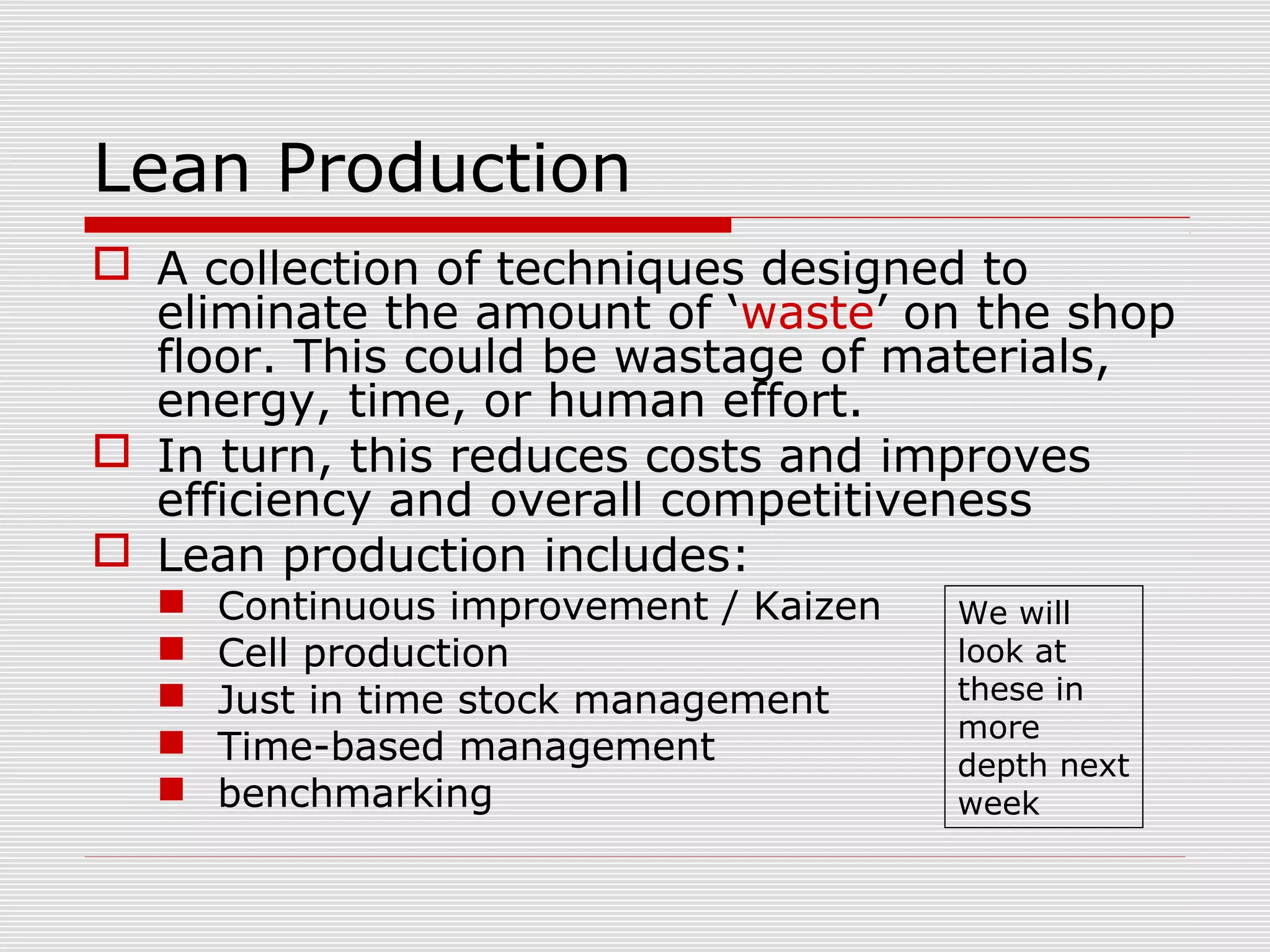
Lean Production
 A collection of techniques designed to
eliminate the amount of ‘waste’ on the shop
floor. This could be wastage of materials,
energy, time, or human effort.
 In turn, this reduces costs and improves
efficiency and overall competitiveness
 Lean production includes:






Continuous improvement / Kaizen
Cell production
Just in time stock management
Time-based management
benchmarking

We will
look at
these in
more
depth next
week
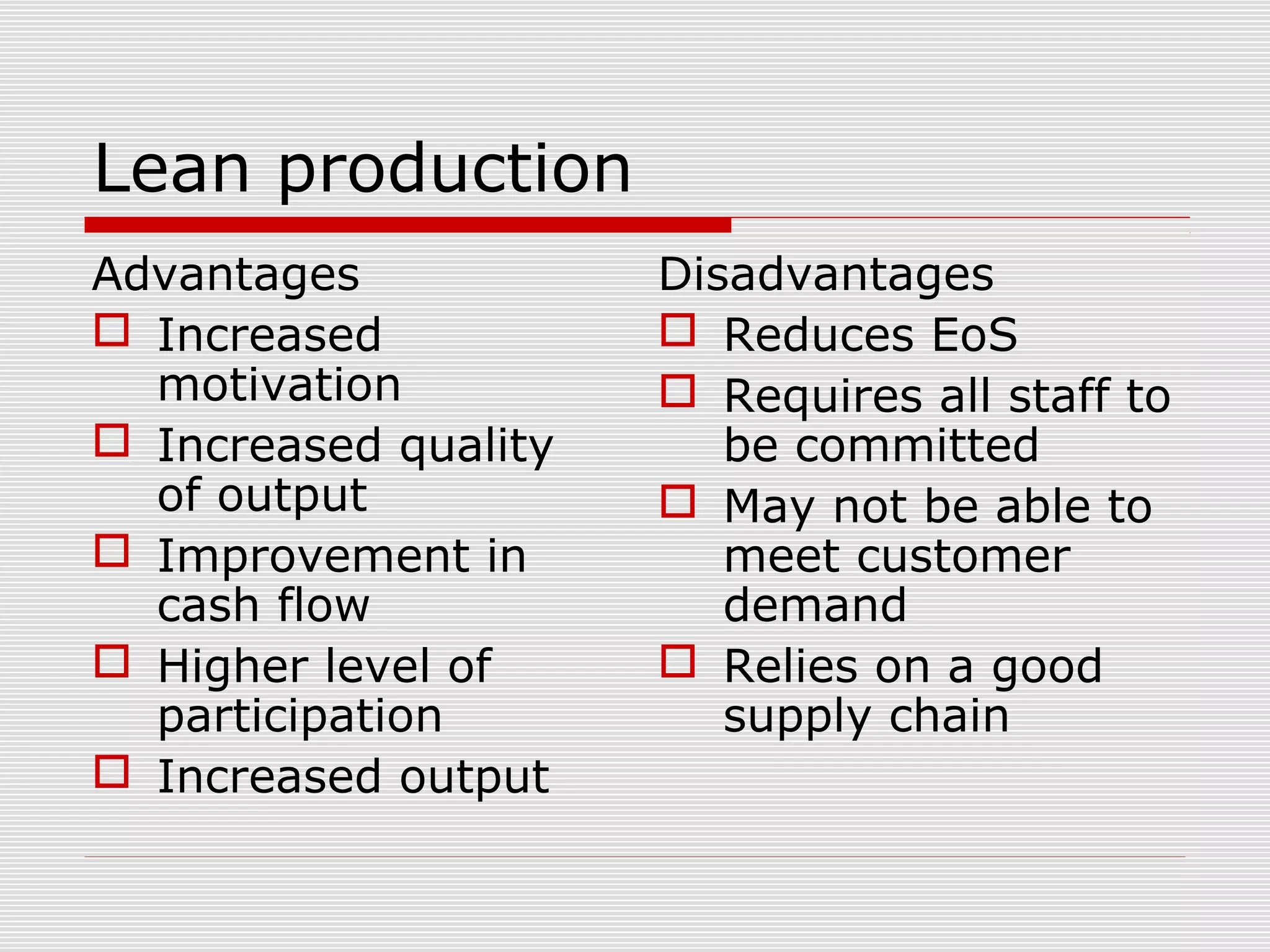
Lean production
Advantages
 Increased
motivation
 Increased quality
of output
 Improvement in
cash flow
 Higher level of
participation
 Increased output

Disadvantages
 Reduces EoS
 Requires all staff to
be committed
 May not be able to
meet customer
demand
 Relies on a good
supply chain
Activity
 Complete the Kodak case study
on page 273 of textbook.
Plenary

 Pictionary for keywords learnt today
 http://www.tutor2u.net/business/quizzes/

Operations management1

  • 1.
  • 2.
    Introduction  Efficiency, Productivityand competitiveness are linked. Better productivity means increased efficiency which results in a higher level of competitiveness.
  • 3.
    Efficiency is aboutmaking the best possible use of resources. Efficient firms maximise outputs from given inputs, and so minimise their costs. By improving efficiency, a business can reduce its costs and improve its competitiveness.  There is a difference between production and productivity. Production is the total amount made by a business in a given time period. Productivity measures how much each employee makes over a period of time. It is calculated by dividing total output by the number of workers. If a factory employing 50 staff produces 1000 tables a day, than the productivity of each worker is:  1,000 tables/50 staff = 20 tables 
  • 4.
    Graph showing StaffEfficiency An increase in productivity from 20 tables to 25 tables, without any increase in costs, means the firm has improved efficiency. The resultant lower unit costs increase profit margins. Staff productivity depends on their skill, the quality of machines available and effective management. Productivity can be improved through training, investment in equipment and better management of staff. Training and investment cost money in the short term, but can raise long – term productivity.
  • 5.
    Other methods ofCutting Costs • • • • • • As well as improving productivity, a business can cut costs by: Reducing overheads such as administration, e.g. making some support staff redundant. Customer service may suffer as a result of this. Relocation to countries where staff with appropriate skills can be hired at lower wages. Improving management so staff are motivated to work harder, or are better used. Redesigning the product so an item is easier and cheaper to make. Lean Production is set of measures that aim to reduce waist during production. Waste reduction methods, such as just in time of ordering the stock, will increase efficiency.
  • 6.
    Ways to measureemployee performance efficiency
  • 7.
    Labour Productivity, LabourTurnover, Absenteeism and Health and Safety At the end of todays lesson you will be able to: • Measure Employee Performance/Productivity • Calculate and measure absenteeism • Calculate and describe Labour Turnover • Describe Health and Safety Measure and analyse time lost through accidents at work.
  • 8.
    • Managers needto assess the impact of any changes they may make. • It is no good implementing workforce planning, rewards systems, appraisals etc if the impact of these changes cannot be measured. • There are many ways in which employee performance can be assessed/measured. These are called ‘Key Performance Indicators’.
  • 9.
    Key Performance Indicators LabourProductivity = Output per period No. of employees at work This measures the performance of a group of employees. However it is important to remember that productivity can also depend upon other factors such as talents and motivation of the workforce and capital equipment used.
  • 10.
    Key Performance Indicators Absenteeism= Number of staff absent on 1 day Total Number of Staff X 100 Absenteeism is a term used to describe a situation where an employee is absent from work frequently and without good reason, and therefore is a good indicator of the levels of morale within the workforce. High Absenteeism means……. Low absenteeism means……
  • 11.
    Key Performance Indicators LabourTurnover = Number of Staff leaving during the year Average Number of Staff X 100 This ratio measures the proportion of people leaving a business over a period of time (usually one year). Poor morale can lead to high labour turnover and this can be caused by low wages, inadequate training and ineffective recruitment procedures. This can cost the business a lot of money. Businesses require some levels of labour turnover to bring new ideas into the business.
  • 12.
  • 13.
    Learning Objectives  Toidentify and define the key terminology required for the topic  To describe the purpose of operations managements within business  To explain the utilisation of capacity  To differentiate between economies and diseconomies of scale  To assess the 4 methods of production  To explain the purpose of lean production and the impact on effectiveness
  • 14.
    Operations Management The purposeof operations management is to ensure that the business provides the right goods, at the right time, at the right cost and of the right quality. Thus improving competitiveness.
  • 15.
    Capacity      The maximum outputwhich a business can produce at any moment in time given its resources. What will this depend on? How could it increase its capacity? Capacity utilisation measures the amount it is producing compared to the amount it could produce. Capacity utilisation (%) = Actual level of output x 100 maximum possible output  If firm produces 60,000 in given period and its full capacity would allow 80,000 items to be produced, what is the capacity utilisation?  Answer = 75%
  • 16.
    Capacity….  why mightfirms have to produce less than the maximum capacity level?  How could a firm increase its capacity?  What problems could be encountered if over producing?
  • 17.
    Economies of Scale EoS occur when the cost of producing a unit falls as output increases.  DoS occur when a business increases its output and the cost per unit increases too.  Why might diseconomies of scale occur?  What is the difference between internal and external economies of scale?
  • 18.
    Production When talking aboutproduction, it can be labour intensive or capital intensive. Refer back to your match it cards and decide whether the following would be LI or CI:  Wedding dress maker  Oil refinery  Hotel  Factory making crisps
  • 19.
    Activity - Methodsof Production  Job  Batch  Flow – – – Ramy, Tamara, johny Abdulwahab, Khadija Sarah, Mariyah, Khalid Activity Each pair must create a revision sheet for a specific method, explaining what it is and the advantages and disadvantages associated with using the particular Method.
  • 20.
    Which Production Method? Whatwould influence the type of production method they use?
  • 21.
    Which method touse?  Type of product  Demand for the product  Quality level demanded by the customer  Size of firm  Availability of technology
  • 22.
    Activity  Read throughthe exam pre-release case study and answer the following:  What is the current method of production at Hoiles Crisps?  What capacity is Hoiles currently operating at?  What are the advantages and disadvantages of the new production method explained in line 61?  Discuss which production method you would recommend Hoiles to introduce (if need be)?
  • 23.
    Lean Production  Acollection of techniques designed to eliminate the amount of ‘waste’ on the shop floor. This could be wastage of materials, energy, time, or human effort.  In turn, this reduces costs and improves efficiency and overall competitiveness  Lean production includes:      Continuous improvement / Kaizen Cell production Just in time stock management Time-based management benchmarking We will look at these in more depth next week
  • 24.
    Lean production Advantages  Increased motivation Increased quality of output  Improvement in cash flow  Higher level of participation  Increased output Disadvantages  Reduces EoS  Requires all staff to be committed  May not be able to meet customer demand  Relies on a good supply chain
  • 25.
    Activity  Complete theKodak case study on page 273 of textbook.
  • 26.
    Plenary  Pictionary forkeywords learnt today  http://www.tutor2u.net/business/quizzes/