Manufacturing Industries
BY- MANOJ KUMAR
T.G.T (S.ST)
K V CRPF , GHY
Manufacturing
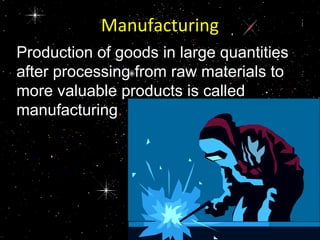
Production of goods in large quantities
after processing from raw materials to
more valuable products is called
manufacturing.
Importance of Manufacturing
Manufacturing sector is considered the backbone
of development.
Manufacturing industries helps in modernising
agriculture and reduces the heavy dependence of
people on agricultural income by providing them jobs
in secondary and tertiary sectors.
Manufacturing helps in eradication of
unemployment, poverty and bringing down regional
disparities by establishing industries in tribal and
backward areas.
Export of manufactured goods expands trade and
commerce and brings in foreign exchange.
Manufacturing industries transforms raw materials
into a wide variety of furnished goods of higher value.
Industrial Location
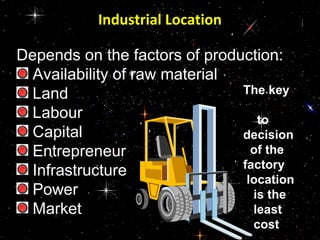
Depends on the factors of production:
Availability of raw material
Land
Labour
Capital
Entrepreneur
Infrastructure
Power
Market
The key
to
decision
of the
factory
location
is the
least
cost
Classification of Industries
Industries can be classified on the
following basis:
1. Source of raw materials used
2. Their main role
3. Capital investment
4. Ownership
5. Bulk and weight of raw material and
finished goods
Agro Based Industries
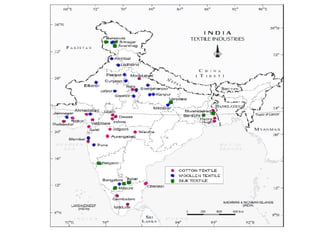
Textile Industry
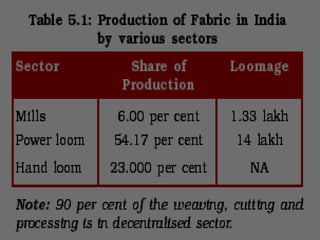
1. Occupies unique position in the Indian
economy.
2. Only industry in the country which is self-
reliant and complete in the value chain i.e.
from raw material to the highest value added
products.
3. Contributes significantly to industrial
production (14 per cent), employment
generation (35 million persons directly,
second largest after agriculture)
Cotton Textiles
1. Close links with agriculture and provides a living to
farmers e.g. cotton boll pluckers and workers engaged
in ginning, spinning, weaving, dyeing, and packaging
etc. 2. Supports many other industries e.g.
chemicals and dyes, mill stores, packaging materials
and engineering works.
Factors of production:
1. Availability of raw cotton
2. Market
3.
Transport including accessible port facilities,
4. Labour
5. Moist climate
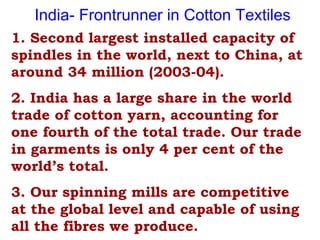
1. Second largest installed capacity of
spindles in the world, next to China, at
around 34 million (2003-04).
2. India has a large share in the world
trade of cotton yarn, accounting for
one fourth of the total trade. Our trade
in garments is only 4 per cent of the
world’s total.
3. Our spinning mills are competitive
at the global level and capable of using
all the fibres we produce.
India- Frontrunner in Cotton Textiles
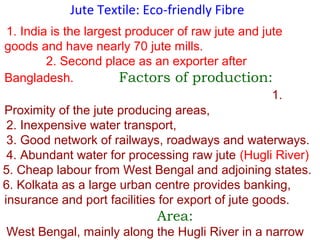
Jute Textile: Eco-friendly Fibre
1. India is the largest producer of raw jute and jute
goods and have nearly 70 jute mills.
2. Second place as an exporter after
Bangladesh. Factors of production:
1.
Proximity of the jute producing areas,
2. Inexpensive water transport,
3. Good network of railways, roadways and waterways.
4. Abundant water for processing raw jute (Hugli River)
5. Cheap labour from West Bengal and adjoining states.
6. Kolkata as a large urban centre provides banking,
insurance and port facilities for export of jute goods.
Area:
West Bengal, mainly along the Hugli River in a narrow
Challenges faced by the Jute industry:
1.Stiff competition in the international market
from synthetic substitutes.
2.Competitors like Bangladesh, Brazil,
Philippines, Egypt and Thailand.
Government Support:
1.Government policy of mandatory use of jute
packaging.
2.National Jute Policy in 2005 was formulated
with the objective of increasing productivity,
improving quality, ensuring good prices to
the jute farmers and enhancing the yield per
Problems faced by Textile industry
1. Erratic power supply
2. Out dated machinery
3. Low output of Labour
4. Stiff competition with synthetic
fibers
Sugar Industry
India stands second as a world producer of sugar
but occupies the first place in the production of
gur and khandsari. This industry is seasonal in
nature so, it is ideally suited to the cooperative
sector.
Factors of Production:
The raw material used in this industry is
Sugarcane. It is bulky and in haulage its sucrose
content reduces.
Areas: There are over 460 sugar mills in the
country spread over Uttar Pradesh, Bihar,
Maharashtra, Karnataka, Tamil Nadu, Andhra
Shifting of Sugar Industry towards South India
Recently, there is a tendency for the mills to shift
and concentrate in the southern and western
states especially in Maharashtra. This is because
the cane produced here has a higher sucrose
content. The cooler climate also ensures a longer
crushing season. Moreover, the cooperatives are
more successful in these states.
Major Challenges
1. Seasonal nature of the industry
2. Old and inefficient methods of production
3. Transport delay in reaching cane to factories
4. Use of baggase
Mineral based Industries
Iron and Steel Industry
1. The iron and steel Industry is the basic industry
since all the other industries — heavy, medium and
light, depend on it for their machinery. Steel is needed
to manufacture a variety of engineering goods,
construction material, defence, medical, telephonic,
scientific equipment and a variety of consumer goods.
2. Production and consumption of steel is often
regarded as the index of a country’s development.
3. Iron and steel is a heavy industry because all the
raw materials as well as finished goods are heavy and
bulky entailing heavy transportation costs. Iron ore,
coking coal and lime stone are required in the ratio of
approximately 4 : 2 : 1. Some quantities of manganese
are also required to harden the steel.
Location of Iron and Steel Industry
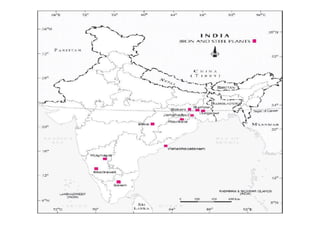
Chhotanagpur plateau region has the maximum
concentration of iron and steel industries. It is largely
because of the:
1. High grade raw materials and low cost of iron ore
2. Proximity to road, rail and water
transport
3. Cheap labour
4. Market.
Factors behind underperformance of India in Iron
and steel Industry:
(a) High costs and limited availability of coking coal
Aluminium Smelting
1. Aluminium smelting is the second most important
metallurgical industry in India.
2. It is light, resistant to corrosion, a good conductor
of heat, malleable and becomes strong when it is
mixed with other metals.
3. It is used to manufacture
aircraft, utensils and wires.
4. It has gained
popularity as a substitute of steel, copper, zinc and
lead in a number of industries.
5. There are 8 Aluminium smelting plants in the
country located in Orissa, West Bengal, Kerala, Uttar
Pradesh, Chattisgarh, Maharashtra and Tamil Nadu.
6. Bauxite - the raw material used is very
Chemical Industries
1. Fast growing and diversifying
2.
Contributes approximately 3 per cent of the GDP
3. Third largest in Asia
and twelfth place in the world in term of its size.
4.
Comprises of both large and small scale units in
inorganic and organic chemicals.
(i) Inorganic chemicals include sulphuric acid,
nitric acid, alkalies, soda ash and caustic soda.
(ii) Organic
chemicals include petrochemicals which are used
for manufacturing of synthetic fibers, synthetic
rubber, plastics, dye-stuffs, drugs and
Fertiliser Industry
Centred around the production of nitrogenous fertilisers
(mainly urea), phosphatic fertilisers and ammonium
phosphate (DAP) and complex fertilisers which have a
combination of nitrogen (N), phosphate (P), and potash
(K). There are 10 public sector undertakings and one in
cooperative sector at Hazira.
Potash is entirely imported as the country does not have
any reserves of commercially usable potash.
India is the third largest producer of nitrogenous
fertilisers.
There are 57 fertiliser units manufacturing nitrogenous
and complex nitrogenous fertilisers, 29 for urea and 9 for
producing ammonium sulphate as a byproduct and 68
other small units produce single superphosphate.
Cement Industry
Cement is essential for construction activity such
as building houses, factories, bridges, roads,
airports, dams and for other commercial
establishments.
Factors of Production:
1. Bulky
and heavy raw materials like limestone, silica,
alumina and gypsum.
2. Coal and electric power
3. Rail
transportation.
The first cement plant was set up in Chennai in
Automobile Industry
1. Trucks, buses, cars, motor cycles, scooters,
three-wheelers and multi-utility vehicles are
manufactured in India at various centres.
2. Foreign Direct Investment brought in new
technology and aligned the industry with global
developments.
3. At present, there are 15 manufacturers of
passenger cars and multiutility vehicles, 9 of
commercial vehicles, 14 of the two and three-
wheelers.
4. The industry is located around Delhi, Gurgaon,
Mumbai, Pune, Chennai, Kolkata, Lucknow,
Indore, Hyderabad, Jamshedpur and Bangalore.
Information Technology and
Electronics Industry
 The electronics industry covers a wide range of
products from transistor sets to television,
telephones, cellular telecom, telephone exchange,
radars, computers and many other equipments
required by the telecommunication industry.
 Bangalore has emerged as the electronic capital of
India. Other important centres for electronic goods
are Mumbai, Delhi, Hyderabad, Pune, Chennai,
Kolkata, Lucknow and Coimbatore.
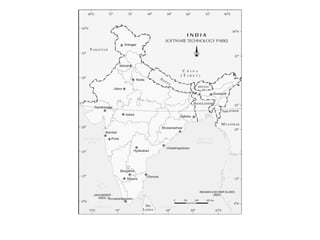
 18 software technology parks has been set up to
provide single window service and high data
communication facility to software experts.
Industrial Pollution and Environmental
Degradation
Industries are responsible for four types
of pollution:
(a) Air
(b) Water
(c) Land
(d) Noise.
The polluting industries also include
thermal power plants.
Control of Environmental Degradation
Air Pollution:
1. Fitting smoke stacks to factories with
electrostatic precipitators, fabric filters, scrubbers
and inertial separators.
2. Smoke can be reduced by using oil or gas
instead of coal in factories.
Water Pollution:
(i) Minimising use water for processing by reusing
and recycling it in two or more successive stages
(ii) Harvesting of rainwater to meet water
requirements
(iii) Treating hot water and effluents before
releasing them in rivers and ponds.
Land Pollution:
1. Proper disposal of solid waste
2. Integrated waste management
programmes
3. Using solid waste for useful works.
Noise Pollution:
1. Fitting silencers
2. Redesigning machines to increase
energy efficiency and reduce noise.
3. Noise absorbing material may be used.
4. Use of earplugs and earphones.
Review
(i) What is manufacturing?
(ii) Name any three physical factors for
the location of the industry.
(iii) Name any three human factors for
the location of an industry.
(iv) What are basic industries? Give an
example.
(v) Name the important raw materials
used in the manufacturing of cement?

Manufacturing industries

  • 1.
    Manufacturing Industries BY- MANOJKUMAR T.G.T (S.ST) K V CRPF , GHY
  • 2.
    Manufacturing Production of goodsin large quantities after processing from raw materials to more valuable products is called manufacturing.
  • 3.
    Importance of Manufacturing Manufacturingsector is considered the backbone of development. Manufacturing industries helps in modernising agriculture and reduces the heavy dependence of people on agricultural income by providing them jobs in secondary and tertiary sectors. Manufacturing helps in eradication of unemployment, poverty and bringing down regional disparities by establishing industries in tribal and backward areas. Export of manufactured goods expands trade and commerce and brings in foreign exchange. Manufacturing industries transforms raw materials into a wide variety of furnished goods of higher value.
  • 4.
    Industrial Location Depends onthe factors of production: Availability of raw material Land Labour Capital Entrepreneur Infrastructure Power Market The key to decision of the factory location is the least cost
  • 5.
    Classification of Industries Industriescan be classified on the following basis: 1. Source of raw materials used 2. Their main role 3. Capital investment 4. Ownership 5. Bulk and weight of raw material and finished goods
  • 6.
  • 7.
    Textile Industry 1. Occupiesunique position in the Indian economy. 2. Only industry in the country which is self- reliant and complete in the value chain i.e. from raw material to the highest value added products. 3. Contributes significantly to industrial production (14 per cent), employment generation (35 million persons directly, second largest after agriculture)
  • 8.
    Cotton Textiles 1. Closelinks with agriculture and provides a living to farmers e.g. cotton boll pluckers and workers engaged in ginning, spinning, weaving, dyeing, and packaging etc. 2. Supports many other industries e.g. chemicals and dyes, mill stores, packaging materials and engineering works. Factors of production: 1. Availability of raw cotton 2. Market 3. Transport including accessible port facilities, 4. Labour 5. Moist climate
  • 10.
    1. Second largestinstalled capacity of spindles in the world, next to China, at around 34 million (2003-04). 2. India has a large share in the world trade of cotton yarn, accounting for one fourth of the total trade. Our trade in garments is only 4 per cent of the world’s total. 3. Our spinning mills are competitive at the global level and capable of using all the fibres we produce. India- Frontrunner in Cotton Textiles
  • 11.
    Jute Textile: Eco-friendlyFibre 1. India is the largest producer of raw jute and jute goods and have nearly 70 jute mills. 2. Second place as an exporter after Bangladesh. Factors of production: 1. Proximity of the jute producing areas, 2. Inexpensive water transport, 3. Good network of railways, roadways and waterways. 4. Abundant water for processing raw jute (Hugli River) 5. Cheap labour from West Bengal and adjoining states. 6. Kolkata as a large urban centre provides banking, insurance and port facilities for export of jute goods. Area: West Bengal, mainly along the Hugli River in a narrow
  • 12.
    Challenges faced bythe Jute industry: 1.Stiff competition in the international market from synthetic substitutes. 2.Competitors like Bangladesh, Brazil, Philippines, Egypt and Thailand. Government Support: 1.Government policy of mandatory use of jute packaging. 2.National Jute Policy in 2005 was formulated with the objective of increasing productivity, improving quality, ensuring good prices to the jute farmers and enhancing the yield per
  • 14.
    Problems faced byTextile industry 1. Erratic power supply 2. Out dated machinery 3. Low output of Labour 4. Stiff competition with synthetic fibers
  • 15.
    Sugar Industry India standssecond as a world producer of sugar but occupies the first place in the production of gur and khandsari. This industry is seasonal in nature so, it is ideally suited to the cooperative sector. Factors of Production: The raw material used in this industry is Sugarcane. It is bulky and in haulage its sucrose content reduces. Areas: There are over 460 sugar mills in the country spread over Uttar Pradesh, Bihar, Maharashtra, Karnataka, Tamil Nadu, Andhra
  • 16.
    Shifting of SugarIndustry towards South India Recently, there is a tendency for the mills to shift and concentrate in the southern and western states especially in Maharashtra. This is because the cane produced here has a higher sucrose content. The cooler climate also ensures a longer crushing season. Moreover, the cooperatives are more successful in these states. Major Challenges 1. Seasonal nature of the industry 2. Old and inefficient methods of production 3. Transport delay in reaching cane to factories 4. Use of baggase
  • 17.
  • 18.
    Iron and SteelIndustry 1. The iron and steel Industry is the basic industry since all the other industries — heavy, medium and light, depend on it for their machinery. Steel is needed to manufacture a variety of engineering goods, construction material, defence, medical, telephonic, scientific equipment and a variety of consumer goods. 2. Production and consumption of steel is often regarded as the index of a country’s development. 3. Iron and steel is a heavy industry because all the raw materials as well as finished goods are heavy and bulky entailing heavy transportation costs. Iron ore, coking coal and lime stone are required in the ratio of approximately 4 : 2 : 1. Some quantities of manganese are also required to harden the steel.
  • 19.
    Location of Ironand Steel Industry Chhotanagpur plateau region has the maximum concentration of iron and steel industries. It is largely because of the: 1. High grade raw materials and low cost of iron ore 2. Proximity to road, rail and water transport 3. Cheap labour 4. Market. Factors behind underperformance of India in Iron and steel Industry: (a) High costs and limited availability of coking coal
  • 21.
    Aluminium Smelting 1. Aluminiumsmelting is the second most important metallurgical industry in India. 2. It is light, resistant to corrosion, a good conductor of heat, malleable and becomes strong when it is mixed with other metals. 3. It is used to manufacture aircraft, utensils and wires. 4. It has gained popularity as a substitute of steel, copper, zinc and lead in a number of industries. 5. There are 8 Aluminium smelting plants in the country located in Orissa, West Bengal, Kerala, Uttar Pradesh, Chattisgarh, Maharashtra and Tamil Nadu. 6. Bauxite - the raw material used is very
  • 22.
    Chemical Industries 1. Fastgrowing and diversifying 2. Contributes approximately 3 per cent of the GDP 3. Third largest in Asia and twelfth place in the world in term of its size. 4. Comprises of both large and small scale units in inorganic and organic chemicals. (i) Inorganic chemicals include sulphuric acid, nitric acid, alkalies, soda ash and caustic soda. (ii) Organic chemicals include petrochemicals which are used for manufacturing of synthetic fibers, synthetic rubber, plastics, dye-stuffs, drugs and
  • 23.
    Fertiliser Industry Centred aroundthe production of nitrogenous fertilisers (mainly urea), phosphatic fertilisers and ammonium phosphate (DAP) and complex fertilisers which have a combination of nitrogen (N), phosphate (P), and potash (K). There are 10 public sector undertakings and one in cooperative sector at Hazira. Potash is entirely imported as the country does not have any reserves of commercially usable potash. India is the third largest producer of nitrogenous fertilisers. There are 57 fertiliser units manufacturing nitrogenous and complex nitrogenous fertilisers, 29 for urea and 9 for producing ammonium sulphate as a byproduct and 68 other small units produce single superphosphate.
  • 24.
    Cement Industry Cement isessential for construction activity such as building houses, factories, bridges, roads, airports, dams and for other commercial establishments. Factors of Production: 1. Bulky and heavy raw materials like limestone, silica, alumina and gypsum. 2. Coal and electric power 3. Rail transportation. The first cement plant was set up in Chennai in
  • 25.
    Automobile Industry 1. Trucks,buses, cars, motor cycles, scooters, three-wheelers and multi-utility vehicles are manufactured in India at various centres. 2. Foreign Direct Investment brought in new technology and aligned the industry with global developments. 3. At present, there are 15 manufacturers of passenger cars and multiutility vehicles, 9 of commercial vehicles, 14 of the two and three- wheelers. 4. The industry is located around Delhi, Gurgaon, Mumbai, Pune, Chennai, Kolkata, Lucknow, Indore, Hyderabad, Jamshedpur and Bangalore.
  • 26.
    Information Technology and ElectronicsIndustry  The electronics industry covers a wide range of products from transistor sets to television, telephones, cellular telecom, telephone exchange, radars, computers and many other equipments required by the telecommunication industry.  Bangalore has emerged as the electronic capital of India. Other important centres for electronic goods are Mumbai, Delhi, Hyderabad, Pune, Chennai, Kolkata, Lucknow and Coimbatore.  18 software technology parks has been set up to provide single window service and high data communication facility to software experts.
  • 28.
    Industrial Pollution andEnvironmental Degradation Industries are responsible for four types of pollution: (a) Air (b) Water (c) Land (d) Noise. The polluting industries also include thermal power plants.
  • 29.
    Control of EnvironmentalDegradation Air Pollution: 1. Fitting smoke stacks to factories with electrostatic precipitators, fabric filters, scrubbers and inertial separators. 2. Smoke can be reduced by using oil or gas instead of coal in factories. Water Pollution: (i) Minimising use water for processing by reusing and recycling it in two or more successive stages (ii) Harvesting of rainwater to meet water requirements (iii) Treating hot water and effluents before releasing them in rivers and ponds.
  • 30.
    Land Pollution: 1. Properdisposal of solid waste 2. Integrated waste management programmes 3. Using solid waste for useful works. Noise Pollution: 1. Fitting silencers 2. Redesigning machines to increase energy efficiency and reduce noise. 3. Noise absorbing material may be used. 4. Use of earplugs and earphones.
  • 31.
    Review (i) What ismanufacturing? (ii) Name any three physical factors for the location of the industry. (iii) Name any three human factors for the location of an industry. (iv) What are basic industries? Give an example. (v) Name the important raw materials used in the manufacturing of cement?