

Functional Classification
Business Classification
Schemes Why and How-to
Human beings classify, it
is how our brains work
taxonomies
folksonomies
ontologies
biological classification
Dewey decimal system
As long as we know the
rules of classification it is
easy to achieve
 But who makes the rules?
 And what rules work best for business?
 Let’s consider something simple first…
yellow
banana
food
fruit
nutrition
Which characteristic
should we use?
What’s
the rule?
alphabetical
but is it a “banana” or
“Musa acuminata”
What’s
the rule?
colour
but what happens when
it isn’t that simple?
What’s
the rule?
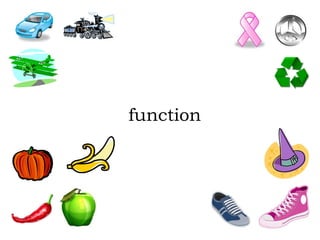
function
food
fruit
vegetables
dairy
meat
sugar
Functions can still be
ambiguous, but in business
they have many benefits
over…
 XYZ Company
 Corporate Services Directorate
 Director
 Operational Services Directorate
 AB Unit
 BC Unit
 #Services Manager
 Customer Support
 Mary’s stuff
 Help desk procedures
 Minute to Services Manager
 Operational Strategy Directorate
The dreaded
organisational structure
Organisational structure
issues
 Restructures or re-named position/section
 Work that crosses organisational groups
 Relies on staff to know who did the work
A functional structure
resolves these issues
 The functions of the business stay the same
 Everything for one activity is in one place
 Organisations can share and find content
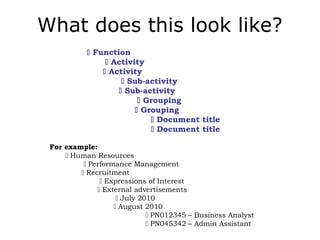
 Function
 Activity
 Activity
 Sub-activity
 Sub-activity
 Grouping
 Grouping
 Document title
 Document title
For example:
 Human Resources
 Performance Management
 Recruitment
 Expressions of Interest
 External advertisements
 July 2010
 August 2010
 PN012345 – Business Analyst
 PN045342 – Admin Assistant
What does this look like?
The only problem with
functional classification
 Helping the organisation understand the
rules
But let’s go back a step to
the documents
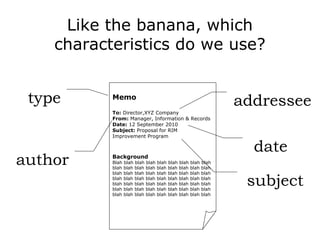
Memo
To: Director,XYZ Company
From: Manager, Information & Records
Date: 12 September 2010
Subject: Proposal for RIM
Improvement Program
Background
Blah blah blah blah blah blah blah blah blah
blah blah blah blah blah blah blah blah blah
type addressee
author
date
subject
Like the banana, which
characteristics do we use?
Characteristics provide
content and context
 Some go in the folder structure for context
 The document title explains the content
 Together they inform the document
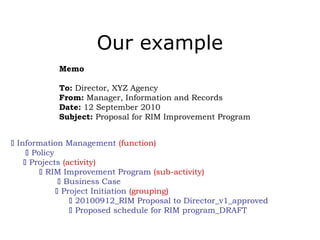
Our example
Memo
To: Director, XYZ Agency
From: Manager, Information and Records
Date: 12 September 2010
Subject: Proposal for RIM Improvement Program
 Information Management (function)
 Policy
 Projects (activity)
 RIM Improvement Program (sub-activity)
 Business Case
 Project Initiation (grouping)
 20100912_RIM Proposal to Director_v1_approved
 Proposed schedule for RIM program_DRAFT
Training is the answer
 A simple explanation of the structure
 Detailed examples specific to each area of
the business
We have to stop assuming
people will be able to work
out the classification rules
 Document that defines top two layers
 Read me file in top two layers of folders
And one last time…
Please train your staff, they aren’t psychic
and if they don’t know your rules they will
make up their own!

Functional classification for business - why and how-to

  • 1.
  • 2.
    Human beings classify,it is how our brains work taxonomies folksonomies ontologies biological classification Dewey decimal system
  • 3.
    As long aswe know the rules of classification it is easy to achieve  But who makes the rules?  And what rules work best for business?  Let’s consider something simple first…
  • 4.
  • 5.
  • 6.
  • 7.
    but is ita “banana” or “Musa acuminata”
  • 8.
  • 9.
  • 10.
    but what happenswhen it isn’t that simple?
  • 11.
  • 12.
  • 13.
  • 14.
    Functions can stillbe ambiguous, but in business they have many benefits over…
  • 15.
     XYZ Company Corporate Services Directorate  Director  Operational Services Directorate  AB Unit  BC Unit  #Services Manager  Customer Support  Mary’s stuff  Help desk procedures  Minute to Services Manager  Operational Strategy Directorate The dreaded organisational structure
  • 16.
    Organisational structure issues  Restructuresor re-named position/section  Work that crosses organisational groups  Relies on staff to know who did the work
  • 17.
    A functional structure resolvesthese issues  The functions of the business stay the same  Everything for one activity is in one place  Organisations can share and find content
  • 18.
     Function  Activity Activity  Sub-activity  Sub-activity  Grouping  Grouping  Document title  Document title For example:  Human Resources  Performance Management  Recruitment  Expressions of Interest  External advertisements  July 2010  August 2010  PN012345 – Business Analyst  PN045342 – Admin Assistant What does this look like?
  • 19.
    The only problemwith functional classification  Helping the organisation understand the rules
  • 20.
    But let’s goback a step to the documents
  • 21.
    Memo To: Director,XYZ Company From:Manager, Information & Records Date: 12 September 2010 Subject: Proposal for RIM Improvement Program Background Blah blah blah blah blah blah blah blah blah blah blah blah blah blah blah blah blah blah blah blah blah blah blah blah blah blah blah blah blah blah blah blah blah blah blah blah blah blah blah blah blah blah blah blah blah blah blah blah blah blah blah blah blah blah blah blah blah blah blah blah blah blah blah type addressee author date subject Like the banana, which characteristics do we use?
  • 22.
    Characteristics provide content andcontext  Some go in the folder structure for context  The document title explains the content  Together they inform the document
  • 23.
    Our example Memo To: Director,XYZ Agency From: Manager, Information and Records Date: 12 September 2010 Subject: Proposal for RIM Improvement Program  Information Management (function)  Policy  Projects (activity)  RIM Improvement Program (sub-activity)  Business Case  Project Initiation (grouping)  20100912_RIM Proposal to Director_v1_approved  Proposed schedule for RIM program_DRAFT
  • 24.
    Training is theanswer  A simple explanation of the structure  Detailed examples specific to each area of the business
  • 25.
    We have tostop assuming people will be able to work out the classification rules  Document that defines top two layers  Read me file in top two layers of folders
  • 26.
    And one lasttime… Please train your staff, they aren’t psychic and if they don’t know your rules they will make up their own!