DONE BY :
MR. ASWIN BABU
X th
aswinachukv10@gmail.com
Economic strength of a country is measured from the
development of manufacturing industries. It is the
backbone of our economy.
They reduce the dependence of people on agriculture
Providing jobs.
Export of manufactured goods
Bring foreign exchange
Eradicates poverty and unemployment.
Countries that transform their raw materials into a
wide variety of furnished goods of higher value are
prosperous.
aswinachukv10@gmail.com
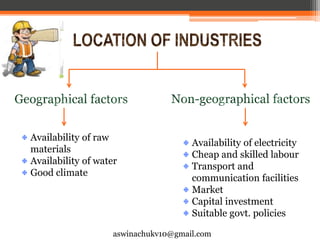
Availability of raw
materials
Availability of water
Good climate
Availability of electricity
Cheap and skilled labour
Transport and
communication facilities
Market
Capital investment
Suitable govt. policies
aswinachukv10@gmail.com
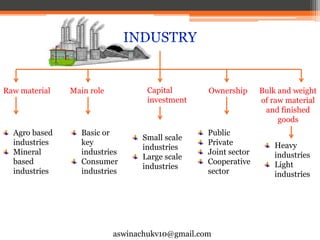
Raw material Main role Capital
investment
Ownership Bulk and weight
of raw material
and finished
goods
Agro based
industries
Mineral
based
industries
Basic or
key
industries
Consumer
industries
Small scale
industries
Large scale
industries
Public
Private
Joint sector
Cooperative
sector
Heavy
industries
Light
industries
aswinachukv10@gmail.com
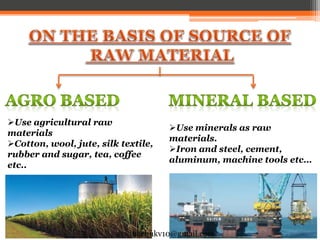
Use agricultural raw
materials
Cotton, wool, jute, silk textile,
rubber and sugar, tea, coffee
etc..
Use minerals as raw
materials.
Iron and steel, cement,
aluminum, machine tools etc…
aswinachukv10@gmail.com
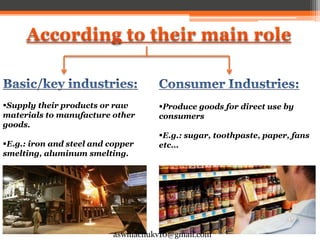
Supply their products or raw
materials to manufacture other
goods.
E.g.: iron and steel and copper
smelting, aluminum smelting.
Produce goods for direct use by
consumers
E.g.: sugar, toothpaste, paper, fans
etc…
aswinachukv10@gmail.com
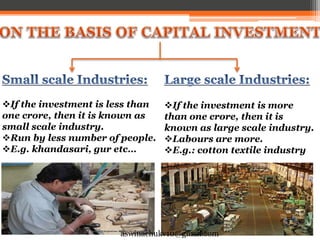
If the investment is less than
one crore, then it is known as
small scale industry.
Run by less number of people.
E.g. khandasari, gur etc…
If the investment is more
than one crore, then it is
known as large scale industry.
Labours are more.
E.g.: cotton textile industry
aswinachukv10@gmail.com
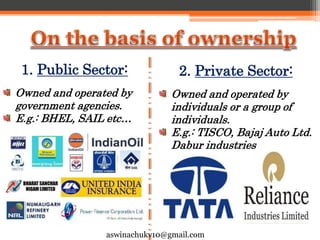
1. Public Sector:
Owned and operated by
government agencies.
E.g.: BHEL, SAIL etc…
2. Private Sector:
Owned and operated by
individuals or a group of
individuals.
E.g.: TISCO, Bajaj Auto Ltd.
Dabur industries
aswinachukv10@gmail.com
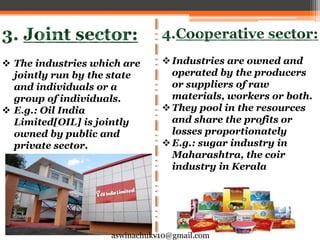
 The industries which are
jointly run by the state
and individuals or a
group of individuals.
 E.g.: Oil India
Limited[OIL] is jointly
owned by public and
private sector.
Industries are owned and
operated by the producers
or suppliers of raw
materials, workers or both.
They pool in the resources
and share the profits or
losses proportionately
E.g.: sugar industry in
Maharashtra, the coir
industry in Kerala
aswinachukv10@gmail.com
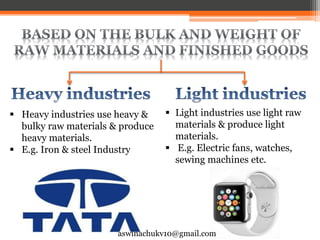
 Heavy industries use heavy &
bulky raw materials & produce
heavy materials.
 E.g. Iron & steel Industry
 Light industries use light raw
materials & produce light
materials.
 E.g. Electric fans, watches,
sewing machines etc.
aswinachukv10@gmail.com
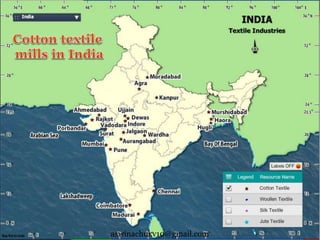
The first cotton textile mill was set up in Mumbai in 1854.
The cotton textile is mainly located in Maharashtra and Gujarat.
Because
Availability of raw cotton as black cotton soil is present.
Good transport facilities including port facilities.
Availability of labour
Good moist climate
Main exports: Japan, U.S.A, U.K, France, Sri Lanka, Nepal, East
European Countries etc…
Cotton textile is produced by three methods in India:
a) Handloom, b) Power-looms and c) Mills
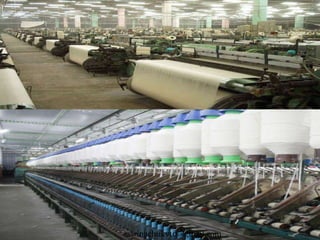
Cotton textile industry involves ginning, spinning, weaving,
dyeing, designing, tailoring and packaging to produce
readymade garments.
aswinachukv10@gmail.com
Scarcity of good quality cotton
Main cotton growing area went to Pakistan during
division
Old machinery
Erratic power supply
Low output from labour
Tough competition from synthetic fibres.
aswinachukv10@gmail.com
India is largest producer of raw jute and jute goods. There are
about 70 jute mills in our country.
First jute mill was setup in Rishra [Kolkata] in 1859.
Jute is used in making rope, bags, carpets etc.
Most of the jute mills are located along Hugli River in West
Bengal. Because
Raw jute is available for West Bengal.
Inexpensive water transport
A good network of railways, roadways and waterways to
facilitate movement of raw material to the mills
Abundant water for processing raw jute
Cheap labour from West Bengal and adjoining states of
Bihar, Orissa and Uttar Pradesh.
Kolkata as a large urban centre provides banking, insurance
and port facilities for export of jute goods.
aswinachukv10@gmail.com
Stiff competition in the international market from
synthetic substitutes and from other competitors like
Bangladesh, Brazil, Philippines, Egypt and Thailand.
In 2005, National Jute Policy was formulated with
the objective of increasing productivity, improving
quality, ensuring good prices to the jute farmers and
enhancing the yield per hectare.
aswinachukv10@gmail.com
Earlier UP and Bihar were the main producer of sugarcane.
Therefore, most of the sugar mills were located in these two states
only. But now, sugar mills are shifting towards Maharashtra and
Karnataka because of following reasons.
Per hectare production of sugarcane is higher in southern India.
Black soil is quite suitable for cultivation of sugarcane.
Sucrose content in the sugarcane is higher in Maharashtra and
Karnataka. It means more sugar can be produced for less sugarcane.
Mills and machines are new in southern states. New and modern
machines increase the productivity.
Crushing season for sugarcane is longer in southern states.
Cooperative sugar mills are running successfully in southern states.
aswinachukv10@gmail.com
 This industry is called as basic industry because it provide raw
material to many other industries such as machine an tools,
transport equipment, construction material etc.
 It is also called as heavy industry because raw materials [iron
ore, coal, limestone] are bulky in nature.
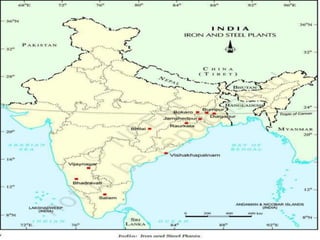
 Most of the steel plants are located in Chottanagpur region.
High cost of production
Limited availability of coking coal
Low productivity of labour
Irregular supply of energy
Raw materials are found only in a certain pocket of India.
Poor infrastructure like transport and communication etc.
aswinachukv10@gmail.com
Why is the iron and steel industry located in
peninsular India only?
Good and more raw materials: Large quantities of quality iron
and steel is available in peninsular India.
Power resources: coal, oil and water power are available in
peninsular India.
Skilled labour: Cheap and skilled labour is available .it can be
also had from Bihar Orissa, West Bengal and M.P. Besides
skilled labour is also locally available.
Nearness to market: large indigenous markets are available in
Peninsular India.
Port facilities are available for the export of iron and steel
manufactured goods.
aswinachukv10@gmail.com
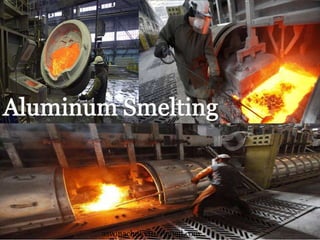
Aluminium smelting is the second most important metallurgical
industry in India.
It is light, resistant to corrosion, a good conductor of heat,
malleable and becomes strong when it is mixed with other
metals.
It is used to manufacture aircraft, utensils and wires. It has
gained popularity as a substitute of steel, copper, zinc and lead
in a number of industries.
Aluminium smelting plants in the country are located in Odisha,
West Bengal, Kerala, Uttar Pradesh, Chhattisgarh, Maharashtra
and Tamil Nadu. In 2008-09 India produced over 15.29 lakh
million tonnes of aluminium.
Bauxite, the raw material used in the smelters is a very bulky,
dark reddish coloured rock.
Regular supply of electricity and an assured source of raw
material at minimum cost are the two prime factors for location
of the industry. aswinachukv10@gmail.com
aswinachukv10@gmail.com
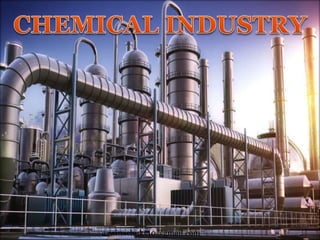
The Chemical industry in India is fast growing and
diversifying.
It contributes approximately 3 per cent of the GDP.
It is the third largest in Asia and occupies the twelfth
place in the world in term of its size.
It comprises both large and small scale manufacturing
units.
The chemical industry is its own largest consumer.
Because, Basic chemicals undergo processing to
further produce other chemicals that are used for
industrial application, agriculture or directly for
consumer markets.
Two types: organic and inorganic chemicals.
aswinachukv10@gmail.com
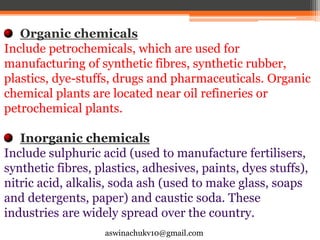
Organic chemicals
Include petrochemicals, which are used for
manufacturing of synthetic fibres, synthetic rubber,
plastics, dye-stuffs, drugs and pharmaceuticals. Organic
chemical plants are located near oil refineries or
petrochemical plants.
Inorganic chemicals
aswinachukv10@gmail.com
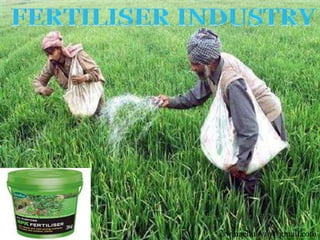
Distribution:
 Gujarat, Tamil Nadu, Uttar Pradesh, Punjab and Kerala produce
more than half of the total fertilizer production in India.
 Andhra Pradesh and Karnataka are other important producers.
Because of the easy availability of natural gas the fertilizer
industry is widely spread in the country.
Production:
 India produces about 1 million tones of nitrogenous, 4 million
tones of phosphatic and 1.7 million tones of potassic fertilizers.
The country is required to import potassium from abroad.
aswinachukv10@gmail.com
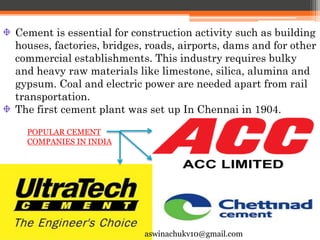
Cement is essential for construction activity such as building
houses, factories, bridges, roads, airports, dams and for other
commercial establishments. This industry requires bulky
and heavy raw materials like limestone, silica, alumina and
gypsum. Coal and electric power are needed apart from rail
transportation.
The first cement plant was set up In Chennai in 1904.
POPULAR CEMENT
COMPANIES IN INDIA
aswinachukv10@gmail.com
FAMOUS AUTOMOBILE COMPANIES IN WORLD
aswinachukv10@gmail.com
The electronics industry covers a wide range of products from
transistor sets to television, telephones, cellular telecom,
pagers, telephone exchange, radars, computers and many other
equipments required by the telecommunication industry.
Bangalore has emerged as the electronic capital of India.
Other important centres for electronic goods are Mumbai,
Delhi, Hyderabad, Pune, Chennai, Kolkata, Lucknow and
Coimbatore.
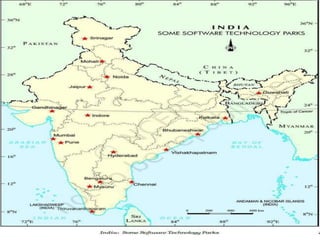
By 2010-11 (STPI) Software Technology Parks of India
have come up across 46 locations at different centres of India.
A major impact of this industry has been on
employment generation. It is encouraging to know that 30
per cent of the people employed in this sector are women.
aswinachukv10@gmail.com
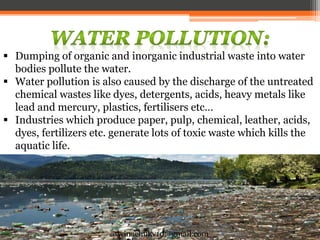
 Dumping of organic and inorganic industrial waste into water
bodies pollute the water.
 Water pollution is also caused by the discharge of the untreated
chemical wastes like dyes, detergents, acids, heavy metals like
lead and mercury, plastics, fertilisers etc…
 Industries which produce paper, pulp, chemical, leather, acids,
dyes, fertilizers etc. generate lots of toxic waste which kills the
aquatic life.
aswinachukv10@gmail.com
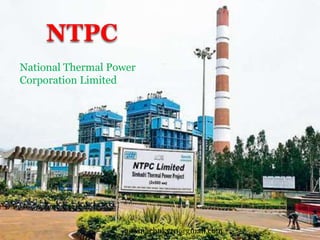
National Thermal Power
Corporation Limited
NTPC
aswinachukv10@gmail.com
NTPC is a major power providing corporation in India.
It has ISO certification for EMS [environment management
system] 14001.
The corporation has a pro-active approach for preserving the
natural environment and resources like water, oil and gas and
fuels in places where it is setting up power plants.
This has been possible through-
Optimum utilisation of equipment adopting latest techniques
and upgrading existing equipment.
Minimising waste generation by maximising ash utilisation.
Providing green belts for nurturing ecological balance and
addressing the question of special purpose vehicles for
afforestation.
Reducing environmental pollution through ash pond
management, ash water recycling system and liquid waste
management .
Ecological monitoring, reviews and online database
management for all its power stations.
aswinachukv10@gmail.com