Classification of Business
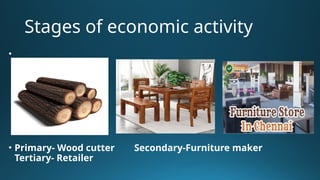
Stages of economic activity
•
• Primary- Wood cutter Secondary-Furniture maker
Tertiary- Retailer
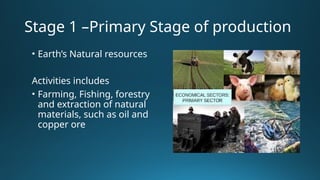
Stage 1 –Primary Stage of production
• Earth’s Natural resources
Activities includes
• Farming, Fishing, forestry
and extraction of natural
materials, such as oil and
copper ore
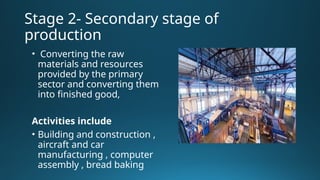
Stage 2- Secondary stage of
production
• Converting the raw
materials and resources
provided by the primary
sector and converting them
into finished good,
Activities include
• Building and construction ,
aircraft and car
manufacturing , computer
assembly , bread baking
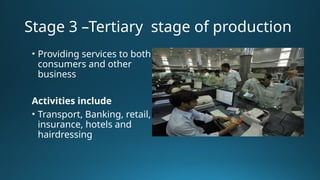
Stage 3 –Tertiary stage of production
• Providing services to both
consumers and other
business
Activities include
• Transport, Banking, retail,
insurance, hotels and
hairdressing
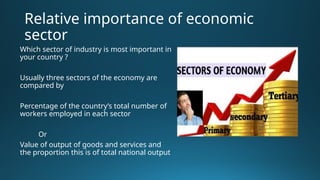
Relative importance of economic
sector
Which sector of industry is most important in
your country ?
Usually three sectors of the economy are
compared by
Percentage of the country’s total number of
workers employed in each sector
Or
Value of output of goods and services and
the proportion this is of total national output
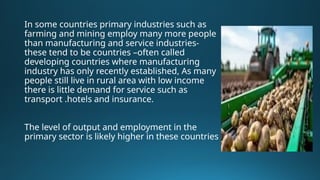
In some countries primary industries such as
farming and mining employ many more people
than manufacturing and service industries-
these tend to be countries –often called
developing countries where manufacturing
industry has only recently established, As many
people still live in rural area with low income
there is little demand for service such as
transport .hotels and insurance.
The level of output and employment in the
primary sector is likely higher in these countries
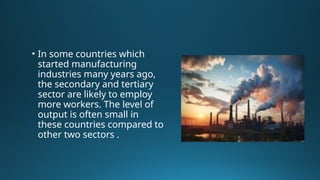
• In some countries which
started manufacturing
industries many years ago,
the secondary and tertiary
sector are likely to employ
more workers. The level of
output is often small in
these countries compared to
other two sectors .
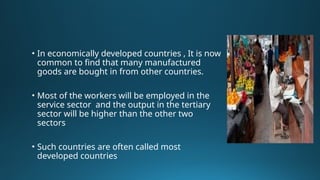
• In economically developed countries , It is now
common to find that many manufactured
goods are bought in from other countries.
• Most of the workers will be employed in the
service sector and the output in the tertiary
sector will be higher than the other two
sectors
• Such countries are often called most
developed countries
Changes in sector importance
• In Uk and other developed economies there has been a decline
in the importance of manufacturing industry
• Since 1970- the tertiary sector in Uk now employs well over 75
per cent of all workers,
• Many workers lost job as factories closed have found it difficult
to obtain work in the service industries
• This decline in manufacturing sector is called de-industrialisation
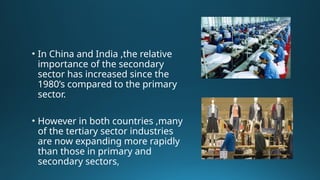
• In China and India ,the relative
importance of the secondary
sector has increased since the
1980’s compared to the primary
sector.
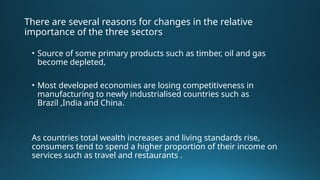
• However in both countries ,many
of the tertiary sector industries
are now expanding more rapidly
than those in primary and
secondary sectors,
There are several reasons for changes in the relative
importance of the three sectors
• Source of some primary products such as timber, oil and gas
become depleted,
• Most developed economies are losing competitiveness in
manufacturing to newly industrialised countries such as
Brazil ,India and China.
As countries total wealth increases and living standards rise,
consumers tend to spend a higher proportion of their income on
services such as travel and restaurants .
Mixed Economy
Private Sector
• Business not owned by
the government,
• Make their own decision
about what and how to
produce and price to be
charged ,
• Private sector will aim to
make a profit .
Public Sector
• Government or state owned and controlled businesses
and organisation
• The government or public sector authorities make
decisions about what a how to produce goods and services
and how much to charge consumers
• Health , education services ,
• The money of these comes from the tax payers
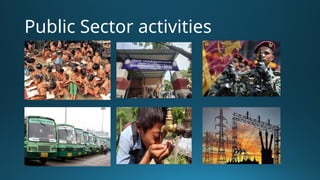
Public Sector activities
Mixed economies- recent
changes
• In recent years the government have changed the balance
between the private and public sector
• They have done this by selling public sector businesses to
private sector .
• This is called Privatisation
• In many European and Asian countries the water supply ,
electricity and public transport system have been privatised
Why have government done
this
• Private sector is more efficient than public sector
businesses
• This is because their main aim is profit and therefore
costs must be controlled
• Private sector owners might invest more capital in the
business than the government can afford ,
• Competition between private and public can help to
improve the product quality
• However , a business in the private sector might make
more workers unemployed than the public sector business
in order to cut costs
• A private sector business is also less likely to focus on
social objectives
Unit 1 Chaptet 1.2.pptx igcse sub code 0450 paper 1

  • 1.
  • 2.
    Stages of economicactivity • • Primary- Wood cutter Secondary-Furniture maker Tertiary- Retailer
  • 3.
    Stage 1 –PrimaryStage of production • Earth’s Natural resources Activities includes • Farming, Fishing, forestry and extraction of natural materials, such as oil and copper ore
  • 4.
    Stage 2- Secondarystage of production • Converting the raw materials and resources provided by the primary sector and converting them into finished good, Activities include • Building and construction , aircraft and car manufacturing , computer assembly , bread baking
  • 5.
    Stage 3 –Tertiarystage of production • Providing services to both consumers and other business Activities include • Transport, Banking, retail, insurance, hotels and hairdressing
  • 6.
    Relative importance ofeconomic sector Which sector of industry is most important in your country ? Usually three sectors of the economy are compared by Percentage of the country’s total number of workers employed in each sector Or Value of output of goods and services and the proportion this is of total national output
  • 7.
    In some countriesprimary industries such as farming and mining employ many more people than manufacturing and service industries- these tend to be countries –often called developing countries where manufacturing industry has only recently established, As many people still live in rural area with low income there is little demand for service such as transport .hotels and insurance. The level of output and employment in the primary sector is likely higher in these countries
  • 8.
    • In somecountries which started manufacturing industries many years ago, the secondary and tertiary sector are likely to employ more workers. The level of output is often small in these countries compared to other two sectors .
  • 9.
    • In economicallydeveloped countries , It is now common to find that many manufactured goods are bought in from other countries. • Most of the workers will be employed in the service sector and the output in the tertiary sector will be higher than the other two sectors • Such countries are often called most developed countries
  • 10.
    Changes in sectorimportance • In Uk and other developed economies there has been a decline in the importance of manufacturing industry • Since 1970- the tertiary sector in Uk now employs well over 75 per cent of all workers, • Many workers lost job as factories closed have found it difficult to obtain work in the service industries • This decline in manufacturing sector is called de-industrialisation
  • 11.
    • In Chinaand India ,the relative importance of the secondary sector has increased since the 1980’s compared to the primary sector. • However in both countries ,many of the tertiary sector industries are now expanding more rapidly than those in primary and secondary sectors,
  • 12.
    There are severalreasons for changes in the relative importance of the three sectors • Source of some primary products such as timber, oil and gas become depleted, • Most developed economies are losing competitiveness in manufacturing to newly industrialised countries such as Brazil ,India and China. As countries total wealth increases and living standards rise, consumers tend to spend a higher proportion of their income on services such as travel and restaurants .
  • 13.
  • 14.
    Private Sector • Businessnot owned by the government, • Make their own decision about what and how to produce and price to be charged , • Private sector will aim to make a profit .
  • 15.
    Public Sector • Governmentor state owned and controlled businesses and organisation • The government or public sector authorities make decisions about what a how to produce goods and services and how much to charge consumers • Health , education services , • The money of these comes from the tax payers
  • 16.
  • 17.
    Mixed economies- recent changes •In recent years the government have changed the balance between the private and public sector • They have done this by selling public sector businesses to private sector . • This is called Privatisation • In many European and Asian countries the water supply , electricity and public transport system have been privatised
  • 18.
    Why have governmentdone this • Private sector is more efficient than public sector businesses • This is because their main aim is profit and therefore costs must be controlled • Private sector owners might invest more capital in the business than the government can afford , • Competition between private and public can help to improve the product quality
  • 19.
    • However ,a business in the private sector might make more workers unemployed than the public sector business in order to cut costs • A private sector business is also less likely to focus on social objectives