INDUSTRIES
Secondary activities
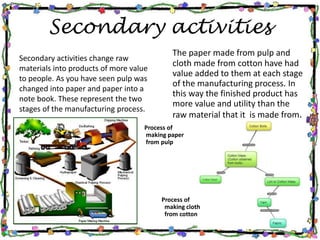
Secondary activities change raw
materials into products of more value
to people. As you have seen pulp was
changed into paper and paper into a
note book. These represent the two
stages of the manufacturing process.
Process of
making paper
from pulp
The paper made from pulp and
cloth made from cotton have had
value added to them at each stage
of the manufacturing process. In
this way the finished product has
more value and utility than the
raw material that it is made from.
Process of
making cloth
from cotton
Industry
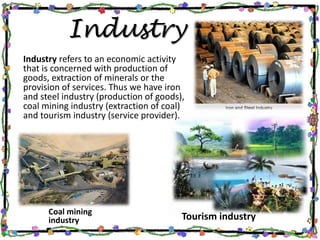
Coal mining
industry
Industry refers to an economic activity
that is concerned with production of
goods, extraction of minerals or the
provision of services. Thus we have iron
and steel industry (production of goods),
coal mining industry (extraction of coal)
and tourism industry (service provider).
Tourism industry
Classification of industries on
the basis of raw materials
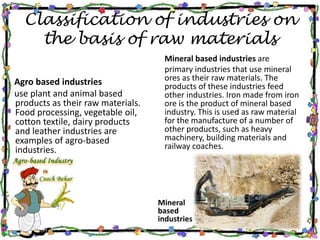
Agro based industries
use plant and animal based
products as their raw materials.
Food processing, vegetable oil,
cotton textile, dairy products
and leather industries are
examples of agro-based
industries.
Mineral
based
industries
Mineral based industries are
primary industries that use mineral
ores as their raw materials. The
products of these industries feed
other industries. Iron made from iron
ore is the product of mineral based
industry. This is used as raw material
for the manufacture of a number of
other products, such as heavy
machinery, building materials and
railway coaches.
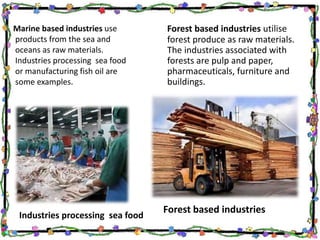
Industries processing sea food
Marine based industries use
products from the sea and
oceans as raw materials.
Industries processing sea food
or manufacturing fish oil are
some examples.
Forest based industries
Forest based industries utilise
forest produce as raw materials.
The industries associated with
forests are pulp and paper,
pharmaceuticals, furniture and
buildings.
Classification of industries
on the basis of size
Investment of capital is higher and the
technology used is superior in large scale
industries. Silk weaving and food processing
industries are small scale industries. Production
of automobiles and heavy machinery are large
scale industries.
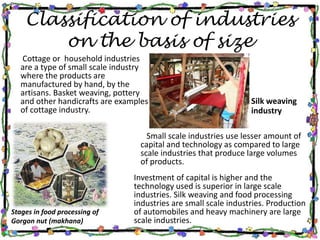
Cottage or household industries
are a type of small scale industry
where the products are
manufactured by hand, by the
artisans. Basket weaving, pottery
and other handicrafts are examples
of cottage industry.
Stages in food processing of
Gorgon nut (makhana)
Small scale industries use lesser amount of
capital and technology as compared to large
scale industries that produce large volumes
of products.
Silk weaving
industry
Classification of industries
on the basis of ownership
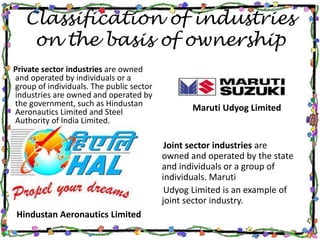
Hindustan Aeronautics Limited
Private sector industries are owned
and operated by individuals or a
group of individuals. The public sector
industries are owned and operated by
the government, such as Hindustan
Aeronautics Limited and Steel
Authority of India Limited.
Joint sector industries are
owned and operated by the state
and individuals or a group of
individuals. Maruti
Udyog Limited is an example of
joint sector industry.
Maruti Udyog Limited
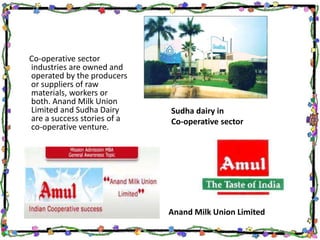
Sudha dairy in
Co-operative sector
Co-operative sector
industries are owned and
operated by the producers
or suppliers of raw
materials, workers or
both. Anand Milk Union
Limited and Sudha Dairy
are a success stories of a
co-operative venture.
Anand Milk Union Limited
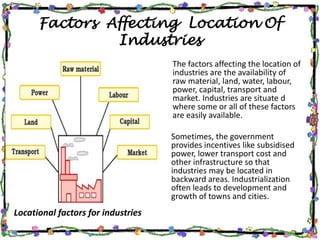
Factors Affecting Location Of
Industries
Locational factors for industries
The factors affecting the location of
industries are the availability of
raw material, land, water, labour,
power, capital, transport and
market. Industries are situate d
where some or all of these factors
are easily available.
Sometimes, the government
provides incentives like subsidised
power, lower transport cost and
other infrastructure so that
industries may be located in
backward areas. Industrialization
often leads to development and
growth of towns and cities.
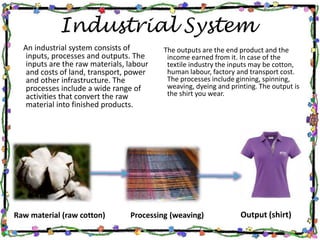
Industrial System
Output (shirt)
An industrial system consists of
inputs, processes and outputs. The
inputs are the raw materials, labour
and costs of land, transport, power
and other infrastructure. The
processes include a wide range of
activities that convert the raw
material into finished products.
Raw material (raw cotton)
The outputs are the end product and the
income earned from it. In case of the
textile industry the inputs may be cotton,
human labour, factory and transport cost.
The processes include ginning, spinning,
weaving, dyeing and printing. The output is
the shirt you wear.
Processing (weaving)
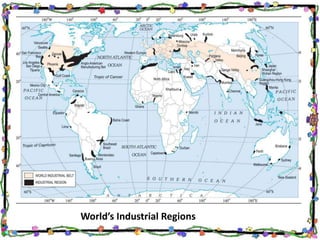
Industrial Regions
Industrial regions emerge when a
number of industries locate close to
each other and share the benefits of
their closeness. Major industrial
regions of the world are eastern North
America, western and central Europe,
eastern Europe and eastern Asia
.Major industrial regions tend to be
located in the temperate areas, near
sea ports and especially near coal
fields.
India has several industrial
regions like Mumbai-Pune cluster,
Bangalore-Tamil Nadu region,
Hugli region, Ahmedabad-Baroda
region, Chottanagpur industrial
belt, Vishakhapatnam-Guntur
belt, Gurgaon-Delhi-Meerut
region and the Kollam
Thiruvanathapuram industrial
cluster.
World’s Industrial Regions
Cotton Textile
Industry
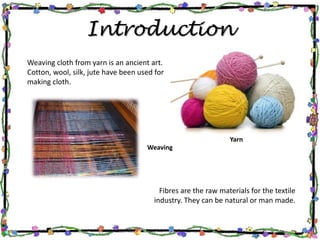
Introduction
Weaving cloth from yarn is an ancient art.
Cotton, wool, silk, jute have been used for
making cloth.
Fibres are the raw materials for the textile
industry. They can be natural or man made.
Yarn
Weaving
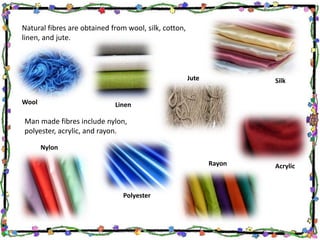
Natural fibres are obtained from wool, silk, cotton,
linen, and jute.
Man made fibres include nylon,
polyester, acrylic, and rayon.
Wool Linen
Jute Silk
Nylon
Polyester
Rayon Acrylic
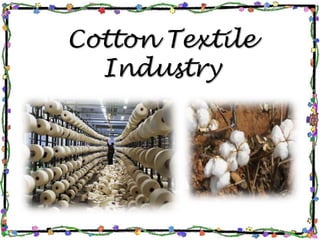
Cotton Textile Industry
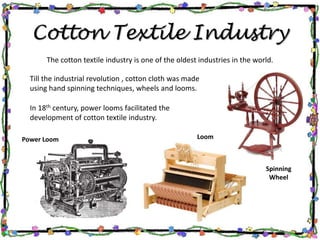
The cotton textile industry is one of the oldest industries in the world.
Till the industrial revolution , cotton cloth was made
using hand spinning techniques, wheels and looms.
In 18th century, power looms facilitated the
development of cotton textile industry.
Spinning
Wheel
LoomPower Loom
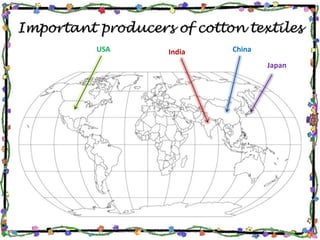
India China
Japan
Important producers of cotton textiles
USA
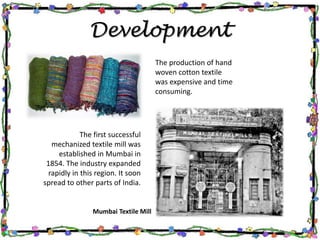
Development
The production of hand
woven cotton textile
was expensive and time
consuming.
The first successful
mechanized textile mill was
established in Mumbai in
1854. The industry expanded
rapidly in this region. It soon
spread to other parts of India.
Mumbai Textile Mill
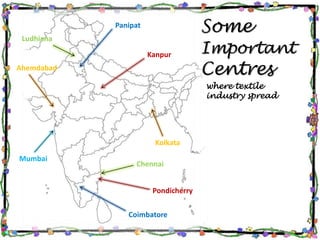
Some
Important
Centres
Coimbatore
Kanpur
Chennai
Ahemdabad
Mumbai
Kolkata
Ludhiana
Pondicherry
Panipat
where textile
industry spread
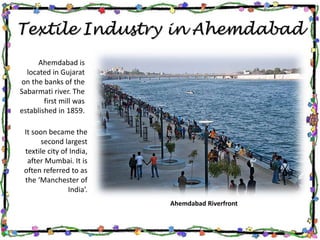
Textile Industry in Ahemdabad
Ahemdabad is
located in Gujarat
on the banks of the
Sabarmati river. The
first mill was
established in 1859.
It soon became the
second largest
textile city of India,
after Mumbai. It is
often referred to as
the ‘Manchester of
India’.
Ahemdabad Riverfront
Factors responsible for the
development of textile industry
in Ahemdabad
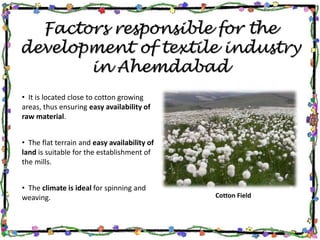
• It is located close to cotton growing
areas, thus ensuring easy availability of
raw material.
Cotton Field
• The flat terrain and easy availability of
land is suitable for the establishment of
the mills.
• The climate is ideal for spinning and
weaving.
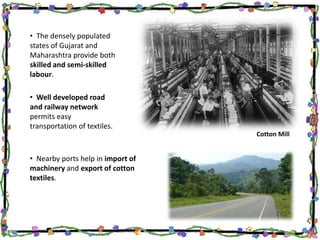
• The densely populated
states of Gujarat and
Maharashtra provide both
skilled and semi-skilled
labour.
Cotton Mill
• Well developed road
and railway network
permits easy
transportation of textiles.
• Nearby ports help in import of
machinery and export of cotton
textiles.
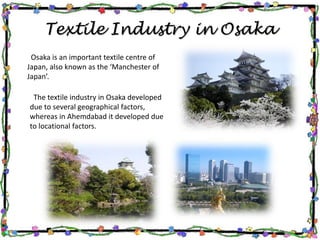
Textile Industry in Osaka
Osaka is an important textile centre of
Japan, also known as the ‘Manchester of
Japan’.
The textile industry in Osaka developed
due to several geographical factors,
whereas in Ahemdabad it developed due
to locational factors.
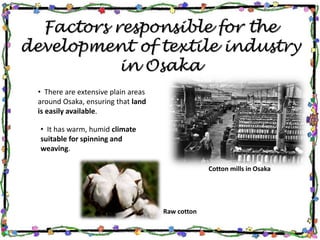
Factors responsible for the
development of textile industry
in Osaka
• There are extensive plain areas
around Osaka, ensuring that land
is easily available.
• It has warm, humid climate
suitable for spinning and
weaving.
Cotton mills in Osaka
Raw cotton
• Labour is easily available.
• There are ports nearby
that help in the import of
raw cotton and export of
textiles.
Yodo river, Osaka
• The river Yodo provides
sufficient water for the
mills.
Made by-
Teetiksha

Industries

  • 1.
  • 2.
    Secondary activities Secondary activitieschange raw materials into products of more value to people. As you have seen pulp was changed into paper and paper into a note book. These represent the two stages of the manufacturing process. Process of making paper from pulp The paper made from pulp and cloth made from cotton have had value added to them at each stage of the manufacturing process. In this way the finished product has more value and utility than the raw material that it is made from. Process of making cloth from cotton
  • 3.
    Industry Coal mining industry Industry refersto an economic activity that is concerned with production of goods, extraction of minerals or the provision of services. Thus we have iron and steel industry (production of goods), coal mining industry (extraction of coal) and tourism industry (service provider). Tourism industry
  • 4.
    Classification of industrieson the basis of raw materials Agro based industries use plant and animal based products as their raw materials. Food processing, vegetable oil, cotton textile, dairy products and leather industries are examples of agro-based industries. Mineral based industries Mineral based industries are primary industries that use mineral ores as their raw materials. The products of these industries feed other industries. Iron made from iron ore is the product of mineral based industry. This is used as raw material for the manufacture of a number of other products, such as heavy machinery, building materials and railway coaches.
  • 5.
    Industries processing seafood Marine based industries use products from the sea and oceans as raw materials. Industries processing sea food or manufacturing fish oil are some examples. Forest based industries Forest based industries utilise forest produce as raw materials. The industries associated with forests are pulp and paper, pharmaceuticals, furniture and buildings.
  • 6.
    Classification of industries onthe basis of size Investment of capital is higher and the technology used is superior in large scale industries. Silk weaving and food processing industries are small scale industries. Production of automobiles and heavy machinery are large scale industries. Cottage or household industries are a type of small scale industry where the products are manufactured by hand, by the artisans. Basket weaving, pottery and other handicrafts are examples of cottage industry. Stages in food processing of Gorgon nut (makhana) Small scale industries use lesser amount of capital and technology as compared to large scale industries that produce large volumes of products. Silk weaving industry
  • 7.
    Classification of industries onthe basis of ownership Hindustan Aeronautics Limited Private sector industries are owned and operated by individuals or a group of individuals. The public sector industries are owned and operated by the government, such as Hindustan Aeronautics Limited and Steel Authority of India Limited. Joint sector industries are owned and operated by the state and individuals or a group of individuals. Maruti Udyog Limited is an example of joint sector industry. Maruti Udyog Limited
  • 8.
    Sudha dairy in Co-operativesector Co-operative sector industries are owned and operated by the producers or suppliers of raw materials, workers or both. Anand Milk Union Limited and Sudha Dairy are a success stories of a co-operative venture. Anand Milk Union Limited
  • 9.
    Factors Affecting LocationOf Industries Locational factors for industries The factors affecting the location of industries are the availability of raw material, land, water, labour, power, capital, transport and market. Industries are situate d where some or all of these factors are easily available. Sometimes, the government provides incentives like subsidised power, lower transport cost and other infrastructure so that industries may be located in backward areas. Industrialization often leads to development and growth of towns and cities.
  • 10.
    Industrial System Output (shirt) Anindustrial system consists of inputs, processes and outputs. The inputs are the raw materials, labour and costs of land, transport, power and other infrastructure. The processes include a wide range of activities that convert the raw material into finished products. Raw material (raw cotton) The outputs are the end product and the income earned from it. In case of the textile industry the inputs may be cotton, human labour, factory and transport cost. The processes include ginning, spinning, weaving, dyeing and printing. The output is the shirt you wear. Processing (weaving)
  • 11.
    Industrial Regions Industrial regionsemerge when a number of industries locate close to each other and share the benefits of their closeness. Major industrial regions of the world are eastern North America, western and central Europe, eastern Europe and eastern Asia .Major industrial regions tend to be located in the temperate areas, near sea ports and especially near coal fields. India has several industrial regions like Mumbai-Pune cluster, Bangalore-Tamil Nadu region, Hugli region, Ahmedabad-Baroda region, Chottanagpur industrial belt, Vishakhapatnam-Guntur belt, Gurgaon-Delhi-Meerut region and the Kollam Thiruvanathapuram industrial cluster.
  • 12.
  • 13.
  • 14.
    Introduction Weaving cloth fromyarn is an ancient art. Cotton, wool, silk, jute have been used for making cloth. Fibres are the raw materials for the textile industry. They can be natural or man made. Yarn Weaving
  • 15.
    Natural fibres areobtained from wool, silk, cotton, linen, and jute. Man made fibres include nylon, polyester, acrylic, and rayon. Wool Linen Jute Silk Nylon Polyester Rayon Acrylic
  • 16.
    Cotton Textile Industry Thecotton textile industry is one of the oldest industries in the world. Till the industrial revolution , cotton cloth was made using hand spinning techniques, wheels and looms. In 18th century, power looms facilitated the development of cotton textile industry. Spinning Wheel LoomPower Loom
  • 17.
  • 18.
    Development The production ofhand woven cotton textile was expensive and time consuming. The first successful mechanized textile mill was established in Mumbai in 1854. The industry expanded rapidly in this region. It soon spread to other parts of India. Mumbai Textile Mill
  • 19.
  • 20.
    Textile Industry inAhemdabad Ahemdabad is located in Gujarat on the banks of the Sabarmati river. The first mill was established in 1859. It soon became the second largest textile city of India, after Mumbai. It is often referred to as the ‘Manchester of India’. Ahemdabad Riverfront
  • 21.
    Factors responsible forthe development of textile industry in Ahemdabad • It is located close to cotton growing areas, thus ensuring easy availability of raw material. Cotton Field • The flat terrain and easy availability of land is suitable for the establishment of the mills. • The climate is ideal for spinning and weaving.
  • 22.
    • The denselypopulated states of Gujarat and Maharashtra provide both skilled and semi-skilled labour. Cotton Mill • Well developed road and railway network permits easy transportation of textiles. • Nearby ports help in import of machinery and export of cotton textiles.
  • 23.
    Textile Industry inOsaka Osaka is an important textile centre of Japan, also known as the ‘Manchester of Japan’. The textile industry in Osaka developed due to several geographical factors, whereas in Ahemdabad it developed due to locational factors.
  • 24.
    Factors responsible forthe development of textile industry in Osaka • There are extensive plain areas around Osaka, ensuring that land is easily available. • It has warm, humid climate suitable for spinning and weaving. Cotton mills in Osaka Raw cotton
  • 25.
    • Labour iseasily available. • There are ports nearby that help in the import of raw cotton and export of textiles. Yodo river, Osaka • The river Yodo provides sufficient water for the mills.
  • 26.