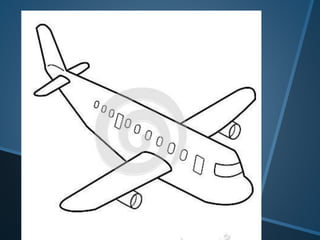
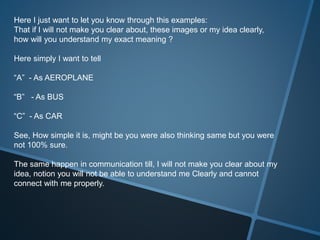
Here I just want to let you know through this examples:
That if I will not make you clear about, these images or my idea clearly,
how will you understand my exact meaning ?
Here simply I want to tell
“A” - As AEROPLANE
“B” - As BUS
“C” - As CAR
See, How simple it is, might be you were also thinking same but you were
not 100% sure.
The same happen in communication till, I will not make you clear about my
idea, notion you will not be able to understand me Clearly and cannot
connect with me properly.
ਕਾਰੋਬਾਰ ਸੰਚਾਰ 'ਤੇ ਪੇਸ਼ਕਾਰ
DEFINITION OF BUSINESS
"The regular production or purchase and sale of goods undertaken with an
objective of earning profit and acquiring wealth through the satisfaction of human
wants.“
- Stephenson
"Business refers to a form of activity conducted with an objective of earning profits
for the benefit of those on whose behalf the activity is conducted.“
- Dicksee
Business is an economic activity, which is related with continuous and regular
production and distribution of goods and services for satisfying human wants and
earning money.
DEFINITION OF COMMUNICATION
Communication is a process of passing information and understanding from one
person to another person.
- Keith
Davis
Communication is any behavior that results is an exchange of meaning
- The American management Association
Communication is not a soliloquy process
Without effective communication there is confusion, dissatisfaction and
misunderstandings
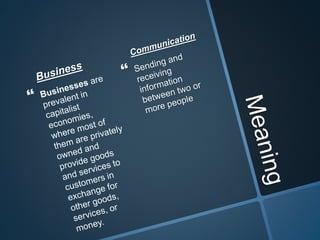
Business communication is the sharing of information between people within
and outside the organization that is performed for the commercial benefit of the
organization. It can also be defined as relaying of information within
a business by its people.
Business communication is formal and very organized.
“The sharing of information between people within an enterprise that is performed
for the commercial benefit of the organization. In addition, business
communication can also refer to how a company shares information
to promote its product or services to potential consumers.”
- The Business Dictionary
Lifeblood of an Organization
Communication is the lifeblood of an organization. If we could somehow
remove communication flow from an organization, we would not have an
organization. When communication stops, organized activity ceases to exist.
Individual uncoordinated activity returns in an organization. So, Communication in
an organization, is as vital as blood for life.
It is needed for:
• Exchanging information
• Exchanging options
• Making plans and proposals
• Reaching agreement
• Executing decisions
• Sending and fulfilling orders
• Conducting sales
PROCESS OF COMMUNICATION
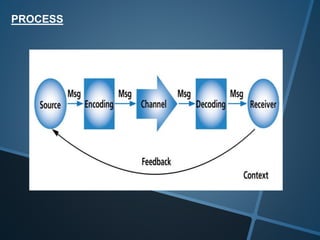
The basic process of communication begins when a fact or idea is observed
by one person. That person (the sender) may decide to translate the
observation into a message, and then transmit the message through some
communication medium to another person (the receiver). The receiver then
must interpret the message and provide feedback to the sender indicating that
the message has been understood and appropriate action taken.
Transmission of a message from a sender to receiver in an understandable
manner.
Communication is a process where
a person or group share information to get a connected.
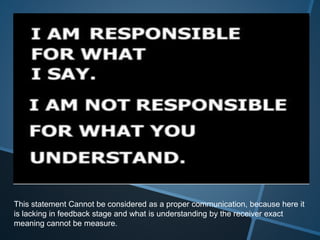
This statement Cannot be considered as a proper communication, because here it
is lacking in feedback stage and what is understanding by the receiver exact
meaning cannot be measure.
PROCESS
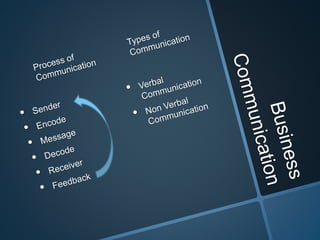
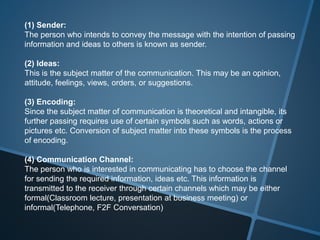
(1) Sender:
The person who intends to convey the message with the intention of passing
information and ideas to others is known as sender.
(2) Ideas:
This is the subject matter of the communication. This may be an opinion,
attitude, feelings, views, orders, or suggestions.
(3) Encoding:
Since the subject matter of communication is theoretical and intangible, its
further passing requires use of certain symbols such as words, actions or
pictures etc. Conversion of subject matter into these symbols is the process
of encoding.
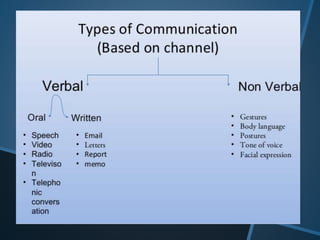
(4) Communication Channel:
The person who is interested in communicating has to choose the channel
for sending the required information, ideas etc. This information is
transmitted to the receiver through certain channels which may be either
formal(Classroom lecture, presentation at business meeting) or
informal(Telephone, F2F Conversation)
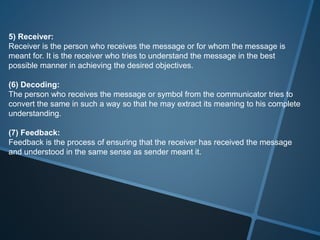
5) Receiver:
Receiver is the person who receives the message or for whom the message is
meant for. It is the receiver who tries to understand the message in the best
possible manner in achieving the desired objectives.
(6) Decoding:
The person who receives the message or symbol from the communicator tries to
convert the same in such a way so that he may extract its meaning to his complete
understanding.
(7) Feedback:
Feedback is the process of ensuring that the receiver has received the message
and understood in the same sense as sender meant it.
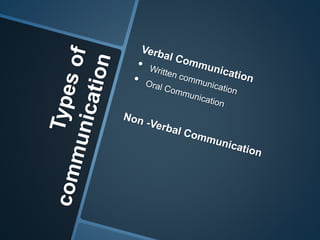
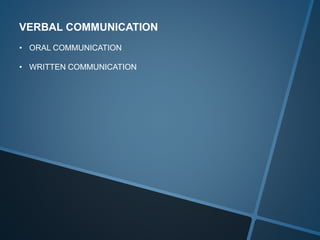
VERBAL COMMUNICATION
• ORAL COMMUNICATION
• WRITTEN COMMUNICATION
Oral Communication
Verbally transmitting information an ideas from one individual or group to
another.
Oral communication implies communication through mouth. It includes
individuals conversing with each other, be it direct conversation or
telephonic conversation. Speeches, presentations, discussions are all forms
of oral communication.
Oral communication is generally recommended when the communication
matter is of temporary kind or where a direct interaction is required. Face to
face communication (meetings, lectures, conferences, interviews, etc.) is
significant so as to build a rapport and trust.
Advantages of Oral Communication
• Understanding and transparency,
• Flexibility,
• The feedback is spontaneous in case of oral communication. Thus, decisions
can be made quickly without any delay,
• Time saving, saves upon money and efforts,
• Best in case of problem resolution(conflicts, disputes and many issues),
• Encouraging morale among organizational employees,
• Oral communication can be best used to transfer private and confidential
information/matter.
Disadvantages/Limitations of Oral Communication
• Relying only on oral communication may not be sufficient as business
communication is formal and very organized.
• Oral communication is less authentic than written communication as they are
informal and not as organized as written communication.
• There may be misunderstandings as the information is not complete and may
lack essentials.
• It requires attentiveness and great receptivity on part of the
receivers/audience.
• Oral communication (such as speeches) is not frequently used as legal
records except in investigation work.
Written communication
• Written communication is formal and very organized.
• Written communication involves any type of interaction that makes use of the
written word.
• written communication is the most common form of business
communication.
•
• Electronic mail has emerged as a highly popular business communication
tool in recent years.
ADVANTAGES OF WRITTEN COMMUNICATION
• They can be edited and revised several times before they are sent ,
• Permanent record of the messages and can be saved for later study.
• Good writing skills
• Customer client satisfaction
DISADVANTAGES OF WRITTEN COMMUNICATION
Several potential pitfalls associated with written communication
• Impressions and reactions
• Immediate feedback
• Writing abilities,
NON-VERBAL COMMUNICATION
Non Verbal Communication
Non-verbal Communication has been defined as communication without
words. It includes apparent behaviors such as facial expressions, eyes,
touching, and tone of voice, as well as less obvious messages such as
dress, posture and distance between two or more people.
The implication being that if the meaning of every nod, eye movement, and
gesture were known, the real feelings and intentions of a person would be
understood.
Unfortunately interpreting non-verbal communication is not that simple.
non-verbal communication is not a language with a fixed meaning.
It is influenced and driven by the context in which it occurs. This includes both
the place and the people concerned, as well as the culture.
The thumbs-up gesture, which generally signals approval in English-
speaking countries, is considered offensive in other countries, including
apparently Greece, Italy and some parts of the Middle East.
Making a circle with your thumb and forefinger like this means OK in
Western cultures. It is used in particular by divers in this way. In Japan,
however, it is reputedly the sign for money, and in Arabic countries, it is a
threat.
There are many different types of non-verbal
communication.
1) Body Movements (Kinesics):- for example, hand gestures or nodding or
shaking the head; Posture, or how you stand or sit, whether your arms are
crossed,
2) Eye Contact:- where the amount of eye contact often determines the level of
trust and trustworthiness
3) Para-language:- or aspects of the voice apart from speech, such as pitch,
tone, and speed of speaking
4) Closeness or Personal Space (Proxemics):-which determines the level
of intimacy
5) Facial Expressions:- including smiling, frowning and even blinking
6) Physiological Changes:-for example, sweating or blinking more when
nervous.
ਤੁਹਾਡਾ ਧੰਨਵਾਦ
THANK YOU
Prepared by-
Prashant Raghav

BC with examples

  • 8.
    Here I justwant to let you know through this examples: That if I will not make you clear about, these images or my idea clearly, how will you understand my exact meaning ? Here simply I want to tell “A” - As AEROPLANE “B” - As BUS “C” - As CAR See, How simple it is, might be you were also thinking same but you were not 100% sure. The same happen in communication till, I will not make you clear about my idea, notion you will not be able to understand me Clearly and cannot connect with me properly.
  • 10.
  • 11.
    DEFINITION OF BUSINESS "Theregular production or purchase and sale of goods undertaken with an objective of earning profit and acquiring wealth through the satisfaction of human wants.“ - Stephenson "Business refers to a form of activity conducted with an objective of earning profits for the benefit of those on whose behalf the activity is conducted.“ - Dicksee Business is an economic activity, which is related with continuous and regular production and distribution of goods and services for satisfying human wants and earning money.
  • 12.
    DEFINITION OF COMMUNICATION Communicationis a process of passing information and understanding from one person to another person. - Keith Davis Communication is any behavior that results is an exchange of meaning - The American management Association Communication is not a soliloquy process Without effective communication there is confusion, dissatisfaction and misunderstandings
  • 14.
    Business communication isthe sharing of information between people within and outside the organization that is performed for the commercial benefit of the organization. It can also be defined as relaying of information within a business by its people. Business communication is formal and very organized. “The sharing of information between people within an enterprise that is performed for the commercial benefit of the organization. In addition, business communication can also refer to how a company shares information to promote its product or services to potential consumers.” - The Business Dictionary
  • 15.
    Lifeblood of anOrganization Communication is the lifeblood of an organization. If we could somehow remove communication flow from an organization, we would not have an organization. When communication stops, organized activity ceases to exist. Individual uncoordinated activity returns in an organization. So, Communication in an organization, is as vital as blood for life.
  • 16.
    It is neededfor: • Exchanging information • Exchanging options • Making plans and proposals • Reaching agreement • Executing decisions • Sending and fulfilling orders • Conducting sales
  • 18.
    PROCESS OF COMMUNICATION Thebasic process of communication begins when a fact or idea is observed by one person. That person (the sender) may decide to translate the observation into a message, and then transmit the message through some communication medium to another person (the receiver). The receiver then must interpret the message and provide feedback to the sender indicating that the message has been understood and appropriate action taken. Transmission of a message from a sender to receiver in an understandable manner. Communication is a process where a person or group share information to get a connected.
  • 19.
    This statement Cannotbe considered as a proper communication, because here it is lacking in feedback stage and what is understanding by the receiver exact meaning cannot be measure.
  • 20.
  • 21.
    (1) Sender: The personwho intends to convey the message with the intention of passing information and ideas to others is known as sender. (2) Ideas: This is the subject matter of the communication. This may be an opinion, attitude, feelings, views, orders, or suggestions. (3) Encoding: Since the subject matter of communication is theoretical and intangible, its further passing requires use of certain symbols such as words, actions or pictures etc. Conversion of subject matter into these symbols is the process of encoding. (4) Communication Channel: The person who is interested in communicating has to choose the channel for sending the required information, ideas etc. This information is transmitted to the receiver through certain channels which may be either formal(Classroom lecture, presentation at business meeting) or informal(Telephone, F2F Conversation)
  • 22.
    5) Receiver: Receiver isthe person who receives the message or for whom the message is meant for. It is the receiver who tries to understand the message in the best possible manner in achieving the desired objectives. (6) Decoding: The person who receives the message or symbol from the communicator tries to convert the same in such a way so that he may extract its meaning to his complete understanding. (7) Feedback: Feedback is the process of ensuring that the receiver has received the message and understood in the same sense as sender meant it.
  • 25.
    VERBAL COMMUNICATION • ORALCOMMUNICATION • WRITTEN COMMUNICATION
  • 26.
    Oral Communication Verbally transmittinginformation an ideas from one individual or group to another. Oral communication implies communication through mouth. It includes individuals conversing with each other, be it direct conversation or telephonic conversation. Speeches, presentations, discussions are all forms of oral communication. Oral communication is generally recommended when the communication matter is of temporary kind or where a direct interaction is required. Face to face communication (meetings, lectures, conferences, interviews, etc.) is significant so as to build a rapport and trust.
  • 27.
    Advantages of OralCommunication • Understanding and transparency, • Flexibility, • The feedback is spontaneous in case of oral communication. Thus, decisions can be made quickly without any delay, • Time saving, saves upon money and efforts, • Best in case of problem resolution(conflicts, disputes and many issues), • Encouraging morale among organizational employees, • Oral communication can be best used to transfer private and confidential information/matter.
  • 28.
    Disadvantages/Limitations of OralCommunication • Relying only on oral communication may not be sufficient as business communication is formal and very organized. • Oral communication is less authentic than written communication as they are informal and not as organized as written communication. • There may be misunderstandings as the information is not complete and may lack essentials. • It requires attentiveness and great receptivity on part of the receivers/audience. • Oral communication (such as speeches) is not frequently used as legal records except in investigation work.
  • 29.
    Written communication • Writtencommunication is formal and very organized. • Written communication involves any type of interaction that makes use of the written word. • written communication is the most common form of business communication. • • Electronic mail has emerged as a highly popular business communication tool in recent years.
  • 30.
    ADVANTAGES OF WRITTENCOMMUNICATION • They can be edited and revised several times before they are sent , • Permanent record of the messages and can be saved for later study. • Good writing skills • Customer client satisfaction DISADVANTAGES OF WRITTEN COMMUNICATION Several potential pitfalls associated with written communication • Impressions and reactions • Immediate feedback • Writing abilities,
  • 31.
  • 32.
    Non Verbal Communication Non-verbalCommunication has been defined as communication without words. It includes apparent behaviors such as facial expressions, eyes, touching, and tone of voice, as well as less obvious messages such as dress, posture and distance between two or more people. The implication being that if the meaning of every nod, eye movement, and gesture were known, the real feelings and intentions of a person would be understood. Unfortunately interpreting non-verbal communication is not that simple. non-verbal communication is not a language with a fixed meaning. It is influenced and driven by the context in which it occurs. This includes both the place and the people concerned, as well as the culture.
  • 33.
    The thumbs-up gesture,which generally signals approval in English- speaking countries, is considered offensive in other countries, including apparently Greece, Italy and some parts of the Middle East. Making a circle with your thumb and forefinger like this means OK in Western cultures. It is used in particular by divers in this way. In Japan, however, it is reputedly the sign for money, and in Arabic countries, it is a threat.
  • 34.
    There are manydifferent types of non-verbal communication. 1) Body Movements (Kinesics):- for example, hand gestures or nodding or shaking the head; Posture, or how you stand or sit, whether your arms are crossed, 2) Eye Contact:- where the amount of eye contact often determines the level of trust and trustworthiness 3) Para-language:- or aspects of the voice apart from speech, such as pitch, tone, and speed of speaking 4) Closeness or Personal Space (Proxemics):-which determines the level of intimacy 5) Facial Expressions:- including smiling, frowning and even blinking 6) Physiological Changes:-for example, sweating or blinking more when nervous.
  • 35.
  • 36.