WHAT IS BODY LANGUAGE?
 Communicating NON-VERBAL
 Body movements
 Postures
 Gestures
 Expressions
Why body language is important?
 10% only words
 60% visuals
 30% vocal
SOME BEST BODY LANGUAGE
POSSESSORS
Bill Gates
Steve Jobs
Bill Clinton
FACIAL EXPRESSIONS
SEVEN UNIVERSAL EXPRESSIONS
1. Happiness
2. Sadness
3. Angry
4. Fear
5. Surprise
6. Contempt
7. Disgust
EYES (AS YOU SEE THEM)
Eyes - upward to the right (their left).
Trying to recall memories.
Eyes - upwards to the left (their right).
Creating visual images (we think in pictures).
A hand over the mouth whilst talking indicates deceit.
A desire to try and stop the words coming out of the mouth.
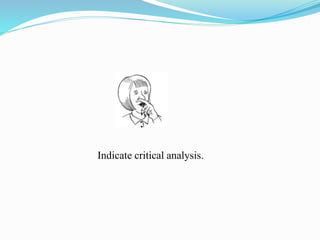
Indicate critical analysis.
Is an evaluation signal.
Generally a positive evaluation.
It's a time for thought process.
Women - bottom of the chin
Is an evaluation gesture.
It is generally a positive evaluation of your ideas,
suggestions, information or requests.
She may feel comfortable.
She may look cool.
Careful, You have a very negative signal,
even if she is smiling.
The lowered stapling of the hands indicates listening,
and can also be a negative confidence gesture.
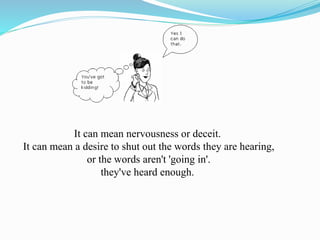
The scratch to the back of the neck indicates uncertainty.
It can mean nervousness or deceit.
It can mean a desire to shut out the words they are hearing,
or the words aren't 'going in'.
they've heard enough.
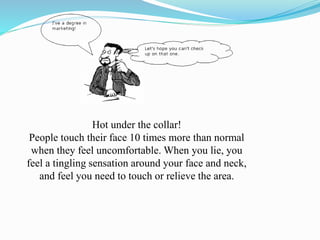
Hot under the collar!
People touch their face 10 times more than normal
when they feel uncomfortable. When you lie, you
feel a tingling sensation around your face and neck,
and feel you need to touch or relieve the area.
Hand clasping at a desk or in a chair
on its own may indicate nervousness,
insecurity or anxiety. The more tightly
clasped they are, the more the anxiety.
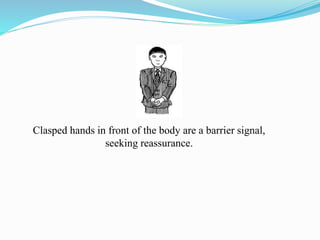
Clasped hands in front of the body are a barrier signal,
seeking reassurance.
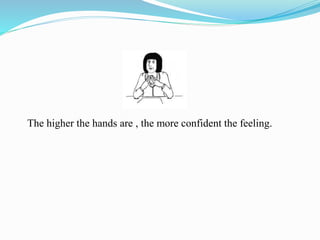
The higher the hands are , the more confident the feeling.
Here's the mother of all confidence gestures.
This gesture can denote even arrogance.
The most supreme will be
when the chair is tilted back onto two legs.
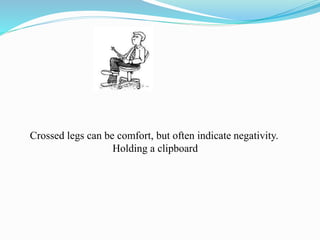
Crossed legs can be comfort, but often indicate negativity.
Holding a clipboard
This is extremely negative.
Indicate lethargy.
They maybe don't want to be there
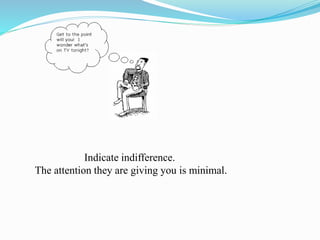
Indicate indifference.
The attention they are giving you is minimal.
It normally indicates mild confrontation and stubbornness
at that point.
This is blatant territorial ownership. Claiming territory.
It could easily be disregard of other people's territory
if it were say your feet on someone else's desk.
This is an aggressive gesture, indicating their hidden behavior
as being aggressive.
Watch for people's feet movements.
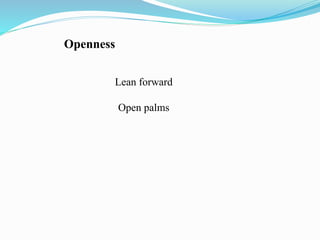
Openness
Lean forward
Open palms
Defensiveness
Arms crossed
Or
gripping
Leg over chair
or
With a leg across
Evaluation
Hand to cheek
or
Beard stroking
or
Lowered specs
or
Pinching the bridge of nose
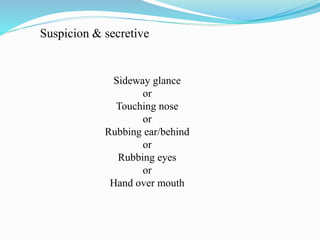
Suspicion & secretive
Sideway glance
or
Touching nose
or
Rubbing ear/behind
or
Rubbing eyes
or
Hand over mouth
Readiness
Hands on hips
or
Sitting on the edge
Reassurance
Clenched hands with thumbs rubbing
Or
hand pinching
or
Women- adjusting necklace
Frustration
Back of head
or
Tightly clenched hands
or
Wringing hands
or
Pain in neck
or
Hot under collar
Self-control
Clenched at back
or
Crossed ankles
Here's a neutral position.
Sat upright, legs together,
arms apart, possibly with the palms of the hands showing,
indicating honesty and sincerity.
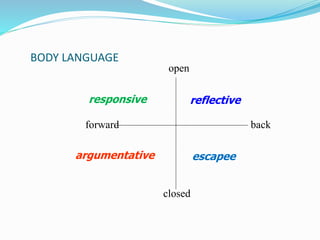
BODY LANGUAGE
Two basic groups of Body Language
Open/closed
Forward/back
BODY LANGUAGE
open
closed
forward back
responsive reflective
escapeeargumentative
HANDSHAKES
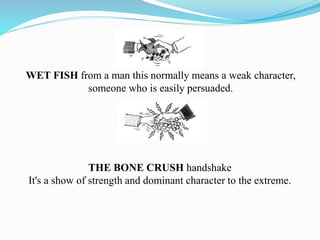
WET FISH from a man this normally means a weak character,
someone who is easily persuaded.
THE BONE CRUSH handshake
It's a show of strength and dominant character to the extreme.
A palm down handshake indicates control.
Anyone who gives you a handshake with two hands,
when first meeting you, is likely to be insincere and
overwhelming, or even deceitful.
BODY LANGUAGE…..?
BODY LANGUAGE….?
BODY LANGUAGE….?
BODY LANGUAGE
-movement
• Do not be frozen
• Display energy & variety
• Purpose
BODY LANGUAGE
-movement
• Forward - making point
• Backward
• Sides
BODY LANGUAGE
Clothes : 23%
+
Gestures : 57%
+
Facial expressions : 20%
Main Aspects Of Body Language
Ways of talking
Talking is not only what you say but also how you say
it.
 By stressing some words in a sentence, you can change
the entire meaning of it without changing the
structure of the sentence.
 Paralanguage
Ways of talking
 Some people feel comfortable speaking very fast, however the listeners
are not able to understand them.
 The pitch of the voice plays a main role for example the low tone
indicates that the person is shy or uncomfortable, but when the tone of
a person is high then people say that he is confident.
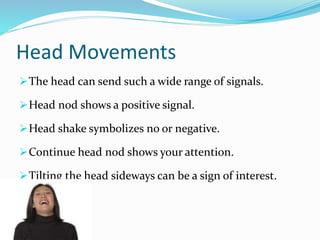
Head Movements
The head can send such a wide range of signals.
Head nod shows a positive signal.
Head shake symbolizes no or negative.
Continue head nod shows your attention.
Tilting the head sideways can be a sign of interest.
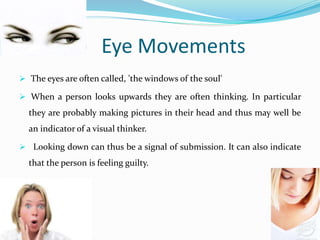
Eye Movements
 The eyes are often called, 'the windows of the soul'
 When a person looks upwards they are often thinking. In particular
they are probably making pictures in their head and thus may well be
an indicator of a visual thinker.
 Looking down can thus be a signal of submission. It can also indicate
that the person is feeling guilty.
Eye Movements
 A quick glance sideways indicates the source of a distraction.
 Gazing at something shows an interest in it.
 Staring generally indicates particular interest in something or
someone.
 People lower or knit their eyebrows to show disagreement.
 Frown when in displeasure.
 Rubbing eyes denotes tiredness or upset.
 Direct eye contact shows attention and interest.
Eye Movements
Closing one eye in a wink is a deliberate gesture that
often suggests conspiratorial.
Blinking eyes infrequently is probably due to boredom.
Mouth
Biting lip.
Pursing lips.
Nail biting.
Smile head tilted ,looking up.
Tight lipped smile.
Dropped jaw smile.
Chewing gum.
Hand clamped over mouth.
Facial Expression
Human face is extremely expressive.
 Face can encode a variety of communicative and informative
messages. Facial expressions are universal.
 Face is the most reliable indicator of emotions.
 Blushing.
 Smiling.
 Frowning.
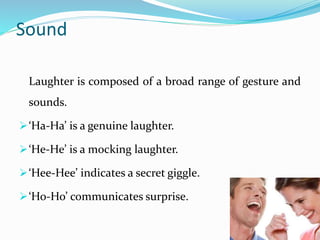
Sound
Laughter is composed of a broad range of gesture and
sounds.
‘Ha-Ha’ is a genuine laughter.
‘He-He’ is a mocking laughter.
‘Hee-Hee’ indicates a secret giggle.
‘Ho-Ho’ communicates surprise.
Walking Gestures
 Arms swinging
 Hands in pocket
 Hands on hips
 Meditative walk
 Confidence walk
 Leadership walk
 Pacing
 swagger
Message clusters Aggressive body language
 Assertive body language.
 Attentive body language.
 Bored body language.
 Closed body language.
 Deceptive body language.
 Defensive body language.
 Dominant body language.
 Emotional body language.
 Evaluating body language.
 Greeting body language.
 Open body language.
Message clusters
Power body language.
Ready body language.
Relaxed body language.
Sales body language.
Submissive body language.
Do’s and the Don'ts
How do I know as to what I am doing is right or not
……..????
OR
What is My Body Language like !!!!!
Let us find out.
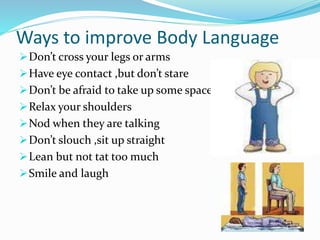
Ways to improve Body Language
Don’t cross your legs or arms
Have eye contact ,but don’t stare
Don’t be afraid to take up some space
Relax your shoulders
Nod when they are talking
Don’t slouch ,sit up straight
Lean but not tat too much
Smile and laugh
Ways to improve Body Language
Don’t touch your face.
Keep your head up.
Slow down a bit.
Don’t fidget.
Use your hands more confidently.
Realize where your spine ends.
Don’t stand too close.
Mirror.
Keep a good attitude.
Positive body language
Facial expressions should be natural and friendly:
raise eyebrows to show surprise ,
open eyes wide ,
curl your eyebrows .
Body movement
move forward to emphasize
move to side to indicate a transition gesture
up and down head motions
pen or pointer to indicate part, place (on a
transparency)
shrug shoulder to indicate I don't know or care.
Positive body language
Hand
Be conscious of what you do with your hands
If you are unhappy, hold notes or cards to occupy
them.
arm - movements back and forth to suggest flow.
Open arms to include or welcome ideas .
Posture
stand straight but relaxed.
Lean forward to emphasize however.
No hands in pockets.
Negative body language
 Failing to make eye contact.
 Looking at the screen/board means your back is turned to
the audience cutting contact.
 Don't stare, or look blankly into people's eyes .
 Avoid swaying back and forth like a pendulum.
 Avoid leaning against walls .
 Be aware of your nervous tics.
 Do not fold your arms like a barrier.
 While one hand in a pocket gives a very relaxed pose, both
hands in pockets looks too casual and should be avoided.
Grooming !
Formal Dress Code
GROOMING & APPERANCE
 Dressing have an impact on
Self, Colleague & Customers
 Your clothes convey the
message that you are
Confident, Presentable,
Ambitious & Sincere
Benefits of Grooming
1. Makes one look Attractive
2. Builds up Self Confidence
3. Helps in better Appearance
GROOMING
MEN
Wear Formal Shirts in Office
As a rule, the simpler the better.
Colours you can choose : White, off white, pale, blue shirts are
preferred;
though you may wear dark colored shirts too.
(given below are the colours preferred by professionals).
Don’t Wear !!
Shirts with thick stripes and checks
TROUSERS:
1. They should preferably be dark though you
may wear beige and with a dark colored
shirt.
2. Try to have at least one pair of black
trousers.
3. Trousers may or may not have pleats
TIES
 To play it safe choose a traditional silk tie.
 No loud colours or patterns.
Given below are some well accepted colours
and patterns
 It may be wise to avoid ties with images and
designer logos
Apt Look of Tie
Your tie should co-ordinate with your attire
The knot should be a perfect triangle.
DON’T
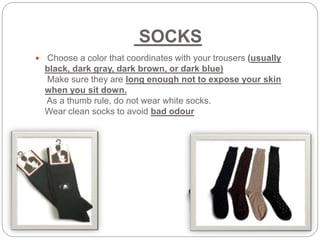
SOCKS
 Choose a color that coordinates with your trousers (usually
black, dark gray, dark brown, or dark blue)
Make sure they are long enough not to expose your skin
when you sit down.
As a thumb rule, do not wear white socks.
Wear clean socks to avoid bad odour
SHOES
Wear a good pair of leather shoes- black and
brown/tan shoes.
Shoes must be polished everyday.
DON’T
Do not wear shoes that look casual.
Also, do not wear shoes with worn out heels.
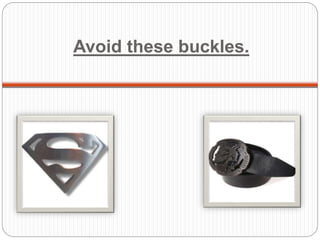
BELTS
Wear only formal belts with a sleek buckle.
As thumb rule, match your belt to your shoes.
Avoid these buckles.
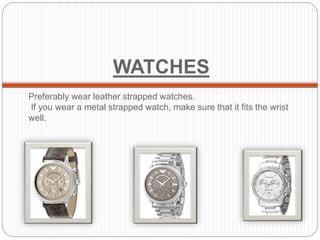
WATCHES
Preferably wear leather strapped watches.
If you wear a metal strapped watch, make sure that it fits the wrist
well.
ALL IS WELL…!

Body language

  • 2.
    WHAT IS BODYLANGUAGE?  Communicating NON-VERBAL  Body movements  Postures  Gestures  Expressions
  • 3.
    Why body languageis important?  10% only words  60% visuals  30% vocal
  • 4.
    SOME BEST BODYLANGUAGE POSSESSORS Bill Gates Steve Jobs Bill Clinton
  • 5.
  • 6.
    SEVEN UNIVERSAL EXPRESSIONS 1.Happiness 2. Sadness 3. Angry 4. Fear 5. Surprise 6. Contempt 7. Disgust
  • 8.
    EYES (AS YOUSEE THEM) Eyes - upward to the right (their left). Trying to recall memories. Eyes - upwards to the left (their right). Creating visual images (we think in pictures).
  • 9.
    A hand overthe mouth whilst talking indicates deceit. A desire to try and stop the words coming out of the mouth.
  • 10.
  • 11.
    Is an evaluationsignal. Generally a positive evaluation. It's a time for thought process. Women - bottom of the chin
  • 12.
    Is an evaluationgesture. It is generally a positive evaluation of your ideas, suggestions, information or requests.
  • 13.
    She may feelcomfortable. She may look cool. Careful, You have a very negative signal, even if she is smiling.
  • 14.
    The lowered staplingof the hands indicates listening, and can also be a negative confidence gesture.
  • 15.
    The scratch tothe back of the neck indicates uncertainty.
  • 16.
    It can meannervousness or deceit. It can mean a desire to shut out the words they are hearing, or the words aren't 'going in'. they've heard enough.
  • 17.
    Hot under thecollar! People touch their face 10 times more than normal when they feel uncomfortable. When you lie, you feel a tingling sensation around your face and neck, and feel you need to touch or relieve the area.
  • 18.
    Hand clasping ata desk or in a chair on its own may indicate nervousness, insecurity or anxiety. The more tightly clasped they are, the more the anxiety.
  • 19.
    Clasped hands infront of the body are a barrier signal, seeking reassurance.
  • 20.
    The higher thehands are , the more confident the feeling.
  • 21.
    Here's the motherof all confidence gestures. This gesture can denote even arrogance. The most supreme will be when the chair is tilted back onto two legs.
  • 22.
    Crossed legs canbe comfort, but often indicate negativity. Holding a clipboard
  • 23.
  • 24.
    Indicate lethargy. They maybedon't want to be there
  • 25.
    Indicate indifference. The attentionthey are giving you is minimal.
  • 26.
    It normally indicatesmild confrontation and stubbornness at that point.
  • 27.
    This is blatantterritorial ownership. Claiming territory. It could easily be disregard of other people's territory if it were say your feet on someone else's desk.
  • 28.
    This is anaggressive gesture, indicating their hidden behavior as being aggressive.
  • 29.
    Watch for people'sfeet movements.
  • 30.
  • 31.
  • 32.
    Evaluation Hand to cheek or Beardstroking or Lowered specs or Pinching the bridge of nose
  • 33.
    Suspicion & secretive Sidewayglance or Touching nose or Rubbing ear/behind or Rubbing eyes or Hand over mouth
  • 34.
  • 35.
    Reassurance Clenched hands withthumbs rubbing Or hand pinching or Women- adjusting necklace
  • 36.
    Frustration Back of head or Tightlyclenched hands or Wringing hands or Pain in neck or Hot under collar
  • 37.
  • 38.
    Here's a neutralposition. Sat upright, legs together, arms apart, possibly with the palms of the hands showing, indicating honesty and sincerity.
  • 39.
    BODY LANGUAGE Two basicgroups of Body Language Open/closed Forward/back
  • 40.
  • 41.
  • 42.
    WET FISH froma man this normally means a weak character, someone who is easily persuaded. THE BONE CRUSH handshake It's a show of strength and dominant character to the extreme.
  • 43.
    A palm downhandshake indicates control. Anyone who gives you a handshake with two hands, when first meeting you, is likely to be insincere and overwhelming, or even deceitful.
  • 44.
  • 45.
  • 46.
  • 47.
    BODY LANGUAGE -movement • Donot be frozen • Display energy & variety • Purpose
  • 48.
    BODY LANGUAGE -movement • Forward- making point • Backward • Sides
  • 49.
    BODY LANGUAGE Clothes :23% + Gestures : 57% + Facial expressions : 20%
  • 51.
    Main Aspects OfBody Language
  • 52.
    Ways of talking Talkingis not only what you say but also how you say it.  By stressing some words in a sentence, you can change the entire meaning of it without changing the structure of the sentence.  Paralanguage
  • 53.
    Ways of talking Some people feel comfortable speaking very fast, however the listeners are not able to understand them.  The pitch of the voice plays a main role for example the low tone indicates that the person is shy or uncomfortable, but when the tone of a person is high then people say that he is confident.
  • 54.
    Head Movements The headcan send such a wide range of signals. Head nod shows a positive signal. Head shake symbolizes no or negative. Continue head nod shows your attention. Tilting the head sideways can be a sign of interest.
  • 55.
    Eye Movements  Theeyes are often called, 'the windows of the soul'  When a person looks upwards they are often thinking. In particular they are probably making pictures in their head and thus may well be an indicator of a visual thinker.  Looking down can thus be a signal of submission. It can also indicate that the person is feeling guilty.
  • 56.
    Eye Movements  Aquick glance sideways indicates the source of a distraction.  Gazing at something shows an interest in it.  Staring generally indicates particular interest in something or someone.  People lower or knit their eyebrows to show disagreement.  Frown when in displeasure.  Rubbing eyes denotes tiredness or upset.  Direct eye contact shows attention and interest.
  • 57.
    Eye Movements Closing oneeye in a wink is a deliberate gesture that often suggests conspiratorial. Blinking eyes infrequently is probably due to boredom.
  • 58.
    Mouth Biting lip. Pursing lips. Nailbiting. Smile head tilted ,looking up. Tight lipped smile. Dropped jaw smile. Chewing gum. Hand clamped over mouth.
  • 59.
    Facial Expression Human faceis extremely expressive.  Face can encode a variety of communicative and informative messages. Facial expressions are universal.  Face is the most reliable indicator of emotions.  Blushing.  Smiling.  Frowning.
  • 60.
    Sound Laughter is composedof a broad range of gesture and sounds. ‘Ha-Ha’ is a genuine laughter. ‘He-He’ is a mocking laughter. ‘Hee-Hee’ indicates a secret giggle. ‘Ho-Ho’ communicates surprise.
  • 61.
    Walking Gestures  Armsswinging  Hands in pocket  Hands on hips  Meditative walk  Confidence walk  Leadership walk  Pacing  swagger
  • 62.
    Message clusters Aggressivebody language  Assertive body language.  Attentive body language.  Bored body language.  Closed body language.  Deceptive body language.  Defensive body language.  Dominant body language.  Emotional body language.  Evaluating body language.  Greeting body language.  Open body language.
  • 63.
    Message clusters Power bodylanguage. Ready body language. Relaxed body language. Sales body language. Submissive body language.
  • 64.
    Do’s and theDon'ts How do I know as to what I am doing is right or not ……..???? OR What is My Body Language like !!!!! Let us find out.
  • 65.
    Ways to improveBody Language Don’t cross your legs or arms Have eye contact ,but don’t stare Don’t be afraid to take up some space Relax your shoulders Nod when they are talking Don’t slouch ,sit up straight Lean but not tat too much Smile and laugh
  • 66.
    Ways to improveBody Language Don’t touch your face. Keep your head up. Slow down a bit. Don’t fidget. Use your hands more confidently. Realize where your spine ends. Don’t stand too close. Mirror. Keep a good attitude.
  • 67.
    Positive body language Facialexpressions should be natural and friendly: raise eyebrows to show surprise , open eyes wide , curl your eyebrows . Body movement move forward to emphasize move to side to indicate a transition gesture up and down head motions pen or pointer to indicate part, place (on a transparency) shrug shoulder to indicate I don't know or care.
  • 68.
    Positive body language Hand Beconscious of what you do with your hands If you are unhappy, hold notes or cards to occupy them. arm - movements back and forth to suggest flow. Open arms to include or welcome ideas . Posture stand straight but relaxed. Lean forward to emphasize however. No hands in pockets.
  • 69.
    Negative body language Failing to make eye contact.  Looking at the screen/board means your back is turned to the audience cutting contact.  Don't stare, or look blankly into people's eyes .  Avoid swaying back and forth like a pendulum.  Avoid leaning against walls .  Be aware of your nervous tics.  Do not fold your arms like a barrier.  While one hand in a pocket gives a very relaxed pose, both hands in pockets looks too casual and should be avoided.
  • 70.
  • 71.
    GROOMING & APPERANCE Dressing have an impact on Self, Colleague & Customers  Your clothes convey the message that you are Confident, Presentable, Ambitious & Sincere
  • 72.
    Benefits of Grooming 1.Makes one look Attractive 2. Builds up Self Confidence 3. Helps in better Appearance
  • 73.
  • 74.
    Wear Formal Shirtsin Office As a rule, the simpler the better. Colours you can choose : White, off white, pale, blue shirts are preferred; though you may wear dark colored shirts too. (given below are the colours preferred by professionals).
  • 75.
    Don’t Wear !! Shirtswith thick stripes and checks
  • 76.
    TROUSERS: 1. They shouldpreferably be dark though you may wear beige and with a dark colored shirt. 2. Try to have at least one pair of black trousers. 3. Trousers may or may not have pleats
  • 77.
    TIES  To playit safe choose a traditional silk tie.  No loud colours or patterns. Given below are some well accepted colours and patterns  It may be wise to avoid ties with images and designer logos
  • 78.
    Apt Look ofTie Your tie should co-ordinate with your attire The knot should be a perfect triangle.
  • 79.
  • 80.
    SOCKS  Choose acolor that coordinates with your trousers (usually black, dark gray, dark brown, or dark blue) Make sure they are long enough not to expose your skin when you sit down. As a thumb rule, do not wear white socks. Wear clean socks to avoid bad odour
  • 81.
    SHOES Wear a goodpair of leather shoes- black and brown/tan shoes. Shoes must be polished everyday.
  • 82.
    DON’T Do not wearshoes that look casual. Also, do not wear shoes with worn out heels.
  • 83.
    BELTS Wear only formalbelts with a sleek buckle. As thumb rule, match your belt to your shoes.
  • 84.
  • 85.
    WATCHES Preferably wear leatherstrapped watches. If you wear a metal strapped watch, make sure that it fits the wrist well.
  • 87.