Presenter: Dr. Shashi K. Singh
Moderater: Dr. Kumar Shrestha, Dr. Piyush,
Dr. Jainendra Chaudhary, Dr. Indra K. Jha
• Burns is defined as a wound caused by
exogenous agent leading to coagulative
necrosis of the tissue.
Causes
• Thermal Burns
Dry heat
Contact burn
Flame burn
Moist heat- Scald burn
Smoke and inhalational injury
• Chemical Burns- acids & alkali
• Electrical burns- High & low voltage
• Cold Burns- frostbite
• Radiation
Thermal Burns
• Heat changes the molecular structure of tissue
Causing Denaturion of proteins
• Extent of burn damage depends on
–Temperature of agent
–Amount of heat
–Duration of contact
• The effects of the burns are influenced by
the:
1.Intensity of the energy
2.duration of exposure
3.type of tissue injured
Pathophysiology of Burns
• Fluid Shift
– Period of inflammatory response
– Vessels adjacent to burn injury dilate → ↑ capillary
hydrostatic pressure and ↑ capillary permeability
– Continuous leak of plasma from intravascular space into
interstitial space
– Associated imbalances of fluids, electrolytes and acid-base
occur
– Hemoconcentration
– Lasts 24-36 hours
• Fluid remobilization
– Capillary leak ceases and fluid shifts back into the
circulation
– Restores fluid balance and renal perfusion
• Increased urine formation and diuresis
– Continued electrolyte imbalances
• Hyponatremia
• Hypokalemia
– Hemodilution
SYSTEMIC CHANGES
• Cardiac
– Decreased cardiac output
• Pulmonary
– Respiratory insufficiency as a secondary process
– Can progress to respiratory failure
– Aggressive pulmonary toilet and oxygenation
• Gastrointestinal
– Decreased or absent motility (may need NG tube)
– Curling’s ulcer formation
• Metabolic
– Hypermetabolic state
• Increased oxygen and calorie requirements
• Increase in core body temperature
• Immunologic
– Loss of protective barrier
– Increased risk of infection
– Suppression of humoral and cell-mediated immune
responses
ACUTE PHASE
• Clinical shock
• External loss of plasma
• Loss of circulating red cells
• Burn edema
SUB ACUTE PHASE
• Diuresis
• Clinical Anemia
• Accelerated metabolic rate
• Nitrogen Disequilibrium
• Bone and joint changes
• Endocrine Disturbances
• Electrolyte and chemical imbalance
• Circulatory Derangements
• Loss of of function of skin as an organ
Body’s Response to Burns
• Emergent Phase (Stage 1)
– Pain response
– Catecholamine release
– Tachycardia, Tachypnea, Mild Hypertension, Mild
Anxiety
• Fluid Shift Phase (Stage 2)
– Length 18-24 hours
– Begins after Emergent Phase
• Reaches peak in 6-8 hours
– Damaged cells initiate inflammatory response
• Increased blood flow to cells
• Shift of fluid from intravascular to extravascular space
– MASSIVE EDEMA
• Hypermetabolic Phase (Stage 3)
–Last for days to weeks
–Large increase in the body’s need for
nutrients as it repairs itself
• Resolution Phase (Stage 4)
–Scar formation
–General rehabilitation and progression to
normal function
Jackson’s Theory of Thermal Wounds
• Jackson’s Theory of Thermal Wounds
– Zone of Coagulation
• Area in a burn nearest the heat source that suffers the most
damage as evidenced by clotted blood and thrombosed
blood vessels
– Zone of Stasis
• Area surrounding zone of coagulation characterized by
decreased blood flow.
– Zone of Hyperemia
• Peripheral area around burn that has an increased blood
flow
Severity is determined by:
–depth of burn
–extend of burn calculated in percent of total
body surface (TBSA)
–location of burn
–patient risk factors
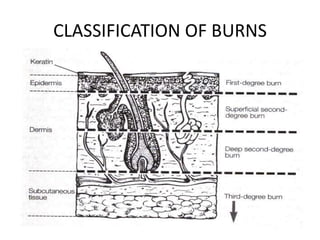
CLASSIFICATION OF BURNS
• First degree—injury localized to the
epidermis
• Superficial second degree—injury to the
epidermis and superficial papillary dermis
• Deep second degree—injury through the
epidermis and deep upto reticular dermis
• Third degree—full-thickness injury through the
epidermis and dermis into subcutaneous fat
• Fourth degree—injury through the skin and
subcutaneous fat into underlying muscle or
bone
CLASSIFICATION OF BURNS
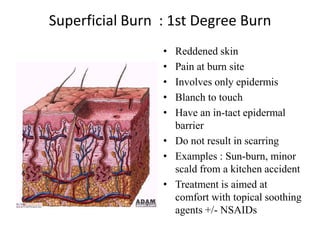
Superficial Burn : 1st Degree Burn
• Reddened skin
• Pain at burn site
• Involves only epidermis
• Blanch to touch
• Have an in-tact epidermal
barrier
• Do not result in scarring
• Examples : Sun-burn, minor
scald from a kitchen accident
• Treatment is aimed at
comfort with topical soothing
agents +/- NSAIDs
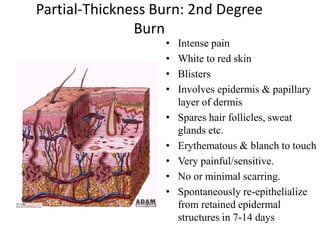
Partial-Thickness Burn: 2nd Degree
Burn
• Intense pain
• White to red skin
• Blisters
• Involves epidermis & papillary
layer of dermis
• Spares hair follicles, sweat
glands etc.
• Erythematous & blanch to touch
• Very painful/sensitive.
• No or minimal scarring.
• Spontaneously re-epithelialize
from retained epidermal
structures in 7-14 days
Deep second degree burn
• Injury to deeper layers of dermis –
reticular dermis
• Appears pale & mottled
• Do not blanch to touch
• Capillary return sluggish or absent
• Less painful, remain painful to pinprick
• Takes 14 to 35 days to heal by
re-epithelialisation from hair
follicles & sweat gland,
keratinocytes often with severe scarring
• Contractures possible
• Require excision & skin grafting
Full-Thickness Burn:3rd Degree Burn
• Dry, leathery skin
(white, dark
brown, or
charred)
• Loss of sensation
(little pain)
• All dermal
layers/tissue may
be involved
• Always require
surgery.
Fourth degree burn
• Involves structures beneath the skin- muscle,
bone.
ASSESSMENT OF BURNS
• Rule of Nine
–Best used for large surface areas
–Expedient tool to measure extent of burn
• Rule of Palms
–Best used for burns < 10% BSA
AREA OF PALM = 1% BODY SURFACE AREA
Management
Pre-hospital care
• Ensure rescuer safety
• Stop the burning process: Stop, drop and roll
• Check for other injuries.
A standard ABC (airway, breathing, circulation)
check followed by a rapid secondary survey.
• Cool the burn wound:
Analgesia
Slows the delayed microvascular damage,
Minimum of 10 min
Effective up to 1 hour after the burn injury
• Give oxygen
• Elevate
Hospital care
• A : Airway control.
• B :Breathing and ventilation.
• C :Circulation.
• D: Disability – neurological status.
• E :Exposure with environmental control.
• F :Fluid resuscitation.
The criteria for acute admission to a burns unit
• Suspected airway or inhalational injury
• Any burn likely to require fluid resuscitation
• Any burn likely to require surgery
• Patients with burns of any significance to the hands, face,
feet or perineum
• Patients whose psychiatric or social background makes it
• inadvisable to send them home
• Any suspicion of non-accidental injury
• Any burn in a patient at the extremes of age
• Any burn with associated potentially serious sequelae
• including high-tension electrical burns and concentrated
• hydrofluoric acid burns
Airway
Recognition of the potentially burned
airway
• A history of being trapped in the presence of
smoke or hot Gases
• Burns on the palate or nasal mucosa, or loss of
all the hairs
• in the nose : Deep burns around the mouth and
neck
Airway
• Burned airway
• Early elective intubation is safest
• Delay can make intubation very difficult
because of Swelling
• Be ready to perform an emergency
cricothyroidotomy if intubation is delayed
Breathing
• Inhalational injury
• Thermal burn injury to the lower airway
• Metabolic poisoning:Carboxyhaemoglobin
• Mechanical block to breathing:Escharotomy
Circulation
• Maintain iv line with wide bore canula
peripherally
• One central line
• Escharotomy of limbs if circulatory
compromise in circumferential burns
Fluids for resuscitation
• In children with burns over 10% TBSA and
adults with burns over 15% TBSA, consider
the need for intravenous fluid resuscitation
• If oral fluids are to be used, salt must be added
• Fluids needed can be calculated from a
standard formula
• The key is to monitor urine output
• Parkland Formula:
Total percentage body surface area × weight
(kg) × 4 = volume (ml)
• Half this volume is given in the first 8 hours,
and
• the second half is given in the subsequent 16
hours.
• Crystalloid : Ringer lactate
• Hypertonic saline
• Human albumin solution
• Colloid resuscitation
• The commonest colloid-based formula is the
Muir and Barclay formula:
0.5 × percentage body surface area burnt ×
weight = one portion;
• Periods of 4/4/4, 6/6 and 12 hours
respectively;
• one portion to be given in each period.
Assessment of adequacy of fluid
replacement
• Urine output is most commonly used parameter
• Urine osmolarity is the most accurate parameter
• U/O > 0.5-1.0 ml/kg/hr
• CVP 5-10 cm/H2O.
• U/O > 2ml/kg/hr – sign of overhydration
Fluid Resuscitation Complications
• Overresuscitation complications:
Poor tissue perfusion
Compartment syndrome
Pulmonary edema
Pleural effusion
Electrolyte abnormalities
TREATING THE BURN WOUND
Escharotomy
• Circumferential full-thickness burns to the
limbs require emergency surgery.
• The tourniquet effect of this injury is easily
treated by incising the whole length of full-
thickness burns.
.
Escharotomy
• Incise along medial
and/or lateral surfaces.
• Avoid bony
prominences.
• Avoid tendons, nerves,
major vessels.
Escharotomy
• Upper limb: Mid-axial, anterior to the elbow
medially to avoid the ulnar nerve
• Hand : Midline in the digits. Release muscle
compartments if tight.
• Lower limb: Mid-axial, Posterior to the ankle
medially to avoid the saphenous vein
• Chest: Down the chest lateral to the nipples,
across the chest below the clavicle and across
the chest at the level of the xiphisternum
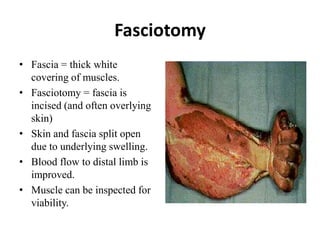
Fasciotomy
• Fascia = thick white
covering of muscles.
• Fasciotomy = fascia is
incised (and often overlying
skin)
• Skin and fascia split open
due to underlying swelling.
• Blood flow to distal limb is
improved.
• Muscle can be inspected for
viability.
Debridement
• Types of debridement:
1. Auto debridement.
2. Tangential excision (at the end of 1st week)
3. Staged primary debridement (1-3 days post
burn).
This early debridement of dead tissue interrupts
and attenuates the systemic inflammatory
response and normalize immune function.
4. For deep circumferential burn, urgent
escharotomy is done
BLISTERS
• Intact blister- barrier to microbial invasion
• Intact blister creates moist environment hence
more rapid reepithelialization
• More rapid angiogenesis
• Rupture of blisters under contaminated
conditions may increase infection rates
BLISTERS
• In the pre-hospital setting, there is no hurry to
remove blisters.
• Leaving the blister intact initially is less
painful and requires fewer dressing changes.
• The blister will either break on its own,
or the fluid will be resorbed.
• Analgesia
Acute
• Small superficial burns : simple oral analgesia,
Topical cooling
• Large burns: intravenous opiates.
Subacute
• Large burns: continuous analgesia is required,
beginning with infusions and continuing with oral
tablets such as slow-release morphine.
Nutrition
• Burns patients need extra feeding
• A nasogastric tube should be used in all
patients with burns over 15% of TBSA
• Removing the burn and achieving healing
stops the catabolic drive.
Nutrition
Sutherland formula
• Children: 60 kcal/ kg + 35 kcal%TBSA
• Adults: 20 kcal /kg + 70 kcal%TBSA
Protein
20% of energy
1.5 to 2 g/kg protein/day
Tetanus prophylaxis
• Tetanus toxoid, 0.5 mL intramuscularly, if the
last booster dose was more than 5 years before
the injury.
• If immunization status is unknown,
human tetanus immunoglobulin 250 to 500
units, I.M. plus tetanus toxoid in opposite side
Monitoring and control of infection
• Burns patients are immunocompromised
• They are susceptible to infection from many
routes
• Sterile precautions must be rigorous
• Swabs should be taken regularly
• A rise in white blood cell count,
thrombocytosis and increased catabolism are
warnings of infection
Topical treatment of deep burns
• 1% silver sulphadiazine cream
• 0.5% silver nitrate solution
• Mafenide acetate cream
• Serum nitrate, silver sulphadiazine and cerium
nitrate
Principles of dressings for burns
• Full-thickness and deep dermal burns need
antibacterial dressings to delay colonisation
prior to surgery
• Superficial burns will heal and need simple
dressings
• An optimal healing environment can make a
difference to outcome in borderline depth
burns
Surgical treatment of deep burns
• Early debridement and grafting is the key to effectively
treating
• deep partial- and full-thickness burns in a majority of
cases
• Deep dermal burns need tangential shaving and split-
skin grafting
• All but the smallest full-thickness burns need surgery
• Should be ready for significant blood loss
• Topical adrenaline reduces bleeding
• All burnt tissue needs to be excised
Surgical treatment of deep burns
• Proper dressing should be done
• Postoperative management requires careful
evaluation of fluid balance and levels of
haemoglobin.
• Physiotherapy and splints are important in
maintaining range of movement and reducing
joint contracture
Delayed reconstruction of burns
• Eyelids must be treated before exposure
keratitis arises
• Transposition flaps and Z-plasties with or
without tissue expansion are useful
• Full-thickness grafts and free flaps may be
needed for large or difficult areas
• Hypertrophy is treated with pressure
garments/Silicone patch(6-18 month)
• Pharmacological treatment of itch is important
Chemical Burns
Chemical Burns
Acids
• Protein injury by hydrolysis.
• Thermal injury is made with skin contact.
Alkali
• Saponification of fat
• Hygroscopic effect- dehydrates cells
• Dissolves proteins by creation of alkaline
proteinates (hydroxide ions)
Electrical Burns
Electrical Burns
• Greatest heat occurs at the points of resistance
– Entrance and Exit wounds
– Dry skin = Greater resistance
– Wet Skin = Less resistance
• Longer the contact, the greater the potential of
injury
– Increased damage inside body
• Smaller the point of contact, the more
concentrated the energy, the greater the injury.
• Electrical Current Flow
–Tissue of Less Resistance
• Blood vessels
• Nerve
–Tissue of Greater Resistance
• Muscle
• Bone
Results in………..
–Serious vascular and nervous injury
–Immobilization of muscles
–Flash burns
– Late complications: cataracts, progressive
demyelinating neurologic loss
– Assess patient
• Entrance & Exit wounds
• Remove clothing, jewelry, and leather items
• Treat any visible injuries
– Thermal burns
• ECG monitoring
– Bradycardia, Tachycardia, VF or Asystole
– Treat cardiac & respiratory arrest
– Aggressive airway, ventilation, and circulatory management.
• Consider Fluid bolus for serious burns
– 20 ml/kg
• Consider Sodium Bicarbonate: 1 mEq/kg
• Consider Mannitol: 10 g
Radiation burns
• Local burns causing ulceration need excision
and vascularised flap cover – usually with free
flaps
• Systemic overdose needs supportive treatment
Cold injuries
• The damage is more difficult to define and
slower to develop than burns
• Acute frostbite needs rapid rewarming, then
observation
• Delay surgery until demarcation is clear
THANKYOU

Burn ppt shashi

  • 1.
    Presenter: Dr. ShashiK. Singh Moderater: Dr. Kumar Shrestha, Dr. Piyush, Dr. Jainendra Chaudhary, Dr. Indra K. Jha
  • 2.
    • Burns isdefined as a wound caused by exogenous agent leading to coagulative necrosis of the tissue.
  • 3.
    Causes • Thermal Burns Dryheat Contact burn Flame burn Moist heat- Scald burn Smoke and inhalational injury • Chemical Burns- acids & alkali • Electrical burns- High & low voltage • Cold Burns- frostbite • Radiation
  • 4.
    Thermal Burns • Heatchanges the molecular structure of tissue Causing Denaturion of proteins • Extent of burn damage depends on –Temperature of agent –Amount of heat –Duration of contact
  • 5.
    • The effectsof the burns are influenced by the: 1.Intensity of the energy 2.duration of exposure 3.type of tissue injured
  • 6.
    Pathophysiology of Burns •Fluid Shift – Period of inflammatory response – Vessels adjacent to burn injury dilate → ↑ capillary hydrostatic pressure and ↑ capillary permeability – Continuous leak of plasma from intravascular space into interstitial space – Associated imbalances of fluids, electrolytes and acid-base occur – Hemoconcentration – Lasts 24-36 hours
  • 7.
    • Fluid remobilization –Capillary leak ceases and fluid shifts back into the circulation – Restores fluid balance and renal perfusion • Increased urine formation and diuresis – Continued electrolyte imbalances • Hyponatremia • Hypokalemia – Hemodilution
  • 8.
    SYSTEMIC CHANGES • Cardiac –Decreased cardiac output • Pulmonary – Respiratory insufficiency as a secondary process – Can progress to respiratory failure – Aggressive pulmonary toilet and oxygenation • Gastrointestinal – Decreased or absent motility (may need NG tube) – Curling’s ulcer formation
  • 9.
    • Metabolic – Hypermetabolicstate • Increased oxygen and calorie requirements • Increase in core body temperature • Immunologic – Loss of protective barrier – Increased risk of infection – Suppression of humoral and cell-mediated immune responses
  • 10.
    ACUTE PHASE • Clinicalshock • External loss of plasma • Loss of circulating red cells • Burn edema
  • 11.
    SUB ACUTE PHASE •Diuresis • Clinical Anemia • Accelerated metabolic rate • Nitrogen Disequilibrium • Bone and joint changes • Endocrine Disturbances • Electrolyte and chemical imbalance • Circulatory Derangements • Loss of of function of skin as an organ
  • 12.
    Body’s Response toBurns • Emergent Phase (Stage 1) – Pain response – Catecholamine release – Tachycardia, Tachypnea, Mild Hypertension, Mild Anxiety • Fluid Shift Phase (Stage 2) – Length 18-24 hours – Begins after Emergent Phase • Reaches peak in 6-8 hours – Damaged cells initiate inflammatory response • Increased blood flow to cells • Shift of fluid from intravascular to extravascular space – MASSIVE EDEMA
  • 13.
    • Hypermetabolic Phase(Stage 3) –Last for days to weeks –Large increase in the body’s need for nutrients as it repairs itself • Resolution Phase (Stage 4) –Scar formation –General rehabilitation and progression to normal function
  • 14.
    Jackson’s Theory ofThermal Wounds • Jackson’s Theory of Thermal Wounds – Zone of Coagulation • Area in a burn nearest the heat source that suffers the most damage as evidenced by clotted blood and thrombosed blood vessels – Zone of Stasis • Area surrounding zone of coagulation characterized by decreased blood flow. – Zone of Hyperemia • Peripheral area around burn that has an increased blood flow
  • 16.
    Severity is determinedby: –depth of burn –extend of burn calculated in percent of total body surface (TBSA) –location of burn –patient risk factors
  • 17.
    CLASSIFICATION OF BURNS •First degree—injury localized to the epidermis • Superficial second degree—injury to the epidermis and superficial papillary dermis • Deep second degree—injury through the epidermis and deep upto reticular dermis • Third degree—full-thickness injury through the epidermis and dermis into subcutaneous fat • Fourth degree—injury through the skin and subcutaneous fat into underlying muscle or bone
  • 18.
  • 19.
    Superficial Burn :1st Degree Burn • Reddened skin • Pain at burn site • Involves only epidermis • Blanch to touch • Have an in-tact epidermal barrier • Do not result in scarring • Examples : Sun-burn, minor scald from a kitchen accident • Treatment is aimed at comfort with topical soothing agents +/- NSAIDs
  • 20.
    Partial-Thickness Burn: 2ndDegree Burn • Intense pain • White to red skin • Blisters • Involves epidermis & papillary layer of dermis • Spares hair follicles, sweat glands etc. • Erythematous & blanch to touch • Very painful/sensitive. • No or minimal scarring. • Spontaneously re-epithelialize from retained epidermal structures in 7-14 days
  • 21.
    Deep second degreeburn • Injury to deeper layers of dermis – reticular dermis • Appears pale & mottled • Do not blanch to touch • Capillary return sluggish or absent • Less painful, remain painful to pinprick • Takes 14 to 35 days to heal by re-epithelialisation from hair follicles & sweat gland, keratinocytes often with severe scarring • Contractures possible • Require excision & skin grafting
  • 22.
    Full-Thickness Burn:3rd DegreeBurn • Dry, leathery skin (white, dark brown, or charred) • Loss of sensation (little pain) • All dermal layers/tissue may be involved • Always require surgery.
  • 23.
    Fourth degree burn •Involves structures beneath the skin- muscle, bone.
  • 25.
    ASSESSMENT OF BURNS •Rule of Nine –Best used for large surface areas –Expedient tool to measure extent of burn • Rule of Palms –Best used for burns < 10% BSA
  • 27.
    AREA OF PALM= 1% BODY SURFACE AREA
  • 29.
    Management Pre-hospital care • Ensurerescuer safety • Stop the burning process: Stop, drop and roll • Check for other injuries. A standard ABC (airway, breathing, circulation) check followed by a rapid secondary survey.
  • 30.
    • Cool theburn wound: Analgesia Slows the delayed microvascular damage, Minimum of 10 min Effective up to 1 hour after the burn injury • Give oxygen • Elevate
  • 31.
    Hospital care • A: Airway control. • B :Breathing and ventilation. • C :Circulation. • D: Disability – neurological status. • E :Exposure with environmental control. • F :Fluid resuscitation.
  • 32.
    The criteria foracute admission to a burns unit • Suspected airway or inhalational injury • Any burn likely to require fluid resuscitation • Any burn likely to require surgery • Patients with burns of any significance to the hands, face, feet or perineum • Patients whose psychiatric or social background makes it • inadvisable to send them home • Any suspicion of non-accidental injury • Any burn in a patient at the extremes of age • Any burn with associated potentially serious sequelae • including high-tension electrical burns and concentrated • hydrofluoric acid burns
  • 33.
    Airway Recognition of thepotentially burned airway • A history of being trapped in the presence of smoke or hot Gases • Burns on the palate or nasal mucosa, or loss of all the hairs • in the nose : Deep burns around the mouth and neck
  • 34.
    Airway • Burned airway •Early elective intubation is safest • Delay can make intubation very difficult because of Swelling • Be ready to perform an emergency cricothyroidotomy if intubation is delayed
  • 35.
    Breathing • Inhalational injury •Thermal burn injury to the lower airway • Metabolic poisoning:Carboxyhaemoglobin • Mechanical block to breathing:Escharotomy
  • 36.
    Circulation • Maintain ivline with wide bore canula peripherally • One central line • Escharotomy of limbs if circulatory compromise in circumferential burns
  • 37.
    Fluids for resuscitation •In children with burns over 10% TBSA and adults with burns over 15% TBSA, consider the need for intravenous fluid resuscitation • If oral fluids are to be used, salt must be added • Fluids needed can be calculated from a standard formula • The key is to monitor urine output
  • 38.
    • Parkland Formula: Totalpercentage body surface area × weight (kg) × 4 = volume (ml) • Half this volume is given in the first 8 hours, and • the second half is given in the subsequent 16 hours.
  • 39.
    • Crystalloid :Ringer lactate • Hypertonic saline • Human albumin solution • Colloid resuscitation
  • 40.
    • The commonestcolloid-based formula is the Muir and Barclay formula: 0.5 × percentage body surface area burnt × weight = one portion; • Periods of 4/4/4, 6/6 and 12 hours respectively; • one portion to be given in each period.
  • 41.
    Assessment of adequacyof fluid replacement • Urine output is most commonly used parameter • Urine osmolarity is the most accurate parameter • U/O > 0.5-1.0 ml/kg/hr • CVP 5-10 cm/H2O. • U/O > 2ml/kg/hr – sign of overhydration
  • 42.
    Fluid Resuscitation Complications •Overresuscitation complications: Poor tissue perfusion Compartment syndrome Pulmonary edema Pleural effusion Electrolyte abnormalities
  • 43.
    TREATING THE BURNWOUND Escharotomy • Circumferential full-thickness burns to the limbs require emergency surgery. • The tourniquet effect of this injury is easily treated by incising the whole length of full- thickness burns. .
  • 44.
    Escharotomy • Incise alongmedial and/or lateral surfaces. • Avoid bony prominences. • Avoid tendons, nerves, major vessels.
  • 45.
    Escharotomy • Upper limb:Mid-axial, anterior to the elbow medially to avoid the ulnar nerve • Hand : Midline in the digits. Release muscle compartments if tight. • Lower limb: Mid-axial, Posterior to the ankle medially to avoid the saphenous vein • Chest: Down the chest lateral to the nipples, across the chest below the clavicle and across the chest at the level of the xiphisternum
  • 47.
    Fasciotomy • Fascia =thick white covering of muscles. • Fasciotomy = fascia is incised (and often overlying skin) • Skin and fascia split open due to underlying swelling. • Blood flow to distal limb is improved. • Muscle can be inspected for viability.
  • 48.
    Debridement • Types ofdebridement: 1. Auto debridement. 2. Tangential excision (at the end of 1st week) 3. Staged primary debridement (1-3 days post burn). This early debridement of dead tissue interrupts and attenuates the systemic inflammatory response and normalize immune function. 4. For deep circumferential burn, urgent escharotomy is done
  • 49.
    BLISTERS • Intact blister-barrier to microbial invasion • Intact blister creates moist environment hence more rapid reepithelialization • More rapid angiogenesis • Rupture of blisters under contaminated conditions may increase infection rates
  • 50.
    BLISTERS • In thepre-hospital setting, there is no hurry to remove blisters. • Leaving the blister intact initially is less painful and requires fewer dressing changes. • The blister will either break on its own, or the fluid will be resorbed.
  • 51.
    • Analgesia Acute • Smallsuperficial burns : simple oral analgesia, Topical cooling • Large burns: intravenous opiates. Subacute • Large burns: continuous analgesia is required, beginning with infusions and continuing with oral tablets such as slow-release morphine.
  • 52.
    Nutrition • Burns patientsneed extra feeding • A nasogastric tube should be used in all patients with burns over 15% of TBSA • Removing the burn and achieving healing stops the catabolic drive.
  • 53.
    Nutrition Sutherland formula • Children:60 kcal/ kg + 35 kcal%TBSA • Adults: 20 kcal /kg + 70 kcal%TBSA Protein 20% of energy 1.5 to 2 g/kg protein/day
  • 54.
    Tetanus prophylaxis • Tetanustoxoid, 0.5 mL intramuscularly, if the last booster dose was more than 5 years before the injury. • If immunization status is unknown, human tetanus immunoglobulin 250 to 500 units, I.M. plus tetanus toxoid in opposite side
  • 55.
    Monitoring and controlof infection • Burns patients are immunocompromised • They are susceptible to infection from many routes • Sterile precautions must be rigorous • Swabs should be taken regularly • A rise in white blood cell count, thrombocytosis and increased catabolism are warnings of infection
  • 56.
    Topical treatment ofdeep burns • 1% silver sulphadiazine cream • 0.5% silver nitrate solution • Mafenide acetate cream • Serum nitrate, silver sulphadiazine and cerium nitrate
  • 57.
    Principles of dressingsfor burns • Full-thickness and deep dermal burns need antibacterial dressings to delay colonisation prior to surgery • Superficial burns will heal and need simple dressings • An optimal healing environment can make a difference to outcome in borderline depth burns
  • 58.
    Surgical treatment ofdeep burns • Early debridement and grafting is the key to effectively treating • deep partial- and full-thickness burns in a majority of cases • Deep dermal burns need tangential shaving and split- skin grafting • All but the smallest full-thickness burns need surgery • Should be ready for significant blood loss • Topical adrenaline reduces bleeding • All burnt tissue needs to be excised
  • 59.
    Surgical treatment ofdeep burns • Proper dressing should be done • Postoperative management requires careful evaluation of fluid balance and levels of haemoglobin. • Physiotherapy and splints are important in maintaining range of movement and reducing joint contracture
  • 60.
    Delayed reconstruction ofburns • Eyelids must be treated before exposure keratitis arises • Transposition flaps and Z-plasties with or without tissue expansion are useful • Full-thickness grafts and free flaps may be needed for large or difficult areas • Hypertrophy is treated with pressure garments/Silicone patch(6-18 month) • Pharmacological treatment of itch is important
  • 61.
  • 62.
    Chemical Burns Acids • Proteininjury by hydrolysis. • Thermal injury is made with skin contact. Alkali • Saponification of fat • Hygroscopic effect- dehydrates cells • Dissolves proteins by creation of alkaline proteinates (hydroxide ions)
  • 64.
  • 65.
    Electrical Burns • Greatestheat occurs at the points of resistance – Entrance and Exit wounds – Dry skin = Greater resistance – Wet Skin = Less resistance • Longer the contact, the greater the potential of injury – Increased damage inside body • Smaller the point of contact, the more concentrated the energy, the greater the injury.
  • 66.
    • Electrical CurrentFlow –Tissue of Less Resistance • Blood vessels • Nerve –Tissue of Greater Resistance • Muscle • Bone
  • 67.
    Results in……….. –Serious vascularand nervous injury –Immobilization of muscles –Flash burns – Late complications: cataracts, progressive demyelinating neurologic loss
  • 68.
    – Assess patient •Entrance & Exit wounds • Remove clothing, jewelry, and leather items • Treat any visible injuries – Thermal burns • ECG monitoring – Bradycardia, Tachycardia, VF or Asystole – Treat cardiac & respiratory arrest – Aggressive airway, ventilation, and circulatory management. • Consider Fluid bolus for serious burns – 20 ml/kg • Consider Sodium Bicarbonate: 1 mEq/kg • Consider Mannitol: 10 g
  • 69.
    Radiation burns • Localburns causing ulceration need excision and vascularised flap cover – usually with free flaps • Systemic overdose needs supportive treatment
  • 70.
    Cold injuries • Thedamage is more difficult to define and slower to develop than burns • Acute frostbite needs rapid rewarming, then observation • Delay surgery until demarcation is clear
  • 71.