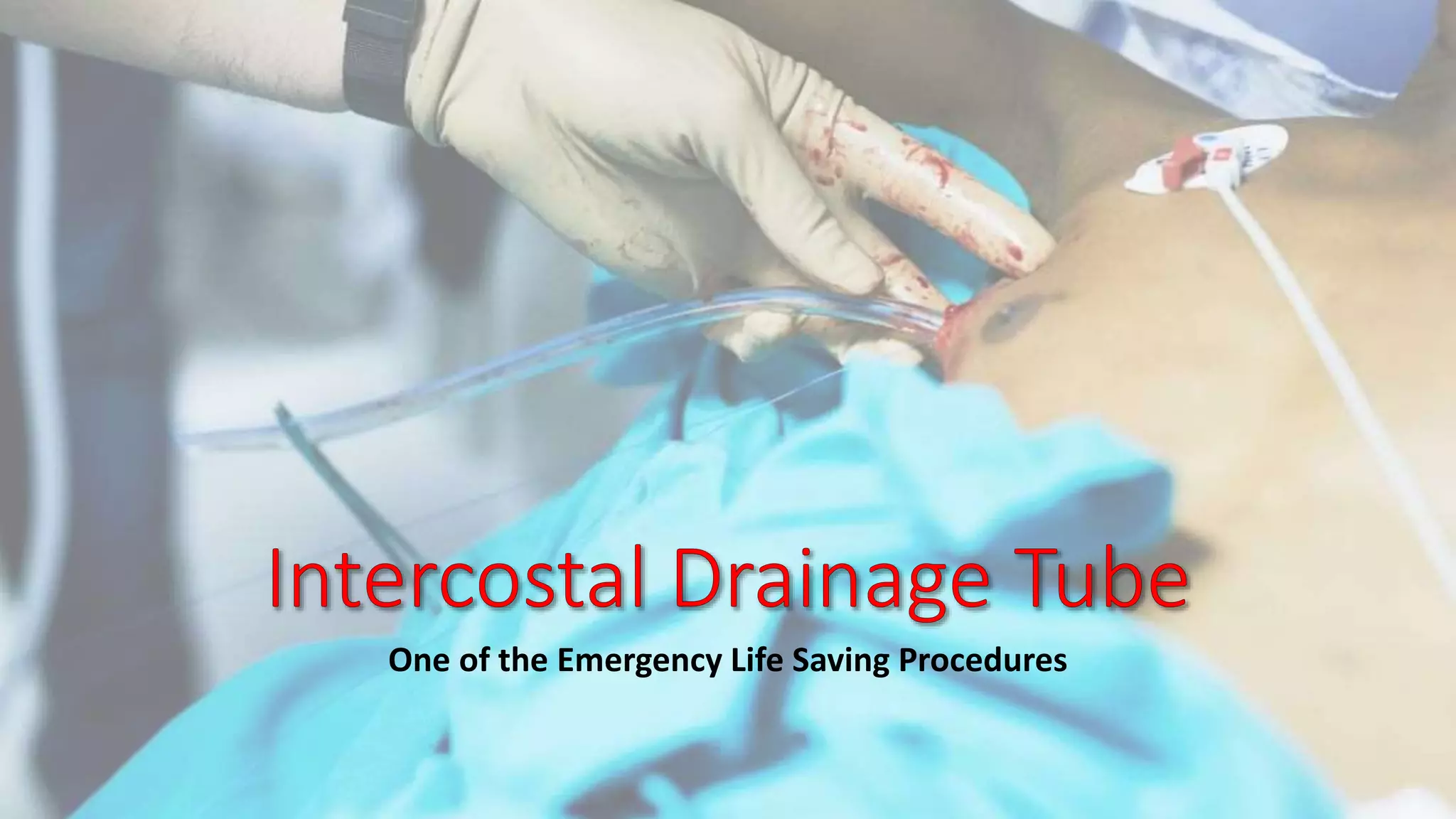
One of the Emergency Life Saving Procedures
Topics to be discussed
• Anatomy
• Physiology
• ICD introduction
• Indications
• ICD insertion technique
• ICD care
• Complications
Anatomy
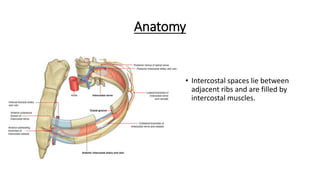
• Intercostal spaces lie between
adjacent ribs and are filled by
intercostal muscles.
Anatomy
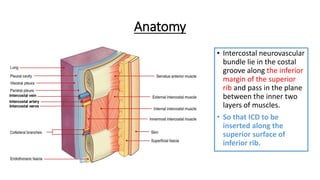
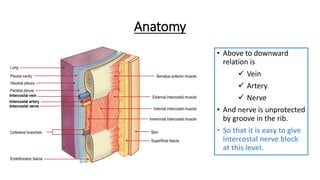
• Intercostal neurovascular
bundle lie in the costal
groove along the inferior
margin of the superior
rib and pass in the plane
between the inner two
layers of muscles.
• So that ICD to be
inserted along the
superior surface of
inferior rib.
Anatomy
• Above to downward
relation is
 Vein
 Artery
 Nerve
• And nerve is unprotected
by groove in the rib.
• So that it is easy to give
intercostal nerve block
at this level.
Anatomy
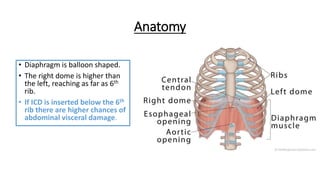
• Diaphragm is balloon shaped.
• The right dome is higher than
the left, reaching as far as 6th
rib.
• If ICD is inserted below the 6th
rib there are higher chances of
abdominal visceral damage.
Anatomy
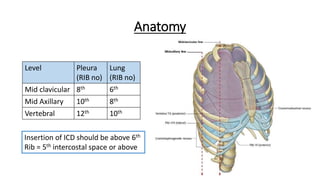
Level Pleura
(RIB no)
Lung
(RIB no)
Mid clavicular 8th 6th
Mid Axillary 10th 8th
Vertebral 12th 10th
Insertion of ICD should be above 6th
Rib = 5th intercostal space or above
Anatomy
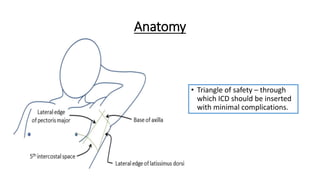
• Triangle of safety – through
which ICD should be inserted
with minimal complications.
Physiology of respiration
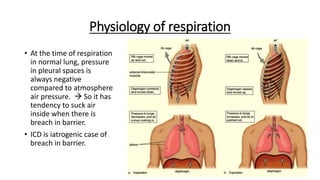
• At the time of respiration
in normal lung, pressure
in pleural spaces is
always negative
compared to atmosphere
air pressure.  So it has
tendency to suck air
inside when there is
breach in barrier.
• ICD is iatrogenic case of
breach in barrier.
Physiology of respiration
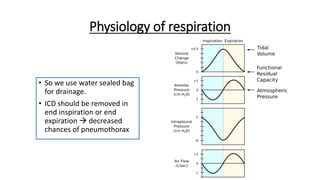
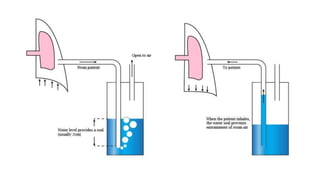
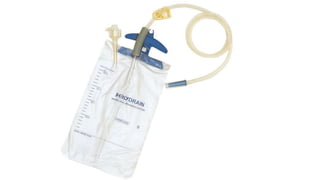
• So we use water sealed bag
for drainage.
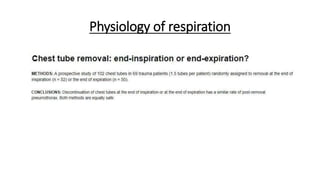
• ICD should be removed in
end inspiration or end
expiration  decreased
chances of pneumothorax
Physiology of respiration
Intercostal Drainage Tube
• The concept of chest drainage was
first advocated by Hippocrates when
he described the treatment
of empyema by means of incision,
cautery, and insertion of metal tubes.
• However, the technique was not
widely used until the influenza
epidemic of 1917 to drain post-
pneumonic empyema, which was first
documented by Dr. C. Pope, on "Joel",
a 22-month-old infant.
• The use of chest tubes in
postoperative thoracic care was
reported in 1922, and they were
regularly used post-thoracotomy
in World War II.
• Though they were not routinely used
for emergency tube thoracostomy
following acute trauma until
the Korean War (1950).
Intercostal Drainage Tube
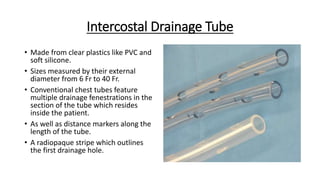
• Made from clear plastics like PVC and
soft silicone.
• Sizes measured by their external
diameter from 6 Fr to 40 Fr.
• Conventional chest tubes feature
multiple drainage fenestrations in the
section of the tube which resides
inside the patient.
• As well as distance markers along the
length of the tube.
• A radiopaque stripe which outlines
the first drainage hole.
Intercostal Drainage Tube
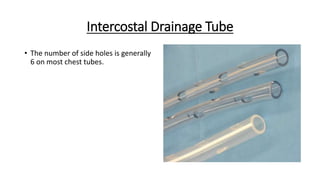
• The number of side holes is generally
6 on most chest tubes.
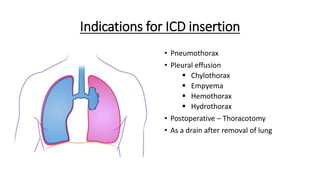
Indications for ICD insertion
• Pneumothorax
• Pleural effusion
 Chylothorax
 Empyema
 Hemothorax
 Hydrothorax
• Postoperative – Thoracotomy
• As a drain after removal of lung
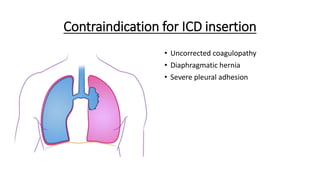
Contraindication for ICD insertion
• Uncorrected coagulopathy
• Diaphragmatic hernia
• Severe pleural adhesion
Patient preparation
• Consent – Informed and Written
• Preparation of materials
• Positioning and marking the site
• Oxygen saturation monitoring
Preparation of materials
• Sterile gloves and gown
• Antiseptic solution
• Atropine Intramuscular and Analgesic
• Local anaesthetic solution
• Sterile gauze
• Scalpel no 11 and 23
• Curved and straight artery forceps
Preparation of materials
• Curved clamp
• Chest tube with connecting tube
• Drainage system ready with 100 cc
saline filled up to mark
• Suture silk no 1
• Dressing material
And obviously an assistant and nursing
staff.
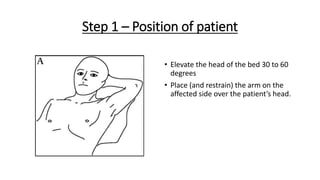
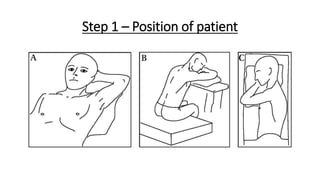
Step 1 – Position of patient
• Elevate the head of the bed 30 to 60
degrees
• Place (and restrain) the arm on the
affected side over the patient’s head.
Step 1 – Position of patient
Step 2 – Checklist
• Confirm that all needed material
are available nearby.
• Check that your assistant is free
for assistance.
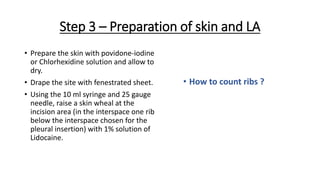
Step 3 – Preparation of skin and LA
• Prepare the skin with povidone-iodine
or Chlorhexidine solution and allow to
dry.
• Drape the site with fenestrated sheet.
• Using the 10 ml syringe and 25 gauge
needle, raise a skin wheal at the
incision area (in the interspace one rib
below the interspace chosen for the
pleural insertion) with 1% solution of
Lidocaine.
• How to count ribs ?
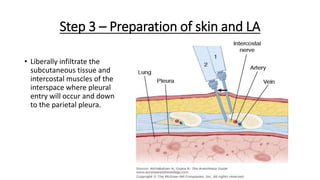
Step 3 – Preparation of skin and LA
• Liberally infiltrate the
subcutaneous tissue and
intercostal muscles of the
interspace where pleural
entry will occur and down
to the parietal pleura.
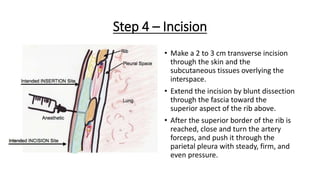
Step 4 – Incision
• Make a 2 to 3 cm transverse incision
through the skin and the
subcutaneous tissues overlying the
interspace.
• Extend the incision by blunt dissection
through the fascia toward the
superior aspect of the rib above.
• After the superior border of the rib is
reached, close and turn the artery
forceps, and push it through the
parietal pleura with steady, firm, and
even pressure.
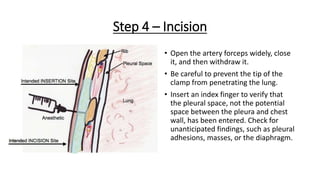
Step 4 – Incision
• Open the artery forceps widely, close
it, and then withdraw it.
• Be careful to prevent the tip of the
clamp from penetrating the lung.
• Insert an index finger to verify that
the pleural space, not the potential
space between the pleura and chest
wall, has been entered. Check for
unanticipated findings, such as pleural
adhesions, masses, or the diaphragm.
Step 5 – ICD insertion
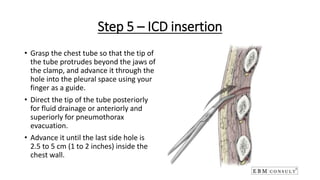
• Grasp the chest tube so that the tip of
the tube protrudes beyond the jaws of
the clamp, and advance it through the
hole into the pleural space using your
finger as a guide.
• Direct the tip of the tube posteriorly
for fluid drainage or anteriorly and
superiorly for pneumothorax
evacuation.
• Advance it until the last side hole is
2.5 to 5 cm (1 to 2 inches) inside the
chest wall.
Step 5 – ICD insertion
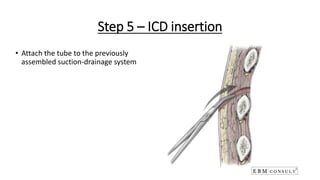
• Attach the tube to the previously
assembled suction-drainage system
Step 6 – Confirm position
• Confirm the correct location of the
chest tube by the visualization of
column movement within the tube
with respiration or by drained pleural
fluid seen within the tube.
• Ask the patient to cough, and observe
whether bubbles form at the water-
seal level.
• If the tube has not been properly
inserted in the pleural space, no fluid
will drain, and the level in the water
column will not vary with respiration.
Step 6 – Confirm position
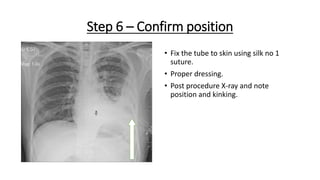
• Fix the tube to skin using silk no 1
suture.
• Proper dressing.
• Post procedure X-ray and note
position and kinking.
Step 7 – Documentation
• Note down the whole procedure
in patient file.
• Reporting of x-ray.
• Note down ICD care details.
Step 8 – Do and Explain ICD care
• Keep chest tube drainage below
chest level.
• Keep chest tube secured to
chest wall.
• Keep ICD bag filled with sterile
water up to marked line.
• Report if continuous bubbling
and continuous blood /
intestinal content in tube.
• Encourage the patient to cough.
• Chest physiotherapy.
• Pain management and
respiratory exercise.
• Daily auscultation and SpO2
monitoring.
• Check local site for
subcutaneous emphysema.
• Never clamp the ICD drain tube.
Chest tube placement – Steps summary
• Step 1 – Position of patient
• Step 2 – Checklist
• Step 3 – Preparation of skin and LA
• Step 4 – Incision
• Step 5 – ICD insertion
• Step 6 – Confirm position
• Step 7 – Documentation
• Step 8 – Explain ICD care

Intercostal Drainage Tube

  • 1.
    One of theEmergency Life Saving Procedures
  • 2.
    Topics to bediscussed • Anatomy • Physiology • ICD introduction • Indications • ICD insertion technique • ICD care • Complications
  • 3.
    Anatomy • Intercostal spaceslie between adjacent ribs and are filled by intercostal muscles.
  • 4.
    Anatomy • Intercostal neurovascular bundlelie in the costal groove along the inferior margin of the superior rib and pass in the plane between the inner two layers of muscles. • So that ICD to be inserted along the superior surface of inferior rib.
  • 5.
    Anatomy • Above todownward relation is  Vein  Artery  Nerve • And nerve is unprotected by groove in the rib. • So that it is easy to give intercostal nerve block at this level.
  • 6.
    Anatomy • Diaphragm isballoon shaped. • The right dome is higher than the left, reaching as far as 6th rib. • If ICD is inserted below the 6th rib there are higher chances of abdominal visceral damage.
  • 7.
    Anatomy Level Pleura (RIB no) Lung (RIBno) Mid clavicular 8th 6th Mid Axillary 10th 8th Vertebral 12th 10th Insertion of ICD should be above 6th Rib = 5th intercostal space or above
  • 8.
    Anatomy • Triangle ofsafety – through which ICD should be inserted with minimal complications.
  • 9.
    Physiology of respiration •At the time of respiration in normal lung, pressure in pleural spaces is always negative compared to atmosphere air pressure.  So it has tendency to suck air inside when there is breach in barrier. • ICD is iatrogenic case of breach in barrier.
  • 10.
    Physiology of respiration •So we use water sealed bag for drainage. • ICD should be removed in end inspiration or end expiration  decreased chances of pneumothorax
  • 12.
  • 13.
  • 14.
    Intercostal Drainage Tube •The concept of chest drainage was first advocated by Hippocrates when he described the treatment of empyema by means of incision, cautery, and insertion of metal tubes. • However, the technique was not widely used until the influenza epidemic of 1917 to drain post- pneumonic empyema, which was first documented by Dr. C. Pope, on "Joel", a 22-month-old infant. • The use of chest tubes in postoperative thoracic care was reported in 1922, and they were regularly used post-thoracotomy in World War II. • Though they were not routinely used for emergency tube thoracostomy following acute trauma until the Korean War (1950).
  • 15.
    Intercostal Drainage Tube •Made from clear plastics like PVC and soft silicone. • Sizes measured by their external diameter from 6 Fr to 40 Fr. • Conventional chest tubes feature multiple drainage fenestrations in the section of the tube which resides inside the patient. • As well as distance markers along the length of the tube. • A radiopaque stripe which outlines the first drainage hole.
  • 16.
    Intercostal Drainage Tube •The number of side holes is generally 6 on most chest tubes.
  • 18.
    Indications for ICDinsertion • Pneumothorax • Pleural effusion  Chylothorax  Empyema  Hemothorax  Hydrothorax • Postoperative – Thoracotomy • As a drain after removal of lung
  • 19.
    Contraindication for ICDinsertion • Uncorrected coagulopathy • Diaphragmatic hernia • Severe pleural adhesion
  • 20.
    Patient preparation • Consent– Informed and Written • Preparation of materials • Positioning and marking the site • Oxygen saturation monitoring
  • 21.
    Preparation of materials •Sterile gloves and gown • Antiseptic solution • Atropine Intramuscular and Analgesic • Local anaesthetic solution • Sterile gauze • Scalpel no 11 and 23 • Curved and straight artery forceps
  • 22.
    Preparation of materials •Curved clamp • Chest tube with connecting tube • Drainage system ready with 100 cc saline filled up to mark • Suture silk no 1 • Dressing material And obviously an assistant and nursing staff.
  • 23.
    Step 1 –Position of patient • Elevate the head of the bed 30 to 60 degrees • Place (and restrain) the arm on the affected side over the patient’s head.
  • 24.
    Step 1 –Position of patient
  • 25.
    Step 2 –Checklist • Confirm that all needed material are available nearby. • Check that your assistant is free for assistance.
  • 26.
    Step 3 –Preparation of skin and LA • Prepare the skin with povidone-iodine or Chlorhexidine solution and allow to dry. • Drape the site with fenestrated sheet. • Using the 10 ml syringe and 25 gauge needle, raise a skin wheal at the incision area (in the interspace one rib below the interspace chosen for the pleural insertion) with 1% solution of Lidocaine. • How to count ribs ?
  • 27.
    Step 3 –Preparation of skin and LA • Liberally infiltrate the subcutaneous tissue and intercostal muscles of the interspace where pleural entry will occur and down to the parietal pleura.
  • 28.
    Step 4 –Incision • Make a 2 to 3 cm transverse incision through the skin and the subcutaneous tissues overlying the interspace. • Extend the incision by blunt dissection through the fascia toward the superior aspect of the rib above. • After the superior border of the rib is reached, close and turn the artery forceps, and push it through the parietal pleura with steady, firm, and even pressure.
  • 29.
    Step 4 –Incision • Open the artery forceps widely, close it, and then withdraw it. • Be careful to prevent the tip of the clamp from penetrating the lung. • Insert an index finger to verify that the pleural space, not the potential space between the pleura and chest wall, has been entered. Check for unanticipated findings, such as pleural adhesions, masses, or the diaphragm.
  • 30.
    Step 5 –ICD insertion • Grasp the chest tube so that the tip of the tube protrudes beyond the jaws of the clamp, and advance it through the hole into the pleural space using your finger as a guide. • Direct the tip of the tube posteriorly for fluid drainage or anteriorly and superiorly for pneumothorax evacuation. • Advance it until the last side hole is 2.5 to 5 cm (1 to 2 inches) inside the chest wall.
  • 31.
    Step 5 –ICD insertion • Attach the tube to the previously assembled suction-drainage system
  • 32.
    Step 6 –Confirm position • Confirm the correct location of the chest tube by the visualization of column movement within the tube with respiration or by drained pleural fluid seen within the tube. • Ask the patient to cough, and observe whether bubbles form at the water- seal level. • If the tube has not been properly inserted in the pleural space, no fluid will drain, and the level in the water column will not vary with respiration.
  • 33.
    Step 6 –Confirm position • Fix the tube to skin using silk no 1 suture. • Proper dressing. • Post procedure X-ray and note position and kinking.
  • 34.
    Step 7 –Documentation • Note down the whole procedure in patient file. • Reporting of x-ray. • Note down ICD care details.
  • 35.
    Step 8 –Do and Explain ICD care • Keep chest tube drainage below chest level. • Keep chest tube secured to chest wall. • Keep ICD bag filled with sterile water up to marked line. • Report if continuous bubbling and continuous blood / intestinal content in tube. • Encourage the patient to cough. • Chest physiotherapy. • Pain management and respiratory exercise. • Daily auscultation and SpO2 monitoring. • Check local site for subcutaneous emphysema. • Never clamp the ICD drain tube.
  • 36.
    Chest tube placement– Steps summary • Step 1 – Position of patient • Step 2 – Checklist • Step 3 – Preparation of skin and LA • Step 4 – Incision • Step 5 – ICD insertion • Step 6 – Confirm position • Step 7 – Documentation • Step 8 – Explain ICD care