BURN
Prepared by-
Deepak Patel
M.Sc. Nursing
CONTENT
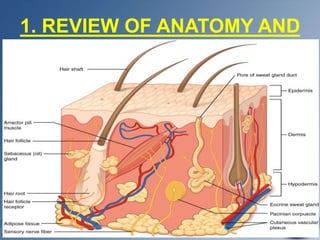
1. Review of anatomy and physiology
of skin
2. Introduction
3. Incidence
4. Definition
5. Aetiology
6. Classification
7. Jackson’s thermal wound injury
Continue…..
CONTENT
8. Pathophysiology
9. Clinical manifestations
10. Diagnostic evaluation
11. Management
12. Complications
13. Prevention
14. summary
15. conclusion
1. REVIEW OF ANATOMY AND
physiology of skin
INTRODUCTION TO BURN
• Burns are one of the most
devastating conditions encountered in
the medicine. The injury represents
an assault on all aspects of the
patients from the physical to the
psychological. The visible physical
and invisible psychological scars are
long lasting.
DEFINITION OF BURN
• Burn can be defined as any
injury that results from the
direct contact or exposure
to any thermal, chemical,
electrical or radiation
source.
INCIDENCE OF BURN
• India records 70 lacs burn injury
annually of which 1.4 lacs people die
and 2.4 suffers from disability.
• 70% of cases are in 15-35 years age
group.
Continue…..
INCIDENCE OF BURN
• 4 out of 5 cases are either women or
children.
• 80% cases with women are related to
kitchen related accidents.
• 11th leading cause of death/injury of
children age 1-9 years.
Continue…..
INCIDENCE OF BURN
• 250 to 300 acid attacks are reported
in India every year.
• 80% to 90% burns occur at home
ETIOLOGY OF BURN
1. Thermal burns
2. Chemical burns
3. Electrical burns
4. Radiation burns
5. Inhalation burns
CLASSIFICATION OF
BURN INJURY
1. According to burn
depth
2. According to extent
of burn
ACCORDING TO BURN
DEPTH
a) Based on skin layers
involvement
b) Based on degree of
burn
Based on skin layers
involvement
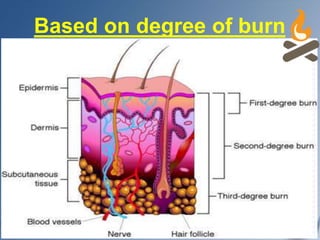
Based on degree of burn
ACCORDING TO EXTENT
OF BURN
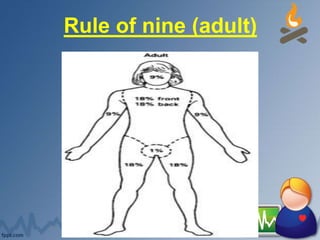
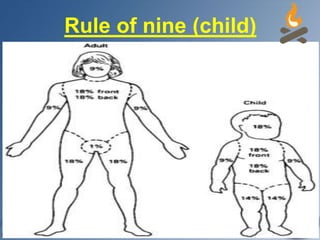
a) Rule of nine
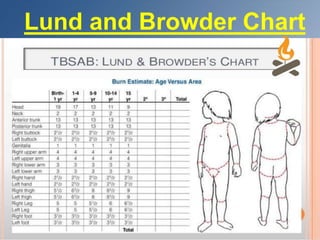
b) Lund and Browder
chart
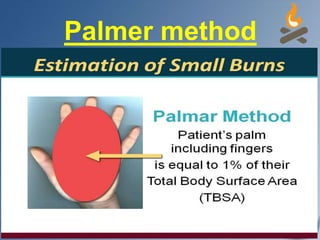
c) Palmer method
Rule of nine (adult)
Rule of nine (child)
Lund and Browder Chart
Palmer method
JACKSON’S THERMAL
WOUND THEORY
1. The inner zone
2. The middle zone
3. The outer zone
Continue…..
PATHOPHYSIOLOGY OF
BURN
1. Cardiovascular alterations
2. Fluid and electrolyte alterations
3. Pulmonary alterations
4. Renal alterations
5. Immunologic alterations
6. Thermoregulatory alterations
7. Gastrointestinal alterations
8. Metabolic alterations
DIAGNOSTIC EVALUATION OF
BURN
1. History taking
2. Physical examination (See table)
3. Diagnostic tests-
• Complete blood count
• ABG analysis
• Human chorionic gonadotropin testing
• Serum urea, electrolytes
• Chest X-ray
• CT scan
• Laser Doppler imaging
1. History Taking
1. Time of injury
2. Place of injury (open/closed)
3. unconsciousness during incidence
4. Mechanism of burn injury/agent
5. Duration of exposure to agent
6. Intentional burn injury
7. Last Tetanus shot
8. Any known Allergies
2. Physical Examination
1. Complete head to toe assessment
2. Systematic assessment
3. Burn estimation / severity
assessment
Burn severity assessment
MINOR MODERATE MAJOR
• Adult <10%
TBSA
• Young or old
<5% TBSA
• <2% Full
thickness Burn
• Adult 10-20%
TBSA
• Young or old 5-
10% TBSA
• 2-5% Full thickness
burn
• High voltage injury
• Possible inhalation
injury
• Circumferential
burn
• Other health
problems
• Adult >20% TBSA
• Young or old >10%
TBSA
• >5% Full thickness
burn
• Known inhalation
injury
• Significant burn to
face, joints, hands or
feet
• Associated injuries
3. Diagnostic Tests
1. Complete blood count
2. ABG analysis
3. Human chorionic gonadotropin testing
4. Serum biochemistry
5. Chest X-ray
6. CT scan
7. Laser Doppler imaging
MANEGEMENT OF BURN
Burn care is typically categorized into
three phases of care;
1. Emergent / resuscitative phase
2. Acute / intermediate phase
3. Rehabilitative phase
PHASES OF BURN CARE
PHASE DURATION PRIORITIES
Emergent /
resuscitative phase
• From onset of injury to
completion of fluid
resuscitation.
• First aid
• Prevention of shock
• Prevention of respiratory
distress
• Detection and treatment of
concomitant injuries
Acute / intermediate
phase
• From beginning of
diuresis to near
completion of wound
closure.
• Wound assessment and care
• Wound closure
• Prevention and treatment of
complications, including
infection
• Nutritional support
Rehabilitation
support
• From major wound
closure to return to
individual’s optimal level
of functioning
• Prevention of scars and
contractures
• Physical, occupational and
vocational rehabilitation
• Cosmetic reconstruction
• Psychosocial counselling
1. Emergent / resuscitative
phase
Medical management
1. Assess burn severity
a) Burn depth
b) Burn size
c) Burn location
d) Age
e) General health
f) Mechanism of injury
1. Emergent / resuscitative
phase
Medical management
2. Treat minor burns
3. Major burns
a) Monitor airway and breathing
b) Prevent burn (hypovolemic) shock (see formula)
c) Prevent aspiration
d) Minimizing pain and anxiety
e) Wound care
f) Prevent tetanus
g) Prevent tissue ischemia
h) Transport to burn facility
Emergent / resuscitative phase
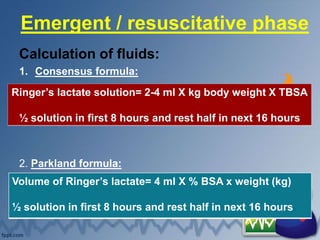
Calculation of fluids:
1. Consensus formula:
2. Parkland formula:
Ringer’s lactate solution= 2-4 ml X kg body weight X TBSA
½ solution in first 8 hours and rest half in next 16 hours
Volume of Ringer’s lactate= 4 ml X % BSA x weight (kg)
½ solution in first 8 hours and rest half in next 16 hours
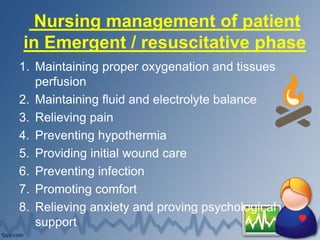
Nursing management of patient
in Emergent / resuscitative phase
1. Maintaining proper oxygenation and tissues
perfusion
2. Maintaining fluid and electrolyte balance
3. Relieving pain
4. Preventing hypothermia
5. Providing initial wound care
6. Preventing infection
7. Promoting comfort
8. Relieving anxiety and proving psychological
support
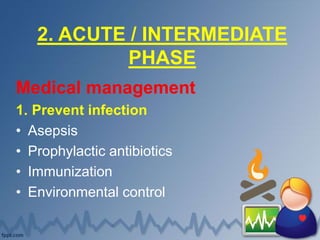
2. ACUTE / INTERMEDIATE
PHASE
Medical management
1. Prevent infection
• Asepsis
• Prophylactic antibiotics
• Immunization
• Environmental control
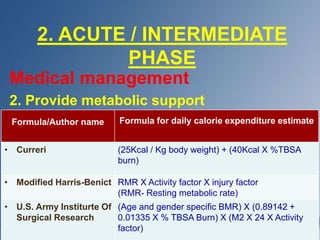
2. ACUTE / INTERMEDIATE
PHASE
Medical management
2. Provide metabolic support
Formula/Author name Formula for daily calorie expenditure estimate
• Curreri (25Kcal / Kg body weight) + (40Kcal X %TBSA
burn)
• Modified Harris-Benict RMR X Activity factor X injury factor
(RMR- Resting metabolic rate)
• U.S. Army Institurte Of
Surgical Research
(Age and gender specific BMR) X (0.89142 +
0.01335 X % TBSA Burn) X (M2 X 24 X Activity
factor)
2. ACUTE / INTERMEDIATE
PHASE
Medical management
3. Minimizing pain
• Patient controlled analgesia devices
• Inhalation analgesic (nitrous oxide)
• Oral analgesics; opioid analgesics, NSAID’s
• Hypnosis, art and play therapy
• Guided imaginary, relaxation techniques
• Distraction therapy, biofeedback
• Music therapy
2. ACUTE / INTERMEDIATE
PHASE
Medical management
4. Provide wound care
a) Wound cleansing
b) Wound debridement
i. Natural debridement
ii. Mechanical debridement
iii. Chemical debridement
iv. Surgical debridement
2. ACUTE / INTERMEDIATE
PHASE
Medical management
c) Topical antimicrobial treatment
• Silver sulfadiazine 1%
• Mafenide acetate 5%
• Silver nitrate 0.5%
• acticoat
2. ACUTE / INTERMEDIATE
PHASE
Medical management
d) Wound dressing
• Moist dressing
• Occlusive dressing for new grafts
• Non-adhesive dressings covers
2. ACUTE / INTERMEDIATE
PHASE
Medical management
5. Maximize function
• Splinting
• Positioning
• Exercise
• Ambulation performance of ADI
• Pressure therapy
2. ACUTE / INTERMEDIATE
PHASE
Medical management
6. Provide psychological support
• Meeting the psychological needs
• Involvement in physical therapy
• Encouragement in wound care
• Ventilation of feeling, emotions, fear
• Promoting self image
2. ACUTE / INTERMEDIATE
PHASE
Surgical management
1. Escharotomy
2. ACUTE / INTERMEDIATE
PHASE
Surgical management
2. Faciotomy or
faciectomy
2. ACUTE / INTERMEDIATE
PHASE
Surgical management
2. Wound grafting
# Biologic dressing / graft
# biosynthetic and synthetic grafts
2. ACUTE / INTERMEDIATE
PHASE
Surgical management
2. Wound grafting
# Biologic dressing / graft types
• Autograft
• Isograft
• Allograft
• Xenograft
2. ACUTE / INTERMEDIATE
PHASE
Surgical management
2. Wound grafting
# Biosynthetic and synthetic graft types
• Biobrane
• Integra
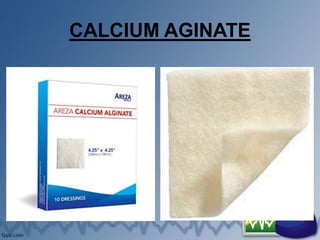
• Calcium alginate
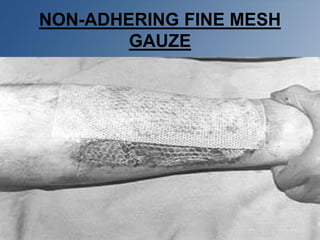
• Non-adhering fine mesh gauze
INTEGRA
CALCIUM AGINATE
NON-ADHERING FINE MESH
GAUZE
Nursing management of patient
in acute / intermediate phase
1. Maintaining proper oxygenation and
tissues perfusion
2. Maintaining fluid and electrolyte
balance
3. Relieving pain
4. Preventing hypothermia
5. Providing wound care
6. Preventing infection
Nursing management of patient in
acute / intermediate phase
8. Relieving anxiety and proving
psychological support
9. Graft care
10.Nutritional support
11.Improving mobility
12.Promoting comfort
3. REHABILIATION PHASE
Medical management
1. Minimizing functional loss
• Exercise
• Splinting
• positioning
3. REHABILIATION PHASE
Medical management
2. Provide psychological support
• Self image issues
• Physical limitations
• Reintegration into society
• Fear of rejection
• Good communication
• Encourage independence
3. REHABILIATION PHASE
Medical management
3. Abnormal wound healing
• Hypertrophic
• Keloid scars
3. REHABILIATION PHASE
Medical management
4. Prevention and treatment of scars
• Pressure use of topical silicon
• Scar massage
• Steroid injections
• Application of elastic pressure garments
• Cosmetic interventions
Nursing management of patient
in Rehabilitation phase
1. Improving mobility
2. Improving self esteem
3. Promoting independence
4. Cosmetic counselling
5. Vocational training
6. Improving body image
COMPLICATIONS OF BURN
1. Burn shock
2. Pulmonary complications due to
inhalation burn
3. Acute renal failure
4. Infections and sepsis
COMPLICATIONS OF BURN
5. Curling’s ulcers
6. Extensive and disabling scarring
7. Psychological trauma
8. Marjolin’s ulcer
9. Multiple organ failure
Burn

Burn

  • 1.
  • 2.
    CONTENT 1. Review ofanatomy and physiology of skin 2. Introduction 3. Incidence 4. Definition 5. Aetiology 6. Classification 7. Jackson’s thermal wound injury Continue…..
  • 3.
    CONTENT 8. Pathophysiology 9. Clinicalmanifestations 10. Diagnostic evaluation 11. Management 12. Complications 13. Prevention 14. summary 15. conclusion
  • 4.
    1. REVIEW OFANATOMY AND physiology of skin
  • 5.
    INTRODUCTION TO BURN •Burns are one of the most devastating conditions encountered in the medicine. The injury represents an assault on all aspects of the patients from the physical to the psychological. The visible physical and invisible psychological scars are long lasting.
  • 6.
    DEFINITION OF BURN •Burn can be defined as any injury that results from the direct contact or exposure to any thermal, chemical, electrical or radiation source.
  • 7.
    INCIDENCE OF BURN •India records 70 lacs burn injury annually of which 1.4 lacs people die and 2.4 suffers from disability. • 70% of cases are in 15-35 years age group. Continue…..
  • 8.
    INCIDENCE OF BURN •4 out of 5 cases are either women or children. • 80% cases with women are related to kitchen related accidents. • 11th leading cause of death/injury of children age 1-9 years. Continue…..
  • 9.
    INCIDENCE OF BURN •250 to 300 acid attacks are reported in India every year. • 80% to 90% burns occur at home
  • 10.
    ETIOLOGY OF BURN 1.Thermal burns 2. Chemical burns 3. Electrical burns 4. Radiation burns 5. Inhalation burns
  • 11.
    CLASSIFICATION OF BURN INJURY 1.According to burn depth 2. According to extent of burn
  • 12.
    ACCORDING TO BURN DEPTH a)Based on skin layers involvement b) Based on degree of burn
  • 13.
    Based on skinlayers involvement
  • 14.
  • 15.
    ACCORDING TO EXTENT OFBURN a) Rule of nine b) Lund and Browder chart c) Palmer method
  • 16.
    Rule of nine(adult)
  • 17.
    Rule of nine(child)
  • 18.
  • 19.
  • 20.
    JACKSON’S THERMAL WOUND THEORY 1.The inner zone 2. The middle zone 3. The outer zone Continue…..
  • 22.
    PATHOPHYSIOLOGY OF BURN 1. Cardiovascularalterations 2. Fluid and electrolyte alterations 3. Pulmonary alterations 4. Renal alterations 5. Immunologic alterations 6. Thermoregulatory alterations 7. Gastrointestinal alterations 8. Metabolic alterations
  • 24.
    DIAGNOSTIC EVALUATION OF BURN 1.History taking 2. Physical examination (See table) 3. Diagnostic tests- • Complete blood count • ABG analysis • Human chorionic gonadotropin testing • Serum urea, electrolytes • Chest X-ray • CT scan • Laser Doppler imaging
  • 25.
    1. History Taking 1.Time of injury 2. Place of injury (open/closed) 3. unconsciousness during incidence 4. Mechanism of burn injury/agent 5. Duration of exposure to agent 6. Intentional burn injury 7. Last Tetanus shot 8. Any known Allergies
  • 26.
    2. Physical Examination 1.Complete head to toe assessment 2. Systematic assessment 3. Burn estimation / severity assessment
  • 27.
    Burn severity assessment MINORMODERATE MAJOR • Adult <10% TBSA • Young or old <5% TBSA • <2% Full thickness Burn • Adult 10-20% TBSA • Young or old 5- 10% TBSA • 2-5% Full thickness burn • High voltage injury • Possible inhalation injury • Circumferential burn • Other health problems • Adult >20% TBSA • Young or old >10% TBSA • >5% Full thickness burn • Known inhalation injury • Significant burn to face, joints, hands or feet • Associated injuries
  • 28.
    3. Diagnostic Tests 1.Complete blood count 2. ABG analysis 3. Human chorionic gonadotropin testing 4. Serum biochemistry 5. Chest X-ray 6. CT scan 7. Laser Doppler imaging
  • 29.
    MANEGEMENT OF BURN Burncare is typically categorized into three phases of care; 1. Emergent / resuscitative phase 2. Acute / intermediate phase 3. Rehabilitative phase
  • 30.
    PHASES OF BURNCARE PHASE DURATION PRIORITIES Emergent / resuscitative phase • From onset of injury to completion of fluid resuscitation. • First aid • Prevention of shock • Prevention of respiratory distress • Detection and treatment of concomitant injuries Acute / intermediate phase • From beginning of diuresis to near completion of wound closure. • Wound assessment and care • Wound closure • Prevention and treatment of complications, including infection • Nutritional support Rehabilitation support • From major wound closure to return to individual’s optimal level of functioning • Prevention of scars and contractures • Physical, occupational and vocational rehabilitation • Cosmetic reconstruction • Psychosocial counselling
  • 31.
    1. Emergent /resuscitative phase Medical management 1. Assess burn severity a) Burn depth b) Burn size c) Burn location d) Age e) General health f) Mechanism of injury
  • 32.
    1. Emergent /resuscitative phase Medical management 2. Treat minor burns 3. Major burns a) Monitor airway and breathing b) Prevent burn (hypovolemic) shock (see formula) c) Prevent aspiration d) Minimizing pain and anxiety e) Wound care f) Prevent tetanus g) Prevent tissue ischemia h) Transport to burn facility
  • 33.
    Emergent / resuscitativephase Calculation of fluids: 1. Consensus formula: 2. Parkland formula: Ringer’s lactate solution= 2-4 ml X kg body weight X TBSA ½ solution in first 8 hours and rest half in next 16 hours Volume of Ringer’s lactate= 4 ml X % BSA x weight (kg) ½ solution in first 8 hours and rest half in next 16 hours
  • 34.
    Nursing management ofpatient in Emergent / resuscitative phase 1. Maintaining proper oxygenation and tissues perfusion 2. Maintaining fluid and electrolyte balance 3. Relieving pain 4. Preventing hypothermia 5. Providing initial wound care 6. Preventing infection 7. Promoting comfort 8. Relieving anxiety and proving psychological support
  • 35.
    2. ACUTE /INTERMEDIATE PHASE Medical management 1. Prevent infection • Asepsis • Prophylactic antibiotics • Immunization • Environmental control
  • 36.
    2. ACUTE /INTERMEDIATE PHASE Medical management 2. Provide metabolic support Formula/Author name Formula for daily calorie expenditure estimate • Curreri (25Kcal / Kg body weight) + (40Kcal X %TBSA burn) • Modified Harris-Benict RMR X Activity factor X injury factor (RMR- Resting metabolic rate) • U.S. Army Institurte Of Surgical Research (Age and gender specific BMR) X (0.89142 + 0.01335 X % TBSA Burn) X (M2 X 24 X Activity factor)
  • 37.
    2. ACUTE /INTERMEDIATE PHASE Medical management 3. Minimizing pain • Patient controlled analgesia devices • Inhalation analgesic (nitrous oxide) • Oral analgesics; opioid analgesics, NSAID’s • Hypnosis, art and play therapy • Guided imaginary, relaxation techniques • Distraction therapy, biofeedback • Music therapy
  • 38.
    2. ACUTE /INTERMEDIATE PHASE Medical management 4. Provide wound care a) Wound cleansing b) Wound debridement i. Natural debridement ii. Mechanical debridement iii. Chemical debridement iv. Surgical debridement
  • 39.
    2. ACUTE /INTERMEDIATE PHASE Medical management c) Topical antimicrobial treatment • Silver sulfadiazine 1% • Mafenide acetate 5% • Silver nitrate 0.5% • acticoat
  • 40.
    2. ACUTE /INTERMEDIATE PHASE Medical management d) Wound dressing • Moist dressing • Occlusive dressing for new grafts • Non-adhesive dressings covers
  • 41.
    2. ACUTE /INTERMEDIATE PHASE Medical management 5. Maximize function • Splinting • Positioning • Exercise • Ambulation performance of ADI • Pressure therapy
  • 42.
    2. ACUTE /INTERMEDIATE PHASE Medical management 6. Provide psychological support • Meeting the psychological needs • Involvement in physical therapy • Encouragement in wound care • Ventilation of feeling, emotions, fear • Promoting self image
  • 43.
    2. ACUTE /INTERMEDIATE PHASE Surgical management 1. Escharotomy
  • 44.
    2. ACUTE /INTERMEDIATE PHASE Surgical management 2. Faciotomy or faciectomy
  • 45.
    2. ACUTE /INTERMEDIATE PHASE Surgical management 2. Wound grafting # Biologic dressing / graft # biosynthetic and synthetic grafts
  • 46.
    2. ACUTE /INTERMEDIATE PHASE Surgical management 2. Wound grafting # Biologic dressing / graft types • Autograft • Isograft • Allograft • Xenograft
  • 48.
    2. ACUTE /INTERMEDIATE PHASE Surgical management 2. Wound grafting # Biosynthetic and synthetic graft types • Biobrane • Integra • Calcium alginate • Non-adhering fine mesh gauze
  • 50.
  • 51.
  • 52.
  • 53.
    Nursing management ofpatient in acute / intermediate phase 1. Maintaining proper oxygenation and tissues perfusion 2. Maintaining fluid and electrolyte balance 3. Relieving pain 4. Preventing hypothermia 5. Providing wound care 6. Preventing infection
  • 54.
    Nursing management ofpatient in acute / intermediate phase 8. Relieving anxiety and proving psychological support 9. Graft care 10.Nutritional support 11.Improving mobility 12.Promoting comfort
  • 55.
    3. REHABILIATION PHASE Medicalmanagement 1. Minimizing functional loss • Exercise • Splinting • positioning
  • 56.
    3. REHABILIATION PHASE Medicalmanagement 2. Provide psychological support • Self image issues • Physical limitations • Reintegration into society • Fear of rejection • Good communication • Encourage independence
  • 57.
    3. REHABILIATION PHASE Medicalmanagement 3. Abnormal wound healing • Hypertrophic • Keloid scars
  • 58.
    3. REHABILIATION PHASE Medicalmanagement 4. Prevention and treatment of scars • Pressure use of topical silicon • Scar massage • Steroid injections • Application of elastic pressure garments • Cosmetic interventions
  • 59.
    Nursing management ofpatient in Rehabilitation phase 1. Improving mobility 2. Improving self esteem 3. Promoting independence 4. Cosmetic counselling 5. Vocational training 6. Improving body image
  • 60.
    COMPLICATIONS OF BURN 1.Burn shock 2. Pulmonary complications due to inhalation burn 3. Acute renal failure 4. Infections and sepsis
  • 61.
    COMPLICATIONS OF BURN 5.Curling’s ulcers 6. Extensive and disabling scarring 7. Psychological trauma 8. Marjolin’s ulcer 9. Multiple organ failure