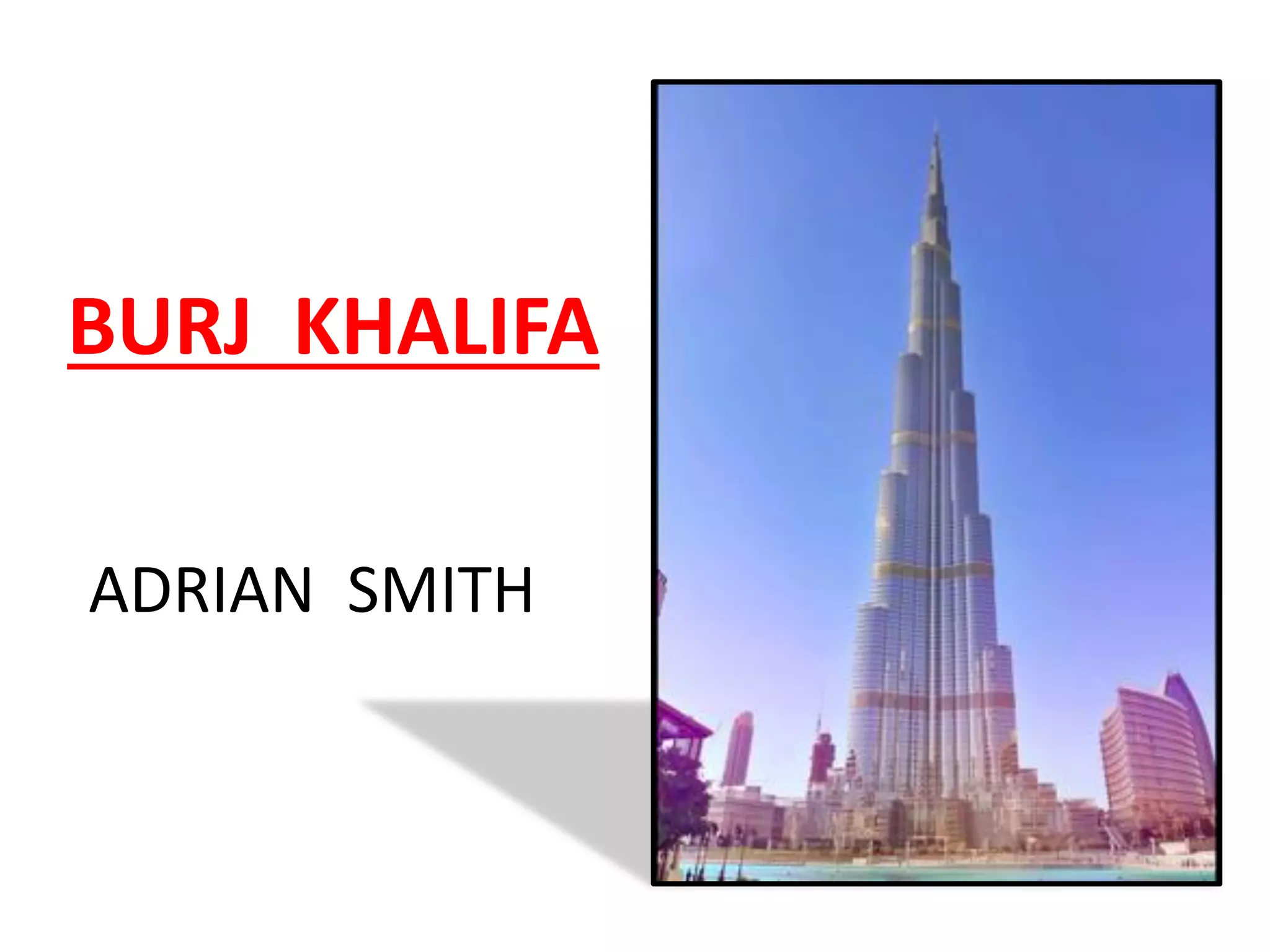
BURJ KHALIFA
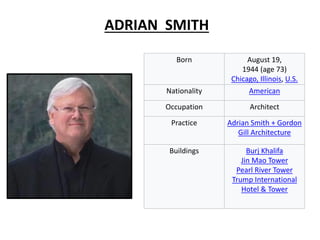
ADRIAN SMITH
Born August 19,
1944 (age 73)
Chicago, Illinois, U.S.
Nationality American
Occupation Architect
Practice Adrian Smith + Gordon
Gill Architecture
Buildings Burj Khalifa
Jin Mao Tower
Pearl River Tower
Trump International
Hotel & Tower
ADRIAN SMITH
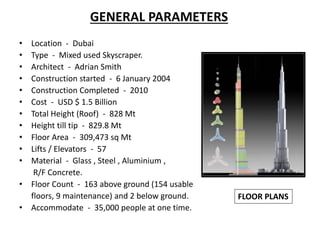
GENERAL PARAMETERS
• Location - Dubai
• Type - Mixed used Skyscraper.
• Architect - Adrian Smith
• Construction started - 6 January 2004
• Construction Completed - 2010
• Cost - USD $ 1.5 Billion
• Total Height (Roof) - 828 Mt
• Height till tip - 829.8 Mt
• Floor Area - 309,473 sq Mt
• Lifts / Elevators - 57
• Material - Glass , Steel , Aluminium ,
R/F Concrete.
• Floor Count - 163 above ground (154 usable
floors, 9 maintenance) and 2 below ground.
• Accommodate - 35,000 people at one time.
FLOOR PLANS
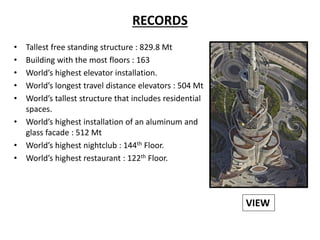
RECORDS
• Tallest free standing structure : 829.8 Mt
• Building with the most floors : 163
• World’s highest elevator installation.
• World’s longest travel distance elevators : 504 Mt
• World’s tallest structure that includes residential
spaces.
• World’s highest installation of an aluminum and
glass facade : 512 Mt
• World’s highest nightclub : 144th Floor.
• World’s highest restaurant : 122th Floor.
VIEW
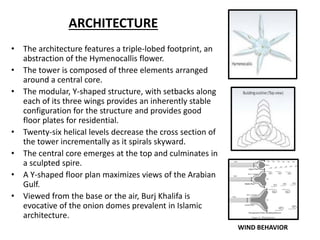
ARCHITECTURE
• The architecture features a triple-lobed footprint, an
abstraction of the Hymenocallis flower.
• The tower is composed of three elements arranged
around a central core.
• The modular, Y-shaped structure, with setbacks along
each of its three wings provides an inherently stable
configuration for the structure and provides good
floor plates for residential.
• Twenty-six helical levels decrease the cross section of
the tower incrementally as it spirals skyward.
• The central core emerges at the top and culminates in
a sculpted spire.
• A Y-shaped floor plan maximizes views of the Arabian
Gulf.
• Viewed from the base or the air, Burj Khalifa is
evocative of the onion domes prevalent in Islamic
architecture.
WIND BEHAVIOR
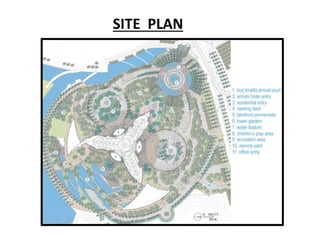
SITE PLAN
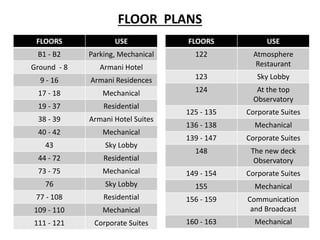
FLOOR PLANS
FLOORS USE
B1 - B2 Parking, Mechanical
Ground - 8 Armani Hotel
9 - 16 Armani Residences
17 - 18 Mechanical
19 - 37 Residential
38 - 39 Armani Hotel Suites
40 - 42 Mechanical
43 Sky Lobby
44 - 72 Residential
73 - 75 Mechanical
76 Sky Lobby
77 - 108 Residential
109 - 110 Mechanical
111 - 121 Corporate Suites
FLOORS USE
122 Atmosphere
Restaurant
123 Sky Lobby
124 At the top
Observatory
125 - 135 Corporate Suites
136 - 138 Mechanical
139 - 147 Corporate Suites
148 The new deck
Observatory
149 - 154 Corporate Suites
155 Mechanical
156 - 159 Communication
and Broadcast
160 - 163 Mechanical
INTERIOR
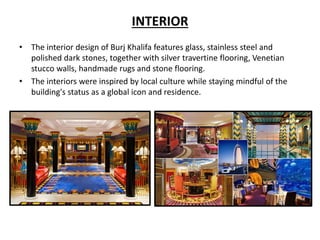
• The interior design of Burj Khalifa features glass, stainless steel and
polished dark stones, together with silver travertine flooring, Venetian
stucco walls, handmade rugs and stone flooring.
• The interiors were inspired by local culture while staying mindful of the
building's status as a global icon and residence.
EXTERIOR CLADDING
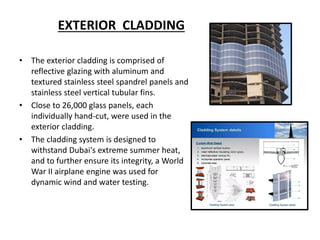
• The exterior cladding is comprised of
reflective glazing with aluminum and
textured stainless steel spandrel panels and
stainless steel vertical tubular fins.
• Close to 26,000 glass panels, each
individually hand-cut, were used in the
exterior cladding.
• The cladding system is designed to
withstand Dubai's extreme summer heat,
and to further ensure its integrity, a World
War II airplane engine was used for
dynamic wind and water testing.
GREEN IRRIGATION
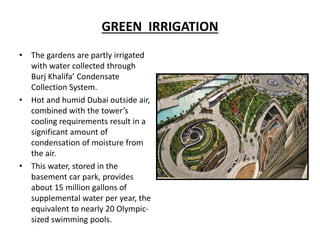
• The gardens are partly irrigated
with water collected through
Burj Khalifa’ Condensate
Collection System.
• Hot and humid Dubai outside air,
combined with the tower’s
cooling requirements result in a
significant amount of
condensation of moisture from
the air.
• This water, stored in the
basement car park, provides
about 15 million gallons of
supplemental water per year, the
equivalent to nearly 20 Olympic-
sized swimming pools.
FOUNDATION
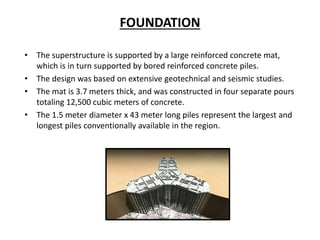
• The superstructure is supported by a large reinforced concrete mat,
which is in turn supported by bored reinforced concrete piles.
• The design was based on extensive geotechnical and seismic studies.
• The mat is 3.7 meters thick, and was constructed in four separate pours
totaling 12,500 cubic meters of concrete.
• The 1.5 meter diameter x 43 meter long piles represent the largest and
longest piles conventionally available in the region.
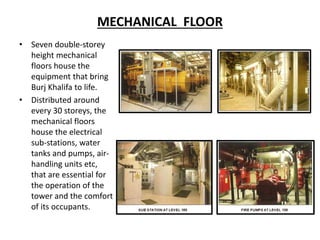
MECHANICAL FLOOR
• Seven double-storey
height mechanical
floors house the
equipment that bring
Burj Khalifa to life.
• Distributed around
every 30 storeys, the
mechanical floors
house the electrical
sub-stations, water
tanks and pumps, air-
handling units etc,
that are essential for
the operation of the
tower and the comfort
of its occupants.
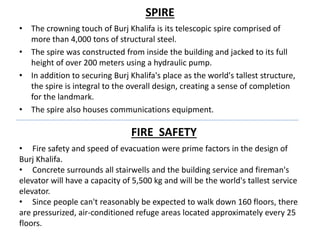
SPIRE
• The crowning touch of Burj Khalifa is its telescopic spire comprised of
more than 4,000 tons of structural steel.
• The spire was constructed from inside the building and jacked to its full
height of over 200 meters using a hydraulic pump.
• In addition to securing Burj Khalifa's place as the world's tallest structure,
the spire is integral to the overall design, creating a sense of completion
for the landmark.
• The spire also houses communications equipment.
FIRE SAFETY
• Fire safety and speed of evacuation were prime factors in the design of
Burj Khalifa.
• Concrete surrounds all stairwells and the building service and fireman's
elevator will have a capacity of 5,500 kg and will be the world's tallest service
elevator.
• Since people can't reasonably be expected to walk down 160 floors, there
are pressurized, air-conditioned refuge areas located approximately every 25
floors.
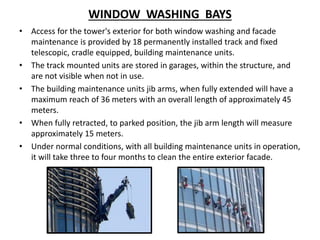
WINDOW WASHING BAYS
• Access for the tower's exterior for both window washing and facade
maintenance is provided by 18 permanently installed track and fixed
telescopic, cradle equipped, building maintenance units.
• The track mounted units are stored in garages, within the structure, and
are not visible when not in use.
• The building maintenance units jib arms, when fully extended will have a
maximum reach of 36 meters with an overall length of approximately 45
meters.
• When fully retracted, to parked position, the jib arm length will measure
approximately 15 meters.
• Under normal conditions, with all building maintenance units in operation,
it will take three to four months to clean the entire exterior facade.
THANK YOU… BELA RATHI
309118
C.A.
T.Y. ARCH

Burj khalifa, Dubai.

  • 1.
  • 2.
    Born August 19, 1944(age 73) Chicago, Illinois, U.S. Nationality American Occupation Architect Practice Adrian Smith + Gordon Gill Architecture Buildings Burj Khalifa Jin Mao Tower Pearl River Tower Trump International Hotel & Tower ADRIAN SMITH
  • 3.
    GENERAL PARAMETERS • Location- Dubai • Type - Mixed used Skyscraper. • Architect - Adrian Smith • Construction started - 6 January 2004 • Construction Completed - 2010 • Cost - USD $ 1.5 Billion • Total Height (Roof) - 828 Mt • Height till tip - 829.8 Mt • Floor Area - 309,473 sq Mt • Lifts / Elevators - 57 • Material - Glass , Steel , Aluminium , R/F Concrete. • Floor Count - 163 above ground (154 usable floors, 9 maintenance) and 2 below ground. • Accommodate - 35,000 people at one time. FLOOR PLANS
  • 4.
    RECORDS • Tallest freestanding structure : 829.8 Mt • Building with the most floors : 163 • World’s highest elevator installation. • World’s longest travel distance elevators : 504 Mt • World’s tallest structure that includes residential spaces. • World’s highest installation of an aluminum and glass facade : 512 Mt • World’s highest nightclub : 144th Floor. • World’s highest restaurant : 122th Floor. VIEW
  • 5.
    ARCHITECTURE • The architecturefeatures a triple-lobed footprint, an abstraction of the Hymenocallis flower. • The tower is composed of three elements arranged around a central core. • The modular, Y-shaped structure, with setbacks along each of its three wings provides an inherently stable configuration for the structure and provides good floor plates for residential. • Twenty-six helical levels decrease the cross section of the tower incrementally as it spirals skyward. • The central core emerges at the top and culminates in a sculpted spire. • A Y-shaped floor plan maximizes views of the Arabian Gulf. • Viewed from the base or the air, Burj Khalifa is evocative of the onion domes prevalent in Islamic architecture. WIND BEHAVIOR
  • 6.
  • 7.
    FLOOR PLANS FLOORS USE B1- B2 Parking, Mechanical Ground - 8 Armani Hotel 9 - 16 Armani Residences 17 - 18 Mechanical 19 - 37 Residential 38 - 39 Armani Hotel Suites 40 - 42 Mechanical 43 Sky Lobby 44 - 72 Residential 73 - 75 Mechanical 76 Sky Lobby 77 - 108 Residential 109 - 110 Mechanical 111 - 121 Corporate Suites FLOORS USE 122 Atmosphere Restaurant 123 Sky Lobby 124 At the top Observatory 125 - 135 Corporate Suites 136 - 138 Mechanical 139 - 147 Corporate Suites 148 The new deck Observatory 149 - 154 Corporate Suites 155 Mechanical 156 - 159 Communication and Broadcast 160 - 163 Mechanical
  • 8.
    INTERIOR • The interiordesign of Burj Khalifa features glass, stainless steel and polished dark stones, together with silver travertine flooring, Venetian stucco walls, handmade rugs and stone flooring. • The interiors were inspired by local culture while staying mindful of the building's status as a global icon and residence.
  • 9.
    EXTERIOR CLADDING • Theexterior cladding is comprised of reflective glazing with aluminum and textured stainless steel spandrel panels and stainless steel vertical tubular fins. • Close to 26,000 glass panels, each individually hand-cut, were used in the exterior cladding. • The cladding system is designed to withstand Dubai's extreme summer heat, and to further ensure its integrity, a World War II airplane engine was used for dynamic wind and water testing.
  • 10.
    GREEN IRRIGATION • Thegardens are partly irrigated with water collected through Burj Khalifa’ Condensate Collection System. • Hot and humid Dubai outside air, combined with the tower’s cooling requirements result in a significant amount of condensation of moisture from the air. • This water, stored in the basement car park, provides about 15 million gallons of supplemental water per year, the equivalent to nearly 20 Olympic- sized swimming pools.
  • 11.
    FOUNDATION • The superstructureis supported by a large reinforced concrete mat, which is in turn supported by bored reinforced concrete piles. • The design was based on extensive geotechnical and seismic studies. • The mat is 3.7 meters thick, and was constructed in four separate pours totaling 12,500 cubic meters of concrete. • The 1.5 meter diameter x 43 meter long piles represent the largest and longest piles conventionally available in the region.
  • 12.
    MECHANICAL FLOOR • Sevendouble-storey height mechanical floors house the equipment that bring Burj Khalifa to life. • Distributed around every 30 storeys, the mechanical floors house the electrical sub-stations, water tanks and pumps, air- handling units etc, that are essential for the operation of the tower and the comfort of its occupants.
  • 13.
    SPIRE • The crowningtouch of Burj Khalifa is its telescopic spire comprised of more than 4,000 tons of structural steel. • The spire was constructed from inside the building and jacked to its full height of over 200 meters using a hydraulic pump. • In addition to securing Burj Khalifa's place as the world's tallest structure, the spire is integral to the overall design, creating a sense of completion for the landmark. • The spire also houses communications equipment. FIRE SAFETY • Fire safety and speed of evacuation were prime factors in the design of Burj Khalifa. • Concrete surrounds all stairwells and the building service and fireman's elevator will have a capacity of 5,500 kg and will be the world's tallest service elevator. • Since people can't reasonably be expected to walk down 160 floors, there are pressurized, air-conditioned refuge areas located approximately every 25 floors.
  • 14.
    WINDOW WASHING BAYS •Access for the tower's exterior for both window washing and facade maintenance is provided by 18 permanently installed track and fixed telescopic, cradle equipped, building maintenance units. • The track mounted units are stored in garages, within the structure, and are not visible when not in use. • The building maintenance units jib arms, when fully extended will have a maximum reach of 36 meters with an overall length of approximately 45 meters. • When fully retracted, to parked position, the jib arm length will measure approximately 15 meters. • Under normal conditions, with all building maintenance units in operation, it will take three to four months to clean the entire exterior facade.
  • 15.
    THANK YOU… BELARATHI 309118 C.A. T.Y. ARCH