P12234047

               ASSIGNMENT TITLE:
            LOW CARBON BUILDING DESIGN


Student Name: Balasubramanian Venkiteswaran
Enrolment Number: P12234047
Module Title: Energy in Buildings
Module Code: ENGT5112


                                              1
P12234047
      SL NO     CONTENTS                           PAGE NUMBER

      01. Executive summery                                03

      02. Introduction                                     03

      03. Aim                                              04

      04. Architecture                                     04

              04.1 Fig 1 Total View                        04

              04.2 Fig Elevation                           05

              04.3 Fig Main Structure and design           05

      05. Facts and Figures                                06

      06. Environmental Features                           06

      07. Sustainability                                   07

      08. Energy and its impacts                           07

              8.1 Fig Heat map                             09

              8.2 Fig Glass used                           10

      09. Interior                                         10

              9.1 Fig Internal Furnishing                  11

      10. Local Ecology of UAE                             11

              10.1 Phase 1                                 11

              10.2 Phase 2                                 12

              10.3 Chat of comparison                      12

      11. Problems and Solutions                           13

      12. Conclusion                                       13

      13. Bibliography                                     14


                                                                 2
P12234047


                                 01. EXECUTIVE SUMMARY

The construction of buildings now a day are based on customer needs and to have all the
basic features to attract the clients as well as the design features and the comfortless are also
considered as the major things due to more security threats on occupants the structures are
made very strong The new generation buildings are concerned about lots of factors like
materials, design, sustainability, construction, and IT technologies. Here I am going to
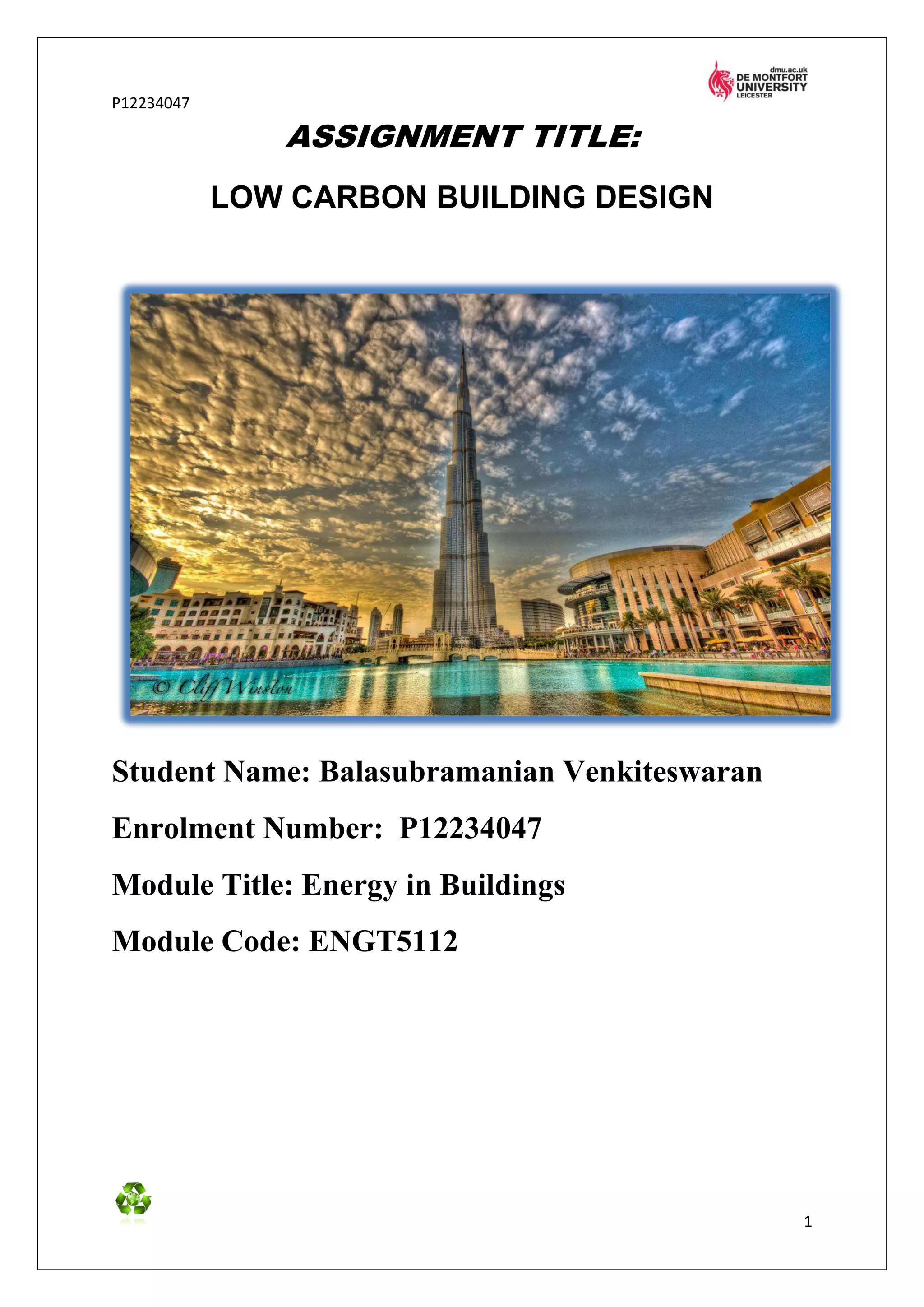
explain about my own work experience the massive structure called Burj Khalifa the
world’s tallest tower at the moment located in United Arab Emirates, How the design reduces
the carbon foot print , the energy efficiency in lighting, the cooling system and how the
building is related to echo friendly In the following paragraphs, we will discuss the
construction technology associated with buildings and will present a case analysing the
architecture and construction technology applied in a skyscraper. Moreover, we will also
discuss different building systems associated with the design, construction and echo
friendliness of the buildings.

                                    02. INTRODUCTION

The building is located in the United Arab Emirates which is 828 Meters high as well as 5.67
million square feet across and consist of 160 floors The construction is done in such way that
on a Y shaped structure with three wings which gives stable configuration moreover the
building has twenty six helical levels which decreases the cross section area of the tower as
its spirally skywards. The tower consists of 37 offices, 900 residential apartments, 160 Guest
rooms, 144 private residences and a floor area of 334,000 Square meters. Tower needs 50
Mega Volt Ampere at its peak time which equivalent to a large township more over which
uses a water of 946,000 litres of water a day as the United Arab Emirates a hot country where
the temperature goes up to 50 degree centigrade the tower require cooling which is 12,500
tons on a hot sunny day.

                                           03. AIM

The aim of this assignment is to rug light on different methods and procedures in terms of
carbon foot print employed in constructing buildings, particularly high rise structures and
also evaluate the use of these procedures in a famous building built in UAE.


                                                                                               3
P12234047
                                  04. ARCHITECTURE

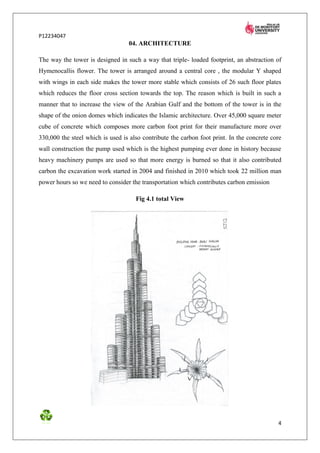
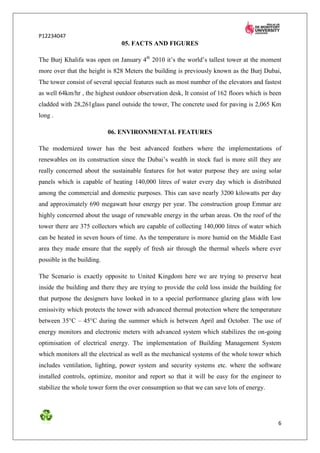
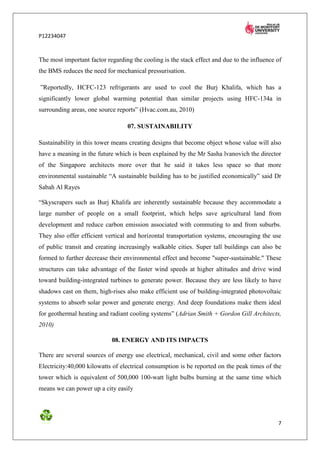
The way the tower is designed in such a way that triple- loaded footprint, an abstraction of
Hymenocallis flower. The tower is arranged around a central core , the modular Y shaped
with wings in each side makes the tower more stable which consists of 26 such floor plates
which reduces the floor cross section towards the top. The reason which is built in such a
manner that to increase the view of the Arabian Gulf and the bottom of the tower is in the
shape of the onion domes which indicates the Islamic architecture. Over 45,000 square meter
cube of concrete which composes more carbon foot print for their manufacture more over
330,000 the steel which is used is also contribute the carbon foot print. In the concrete core
wall construction the pump used which is the highest pumping ever done in history because
heavy machinery pumps are used so that more energy is burned so that it also contributed
carbon the excavation work started in 2004 and finished in 2010 which took 22 million man
power hours so we need to consider the transportation which contributes carbon emission

                                     Fig 4.1 total View


                                                                                            4
P12234047
            Fig 4.2 Elevation


                 Fig.4.3


                                5
P12234047
                                05. FACTS AND FIGURES

The Burj Khalifa was open on January 4th 2010 it’s the world’s tallest tower at the moment
more over that the height is 828 Meters the building is previously known as the Burj Dubai,
The tower consist of several special features such as most number of the elevators and fastest
as well 64km/hr , the highest outdoor observation desk, It consist of 162 floors which is been
cladded with 28,261glass panel outside the tower, The concrete used for paving is 2,065 Km
long .

                            06. ENVIRONMENTAL FEATURES

The modernized tower has the best advanced feathers where the implementations of
renewables on its construction since the Dubai’s wealth in stock fuel is more still they are
really concerned about the sustainable features for hot water purpose they are using solar
panels which is capable of heating 140,000 litres of water every day which is distributed
among the commercial and domestic purposes. This can save nearly 3200 kilowatts per day
and approximately 690 megawatt hour energy per year. The construction group Emmar are
highly concerned about the usage of renewable energy in the urban areas. On the roof of the
tower there are 375 collectors which are capable of collecting 140,000 litres of water which
can be heated in seven hours of time. As the temperature is more humid on the Middle East
area they made ensure that the supply of fresh air through the thermal wheels where ever
possible in the building.

The Scenario is exactly opposite to United Kingdom here we are trying to preserve heat
inside the building and there they are trying to provide the cold loss inside the building for
that purpose the designers have looked in to a special performance glazing glass with low
emissivity which protects the tower with advanced thermal protection where the temperature
between 35°C – 45°C during the summer which is between April and October. The use of
energy monitors and electronic meters with advanced system which stabilizes the on-going
optimisation of electrical energy. The implementation of Building Management System
which monitors all the electrical as well as the mechanical systems of the whole tower which
includes ventilation, lighting, power system and security systems etc. where the software
installed controls, optimize, monitor and report so that it will be easy for the engineer to
stabilize the whole tower form the over consumption so that we can save lots of energy.


                                                                                            6
P12234047


The most important factor regarding the cooling is the stack effect and due to the influence of
the BMS reduces the need for mechanical pressurisation.

”Reportedly, HCFC-123 refrigerants are used to cool the Burj Khalifa, which has a
significantly lower global warming potential than similar projects using HFC-134a in
surrounding areas, one source reports” (Hvac.com.au, 2010)

                                  07. SUSTAINABILITY

Sustainability in this tower means creating designs that become object whose value will also
have a meaning in the future which is been explained by the Mr Sasha lvanovich the director
of the Singapore architects more over that he said it takes less space so that more
environmental sustainable “A sustainable building has to be justified economically” said Dr
Sabah Al Rayes

“Skyscrapers such as Burj Khalifa are inherently sustainable because they accommodate a
large number of people on a small footprint, which helps save agricultural land from
development and reduce carbon emission associated with commuting to and from suburbs.
They also offer efficient vertical and horizontal transportation systems, encouraging the use
of public transit and creating increasingly walkable cities. Super tall buildings can also be
formed to further decrease their environmental effect and become "super-sustainable." These
structures can take advantage of the faster wind speeds at higher altitudes and drive wind
toward building-integrated turbines to generate power. Because they are less likely to have
shadows cast on them, high-rises also make efficient use of building-integrated photovoltaic
systems to absorb solar power and generate energy. And deep foundations make them ideal
for geothermal heating and radiant cooling systems” (Adrian Smith + Gordon Gill Architects,
2010)

                            08. ENERGY AND ITS IMPACTS

There are several sources of energy use electrical, mechanical, civil and some other factors
Electricity:40,000 kilowatts of electrical consumption is be reported on the peak times of the
tower which is equivalent of 500,000 100-watt light bulbs burning at the same time which
means we can power up a city easily


                                                                                             7
P12234047
Raw materials used in this tower are nearly 40,000 tons of steel which is sufficient to connect
a quarter areas round the earth. The transportation for this also have to considered because it
also have to considered in the energy consumption

Space utilization is very poor in this building where the top 30 floors are used as a storage
due to lack of area as it gets steeper domestic and commercial purpose and the condensed
water from the air condition are utilized for the plants in the garden. As everyone know in an
year the UAE got a good amount of sunlight so why can’t they install the solar panels for the
electricity in the practical point its will consume more space but a some considerable amount
attest have to be on their design which will make the energy consumption is a big question
for the designers ?


Burj Khalifa comprises a hotel, offices and residential accommodation, all constructed in
compliance with Dubai’s Green Building Code to ensure a high level of sustainability.
Tridonic products have played a key role in achieving this. For example, LED modules
TALEXXchain P511 and TALEXXconverter have been used for signage throughout, as well
as on the viewing platform at the top of the hotel, to ensure reliable, low maintenance lighting
with low energy consumption.
Within the Armani Hotel, extensive use has been made of low voltage lighting, and to ensure
maximum efficiency this has been combined with Tridonic Possum transformers.

In offices and corridors a range of Tridonic PC fixed output electronic ballasts have been
used. These feature the innovative Intelligent Voltage Guard, which constantly monitors the
mains voltage to the control gear to protect it against possible damage due to over or under-
voltage. (Tridonic, 2011)

The grounds of the Burj Khalifa cover an area of 11 ha and much of the exterior lighting has
been fitted with magnetic ballasts from Tridonic. These include OGS 250 & OGS 400 large
magnetic ballasts controlling 250 and 400 W street lamps for paths around the area of the
building, lighting the roads and entrance areas of the building. Lighting in the service area
uses EC magnetic ballasts, with impedance matched to the lamp type.Through its use of
various Tridonic products, the Burj Khalifa clearly demonstrates that energy efficiency and
low cost of ownership can be combined with high performance lighting that adds real value
to both, interior and exterior environments. (Tridonic, 2011)


                                                                                              8
P12234047
Water used Around 250,000 gallons of water a day where on UAE the Dubai Electricity and
water authority is running several pumps in the desalination plant to filter water here by more
energy is consumed Cooling is done by the central district water plant from which the tower
is normally serviced. In the case of a problem, the system can be switched to use water from
one of the other cooling plants to service the tower. The central water plant uses a massive ice
reservoir as a thermal storage system. Ice slurry is created on the top The only advantage
which is which can be considered as an energy saving measure is that the solar water heating
for the which requires more energy to make ice in the Persian Gulf humid climate .The
Glasses which has been fixed in the tower is specially manufactured which is reflective in
nature which won’t allow the heat to come in but the light so the illuminations so good in this
building Sky Sourced Ventilation: Cooler air temperatures, reduced air density, and reduced
relative humidity at the top of the building allow for “sky-sourced” fresh air. When air is
drawn in at the top of the building, it requires less energy for air conditioning, ventilation,
and dehumidification

“Mechanical system used is seven double storey height mechanical floors house the
equipment that brings the Burj Khalifa to life. Distributed around 30 storeys, the mechanical
floors houses the electrical substations, Water tanks, Pumps and air handling units etc, that
essential for the operation of the tower and the comfort of its occupants” ( Burj Khalifa,
2011)

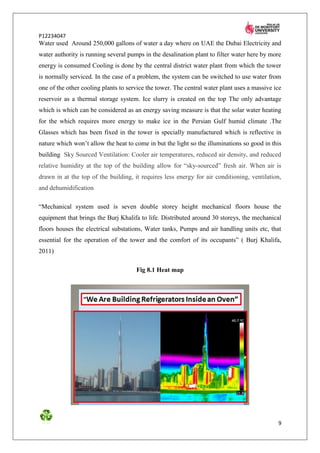
                                      Fig 8.1 Heat map


                                                                                              9
P12234047
The figure clearly states that the usage of energy in Burj Khalifa among the all the building
the tower uses energy at its maximum to stop the inflriation rate to make it cool in the humid
condition.

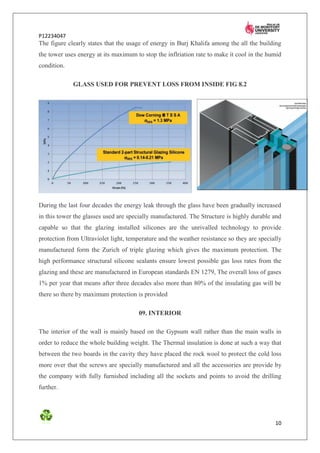
             GLASS USED FOR PREVENT LOSS FROM INSIDE FIG 8.2


During the last four decades the energy leak through the glass have been gradually increased
in this tower the glasses used are specially manufactured. The Structure is highly durable and
capable so that the glazing installed silicones are the unrivalled technology to provide
protection from Ultraviolet light, temperature and the weather resistance so they are specially
manufactured form the Zurich of triple glazing which gives the maximum protection. The
high performance structural silicone sealants ensure lowest possible gas loss rates from the
glazing and these are manufactured in European standards EN 1279, The overall loss of gases
1% per year that means after three decades also more than 80% of the insulating gas will be
there so there by maximum protection is provided

                                       09. INTERIOR

The interior of the wall is mainly based on the Gypsum wall rather than the main walls in
order to reduce the whole building weight. The Thermal insulation is done at such a way that
between the two boards in the cavity they have placed the rock wool to protect the cold loss
more over that the screws are specially manufactured and all the accessories are provide by
the company with fully furnished including all the sockets and points to avoid the drilling
further.


                                                                                            10
P12234047
All the rooms have well day light availability so that to avoid the electrical usage and the
lighting provided are well efficient ones and a proper advanced electronic monitors are
provided. Good loft insulation is also provided with a rock wool and false ceiling with central
cooling system.

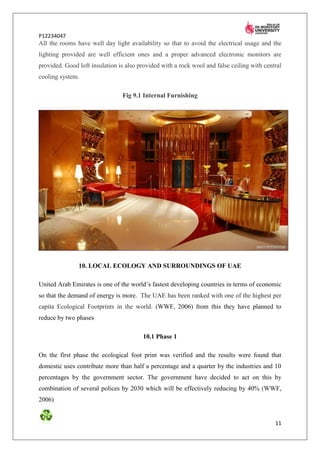
                                Fig 9.1 Internal Furnishing


               10. LOCAL ECOLOGY AND SURROUNDINGS OF UAE

United Arab Emirates is one of the world’s fastest developing countries in terms of economic
so that the demand of energy is more. The UAE has been ranked with one of the highest per
capita Ecological Footprints in the world. (WWF, 2006) from this they have planned to
reduce by two phases

                                        10.1 Phase 1

On the first phase the ecological foot print was verified and the results were found that
domestic uses contribute more than half a percentage and a quarter by the industries and 10
percentages by the government sector. The government have decided to act on this by
combination of several polices by 2030 which will be effectively reducing by 40% (WWF,
2006)


                                                                                            11
P12234047
                                       10.2 PHASE 2

The second phase started in 2012 and is focusing on developing science-based environmental
policies to help reduce the UAE’s carbon dioxide emissions and per capita ecological
footprint by several steps they are


1. Developing energy efficiency standards for residential lighting;


2. Conducting a socio-economic assessment of the policies outlined in the scenario model
   created in Phase 1, targeting the energy and water sector of the UAE;


3. Verifying the UAE’s Ecological Footprint and communicating the results to policymakers.
   (WWF, 2012)

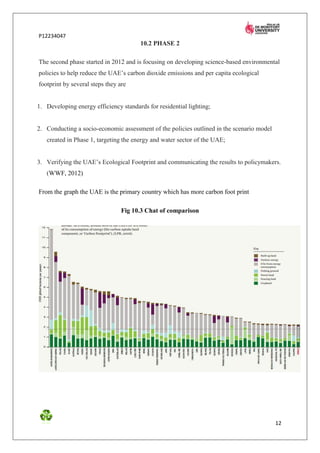
From the graph the UAE is the primary country which has more carbon foot print

                                 Fig 10.3 Chat of comparison


                                                                                           12
P12234047


                            11. PROBLEMS AND SOLUTION

The main problem the tower is facing is the lacking of renewable technology as well as the
sewage system which indirectly produces atmospheric pollution as well as the carbon foot
print. The tower is not directly connected to the central drainage every day the trucks have to
manually collect the drainage and travel out of the Dubai city.

From the studies from the Yale University pointed out that the sky scrapers have adversely
effected the climate on area will change by increasing smog and decreasing precipitation
which cause in increase in thunderstorm. As Dubai is a most modernized city with lots of
towers so in the coming year’s climate change is a major threat for this city. To avoid this
problem they have to go for renewable solution As the Persian gulf climate is sunny most of
the days in an year so that the designers could have suggest more solar power to the building
and the policy of the government have to be more tight to make the world more greener as
from the one end we are patching up the greenness around the world by eradicating the stock
fuel in order to achieve sustainability. The tower has also green irrigation project which
partially irrigates with the water which is collected from condense collection of water from
the cooling system which is approximately 15 million gallons which can be modified to a
fully irrigated one by recycling the waste water from the occupants

                                     12. CONCLUSION

The tallest man made free standing structure have altogether achieved the energy saving
measures more than 30 percentage by daylight efficiency as well as solar water heating their
participation of the tower on the earth hour contributed its role among the world so this
building is said to be a low carbon building more over that like a coin has two sides on the
flip side they must be more concerned about the carbon foot print towards the environment
not only showing their name in the book by creating a massive structure but also if they have
provided more greener atmosphere this could have been even more success tower and also
the space utilization could have been more effectively designed so that the utilization of space
could have been more economical and greener way.


                                                                                             13
P12234047


                                       13. BIBLIOGRAPHY

   1. OSHUA C. FEBLOWITZ. (2010). Confusing The Wind: The Burj Khalifa, Mother
      Nature,             and              the             Modern                Skyscraper. Available:
      http://www.studentpulse.com/articles/124/confusing-the-wind-the-burj-khalifa-
      mother-nature-and-the-modern-skyscraper. Last accessed 12 Jan 2013.
   2. Linda C. Lentz. (2010). Shedding Light on the World’s Tallest Building.Available:
      http://archrecord.construction.com/projects/lighting/2010/08/burj_khalifa.asp.                   Last
      accessed 12 Jan 2013.
   3. Emmar. (2010). Burj Khalifa. Available: http://www.burjkhalifa.ae. Last accessed 12
      Jan 2013.
   4. Josephine              Minutillo.               (2010). Beyond                  Limits. Available:
      http://continuingeducation.construction.com/article.php?L=5&C=690. Last accessed
      12 Jan 2013.
   5. Maurice Picow. (2010). Burj Dubai is Finished, But at What Environmental
      Value?. Available:     http://www.greenprophet.com/2010/01/burj-dubai-environment/.
      Last accessed 12 Jan 2013.
   6. Arabian        Business      .       (2010). Top         Burj        Dubai           facts. Available:
      http://www.arabianbusiness.com/top-burj-dubai-facts-27518.html. Last accessed 12
      Jan 2013.
   7. HVAC&R Nation. (2010). A tall order – Cooling Dubai’s Burj Khalifa. Available:
      http://www.airah.org.au/imis15_prod/Content_Files/HVACRNation/2010/March2010
      /HVACRNation2010-03-F01.pdf. Last accessed 12 Jan 2013.
   8. Clean     Middle     East.   (2010). A       challenge       to    the     science      of   facilities
      management. Available:           http://www.cleanmiddleeast.ae/articles/179/burj-khalifa-a-
      challenge-to-the-science-of-facilities-management.html. Last accessed 12 Jan 2013.
   9. Emirates    24/7.     (2010). Burj         Khalifa    sets        energy     landmark. Available:
      http://www.emirates247.com/eb247/the-business-of-life/environment/burj-khalifa-
      sets-energy-landmark-2010-04-05-1.102909. Last accessed 12 Jan 2013.
   10. Geraldine Bedell. (2010). Burj Khalifa – a bleak symbol of Dubai's era of
      bling. Available:    http://www.guardian.co.uk/culture/2010/jan/10/burj-khalifa-dubai-
      skyscraper-architecture. Last accessed 12 Jan 2013.


                                                                                                          14
P12234047
   11. HASEEB JAMAL. (2010). Design, Construction & Structural Details of Burj Dubai -
      Khalifa | Tallest Skyscraper. Available: http://www.enggpedia.com/civil-engineering-
      encyclopedia/megastructures/burj-khalifa-structural-details. Last accessed 12 Jan
      2013.
   12. Ahmad Abdelrazaq. (2010). Validating the Structural Behavior and Response of Burj
      Khalifa:      Synopsis       of    the   Full     Scale   Structural         Health     Monitoring
      Programs. Available:
      http://www.ctbuh.org/LinkClick.aspx?fileticket=DUN2DTspi%2Fs%3D&tabid=468
      &language=en-US. Last accessed 12 Jan 2013.
   13. Ratsdorf. (2013). The Incredible Story Of How The Burj Khalifa's Poop is Trucked
      Out of Town. Available: http://www.envirology.co.nz/blog/blog-list/317-bridgette-
      meinhold-the-incredible-story-of-how-the-burj-khalifa-s-poop-is-trucked-out-of-town.
      Last accessed 12 Jan 2013.
   14. Vesela Todorova. (2010). Unplugged Burj Khalifa turns into Earth Hour's tallest
      dark tower Read more: http://www.thenational.ae/news/uae-news/unplugged-burj-
      khalifa-turns-into-earth-hours-tallest-dark-tower#ixzz2HorILeKl                       Fo. Available:
      http://www.thenational.ae/news/uae-news/unplugged-burj-khalifa-turns-into-earth-
      hours-tallest-dark-tower. Last accessed 12 Jan 2013.
   15. Markus Plettau. (2010). When technology meets aesthetics New generation of crystal
      clear bonding. Available: http://media.bdonline.co.uk/PDF/IGS_When-technology-
      meets.pdf. Last accessed 12 Jan 2013.
   16. Tridonic. (2011). The spectacular Burj Khalifa in downtown Dubai, the world’s
      tallest building, is using a wide range of products from Tridonic.Available:
      http://www.tridonic.com/com/en/burj-khalifa-ae.asp. Last accessed 12 Jan 2013.
   17. WWF.         (2006). The         Ecoligical      foot    print        initiative       . Available:
      http://uae.panda.org/what_we_do/projects2/2c/. Last accessed 12 Jan 2013.
   18. Asia        Travel      .        (2010). Burj       Khalifa      Goes          Solar. Available:
      http://www.asiatraveltips.com/news10/74-BurjKhalifa.shtml. Last accessed 12 Jan
      2013.
   19. Glazette.                                     (2010). FEATURESVIDEOSWEBINARSGLASS
      RESOURCESCONTESTSJOBSMEMBERSSEARCH                             Solar     &     Thermal      Control
      Glasses In Burj Khalifa. Available: http://www.glazette.com/solar-&-thermal-control-
      glasses-in-burj-khalifa-194.html. Last accessed 12 Jan 2013.


                                                                                                       15
P12234047
   20. Burj Khalifa . (2010). STRUCTURAL ELEMENTS — ELEVATORS, SPIRE, AND
      MORE. Available:   http://www.burjkhalifa.ae/the-tower/structure.aspx.   Last
      accessed 12 Jan 2013


                                                                                16

Burj khalifa

  • 1.
    P12234047 ASSIGNMENT TITLE: LOW CARBON BUILDING DESIGN Student Name: Balasubramanian Venkiteswaran Enrolment Number: P12234047 Module Title: Energy in Buildings Module Code: ENGT5112 1
  • 2.
    P12234047 SL NO CONTENTS PAGE NUMBER 01. Executive summery 03 02. Introduction 03 03. Aim 04 04. Architecture 04 04.1 Fig 1 Total View 04 04.2 Fig Elevation 05 04.3 Fig Main Structure and design 05 05. Facts and Figures 06 06. Environmental Features 06 07. Sustainability 07 08. Energy and its impacts 07 8.1 Fig Heat map 09 8.2 Fig Glass used 10 09. Interior 10 9.1 Fig Internal Furnishing 11 10. Local Ecology of UAE 11 10.1 Phase 1 11 10.2 Phase 2 12 10.3 Chat of comparison 12 11. Problems and Solutions 13 12. Conclusion 13 13. Bibliography 14 2
  • 3.
    P12234047 01. EXECUTIVE SUMMARY The construction of buildings now a day are based on customer needs and to have all the basic features to attract the clients as well as the design features and the comfortless are also considered as the major things due to more security threats on occupants the structures are made very strong The new generation buildings are concerned about lots of factors like materials, design, sustainability, construction, and IT technologies. Here I am going to explain about my own work experience the massive structure called Burj Khalifa the world’s tallest tower at the moment located in United Arab Emirates, How the design reduces the carbon foot print , the energy efficiency in lighting, the cooling system and how the building is related to echo friendly In the following paragraphs, we will discuss the construction technology associated with buildings and will present a case analysing the architecture and construction technology applied in a skyscraper. Moreover, we will also discuss different building systems associated with the design, construction and echo friendliness of the buildings. 02. INTRODUCTION The building is located in the United Arab Emirates which is 828 Meters high as well as 5.67 million square feet across and consist of 160 floors The construction is done in such way that on a Y shaped structure with three wings which gives stable configuration moreover the building has twenty six helical levels which decreases the cross section area of the tower as its spirally skywards. The tower consists of 37 offices, 900 residential apartments, 160 Guest rooms, 144 private residences and a floor area of 334,000 Square meters. Tower needs 50 Mega Volt Ampere at its peak time which equivalent to a large township more over which uses a water of 946,000 litres of water a day as the United Arab Emirates a hot country where the temperature goes up to 50 degree centigrade the tower require cooling which is 12,500 tons on a hot sunny day. 03. AIM The aim of this assignment is to rug light on different methods and procedures in terms of carbon foot print employed in constructing buildings, particularly high rise structures and also evaluate the use of these procedures in a famous building built in UAE. 3
  • 4.
    P12234047 04. ARCHITECTURE The way the tower is designed in such a way that triple- loaded footprint, an abstraction of Hymenocallis flower. The tower is arranged around a central core , the modular Y shaped with wings in each side makes the tower more stable which consists of 26 such floor plates which reduces the floor cross section towards the top. The reason which is built in such a manner that to increase the view of the Arabian Gulf and the bottom of the tower is in the shape of the onion domes which indicates the Islamic architecture. Over 45,000 square meter cube of concrete which composes more carbon foot print for their manufacture more over 330,000 the steel which is used is also contribute the carbon foot print. In the concrete core wall construction the pump used which is the highest pumping ever done in history because heavy machinery pumps are used so that more energy is burned so that it also contributed carbon the excavation work started in 2004 and finished in 2010 which took 22 million man power hours so we need to consider the transportation which contributes carbon emission Fig 4.1 total View 4
  • 5.
    P12234047 Fig 4.2 Elevation Fig.4.3 5
  • 6.
    P12234047 05. FACTS AND FIGURES The Burj Khalifa was open on January 4th 2010 it’s the world’s tallest tower at the moment more over that the height is 828 Meters the building is previously known as the Burj Dubai, The tower consist of several special features such as most number of the elevators and fastest as well 64km/hr , the highest outdoor observation desk, It consist of 162 floors which is been cladded with 28,261glass panel outside the tower, The concrete used for paving is 2,065 Km long . 06. ENVIRONMENTAL FEATURES The modernized tower has the best advanced feathers where the implementations of renewables on its construction since the Dubai’s wealth in stock fuel is more still they are really concerned about the sustainable features for hot water purpose they are using solar panels which is capable of heating 140,000 litres of water every day which is distributed among the commercial and domestic purposes. This can save nearly 3200 kilowatts per day and approximately 690 megawatt hour energy per year. The construction group Emmar are highly concerned about the usage of renewable energy in the urban areas. On the roof of the tower there are 375 collectors which are capable of collecting 140,000 litres of water which can be heated in seven hours of time. As the temperature is more humid on the Middle East area they made ensure that the supply of fresh air through the thermal wheels where ever possible in the building. The Scenario is exactly opposite to United Kingdom here we are trying to preserve heat inside the building and there they are trying to provide the cold loss inside the building for that purpose the designers have looked in to a special performance glazing glass with low emissivity which protects the tower with advanced thermal protection where the temperature between 35°C – 45°C during the summer which is between April and October. The use of energy monitors and electronic meters with advanced system which stabilizes the on-going optimisation of electrical energy. The implementation of Building Management System which monitors all the electrical as well as the mechanical systems of the whole tower which includes ventilation, lighting, power system and security systems etc. where the software installed controls, optimize, monitor and report so that it will be easy for the engineer to stabilize the whole tower form the over consumption so that we can save lots of energy. 6
  • 7.
    P12234047 The most importantfactor regarding the cooling is the stack effect and due to the influence of the BMS reduces the need for mechanical pressurisation. ”Reportedly, HCFC-123 refrigerants are used to cool the Burj Khalifa, which has a significantly lower global warming potential than similar projects using HFC-134a in surrounding areas, one source reports” (Hvac.com.au, 2010) 07. SUSTAINABILITY Sustainability in this tower means creating designs that become object whose value will also have a meaning in the future which is been explained by the Mr Sasha lvanovich the director of the Singapore architects more over that he said it takes less space so that more environmental sustainable “A sustainable building has to be justified economically” said Dr Sabah Al Rayes “Skyscrapers such as Burj Khalifa are inherently sustainable because they accommodate a large number of people on a small footprint, which helps save agricultural land from development and reduce carbon emission associated with commuting to and from suburbs. They also offer efficient vertical and horizontal transportation systems, encouraging the use of public transit and creating increasingly walkable cities. Super tall buildings can also be formed to further decrease their environmental effect and become "super-sustainable." These structures can take advantage of the faster wind speeds at higher altitudes and drive wind toward building-integrated turbines to generate power. Because they are less likely to have shadows cast on them, high-rises also make efficient use of building-integrated photovoltaic systems to absorb solar power and generate energy. And deep foundations make them ideal for geothermal heating and radiant cooling systems” (Adrian Smith + Gordon Gill Architects, 2010) 08. ENERGY AND ITS IMPACTS There are several sources of energy use electrical, mechanical, civil and some other factors Electricity:40,000 kilowatts of electrical consumption is be reported on the peak times of the tower which is equivalent of 500,000 100-watt light bulbs burning at the same time which means we can power up a city easily 7
  • 8.
    P12234047 Raw materials usedin this tower are nearly 40,000 tons of steel which is sufficient to connect a quarter areas round the earth. The transportation for this also have to considered because it also have to considered in the energy consumption Space utilization is very poor in this building where the top 30 floors are used as a storage due to lack of area as it gets steeper domestic and commercial purpose and the condensed water from the air condition are utilized for the plants in the garden. As everyone know in an year the UAE got a good amount of sunlight so why can’t they install the solar panels for the electricity in the practical point its will consume more space but a some considerable amount attest have to be on their design which will make the energy consumption is a big question for the designers ? Burj Khalifa comprises a hotel, offices and residential accommodation, all constructed in compliance with Dubai’s Green Building Code to ensure a high level of sustainability. Tridonic products have played a key role in achieving this. For example, LED modules TALEXXchain P511 and TALEXXconverter have been used for signage throughout, as well as on the viewing platform at the top of the hotel, to ensure reliable, low maintenance lighting with low energy consumption. Within the Armani Hotel, extensive use has been made of low voltage lighting, and to ensure maximum efficiency this has been combined with Tridonic Possum transformers. In offices and corridors a range of Tridonic PC fixed output electronic ballasts have been used. These feature the innovative Intelligent Voltage Guard, which constantly monitors the mains voltage to the control gear to protect it against possible damage due to over or under- voltage. (Tridonic, 2011) The grounds of the Burj Khalifa cover an area of 11 ha and much of the exterior lighting has been fitted with magnetic ballasts from Tridonic. These include OGS 250 & OGS 400 large magnetic ballasts controlling 250 and 400 W street lamps for paths around the area of the building, lighting the roads and entrance areas of the building. Lighting in the service area uses EC magnetic ballasts, with impedance matched to the lamp type.Through its use of various Tridonic products, the Burj Khalifa clearly demonstrates that energy efficiency and low cost of ownership can be combined with high performance lighting that adds real value to both, interior and exterior environments. (Tridonic, 2011) 8
  • 9.
    P12234047 Water used Around250,000 gallons of water a day where on UAE the Dubai Electricity and water authority is running several pumps in the desalination plant to filter water here by more energy is consumed Cooling is done by the central district water plant from which the tower is normally serviced. In the case of a problem, the system can be switched to use water from one of the other cooling plants to service the tower. The central water plant uses a massive ice reservoir as a thermal storage system. Ice slurry is created on the top The only advantage which is which can be considered as an energy saving measure is that the solar water heating for the which requires more energy to make ice in the Persian Gulf humid climate .The Glasses which has been fixed in the tower is specially manufactured which is reflective in nature which won’t allow the heat to come in but the light so the illuminations so good in this building Sky Sourced Ventilation: Cooler air temperatures, reduced air density, and reduced relative humidity at the top of the building allow for “sky-sourced” fresh air. When air is drawn in at the top of the building, it requires less energy for air conditioning, ventilation, and dehumidification “Mechanical system used is seven double storey height mechanical floors house the equipment that brings the Burj Khalifa to life. Distributed around 30 storeys, the mechanical floors houses the electrical substations, Water tanks, Pumps and air handling units etc, that essential for the operation of the tower and the comfort of its occupants” ( Burj Khalifa, 2011) Fig 8.1 Heat map 9
  • 10.
    P12234047 The figure clearlystates that the usage of energy in Burj Khalifa among the all the building the tower uses energy at its maximum to stop the inflriation rate to make it cool in the humid condition. GLASS USED FOR PREVENT LOSS FROM INSIDE FIG 8.2 During the last four decades the energy leak through the glass have been gradually increased in this tower the glasses used are specially manufactured. The Structure is highly durable and capable so that the glazing installed silicones are the unrivalled technology to provide protection from Ultraviolet light, temperature and the weather resistance so they are specially manufactured form the Zurich of triple glazing which gives the maximum protection. The high performance structural silicone sealants ensure lowest possible gas loss rates from the glazing and these are manufactured in European standards EN 1279, The overall loss of gases 1% per year that means after three decades also more than 80% of the insulating gas will be there so there by maximum protection is provided 09. INTERIOR The interior of the wall is mainly based on the Gypsum wall rather than the main walls in order to reduce the whole building weight. The Thermal insulation is done at such a way that between the two boards in the cavity they have placed the rock wool to protect the cold loss more over that the screws are specially manufactured and all the accessories are provide by the company with fully furnished including all the sockets and points to avoid the drilling further. 10
  • 11.
    P12234047 All the roomshave well day light availability so that to avoid the electrical usage and the lighting provided are well efficient ones and a proper advanced electronic monitors are provided. Good loft insulation is also provided with a rock wool and false ceiling with central cooling system. Fig 9.1 Internal Furnishing 10. LOCAL ECOLOGY AND SURROUNDINGS OF UAE United Arab Emirates is one of the world’s fastest developing countries in terms of economic so that the demand of energy is more. The UAE has been ranked with one of the highest per capita Ecological Footprints in the world. (WWF, 2006) from this they have planned to reduce by two phases 10.1 Phase 1 On the first phase the ecological foot print was verified and the results were found that domestic uses contribute more than half a percentage and a quarter by the industries and 10 percentages by the government sector. The government have decided to act on this by combination of several polices by 2030 which will be effectively reducing by 40% (WWF, 2006) 11
  • 12.
    P12234047 10.2 PHASE 2 The second phase started in 2012 and is focusing on developing science-based environmental policies to help reduce the UAE’s carbon dioxide emissions and per capita ecological footprint by several steps they are 1. Developing energy efficiency standards for residential lighting; 2. Conducting a socio-economic assessment of the policies outlined in the scenario model created in Phase 1, targeting the energy and water sector of the UAE; 3. Verifying the UAE’s Ecological Footprint and communicating the results to policymakers. (WWF, 2012) From the graph the UAE is the primary country which has more carbon foot print Fig 10.3 Chat of comparison 12
  • 13.
    P12234047 11. PROBLEMS AND SOLUTION The main problem the tower is facing is the lacking of renewable technology as well as the sewage system which indirectly produces atmospheric pollution as well as the carbon foot print. The tower is not directly connected to the central drainage every day the trucks have to manually collect the drainage and travel out of the Dubai city. From the studies from the Yale University pointed out that the sky scrapers have adversely effected the climate on area will change by increasing smog and decreasing precipitation which cause in increase in thunderstorm. As Dubai is a most modernized city with lots of towers so in the coming year’s climate change is a major threat for this city. To avoid this problem they have to go for renewable solution As the Persian gulf climate is sunny most of the days in an year so that the designers could have suggest more solar power to the building and the policy of the government have to be more tight to make the world more greener as from the one end we are patching up the greenness around the world by eradicating the stock fuel in order to achieve sustainability. The tower has also green irrigation project which partially irrigates with the water which is collected from condense collection of water from the cooling system which is approximately 15 million gallons which can be modified to a fully irrigated one by recycling the waste water from the occupants 12. CONCLUSION The tallest man made free standing structure have altogether achieved the energy saving measures more than 30 percentage by daylight efficiency as well as solar water heating their participation of the tower on the earth hour contributed its role among the world so this building is said to be a low carbon building more over that like a coin has two sides on the flip side they must be more concerned about the carbon foot print towards the environment not only showing their name in the book by creating a massive structure but also if they have provided more greener atmosphere this could have been even more success tower and also the space utilization could have been more effectively designed so that the utilization of space could have been more economical and greener way. 13
  • 14.
    P12234047 13. BIBLIOGRAPHY 1. OSHUA C. FEBLOWITZ. (2010). Confusing The Wind: The Burj Khalifa, Mother Nature, and the Modern Skyscraper. Available: http://www.studentpulse.com/articles/124/confusing-the-wind-the-burj-khalifa- mother-nature-and-the-modern-skyscraper. Last accessed 12 Jan 2013. 2. Linda C. Lentz. (2010). Shedding Light on the World’s Tallest Building.Available: http://archrecord.construction.com/projects/lighting/2010/08/burj_khalifa.asp. Last accessed 12 Jan 2013. 3. Emmar. (2010). Burj Khalifa. Available: http://www.burjkhalifa.ae. Last accessed 12 Jan 2013. 4. Josephine Minutillo. (2010). Beyond Limits. Available: http://continuingeducation.construction.com/article.php?L=5&C=690. Last accessed 12 Jan 2013. 5. Maurice Picow. (2010). Burj Dubai is Finished, But at What Environmental Value?. Available: http://www.greenprophet.com/2010/01/burj-dubai-environment/. Last accessed 12 Jan 2013. 6. Arabian Business . (2010). Top Burj Dubai facts. Available: http://www.arabianbusiness.com/top-burj-dubai-facts-27518.html. Last accessed 12 Jan 2013. 7. HVAC&R Nation. (2010). A tall order – Cooling Dubai’s Burj Khalifa. Available: http://www.airah.org.au/imis15_prod/Content_Files/HVACRNation/2010/March2010 /HVACRNation2010-03-F01.pdf. Last accessed 12 Jan 2013. 8. Clean Middle East. (2010). A challenge to the science of facilities management. Available: http://www.cleanmiddleeast.ae/articles/179/burj-khalifa-a- challenge-to-the-science-of-facilities-management.html. Last accessed 12 Jan 2013. 9. Emirates 24/7. (2010). Burj Khalifa sets energy landmark. Available: http://www.emirates247.com/eb247/the-business-of-life/environment/burj-khalifa- sets-energy-landmark-2010-04-05-1.102909. Last accessed 12 Jan 2013. 10. Geraldine Bedell. (2010). Burj Khalifa – a bleak symbol of Dubai's era of bling. Available: http://www.guardian.co.uk/culture/2010/jan/10/burj-khalifa-dubai- skyscraper-architecture. Last accessed 12 Jan 2013. 14
  • 15.
    P12234047 11. HASEEB JAMAL. (2010). Design, Construction & Structural Details of Burj Dubai - Khalifa | Tallest Skyscraper. Available: http://www.enggpedia.com/civil-engineering- encyclopedia/megastructures/burj-khalifa-structural-details. Last accessed 12 Jan 2013. 12. Ahmad Abdelrazaq. (2010). Validating the Structural Behavior and Response of Burj Khalifa: Synopsis of the Full Scale Structural Health Monitoring Programs. Available: http://www.ctbuh.org/LinkClick.aspx?fileticket=DUN2DTspi%2Fs%3D&tabid=468 &language=en-US. Last accessed 12 Jan 2013. 13. Ratsdorf. (2013). The Incredible Story Of How The Burj Khalifa's Poop is Trucked Out of Town. Available: http://www.envirology.co.nz/blog/blog-list/317-bridgette- meinhold-the-incredible-story-of-how-the-burj-khalifa-s-poop-is-trucked-out-of-town. Last accessed 12 Jan 2013. 14. Vesela Todorova. (2010). Unplugged Burj Khalifa turns into Earth Hour's tallest dark tower Read more: http://www.thenational.ae/news/uae-news/unplugged-burj- khalifa-turns-into-earth-hours-tallest-dark-tower#ixzz2HorILeKl Fo. Available: http://www.thenational.ae/news/uae-news/unplugged-burj-khalifa-turns-into-earth- hours-tallest-dark-tower. Last accessed 12 Jan 2013. 15. Markus Plettau. (2010). When technology meets aesthetics New generation of crystal clear bonding. Available: http://media.bdonline.co.uk/PDF/IGS_When-technology- meets.pdf. Last accessed 12 Jan 2013. 16. Tridonic. (2011). The spectacular Burj Khalifa in downtown Dubai, the world’s tallest building, is using a wide range of products from Tridonic.Available: http://www.tridonic.com/com/en/burj-khalifa-ae.asp. Last accessed 12 Jan 2013. 17. WWF. (2006). The Ecoligical foot print initiative . Available: http://uae.panda.org/what_we_do/projects2/2c/. Last accessed 12 Jan 2013. 18. Asia Travel . (2010). Burj Khalifa Goes Solar. Available: http://www.asiatraveltips.com/news10/74-BurjKhalifa.shtml. Last accessed 12 Jan 2013. 19. Glazette. (2010). FEATURESVIDEOSWEBINARSGLASS RESOURCESCONTESTSJOBSMEMBERSSEARCH Solar & Thermal Control Glasses In Burj Khalifa. Available: http://www.glazette.com/solar-&-thermal-control- glasses-in-burj-khalifa-194.html. Last accessed 12 Jan 2013. 15
  • 16.
    P12234047 20. Burj Khalifa . (2010). STRUCTURAL ELEMENTS — ELEVATORS, SPIRE, AND MORE. Available: http://www.burjkhalifa.ae/the-tower/structure.aspx. Last accessed 12 Jan 2013 16