PARLIAMENT LIBRARY,NEW
DELHI-2003
AR. RAJ REWAL
ABOUT THE ARCHITECT-RAJ REWAL
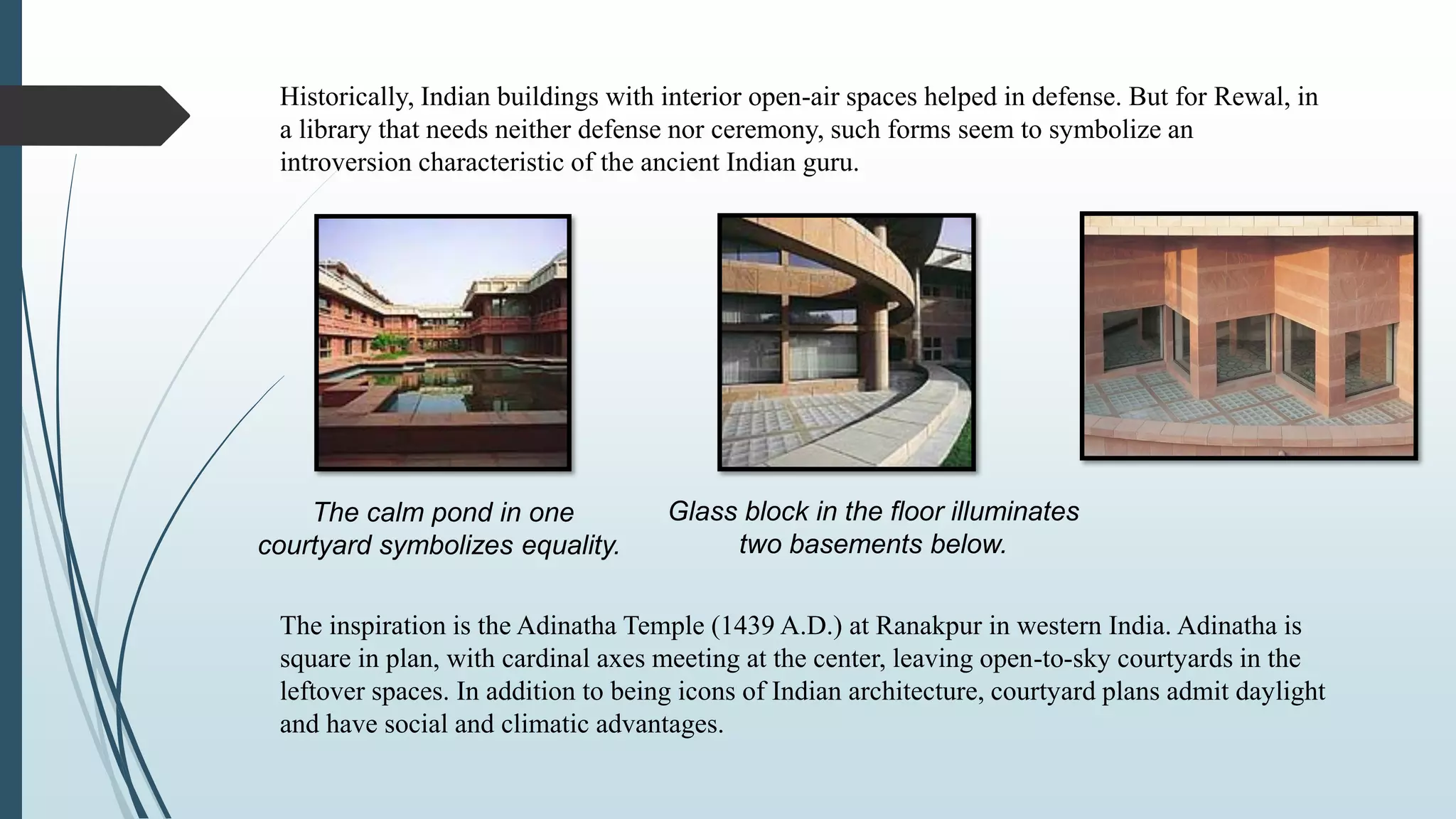
Raj Rewal was born in 1934 in Hoshiarpur, Punjab,
India.
Rewal lived in Delhi and Shimla from 1934–1951.
He attended Harcourt Butler higher secondary
school. Between 1951-1954 he attended the Delhi
School of Architecture in New Delhi.
After completing a degree in architecture in New
Delhi, he moved to London in 1955 where he lived
until 1961. He attended the Architectural
Association School of Architecture for one year and
the Brixton School of Building, London from 1956-
60.
PURPOSE
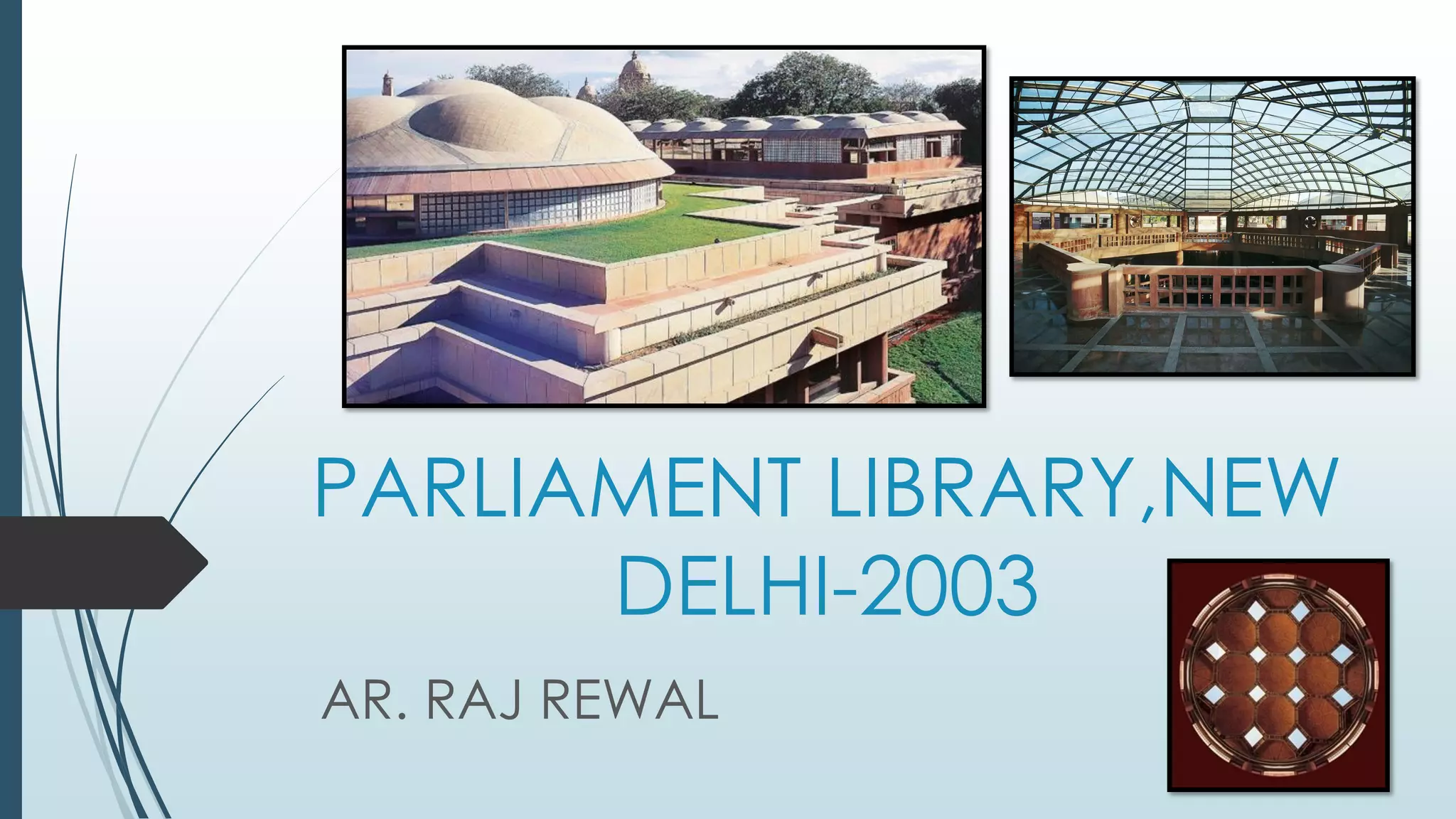
• Symbolically a house of knowledge, the Parliament Library has its site next to the
Parliament House in Lutyens Delhi. Both visually and symbolically, the central hall of
the existing Parliament denotes power, consensus and democracy and is linked to the
central core of the new complex. For the library, a formal structure is conceived within
the Indian tradition, built in a contemporary idiom to capture the essence without
mimicry of past historical styles. The site measures 10 acres with a built-up area of
50,000 sqm.
• The design for the existing Parliament follows the "Beaux Arts", the central line axis
planning criteria. It is circular in plan with three axes culminating in a central dome.
• Courtyards form an important feature of the design vocabulary, keeping in mind
Delhi's extreme climate. They help in creating a dust free atmosphere and in reducing
the summer heat.
• The height of the building is restricted to the podium level of the Parliament House.
CONCEPT BEHIND THE DESIGN
To give the library an identity of its own while respecting the Parliament building, Rewal says
he drew on Indian history and likened the relationship between buildings to the traditional
relationship between guru and king. A guru acknowledges the power of the king — neither
confronting nor submitting — and retains the strength of his integrity as a sage.
Regionally quarried sandstone
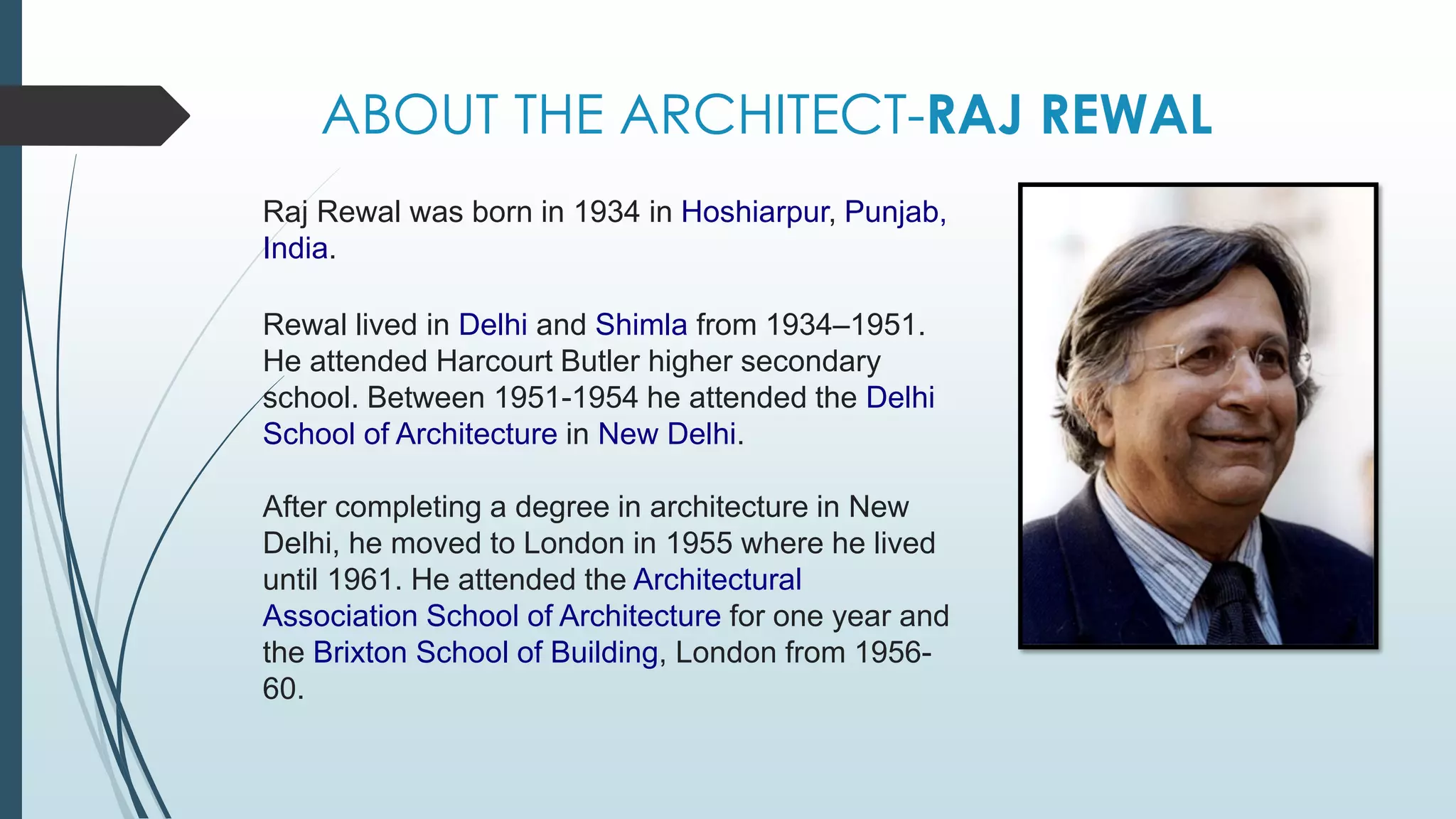
The tubular steel roof structure of the
scholars' reading room with skylight
panels inset in the roof domes.
Hand crafted stone jalis
are used throughout the building.
BASIC IDEA
• Rewal decided to sink part of the library underground, leaving two of the four floors above
grade. The terrace of the library aligns with the first floor level of the Parliament building. Only
the domes of the library rise higher. The sight lines leading to the colonnade and entablature of
the Parliament are left unobstructed.
• Also, the exterior walls of the library are clad in the same red and beige sandstone as that used in
the Parliament building. This local stone has been used extensively in northern and northwestern
India through the centuries and therefore expresses regionalism. In these two decisions regarding
height and materials, the guru acknowledges the power of the king. But the guru's wisdom and
integrity are demonstrated in the architecture of the library.
• The plan of the building is inspired by precolonial Indian architecture such as the
magnificent Taj Mahal, with its square base and symmetrical composition- POST
INDEPENDENCE ARCHITECTURE.
Historically, Indian buildings with interior open-air spaces helped in defense. But for Rewal, in
a library that needs neither defense nor ceremony, such forms seem to symbolize an
introversion characteristic of the ancient Indian guru.
The calm pond in one
courtyard symbolizes equality.
Glass block in the floor illuminates
two basements below.
The inspiration is the Adinatha Temple (1439 A.D.) at Ranakpur in western India. Adinatha is
square in plan, with cardinal axes meeting at the center, leaving open-to-sky courtyards in the
leftover spaces. In addition to being icons of Indian architecture, courtyard plans admit daylight
and have social and climatic advantages.
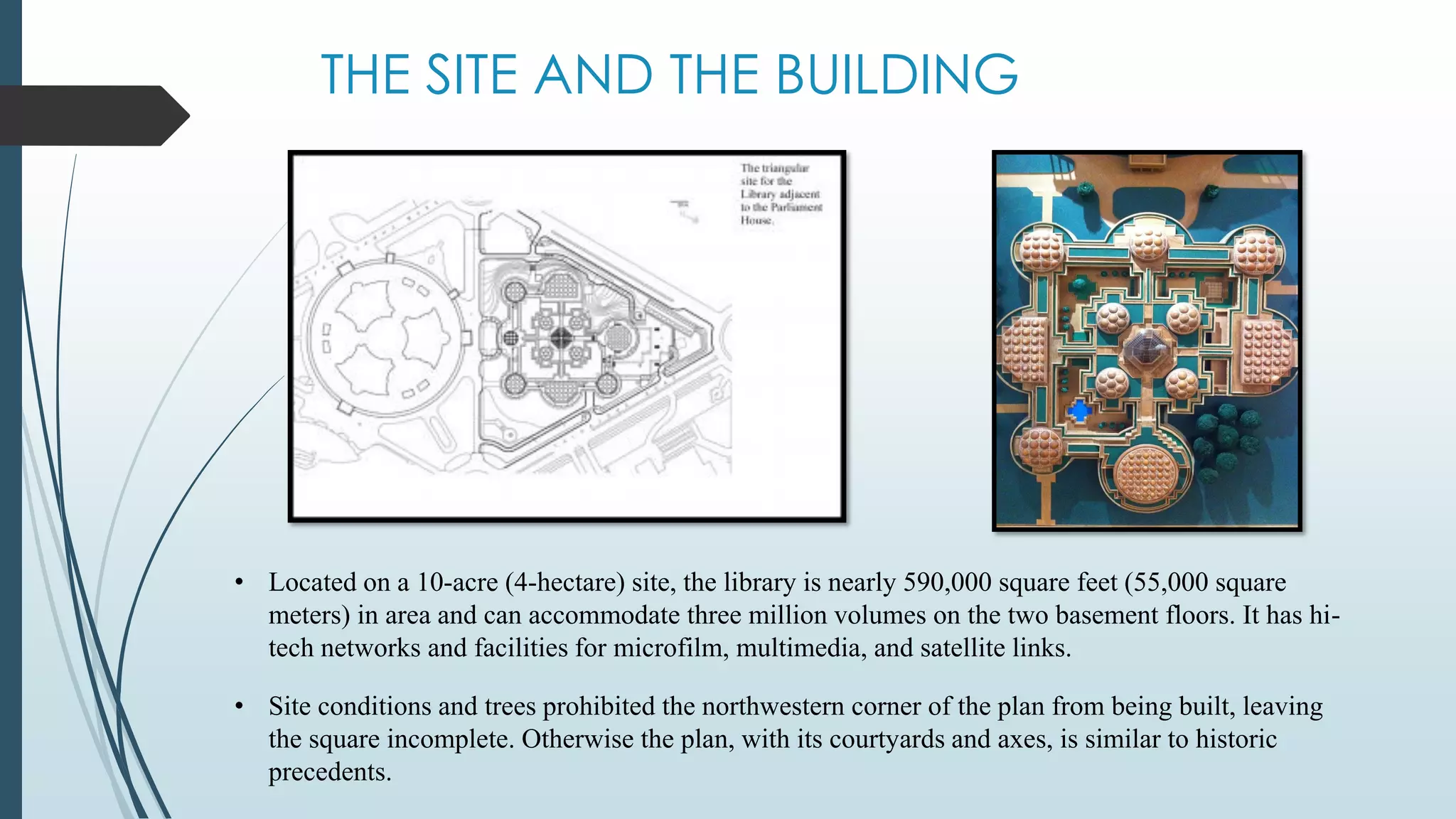
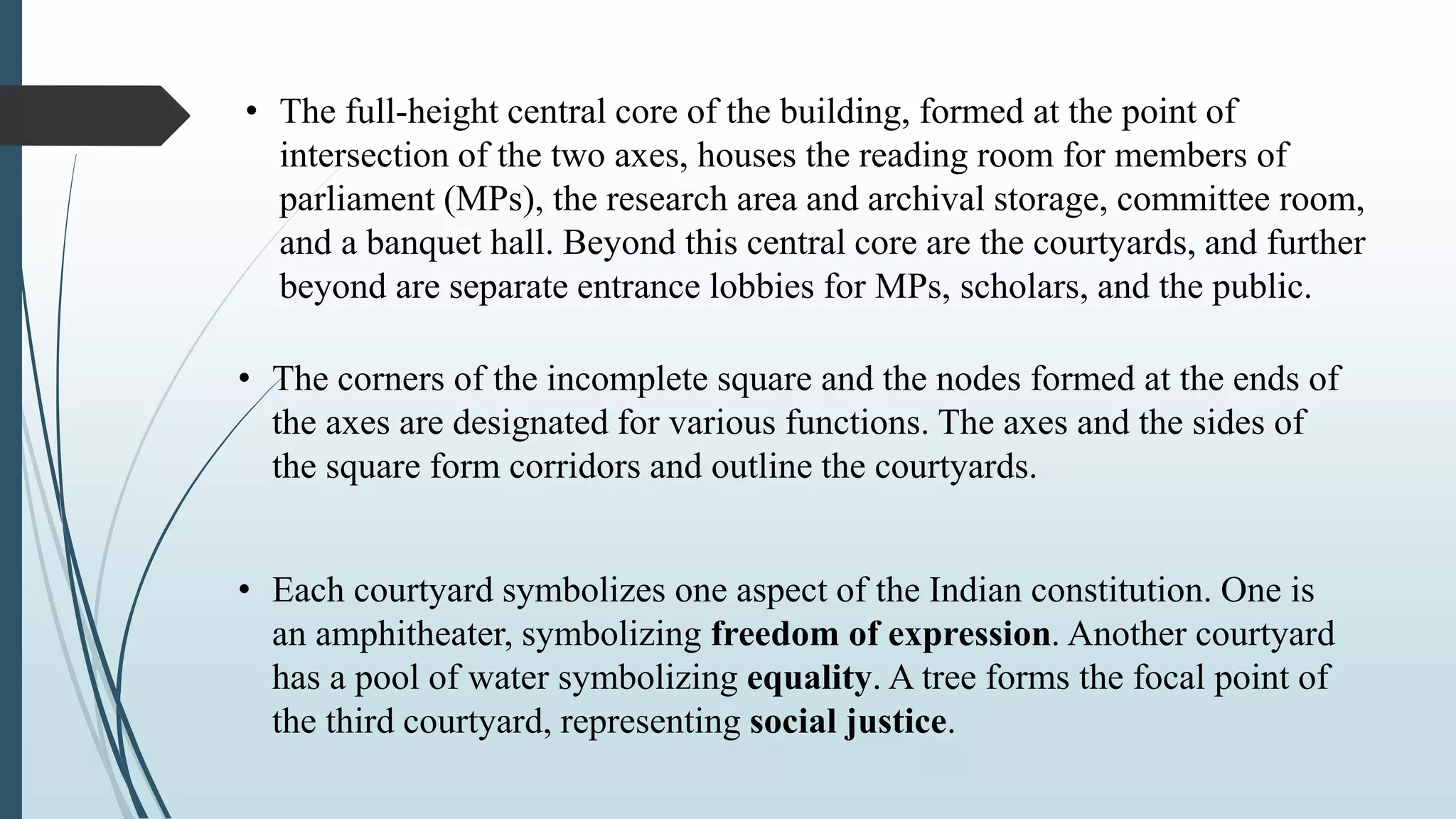
THE SITE AND THE BUILDING
• Located on a 10-acre (4-hectare) site, the library is nearly 590,000 square feet (55,000 square
meters) in area and can accommodate three million volumes on the two basement floors. It has hi-
tech networks and facilities for microfilm, multimedia, and satellite links.
• Site conditions and trees prohibited the northwestern corner of the plan from being built, leaving
the square incomplete. Otherwise the plan, with its courtyards and axes, is similar to historic
precedents.
• The full-height central core of the building, formed at the point of
intersection of the two axes, houses the reading room for members of
parliament (MPs), the research area and archival storage, committee room,
and a banquet hall. Beyond this central core are the courtyards, and further
beyond are separate entrance lobbies for MPs, scholars, and the public.
• The corners of the incomplete square and the nodes formed at the ends of
the axes are designated for various functions. The axes and the sides of
the square form corridors and outline the courtyards.
• Each courtyard symbolizes one aspect of the Indian constitution. One is
an amphitheater, symbolizing freedom of expression. Another courtyard
has a pool of water symbolizing equality. A tree forms the focal point of
the third courtyard, representing social justice.
TECHNOLOGY AND STRUCTURE
• The domes are perhaps the building's most significant feature. Several domes of different sizes
and types make up the roof and benefit from Rewal's experiments in earlier buildings.
• The central dome, spanning 82 feet (25 meters), is entirely of glass that was specially developed
for this building. The intense heat and glare of New Delhi, with summer temperatures rising to
over 110 degrees Fahrenheit (43 degrees Centigrade), make conventional glass impractical for
skylights.
The glass dome above the
central core.
• Rewal insisted on using glass to let in light. Conventional reflective glass reduces glare and
heat build-up, and this specially developed glass is claimed to be still more efficient in
resisting heat transfer. The result: almost magical views of the blue sky, of the sun minus its
heat and glare, and of the seasonal monsoon clouds.
• This dome reminds you that you are standing at the intersection of the building's two main
axes. The point of intersection projects up in the dome in the form of two bands formed by
the structural frame for the glass panels. The remainder of the dome consists of a lattice of
structural frames held together by a network of steel cables converging at key tension nodes.
• Other domes are made of thin fiber-reinforced concrete shells, sometimes with inset glass
panels. Tensile forces are transferred through tubular steel members.
• Other structural elements of the building are of reinforced concrete. The slabs are coffered to
support long spans. The diaphragm walls and the foundation slab of the underground
structure resist inward and upward pressure from the water table through anchors into the
surrounding soil and the rocky substrate.
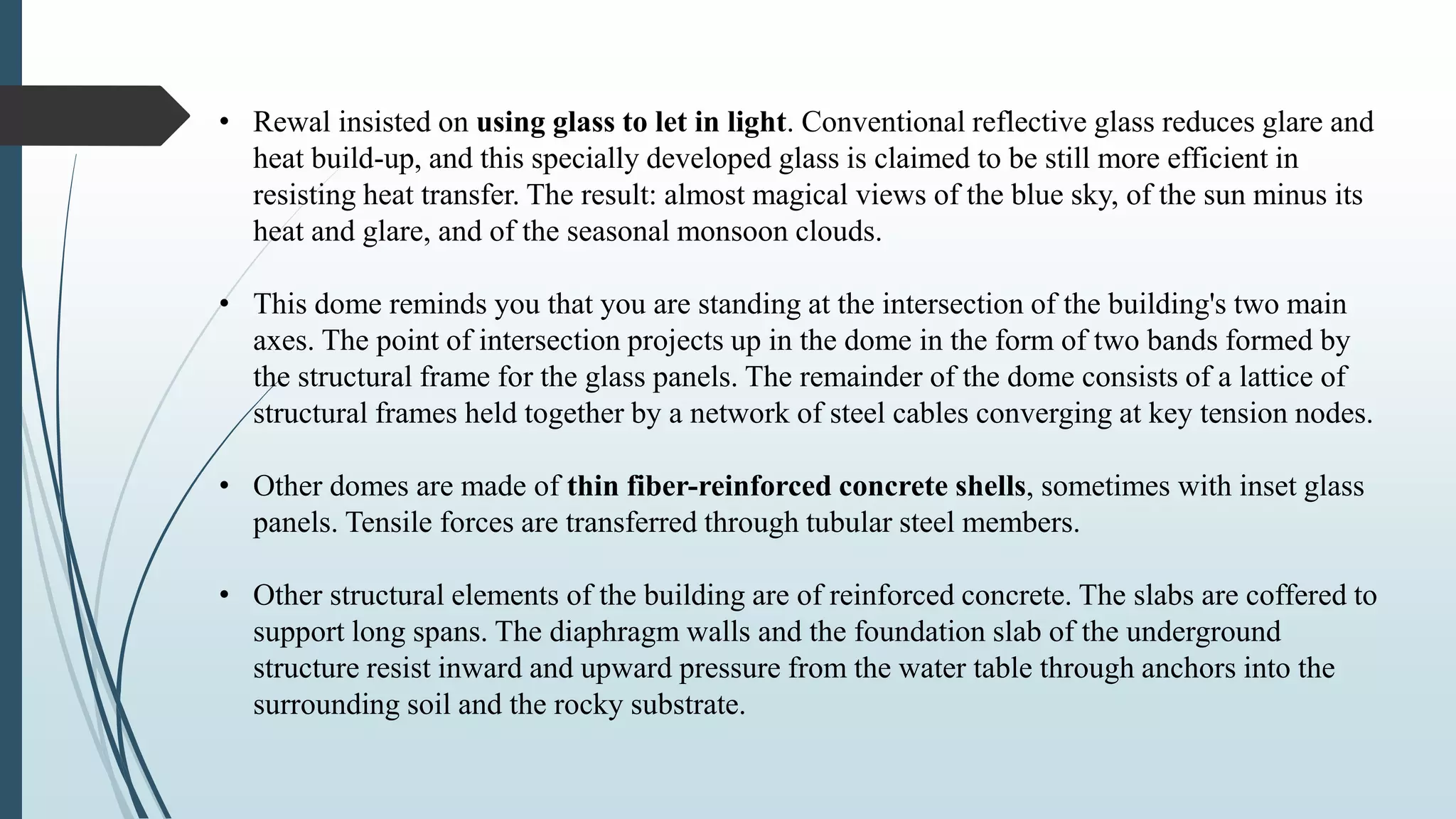
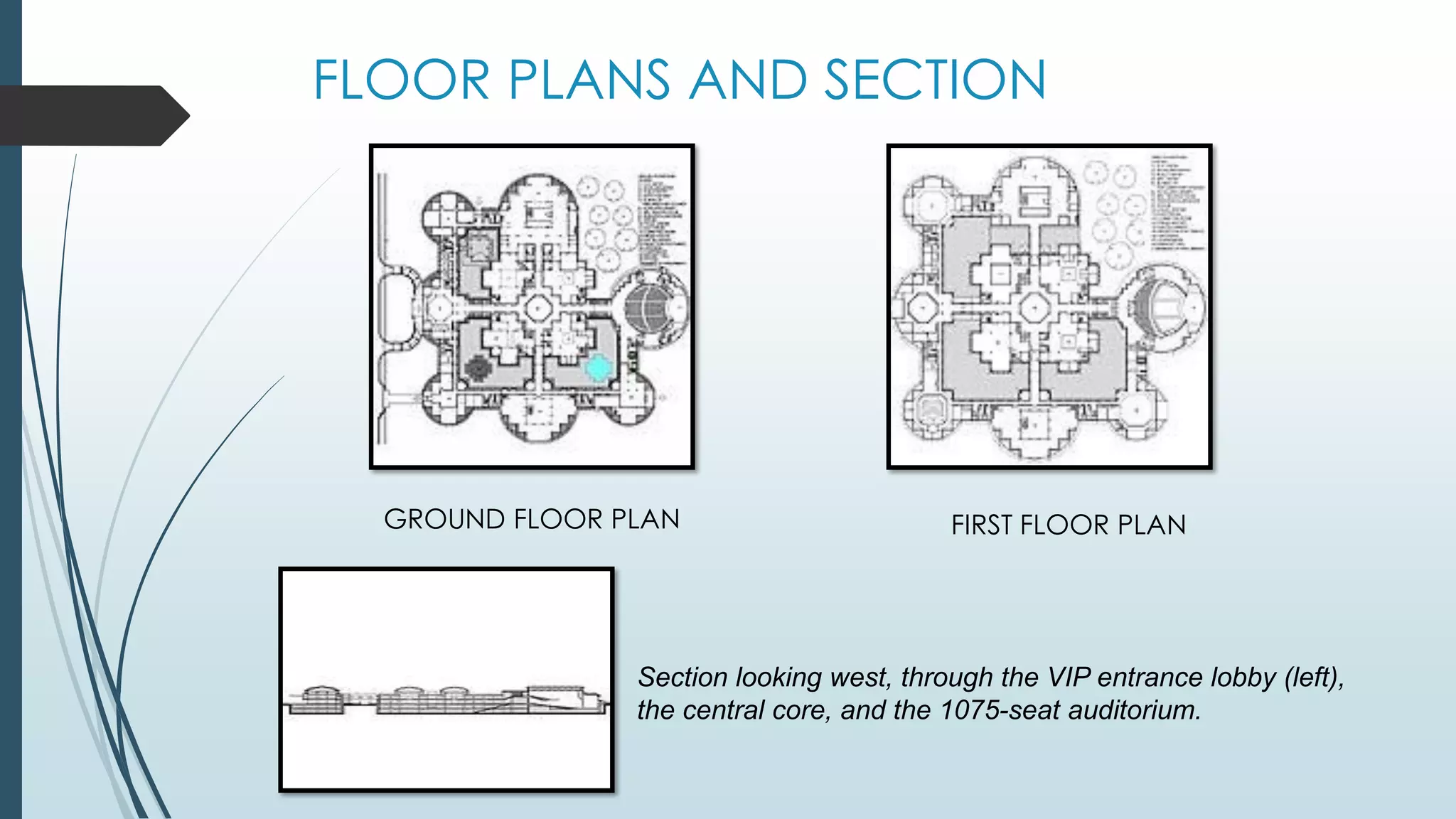
FLOOR PLANS AND SECTION
GROUND FLOOR PLAN FIRST FLOOR PLAN
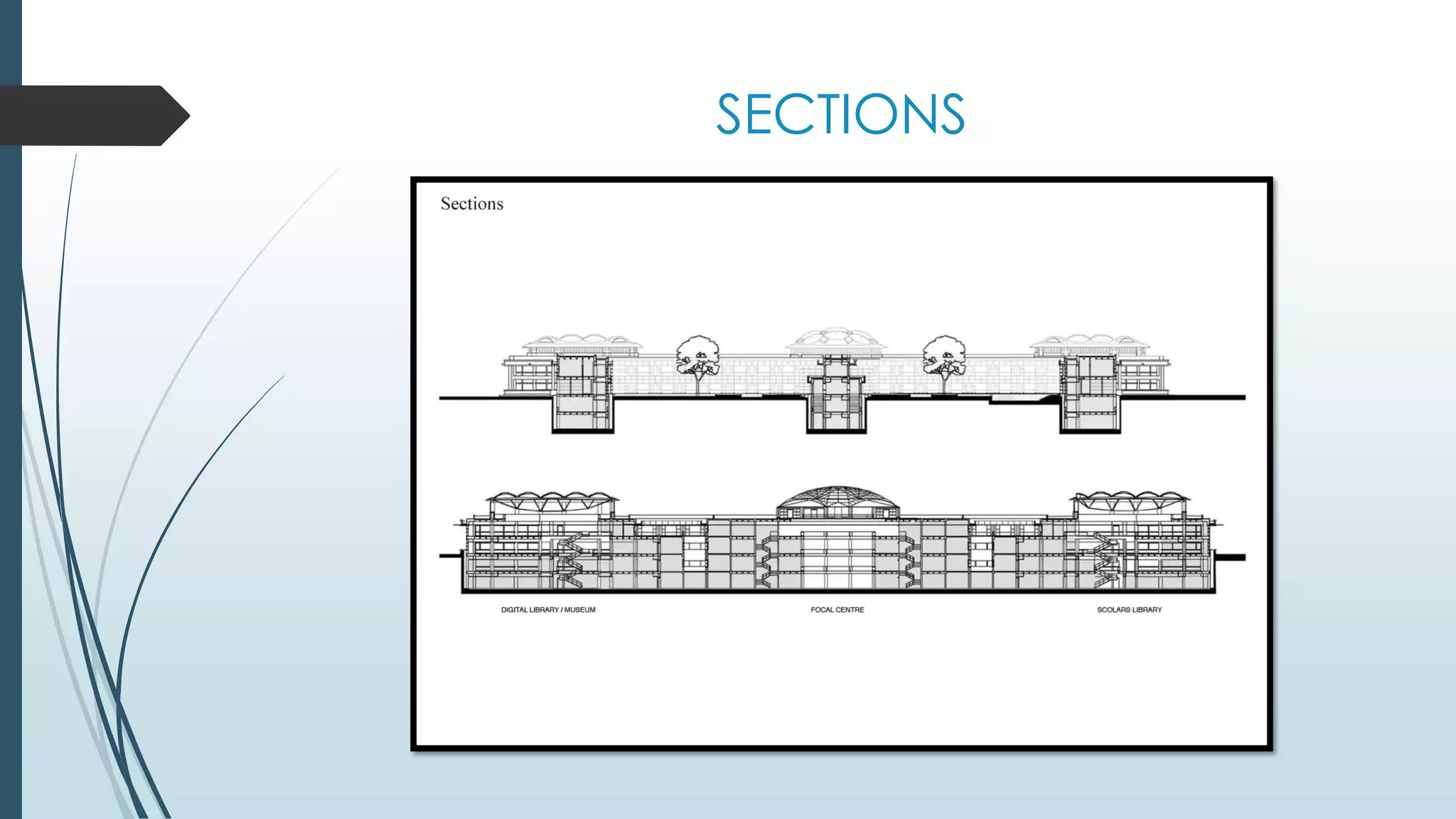
Section looking west, through the VIP entrance lobby (left),
the central core, and the 1075-seat auditorium.
SECTIONS
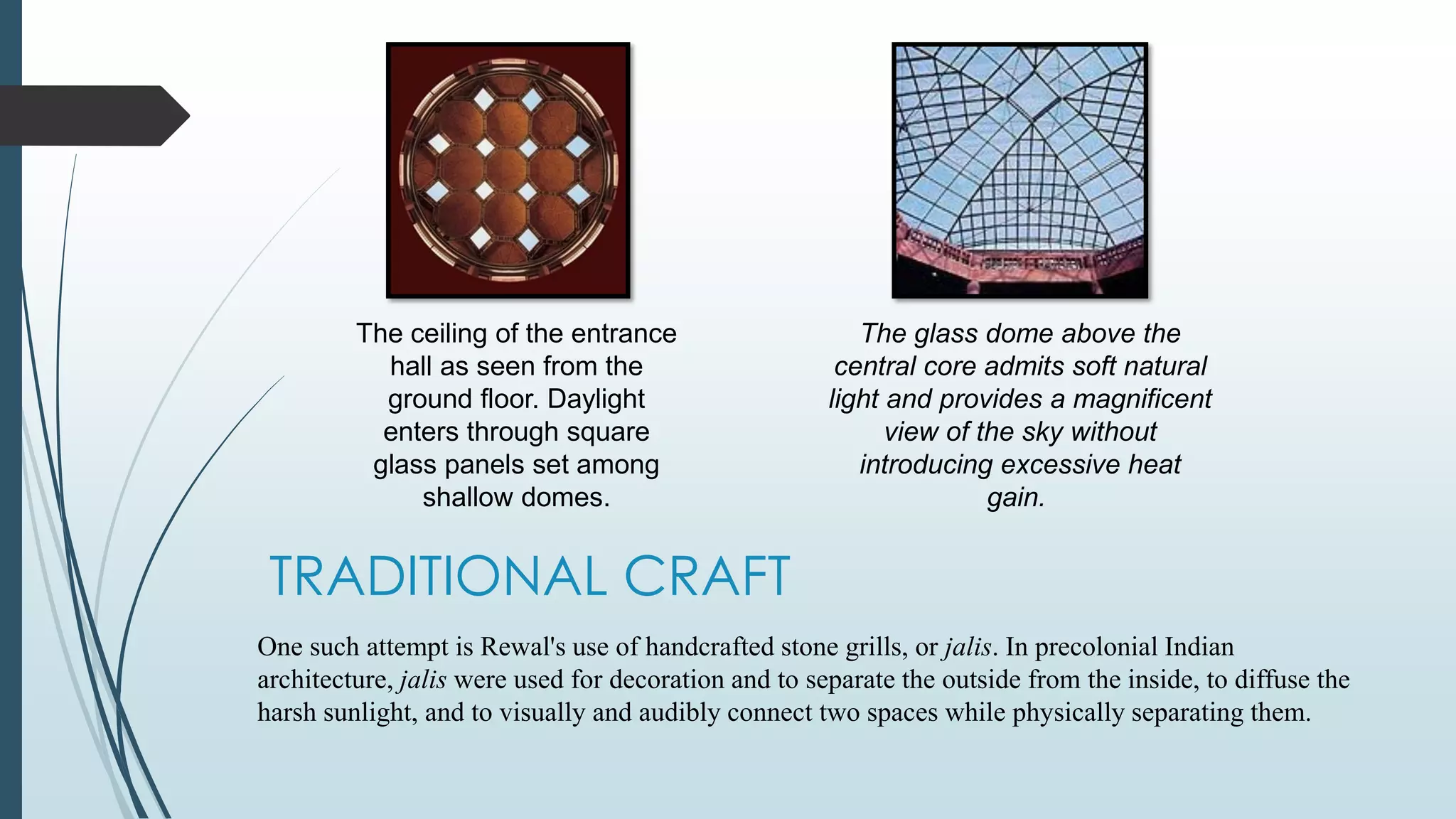
The ceiling of the entrance
hall as seen from the
ground floor. Daylight
enters through square
glass panels set among
shallow domes.
The glass dome above the
central core admits soft natural
light and provides a magnificent
view of the sky without
introducing excessive heat
gain.
TRADITIONAL CRAFT
One such attempt is Rewal's use of handcrafted stone grills, or jalis. In precolonial Indian
architecture, jalis were used for decoration and to separate the outside from the inside, to diffuse the
harsh sunlight, and to visually and audibly connect two spaces while physically separating them.
MODERNIST IDIOM
• Rewal has introduced craftsmen to modern tools and chemicals hoping that they will revive
the tradition. In the Parliament Library, jalis are integrated artfully, creating a typically
Indian look.
• Rewal's search for a contemporary Indian identity does not stop there. The building typology
and the spirituality associated with the mandala are quintessentially Indian. He has created
contemporary Indian architecture that uses innovative technology to express both modernity
and regionalism with connections to the physical surroundings and to a venerable history.
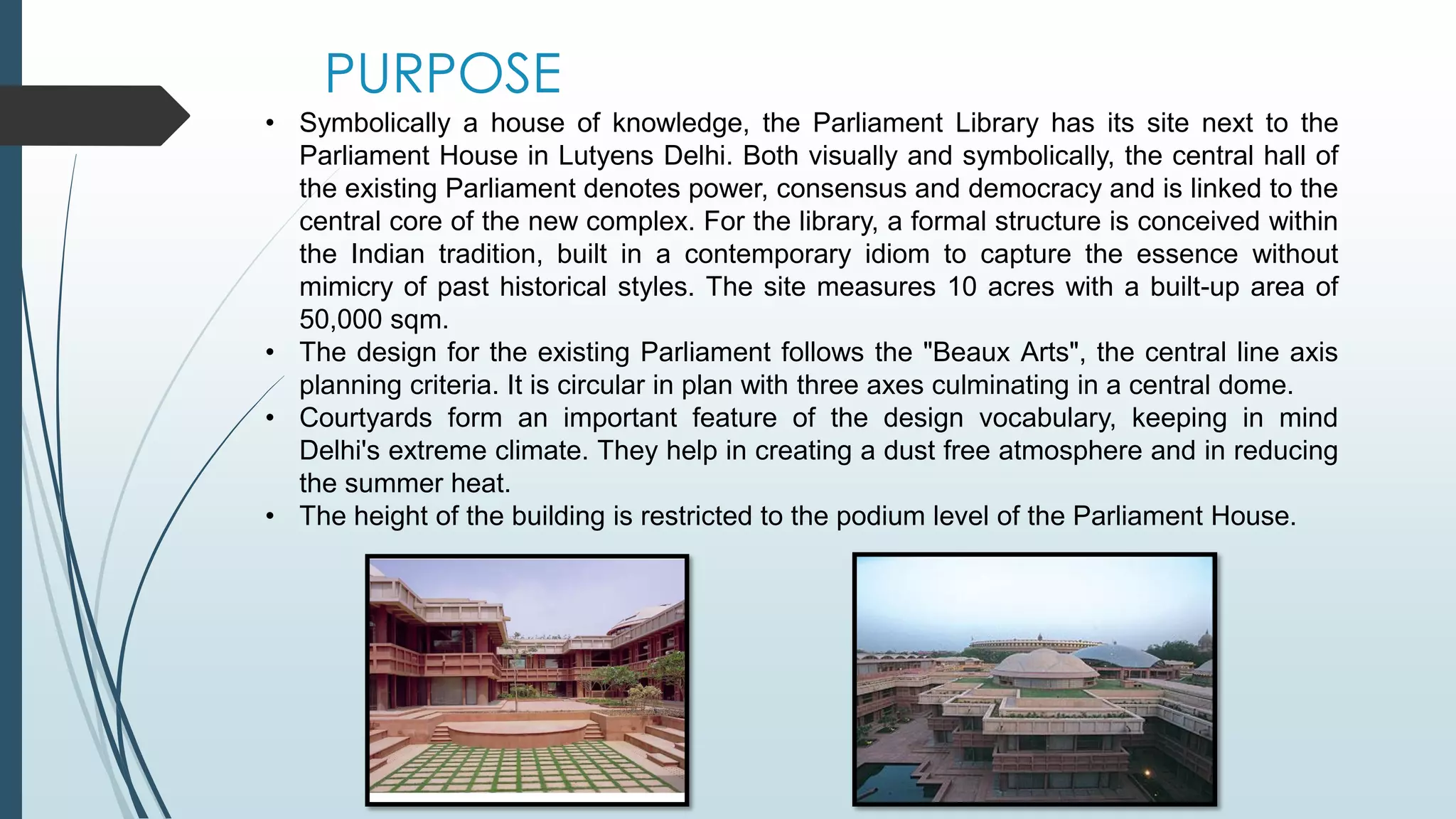
Colored marble floor pattern in the form of a yantra, an
ancient Indian graphic that aids meditation.

Parliament library, New Delhi.

  • 1.
  • 2.
    ABOUT THE ARCHITECT-RAJREWAL Raj Rewal was born in 1934 in Hoshiarpur, Punjab, India. Rewal lived in Delhi and Shimla from 1934–1951. He attended Harcourt Butler higher secondary school. Between 1951-1954 he attended the Delhi School of Architecture in New Delhi. After completing a degree in architecture in New Delhi, he moved to London in 1955 where he lived until 1961. He attended the Architectural Association School of Architecture for one year and the Brixton School of Building, London from 1956- 60.
  • 3.
    PURPOSE • Symbolically ahouse of knowledge, the Parliament Library has its site next to the Parliament House in Lutyens Delhi. Both visually and symbolically, the central hall of the existing Parliament denotes power, consensus and democracy and is linked to the central core of the new complex. For the library, a formal structure is conceived within the Indian tradition, built in a contemporary idiom to capture the essence without mimicry of past historical styles. The site measures 10 acres with a built-up area of 50,000 sqm. • The design for the existing Parliament follows the "Beaux Arts", the central line axis planning criteria. It is circular in plan with three axes culminating in a central dome. • Courtyards form an important feature of the design vocabulary, keeping in mind Delhi's extreme climate. They help in creating a dust free atmosphere and in reducing the summer heat. • The height of the building is restricted to the podium level of the Parliament House.
  • 4.
    CONCEPT BEHIND THEDESIGN To give the library an identity of its own while respecting the Parliament building, Rewal says he drew on Indian history and likened the relationship between buildings to the traditional relationship between guru and king. A guru acknowledges the power of the king — neither confronting nor submitting — and retains the strength of his integrity as a sage. Regionally quarried sandstone The tubular steel roof structure of the scholars' reading room with skylight panels inset in the roof domes. Hand crafted stone jalis are used throughout the building.
  • 5.
    BASIC IDEA • Rewaldecided to sink part of the library underground, leaving two of the four floors above grade. The terrace of the library aligns with the first floor level of the Parliament building. Only the domes of the library rise higher. The sight lines leading to the colonnade and entablature of the Parliament are left unobstructed. • Also, the exterior walls of the library are clad in the same red and beige sandstone as that used in the Parliament building. This local stone has been used extensively in northern and northwestern India through the centuries and therefore expresses regionalism. In these two decisions regarding height and materials, the guru acknowledges the power of the king. But the guru's wisdom and integrity are demonstrated in the architecture of the library. • The plan of the building is inspired by precolonial Indian architecture such as the magnificent Taj Mahal, with its square base and symmetrical composition- POST INDEPENDENCE ARCHITECTURE.
  • 6.
    Historically, Indian buildingswith interior open-air spaces helped in defense. But for Rewal, in a library that needs neither defense nor ceremony, such forms seem to symbolize an introversion characteristic of the ancient Indian guru. The calm pond in one courtyard symbolizes equality. Glass block in the floor illuminates two basements below. The inspiration is the Adinatha Temple (1439 A.D.) at Ranakpur in western India. Adinatha is square in plan, with cardinal axes meeting at the center, leaving open-to-sky courtyards in the leftover spaces. In addition to being icons of Indian architecture, courtyard plans admit daylight and have social and climatic advantages.
  • 7.
    THE SITE ANDTHE BUILDING • Located on a 10-acre (4-hectare) site, the library is nearly 590,000 square feet (55,000 square meters) in area and can accommodate three million volumes on the two basement floors. It has hi- tech networks and facilities for microfilm, multimedia, and satellite links. • Site conditions and trees prohibited the northwestern corner of the plan from being built, leaving the square incomplete. Otherwise the plan, with its courtyards and axes, is similar to historic precedents.
  • 8.
    • The full-heightcentral core of the building, formed at the point of intersection of the two axes, houses the reading room for members of parliament (MPs), the research area and archival storage, committee room, and a banquet hall. Beyond this central core are the courtyards, and further beyond are separate entrance lobbies for MPs, scholars, and the public. • The corners of the incomplete square and the nodes formed at the ends of the axes are designated for various functions. The axes and the sides of the square form corridors and outline the courtyards. • Each courtyard symbolizes one aspect of the Indian constitution. One is an amphitheater, symbolizing freedom of expression. Another courtyard has a pool of water symbolizing equality. A tree forms the focal point of the third courtyard, representing social justice.
  • 9.
    TECHNOLOGY AND STRUCTURE •The domes are perhaps the building's most significant feature. Several domes of different sizes and types make up the roof and benefit from Rewal's experiments in earlier buildings. • The central dome, spanning 82 feet (25 meters), is entirely of glass that was specially developed for this building. The intense heat and glare of New Delhi, with summer temperatures rising to over 110 degrees Fahrenheit (43 degrees Centigrade), make conventional glass impractical for skylights. The glass dome above the central core.
  • 10.
    • Rewal insistedon using glass to let in light. Conventional reflective glass reduces glare and heat build-up, and this specially developed glass is claimed to be still more efficient in resisting heat transfer. The result: almost magical views of the blue sky, of the sun minus its heat and glare, and of the seasonal monsoon clouds. • This dome reminds you that you are standing at the intersection of the building's two main axes. The point of intersection projects up in the dome in the form of two bands formed by the structural frame for the glass panels. The remainder of the dome consists of a lattice of structural frames held together by a network of steel cables converging at key tension nodes. • Other domes are made of thin fiber-reinforced concrete shells, sometimes with inset glass panels. Tensile forces are transferred through tubular steel members. • Other structural elements of the building are of reinforced concrete. The slabs are coffered to support long spans. The diaphragm walls and the foundation slab of the underground structure resist inward and upward pressure from the water table through anchors into the surrounding soil and the rocky substrate.
  • 11.
    FLOOR PLANS ANDSECTION GROUND FLOOR PLAN FIRST FLOOR PLAN Section looking west, through the VIP entrance lobby (left), the central core, and the 1075-seat auditorium.
  • 12.
  • 13.
    The ceiling ofthe entrance hall as seen from the ground floor. Daylight enters through square glass panels set among shallow domes. The glass dome above the central core admits soft natural light and provides a magnificent view of the sky without introducing excessive heat gain. TRADITIONAL CRAFT One such attempt is Rewal's use of handcrafted stone grills, or jalis. In precolonial Indian architecture, jalis were used for decoration and to separate the outside from the inside, to diffuse the harsh sunlight, and to visually and audibly connect two spaces while physically separating them.
  • 14.
    MODERNIST IDIOM • Rewalhas introduced craftsmen to modern tools and chemicals hoping that they will revive the tradition. In the Parliament Library, jalis are integrated artfully, creating a typically Indian look. • Rewal's search for a contemporary Indian identity does not stop there. The building typology and the spirituality associated with the mandala are quintessentially Indian. He has created contemporary Indian architecture that uses innovative technology to express both modernity and regionalism with connections to the physical surroundings and to a venerable history. Colored marble floor pattern in the form of a yantra, an ancient Indian graphic that aids meditation.