Burj
Khalifa
HIGH RISE MIXED USE DEVELPOMENT
TEAM :
SALONI HOSMANI
PRAVEEN MADHAVAN
MELNA MATHEW
CHIRAG HAMIGI
VIII SEMESTER | DESIGN
LITERATURE CASE STUDY
Table of
Contents
1 . Building
2 . Site Analysis
3 . Architecture
4 . Foundation
5 . Podium
6 . Structural System
7 . Cladding System
8 . Services
9 . Interiors
10. Facts
11 . Inference
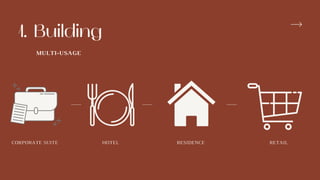
1. Building
MULTI-USAGE
CORPORATE SUITE HOTEL RESIDENCE RETAIL
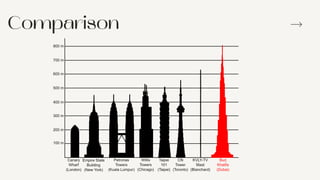
Comparison
About the
Building
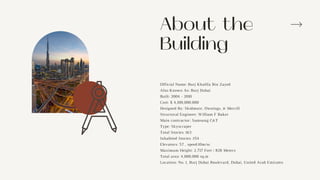
Official Name: Burj Khalifa Bin Zayed
Also Known As: Burj Dubai
Built: 2004 - 2010
Cost: $ 4,100,000,000
Designed By: Skidmore, Ownings, & Merrill
Structural Engineer: William F Baker
Main contractor: Samsung C&T
Type: Skyscraper
Total Stories: 163
Inhabited Stories :154
Elevators: 57 , speed:10m/sc
Maximum Height: 2,717 Feet / 828 Meters
Total area: 4,000,000 sq.m
Location: No. 1, Burj Dubai Boulevard, Dubai, United Arab Emirates
Construction Type: Skyscraper Current
Status: Existing [Completed]
Structural System: Buttressed
Core Structural Material: Concrete, Steel
FaƧade Material: Stainless Steel
FaƧade System: Curtain Wall
Architectural Style: Modernism
Floor Plan: 517,240m2
Order Year: 2003
Construction Start: 2004
Project Type: Mall, Residential And Retail Facilities And World's
Tallest Skyscraper
Estimated Investment: Aed800m (Mall, Residential And Retail
Facilities); Aed3.9bn (Tower); Overall Development $8bn
Completion: 2008 (Mall); 2008 (Tower), Mall Opening On 31st
August 2008, Tower Officially Opened 4 January 2010
Retail Space: 9 Million Square Feet 7
About the
Structure
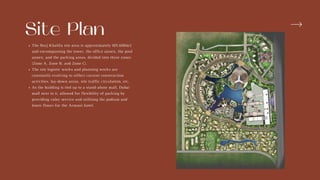
The Burj Khalifa site area is approximately 105,600m2
and encompassing the tower, the office annex, the pool
annex, and the parking areas, divided into three zones
(Zone A, Zone B, and Zone C).
The site logistic works and planning works are
constantly evolving to reflect current construction
activities, lay-down areas, site traffic circulation, etc.
As the building is tied up to a stand-alone mall, Dubai
mall next to it, allowed for flexibility of parking by
providing valey service and utilising the podium and
lower floors for the Armani hotel.
Site Plan
Master Plan
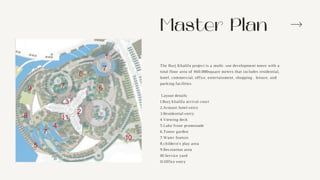
The Burj Khalifa project is a multi- use development tower with a
total floor area of 460,000square meters that includes residential,
hotel, commercial, office, entertainment, shopping , leisure, and
parking facilities.
Layout details:
1.Burj khalifa arrival court
2.Armani hotel entry
3.Residential entry
4.Viewing deck
5.Lake front promenade
6.Tower garden
7.Water feature
8.childern’s play area
9.Recreation area
10.Service yard
11.Office entry
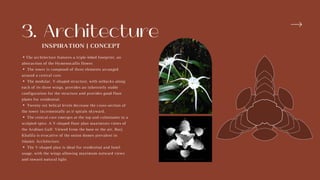
ā–ŖThe architecture features a triple-lobed footprint, an
abstraction of the Hymenocallis flower.
ā–Ŗ The tower is composed of three elements arranged
around a central core.
ā–Ŗ The modular, Y-shaped structure, with setbacks along
each of its three wings, provides an inherently stable
configuration for the structure and provides good floor
plates for residential.
ā–Ŗ Twenty-six helical levels decrease the cross-section of
the tower incrementally as it spirals skyward.
ā–Ŗ The central core emerges at the top and culminates in a
sculpted spire. A Y-shaped floor plan maximizes views of
the Arabian Gulf. Viewed from the base or the air, Burj
Khalifa is evocative of the onion domes prevalent in
Islamic Architecture.
ā–Ŗ The Y-shaped plan is ideal for residential and hotel
usage, with the wings allowing maximum outward views
and inward natural light.
3. Architecture
INSPIRATION | CONCEPT
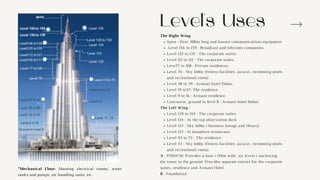
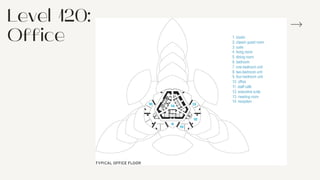
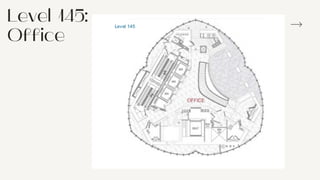
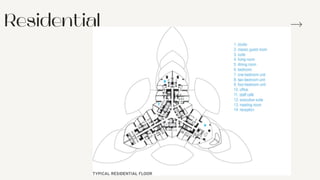
Level's Uses
Spire : Over 200m long and houses communications equipment
Level 156 to 159 : Broadcast and telecoms companies.
Level 125 to 135 : The corporate suites.
Level 112 to 121 : The corporate suites.
Leve77 to 108 : Private residences.
Level 76 : Sky lobby (fitness facilities, jacuzzi, swimming pools
and recreational room) .
Level 38 to 39 : Armani hotel Dubai.
Level 19 to37: The residence.
Level 9 to 16 : Armani residence.
Concourse, ground to level 8 : Armani hotel Dubai.
Level 139 to 154 : The corporate suites.
Level 124 : At the top observation deck
Level 123 : Sky lobby ( business lounge and library) .
Level 122 : At.mosphere restaurant.
Level 44 to 72 : The residence.
Level 43 : Sky lobby (fitness facilities, jacuzzi, swimming pools
and recreational room).
The Right Wing
The Left Wing :
A : PODIUM: Provides a base ( 150m wide, six levels ) anchoring
the tower to the ground. Provides separate entries for the corporate
suites, residence and Armani Hotel.
B : Foundation
*Mechanical Floor: Housing electrical rooms, water
tanks and pumps, air handling units, etc.
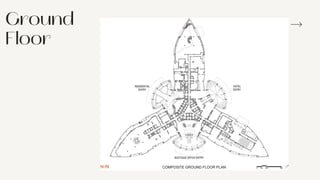
Ground
Floor
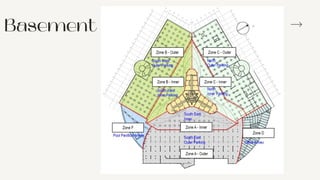
Basement
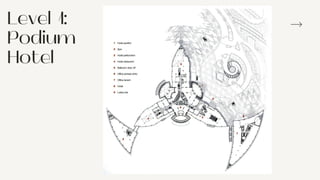
Level 1:
Podium
Hotel
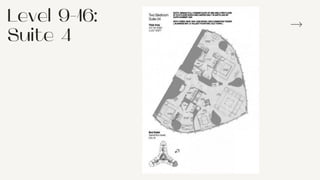
Level 9-16:
Suite 4
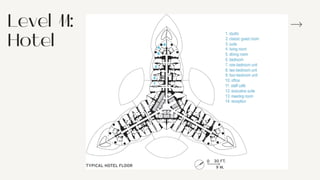
Level 11:
Hotel
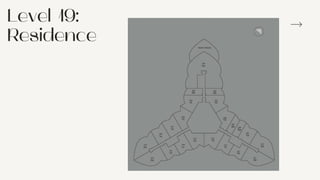
Level 19:
Residence
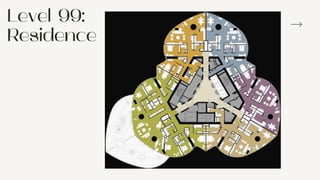
Level 99:
Residence
Level 120:
Office
Level 145:
Office
Residential
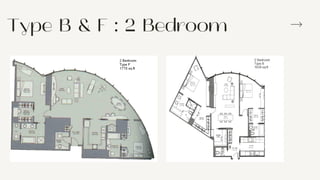
Type B & F : 2 Bedroom
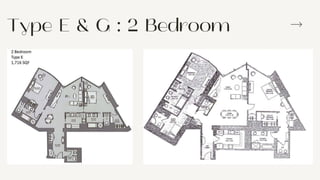
Type E & G : 2 Bedroom
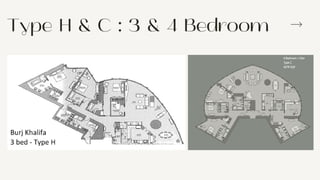
Type H & C : 3 & 4 Bedroom
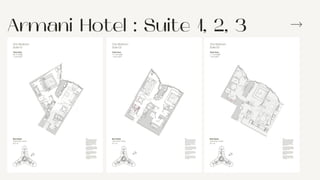
Armani Hotel : Suite 1, 2, 3
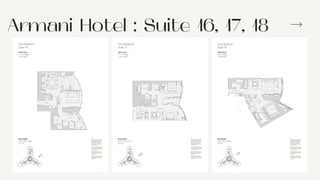
Armani Hotel : Suite 16, 17, 18
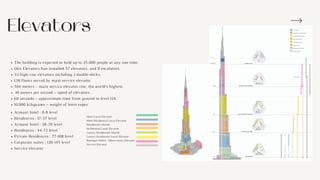
The building is expected to hold up to 35,000 people at any one time.
Otis Elevators has installed 57 elevators, and 8 escalators.
33 high-rise elevators including 2 double-decks.
138 floors served by main service elevator.
504 meters – main service elevator rise, the world’s highest.
10 meters per second – speed of elevators .
60 seconds – approximate time from ground to level 124.
10.000 kilograms – weight of hoist ropes.
Elevators
Armani hotel : 0-8 level
Residences : 17-37 level
Armani hotel : 38-39 level
Residences : 44-72 level
Private Residences : 77-108 level
Corporate suites : 120-145 level
Service elevator
Hotel Local Elevator
Hotel Residential Local Elevator
Residential Shuttle
Residential Local Elevator
Luxury Residential Shuttle
Luxury Residential Local Elevator
Boutique Office / Observatory Elevator
Service Elevator
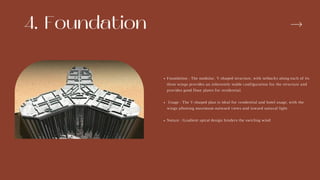
4. Foundation
Foundation : The modular, Y-shaped structure, with setbacks along each of its
three wings provides an inherently stable configuration for the structure and
provides good floor plates for residential.
Usage : The Y-shaped plan is ideal for residential and hotel usage, with the
wings allowing maximum outward views and inward natural light.
Nature : Gradient spiral design hinders the swirling wind .
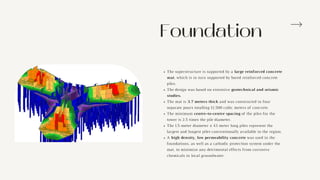
Foundation
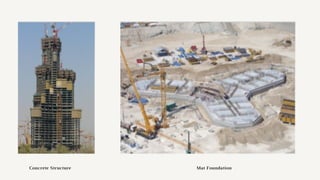
The superstructure is supported by a large reinforced concrete
mat, which is in turn supported by bored reinforced concrete
piles.
The design was based on extensive geotechnical and seismic
studies.
The mat is 3.7 meters thick and was constructed in four
separate pours totalling 12,500 cubic meters of concrete.
The minimum centre-to-centre spacing of the piles for the
tower is 2.5 times the pile diameter.
The 1.5-meter diameter x 43 meter long piles represent the
largest and longest piles conventionally available in the region.
A high density, low permeability concrete was used in the
foundations, as well as a cathodic protection system under the
mat, to minimize any detrimental effects from corrosive
chemicals in local groundwater.
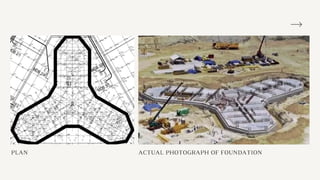
PLAN ACTUAL PHOTOGRAPH OF FOUNDATION
Construction Sequence
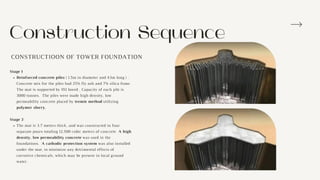
Reinforced concrete piles ( 1.5m in diameter and 43m long ) .
Concrete mix for the piles had 25% fly ash and 7% silica fume.
The mat is supported by 192 bored , Capacity of each pile is
3000 tonnes. The piles were made high density, low
permeability concrete placed by tremie method utilizing
polymer slurry.
The mat is 3.7 meters thick, and was constructed in four
separate pours totaling 12,500 cubic meters of concrete A high
density, low permeability concrete was used in the
foundations. A cathodic protection system was also installed
under the mat, to minimize any detrimental effects of
corrosive chemicals, which may be present in local ground
water.
Stage 1
Stage 2
CONSTRUCTIOON OF TOWER FOUNDATION
Construction Sequence
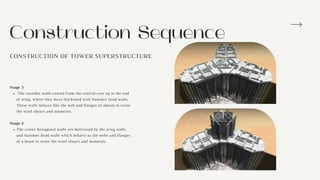
CONSTRUCTION OF TOWER SUPERSTRUCTURE
The corridor walls extend from the central core up to the end
of wing, where they have thickened with hammer head walls.
These walls behave like the web and flanges of abeam to resist
the wind shears and moments.
The center hexagonal walls are buttressed by the wing walls
and hammer head walls which behave as the webs and flanges
of a beam to resist the wind shears and moments.
Stage 3
Stage 4
Construction Sequence
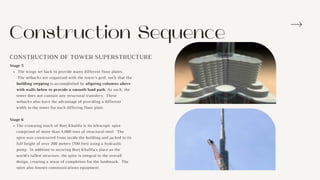
CONSTRUCTION OF TOWER SUPERSTRUCTURE
The wings set back to provide many different floor plates.
The setbacks are organized with the tower’s grid, such that the
building stepping is accomplished by aligning columns above
with walls below to provide a smooth load path. As such, the
tower does not contain any structural transfers. These
setbacks also have the advantage of providing a different
width to the tower for each differing floor plate.
The crowning touch of Burj Khalifa is its telescopic spire
comprised of more than 4,000 tons of structural steel. The
spire was constructed from inside the building and jacked to its
full height of over 200 meters (700 feet) using a hydraulic
pump. In addition to securing Burj Khalifa's place as the
world's tallest structure, the spire is integral to the overall
design, creating a sense of completion for the landmark. The
spire also houses communications equipment.
Stage 5
Stage 6
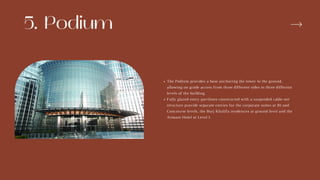
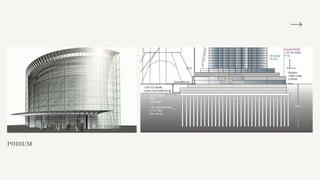
The Podium provides a base anchoring the tower to the ground,
allowing on grade access from three different sides to three different
levels of the building.
Fully glazed entry pavilions constructed with a suspended cable-net
structure provide separate entries for the corporate suites at B1 and
Concourse levels, the Burj Khalifa residences at ground level and the
Armani Hotel at Level 1.
5. Podium
PODIUM
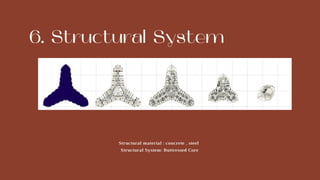
6. Structural System
Structural material : concrete , steel
Structural System: Buttressed Core
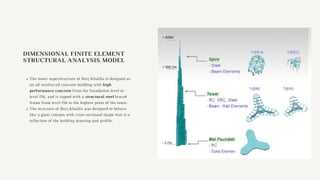
DIMENSIONAL FINITE ELEMENT
STRUCTURAL ANALYSIS MODEL
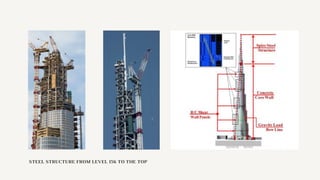
The tower superstructure of Burj Khalifa is designed as
an all reinforced concrete building with high
performance concrete from the foundation level to
level 156, and is topped with a structural steel braced
frame from level 156 to the highest point of the tower.
The structure of Burj Khalifa was designed to behave
like a giant column with cross sectional shape that is a
reflection of the building massing and profile.
Concrete Structure Mat Foundation
STEEL STRUCTURE FROM LEVEL 156 TO THE TOP
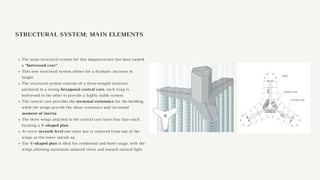
STRUCTURAL SYSTEM; MAIN ELEMENTS
The main structural system for this megastructure has been named
a ā€œbuttressed coreā€.
This new structural system allows for a dramatic increase in
height.
The structural system consists of a three-winged structure
anchored to a strong hexagonal central core, each wing is
buttressed to the other to provide a highly stable system.
The central core provides the torsional resistance for the building,
while the wings provide the shear resistance and increased
moment of inertia
The three wings attached to the central core have four bays each,
forming a Y-shaped plan.
At every seventh level one outer bay is removed from one of the
wings as the tower spirals up.
The Y-shaped plan is ideal for residential and hotel usage, with the
wings allowing maximum outward views and inward natural light.
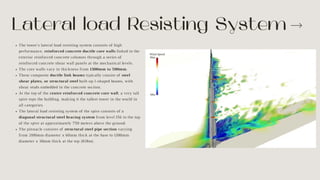
Lateral load Resisting System
The tower’s lateral load resisting system consists of high
performance, reinforced concrete ductile core walls linked to the
exterior reinforced concrete columns through a series of
reinforced concrete shear wall panels at the mechanical levels.
The core walls vary in thickness from 1300mm to 500mm.
These composite ductile link beams typically consist of steel
shear plates, or structural steel built-up I-shaped beams, with
shear studs embedded in the concrete section.
At the top of the centre reinforced concrete core wall, a very tall
spire tops the building, making it the tallest tower in the world in
all categories.
The lateral load resisting system of the spire consists of a
diagonal structural steel bracing system from level 156 to the top
of the spire at approximately 750 meters above the ground.
The pinnacle consists of structural steel pipe section varying
from 2100mm diameter x 60mm thick at the base to 1200mm
diameter x 30mm thick at the top (828m).
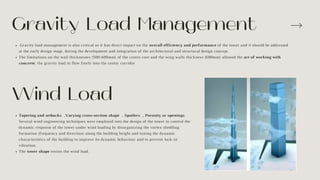
Gravity load management is also critical as it has direct impact on the overall efficiency and performance of the tower and it should be addressed
at the early design stage, during the development and integration of the architectural and structural design concept.
The limitations on the wall thicknesses (500-600mm) of the centre core and the wing walls thickness (600mm) allowed the art of working with
concrete, the gravity load to flow freely into the center corridor
Gravity Load Management
Wind Load
Tapering and setbacks ,Varying cross-section shape , Spoilers , Porosity or openings
Several wind engineering techniques were employed into the design of the tower to control the
dynamic response of the tower under wind loading by disorganizing the vortex shedding
formation (frequency and direction) along the building height and tuning the dynamic
characteristics of the building to improve its dynamic behaviour and to prevent lock-in
vibration.
The tower shape resists the wind load.
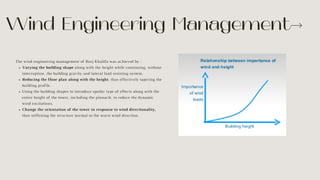
Varying the building shape along with the height while continuing, without
interruption, the building gravity and lateral load resisting system.
Reducing the floor plan along with the height, thus effectively tapering the
building profile.
Using the building shapes to introduce spoiler type of effects along with the
entire height of the tower, including the pinnacle, to reduce the dynamic
wind excitations.
Change the orientation of the tower in response to wind directionality,
thus stiffening the structure normal to the worst wind direction.
The wind engineering management of Burj Khalifa was achieved by :
Wind Engineering Management
Dubai outside the scope of the seismic activity .
Liquefaction analysis of Burj Khalifa soil showed that it is not a problem
Burj Khalifa is located in Dubai, which is a UBC97 Zone 2a seismic region (with a seismic zone factor Z = 0.15 and soil profile Sc).
Thus Earthquake loads did not govern the concrete tower design (wind loads govern) but it does govern the design of the steel spire above the
concrete tower.
However, Burj Khalifa resisted earthquake of M5.8 magnitude that occurred in southern Iran on July 20, 2010.
While the magnitude of this earthquake was diminished when it reached Dubai and was relatively small (less than 1milli- g at BK site),
Earthquake Protective Measures
7. Cladding
System
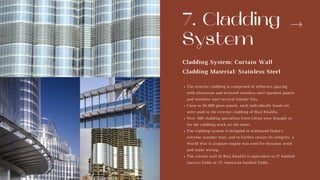
Cladding System: Curtain Wall
Cladding Material: Stainless Steel
The exterior cladding is comprised of reflective glazing
with aluminum and textured stainless steel spandrel panels
and stainless steel vertical tubular fins.
Close to 26,000 glass panels, each individually hand-cut,
were used in the exterior cladding of Burj Khalifa.
Over 300 cladding specialists from China were brought in
for the cladding work on the tower.
The cladding system is designed to withstand Dubai's
extreme summer heat, and to further ensure its integrity, a
World War II airplane engine was used for dynamic wind
and water testing.
The curtain wall of Burj Khalifa is equivalent to 17 football
(soccer) fields or 25 American football fields.
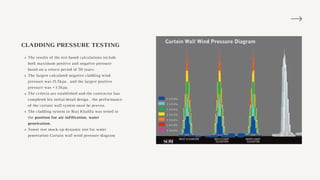
CLADDING PRESSURE TESTING
The results of the test based calculations include
both maximum positive and negative pressure
based on a return period of 50 years.
The largest calculated negative cladding wind
pressure was 15.5kpa , and the largest positive
pressure was +3.5kpa.
The criteria are established and the contractor has
completed his initial detail design , the performance
of the curtain wall system must be proven.
The cladding system in Burj Khalifa was tested in
the position for air infiltration, water
penetration.
Tower test mock-up dynamic test for water
penetration Curtain wall wind pressure diagram
8. Services
Monitoring Program
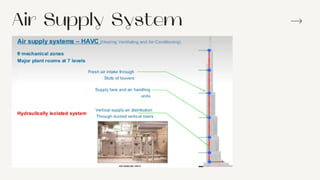
Air Supply System
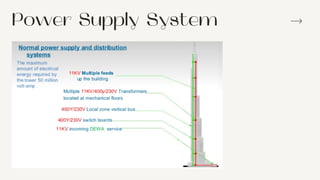
Power Supply System
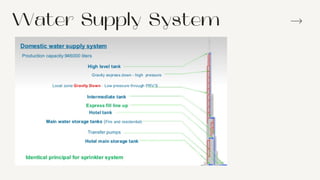
Water Supply System
Fire Safety System
Monitoring Program
STRUCTURAL HEALTH MONITORING PROGRAM AND NETWORK
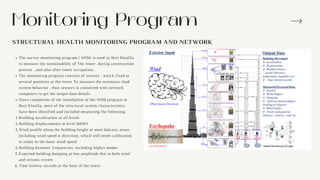
The survey monitoring program ( SHM) is used in Burj Khalifa
to measure the sustainability of The tower ,during construction
process , and also after tower occupation .
The monitoring program consists of sensors , which fixed at
several positions at the tower To measure the resistance load
system behavior , thus sensors is connected with network
computers to get the output data details .
Since completion of the installation of the SHM program at
Burj Khalifa, most of the structural system characteristics
have been identified and included measuring the following:
Building acceleration at all levels
Building displacements at level 160M3
Wind profile along the building height at most balcony areas,
including wind speed & direction, which still needs calibration
to relate to the basic wind speed.
Building dynamic frequencies, including higher modes
Expected building damping at low amplitude due to both wind
and seismic events
Time history records at the base of the tower.
1.
2.
3.
4.
5.
6.
Air Supply System
Power Supply System
Water Supply System
Fire Safety System
FIRE AND LIFE SAFETY PLAN SYSTEM
The design of Burj Khalifa undertook with special attention to
the fire safety and evacuation speed.
The capacity of concrete surrounds of total stairwells besides
building service and fireman's elevator has been so effective
that it can easily bear 5,500 kg.
That is why it is known for being the tallest service elevator in
the world.
Pressurized and air-conditioned refuge areas are designed on
almost every 25 floor of this tower to ensure better safety as
occupants can’t literally walk down to 160 floors in one go
Fire Pumps at Level 136
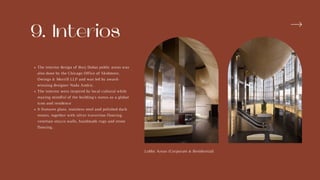
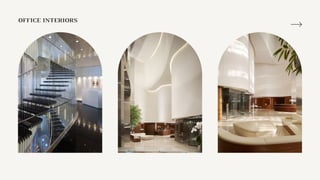
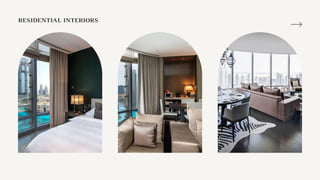
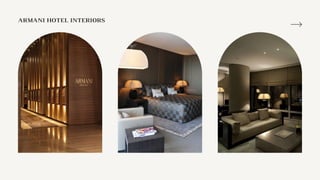
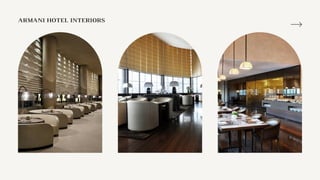
The interior design of Burj Dubai public areas was
also done by the Chicago Office of Skidmore,
Owings & Merrill LLP and was led by award-
winning designer Nada Andric.
The interior were inspired by local cultural while
staying mindful of the building's status as a global
icon and residence
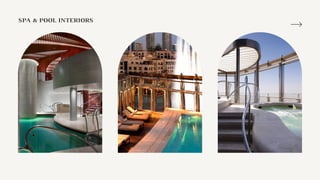
It features glass, stainless steel and polished dark
stones, together with silver travertine flooring,
venetian stucco walls, handmade rugs and stone
flooring.
9. Interios
Lobby Areas (Corporate & Residential)
OFFICE INTERIORS
RESIDENTIAL INTERIORS
ARMANI HOTEL INTERIORS
SPA & POOL INTERIORS
10. Facts
Although the building's shape resembles the bundled tube concept of the Willis Tower, it is structurally very different and is
technically not a tube structure.
The tower is situated on a man-made lake which is designed to wrap around the tower and to provide dramatic views of it.
The elevators have the world’s longest travel distance from lowest to highest stop.
Hot air on the outside condense due to the large cooling needs of the building. The condensation is collected and used to water the
buildings flora and fauna. 20 Olympic-sized swimming pools per year of water.
There are 1,210 fire extinguishers on the site.
At the peak cooling times, the tower require approximately 10,000 tons of cooling per hour.
Condensation on the building is collected and drained down to a holding tank located in the basement from where it is pumped into
the site irrigation system for use on the tower’s landscaped gardens. This system provide about 15 million gallons of supplemental
water per year.
Over 330,000 cubic meters of concrete was used at the completion of the tower.
Dubai has set a new world record for vertical concrete pumping for a building, by pumping to over 660 metres.
The previous record was held by Taipei 101 for pumping concrete up to a height of 448 metres. Burj Dubai break the world record for
altitude transportation of concrete.
The total area of cladding used to cover the Burj Dubai is equivalent to 17 football fields.
The concrete used for the Burj Khalifa is equivalent to: a solid cube of concrete 61 metres on a side, a sidewalk 1,900 kilometres long,
the weight of 100,000 elephants.
The tower’s peak electricity demand is estimated at 36mva, equivalent to roughly 360,000 100-watt light bulbs.
There are 200 metres of dancing fountains at the foot of the Burj Dubai.
The tower’s observation deck is located 442 metres above ground, the highest publicly accessible observation deck in the world.
Engineers working on the design considered installing triple-decker elevators, which would have been the first in the world. In fact,
the realized building uses double-decker elevators.
The amount of steel rebar used for the tower is 31,400 metric tons – laid end to end this would extend over a quarter of the way
around the world.
The Burj Dubai feature the world’s first Armani Hotel.
Burj Dubai derives its design inspiration from the desert flower, hymenocalis, and incorporates patterning systems that are embodied
in Islamic architecture.
At 5,500 kg capacity, the firemen/service elevator is the world’s tallest service elevator.
First mega-rise to have elevators with specially programmed, permit-controlled evacuation procedures. ā–Ŗ The total glass requirement
is 142k sq/m
The car park has approx. 3,000 parking places in four levels and a total area of just under 89,000 m2.
The car park ventilation system is comply with the US Standards Ashrae and Amca for air quality and fan requirements and in case
of fire it is suitable for operating at 300°c for not less than 60 minutes.
The building was rotated 120 degrees to allow for less stress from the prevailing winds.
The double deck cabin elevators are the fastest in the world and also the one to travel the longest from a lower to higher point. The
speed of the cabin is 18 m/sec (40 mph).
It also has the worlds first programmed and controlled evacuation in the world.
It can withstand the worst storm to hit Dubai in a 100 years
It has 15,000 sq ft of fitness facilities.
Connected to the largest mall in the world
11. Inferences
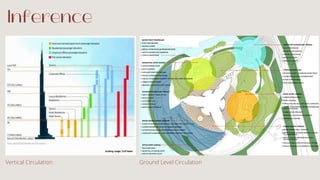
A notable feature that caters to multiple factors, aesthetically and practically, are how the
buttressing that's required for such a design, translated to a triangular wing-type design, providing
multiple access which helps vertical circulation with elevators catering to multiple range of levels.
For supertall/skyscraper structures, the quantity of precipitation that can be collected and utilised
for multiple purposes within the building's usage is huge.
Service floors are typology-shifting intervals, with louvered fenestration that could add visual quality,
as well as be a point of intake for circulation.
Utilising podium design as also a means to house something that utilises the range like radio station
tower etc.
Interior shear walls that can translate into columns on higher floors. This allows for design flexibility.
Inference
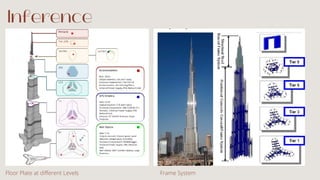
Frame System
Floor Plate at different Levels
Inference
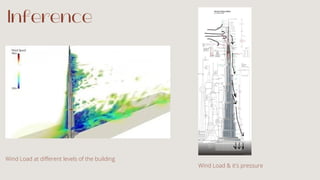
Wind Load & it's pressure
Wind Load at different levels of the building
Inference
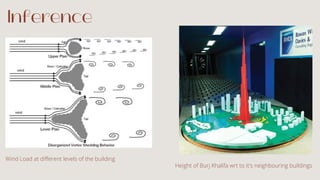
Height of Burj Khalifa wrt to it's neighbouring buildings
Wind Load at different levels of the building
Inference
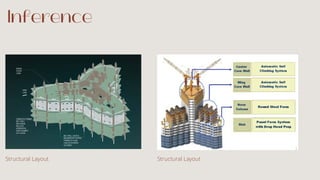
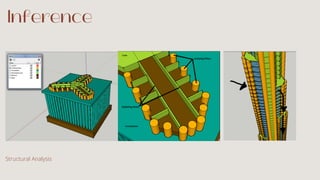
Structural Layout Structural Layout
Inference
Structural Analysis
Inference
Vertical Circulation Ground Level Circulation
http://faculty.arch.tamu.edu/anichols/courses/applied-architectural-structures/projects-631/Files/BurjKhalifa.pdf
https://docplayer.net/20764253-Validating-the-structural-behavior-and-response-of-burj-khalifa-synopsis-of-the-full-scale-structural-
health-monitoring-programs.html
https://www.slideshare.net/safaamohammed5496/burj-khalifa-48217403
https://www.burjkhalifa.ae/en/the-tower/design-construction/
https://www.archdaily.com/882100/burj-khalifa-som/59eb8b87b22e385ec40004a3-burj-khalifa-som-image?next_project=no
https://www.slideshare.net/rajatrmr/burj-khalifa-87137137
https://www.youtube.com/watch?v=aioyngXqPXM
Source
Thank You

Burj khalifa

  • 1.
    Burj Khalifa HIGH RISE MIXEDUSE DEVELPOMENT TEAM : SALONI HOSMANI PRAVEEN MADHAVAN MELNA MATHEW CHIRAG HAMIGI VIII SEMESTER | DESIGN LITERATURE CASE STUDY
  • 2.
    Table of Contents 1 .Building 2 . Site Analysis 3 . Architecture 4 . Foundation 5 . Podium 6 . Structural System 7 . Cladding System 8 . Services 9 . Interiors 10. Facts 11 . Inference
  • 3.
  • 4.
  • 5.
    About the Building Official Name:Burj Khalifa Bin Zayed Also Known As: Burj Dubai Built: 2004 - 2010 Cost: $ 4,100,000,000 Designed By: Skidmore, Ownings, & Merrill Structural Engineer: William F Baker Main contractor: Samsung C&T Type: Skyscraper Total Stories: 163 Inhabited Stories :154 Elevators: 57 , speed:10m/sc Maximum Height: 2,717 Feet / 828 Meters Total area: 4,000,000 sq.m Location: No. 1, Burj Dubai Boulevard, Dubai, United Arab Emirates
  • 6.
    Construction Type: SkyscraperCurrent Status: Existing [Completed] Structural System: Buttressed Core Structural Material: Concrete, Steel FaƧade Material: Stainless Steel FaƧade System: Curtain Wall Architectural Style: Modernism Floor Plan: 517,240m2 Order Year: 2003 Construction Start: 2004 Project Type: Mall, Residential And Retail Facilities And World's Tallest Skyscraper Estimated Investment: Aed800m (Mall, Residential And Retail Facilities); Aed3.9bn (Tower); Overall Development $8bn Completion: 2008 (Mall); 2008 (Tower), Mall Opening On 31st August 2008, Tower Officially Opened 4 January 2010 Retail Space: 9 Million Square Feet 7 About the Structure
  • 7.
    The Burj Khalifasite area is approximately 105,600m2 and encompassing the tower, the office annex, the pool annex, and the parking areas, divided into three zones (Zone A, Zone B, and Zone C). The site logistic works and planning works are constantly evolving to reflect current construction activities, lay-down areas, site traffic circulation, etc. As the building is tied up to a stand-alone mall, Dubai mall next to it, allowed for flexibility of parking by providing valey service and utilising the podium and lower floors for the Armani hotel. Site Plan
  • 8.
    Master Plan The BurjKhalifa project is a multi- use development tower with a total floor area of 460,000square meters that includes residential, hotel, commercial, office, entertainment, shopping , leisure, and parking facilities. Layout details: 1.Burj khalifa arrival court 2.Armani hotel entry 3.Residential entry 4.Viewing deck 5.Lake front promenade 6.Tower garden 7.Water feature 8.childern’s play area 9.Recreation area 10.Service yard 11.Office entry
  • 9.
    ā–ŖThe architecture featuresa triple-lobed footprint, an abstraction of the Hymenocallis flower. ā–Ŗ The tower is composed of three elements arranged around a central core. ā–Ŗ The modular, Y-shaped structure, with setbacks along each of its three wings, provides an inherently stable configuration for the structure and provides good floor plates for residential. ā–Ŗ Twenty-six helical levels decrease the cross-section of the tower incrementally as it spirals skyward. ā–Ŗ The central core emerges at the top and culminates in a sculpted spire. A Y-shaped floor plan maximizes views of the Arabian Gulf. Viewed from the base or the air, Burj Khalifa is evocative of the onion domes prevalent in Islamic Architecture. ā–Ŗ The Y-shaped plan is ideal for residential and hotel usage, with the wings allowing maximum outward views and inward natural light. 3. Architecture INSPIRATION | CONCEPT
  • 10.
    Level's Uses Spire :Over 200m long and houses communications equipment Level 156 to 159 : Broadcast and telecoms companies. Level 125 to 135 : The corporate suites. Level 112 to 121 : The corporate suites. Leve77 to 108 : Private residences. Level 76 : Sky lobby (fitness facilities, jacuzzi, swimming pools and recreational room) . Level 38 to 39 : Armani hotel Dubai. Level 19 to37: The residence. Level 9 to 16 : Armani residence. Concourse, ground to level 8 : Armani hotel Dubai. Level 139 to 154 : The corporate suites. Level 124 : At the top observation deck Level 123 : Sky lobby ( business lounge and library) . Level 122 : At.mosphere restaurant. Level 44 to 72 : The residence. Level 43 : Sky lobby (fitness facilities, jacuzzi, swimming pools and recreational room). The Right Wing The Left Wing : A : PODIUM: Provides a base ( 150m wide, six levels ) anchoring the tower to the ground. Provides separate entries for the corporate suites, residence and Armani Hotel. B : Foundation *Mechanical Floor: Housing electrical rooms, water tanks and pumps, air handling units, etc.
  • 11.
  • 12.
  • 13.
  • 14.
  • 15.
  • 16.
  • 17.
  • 18.
  • 19.
  • 20.
  • 21.
    Type B &F : 2 Bedroom
  • 22.
    Type E &G : 2 Bedroom
  • 23.
    Type H &C : 3 & 4 Bedroom
  • 24.
    Armani Hotel :Suite 1, 2, 3
  • 25.
    Armani Hotel :Suite 16, 17, 18
  • 26.
    The building isexpected to hold up to 35,000 people at any one time. Otis Elevators has installed 57 elevators, and 8 escalators. 33 high-rise elevators including 2 double-decks. 138 floors served by main service elevator. 504 meters – main service elevator rise, the world’s highest. 10 meters per second – speed of elevators . 60 seconds – approximate time from ground to level 124. 10.000 kilograms – weight of hoist ropes. Elevators Armani hotel : 0-8 level Residences : 17-37 level Armani hotel : 38-39 level Residences : 44-72 level Private Residences : 77-108 level Corporate suites : 120-145 level Service elevator Hotel Local Elevator Hotel Residential Local Elevator Residential Shuttle Residential Local Elevator Luxury Residential Shuttle Luxury Residential Local Elevator Boutique Office / Observatory Elevator Service Elevator
  • 27.
    4. Foundation Foundation :The modular, Y-shaped structure, with setbacks along each of its three wings provides an inherently stable configuration for the structure and provides good floor plates for residential. Usage : The Y-shaped plan is ideal for residential and hotel usage, with the wings allowing maximum outward views and inward natural light. Nature : Gradient spiral design hinders the swirling wind .
  • 28.
    Foundation The superstructure issupported by a large reinforced concrete mat, which is in turn supported by bored reinforced concrete piles. The design was based on extensive geotechnical and seismic studies. The mat is 3.7 meters thick and was constructed in four separate pours totalling 12,500 cubic meters of concrete. The minimum centre-to-centre spacing of the piles for the tower is 2.5 times the pile diameter. The 1.5-meter diameter x 43 meter long piles represent the largest and longest piles conventionally available in the region. A high density, low permeability concrete was used in the foundations, as well as a cathodic protection system under the mat, to minimize any detrimental effects from corrosive chemicals in local groundwater.
  • 29.
  • 30.
    Construction Sequence Reinforced concretepiles ( 1.5m in diameter and 43m long ) . Concrete mix for the piles had 25% fly ash and 7% silica fume. The mat is supported by 192 bored , Capacity of each pile is 3000 tonnes. The piles were made high density, low permeability concrete placed by tremie method utilizing polymer slurry. The mat is 3.7 meters thick, and was constructed in four separate pours totaling 12,500 cubic meters of concrete A high density, low permeability concrete was used in the foundations. A cathodic protection system was also installed under the mat, to minimize any detrimental effects of corrosive chemicals, which may be present in local ground water. Stage 1 Stage 2 CONSTRUCTIOON OF TOWER FOUNDATION
  • 31.
    Construction Sequence CONSTRUCTION OFTOWER SUPERSTRUCTURE The corridor walls extend from the central core up to the end of wing, where they have thickened with hammer head walls. These walls behave like the web and flanges of abeam to resist the wind shears and moments. The center hexagonal walls are buttressed by the wing walls and hammer head walls which behave as the webs and flanges of a beam to resist the wind shears and moments. Stage 3 Stage 4
  • 32.
    Construction Sequence CONSTRUCTION OFTOWER SUPERSTRUCTURE The wings set back to provide many different floor plates. The setbacks are organized with the tower’s grid, such that the building stepping is accomplished by aligning columns above with walls below to provide a smooth load path. As such, the tower does not contain any structural transfers. These setbacks also have the advantage of providing a different width to the tower for each differing floor plate. The crowning touch of Burj Khalifa is its telescopic spire comprised of more than 4,000 tons of structural steel. The spire was constructed from inside the building and jacked to its full height of over 200 meters (700 feet) using a hydraulic pump. In addition to securing Burj Khalifa's place as the world's tallest structure, the spire is integral to the overall design, creating a sense of completion for the landmark. The spire also houses communications equipment. Stage 5 Stage 6
  • 33.
    The Podium providesa base anchoring the tower to the ground, allowing on grade access from three different sides to three different levels of the building. Fully glazed entry pavilions constructed with a suspended cable-net structure provide separate entries for the corporate suites at B1 and Concourse levels, the Burj Khalifa residences at ground level and the Armani Hotel at Level 1. 5. Podium
  • 34.
  • 35.
    6. Structural System Structuralmaterial : concrete , steel Structural System: Buttressed Core
  • 36.
    DIMENSIONAL FINITE ELEMENT STRUCTURALANALYSIS MODEL The tower superstructure of Burj Khalifa is designed as an all reinforced concrete building with high performance concrete from the foundation level to level 156, and is topped with a structural steel braced frame from level 156 to the highest point of the tower. The structure of Burj Khalifa was designed to behave like a giant column with cross sectional shape that is a reflection of the building massing and profile.
  • 37.
  • 38.
    STEEL STRUCTURE FROMLEVEL 156 TO THE TOP
  • 39.
    STRUCTURAL SYSTEM; MAINELEMENTS The main structural system for this megastructure has been named a ā€œbuttressed coreā€. This new structural system allows for a dramatic increase in height. The structural system consists of a three-winged structure anchored to a strong hexagonal central core, each wing is buttressed to the other to provide a highly stable system. The central core provides the torsional resistance for the building, while the wings provide the shear resistance and increased moment of inertia The three wings attached to the central core have four bays each, forming a Y-shaped plan. At every seventh level one outer bay is removed from one of the wings as the tower spirals up. The Y-shaped plan is ideal for residential and hotel usage, with the wings allowing maximum outward views and inward natural light.
  • 40.
    Lateral load ResistingSystem The tower’s lateral load resisting system consists of high performance, reinforced concrete ductile core walls linked to the exterior reinforced concrete columns through a series of reinforced concrete shear wall panels at the mechanical levels. The core walls vary in thickness from 1300mm to 500mm. These composite ductile link beams typically consist of steel shear plates, or structural steel built-up I-shaped beams, with shear studs embedded in the concrete section. At the top of the centre reinforced concrete core wall, a very tall spire tops the building, making it the tallest tower in the world in all categories. The lateral load resisting system of the spire consists of a diagonal structural steel bracing system from level 156 to the top of the spire at approximately 750 meters above the ground. The pinnacle consists of structural steel pipe section varying from 2100mm diameter x 60mm thick at the base to 1200mm diameter x 30mm thick at the top (828m).
  • 41.
    Gravity load managementis also critical as it has direct impact on the overall efficiency and performance of the tower and it should be addressed at the early design stage, during the development and integration of the architectural and structural design concept. The limitations on the wall thicknesses (500-600mm) of the centre core and the wing walls thickness (600mm) allowed the art of working with concrete, the gravity load to flow freely into the center corridor Gravity Load Management Wind Load Tapering and setbacks ,Varying cross-section shape , Spoilers , Porosity or openings Several wind engineering techniques were employed into the design of the tower to control the dynamic response of the tower under wind loading by disorganizing the vortex shedding formation (frequency and direction) along the building height and tuning the dynamic characteristics of the building to improve its dynamic behaviour and to prevent lock-in vibration. The tower shape resists the wind load.
  • 42.
    Varying the buildingshape along with the height while continuing, without interruption, the building gravity and lateral load resisting system. Reducing the floor plan along with the height, thus effectively tapering the building profile. Using the building shapes to introduce spoiler type of effects along with the entire height of the tower, including the pinnacle, to reduce the dynamic wind excitations. Change the orientation of the tower in response to wind directionality, thus stiffening the structure normal to the worst wind direction. The wind engineering management of Burj Khalifa was achieved by : Wind Engineering Management
  • 43.
    Dubai outside thescope of the seismic activity . Liquefaction analysis of Burj Khalifa soil showed that it is not a problem Burj Khalifa is located in Dubai, which is a UBC97 Zone 2a seismic region (with a seismic zone factor Z = 0.15 and soil profile Sc). Thus Earthquake loads did not govern the concrete tower design (wind loads govern) but it does govern the design of the steel spire above the concrete tower. However, Burj Khalifa resisted earthquake of M5.8 magnitude that occurred in southern Iran on July 20, 2010. While the magnitude of this earthquake was diminished when it reached Dubai and was relatively small (less than 1milli- g at BK site), Earthquake Protective Measures
  • 44.
    7. Cladding System Cladding System:Curtain Wall Cladding Material: Stainless Steel The exterior cladding is comprised of reflective glazing with aluminum and textured stainless steel spandrel panels and stainless steel vertical tubular fins. Close to 26,000 glass panels, each individually hand-cut, were used in the exterior cladding of Burj Khalifa. Over 300 cladding specialists from China were brought in for the cladding work on the tower. The cladding system is designed to withstand Dubai's extreme summer heat, and to further ensure its integrity, a World War II airplane engine was used for dynamic wind and water testing. The curtain wall of Burj Khalifa is equivalent to 17 football (soccer) fields or 25 American football fields.
  • 45.
    CLADDING PRESSURE TESTING Theresults of the test based calculations include both maximum positive and negative pressure based on a return period of 50 years. The largest calculated negative cladding wind pressure was 15.5kpa , and the largest positive pressure was +3.5kpa. The criteria are established and the contractor has completed his initial detail design , the performance of the curtain wall system must be proven. The cladding system in Burj Khalifa was tested in the position for air infiltration, water penetration. Tower test mock-up dynamic test for water penetration Curtain wall wind pressure diagram
  • 46.
    8. Services Monitoring Program AirSupply System Power Supply System Water Supply System Fire Safety System
  • 47.
    Monitoring Program STRUCTURAL HEALTHMONITORING PROGRAM AND NETWORK The survey monitoring program ( SHM) is used in Burj Khalifa to measure the sustainability of The tower ,during construction process , and also after tower occupation . The monitoring program consists of sensors , which fixed at several positions at the tower To measure the resistance load system behavior , thus sensors is connected with network computers to get the output data details . Since completion of the installation of the SHM program at Burj Khalifa, most of the structural system characteristics have been identified and included measuring the following: Building acceleration at all levels Building displacements at level 160M3 Wind profile along the building height at most balcony areas, including wind speed & direction, which still needs calibration to relate to the basic wind speed. Building dynamic frequencies, including higher modes Expected building damping at low amplitude due to both wind and seismic events Time history records at the base of the tower. 1. 2. 3. 4. 5. 6.
  • 48.
  • 49.
  • 50.
  • 51.
    Fire Safety System FIREAND LIFE SAFETY PLAN SYSTEM The design of Burj Khalifa undertook with special attention to the fire safety and evacuation speed. The capacity of concrete surrounds of total stairwells besides building service and fireman's elevator has been so effective that it can easily bear 5,500 kg. That is why it is known for being the tallest service elevator in the world. Pressurized and air-conditioned refuge areas are designed on almost every 25 floor of this tower to ensure better safety as occupants can’t literally walk down to 160 floors in one go Fire Pumps at Level 136
  • 52.
    The interior designof Burj Dubai public areas was also done by the Chicago Office of Skidmore, Owings & Merrill LLP and was led by award- winning designer Nada Andric. The interior were inspired by local cultural while staying mindful of the building's status as a global icon and residence It features glass, stainless steel and polished dark stones, together with silver travertine flooring, venetian stucco walls, handmade rugs and stone flooring. 9. Interios Lobby Areas (Corporate & Residential)
  • 53.
  • 54.
  • 55.
  • 56.
  • 57.
    SPA & POOLINTERIORS
  • 58.
    10. Facts Although thebuilding's shape resembles the bundled tube concept of the Willis Tower, it is structurally very different and is technically not a tube structure. The tower is situated on a man-made lake which is designed to wrap around the tower and to provide dramatic views of it. The elevators have the world’s longest travel distance from lowest to highest stop. Hot air on the outside condense due to the large cooling needs of the building. The condensation is collected and used to water the buildings flora and fauna. 20 Olympic-sized swimming pools per year of water. There are 1,210 fire extinguishers on the site. At the peak cooling times, the tower require approximately 10,000 tons of cooling per hour. Condensation on the building is collected and drained down to a holding tank located in the basement from where it is pumped into the site irrigation system for use on the tower’s landscaped gardens. This system provide about 15 million gallons of supplemental water per year. Over 330,000 cubic meters of concrete was used at the completion of the tower. Dubai has set a new world record for vertical concrete pumping for a building, by pumping to over 660 metres. The previous record was held by Taipei 101 for pumping concrete up to a height of 448 metres. Burj Dubai break the world record for altitude transportation of concrete. The total area of cladding used to cover the Burj Dubai is equivalent to 17 football fields. The concrete used for the Burj Khalifa is equivalent to: a solid cube of concrete 61 metres on a side, a sidewalk 1,900 kilometres long, the weight of 100,000 elephants. The tower’s peak electricity demand is estimated at 36mva, equivalent to roughly 360,000 100-watt light bulbs.
  • 59.
    There are 200metres of dancing fountains at the foot of the Burj Dubai. The tower’s observation deck is located 442 metres above ground, the highest publicly accessible observation deck in the world. Engineers working on the design considered installing triple-decker elevators, which would have been the first in the world. In fact, the realized building uses double-decker elevators. The amount of steel rebar used for the tower is 31,400 metric tons – laid end to end this would extend over a quarter of the way around the world. The Burj Dubai feature the world’s first Armani Hotel. Burj Dubai derives its design inspiration from the desert flower, hymenocalis, and incorporates patterning systems that are embodied in Islamic architecture. At 5,500 kg capacity, the firemen/service elevator is the world’s tallest service elevator. First mega-rise to have elevators with specially programmed, permit-controlled evacuation procedures. ā–Ŗ The total glass requirement is 142k sq/m The car park has approx. 3,000 parking places in four levels and a total area of just under 89,000 m2. The car park ventilation system is comply with the US Standards Ashrae and Amca for air quality and fan requirements and in case of fire it is suitable for operating at 300°c for not less than 60 minutes. The building was rotated 120 degrees to allow for less stress from the prevailing winds. The double deck cabin elevators are the fastest in the world and also the one to travel the longest from a lower to higher point. The speed of the cabin is 18 m/sec (40 mph). It also has the worlds first programmed and controlled evacuation in the world. It can withstand the worst storm to hit Dubai in a 100 years It has 15,000 sq ft of fitness facilities. Connected to the largest mall in the world
  • 60.
    11. Inferences A notablefeature that caters to multiple factors, aesthetically and practically, are how the buttressing that's required for such a design, translated to a triangular wing-type design, providing multiple access which helps vertical circulation with elevators catering to multiple range of levels. For supertall/skyscraper structures, the quantity of precipitation that can be collected and utilised for multiple purposes within the building's usage is huge. Service floors are typology-shifting intervals, with louvered fenestration that could add visual quality, as well as be a point of intake for circulation. Utilising podium design as also a means to house something that utilises the range like radio station tower etc. Interior shear walls that can translate into columns on higher floors. This allows for design flexibility.
  • 61.
  • 62.
    Inference Wind Load &it's pressure Wind Load at different levels of the building
  • 63.
    Inference Height of BurjKhalifa wrt to it's neighbouring buildings Wind Load at different levels of the building
  • 64.
  • 65.
  • 66.
  • 67.
  • 68.