Burj Al Arab
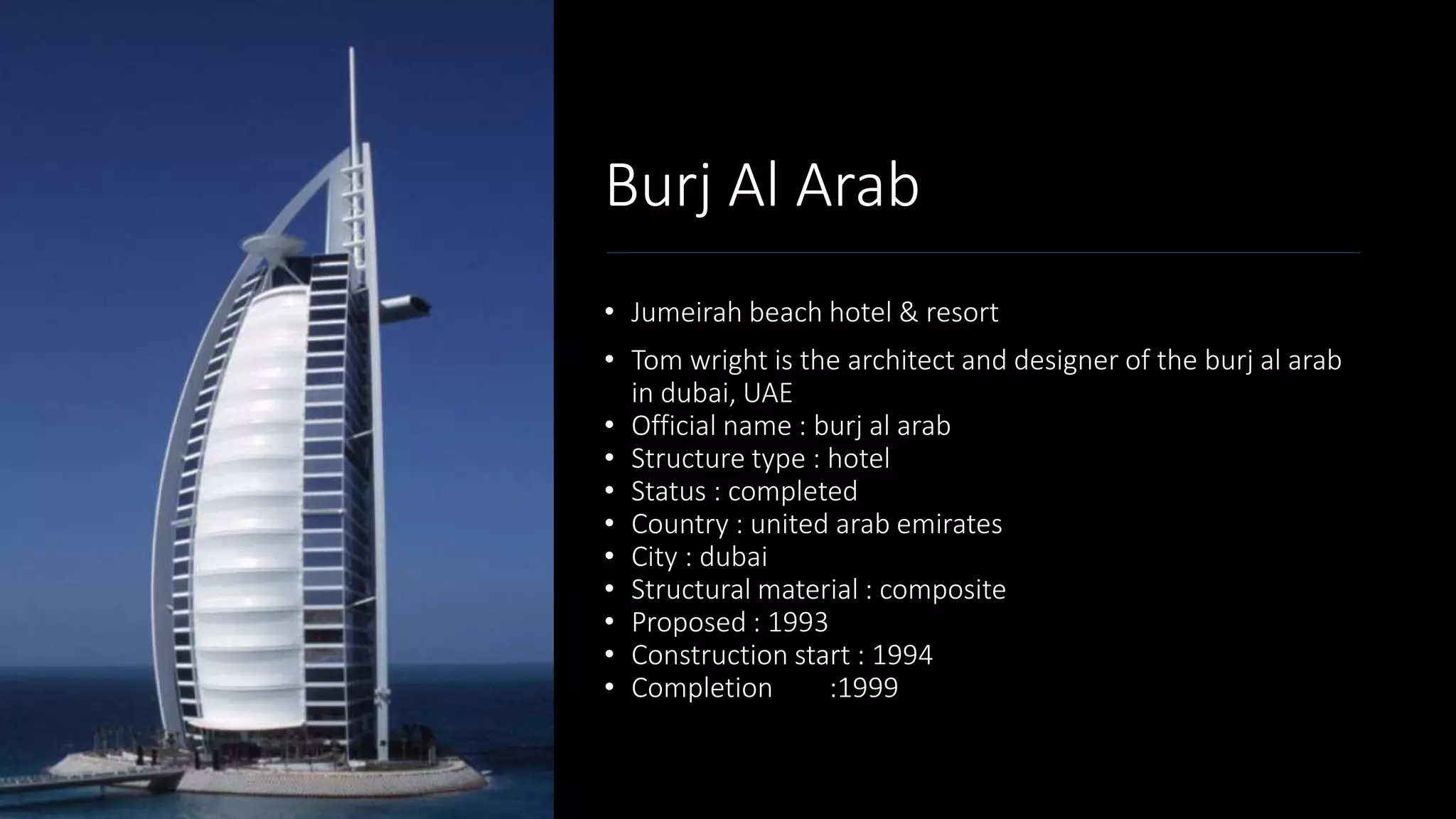
• Jumeirah beach hotel & resort
• Tom wright is the architect and designer of the burj al arab
in dubai, UAE
• Official name : burj al arab
• Structure type : hotel
• Status : completed
• Country : united arab emirates
• City : dubai
• Structural material : composite
• Proposed : 1993
• Construction start : 1994
• Completion :1999
Content
• Introduction And History
• Concept And Facts
• Island Construction And Foundation
• Loads
• Structural Systems : Column,beam,bracings,core,helipad And Restro
• Materials For External Structure
• Interiors Construction And Materials
• Plan,section And Elevation
• Further Extension Of Island
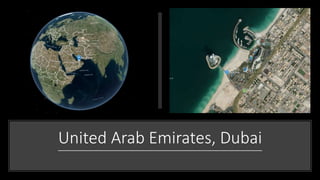
United Arab Emirates, Dubai
What Makes A Building Symbolic ?
We looked at other Buildings in the World that are symbols to see what they had in
common. We found that they were all totally Unique In Shape and they all have a
simple easily Recognizable Form. We decided that the test to determine if a
building is symbolic is if you can draw it in 5 seconds and every one recognizes it.
Why did you make the hotel like A giant sail ?
Dubai It had to become a world resort location so the building had to say holiday,
fun and sophistication all things associated with yachting. This mixed with Dubai's
nautical heritage it seemed an appropriate shape.
Why is the hotel out of sea ?
It helps to achieve its uniqueness. It looks like a sail / boat.
If it was on shore it would block the sun on the beach in the middle of the day.
Does the hotel stand on a rock ?
The Building is built on sand, which is unusual as most tall building are founded
on rock. The building is supported on 250 X 1.5M diameter columns that go 45
meters under the sea. As there is only sand to hold the building and the columns
rely on friction. Burj Al Arab looks like a sailboat, but its design, however, is based on the
sail of a Dhow, which is a traditional Arabian fishing vessel used for fishing and pearling.
CONCEPT
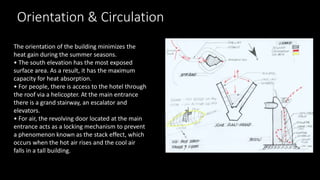
Orientation & Circulation
The orientation of the building minimizes the
heat gain during the summer seasons.
• The south elevation has the most exposed
surface area. As a result, it has the maximum
capacity for heat absorption.
• For people, there is access to the hotel through
the roof via a helicopter. At the main entrance
there is a grand stairway, an escalator and
elevators.
• For air, the revolving door located at the main
entrance acts as a locking mechanism to prevent
a phenomenon known as the stack effect, which
occurs when the hot air rises and the cool air
falls in a tall building.
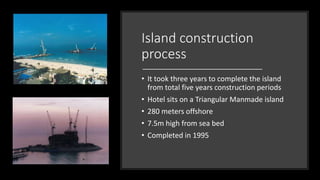
Island construction
process
• It took three years to complete the island
from total five years construction periods
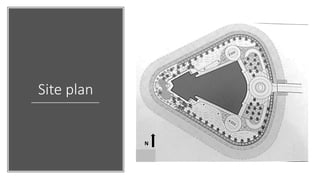
• Hotel sits on a Triangular Manmade island
• 280 meters offshore
• 7.5m high from sea bed
• Completed in 1995
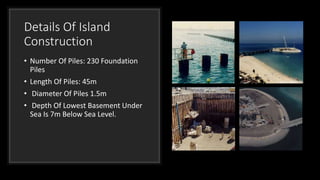
Details Of Island
Construction
• Number Of Piles: 230 Foundation
Piles
• Length Of Piles: 45m
• Diameter Of Piles 1.5m
• Depth Of Lowest Basement Under
Sea Is 7m Below Sea Level.
ISLAND CONSTRUCTION
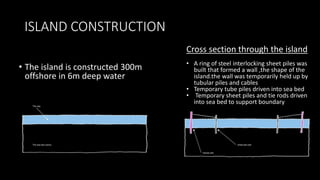
• The island is constructed 300m
offshore in 6m deep water
Cross section through the island
• A ring of steel interlocking sheet piles was
built that formed a wall ,the shape of the
island.the wall was temporarily held up by
tubular piles and cables
• Temporary tube piles driven into sea bed
• Temporary sheet piles and tie rods driven
into sea bed to support boundary rocks.
ISLAND CONSTRUCTION
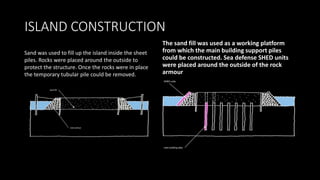
The sand fill was used as a working platform
from which the main building support piles
could be constructed. Sea defense SHED units
were placed around the outside of the rock
armour
Sand was used to fill up the island inside the sheet
piles. Rocks were placed around the outside to
protect the structure. Once the rocks were in place
the temporary tubular pile could be removed.
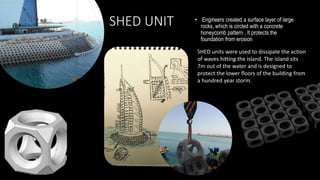
SHED UNIT • Engineers created a surface layer of large
rocks, which is circled with a concrete
honeycomb pattern , It protects the
foundation from erosion
SHED units were used to dissipate the action
of waves hitting the island. The island sits
7m out of the water and is designed to
protect the lower floors of the building from
a hundred year storm.
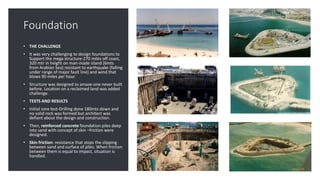
Foundation
• THE CHALLENGE
• It was very challenging to design foundations to
Support the mega structure-270 miles off coast,
320 mtr in height on man-made island (6mts
from Arabian Sea) resistant to earthquake (falling
under range of major fault line) and wind that
blows 90 miles per hour.
• Structure was designed to amaze-one never built
before. Location on a reclaimed land was added
challenge.
• TESTS AND RESULTS
• Initial core test-Drilling done 180mts down and
no solid rock was formed but architect was
defiant about the design and construction.
• Then, reinforced concrete foundation piles deep
into sand with concept of skin –friction were
designed.
• Skin friction: resistance that stops the slipping
between sand and surface of piles. When friction
between them is equal to impact, situation is
handled.
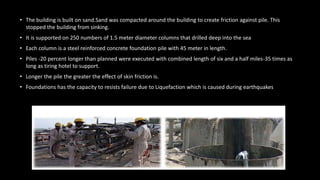
• The building is built on sand.Sand was compacted around the building to create friction against pile. This
stopped the building from sinking.
• It is supported on 250 numbers of 1.5 meter diameter columns that drilled deep into the sea
• Each column is a steel reinforced concrete foundation pile with 45 meter in length.
• Piles -20 percent longer than planned were executed with combined length of six and a half miles-35 times as
long as tiring hotel to support.
• Longer the pile the greater the effect of skin friction is.
• Foundations has the capacity to resists failure due to Liquefaction which is caused during earthquakes
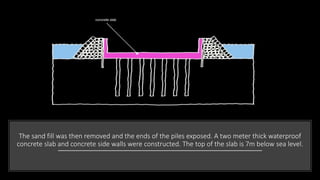
The sand fill was then removed and the ends of the piles exposed. A two meter thick waterproof
concrete slab and concrete side walls were constructed. The top of the slab is 7m below sea level.
Load acting
for resistance
of structure
• Gravity loads : Building is built to a seismic
ground acceleration of 0.2 times gravity
• Wind loads : Building is built to withstand a fifty
year wind of 100 miles per hour
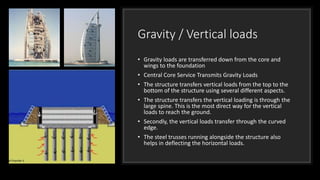
Gravity / Vertical loads
• Gravity loads are transferred down from the core and
wings to the foundation
• Central Core Service Transmits Gravity Loads
• The structure transfers vertical loads from the top to the
bottom of the structure using several different aspects.
• The structure transfers the vertical loading is through the
large spine. This is the most direct way for the vertical
loads to reach the ground.
• Secondly, the vertical loads transfer through the curved
edge.
• The steel trusses running alongside the structure also
helps in deflecting the horizontal loads.
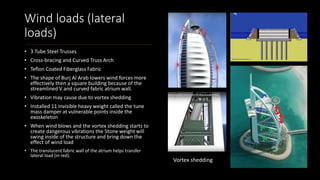
Wind loads (lateral
loads)
• 3 Tube Steel Trusses
• Cross-bracing and Curved Truss Arch
• Teflon Coated Fiberglass Fabric
• The shape of Burj Al Arab lowers wind forces more
effectively then a square building because of the
streamlined V and curved fabric atrium wall.
• Vibration may cause due to vortex shedding
• Installed 11 invisible heavy weight called the tune
mass damper at vulnerable points inside the
exoskeleton
• When wind blows and the vortex shedding starts to
create dangerous vibrations the 5tone weight will
swing inside of the structure and bring down the
effect of wind load
• The translucent fabric wall of the atrium helps transfer
lateral load (in red).
Vortex shedding
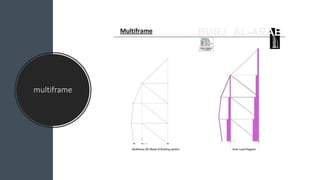
multiframe
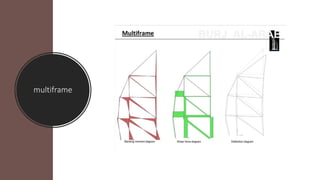
multiframe
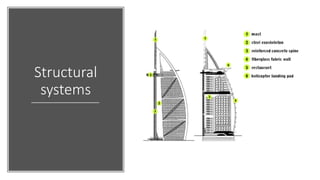
Structural
systems
THE STRUCTURE
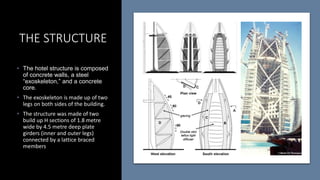
• The hotel structure is composed
of concrete walls, a steel
“exoskeleton,” and a concrete
core.
• The exoskeleton is made up of two
legs on both sides of the building.
• The structure was made of two
build up H sections of 1.8 metre
wide by 4.5 metre deep plate
girders (inner and outer legs)
connected by a lattice braced
members
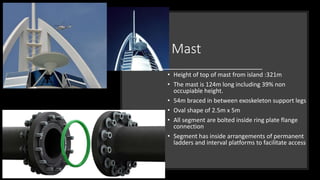
Mast
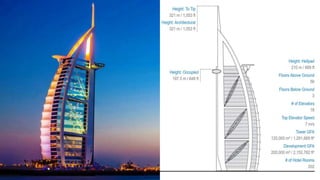
• Height of top of mast from island :321m
• The mast is 124m long including 39% non
occupiable height.
• 54m braced in between exoskeleton support legs
• Oval shape of 2.5m x 5m
• All segment are bolted inside ring plate flange
connection
• Segment has inside arrangements of permanent
ladders and interval platforms to facilitate access
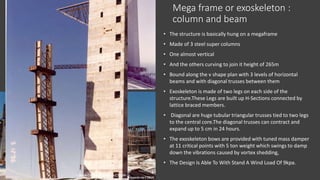
Mega frame or exoskeleton :
column and beam
• The structure is basically hung on a megaframe
• Made of 3 steel super columns
• One almost vertical
• And the others curving to join it height of 265m
• Bound along the v shape plan with 3 levels of horizontal
beams and with diagonal trusses between them
• Exoskeleton is made of two legs on each side of the
structure.These Legs are built up H-Sections connected by
lattice braced members.
• Diagonal are huge tubular triangular trusses tied to two legs
to the central core.The diagonal trusses can contract and
expand up to 5 cm in 24 hours.
• The exoskeleton bows are provided with tuned mass damper
at 11 critical points with 5 ton weight which swings to damp
down the vibrations caused by vortex shedding,
• The Design Is Able To With Stand A Wind Load Of 9kpa.
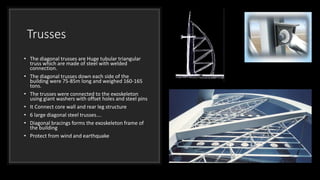
Trusses
• The diagonal trusses are Huge tubular triangular
truss which are made of steel with welded
connection.
• The diagonal trusses down each side of the
building were 75-85m long and weighed 160-165
tons.
• The trusses were connected to the exoskeleton
using giant washers with offset holes and steel pins
• It Connect core wall and rear leg structure
• 6 large diagonal steel trusses….
• Diagonal bracings forms the exoskeleton frame of
the building
• Protect from wind and earthquake
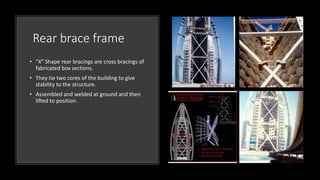
Rear brace frame
• “X” Shape rear bracings are cross bracings of
fabricated box sections.
• They tie two cores of the building to give
stability to the structure.
• Assembled and welded at ground and then
lifted to position.
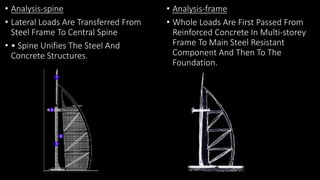
• Analysis-spine
• Lateral Loads Are Transferred From
Steel Frame To Central Spine
• • Spine Unifies The Steel And
Concrete Structures.
• Analysis-frame
• Whole Loads Are First Passed From
Reinforced Concrete In Multi-storey
Frame To Main Steel Resistant
Component And Then To The
Foundation.
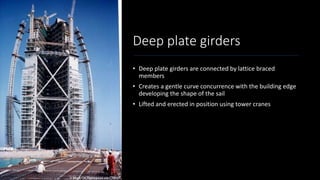
Deep plate girders
• Deep plate girders are connected by lattice braced
members
• Creates a gentle curve concurrence with the building edge
developing the shape of the sail
• Lifted and erected in position using tower cranes
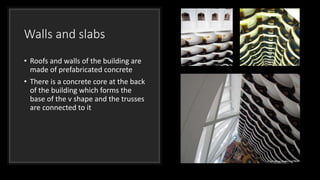
Walls and slabs
• Roofs and walls of the building are
made of prefabricated concrete
• There is a concrete core at the back
of the building which forms the
base of the v shape and the trusses
are connected to it
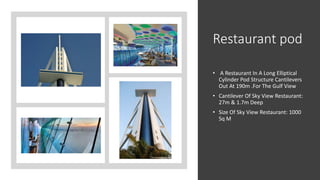
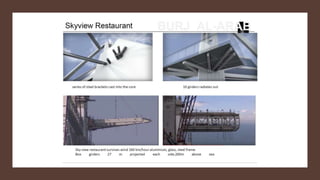
Restaurant pod
• A Restaurant In A Long Elliptical
Cylinder Pod Structure Cantilevers
Out At 190m .For The Gulf View
• Cantilever Of Sky View Restaurant:
27m & 1.7m Deep
• Size Of Sky View Restaurant: 1000
Sq M
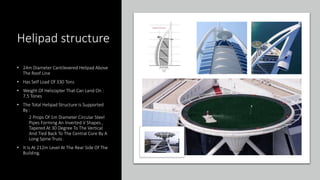
Helipad structure
• 24m Diameter Cantilevered Helipad Above
The Roof Line
• Has Self Load Of 330 Tons
• Weight Of Helicopter That Can Land On :
7.5 Tones
• The Total Helipad Structure Is Supported
By :
2 Props Of 1m Diameter Circular Steel
Pipes Forming An Inverted V Shapes ,
Tapered At 30 Degree To The Vertical
And Tied Back To The Central Core By A
Long Spine Truss .
• It Is At 212m Level At The Rear Side Of The
Building.
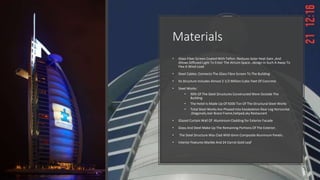
Materials
• Glass Fiber Screen Coated With Teflon :Reduces Solar Heat Gain ,And
Allows Diffused Light To Enter The Atrium Space…design In Such A Away To
Flex A Wind Load
• Steel Cables: Connects The Glass Fibre Screen To The Building
• Its Structure Includes Almost 2 1/2 Million Cubic Feet Of Concrete
• Steel Works:
• 90% Of The Steel Structures Constructed Were Outside The
Building
• The Hotel Is Made Up Of 9200 Ton Of The Structural Steel Works
• Total Steel Works Are Phased Into Exoskeleton Rear Leg Horizontal
,Diagonals,rear Brace Frame,helipad,sky Restaurant
• Glazed Curtain Wall Of Aluminium Cladding for Exterior Facade
• Glass And Steel Make Up The Remaining Portions Of The Exterior.
• The Steel Structure Was Clad With 6mm Composite Aluminum Panels.
• Interior Features Marble And 24 Carrot Gold Leaf
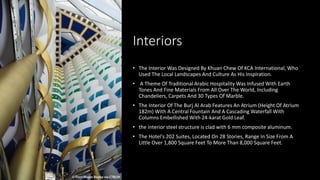
Interiors
• The Interior Was Designed By Khuan Chew Of KCA International, Who
Used The Local Landscapes And Culture As His Inspiration.
• A Theme Of Traditional Arabic Hospitality Was Infused With Earth
Tones And Fine Materials From All Over The World, Including
Chandeliers, Carpets And 30 Types Of Marble.
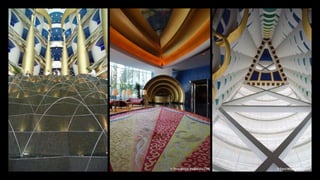
• The Interior Of The Burj Al Arab Features An Atrium (Height Of Atrium
182m) With A Central Fountain And A Cascading Waterfall With
Columns Embellished With 24-karat Gold Leaf.
• the interior steel structure is clad with 6 mm composite aluminum.
• The Hotel's 202 Suites, Located On 28 Stories, Range In Size From A
Little Over 1,800 Square Feet To More Than 8,000 Square Feet.
Site plan
N
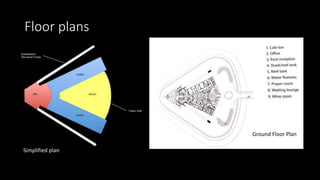
Floor plans
Simplified plan
Ground Floor Plan
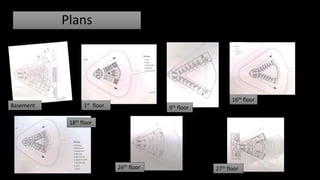
Plans
Basement 1st floor 9th floor
16th floor
18th floor
26th floor 27th floor
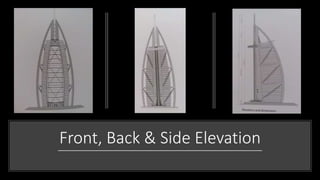
Front, Back & Side Elevation
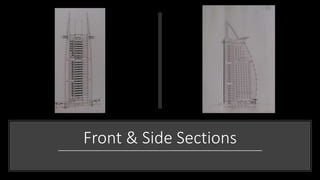
Front & Side Sections
The northward
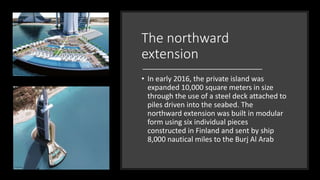
extension
• In early 2016, the private island was
expanded 10,000 square meters in size
through the use of a steel deck attached to
piles driven into the seabed. The
northward extension was built in modular
form using six individual pieces
constructed in Finland and sent by ship
8,000 nautical miles to the Burj Al Arab
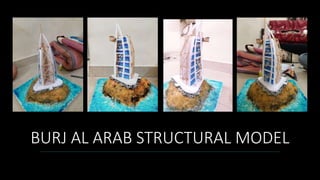
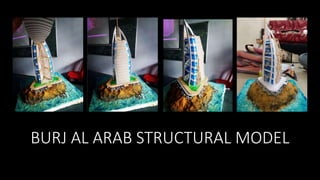
BURJ AL ARAB STRUCTURAL MODEL
GROUP
MEMBERS
• HARSHALI B
• KETAKI K
• ASHLEY J
• SUSHILKUMAR G

BURJ AL ARAB

  • 1.
    Burj Al Arab •Jumeirah beach hotel & resort • Tom wright is the architect and designer of the burj al arab in dubai, UAE • Official name : burj al arab • Structure type : hotel • Status : completed • Country : united arab emirates • City : dubai • Structural material : composite • Proposed : 1993 • Construction start : 1994 • Completion :1999
  • 2.
    Content • Introduction AndHistory • Concept And Facts • Island Construction And Foundation • Loads • Structural Systems : Column,beam,bracings,core,helipad And Restro • Materials For External Structure • Interiors Construction And Materials • Plan,section And Elevation • Further Extension Of Island
  • 3.
  • 5.
    What Makes ABuilding Symbolic ? We looked at other Buildings in the World that are symbols to see what they had in common. We found that they were all totally Unique In Shape and they all have a simple easily Recognizable Form. We decided that the test to determine if a building is symbolic is if you can draw it in 5 seconds and every one recognizes it. Why did you make the hotel like A giant sail ? Dubai It had to become a world resort location so the building had to say holiday, fun and sophistication all things associated with yachting. This mixed with Dubai's nautical heritage it seemed an appropriate shape. Why is the hotel out of sea ? It helps to achieve its uniqueness. It looks like a sail / boat. If it was on shore it would block the sun on the beach in the middle of the day. Does the hotel stand on a rock ? The Building is built on sand, which is unusual as most tall building are founded on rock. The building is supported on 250 X 1.5M diameter columns that go 45 meters under the sea. As there is only sand to hold the building and the columns rely on friction. Burj Al Arab looks like a sailboat, but its design, however, is based on the sail of a Dhow, which is a traditional Arabian fishing vessel used for fishing and pearling. CONCEPT
  • 6.
    Orientation & Circulation Theorientation of the building minimizes the heat gain during the summer seasons. • The south elevation has the most exposed surface area. As a result, it has the maximum capacity for heat absorption. • For people, there is access to the hotel through the roof via a helicopter. At the main entrance there is a grand stairway, an escalator and elevators. • For air, the revolving door located at the main entrance acts as a locking mechanism to prevent a phenomenon known as the stack effect, which occurs when the hot air rises and the cool air falls in a tall building.
  • 7.
    Island construction process • Ittook three years to complete the island from total five years construction periods • Hotel sits on a Triangular Manmade island • 280 meters offshore • 7.5m high from sea bed • Completed in 1995
  • 8.
    Details Of Island Construction •Number Of Piles: 230 Foundation Piles • Length Of Piles: 45m • Diameter Of Piles 1.5m • Depth Of Lowest Basement Under Sea Is 7m Below Sea Level.
  • 9.
    ISLAND CONSTRUCTION • Theisland is constructed 300m offshore in 6m deep water Cross section through the island • A ring of steel interlocking sheet piles was built that formed a wall ,the shape of the island.the wall was temporarily held up by tubular piles and cables • Temporary tube piles driven into sea bed • Temporary sheet piles and tie rods driven into sea bed to support boundary rocks.
  • 10.
    ISLAND CONSTRUCTION The sandfill was used as a working platform from which the main building support piles could be constructed. Sea defense SHED units were placed around the outside of the rock armour Sand was used to fill up the island inside the sheet piles. Rocks were placed around the outside to protect the structure. Once the rocks were in place the temporary tubular pile could be removed.
  • 11.
    SHED UNIT •Engineers created a surface layer of large rocks, which is circled with a concrete honeycomb pattern , It protects the foundation from erosion SHED units were used to dissipate the action of waves hitting the island. The island sits 7m out of the water and is designed to protect the lower floors of the building from a hundred year storm.
  • 12.
    Foundation • THE CHALLENGE •It was very challenging to design foundations to Support the mega structure-270 miles off coast, 320 mtr in height on man-made island (6mts from Arabian Sea) resistant to earthquake (falling under range of major fault line) and wind that blows 90 miles per hour. • Structure was designed to amaze-one never built before. Location on a reclaimed land was added challenge. • TESTS AND RESULTS • Initial core test-Drilling done 180mts down and no solid rock was formed but architect was defiant about the design and construction. • Then, reinforced concrete foundation piles deep into sand with concept of skin –friction were designed. • Skin friction: resistance that stops the slipping between sand and surface of piles. When friction between them is equal to impact, situation is handled.
  • 13.
    • The buildingis built on sand.Sand was compacted around the building to create friction against pile. This stopped the building from sinking. • It is supported on 250 numbers of 1.5 meter diameter columns that drilled deep into the sea • Each column is a steel reinforced concrete foundation pile with 45 meter in length. • Piles -20 percent longer than planned were executed with combined length of six and a half miles-35 times as long as tiring hotel to support. • Longer the pile the greater the effect of skin friction is. • Foundations has the capacity to resists failure due to Liquefaction which is caused during earthquakes
  • 14.
    The sand fillwas then removed and the ends of the piles exposed. A two meter thick waterproof concrete slab and concrete side walls were constructed. The top of the slab is 7m below sea level.
  • 15.
    Load acting for resistance ofstructure • Gravity loads : Building is built to a seismic ground acceleration of 0.2 times gravity • Wind loads : Building is built to withstand a fifty year wind of 100 miles per hour
  • 16.
    Gravity / Verticalloads • Gravity loads are transferred down from the core and wings to the foundation • Central Core Service Transmits Gravity Loads • The structure transfers vertical loads from the top to the bottom of the structure using several different aspects. • The structure transfers the vertical loading is through the large spine. This is the most direct way for the vertical loads to reach the ground. • Secondly, the vertical loads transfer through the curved edge. • The steel trusses running alongside the structure also helps in deflecting the horizontal loads.
  • 17.
    Wind loads (lateral loads) •3 Tube Steel Trusses • Cross-bracing and Curved Truss Arch • Teflon Coated Fiberglass Fabric • The shape of Burj Al Arab lowers wind forces more effectively then a square building because of the streamlined V and curved fabric atrium wall. • Vibration may cause due to vortex shedding • Installed 11 invisible heavy weight called the tune mass damper at vulnerable points inside the exoskeleton • When wind blows and the vortex shedding starts to create dangerous vibrations the 5tone weight will swing inside of the structure and bring down the effect of wind load • The translucent fabric wall of the atrium helps transfer lateral load (in red). Vortex shedding
  • 18.
  • 19.
  • 20.
  • 21.
    THE STRUCTURE • Thehotel structure is composed of concrete walls, a steel “exoskeleton,” and a concrete core. • The exoskeleton is made up of two legs on both sides of the building. • The structure was made of two build up H sections of 1.8 metre wide by 4.5 metre deep plate girders (inner and outer legs) connected by a lattice braced members
  • 22.
    Mast • Height oftop of mast from island :321m • The mast is 124m long including 39% non occupiable height. • 54m braced in between exoskeleton support legs • Oval shape of 2.5m x 5m • All segment are bolted inside ring plate flange connection • Segment has inside arrangements of permanent ladders and interval platforms to facilitate access
  • 23.
    Mega frame orexoskeleton : column and beam • The structure is basically hung on a megaframe • Made of 3 steel super columns • One almost vertical • And the others curving to join it height of 265m • Bound along the v shape plan with 3 levels of horizontal beams and with diagonal trusses between them • Exoskeleton is made of two legs on each side of the structure.These Legs are built up H-Sections connected by lattice braced members. • Diagonal are huge tubular triangular trusses tied to two legs to the central core.The diagonal trusses can contract and expand up to 5 cm in 24 hours. • The exoskeleton bows are provided with tuned mass damper at 11 critical points with 5 ton weight which swings to damp down the vibrations caused by vortex shedding, • The Design Is Able To With Stand A Wind Load Of 9kpa.
  • 24.
    Trusses • The diagonaltrusses are Huge tubular triangular truss which are made of steel with welded connection. • The diagonal trusses down each side of the building were 75-85m long and weighed 160-165 tons. • The trusses were connected to the exoskeleton using giant washers with offset holes and steel pins • It Connect core wall and rear leg structure • 6 large diagonal steel trusses…. • Diagonal bracings forms the exoskeleton frame of the building • Protect from wind and earthquake
  • 25.
    Rear brace frame •“X” Shape rear bracings are cross bracings of fabricated box sections. • They tie two cores of the building to give stability to the structure. • Assembled and welded at ground and then lifted to position.
  • 26.
    • Analysis-spine • LateralLoads Are Transferred From Steel Frame To Central Spine • • Spine Unifies The Steel And Concrete Structures. • Analysis-frame • Whole Loads Are First Passed From Reinforced Concrete In Multi-storey Frame To Main Steel Resistant Component And Then To The Foundation.
  • 27.
    Deep plate girders •Deep plate girders are connected by lattice braced members • Creates a gentle curve concurrence with the building edge developing the shape of the sail • Lifted and erected in position using tower cranes
  • 28.
    Walls and slabs •Roofs and walls of the building are made of prefabricated concrete • There is a concrete core at the back of the building which forms the base of the v shape and the trusses are connected to it
  • 29.
    Restaurant pod • ARestaurant In A Long Elliptical Cylinder Pod Structure Cantilevers Out At 190m .For The Gulf View • Cantilever Of Sky View Restaurant: 27m & 1.7m Deep • Size Of Sky View Restaurant: 1000 Sq M
  • 31.
    Helipad structure • 24mDiameter Cantilevered Helipad Above The Roof Line • Has Self Load Of 330 Tons • Weight Of Helicopter That Can Land On : 7.5 Tones • The Total Helipad Structure Is Supported By : 2 Props Of 1m Diameter Circular Steel Pipes Forming An Inverted V Shapes , Tapered At 30 Degree To The Vertical And Tied Back To The Central Core By A Long Spine Truss . • It Is At 212m Level At The Rear Side Of The Building.
  • 32.
    Materials • Glass FiberScreen Coated With Teflon :Reduces Solar Heat Gain ,And Allows Diffused Light To Enter The Atrium Space…design In Such A Away To Flex A Wind Load • Steel Cables: Connects The Glass Fibre Screen To The Building • Its Structure Includes Almost 2 1/2 Million Cubic Feet Of Concrete • Steel Works: • 90% Of The Steel Structures Constructed Were Outside The Building • The Hotel Is Made Up Of 9200 Ton Of The Structural Steel Works • Total Steel Works Are Phased Into Exoskeleton Rear Leg Horizontal ,Diagonals,rear Brace Frame,helipad,sky Restaurant • Glazed Curtain Wall Of Aluminium Cladding for Exterior Facade • Glass And Steel Make Up The Remaining Portions Of The Exterior. • The Steel Structure Was Clad With 6mm Composite Aluminum Panels. • Interior Features Marble And 24 Carrot Gold Leaf
  • 33.
    Interiors • The InteriorWas Designed By Khuan Chew Of KCA International, Who Used The Local Landscapes And Culture As His Inspiration. • A Theme Of Traditional Arabic Hospitality Was Infused With Earth Tones And Fine Materials From All Over The World, Including Chandeliers, Carpets And 30 Types Of Marble. • The Interior Of The Burj Al Arab Features An Atrium (Height Of Atrium 182m) With A Central Fountain And A Cascading Waterfall With Columns Embellished With 24-karat Gold Leaf. • the interior steel structure is clad with 6 mm composite aluminum. • The Hotel's 202 Suites, Located On 28 Stories, Range In Size From A Little Over 1,800 Square Feet To More Than 8,000 Square Feet.
  • 35.
  • 36.
  • 37.
    Plans Basement 1st floor9th floor 16th floor 18th floor 26th floor 27th floor
  • 38.
    Front, Back &Side Elevation
  • 39.
    Front & SideSections
  • 40.
    The northward extension • Inearly 2016, the private island was expanded 10,000 square meters in size through the use of a steel deck attached to piles driven into the seabed. The northward extension was built in modular form using six individual pieces constructed in Finland and sent by ship 8,000 nautical miles to the Burj Al Arab
  • 41.
    BURJ AL ARABSTRUCTURAL MODEL
  • 42.
    BURJ AL ARABSTRUCTURAL MODEL
  • 43.
    GROUP MEMBERS • HARSHALI B •KETAKI K • ASHLEY J • SUSHILKUMAR G