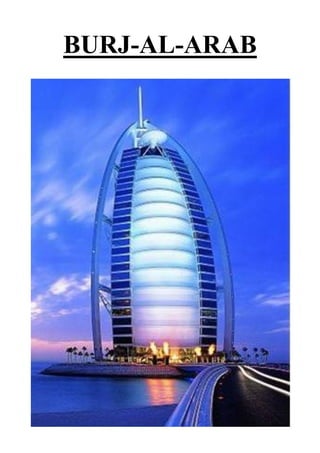
BURJ-AL-ARAB
2
INTRODUCTION
Burj Al Arab is a luxury hotel located in Dubai, United Arab Emirates. At 321 m (1,053 ft), it is the fourth
tallest hotel in the world, however 39% of its total height is made up of non-occupiable space. It stands on an
artificial island 280 m (920 ft) from Jumeirah beach and is connected to the mainland by a private curving
bridge. The total cost to construct the hotel was $650 million.
Total number of rooms – 202
Architect – Tom Wright
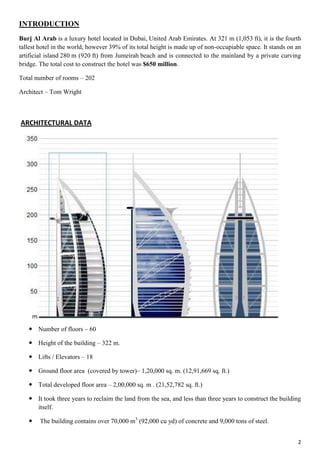
ARCHITECTURAL DATA
 Number of floors – 60
 Height of the building – 322 m.
 Lifts / Elevators – 18
 Ground floor area (covered by tower)– 1,20,000 sq. m. (12,91,669 sq. ft.)
 Total developed floor area – 2,00,000 sq. m . (21,52,782 sq. ft.)
 It took three years to reclaim the land from the sea, and less than three years to construct the building
itself.
 The building contains over 70,000 m3
(92,000 cu yd) of concrete and 9,000 tons of steel.
3
 Height of the building – 322 m. (1,056 ft.)
 Number of floors – 60
 Lifts / Elevators – 18
 Ground floor area (covered by tower)– 1,20,000 sq. m. (12,91,669 sq. ft.)
 Total developed floor area – 2,00,000 sq. m . (21,52,782 sq. ft.)
 It took three years to reclaim the land from the sea, and less than three years to construct the building
itself.
 The building contains over 70,000 m3
(92,000 cu yd) of concrete and 9,000 tons of steel.
HOW IT HAPPENED ?
Tom Wills Wright, architect with WS Atkins, quoted: "The brief was that the client asked to create a
building that would become an icon for Dubai rather like the:
“ Sydney has its Opera House
USA has its Statue of Liberty
Egypt has its pyramids &
Paris has its Eiffel Tower.”
We built the tower on its own island because it enhanced the iconic nature of the building, and that seemed
logical because the building was inspired by the sail of a dhow, looking like the traditional Arabian sailing
vessel.
Two “wings” spread in a V to form a vast “mast”, while the space between them is enclosed in a massive
atrium.
PROJECT TEAM
Architect & Design: WS Atkins & Partners
Chief Architect: Tom Wright
Project Manager: Rick Gregory
Structural Engineer: Anthony McCarter
Interior Designer: Ms Kuan Chew KCA International
Concrete and Block work: Al Habtoor Engineering
Murray and Roberts: Steel Fabricators
Island Engineer: Mike McNicholas
4
CONSTRUCTION
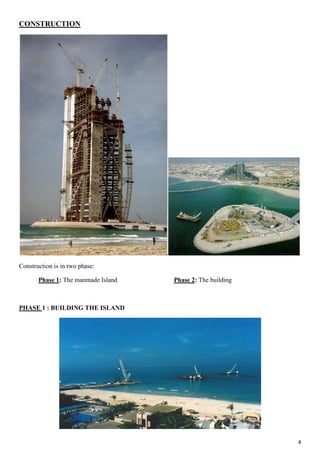
Construction is in two phase:
Phase 1: The manmade Island Phase 2: The building
PHASE 1 : BUILDING THE ISLAND
5
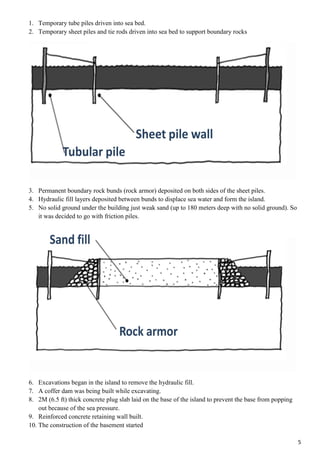
1. Temporary tube piles driven into sea bed.
2. Temporary sheet piles and tie rods driven into sea bed to support boundary rocks
3. Permanent boundary rock bunds (rock armor) deposited on both sides of the sheet piles.
4. Hydraulic fill layers deposited between bunds to displace sea water and form the island.
5. No solid ground under the building just weak sand (up to 180 meters deep with no solid ground). So
it was decided to go with friction piles.
6. Excavations began in the island to remove the hydraulic fill.
7. A coffer dam was being built while excavating.
8. 2M (6.5 ft) thick concrete plug slab laid on the base of the island to prevent the base from popping
out because of the sea pressure.
9. Reinforced concrete retaining wall built.
10. The construction of the basement started
6
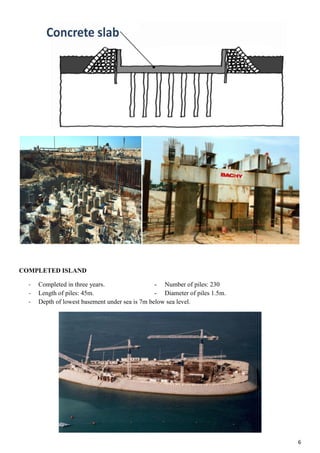
COMPLETED ISLAND
- Completed in three years. - Number of piles: 230
- Length of piles: 45m. - Diameter of piles 1.5m.
- Depth of lowest basement under sea is 7m below sea level.
7
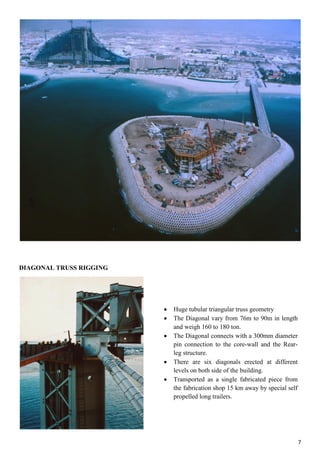
DIAGONAL TRUSS RIGGING
 Huge tubular triangular truss geometry
 The Diagonal vary from 76m to 90m in length
and weigh 160 to 180 ton.
 The Diagonal connects with a 300mm diameter
pin connection to the core-wall and the Rear-
leg structure.
 There are six diagonals erected at different
levels on both side of the building.
 Transported as a single fabricated piece from
the fabrication shop 15 km away by special self
propelled long trailers.
8
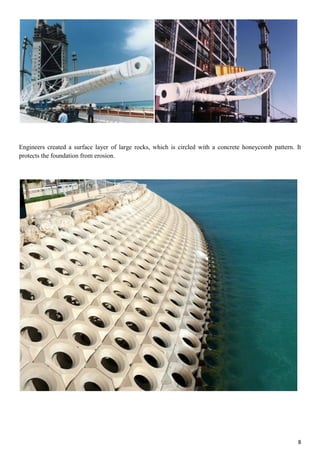
Engineers created a surface layer of large rocks, which is circled with a concrete honeycomb pattern. It
protects the foundation from erosion.
9
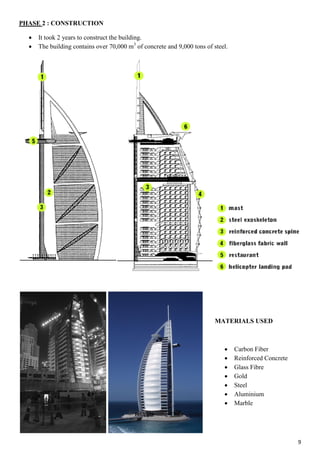
PHASE 2 : CONSTRUCTION
 It took 2 years to construct the building.
 The building contains over 70,000 m3
of concrete and 9,000 tons of steel.
MATERIALS USED
 Carbon Fiber
 Reinforced Concrete
 Glass Fibre
 Gold
 Steel
 Aluminium
 Marble
10
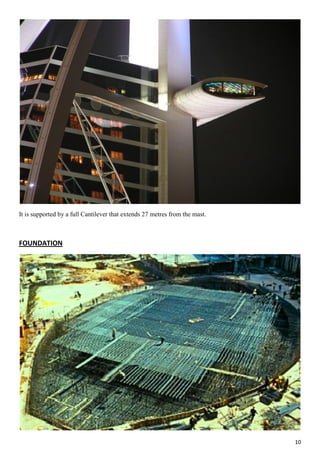
It is supported by a full Cantilever that extends 27 metres from the mast.
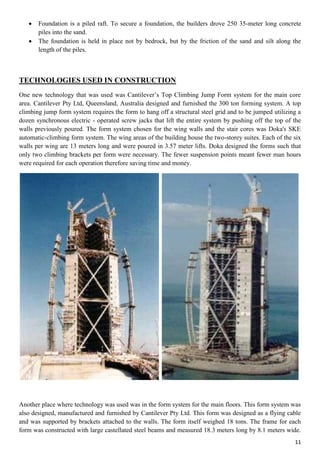
FOUNDATION
11
 Foundation is a piled raft. To secure a foundation, the builders drove 250 35-meter long concrete
piles into the sand.
 The foundation is held in place not by bedrock, but by the friction of the sand and silt along the
length of the piles.
TECHNOLOGIES USED IN CONSTRUCTION
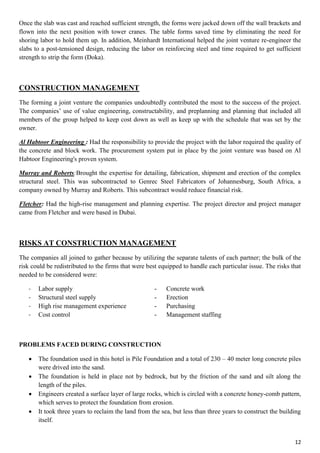
One new technology that was used was Cantilever’s Top Climbing Jump Form system for the main core
area. Cantilever Pty Ltd, Queensland, Australia designed and furnished the 300 ton forming system. A top
climbing jump form system requires the form to hang off a structural steel grid and to be jumped utilizing a
dozen synchronous electric - operated screw jacks that lift the entire system by pushing off the top of the
walls previously poured. The form system chosen for the wing walls and the stair cores was Doka's SKE
automatic-climbing form system. The wing areas of the building house the two-storey suites. Each of the six
walls per wing are 13 meters long and were poured in 3.57 meter lifts. Doka designed the forms such that
only two climbing brackets per form were necessary. The fewer suspension points meant fewer man hours
were required for each operation therefore saving time and money.
Another place where technology was used was in the form system for the main floors. This form system was
also designed, manufactured and furnished by Cantilever Pty Ltd. This form was designed as a flying cable
and was supported by brackets attached to the walls. The form itself weighed 18 tons. The frame for each
form was constructed with large castellated steel beams and measured 18.3 meters long by 8.1 meters wide.
12
Once the slab was cast and reached sufficient strength, the forms were jacked down off the wall brackets and
flown into the next position with tower cranes. The table forms saved time by eliminating the need for
shoring labor to hold them up. In addition, Meinhardt International helped the joint venture re-engineer the
slabs to a post-tensioned design, reducing the labor on reinforcing steel and time required to get sufficient
strength to strip the form (Doka).
CONSTRUCTION MANAGEMENT
The forming a joint venture the companies undoubtedly contributed the most to the success of the project.
The companies’ use of value engineering, constructability, and preplanning and planning that included all
members of the group helped to keep cost down as well as keep up with the schedule that was set by the
owner.
Al Habtoor Engineering : Had the responsibility to provide the project with the labor required the quality of
the concrete and block work. The procurement system put in place by the joint venture was based on Al
Habtoor Engineering's proven system.
Murray and Roberts:Brought the expertise for detailing, fabrication, shipment and erection of the complex
structural steel. This was subcontracted to Genrec Steel Fabricators of Johannesburg, South Africa, a
company owned by Murray and Roberts. This subcontract would reduce financial risk.
Fletcher: Had the high-rise management and planning expertise. The project director and project manager
came from Fletcher and were based in Dubai.
RISKS AT CONSTRUCTION MANAGEMENT
The companies all joined to gather because by utilizing the separate talents of each partner; the bulk of the
risk could be redistributed to the firms that were best equipped to handle each particular issue. The risks that
needed to be considered were:
- Labor supply - Concrete work
- Structural steel supply - Erection
- High rise management experience - Purchasing
- Cost control - Management staffing
PROBLEMS FACED DURING CONSTRUCTION
 The foundation used in this hotel is Pile Foundation and a total of 230 – 40 meter long concrete piles
were drived into the sand.
 The foundation is held in place not by bedrock, but by the friction of the sand and silt along the
length of the piles.
 Engineers created a surface layer of large rocks, which is circled with a concrete honey-comb pattern,
which serves to protect the foundation from erosion.
 It took three years to reclaim the land from the sea, but less than three years to construct the building
itself.
13
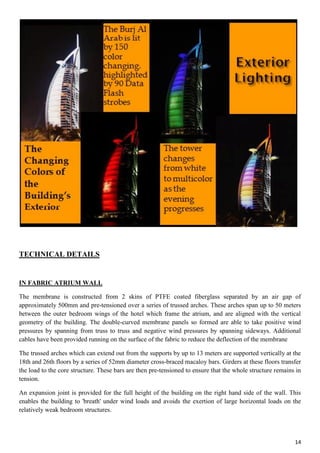
EXTERIOR
The structure is made of a steel exoskeleton wrapped around an reinforced concrete tower. The space
between the wings is enclosed by a Teflon-coated fiberglass sail, curving across the front of the building and
creating an atrium inside. The sail is made of a material called Dyneon, spanning over 161,000 square feet,
consists of two layers, and is divided into twelve panels and installed vertically. The fabric is coated with
DuPont Teflon to protect it from harsh desert heat, wind, and dirt. The fabricators estimate that it will hold
up for up to 50 years.
LIGHTING CONTROL SYSTEM
At 14,000 channels it is the largest architectural lighting control system ever made (Futronix). Each suite has
one or more PFX-32 dimming control systems, which operate the lighting in every room. The largest suites
have five systems giving a total of 160 channels of lighting. As if the interior lighting schemes were not
enough, each suite is also equipped with digital surround sound, multimedia enhanced 42” plasma television,
internet access, touch-screen video and teleconferencing, fax machine, photocopier, data port and to top it all
off, automated curtains (Burj Al Arab).
14
TECHNICAL DETAILS
IN FABRIC ATRIUM WALL
The membrane is constructed from 2 skins of PTFE coated fiberglass separated by an air gap of
approximately 500mm and pre-tensioned over a series of trussed arches. These arches span up to 50 meters
between the outer bedroom wings of the hotel which frame the atrium, and are aligned with the vertical
geometry of the building. The double-curved membrane panels so formed are able to take positive wind
pressures by spanning from truss to truss and negative wind pressures by spanning sideways. Additional
cables have been provided running on the surface of the fabric to reduce the deflection of the membrane
The trussed arches which can extend out from the supports by up to 13 meters are supported vertically at the
18th and 26th floors by a series of 52mm diameter cross-braced macaloy bars. Girders at these floors transfer
the load to the core structure. These bars are then pre-tensioned to ensure that the whole structure remains in
tension.
An expansion joint is provided for the full height of the building on the right hand side of the wall. This
enables the building to 'breath' under wind loads and avoids the exertion of large horizontal loads on the
relatively weak bedroom structures.
15
The resulting form is entirely appropriate for the building and its function with the fabric reducing solar gain
into the atrium and providing an effective diffused light quality. It is also appropriate for the Middle-East
region where its predicted lifespan and self-cleansing qualities should resist the aggressive environment.
PRODUCTIVITY
 Joint venture the companies contributed to the success of the project.
 The companies use of value engineering, constructability, and preplanning and planning helped to
keep cost down.
 Also to keep up with the schedule that was set by the owner.
ENVIRONMENTAL IMPACT
 Indirect energy (purchased electricity) consumption in the hotels and resorts and related greenhouse
gas (GHG) emissions
 The impact of our hotels and resorts on biodiversity
 Water consumption in our guest rooms, laundry, swimming pool sand gardens
 Waste generation in our hotels and resorts
 Water in the UAE is mostly derived from sea water through an energy-intensive desalination process
 Water in the lobby/mezzanine rolling water embankment and shooting fountain is recycled but there
are no further specific environmental measures or environmental plans in place at Burj Al Arab.
 There are a total of more than 4,000 fish in the aquarium, which was created over the course of three
months by Pangea Rocks. They take extreme pride in nurturing fish and providing it with as natural
an environment as much as possible.
 Jumeirah's organizational structure to successfully manage the widespread growth and change the
company is undergoing.
 Jumeirah has extensive expansion plans to grow its assortment of luxury hotels and resorts into key
gateway or letterhead cities and inspirational resort destinations internationally.
 They enhanced the governance structure to better protect their stakeholders interests.
 They established the CR Review Group as part of the governance structure to strengthen overall CR
practices.
 Dubai, 26 November 2012: Jumeirah Group, the global hospitality company and a member of Dubai
Holding, has signed a management agreement to operate a luxury hotel in central Mumbai, India.
 The hotel is part of a major new development in the Lower Parel district of the city and is expected to
open in 2017.
 This agreement represents the first phase of Jumeirah Group’s expansion into India. The company is
currently in advanced negotiations on potential projects for hotels and resorts in other key
destinations in India.
16
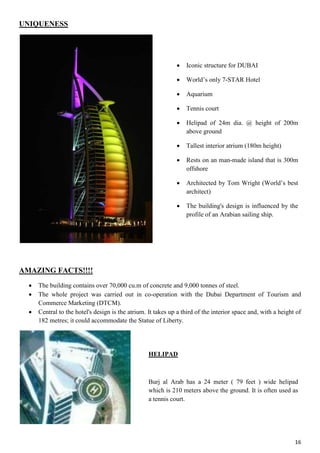
UNIQUENESS
AMAZING FACTS!!!!
 The building contains over 70,000 cu.m of concrete and 9,000 tonnes of steel.
 The whole project was carried out in co-operation with the Dubai Department of Tourism and
Commerce Marketing (DTCM).
 Central to the hotel's design is the atrium. It takes up a third of the interior space and, with a height of
182 metres; it could accommodate the Statue of Liberty.
 Iconic structure for DUBAI
 World’s only 7-STAR Hotel
 Aquarium
 Tennis court
 Helipad of 24m dia. @ height of 200m
above ground
 Tallest interior atrium (180m height)
 Rests on an man-made island that is 300m
offshore
 Architected by Tom Wright (World’s best
architect)
 The building's design is influenced by the
profile of an Arabian sailing ship.
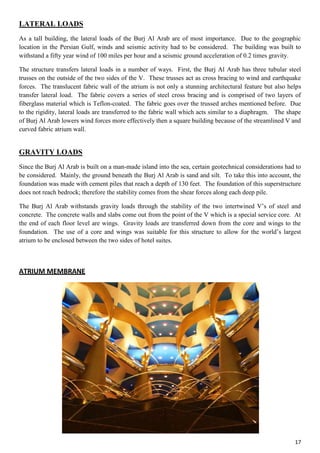
HELIPAD
Burj al Arab has a 24 meter ( 79 feet ) wide helipad
which is 210 meters above the ground. It is often used as
a tennis court.
17
LATERAL LOADS
As a tall building, the lateral loads of the Burj Al Arab are of most importance. Due to the geographic
location in the Persian Gulf, winds and seismic activity had to be considered. The building was built to
withstand a fifty year wind of 100 miles per hour and a seismic ground acceleration of 0.2 times gravity.
The structure transfers lateral loads in a number of ways. First, the Burj Al Arab has three tubular steel
trusses on the outside of the two sides of the V. These trusses act as cross bracing to wind and earthquake
forces. The translucent fabric wall of the atrium is not only a stunning architectural feature but also helps
transfer lateral load. The fabric covers a series of steel cross bracing and is comprised of two layers of
fiberglass material which is Teflon-coated. The fabric goes over the trussed arches mentioned before. Due
to the rigidity, lateral loads are transferred to the fabric wall which acts similar to a diaphragm. The shape
of Burj Al Arab lowers wind forces more effectively then a square building because of the streamlined V and
curved fabric atrium wall.
GRAVITY LOADS
Since the Burj Al Arab is built on a man-made island into the sea, certain geotechnical considerations had to
be considered. Mainly, the ground beneath the Burj Al Arab is sand and silt. To take this into account, the
foundation was made with cement piles that reach a depth of 130 feet. The foundation of this superstructure
does not reach bedrock; therefore the stability comes from the shear forces along each deep pile.
The Burj Al Arab withstands gravity loads through the stability of the two intertwined V’s of steel and
concrete. The concrete walls and slabs come out from the point of the V which is a special service core. At
the end of each floor level are wings. Gravity loads are transferred down from the core and wings to the
foundation. The use of a core and wings was suitable for this structure to allow for the world’s largest
atrium to be enclosed between the two sides of hotel suites.
ATRIUM MEMBRANE
18
 The facade for world’s tallest atrium.
 Material is Teflon coated Fiberglass. It is supported on arched trusses.
 Trusses are supported by cross braced steel rods. It reduces glare and allows diffused lighting into
atrium.
 In fabric atrium wall, the membrane is constructed from 2 skins of PTFE coated fiberglass separated
by an air gap of approximately 500mm and pre-tensioned over a series of trussed arches.
 These arches span up to 50 meters between the outer bedroom wings of the hotel which frame the
atrium, and are aligned with the vertical geometry of the building.
 The double-curved membrane panels so formed are able to take positive wind pressures by spanning
from truss to truss and negative wind pressures by spanning sideways.
 Additional cables have been provided running on the surface of the fabric to reduce the deflection of
the membrane.
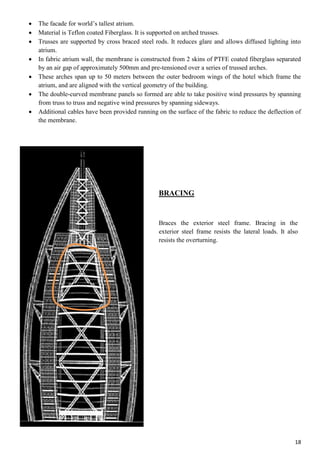
BRACING
Braces the exterior steel frame. Bracing in the
exterior steel frame resists the lateral loads. It also
resists the overturning.
19
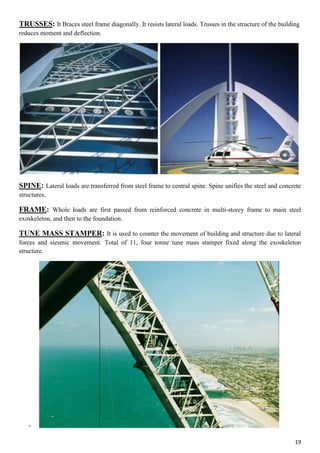
TRUSSES: It Braces steel frame diagonally. It resists lateral loads. Trusses in the structure of the building
reduces moment and deflection.
SPINE: Lateral loads are transferred from steel frame to central spine. Spine unifies the steel and concrete
structures.
FRAME: Whole loads are first passed from reinforced concrete in multi-storey frame to main steel
exoskeleton, and then to the foundation.
TUNE MASS STAMPER: It is used to counter the movement of building and structure due to lateral
forces and siesmic movement. Total of 11, four tonne tune mass stamper fixed along the exoskeleton
structure.
-

Burj al arab

  • 1.
  • 2.
    2 INTRODUCTION Burj Al Arabis a luxury hotel located in Dubai, United Arab Emirates. At 321 m (1,053 ft), it is the fourth tallest hotel in the world, however 39% of its total height is made up of non-occupiable space. It stands on an artificial island 280 m (920 ft) from Jumeirah beach and is connected to the mainland by a private curving bridge. The total cost to construct the hotel was $650 million. Total number of rooms – 202 Architect – Tom Wright ARCHITECTURAL DATA  Number of floors – 60  Height of the building – 322 m.  Lifts / Elevators – 18  Ground floor area (covered by tower)– 1,20,000 sq. m. (12,91,669 sq. ft.)  Total developed floor area – 2,00,000 sq. m . (21,52,782 sq. ft.)  It took three years to reclaim the land from the sea, and less than three years to construct the building itself.  The building contains over 70,000 m3 (92,000 cu yd) of concrete and 9,000 tons of steel.
  • 3.
    3  Height ofthe building – 322 m. (1,056 ft.)  Number of floors – 60  Lifts / Elevators – 18  Ground floor area (covered by tower)– 1,20,000 sq. m. (12,91,669 sq. ft.)  Total developed floor area – 2,00,000 sq. m . (21,52,782 sq. ft.)  It took three years to reclaim the land from the sea, and less than three years to construct the building itself.  The building contains over 70,000 m3 (92,000 cu yd) of concrete and 9,000 tons of steel. HOW IT HAPPENED ? Tom Wills Wright, architect with WS Atkins, quoted: "The brief was that the client asked to create a building that would become an icon for Dubai rather like the: “ Sydney has its Opera House USA has its Statue of Liberty Egypt has its pyramids & Paris has its Eiffel Tower.” We built the tower on its own island because it enhanced the iconic nature of the building, and that seemed logical because the building was inspired by the sail of a dhow, looking like the traditional Arabian sailing vessel. Two “wings” spread in a V to form a vast “mast”, while the space between them is enclosed in a massive atrium. PROJECT TEAM Architect & Design: WS Atkins & Partners Chief Architect: Tom Wright Project Manager: Rick Gregory Structural Engineer: Anthony McCarter Interior Designer: Ms Kuan Chew KCA International Concrete and Block work: Al Habtoor Engineering Murray and Roberts: Steel Fabricators Island Engineer: Mike McNicholas
  • 4.
    4 CONSTRUCTION Construction is intwo phase: Phase 1: The manmade Island Phase 2: The building PHASE 1 : BUILDING THE ISLAND
  • 5.
    5 1. Temporary tubepiles driven into sea bed. 2. Temporary sheet piles and tie rods driven into sea bed to support boundary rocks 3. Permanent boundary rock bunds (rock armor) deposited on both sides of the sheet piles. 4. Hydraulic fill layers deposited between bunds to displace sea water and form the island. 5. No solid ground under the building just weak sand (up to 180 meters deep with no solid ground). So it was decided to go with friction piles. 6. Excavations began in the island to remove the hydraulic fill. 7. A coffer dam was being built while excavating. 8. 2M (6.5 ft) thick concrete plug slab laid on the base of the island to prevent the base from popping out because of the sea pressure. 9. Reinforced concrete retaining wall built. 10. The construction of the basement started
  • 6.
    6 COMPLETED ISLAND - Completedin three years. - Number of piles: 230 - Length of piles: 45m. - Diameter of piles 1.5m. - Depth of lowest basement under sea is 7m below sea level.
  • 7.
    7 DIAGONAL TRUSS RIGGING Huge tubular triangular truss geometry  The Diagonal vary from 76m to 90m in length and weigh 160 to 180 ton.  The Diagonal connects with a 300mm diameter pin connection to the core-wall and the Rear- leg structure.  There are six diagonals erected at different levels on both side of the building.  Transported as a single fabricated piece from the fabrication shop 15 km away by special self propelled long trailers.
  • 8.
    8 Engineers created asurface layer of large rocks, which is circled with a concrete honeycomb pattern. It protects the foundation from erosion.
  • 9.
    9 PHASE 2 :CONSTRUCTION  It took 2 years to construct the building.  The building contains over 70,000 m3 of concrete and 9,000 tons of steel. MATERIALS USED  Carbon Fiber  Reinforced Concrete  Glass Fibre  Gold  Steel  Aluminium  Marble
  • 10.
    10 It is supportedby a full Cantilever that extends 27 metres from the mast. FOUNDATION
  • 11.
    11  Foundation isa piled raft. To secure a foundation, the builders drove 250 35-meter long concrete piles into the sand.  The foundation is held in place not by bedrock, but by the friction of the sand and silt along the length of the piles. TECHNOLOGIES USED IN CONSTRUCTION One new technology that was used was Cantilever’s Top Climbing Jump Form system for the main core area. Cantilever Pty Ltd, Queensland, Australia designed and furnished the 300 ton forming system. A top climbing jump form system requires the form to hang off a structural steel grid and to be jumped utilizing a dozen synchronous electric - operated screw jacks that lift the entire system by pushing off the top of the walls previously poured. The form system chosen for the wing walls and the stair cores was Doka's SKE automatic-climbing form system. The wing areas of the building house the two-storey suites. Each of the six walls per wing are 13 meters long and were poured in 3.57 meter lifts. Doka designed the forms such that only two climbing brackets per form were necessary. The fewer suspension points meant fewer man hours were required for each operation therefore saving time and money. Another place where technology was used was in the form system for the main floors. This form system was also designed, manufactured and furnished by Cantilever Pty Ltd. This form was designed as a flying cable and was supported by brackets attached to the walls. The form itself weighed 18 tons. The frame for each form was constructed with large castellated steel beams and measured 18.3 meters long by 8.1 meters wide.
  • 12.
    12 Once the slabwas cast and reached sufficient strength, the forms were jacked down off the wall brackets and flown into the next position with tower cranes. The table forms saved time by eliminating the need for shoring labor to hold them up. In addition, Meinhardt International helped the joint venture re-engineer the slabs to a post-tensioned design, reducing the labor on reinforcing steel and time required to get sufficient strength to strip the form (Doka). CONSTRUCTION MANAGEMENT The forming a joint venture the companies undoubtedly contributed the most to the success of the project. The companies’ use of value engineering, constructability, and preplanning and planning that included all members of the group helped to keep cost down as well as keep up with the schedule that was set by the owner. Al Habtoor Engineering : Had the responsibility to provide the project with the labor required the quality of the concrete and block work. The procurement system put in place by the joint venture was based on Al Habtoor Engineering's proven system. Murray and Roberts:Brought the expertise for detailing, fabrication, shipment and erection of the complex structural steel. This was subcontracted to Genrec Steel Fabricators of Johannesburg, South Africa, a company owned by Murray and Roberts. This subcontract would reduce financial risk. Fletcher: Had the high-rise management and planning expertise. The project director and project manager came from Fletcher and were based in Dubai. RISKS AT CONSTRUCTION MANAGEMENT The companies all joined to gather because by utilizing the separate talents of each partner; the bulk of the risk could be redistributed to the firms that were best equipped to handle each particular issue. The risks that needed to be considered were: - Labor supply - Concrete work - Structural steel supply - Erection - High rise management experience - Purchasing - Cost control - Management staffing PROBLEMS FACED DURING CONSTRUCTION  The foundation used in this hotel is Pile Foundation and a total of 230 – 40 meter long concrete piles were drived into the sand.  The foundation is held in place not by bedrock, but by the friction of the sand and silt along the length of the piles.  Engineers created a surface layer of large rocks, which is circled with a concrete honey-comb pattern, which serves to protect the foundation from erosion.  It took three years to reclaim the land from the sea, but less than three years to construct the building itself.
  • 13.
    13 EXTERIOR The structure ismade of a steel exoskeleton wrapped around an reinforced concrete tower. The space between the wings is enclosed by a Teflon-coated fiberglass sail, curving across the front of the building and creating an atrium inside. The sail is made of a material called Dyneon, spanning over 161,000 square feet, consists of two layers, and is divided into twelve panels and installed vertically. The fabric is coated with DuPont Teflon to protect it from harsh desert heat, wind, and dirt. The fabricators estimate that it will hold up for up to 50 years. LIGHTING CONTROL SYSTEM At 14,000 channels it is the largest architectural lighting control system ever made (Futronix). Each suite has one or more PFX-32 dimming control systems, which operate the lighting in every room. The largest suites have five systems giving a total of 160 channels of lighting. As if the interior lighting schemes were not enough, each suite is also equipped with digital surround sound, multimedia enhanced 42” plasma television, internet access, touch-screen video and teleconferencing, fax machine, photocopier, data port and to top it all off, automated curtains (Burj Al Arab).
  • 14.
    14 TECHNICAL DETAILS IN FABRICATRIUM WALL The membrane is constructed from 2 skins of PTFE coated fiberglass separated by an air gap of approximately 500mm and pre-tensioned over a series of trussed arches. These arches span up to 50 meters between the outer bedroom wings of the hotel which frame the atrium, and are aligned with the vertical geometry of the building. The double-curved membrane panels so formed are able to take positive wind pressures by spanning from truss to truss and negative wind pressures by spanning sideways. Additional cables have been provided running on the surface of the fabric to reduce the deflection of the membrane The trussed arches which can extend out from the supports by up to 13 meters are supported vertically at the 18th and 26th floors by a series of 52mm diameter cross-braced macaloy bars. Girders at these floors transfer the load to the core structure. These bars are then pre-tensioned to ensure that the whole structure remains in tension. An expansion joint is provided for the full height of the building on the right hand side of the wall. This enables the building to 'breath' under wind loads and avoids the exertion of large horizontal loads on the relatively weak bedroom structures.
  • 15.
    15 The resulting formis entirely appropriate for the building and its function with the fabric reducing solar gain into the atrium and providing an effective diffused light quality. It is also appropriate for the Middle-East region where its predicted lifespan and self-cleansing qualities should resist the aggressive environment. PRODUCTIVITY  Joint venture the companies contributed to the success of the project.  The companies use of value engineering, constructability, and preplanning and planning helped to keep cost down.  Also to keep up with the schedule that was set by the owner. ENVIRONMENTAL IMPACT  Indirect energy (purchased electricity) consumption in the hotels and resorts and related greenhouse gas (GHG) emissions  The impact of our hotels and resorts on biodiversity  Water consumption in our guest rooms, laundry, swimming pool sand gardens  Waste generation in our hotels and resorts  Water in the UAE is mostly derived from sea water through an energy-intensive desalination process  Water in the lobby/mezzanine rolling water embankment and shooting fountain is recycled but there are no further specific environmental measures or environmental plans in place at Burj Al Arab.  There are a total of more than 4,000 fish in the aquarium, which was created over the course of three months by Pangea Rocks. They take extreme pride in nurturing fish and providing it with as natural an environment as much as possible.  Jumeirah's organizational structure to successfully manage the widespread growth and change the company is undergoing.  Jumeirah has extensive expansion plans to grow its assortment of luxury hotels and resorts into key gateway or letterhead cities and inspirational resort destinations internationally.  They enhanced the governance structure to better protect their stakeholders interests.  They established the CR Review Group as part of the governance structure to strengthen overall CR practices.  Dubai, 26 November 2012: Jumeirah Group, the global hospitality company and a member of Dubai Holding, has signed a management agreement to operate a luxury hotel in central Mumbai, India.  The hotel is part of a major new development in the Lower Parel district of the city and is expected to open in 2017.  This agreement represents the first phase of Jumeirah Group’s expansion into India. The company is currently in advanced negotiations on potential projects for hotels and resorts in other key destinations in India.
  • 16.
    16 UNIQUENESS AMAZING FACTS!!!!  Thebuilding contains over 70,000 cu.m of concrete and 9,000 tonnes of steel.  The whole project was carried out in co-operation with the Dubai Department of Tourism and Commerce Marketing (DTCM).  Central to the hotel's design is the atrium. It takes up a third of the interior space and, with a height of 182 metres; it could accommodate the Statue of Liberty.  Iconic structure for DUBAI  World’s only 7-STAR Hotel  Aquarium  Tennis court  Helipad of 24m dia. @ height of 200m above ground  Tallest interior atrium (180m height)  Rests on an man-made island that is 300m offshore  Architected by Tom Wright (World’s best architect)  The building's design is influenced by the profile of an Arabian sailing ship. HELIPAD Burj al Arab has a 24 meter ( 79 feet ) wide helipad which is 210 meters above the ground. It is often used as a tennis court.
  • 17.
    17 LATERAL LOADS As atall building, the lateral loads of the Burj Al Arab are of most importance. Due to the geographic location in the Persian Gulf, winds and seismic activity had to be considered. The building was built to withstand a fifty year wind of 100 miles per hour and a seismic ground acceleration of 0.2 times gravity. The structure transfers lateral loads in a number of ways. First, the Burj Al Arab has three tubular steel trusses on the outside of the two sides of the V. These trusses act as cross bracing to wind and earthquake forces. The translucent fabric wall of the atrium is not only a stunning architectural feature but also helps transfer lateral load. The fabric covers a series of steel cross bracing and is comprised of two layers of fiberglass material which is Teflon-coated. The fabric goes over the trussed arches mentioned before. Due to the rigidity, lateral loads are transferred to the fabric wall which acts similar to a diaphragm. The shape of Burj Al Arab lowers wind forces more effectively then a square building because of the streamlined V and curved fabric atrium wall. GRAVITY LOADS Since the Burj Al Arab is built on a man-made island into the sea, certain geotechnical considerations had to be considered. Mainly, the ground beneath the Burj Al Arab is sand and silt. To take this into account, the foundation was made with cement piles that reach a depth of 130 feet. The foundation of this superstructure does not reach bedrock; therefore the stability comes from the shear forces along each deep pile. The Burj Al Arab withstands gravity loads through the stability of the two intertwined V’s of steel and concrete. The concrete walls and slabs come out from the point of the V which is a special service core. At the end of each floor level are wings. Gravity loads are transferred down from the core and wings to the foundation. The use of a core and wings was suitable for this structure to allow for the world’s largest atrium to be enclosed between the two sides of hotel suites. ATRIUM MEMBRANE
  • 18.
    18  The facadefor world’s tallest atrium.  Material is Teflon coated Fiberglass. It is supported on arched trusses.  Trusses are supported by cross braced steel rods. It reduces glare and allows diffused lighting into atrium.  In fabric atrium wall, the membrane is constructed from 2 skins of PTFE coated fiberglass separated by an air gap of approximately 500mm and pre-tensioned over a series of trussed arches.  These arches span up to 50 meters between the outer bedroom wings of the hotel which frame the atrium, and are aligned with the vertical geometry of the building.  The double-curved membrane panels so formed are able to take positive wind pressures by spanning from truss to truss and negative wind pressures by spanning sideways.  Additional cables have been provided running on the surface of the fabric to reduce the deflection of the membrane. BRACING Braces the exterior steel frame. Bracing in the exterior steel frame resists the lateral loads. It also resists the overturning.
  • 19.
    19 TRUSSES: It Bracessteel frame diagonally. It resists lateral loads. Trusses in the structure of the building reduces moment and deflection. SPINE: Lateral loads are transferred from steel frame to central spine. Spine unifies the steel and concrete structures. FRAME: Whole loads are first passed from reinforced concrete in multi-storey frame to main steel exoskeleton, and then to the foundation. TUNE MASS STAMPER: It is used to counter the movement of building and structure due to lateral forces and siesmic movement. Total of 11, four tonne tune mass stamper fixed along the exoskeleton structure. -