



Source-Kirsten Jørgensen,TheTechnical University of Denmark, Lyngby, DK (email kirj@man.dtu.dk
)
020
ANALYSIS OF
FAILURE IN A
BUILDING PROJECT
Science Art Religion Politics Scholarly Articles For Mathematics
and Productivity
http://www.twitlonger.com/show/n_1sp9pjo?new_post=true
MICROSOFT OneDrive PPT’s PDF’s BOOK LESSONS
Dr f Dejahang BSc CEng, BSc (Hons) Construction Mgmt, MSc,
PhD
THE BOW TIE – AN
ANALYTICAL METHOD
THE BOW TIE – AN
ANALYTICAL METHOD
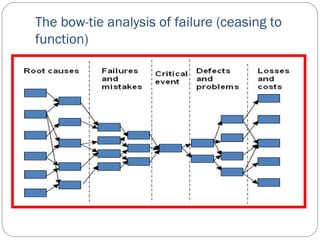
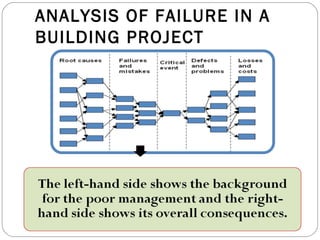
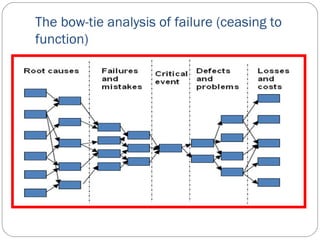
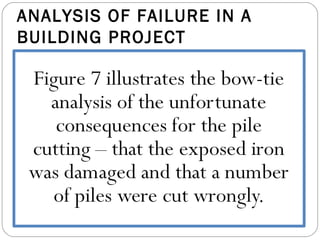
The bow-tie analysis of failure (ceasing to
function)
ANALYSIS OF FAILURE IN A
BUILDING PROJECT
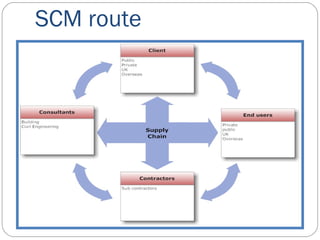
SCM route
ANALYSIS OF FAILURE IN A
BUILDING PROJECT
ANALYSIS OF FAILURE IN A
BUILDING PROJECT
ANALYSIS OF FAILURE IN A
BUILDING PROJECT
ANALYSIS OF FAILURE IN A
BUILDING PROJECT
ANALYSIS OF FAILURE IN A
BUILDING PROJECT
ANALYSIS OF FAILURE IN A
BUILDING PROJECT
ANALYSIS OF FAILURE IN A
BUILDING PROJECT
The bow-tie analysis of failure (ceasing to
function)
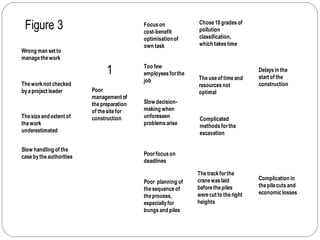
Poor
management of
thepreparation
of thesitefor
construction
Wrong man set to
managethework
Theworknot checked
byaproject leader
Thesizeand extent of
thework
underestimated
Slow handling of the
casebytheauthorities
Delaysin the
start of the
construction
Chose10gradesof
pollution
classification,
which takestime
Thetrackforthe
cranewaslaid
beforethepiles
werecut to theright
heights
Complicated
methodsforthe
excavation
Theuseof timeand
resourcesnot
optimal
Focuson
cost-benefit
optimisationof
own task
Poor planning of
thesequenceof
theprocess,
especiallyfor
bungsand piles
Slow decision-
making when
unforeseen
problemsarise
Too few
employeesforthe
job
Poorfocuson
deadlines
Complication in
thepilecutsand
economiclosses
1
Figure 3
ANALYSIS OF FAILURE IN A
BUILDING PROJECT
ANALYSIS OF FAILURE IN A
BUILDING PROJECT
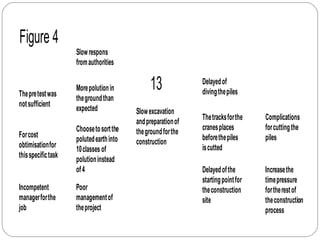
Slowexcavation
andpreparationof
thegroundforthe
construction
Slowrespons
fromauthorities
Morepolutionin
thegroundthan
expected
Choosetosortthe
polutedearthinto
10classes of
polutioninstead
of4
Poor
managementof
theproject
Forcost
obtimisationfor
thisspecifictask
Incompetent
managerforthe
job
Thepretestwas
notsufficient
Delayedofthe
startingpointfor
theconstruction
site
Delayedof
divingthepiles
Thetracksforthe
cranesplaces
beforethepiles
iscutted
Complications
forcuttingthe
piles
Increasethe
timepressure
fortherestof
theconstruction
process
13
Figure 4
ANALYSIS OF FAILURE IN A
BUILDING PROJECT
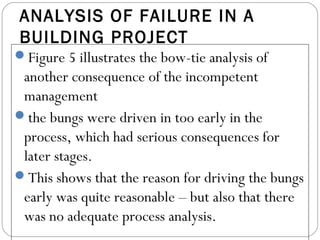
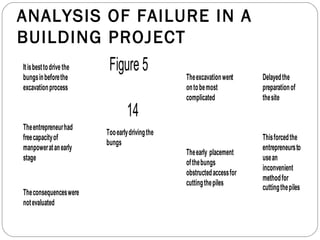
Figure 5 illustrates the bow-tie analysis of
another consequence of the incompetent
management
the bungs were driven in too early in the
process, which had serious consequences for
later stages.
This shows that the reason for driving the bungs
early was quite reasonable – but also that there
was no adequate process analysis.
ANALYSIS OF FAILURE IN A
BUILDING PROJECT
Tooearlydrivingthe
bungs
Itisbesttodrivethe
bungsinbeforethe
excavationprocess
Theentrepreneurhad
freecapacityof
manpoweratanearly
stage
Theconsequenceswere
notevaluated
Theexcavationwent
ontobemost
complicated
Theearly placement
ofthebungs
obstructedaccessfor
cuttingthepiles
Delayedthe
preparationof
thesite
Thisforcedthe
entrepreneursto
usean
inconvenient
methodfor
cuttingthepiles
14
Figure 5
ANALYSIS OF FAILURE IN A
BUILDING PROJECT
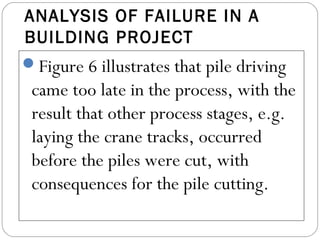
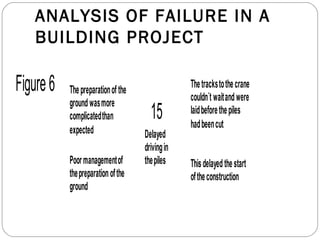
Figure 6 illustrates that pile driving
came too late in the process, with the
result that other process stages, e.g.
laying the crane tracks, occurred
before the piles were cut, with
consequences for the pile cutting.
ANALYSIS OF FAILURE IN A
BUILDING PROJECT
Delayed
drivingin
thepiles
Thepreparationof the
groundwasmore
complicatedthan
expected
Poormanagementof
thepreparationofthe
ground
Thetrackstothecrane
couldn´t waitandwere
laidbeforethepiles
hadbeencut
Thisdelayedthestart
oftheconstruction
15
Figure6
ANALYSIS OF FAILURE IN A
BUILDING PROJECT
ANALYSIS OF FAILURE IN A
BUILDING PROJECT
ANALYSIS OF FAILURE IN A
BUILDING PROJECT
ANALYSIS OF FAILURE IN A
BUILDING PROJECT
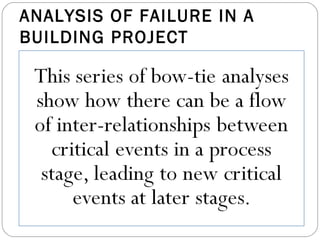
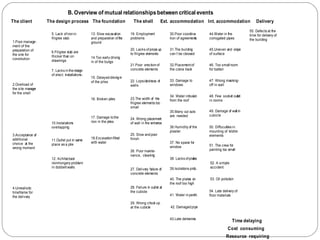
B. Overview of mutual relationships between critical events
Time delaying
Cost consuming
Resource requiring
The client The design process The foundation The shell Ext. accommodation Int. accommodation Delivery
4.Unrealistic
timeframe for
the delivery
2.Overload of
the site manager
for the shell
1.Poor manage-
ment of the
preparation of
the site for
constrution
3.Acceptance of
additional
choice at the
wrong moment
5. Lack ofironin
filigree slab
6.Filigree slab are
thicker than on
drawrings
10.Instalations
overlapping
11.Outlet put in same
place as a pile
12. Achitectural
ironmongery problem
in dobbeltwalls
13. Slow excavation
and preparation ofthe
ground
14.Too early driving
in of the bungs
15. Delayed drivingin
of the piles
16. Broken piles
17. Damage tothe
iron in the piles
18.Excavationfilled
with water
19. Employment
problems
20. Lacks ofprops up
to filigree elements
21.Poor erectionof
concrete elements
22. Lopsidedness of
walls
23.The width of the
filigree elements too
small
24. Wrong placement
of wall in the entrance
25. Slow and poor
finish
26. Poor mainte-
nance, cleaning
27. Delivery failure of
concrete elements
28. Failure in outlet at
the cubicle
29. Wrong chock up
at the cubicle
44.Water in the
corrugated pipes
45.Uneven and slope
of surface
46. Too small room
for batten
47. Wrong masking-
off in wall
48. Few socket outlet
in rooms
49. Damage of wall in
cubicle
50. Diffuculties in
mounting of kitchin
elements
51. The crew for
painting too small
52. A simple
accident
53. Oil pollution
54. Late delivery of
floor materials
55. Defects at the
time for delivery of
the building
7. Lacks in the design
of elect. installations-
30.Poor coordina-
tion of agreements
31.The building
can´t be cloosed
32.Placementof
the crane track
33. Damage to
windows
34. Water intrusion
from the roof
37. No space for
window
36.Humidity of the
plaster
35.Many cut outs
are needed
38. Lacks ofplates
39.Isolations prob.
41. Water inpenth.
42. Damagedpipe
43.Late deliveries
40. The plates on
the roof too high
ANALYSIS OF FAILURE IN A
BUILDING PROJECT
ANALYSIS OF FAILURE IN A
BUILDING PROJECT
ANALYSIS OF FAILURE IN A
BUILDING PROJECT
ANALYSIS OF FAILURE IN A
BUILDING PROJECT
ANALYSIS OF FAILURE IN A
BUILDING PROJECT
ANALYSIS OF FAILURE IN A
BUILDING PROJECT
It was also possible to clarify the
link between deficient electrical
planning and a number of critical
events later in the construction
phase during the internal fitting
out.
NETWORK PROGRAMMING

Building failure case study

  • 1.
    Source-Kirsten Jørgensen,TheTechnical Universityof Denmark, Lyngby, DK (email kirj@man.dtu.dk ) 020 ANALYSIS OF FAILURE IN A BUILDING PROJECT
  • 2.
    Science Art ReligionPolitics Scholarly Articles For Mathematics and Productivity http://www.twitlonger.com/show/n_1sp9pjo?new_post=true MICROSOFT OneDrive PPT’s PDF’s BOOK LESSONS Dr f Dejahang BSc CEng, BSc (Hons) Construction Mgmt, MSc, PhD
  • 3.
    THE BOW TIE– AN ANALYTICAL METHOD
  • 4.
    THE BOW TIE– AN ANALYTICAL METHOD
  • 5.
    The bow-tie analysisof failure (ceasing to function)
  • 6.
    ANALYSIS OF FAILUREIN A BUILDING PROJECT
  • 8.
  • 9.
    ANALYSIS OF FAILUREIN A BUILDING PROJECT
  • 10.
    ANALYSIS OF FAILUREIN A BUILDING PROJECT
  • 11.
    ANALYSIS OF FAILUREIN A BUILDING PROJECT
  • 12.
    ANALYSIS OF FAILUREIN A BUILDING PROJECT
  • 13.
    ANALYSIS OF FAILUREIN A BUILDING PROJECT
  • 14.
    ANALYSIS OF FAILUREIN A BUILDING PROJECT
  • 15.
    ANALYSIS OF FAILUREIN A BUILDING PROJECT
  • 16.
    The bow-tie analysisof failure (ceasing to function)
  • 17.
    Poor management of thepreparation of thesitefor construction Wrongman set to managethework Theworknot checked byaproject leader Thesizeand extent of thework underestimated Slow handling of the casebytheauthorities Delaysin the start of the construction Chose10gradesof pollution classification, which takestime Thetrackforthe cranewaslaid beforethepiles werecut to theright heights Complicated methodsforthe excavation Theuseof timeand resourcesnot optimal Focuson cost-benefit optimisationof own task Poor planning of thesequenceof theprocess, especiallyfor bungsand piles Slow decision- making when unforeseen problemsarise Too few employeesforthe job Poorfocuson deadlines Complication in thepilecutsand economiclosses 1 Figure 3
  • 18.
    ANALYSIS OF FAILUREIN A BUILDING PROJECT
  • 19.
    ANALYSIS OF FAILUREIN A BUILDING PROJECT
  • 20.
  • 21.
    ANALYSIS OF FAILUREIN A BUILDING PROJECT Figure 5 illustrates the bow-tie analysis of another consequence of the incompetent management the bungs were driven in too early in the process, which had serious consequences for later stages. This shows that the reason for driving the bungs early was quite reasonable – but also that there was no adequate process analysis.
  • 22.
    ANALYSIS OF FAILUREIN A BUILDING PROJECT Tooearlydrivingthe bungs Itisbesttodrivethe bungsinbeforethe excavationprocess Theentrepreneurhad freecapacityof manpoweratanearly stage Theconsequenceswere notevaluated Theexcavationwent ontobemost complicated Theearly placement ofthebungs obstructedaccessfor cuttingthepiles Delayedthe preparationof thesite Thisforcedthe entrepreneursto usean inconvenient methodfor cuttingthepiles 14 Figure 5
  • 23.
    ANALYSIS OF FAILUREIN A BUILDING PROJECT Figure 6 illustrates that pile driving came too late in the process, with the result that other process stages, e.g. laying the crane tracks, occurred before the piles were cut, with consequences for the pile cutting.
  • 24.
    ANALYSIS OF FAILUREIN A BUILDING PROJECT Delayed drivingin thepiles Thepreparationof the groundwasmore complicatedthan expected Poormanagementof thepreparationofthe ground Thetrackstothecrane couldn´t waitandwere laidbeforethepiles hadbeencut Thisdelayedthestart oftheconstruction 15 Figure6
  • 25.
    ANALYSIS OF FAILUREIN A BUILDING PROJECT
  • 26.
    ANALYSIS OF FAILUREIN A BUILDING PROJECT
  • 27.
    ANALYSIS OF FAILUREIN A BUILDING PROJECT
  • 28.
    ANALYSIS OF FAILUREIN A BUILDING PROJECT
  • 29.
    B. Overview ofmutual relationships between critical events Time delaying Cost consuming Resource requiring The client The design process The foundation The shell Ext. accommodation Int. accommodation Delivery 4.Unrealistic timeframe for the delivery 2.Overload of the site manager for the shell 1.Poor manage- ment of the preparation of the site for constrution 3.Acceptance of additional choice at the wrong moment 5. Lack ofironin filigree slab 6.Filigree slab are thicker than on drawrings 10.Instalations overlapping 11.Outlet put in same place as a pile 12. Achitectural ironmongery problem in dobbeltwalls 13. Slow excavation and preparation ofthe ground 14.Too early driving in of the bungs 15. Delayed drivingin of the piles 16. Broken piles 17. Damage tothe iron in the piles 18.Excavationfilled with water 19. Employment problems 20. Lacks ofprops up to filigree elements 21.Poor erectionof concrete elements 22. Lopsidedness of walls 23.The width of the filigree elements too small 24. Wrong placement of wall in the entrance 25. Slow and poor finish 26. Poor mainte- nance, cleaning 27. Delivery failure of concrete elements 28. Failure in outlet at the cubicle 29. Wrong chock up at the cubicle 44.Water in the corrugated pipes 45.Uneven and slope of surface 46. Too small room for batten 47. Wrong masking- off in wall 48. Few socket outlet in rooms 49. Damage of wall in cubicle 50. Diffuculties in mounting of kitchin elements 51. The crew for painting too small 52. A simple accident 53. Oil pollution 54. Late delivery of floor materials 55. Defects at the time for delivery of the building 7. Lacks in the design of elect. installations- 30.Poor coordina- tion of agreements 31.The building can´t be cloosed 32.Placementof the crane track 33. Damage to windows 34. Water intrusion from the roof 37. No space for window 36.Humidity of the plaster 35.Many cut outs are needed 38. Lacks ofplates 39.Isolations prob. 41. Water inpenth. 42. Damagedpipe 43.Late deliveries 40. The plates on the roof too high
  • 30.
    ANALYSIS OF FAILUREIN A BUILDING PROJECT
  • 31.
    ANALYSIS OF FAILUREIN A BUILDING PROJECT
  • 32.
    ANALYSIS OF FAILUREIN A BUILDING PROJECT
  • 33.
    ANALYSIS OF FAILUREIN A BUILDING PROJECT
  • 34.
    ANALYSIS OF FAILUREIN A BUILDING PROJECT
  • 35.
    ANALYSIS OF FAILUREIN A BUILDING PROJECT It was also possible to clarify the link between deficient electrical planning and a number of critical events later in the construction phase during the internal fitting out.
  • 36.