CRACKS IN BUILDINGS: Some Remedial Measures Dr. J. N.Jha Professor and Dean (Consultancy) Department of Civil Engineering Guru Nanak Dev Engineering College, Ludhiana
IS THAT CRACK SERIOUS? Simplest questions to ask. One of the most difficult to answer. Prof. Mealcom Hollis-”Surveying buildings is an art, verifying the cause of failure is a science”
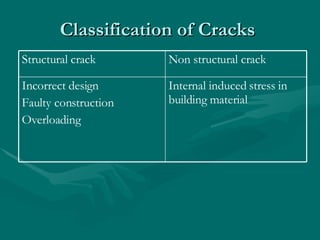
Classification of Cracks  Internal induced stress in building material Incorrect design Faulty construction Overloading Non structural crack  Structural crack
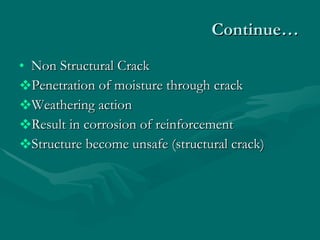
Continue… Non Structural Crack  Penetration of moisture through crack Weathering action Result in corrosion of reinforcement Structure become unsafe (structural crack)
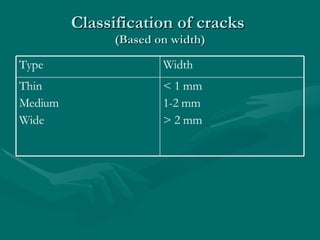
Classification of cracks  (Based on width) < 1 mm 1-2 mm > 2 mm Thin Medium Wide Width Type
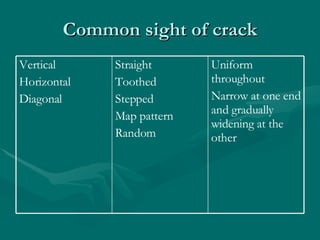
Common sight of crack Uniform throughout Narrow at one end and gradually widening at the other  Straight Toothed Stepped Map pattern Random Vertical Horizontal Diagonal
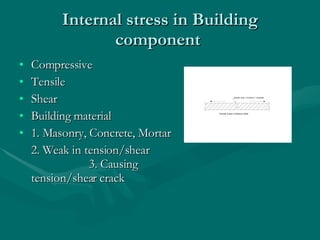
Internal stress in Building component  Compressive  Tensile Shear Building material 1. Masonry, Concrete, Mortar  2. Weak in tension/shear  3. Causing tension/shear crack
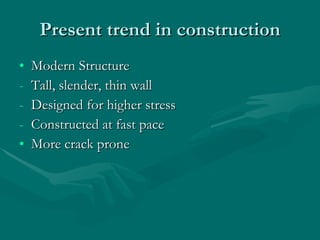
Present trend in construction Modern Structure Tall, slender, thin wall Designed for higher stress Constructed at fast pace More crack prone
Continue…
Continue…
Continue…
Continue…
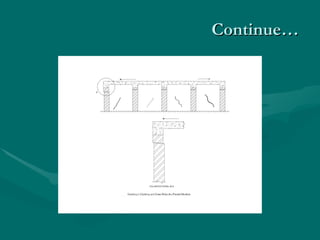
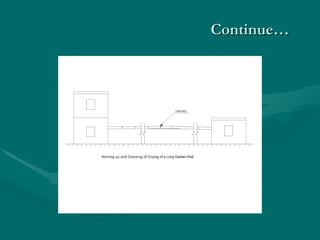
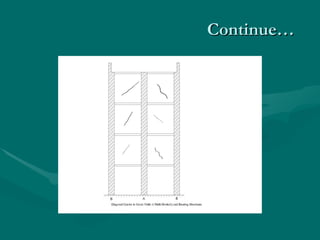
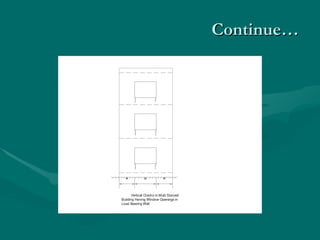
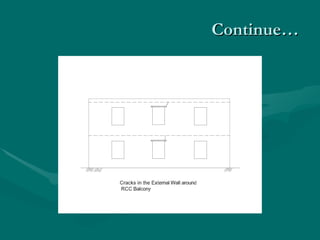
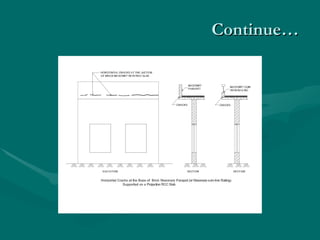
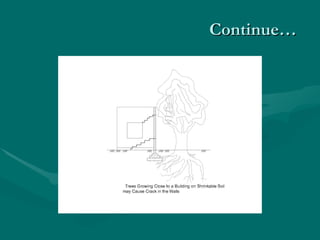
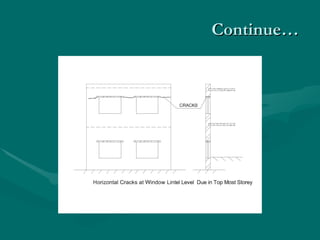
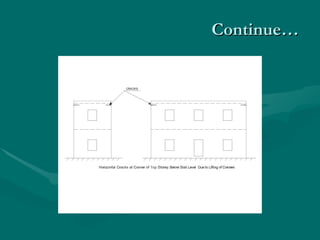
Cause of cracks in buildings Moisture change Thermal variation Elastic deformation Creep Chemical reaction Foundation movement and settlement of soil Vegetation
Moisture Movement  Reversible Movement  Material expands on absorbing  moisture content  Shrinks on drying  Irreversible movement  - Material undergo some irreversible movement due to initial moisture change
Types and causes of cracks in Concrete Before hardening Drying  Plastic shrinkage Settlement shrinkage Bleeding Delayed curing
Continue… Constructional Formwork movement Excess vibration Subgrade settlement Finishing Early frost damage
Continue… After hardening Unsound material Long term drying shrinkage Thermal Moisture movement Biological Structural design deficiencies Chemical Corrosion of reinforcement
Plastic shrinkage cracks Concrete surface loses water faster than the bleeding action brings it to top Quick drying of concrete at the surface results in shrinkage Concrete at the plastic state can not resist tension  Crack  Depth 5 to 10 cm, width 3 mm Once developed difficult to rectify
Measure to reduce plastic crack  Moisture  the sub grade and form work Erect the temporary  wind breaker Erect the temporary  roof to protect green concrete  from hot sun Reduce the time between placing & finishing In case of delay in finishing cover the concrete with polythene
Settlement shrinkage  If concrete is free to settle uniformly, no crack occurs Obstruction  to uniform settlement creates voids/cracks (Reinforcement/Aggregate) Settlement crack (common in deep beam)
Measure Pouring of concrete in layers with proper compaction Revibration, if possible
Bleeding Upward movement of water when concrete settle downs Internal bleeding Bleeding water trapped below reinforcement & aggregate Affects bonds between reinforcement and concrete  Interface, prone to micro cracking Weak link in concrete Further loading propagate cracking
Continue… External Bleeding Upward movement of water emerged at top surface After evaporation : surface – Porous and abrasion resistance very little.
General Observations  Mason floats concrete when bleeding water still standing. Results  - Downward movement of coarse aggregate Upward movement of fine particles (cement and water) Top surface  Presence of fine materials develops crack and craziness  (Craziness: occurrence of closely spaced crack at surface)
Delayed Curing Common practice  Delayed curing Interruption  in continuous curing Curing not done for required period  Major cause for shrinkage Minimum 7 to 10 days curing required
Constructional Effects  Crack/Deformation of plastic concrete (After Compaction) -Lack of rigidity of formwork (Remains unnoticed)  -Use of high consistency concrete (present trend) : Pumping requirement, Use of superplasticizer -Avoid segregation by proper vibration Segregated Concrete Mix- Exhibits high shrinkage crack
Unsound Material Use of crushed sand very common now Amount of dust (<75 micron): Very high Presence of excess dust : - Causes crack formation - Interfere with setting time, Shrinkage and   Bond  Maximum %age of fine = 3% (Coarse aggregate)
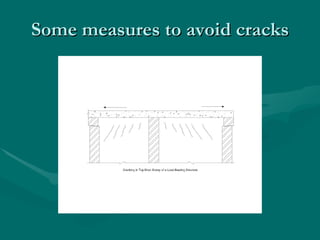
Some measures to avoid cracks
Continue…
Continue…
Continue…
Continue…
Continue…
Continue…
Continue…
Continue…
Continue…
Continue…
Continue…
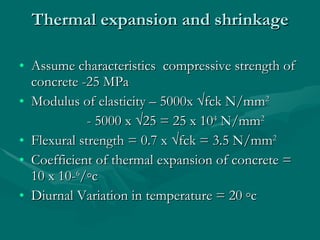
Thermal expansion and shrinkage Assume characteristics  compressive strength of concrete -25 MPa Modulus of elasticity – 5000x √fck N/mm 2   - 5000 x √25 = 25 x 10 4  N/mm 2 Flexural strength = 0.7 x √fck = 3.5 N/mm 2 Coefficient of thermal expansion of concrete = 10 x 10- 6 /◦c Diurnal Variation in temperature = 20 ◦c
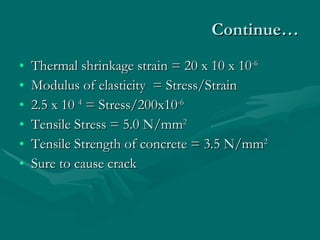
Continue… Thermal shrinkage strain = 20 x 10 x 10 -6 Modulus of elasticity  = Stress/Strain 2.5 x 10  4  = Stress/200x10 -6 Tensile Stress = 5.0 N/mm 2 Tensile Strength of concrete = 3.5 N/mm 2 Sure to cause crack
Continue…
Continue…
Continue…
Continue…
Continue…
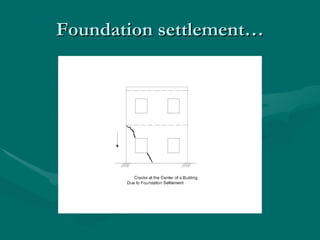
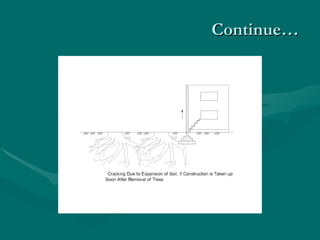
Foundation settlement…
Continue…
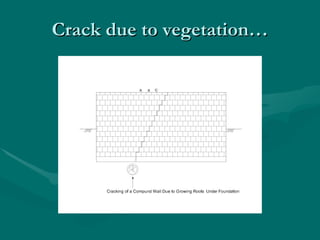
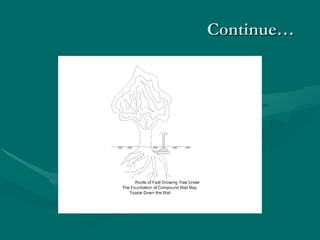
Crack due to vegetation…
Continue…
Continue…
Continue…
Thanks…..

Cracks in Buildings

  • 1.
    CRACKS IN BUILDINGS:Some Remedial Measures Dr. J. N.Jha Professor and Dean (Consultancy) Department of Civil Engineering Guru Nanak Dev Engineering College, Ludhiana
  • 2.
    IS THAT CRACKSERIOUS? Simplest questions to ask. One of the most difficult to answer. Prof. Mealcom Hollis-”Surveying buildings is an art, verifying the cause of failure is a science”
  • 3.
    Classification of Cracks Internal induced stress in building material Incorrect design Faulty construction Overloading Non structural crack Structural crack
  • 4.
    Continue… Non StructuralCrack Penetration of moisture through crack Weathering action Result in corrosion of reinforcement Structure become unsafe (structural crack)
  • 5.
    Classification of cracks (Based on width) < 1 mm 1-2 mm > 2 mm Thin Medium Wide Width Type
  • 6.
    Common sight ofcrack Uniform throughout Narrow at one end and gradually widening at the other Straight Toothed Stepped Map pattern Random Vertical Horizontal Diagonal
  • 7.
    Internal stress inBuilding component Compressive Tensile Shear Building material 1. Masonry, Concrete, Mortar 2. Weak in tension/shear 3. Causing tension/shear crack
  • 8.
    Present trend inconstruction Modern Structure Tall, slender, thin wall Designed for higher stress Constructed at fast pace More crack prone
  • 9.
  • 10.
  • 11.
  • 12.
  • 13.
    Cause of cracksin buildings Moisture change Thermal variation Elastic deformation Creep Chemical reaction Foundation movement and settlement of soil Vegetation
  • 14.
    Moisture Movement Reversible Movement Material expands on absorbing moisture content Shrinks on drying Irreversible movement - Material undergo some irreversible movement due to initial moisture change
  • 15.
    Types and causesof cracks in Concrete Before hardening Drying Plastic shrinkage Settlement shrinkage Bleeding Delayed curing
  • 16.
    Continue… Constructional Formworkmovement Excess vibration Subgrade settlement Finishing Early frost damage
  • 17.
    Continue… After hardeningUnsound material Long term drying shrinkage Thermal Moisture movement Biological Structural design deficiencies Chemical Corrosion of reinforcement
  • 18.
    Plastic shrinkage cracksConcrete surface loses water faster than the bleeding action brings it to top Quick drying of concrete at the surface results in shrinkage Concrete at the plastic state can not resist tension Crack Depth 5 to 10 cm, width 3 mm Once developed difficult to rectify
  • 19.
    Measure to reduceplastic crack Moisture the sub grade and form work Erect the temporary wind breaker Erect the temporary roof to protect green concrete from hot sun Reduce the time between placing & finishing In case of delay in finishing cover the concrete with polythene
  • 20.
    Settlement shrinkage If concrete is free to settle uniformly, no crack occurs Obstruction to uniform settlement creates voids/cracks (Reinforcement/Aggregate) Settlement crack (common in deep beam)
  • 21.
    Measure Pouring ofconcrete in layers with proper compaction Revibration, if possible
  • 22.
    Bleeding Upward movementof water when concrete settle downs Internal bleeding Bleeding water trapped below reinforcement & aggregate Affects bonds between reinforcement and concrete Interface, prone to micro cracking Weak link in concrete Further loading propagate cracking
  • 23.
    Continue… External BleedingUpward movement of water emerged at top surface After evaporation : surface – Porous and abrasion resistance very little.
  • 24.
    General Observations Mason floats concrete when bleeding water still standing. Results - Downward movement of coarse aggregate Upward movement of fine particles (cement and water) Top surface Presence of fine materials develops crack and craziness (Craziness: occurrence of closely spaced crack at surface)
  • 25.
    Delayed Curing Commonpractice Delayed curing Interruption in continuous curing Curing not done for required period Major cause for shrinkage Minimum 7 to 10 days curing required
  • 26.
    Constructional Effects Crack/Deformation of plastic concrete (After Compaction) -Lack of rigidity of formwork (Remains unnoticed) -Use of high consistency concrete (present trend) : Pumping requirement, Use of superplasticizer -Avoid segregation by proper vibration Segregated Concrete Mix- Exhibits high shrinkage crack
  • 27.
    Unsound Material Useof crushed sand very common now Amount of dust (<75 micron): Very high Presence of excess dust : - Causes crack formation - Interfere with setting time, Shrinkage and Bond Maximum %age of fine = 3% (Coarse aggregate)
  • 28.
    Some measures toavoid cracks
  • 29.
  • 30.
  • 31.
  • 32.
  • 33.
  • 34.
  • 35.
  • 36.
  • 37.
  • 38.
  • 39.
  • 40.
    Thermal expansion andshrinkage Assume characteristics compressive strength of concrete -25 MPa Modulus of elasticity – 5000x √fck N/mm 2 - 5000 x √25 = 25 x 10 4 N/mm 2 Flexural strength = 0.7 x √fck = 3.5 N/mm 2 Coefficient of thermal expansion of concrete = 10 x 10- 6 /◦c Diurnal Variation in temperature = 20 ◦c
  • 41.
    Continue… Thermal shrinkagestrain = 20 x 10 x 10 -6 Modulus of elasticity = Stress/Strain 2.5 x 10 4 = Stress/200x10 -6 Tensile Stress = 5.0 N/mm 2 Tensile Strength of concrete = 3.5 N/mm 2 Sure to cause crack
  • 42.
  • 43.
  • 44.
  • 45.
  • 46.
  • 47.
  • 48.
  • 49.
    Crack due tovegetation…
  • 50.
  • 51.
  • 52.
  • 53.