ADVANCED CONSTRUCTION
EQUIPMENTS AND TECHNIQUES
PRESENTED BY,
D.SELVAGANESH,
3rd YEAR,DEPARTMENT OF CIVIL,
FATIMA MICHAEL COLLEGE OF ENGINEERING AND TECHNOLOGY,
MADURAI – 20.
&
G.MATHAN KUMAR,
3rd YEAR,DEPARTMENT OF CIVIL,
KAMARAJAR COLLEGE OF ENGINEERING AND TECHNOLOGY,
VIRUDUNAGAR.
CONTENTS
INTRODUCTION
UNDER WATER CONSTRUCTION
AND ITS CLASSIFICATIONS
METHODS OF PLACING THE
CONCRETE AND ITS TYPES
TRENCHLESS TECHNOLOGYAND
ITS USES
MODERN CONSTRUCTION
MATERIALS AND ITS
APPLICATIONS
CONCLUSION
INTRODUCTION
 Now a days the construction technology and
equipments becomes very advanced.
 The advanced construction techniques such as
under water construction , trenchless technology
and many new innovative materials used in
advanced construction techniques and
equipments to speed up the construction of any
building works.
 So that we will discuss about few techniques
and materials used in that.
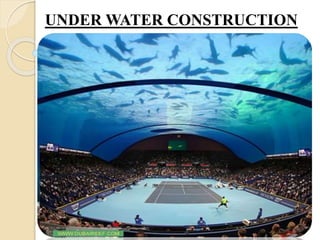
UNDER WATER CONSTRUCTION
During the construction of bridges, dams or
any other structure where foundation part of
the structure is mostly like to lie underwater,
we have to opt for underwater construction.
 Construction in water poses many
difficulties especially in the places where
there the depth is considerable
 During underwater construction our main
objective is to create a dry and water free
environment for working in such a manner
that the structural stability of the structure is
not compromised.
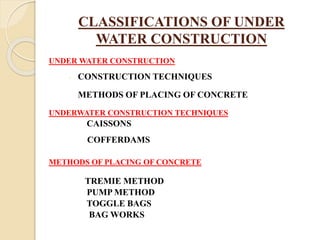
CLASSIFICATIONS OF UNDER
WATER CONSTRUCTION
UNDER WATER CONSTRUCTION
 CONSTRUCTION TECHNIQUES
METHODS OF PLACING OF CONCRETE
UNDERWATER CONSTRUCTION TECHNIQUES
CAISSONS
COFFERDAMS
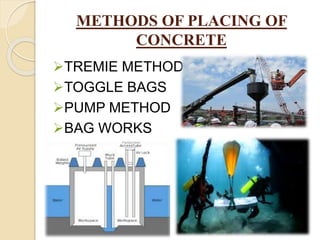
METHODS OF PLACING OF CONCRETE
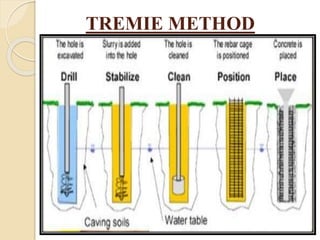
TREMIE METHOD
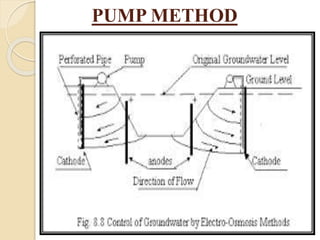
PUMP METHOD
TOGGLE BAGS
BAG WORKS
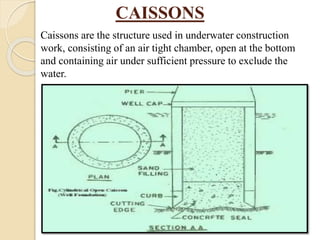
CAISSONS
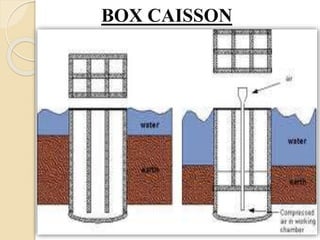
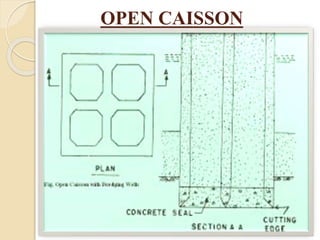
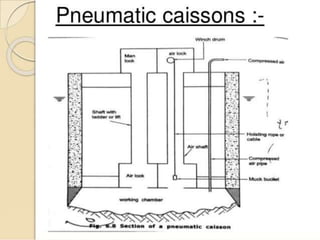
Caissons are the structure used in underwater construction
work, consisting of an air tight chamber, open at the bottom
and containing air under sufficient pressure to exclude the
water.
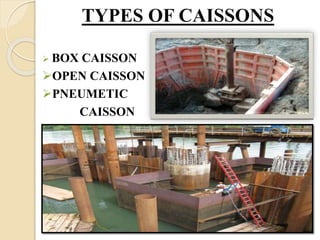
TYPES OF CAISSONS
 BOX CAISSON
OPEN CAISSON
PNEUMETIC
CAISSON
BOX CAISSON
OPEN CAISSON
COFFERDAMS
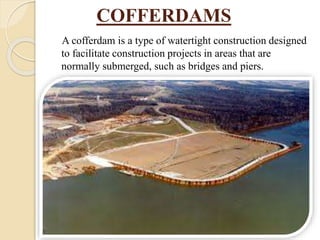
A cofferdam is a type of watertight construction designed
to facilitate construction projects in areas that are
normally submerged, such as bridges and piers.
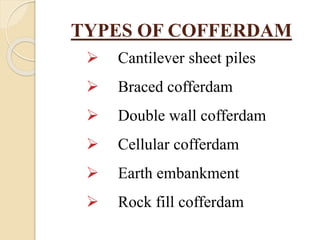
TYPES OF COFFERDAM
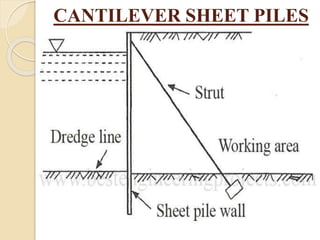
 Cantilever sheet piles
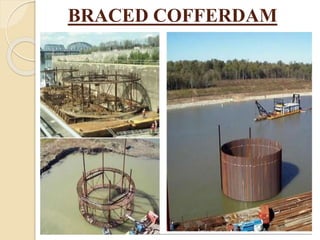
 Braced cofferdam
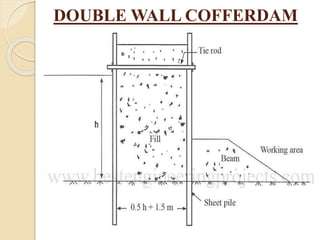
 Double wall cofferdam
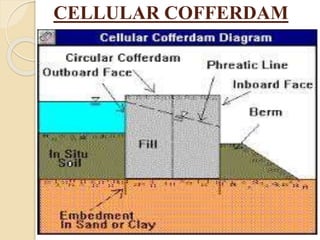
 Cellular cofferdam
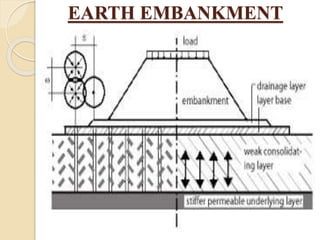
 Earth embankment
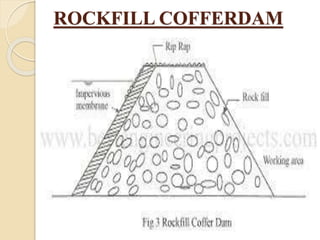
 Rock fill cofferdam
CANTILEVER SHEET PILES
BRACED COFFERDAM
DOUBLE WALL COFFERDAM
CELLULAR COFFERDAM
EARTH EMBANKMENT
ROCKFILL COFFERDAM
METHODS OF PLACING OF
CONCRETE
TREMIE METHOD
TOGGLE BAGS
PUMP METHOD
BAG WORKS
TREMIE METHOD
PUMP METHOD
TOGGLE BAGS BAG WORK
Toggle bags are ideal
for small amount of
concrete placements.
The bag is filled in
the dry with wet
concrete.
Used for repair work.
The concrete is
squeezed out by a
driver.
Bags are made
of open weave
material.
Diver -handled
bags are usually of
10 – 20 litters
capacity but 1
cub.m bags can be
placed using a
crane.
TRENCHLESS TECHNOLOGY
 Trenchless technology methods include all methods of
installing or renewing underground utility systems with
minimum disruption of the surface or subsurface.
 Trenchless technology consist of various methods,
materials and equipment for inspection ,utilization and
rehabilitation .
 Trenchless technology has become popular for
underground utility construction road crossings.
 In recent years, there has been remarkable progress in
development of new trenchless technology equipment
and methods.
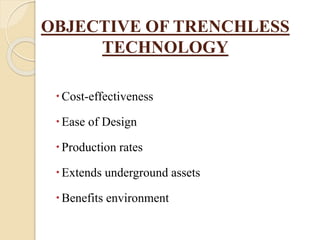
OBJECTIVE OF TRENCHLESS
TECHNOLOGY
Cost-effectiveness
Ease of Design
Production rates
Extends underground assets
Benefits environment
SITE INVESTIGATION
Common problems at site are,
• Loss of invert walls, ceiling due to corrosion
• Leaking joints
• Settlement
• Shape deformation
• In adequate flow capacity
• Voids in embankment around and above the culvert
Hence before take the trenchless excavation work the
site investigation must be made.
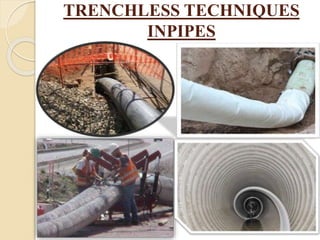
TRENCHLESS TECHNIQUES
INPIPES
TECHNIQUES IN LAYING OF
PIPES
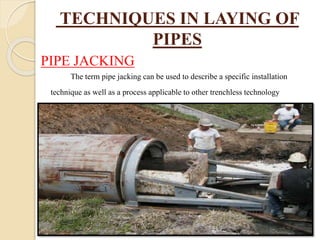
PIPE JACKING
The term pipe jacking can be used to describe a specific installation
technique as well as a process applicable to other trenchless technology
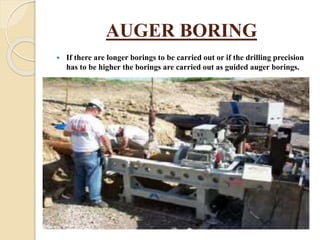
AUGER BORING
 If there are longer borings to be carried out or if the drilling precision
has to be higher the borings are carried out as guided auger borings.
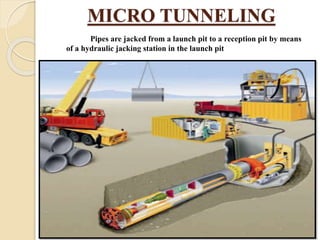
MICRO TUNNELING
Pipes are jacked from a launch pit to a reception pit by means
of a hydraulic jacking station in the launch pit
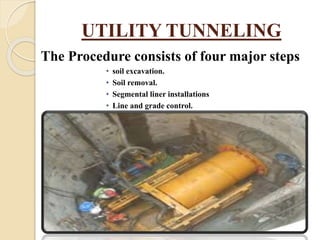
UTILITY TUNNELING
The Procedure consists of four major steps
• soil excavation.
• Soil removal.
• Segmental liner installations
• Line and grade control.
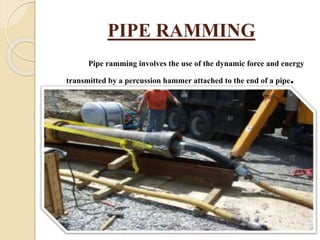
PIPE RAMMING
Pipe ramming involves the use of the dynamic force and energy
transmitted by a percussion hammer attached to the end of a pipe.
ADVANTAGES OF TRENCHLESS
TECHNOLOGY
 Expenses and dates are much easier to calculate.
 Surface life stays mainly undisturbed.
 Up to 95 percent lesser load for landfills due to
minimal excavations.
 Small stress for streets and traffic.
 Minimization of CO2 emissions
INTRODUCTION TO MODERN
CONSTRUCTION MATERIALS
 Now –a- days many new innovative
materials are being invented and many
new materials are being in research.
 New innovative thinking and new
invention is necessary to save our
valuable time and energy.
 Some of the innovative materials are
listed below.
MODERN CONSTRUCTION
MATERIALS
 Fly ash bricks.
 Translucent concrete.
 Sensi tiles.
 Liquid granite.
 Carbon Nano-tubes.
 Unfired clay bricks.
 Bendable concrete.
 Richlite.
 Radient barriers.
 Transparent aluminium.
 Carbon fiber.
 Solar pannel roofing tiles.
These are the several materials used in
advanced construction techniques and
equipments such as
FLY ASH BRICKS
Fly ash bricks are building materials
containing class c fly ash.
In India, the fly ash was first used in rihad dam
which is located at Pipri sonbhadra district in
uttar Pradesh.
The composition of fly ash bricks are fly ash,
lime, gypsum, sand, cement.
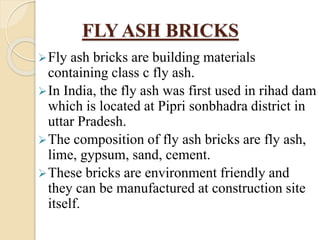
These bricks are environment friendly and
they can be manufactured at construction site
itself.
FLY ASH BRICKS
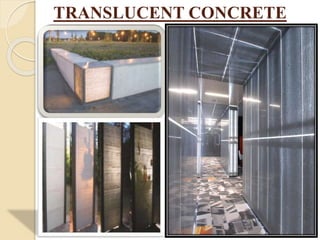
TRANSLUCENT CONCRETE
They have been developed by Hungarian architect
ARON LOSONCZI.
It is mostly same as the regular concrete, visually
appealing by mixing concrete with optical glass
fibers and thus the result was light transmitting
concrete.
The glass fiber in the concrete act like a slit and
carry the light across and the light carried
maintains its original color.
It carries the same amount of light through it, no
matter how thick it is.
TRANSLUCENT CONCRETE
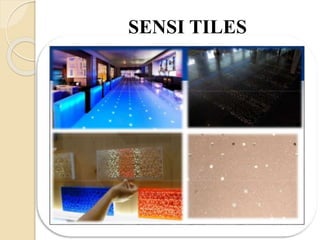
SENSI TILE
If you walk across your kitchen the floor to get
something from the refrigerator, the floor
twinkles with light path that guides your way
through the dark room.
The concrete of the tile is embedded with
acrylic fiber optic channels that transfer the
light from one point to another.
As shadow move across terrazzo’s surface ,
the light channels flicker with a randomized.
SENSI TILES
LIQUID GRANITE
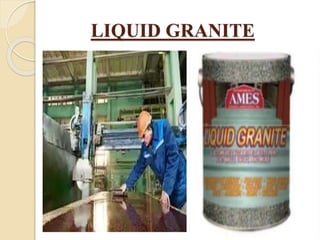
 The material is light weighted and has the
same load bearing capacity of cement but it
is made of recycled materials.
 Liquid granite is not only a fire- resistant
beyond 1,100 degrees celsius, it can also
withstand high temperature for longer
periods .
 So, It has moisture resisting properties also.
LIQUID GRANITE
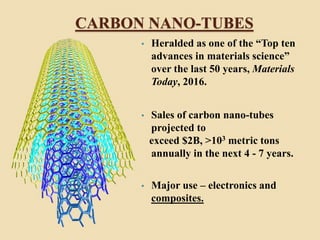
CARBON NANO-TUBES
• Heralded as one of the “Top ten
advances in materials science”
over the last 50 years, Materials
Today, 2016.
• Sales of carbon nano-tubes
projected to
exceed $2B, >103 metric tons
annually in the next 4 - 7 years.
• Major use – electronics and
composites.
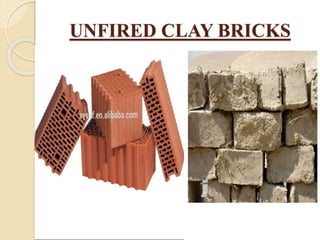
UNFIRED CLAY BRICKS
 Unfired clay bricks are made up of earthy
materials and are air-dried instead of fired
like conventional bricks.
 It is eco- friendly and with additional
construction properties.
 It have the benefit of reducing the energy
used in manufacturing and increases
strength and decreases shrinkage.
UNFIRED CLAY BRICKS
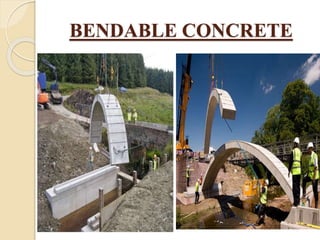
BENDABLE CONCRETE
 A new type of fiber reinforced bendable
concrete is used in various places.
 This new concrete is around 500 times
more resistant to cracking than regular.
 The fibers slide within the concrete when
bending occurs, providing with it is
enough ton prevent breakage.
BENDABLE CONCRETE
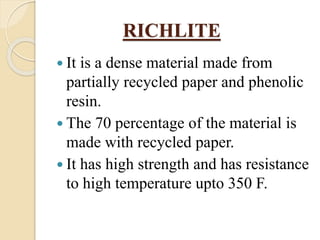
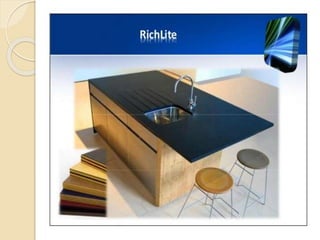
RICHLITE
 It is a dense material made from
partially recycled paper and phenolic
resin.
 The 70 percentage of the material is
made with recycled paper.
 It has high strength and has resistance
to high temperature upto 350 F.
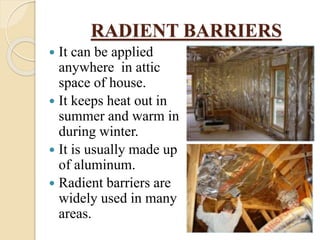
RADIENT BARRIERS
 It can be applied
anywhere in attic
space of house.
 It keeps heat out in
summer and warm in
during winter.
 It is usually made up
of aluminum.
 Radient barriers are
widely used in many
areas.
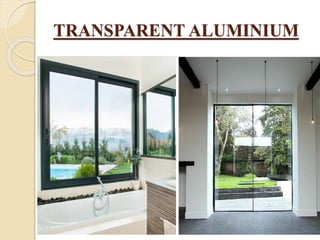
TRANSPARENT ALUMINIUM
 It is extremely durable material with excellent
optical transparency.
 To be used for windows, domes, plates, rods and
tubes with a wide range of sizes and varieties.
 It has excellent clarity.
 Outstanding strength and hardness.
 Cost effective advanced material solution.
 It is used in aerospace, security, defence,and
energy and consumer products.
TRANSPARENT ALUMINIUM
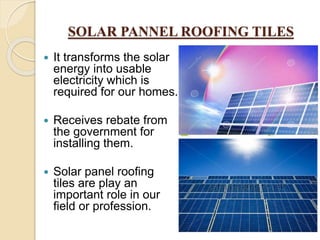
SOLAR PANNEL ROOFING TILES
 It transforms the solar
energy into usable
electricity which is
required for our homes.
 Receives rebate from
the government for
installing them.
 Solar panel roofing
tiles are play an
important role in our
field or profession.
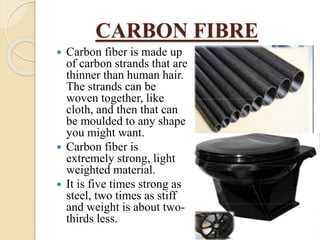
CARBON FIBRE
 Carbon fiber is made up
of carbon strands that are
thinner than human hair.
The strands can be
woven together, like
cloth, and then that can
be moulded to any shape
you might want.
 Carbon fiber is
extremely strong, light
weighted material.
 It is five times strong as
steel, two times as stiff
and weight is about two-
thirds less.
APPLICATIONS OF MODERN
MATERIALS
 Several modern construction materials have
more strength, hardness, toughness and
durability.
 For example, fly ash bricks have these
characters when compared with normal
bricks.
 From the above discussions the modern
materials are mostly used in all over the
world .
 We can make our nation as Hi-tech using
these innovative materials.
CONCLUSION
 Hence the following techniques such as under
water construction and trenchless technology or
like that are very use full in today's life
 These new emerging building materials should be
replaced with the old ones to improve the
properties of materials and helps in recycling of
the materials to save energy, time, money and
make our country as pollution free.
 So more innovative materials should be created
and make construction of the building simpler
with more strength.
Advanced construction equipments and techniques

Advanced construction equipments and techniques

  • 1.
    ADVANCED CONSTRUCTION EQUIPMENTS ANDTECHNIQUES PRESENTED BY, D.SELVAGANESH, 3rd YEAR,DEPARTMENT OF CIVIL, FATIMA MICHAEL COLLEGE OF ENGINEERING AND TECHNOLOGY, MADURAI – 20. & G.MATHAN KUMAR, 3rd YEAR,DEPARTMENT OF CIVIL, KAMARAJAR COLLEGE OF ENGINEERING AND TECHNOLOGY, VIRUDUNAGAR.
  • 2.
    CONTENTS INTRODUCTION UNDER WATER CONSTRUCTION ANDITS CLASSIFICATIONS METHODS OF PLACING THE CONCRETE AND ITS TYPES TRENCHLESS TECHNOLOGYAND ITS USES MODERN CONSTRUCTION MATERIALS AND ITS APPLICATIONS CONCLUSION
  • 3.
    INTRODUCTION  Now adays the construction technology and equipments becomes very advanced.  The advanced construction techniques such as under water construction , trenchless technology and many new innovative materials used in advanced construction techniques and equipments to speed up the construction of any building works.  So that we will discuss about few techniques and materials used in that.
  • 4.
  • 5.
    UNDER WATER CONSTRUCTION Duringthe construction of bridges, dams or any other structure where foundation part of the structure is mostly like to lie underwater, we have to opt for underwater construction.  Construction in water poses many difficulties especially in the places where there the depth is considerable  During underwater construction our main objective is to create a dry and water free environment for working in such a manner that the structural stability of the structure is not compromised.
  • 6.
    CLASSIFICATIONS OF UNDER WATERCONSTRUCTION UNDER WATER CONSTRUCTION  CONSTRUCTION TECHNIQUES METHODS OF PLACING OF CONCRETE UNDERWATER CONSTRUCTION TECHNIQUES CAISSONS COFFERDAMS METHODS OF PLACING OF CONCRETE TREMIE METHOD PUMP METHOD TOGGLE BAGS BAG WORKS
  • 7.
    CAISSONS Caissons are thestructure used in underwater construction work, consisting of an air tight chamber, open at the bottom and containing air under sufficient pressure to exclude the water.
  • 8.
    TYPES OF CAISSONS BOX CAISSON OPEN CAISSON PNEUMETIC CAISSON
  • 9.
  • 10.
  • 12.
    COFFERDAMS A cofferdam isa type of watertight construction designed to facilitate construction projects in areas that are normally submerged, such as bridges and piers.
  • 13.
    TYPES OF COFFERDAM Cantilever sheet piles  Braced cofferdam  Double wall cofferdam  Cellular cofferdam  Earth embankment  Rock fill cofferdam
  • 14.
  • 15.
  • 16.
  • 17.
  • 18.
  • 19.
  • 20.
    METHODS OF PLACINGOF CONCRETE TREMIE METHOD TOGGLE BAGS PUMP METHOD BAG WORKS
  • 21.
  • 22.
  • 23.
    TOGGLE BAGS BAGWORK Toggle bags are ideal for small amount of concrete placements. The bag is filled in the dry with wet concrete. Used for repair work. The concrete is squeezed out by a driver. Bags are made of open weave material. Diver -handled bags are usually of 10 – 20 litters capacity but 1 cub.m bags can be placed using a crane.
  • 24.
    TRENCHLESS TECHNOLOGY  Trenchlesstechnology methods include all methods of installing or renewing underground utility systems with minimum disruption of the surface or subsurface.  Trenchless technology consist of various methods, materials and equipment for inspection ,utilization and rehabilitation .  Trenchless technology has become popular for underground utility construction road crossings.  In recent years, there has been remarkable progress in development of new trenchless technology equipment and methods.
  • 25.
    OBJECTIVE OF TRENCHLESS TECHNOLOGY Cost-effectiveness Easeof Design Production rates Extends underground assets Benefits environment
  • 26.
    SITE INVESTIGATION Common problemsat site are, • Loss of invert walls, ceiling due to corrosion • Leaking joints • Settlement • Shape deformation • In adequate flow capacity • Voids in embankment around and above the culvert Hence before take the trenchless excavation work the site investigation must be made.
  • 27.
  • 28.
    TECHNIQUES IN LAYINGOF PIPES PIPE JACKING The term pipe jacking can be used to describe a specific installation technique as well as a process applicable to other trenchless technology
  • 29.
    AUGER BORING  Ifthere are longer borings to be carried out or if the drilling precision has to be higher the borings are carried out as guided auger borings.
  • 30.
    MICRO TUNNELING Pipes arejacked from a launch pit to a reception pit by means of a hydraulic jacking station in the launch pit
  • 31.
    UTILITY TUNNELING The Procedureconsists of four major steps • soil excavation. • Soil removal. • Segmental liner installations • Line and grade control.
  • 32.
    PIPE RAMMING Pipe ramminginvolves the use of the dynamic force and energy transmitted by a percussion hammer attached to the end of a pipe.
  • 33.
    ADVANTAGES OF TRENCHLESS TECHNOLOGY Expenses and dates are much easier to calculate.  Surface life stays mainly undisturbed.  Up to 95 percent lesser load for landfills due to minimal excavations.  Small stress for streets and traffic.  Minimization of CO2 emissions
  • 34.
    INTRODUCTION TO MODERN CONSTRUCTIONMATERIALS  Now –a- days many new innovative materials are being invented and many new materials are being in research.  New innovative thinking and new invention is necessary to save our valuable time and energy.  Some of the innovative materials are listed below.
  • 35.
    MODERN CONSTRUCTION MATERIALS  Flyash bricks.  Translucent concrete.  Sensi tiles.  Liquid granite.  Carbon Nano-tubes.  Unfired clay bricks.  Bendable concrete.  Richlite.  Radient barriers.  Transparent aluminium.  Carbon fiber.  Solar pannel roofing tiles. These are the several materials used in advanced construction techniques and equipments such as
  • 36.
    FLY ASH BRICKS Flyash bricks are building materials containing class c fly ash. In India, the fly ash was first used in rihad dam which is located at Pipri sonbhadra district in uttar Pradesh. The composition of fly ash bricks are fly ash, lime, gypsum, sand, cement. These bricks are environment friendly and they can be manufactured at construction site itself.
  • 37.
  • 38.
    TRANSLUCENT CONCRETE They havebeen developed by Hungarian architect ARON LOSONCZI. It is mostly same as the regular concrete, visually appealing by mixing concrete with optical glass fibers and thus the result was light transmitting concrete. The glass fiber in the concrete act like a slit and carry the light across and the light carried maintains its original color. It carries the same amount of light through it, no matter how thick it is.
  • 39.
  • 40.
    SENSI TILE If youwalk across your kitchen the floor to get something from the refrigerator, the floor twinkles with light path that guides your way through the dark room. The concrete of the tile is embedded with acrylic fiber optic channels that transfer the light from one point to another. As shadow move across terrazzo’s surface , the light channels flicker with a randomized.
  • 41.
  • 42.
    LIQUID GRANITE  Thematerial is light weighted and has the same load bearing capacity of cement but it is made of recycled materials.  Liquid granite is not only a fire- resistant beyond 1,100 degrees celsius, it can also withstand high temperature for longer periods .  So, It has moisture resisting properties also.
  • 43.
  • 44.
    CARBON NANO-TUBES • Heraldedas one of the “Top ten advances in materials science” over the last 50 years, Materials Today, 2016. • Sales of carbon nano-tubes projected to exceed $2B, >103 metric tons annually in the next 4 - 7 years. • Major use – electronics and composites.
  • 45.
    UNFIRED CLAY BRICKS Unfired clay bricks are made up of earthy materials and are air-dried instead of fired like conventional bricks.  It is eco- friendly and with additional construction properties.  It have the benefit of reducing the energy used in manufacturing and increases strength and decreases shrinkage.
  • 46.
  • 47.
    BENDABLE CONCRETE  Anew type of fiber reinforced bendable concrete is used in various places.  This new concrete is around 500 times more resistant to cracking than regular.  The fibers slide within the concrete when bending occurs, providing with it is enough ton prevent breakage.
  • 48.
  • 49.
    RICHLITE  It isa dense material made from partially recycled paper and phenolic resin.  The 70 percentage of the material is made with recycled paper.  It has high strength and has resistance to high temperature upto 350 F.
  • 51.
    RADIENT BARRIERS  Itcan be applied anywhere in attic space of house.  It keeps heat out in summer and warm in during winter.  It is usually made up of aluminum.  Radient barriers are widely used in many areas.
  • 52.
    TRANSPARENT ALUMINIUM  Itis extremely durable material with excellent optical transparency.  To be used for windows, domes, plates, rods and tubes with a wide range of sizes and varieties.  It has excellent clarity.  Outstanding strength and hardness.  Cost effective advanced material solution.  It is used in aerospace, security, defence,and energy and consumer products.
  • 53.
  • 54.
    SOLAR PANNEL ROOFINGTILES  It transforms the solar energy into usable electricity which is required for our homes.  Receives rebate from the government for installing them.  Solar panel roofing tiles are play an important role in our field or profession.
  • 55.
    CARBON FIBRE  Carbonfiber is made up of carbon strands that are thinner than human hair. The strands can be woven together, like cloth, and then that can be moulded to any shape you might want.  Carbon fiber is extremely strong, light weighted material.  It is five times strong as steel, two times as stiff and weight is about two- thirds less.
  • 56.
    APPLICATIONS OF MODERN MATERIALS Several modern construction materials have more strength, hardness, toughness and durability.  For example, fly ash bricks have these characters when compared with normal bricks.  From the above discussions the modern materials are mostly used in all over the world .  We can make our nation as Hi-tech using these innovative materials.
  • 57.
    CONCLUSION  Hence thefollowing techniques such as under water construction and trenchless technology or like that are very use full in today's life  These new emerging building materials should be replaced with the old ones to improve the properties of materials and helps in recycling of the materials to save energy, time, money and make our country as pollution free.  So more innovative materials should be created and make construction of the building simpler with more strength.

Editor's Notes

  • #28 SLIP LINING WELDED CONTINUOUS PIPES This process refers to a pipe slipping technique where plastic pipe (HDPE) or PVC sections are joined by fusion welding outside of the pipe to be rehabilitated, and then pulled into place as once Solid liner. The installation is quick, but this technique is limited to fusion of circular cross sections only.