PROJECT
CASE STUDY ON BUILDING CRACKS AND ITS
         REMEDIAL MEASURES


                UBMITTED BY

         .SADHAM HUSSAIN   11117203

      .RUPA MANIKANDA PRABU 11117202

         .SANKAR           11117205

     .ASHIK ELAHI               11117168

     .SASI KUMAR                11117206

         .ASIP ALI         11117170


          NDER THE GUIDANCE OF
INTRODUCTION

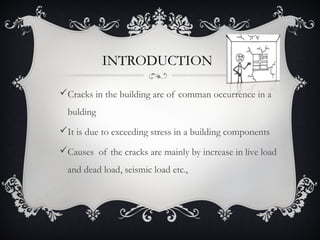
Cracks in the building are of comman occurrence in a
  bulding
It is due to exceeding stress in a building components

Causes of the cracks are mainly by increase in live load
  and dead load, seismic load etc.,
CLASSIFICATION OF CRACKS


racks can be classified into two categories viz.,


tructural cracks


on-structural cracks
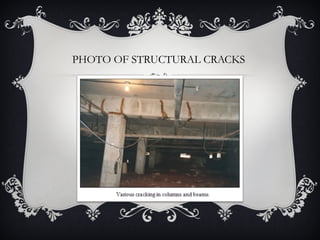
STRUCTURAL CRACKS


t arises due to incorrect designs, overloading of structural
components


xpenses cracking of foundation walls, beams and columns or
slab etc.,
PHOTO OF STRUCTURAL CRACKS
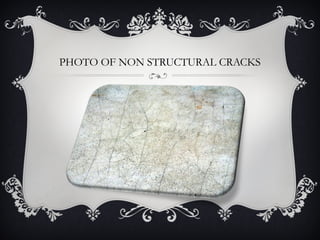
NON STRUCTURAL CRACKS


hey are due to internal forces developed in materials due to moisture
variations, temperature variation, crazing, effects of gases ,liquids etc.,


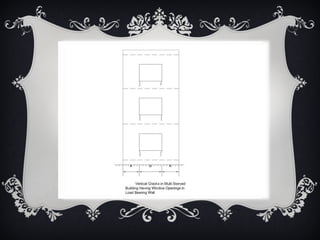
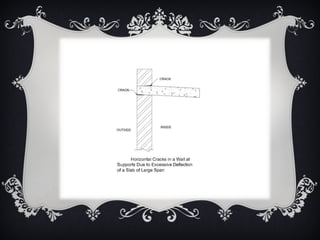
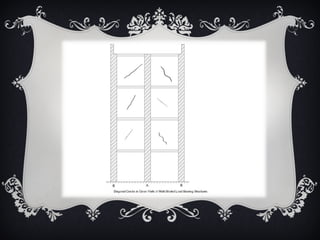
hey can be broadly classified into vertical, horizontal, diagonal,
smoothened cracks
PHOTO OF NON STRUCTURAL CRACKS
DIRECTION OF THE CRACKS


ertical


orizontal


iagonal


traight
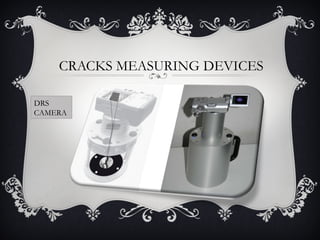
WIDTH OF CRACKS


t can be measured through instrument and
tell-tale signs.


he changes in the length of the cracks
should be noted.
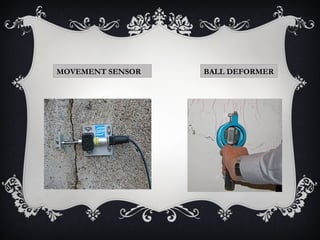
CRACKS MEASURING DEVICES

DRS
CAMERA
MOVEMENT SENSOR   BALL DEFORMER
CAUSES OF CRACKS
MAJOR CAUSES OF CRACKS

 Movements of the ground

 Over loading

 Effect of gases, liquids and solids

 Effect of changes of temperature

 General causes such as vibrations
ovements of grounds                verloading


ue to mining subsidence, land      verloading of the building
slips, earthquakes, moisture
changes due to shrinkable soils.   verloading of the building parts
                                   results in cracks
OVERLOADING FORCED MAY BE
            DUE TO


 External ( excessive wind/snow loads)

 Internal ( from heavy machinery etc.,)
EFFECTS OF GASES, LIQUIDS AND
           SOLIDS


ases


nly gases like Co2 ( carbon di oxide ) is likely to produce cracks.


t causes Carbonation of porous cement products


eads into an overall shrinkage crazing cracks
iquids


ater is the most commonly used liquid when not taken care it can be
hazardous


onstruction water i.e., that in the utilization of water during the
construction process
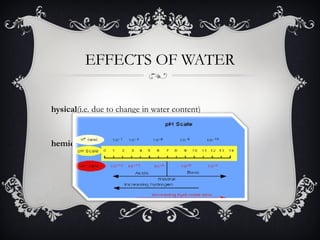
EFFECTS OF WATER

hysical(i.e. due to change in water content)


hemical ( directly or indirectly affecting other materials)
GENERAL VIBRATIONS


ibrations can cause cracks in buildings only when their amplitude

of vibrations are high.


part from vibrations caused due to earthquakes, the vibrations

caused due to heavy machinery, traffic, sonic booms are also

responsible for the occurrence of cracks in buildings.
THERMAL MOVEMENT


ll materials expand on heat and contract on cool.


hermal movement in components of structure creates cracks due

to tensile of shear stresses


ne of the most potent causes of cracking in buildings and need
GENERAL PRECAUTION TO AVOIDING
            CRACKS


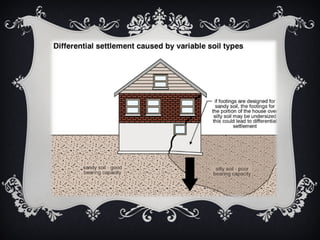
efore laying up foundation, the type of foundation to be used

should be decided based on the safe bearing capacity of soil.


roviding R.C deep beam or an involved T-beam with adequate

reinforcements to withstand the stress due to differential ground

movements. This method is expensive
onstruction operations such as cutting for roads drainages etc., close

to the structures should be avoided this will results in reduction of

soil moisture with consequent shrinkage of soil beneath the

foundation of the structure.


n buildings close to the water courses are noticed in many places
PLACING OF CONCRETE


oncrete should not be placed in heavy rains unless suitable shelter

is provided.


o avoid segregation, concrete should not be dropped from a

height of more than 1m.
hile placing the concrete in R.C.C members the alignment of formwork

should not be disturbed.


oncrete should be laid continuously to avoid irregular and unsightly lines.


nternal surface of the forms either steel or wood should have even

surfaces and should be oiled so that the concrete may not stick to it
MATERIAL QUALITY


ggregate should be hard, sound, durable, non-absorbent and

capable of of developing good bond with mortar.


ater shall be clean and free from alkaline and acid materials and

suitable for drinking purposes.
TEST TO BE CARRIED OUT


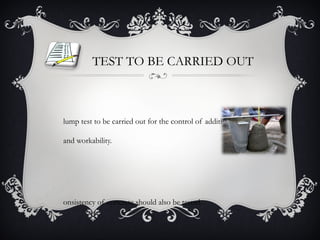
lump test to be carried out for the control of addition of water

and workability.


onsistency of concrete should also be tested.
LAYING TECHNIQUE AND CURING
               METHOD


oncrete should be laid in layers and should be compacted while

laying with wooden tamping rods or with mechanical vibrators until

a dense concrete is obtained


fter two hours of laying concrete, when the concrete has begun to

harden, it shall be kept damp by covering with wet gunny bags or

wet sand for 24 hours
EVALUATION OF CRACKS


o determine the effects of cracks in the building.


irst the cracks location and extent should be noted down for the
adopting suitable methods of repair and the future problems due
to that cracks.
rack widths should be measured to the accuracy of 0.001 in
(0.025mm) using a crack comparator.


ovements should be recorded with movement sensors.


ased on the reports from the location and width the suitable
methods is adopted
rack as narrow as 0.002 in can be bonded by the injection of
epoxy.


poxy injection can alone be used to restore the flexural stiffness.


or water retaining structure cracks it can be repaired by the
autogenous healing.
REPAIRING OF CRACKS

outing and sealing.


titching.


dditional reinforcement.


ravity filling


routing
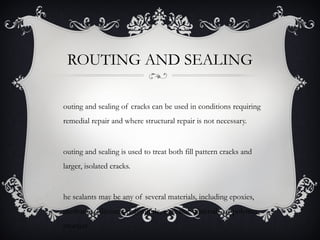
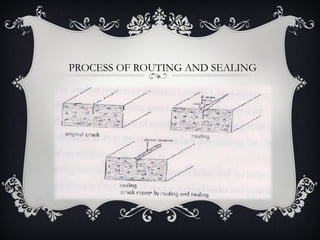
ROUTING AND SEALING

outing and sealing of cracks can be used in conditions requiring
remedial repair and where structural repair is not necessary.


outing and sealing is used to treat both fill pattern cracks and
larger, isolated cracks.


he sealants may be any of several materials, including epoxies,
urethanes, silicones, polysulfide, asphaltic materials, or polymer
mortars
PROCESS OF ROUTING AND SEALING
STITCHING


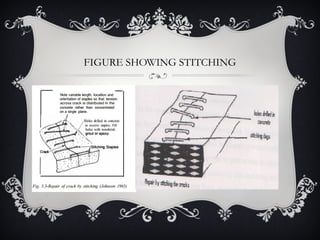
titching involves drilling holes on both sides of the crack and
grouting in U-shaped metal units with short legs (staples or
stitching dogs) that span the crack.


titching a crack tends to stiffen the structure, and the stiffening
may increase the overall structural restraint.
he stitching procedure consists of drilling holes on both sides of
the crack, cleaning the holes, and anchoring the legs of the staples
in the holes, with either a non shrink grout or an epoxy resin-
based bonding system
FIGURE SHOWING STITCHING
ADDITIONAL
                  REINFORCEMENTS

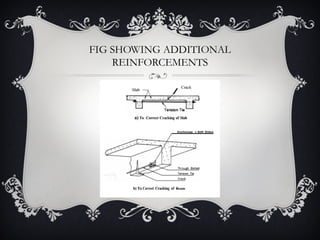
 Conventional reinforcement-Cracked reinforced concrete bridge
   girders have been successfully repaired by inserting reinforcing
   bars and bonding them in place with epoxy .
 This technique consists of sealing the crack, drilling holes that
   intersect the crack plane at approximately 90º ,filling the hole and
   crack with injected epoxy and placing a reinforcing bar into the
   drilled hole
restressing steel-Post-tensioning is often the desirable solution
when a major portion of a member must be strengthened or
when the cracks that have formed must be closed.


dequate anchorage must be provided for the prestressing steel,
and care is needed so that the problem will not merely migrate to
another part of the structure
FIG SHOWING ADDITIONAL
    REINFORCEMENTS
GROUTING


ortland cement grouting-Wide cracks, particularly in gravity dams
and thick concrete walls, may be repaired by filling with portland
cement grout.


his method is effective in stopping water leaks, but it will not
structurally bond cracked sections.
GRAVITY FILLING


ow viscosity monomers and resins can be used to seal cracks with
surface widths of 0.001 to 0.08 in. (0.03 to 2 mm) by gravity
filling.


igh-molecular-weight methacrylates, urethanes, and some low
viscosity epoxies have been used successfully.


he lower the viscosity, the finer the cracks that can be filled.
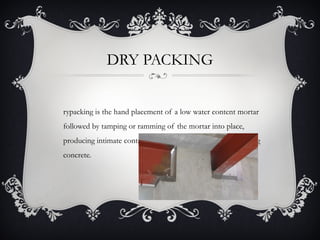
DRY PACKING


rypacking is the hand placement of a low water content mortar
followed by tamping or ramming of the mortar into place,
producing intimate contact between the mortar and the existing
concrete.
POLYMER IMPREGNATION


onomer systems can be used for effective repair of some cracks.
A monomer system is a liquid consisting of monomers which will
polymerize into a solid.


he most common monomer used for this purpose is methyl
methacrylate.
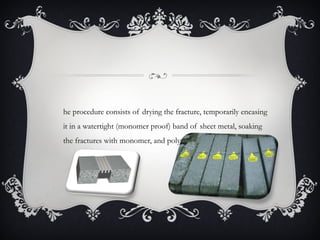
he procedure consists of drying the fracture, temporarily encasing
it in a watertight (monomer proof) band of sheet metal, soaking
the fractures with monomer, and polymerizing the monomer
CONCLUSION


he discussion on our project mainly focused on the cracks deals with
failure due to improper settlement of foundation and poor
construction.


y the following discussed remedies and instruction what we have
concentrated helps to reducing the cracks and move on to the next level
in the construction.
Thank you

CASE STUDY ON CRACKS AND ITS REMEDIAL MEASURES

  • 1.
  • 2.
    CASE STUDY ONBUILDING CRACKS AND ITS REMEDIAL MEASURES UBMITTED BY .SADHAM HUSSAIN 11117203 .RUPA MANIKANDA PRABU 11117202 .SANKAR 11117205 .ASHIK ELAHI 11117168 .SASI KUMAR 11117206 .ASIP ALI 11117170 NDER THE GUIDANCE OF
  • 3.
    INTRODUCTION Cracks in thebuilding are of comman occurrence in a bulding It is due to exceeding stress in a building components Causes of the cracks are mainly by increase in live load and dead load, seismic load etc.,
  • 4.
    CLASSIFICATION OF CRACKS rackscan be classified into two categories viz., tructural cracks on-structural cracks
  • 5.
    STRUCTURAL CRACKS t arisesdue to incorrect designs, overloading of structural components xpenses cracking of foundation walls, beams and columns or slab etc.,
  • 6.
  • 7.
    NON STRUCTURAL CRACKS heyare due to internal forces developed in materials due to moisture variations, temperature variation, crazing, effects of gases ,liquids etc., hey can be broadly classified into vertical, horizontal, diagonal, smoothened cracks
  • 8.
    PHOTO OF NONSTRUCTURAL CRACKS
  • 9.
    DIRECTION OF THECRACKS ertical orizontal iagonal traight
  • 13.
    WIDTH OF CRACKS tcan be measured through instrument and tell-tale signs. he changes in the length of the cracks should be noted.
  • 14.
  • 15.
    MOVEMENT SENSOR BALL DEFORMER
  • 16.
  • 17.
    MAJOR CAUSES OFCRACKS  Movements of the ground  Over loading  Effect of gases, liquids and solids  Effect of changes of temperature  General causes such as vibrations
  • 18.
    ovements of grounds verloading ue to mining subsidence, land verloading of the building slips, earthquakes, moisture changes due to shrinkable soils. verloading of the building parts results in cracks
  • 19.
    OVERLOADING FORCED MAYBE DUE TO  External ( excessive wind/snow loads)  Internal ( from heavy machinery etc.,)
  • 20.
    EFFECTS OF GASES,LIQUIDS AND SOLIDS ases nly gases like Co2 ( carbon di oxide ) is likely to produce cracks. t causes Carbonation of porous cement products eads into an overall shrinkage crazing cracks
  • 21.
    iquids ater is themost commonly used liquid when not taken care it can be hazardous onstruction water i.e., that in the utilization of water during the construction process
  • 22.
    EFFECTS OF WATER hysical(i.e.due to change in water content) hemical ( directly or indirectly affecting other materials)
  • 23.
    GENERAL VIBRATIONS ibrations cancause cracks in buildings only when their amplitude of vibrations are high. part from vibrations caused due to earthquakes, the vibrations caused due to heavy machinery, traffic, sonic booms are also responsible for the occurrence of cracks in buildings.
  • 24.
    THERMAL MOVEMENT ll materialsexpand on heat and contract on cool. hermal movement in components of structure creates cracks due to tensile of shear stresses ne of the most potent causes of cracking in buildings and need
  • 25.
    GENERAL PRECAUTION TOAVOIDING CRACKS efore laying up foundation, the type of foundation to be used should be decided based on the safe bearing capacity of soil. roviding R.C deep beam or an involved T-beam with adequate reinforcements to withstand the stress due to differential ground movements. This method is expensive
  • 27.
    onstruction operations suchas cutting for roads drainages etc., close to the structures should be avoided this will results in reduction of soil moisture with consequent shrinkage of soil beneath the foundation of the structure. n buildings close to the water courses are noticed in many places
  • 28.
    PLACING OF CONCRETE oncreteshould not be placed in heavy rains unless suitable shelter is provided. o avoid segregation, concrete should not be dropped from a height of more than 1m.
  • 29.
    hile placing theconcrete in R.C.C members the alignment of formwork should not be disturbed. oncrete should be laid continuously to avoid irregular and unsightly lines. nternal surface of the forms either steel or wood should have even surfaces and should be oiled so that the concrete may not stick to it
  • 30.
    MATERIAL QUALITY ggregate shouldbe hard, sound, durable, non-absorbent and capable of of developing good bond with mortar. ater shall be clean and free from alkaline and acid materials and suitable for drinking purposes.
  • 31.
    TEST TO BECARRIED OUT lump test to be carried out for the control of addition of water and workability. onsistency of concrete should also be tested.
  • 32.
    LAYING TECHNIQUE ANDCURING METHOD oncrete should be laid in layers and should be compacted while laying with wooden tamping rods or with mechanical vibrators until a dense concrete is obtained fter two hours of laying concrete, when the concrete has begun to harden, it shall be kept damp by covering with wet gunny bags or wet sand for 24 hours
  • 34.
    EVALUATION OF CRACKS odetermine the effects of cracks in the building. irst the cracks location and extent should be noted down for the adopting suitable methods of repair and the future problems due to that cracks.
  • 35.
    rack widths shouldbe measured to the accuracy of 0.001 in (0.025mm) using a crack comparator. ovements should be recorded with movement sensors. ased on the reports from the location and width the suitable methods is adopted
  • 36.
    rack as narrowas 0.002 in can be bonded by the injection of epoxy. poxy injection can alone be used to restore the flexural stiffness. or water retaining structure cracks it can be repaired by the autogenous healing.
  • 37.
    REPAIRING OF CRACKS outingand sealing. titching. dditional reinforcement. ravity filling routing
  • 38.
    ROUTING AND SEALING outingand sealing of cracks can be used in conditions requiring remedial repair and where structural repair is not necessary. outing and sealing is used to treat both fill pattern cracks and larger, isolated cracks. he sealants may be any of several materials, including epoxies, urethanes, silicones, polysulfide, asphaltic materials, or polymer mortars
  • 39.
    PROCESS OF ROUTINGAND SEALING
  • 40.
    STITCHING titching involves drillingholes on both sides of the crack and grouting in U-shaped metal units with short legs (staples or stitching dogs) that span the crack. titching a crack tends to stiffen the structure, and the stiffening may increase the overall structural restraint.
  • 41.
    he stitching procedureconsists of drilling holes on both sides of the crack, cleaning the holes, and anchoring the legs of the staples in the holes, with either a non shrink grout or an epoxy resin- based bonding system
  • 42.
  • 43.
    ADDITIONAL REINFORCEMENTS  Conventional reinforcement-Cracked reinforced concrete bridge girders have been successfully repaired by inserting reinforcing bars and bonding them in place with epoxy .  This technique consists of sealing the crack, drilling holes that intersect the crack plane at approximately 90º ,filling the hole and crack with injected epoxy and placing a reinforcing bar into the drilled hole
  • 44.
    restressing steel-Post-tensioning isoften the desirable solution when a major portion of a member must be strengthened or when the cracks that have formed must be closed. dequate anchorage must be provided for the prestressing steel, and care is needed so that the problem will not merely migrate to another part of the structure
  • 45.
  • 46.
    GROUTING ortland cement grouting-Widecracks, particularly in gravity dams and thick concrete walls, may be repaired by filling with portland cement grout. his method is effective in stopping water leaks, but it will not structurally bond cracked sections.
  • 47.
    GRAVITY FILLING ow viscositymonomers and resins can be used to seal cracks with surface widths of 0.001 to 0.08 in. (0.03 to 2 mm) by gravity filling. igh-molecular-weight methacrylates, urethanes, and some low viscosity epoxies have been used successfully. he lower the viscosity, the finer the cracks that can be filled.
  • 48.
    DRY PACKING rypacking isthe hand placement of a low water content mortar followed by tamping or ramming of the mortar into place, producing intimate contact between the mortar and the existing concrete.
  • 49.
    POLYMER IMPREGNATION onomer systemscan be used for effective repair of some cracks. A monomer system is a liquid consisting of monomers which will polymerize into a solid. he most common monomer used for this purpose is methyl methacrylate.
  • 50.
    he procedure consistsof drying the fracture, temporarily encasing it in a watertight (monomer proof) band of sheet metal, soaking the fractures with monomer, and polymerizing the monomer
  • 51.
    CONCLUSION he discussion onour project mainly focused on the cracks deals with failure due to improper settlement of foundation and poor construction. y the following discussed remedies and instruction what we have concentrated helps to reducing the cracks and move on to the next level in the construction.
  • 52.