FRAME STRUCTURE
Post & Lintel Structure,
Frame Structure & its types
The Simple Frame &
Multiple Frame
LECTURE # 3
TERMINOLOGIES
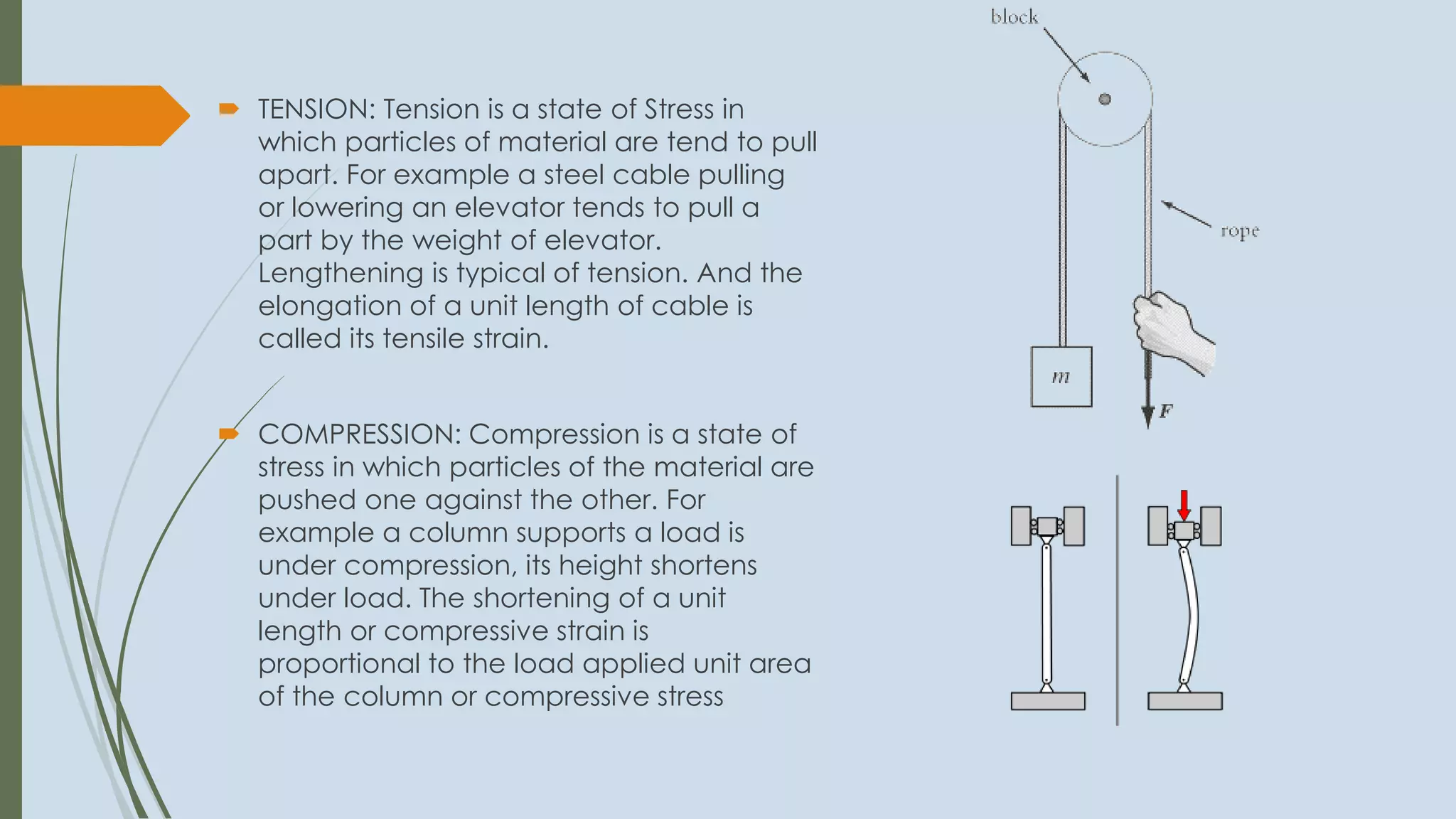
 TENSION: Tension is a state of Stress in
which particles of material are tend to pull
apart. For example a steel cable pulling
or lowering an elevator tends to pull a
part by the weight of elevator.
Lengthening is typical of tension. And the
elongation of a unit length of cable is
called its tensile strain.
 COMPRESSION: Compression is a state of
stress in which particles of the material are
pushed one against the other. For
example a column supports a load is
under compression, its height shortens
under load. The shortening of a unit
length or compressive strain is
proportional to the load applied unit area
of the column or compressive stress
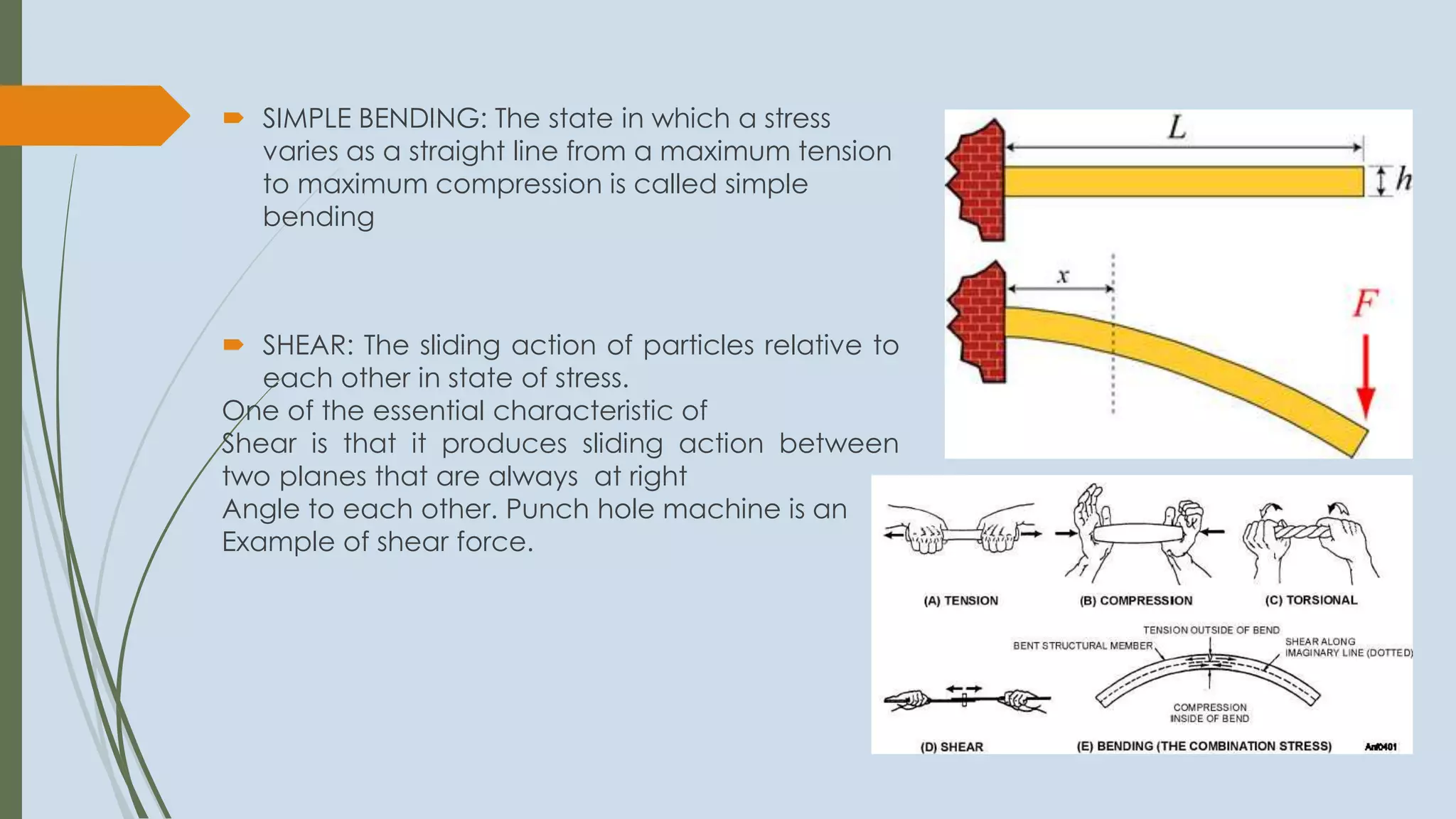
 SIMPLE BENDING: The state in which a stress
varies as a straight line from a maximum tension
to maximum compression is called simple
bending
 SHEAR: The sliding action of particles relative to
each other in state of stress.
One of the essential characteristic of
Shear is that it produces sliding action between
two planes that are always at right
Angle to each other. Punch hole machine is an
Example of shear force.
FRAME STRUCTURE
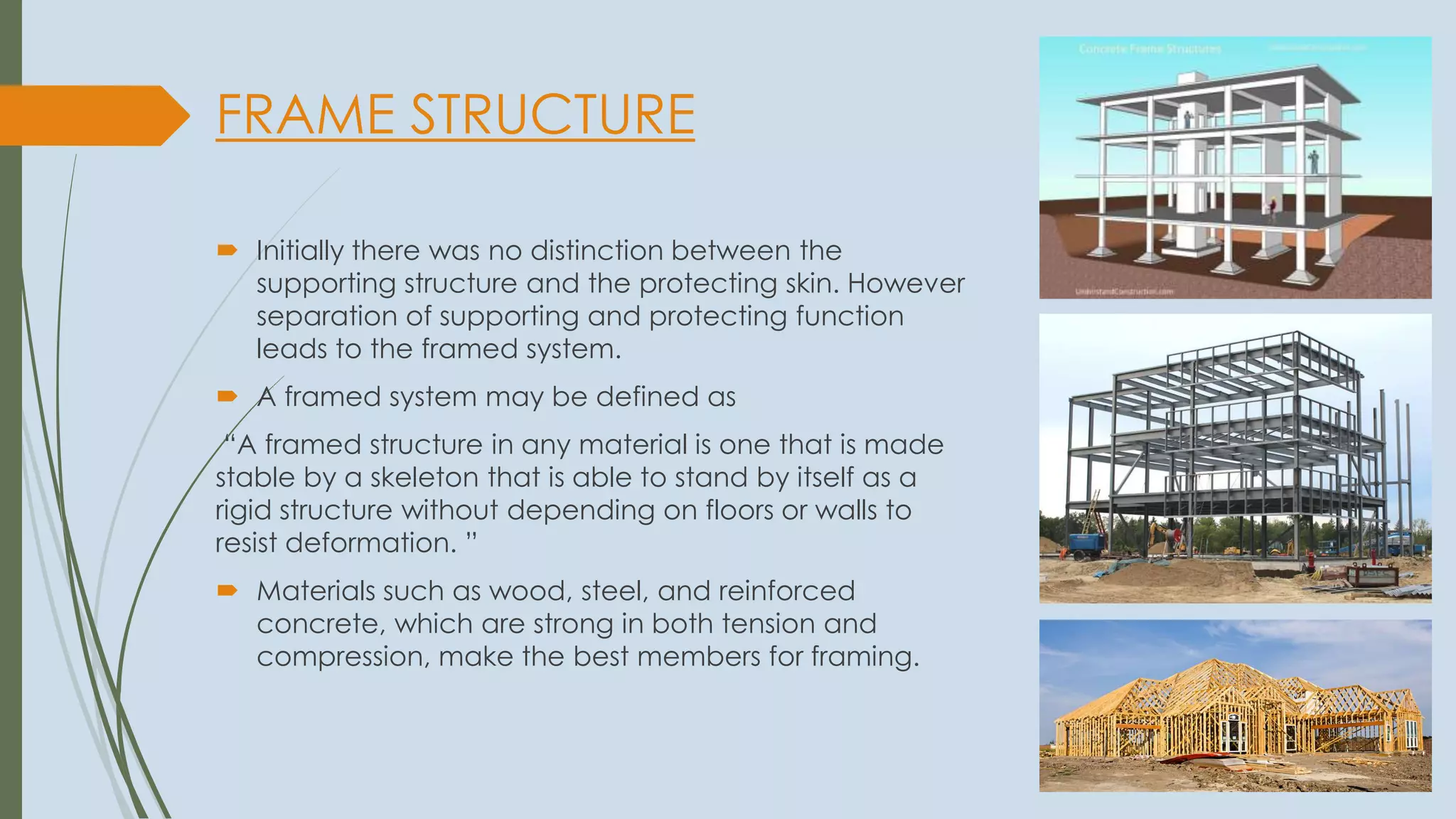
 Initially there was no distinction between the
supporting structure and the protecting skin. However
separation of supporting and protecting function
leads to the framed system.
 A framed system may be defined as
“A framed structure in any material is one that is made
stable by a skeleton that is able to stand by itself as a
rigid structure without depending on floors or walls to
resist deformation. ”
 Materials such as wood, steel, and reinforced
concrete, which are strong in both tension and
compression, make the best members for framing.
POST & LINTEL SYSTEM
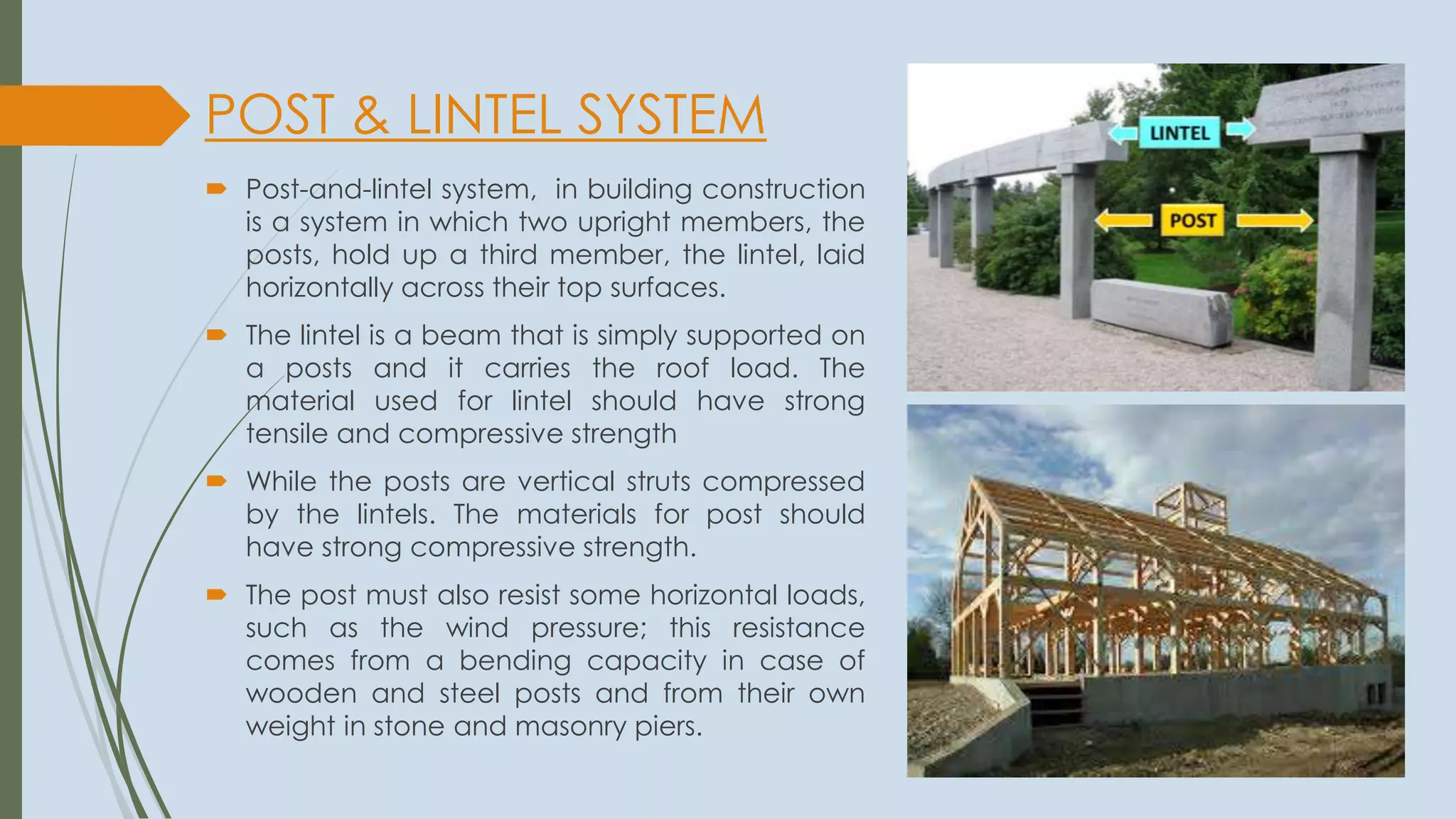
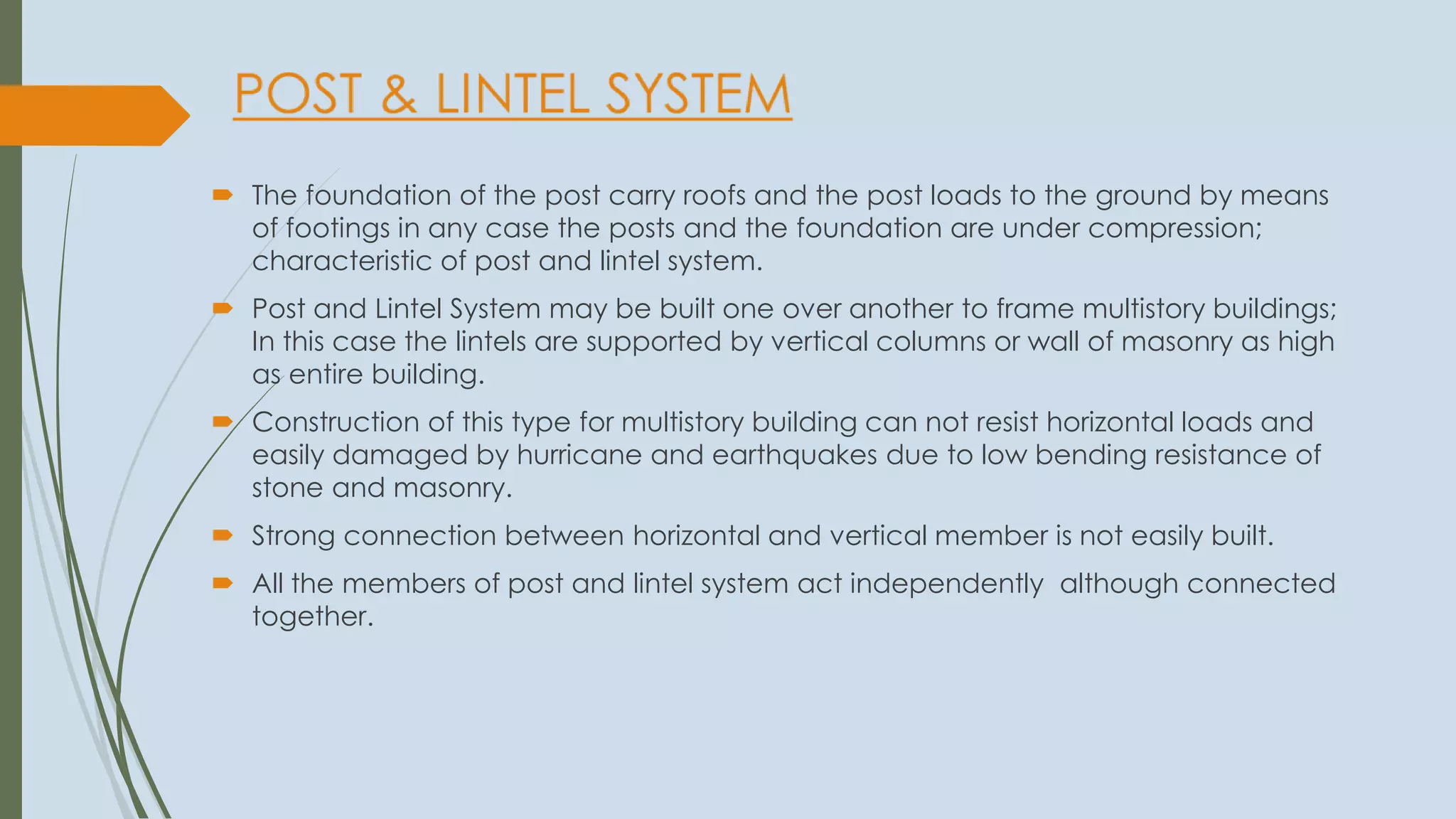
 Post-and-lintel system, in building construction
is a system in which two upright members, the
posts, hold up a third member, the lintel, laid
horizontally across their top surfaces.
 The lintel is a beam that is simply supported on
a posts and it carries the roof load. The
material used for lintel should have strong
tensile and compressive strength
 While the posts are vertical struts compressed
by the lintels. The materials for post should
have strong compressive strength.
 The post must also resist some horizontal loads,
such as the wind pressure; this resistance
comes from a bending capacity in case of
wooden and steel posts and from their own
weight in stone and masonry piers.
 The foundation of the post carry roofs and the post loads to the ground by means
of footings in any case the posts and the foundation are under compression;
characteristic of post and lintel system.
 Post and Lintel System may be built one over another to frame multistory buildings;
In this case the lintels are supported by vertical columns or wall of masonry as high
as entire building.
 Construction of this type for multistory building can not resist horizontal loads and
easily damaged by hurricane and earthquakes due to low bending resistance of
stone and masonry.
 Strong connection between horizontal and vertical member is not easily built.
 All the members of post and lintel system act independently although connected
together.
EXAMPLES OF POST AND LINTEL SYSTEM
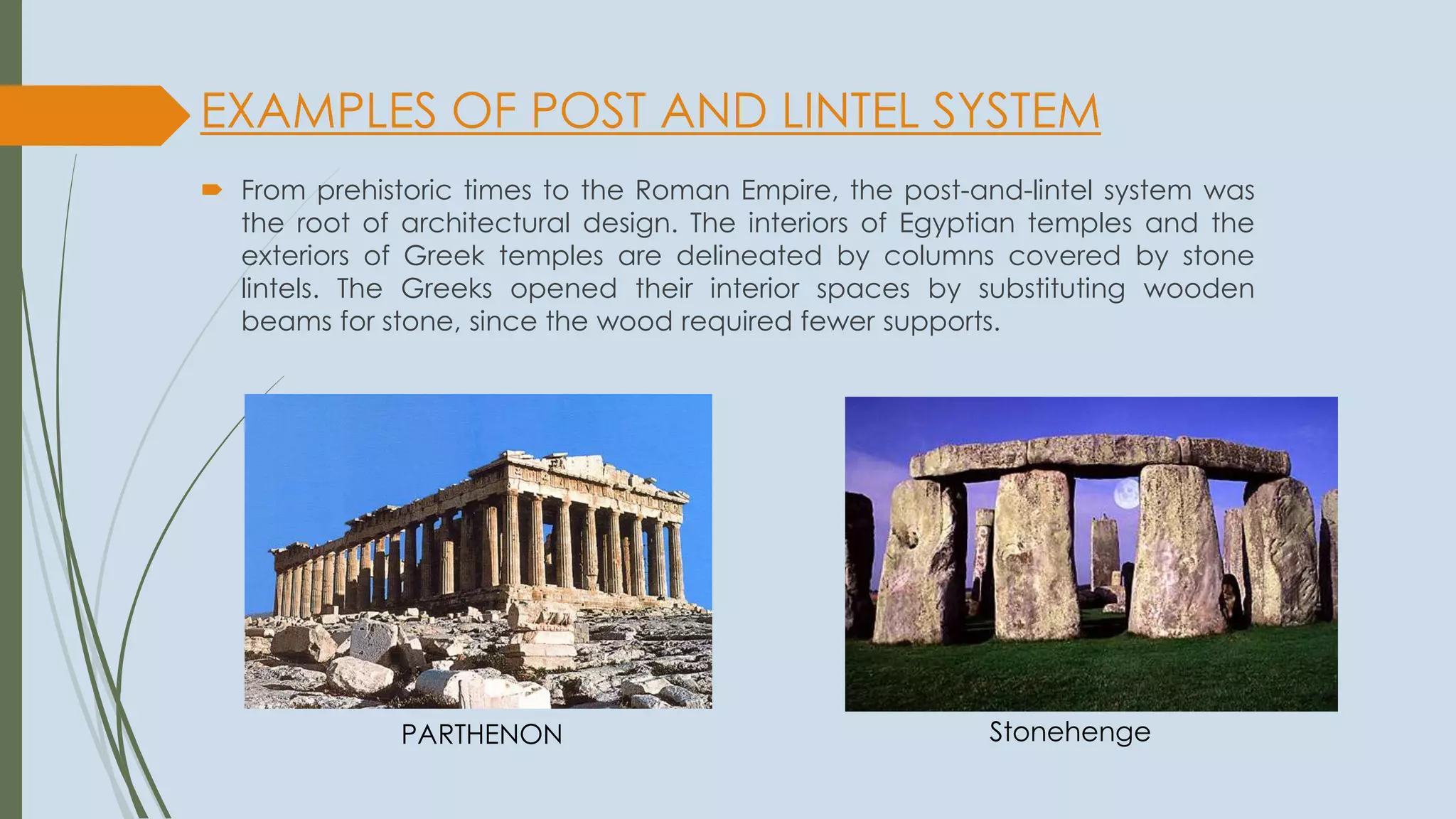
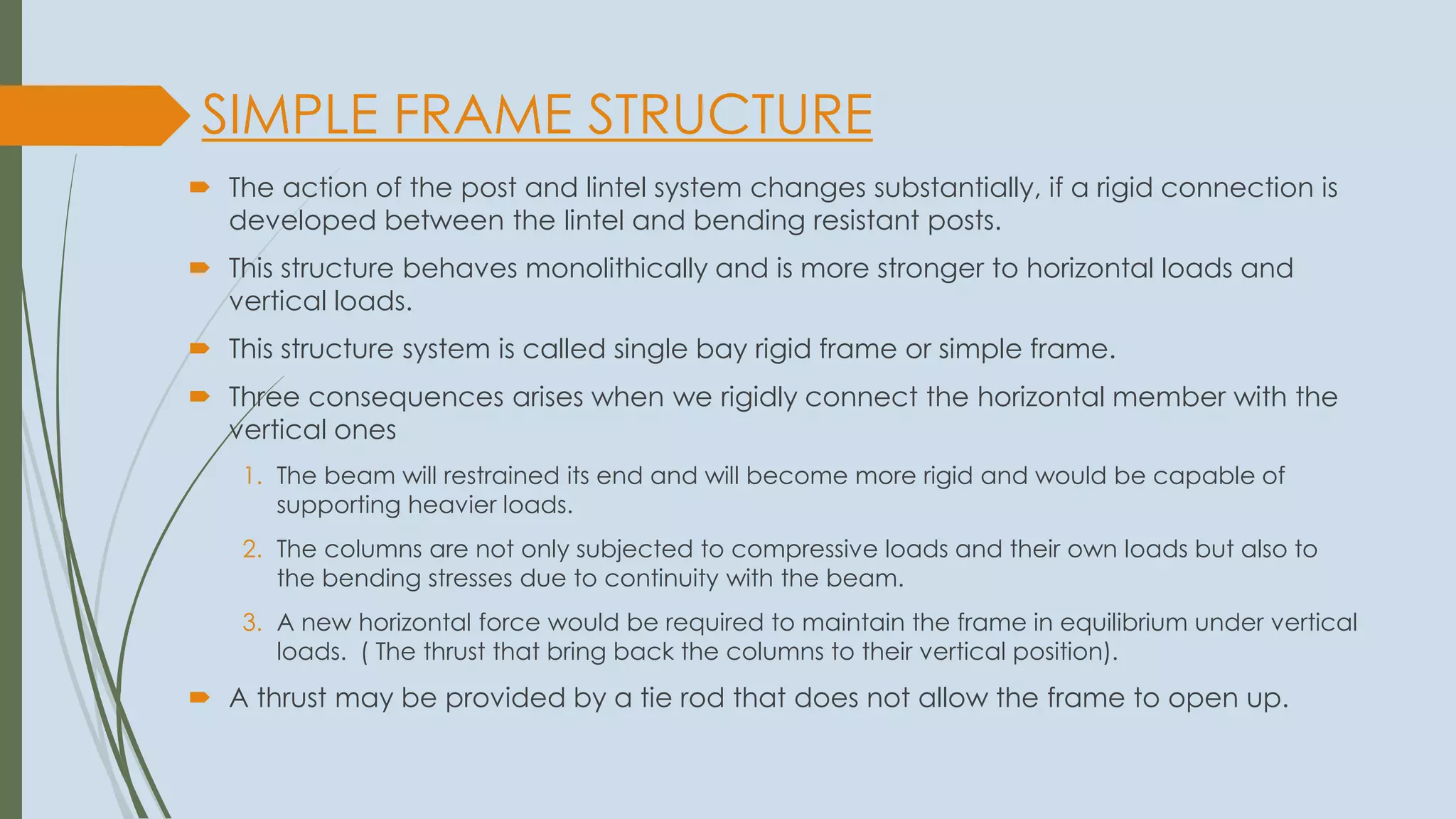
 From prehistoric times to the Roman Empire, the post-and-lintel system was
the root of architectural design. The interiors of Egyptian temples and the
exteriors of Greek temples are delineated by columns covered by stone
lintels. The Greeks opened their interior spaces by substituting wooden
beams for stone, since the wood required fewer supports.
StonehengePARTHENON
SIMPLE FRAME STRUCTURE
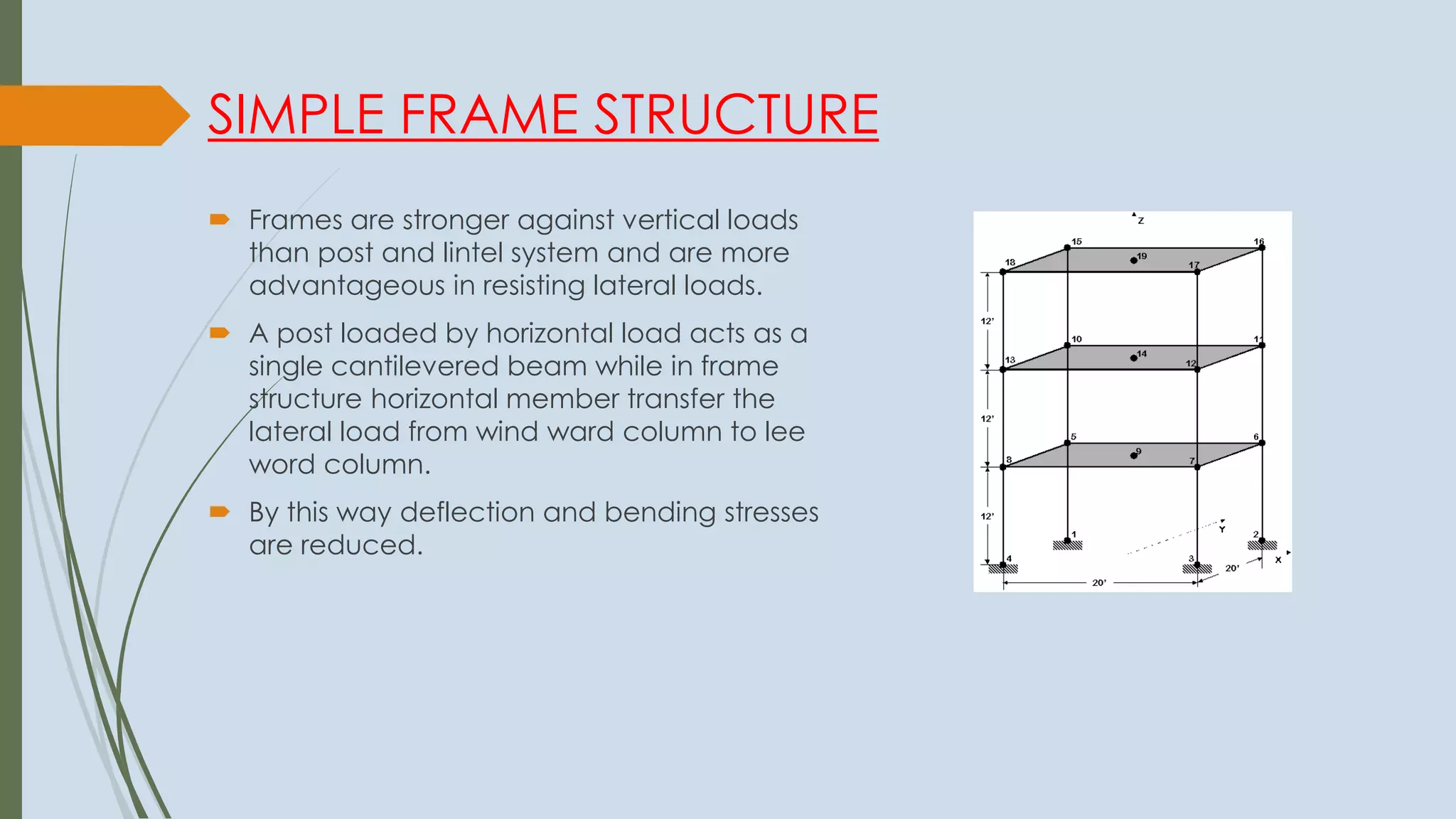
 The action of the post and lintel system changes substantially, if a rigid connection is
developed between the lintel and bending resistant posts.
 This structure behaves monolithically and is more stronger to horizontal loads and
vertical loads.
 This structure system is called single bay rigid frame or simple frame.
 Three consequences arises when we rigidly connect the horizontal member with the
vertical ones
1. The beam will restrained its end and will become more rigid and would be capable of
supporting heavier loads.
2. The columns are not only subjected to compressive loads and their own loads but also to
the bending stresses due to continuity with the beam.
3. A new horizontal force would be required to maintain the frame in equilibrium under vertical
loads. ( The thrust that bring back the columns to their vertical position).
 A thrust may be provided by a tie rod that does not allow the frame to open up.
SIMPLE FRAME STRUCTURE
 Frames are stronger against vertical loads
than post and lintel system and are more
advantageous in resisting lateral loads.
 A post loaded by horizontal load acts as a
single cantilevered beam while in frame
structure horizontal member transfer the
lateral load from wind ward column to lee
word column.
 By this way deflection and bending stresses
are reduced.
MULTIPLE FRAMES
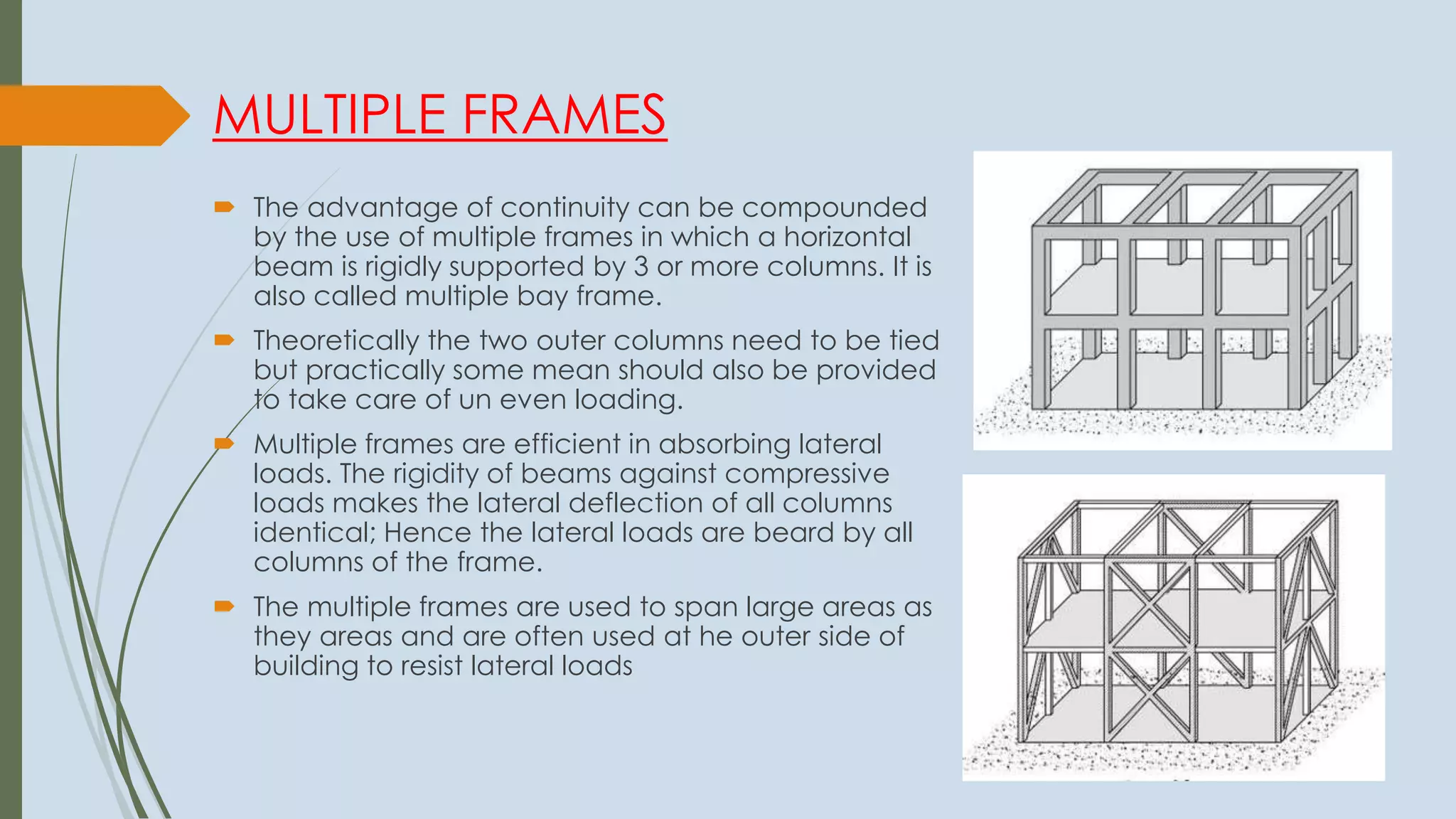
 The advantage of continuity can be compounded
by the use of multiple frames in which a horizontal
beam is rigidly supported by 3 or more columns. It is
also called multiple bay frame.
 Theoretically the two outer columns need to be tied
but practically some mean should also be provided
to take care of un even loading.
 Multiple frames are efficient in absorbing lateral
loads. The rigidity of beams against compressive
loads makes the lateral deflection of all columns
identical; Hence the lateral loads are beard by all
columns of the frame.
 The multiple frames are used to span large areas as
they areas and are often used at he outer side of
building to resist lateral loads
Types of Frames (Simple/ Multiple)
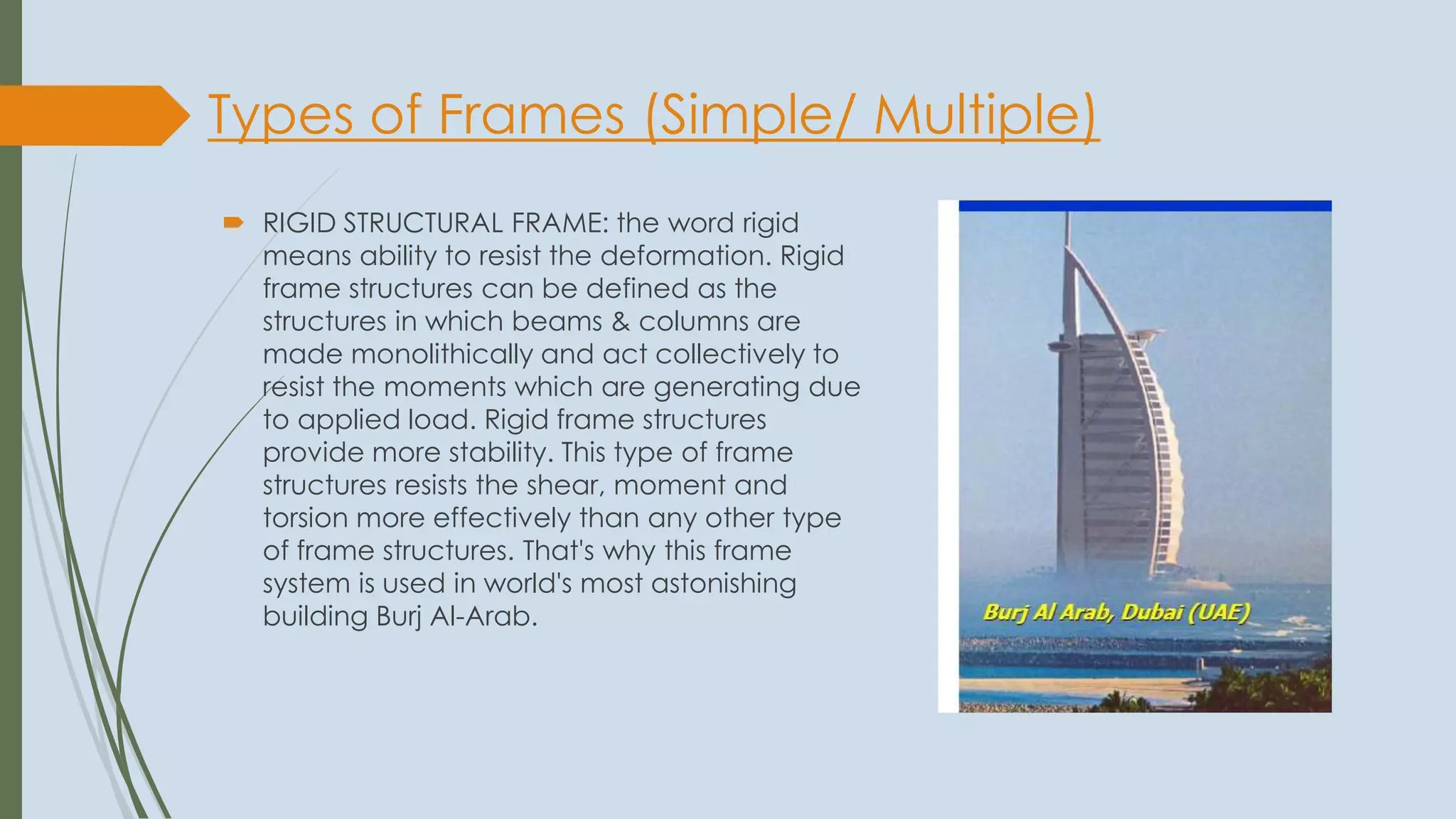
 RIGID STRUCTURAL FRAME: the word rigid
means ability to resist the deformation. Rigid
frame structures can be defined as the
structures in which beams & columns are
made monolithically and act collectively to
resist the moments which are generating due
to applied load. Rigid frame structures
provide more stability. This type of frame
structures resists the shear, moment and
torsion more effectively than any other type
of frame structures. That's why this frame
system is used in world's most astonishing
building Burj Al-Arab.
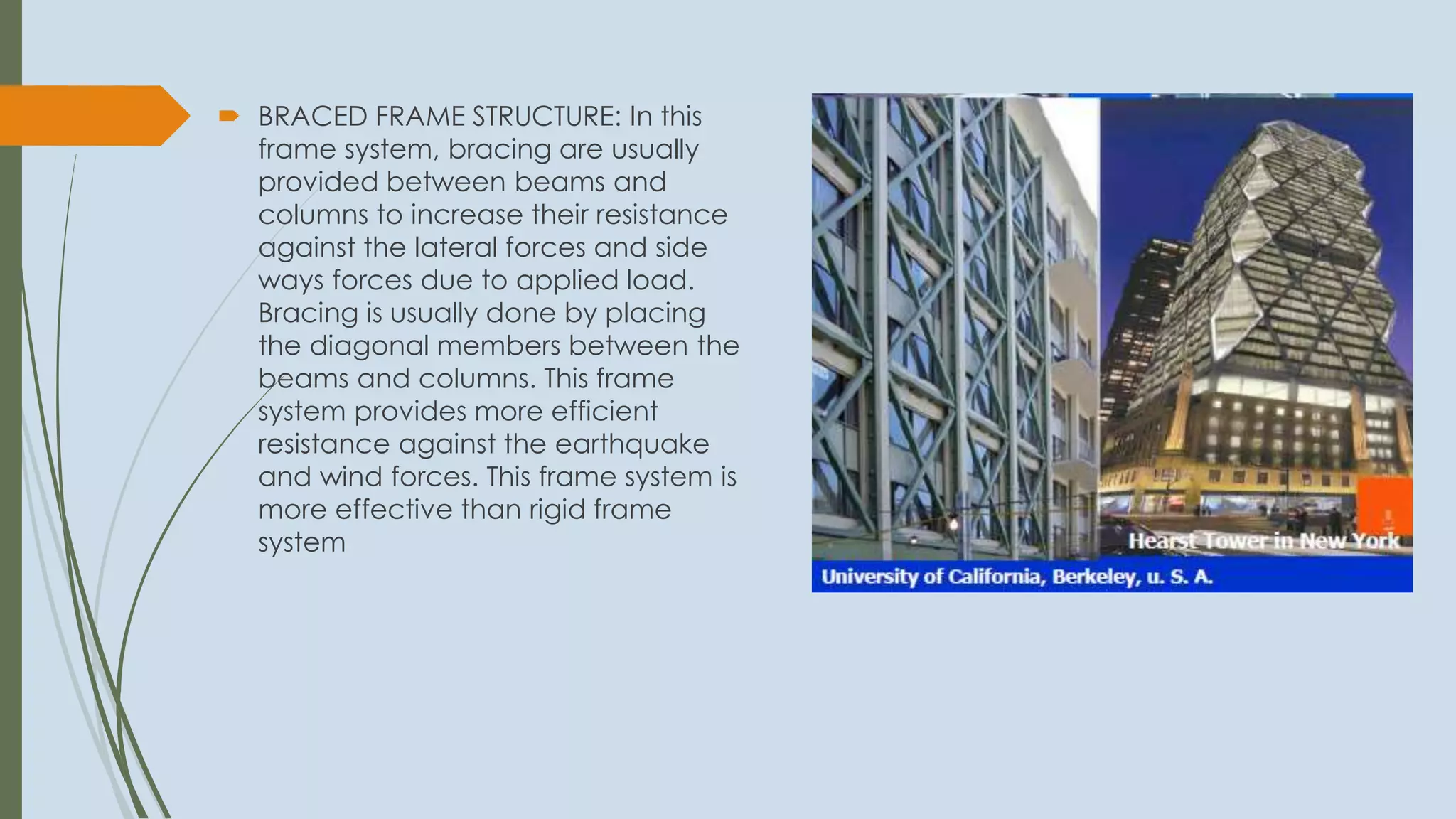
 BRACED FRAME STRUCTURE: In this
frame system, bracing are usually
provided between beams and
columns to increase their resistance
against the lateral forces and side
ways forces due to applied load.
Bracing is usually done by placing
the diagonal members between the
beams and columns. This frame
system provides more efficient
resistance against the earthquake
and wind forces. This frame system is
more effective than rigid frame
system
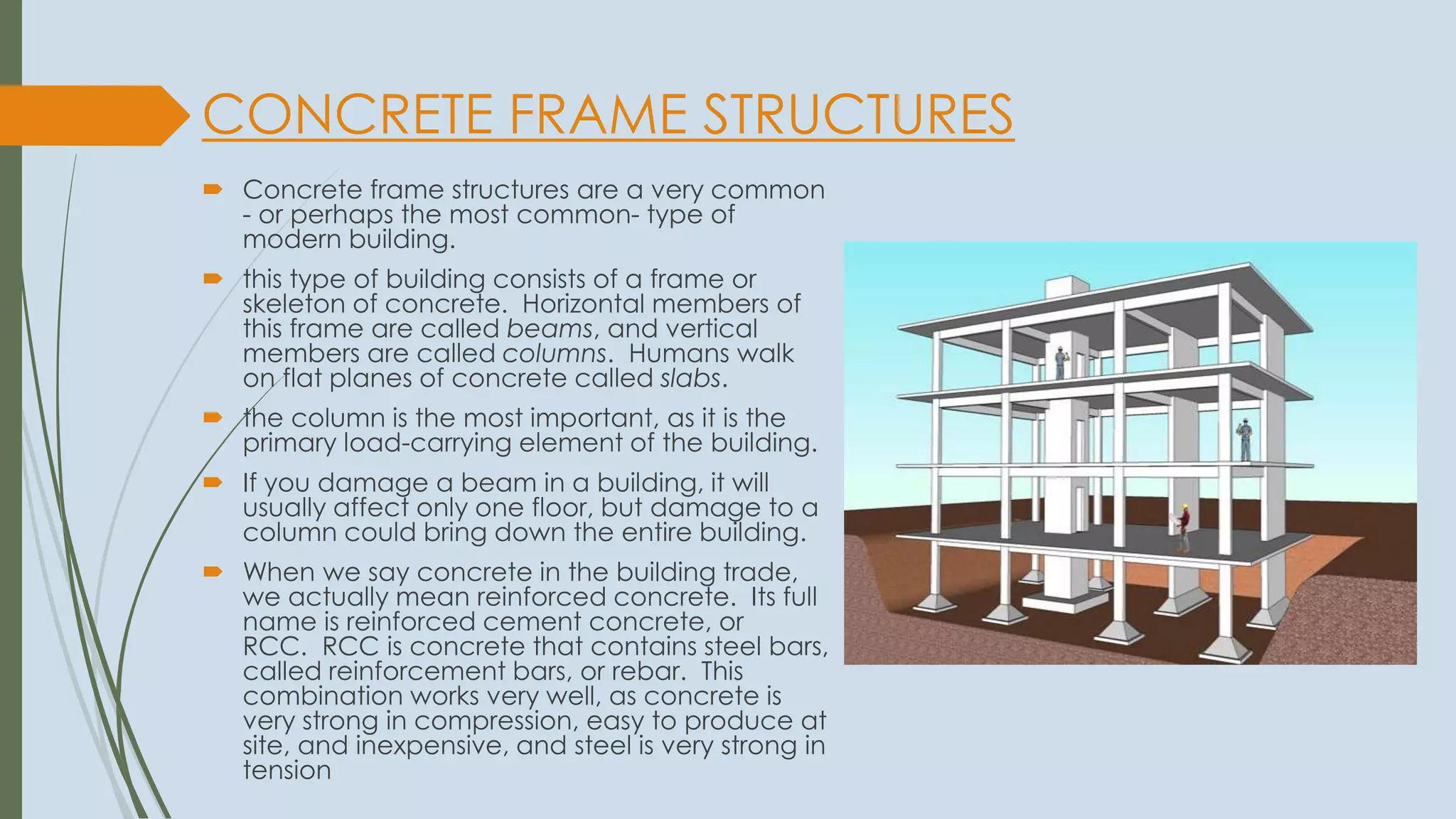
CONCRETE FRAME STRUCTURES
 Concrete frame structures are a very common
- or perhaps the most common- type of
modern building.
 this type of building consists of a frame or
skeleton of concrete. Horizontal members of
this frame are called beams, and vertical
members are called columns. Humans walk
on flat planes of concrete called slabs.
 the column is the most important, as it is the
primary load-carrying element of the building.
 If you damage a beam in a building, it will
usually affect only one floor, but damage to a
column could bring down the entire building.
 When we say concrete in the building trade,
we actually mean reinforced concrete. Its full
name is reinforced cement concrete, or
RCC. RCC is concrete that contains steel bars,
called reinforcement bars, or rebar. This
combination works very well, as concrete is
very strong in compression, easy to produce at
site, and inexpensive, and steel is very strong in
tension
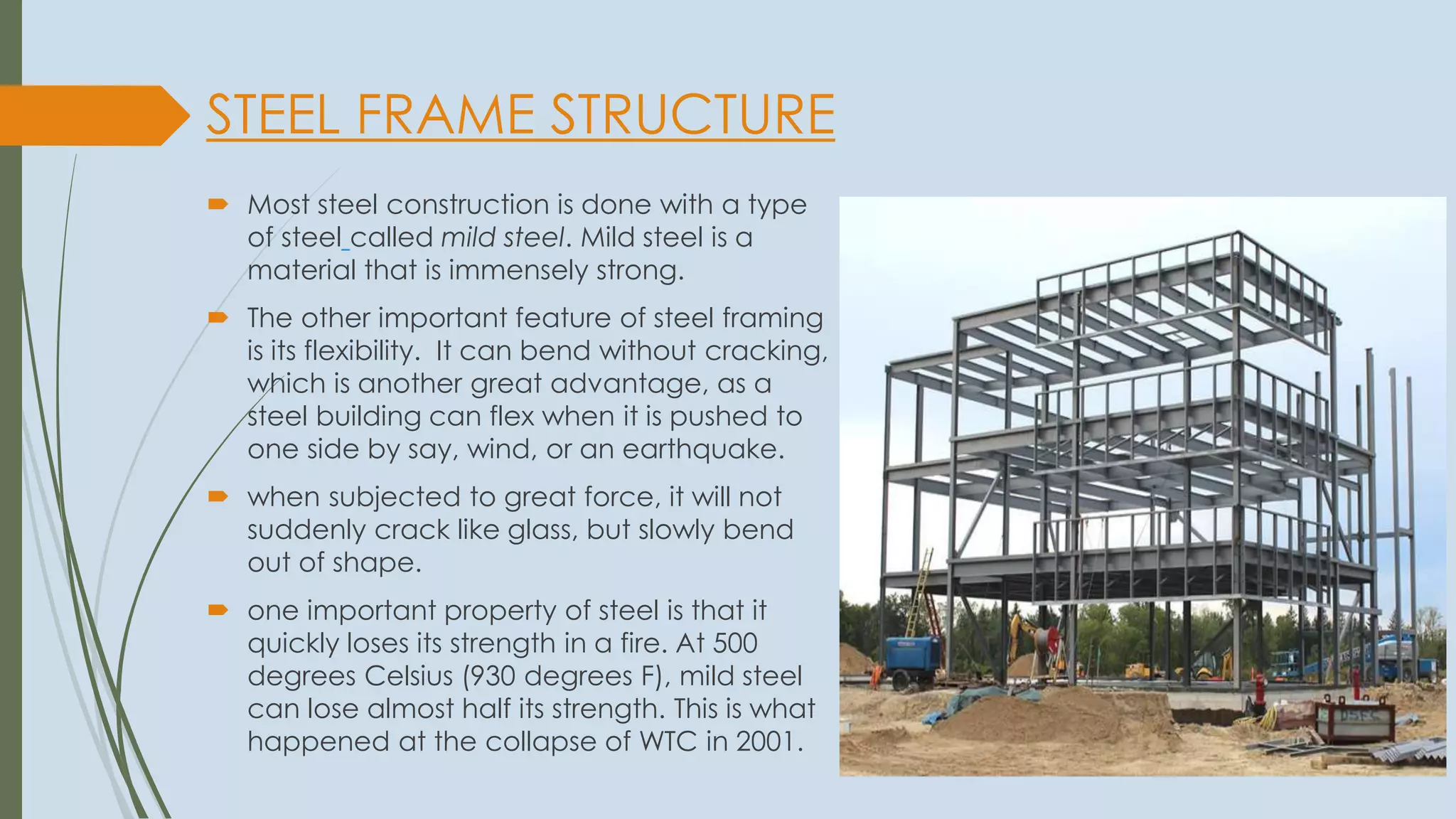
STEEL FRAME STRUCTURE
 Most steel construction is done with a type
of steel called mild steel. Mild steel is a
material that is immensely strong.
 The other important feature of steel framing
is its flexibility. It can bend without cracking,
which is another great advantage, as a
steel building can flex when it is pushed to
one side by say, wind, or an earthquake.
 when subjected to great force, it will not
suddenly crack like glass, but slowly bend
out of shape.
 one important property of steel is that it
quickly loses its strength in a fire. At 500
degrees Celsius (930 degrees F), mild steel
can lose almost half its strength. This is what
happened at the collapse of WTC in 2001.
Steel construction is most often used in
 High rise buildings because of its strength, low weight, and speed of construction
 Industrial buildings because of its ability to create large span spaces at low cost
 Warehouse buildings for the same reason
 Residential buildings in a technique called light gauge steel construction
 Temporary Structures as these are quick to set up and remove
ADVANTAGES OF STEEL STRUCTURES
Steel structures have the following advantages:
 They are super-quick to build at site, as a lot of work can be pre-fab at the factory.
 They are flexible, which makes them very good at resisting dynamic (changing)
forces such as wind or earthquake forces.
 A wide range of ready-made structural sections are available, such as I, C, and
angle sections
 They can be made to take any kind of shape, and clad with any type of material
 A wide range of joining methods is available, such as bolting, welding, and riveting
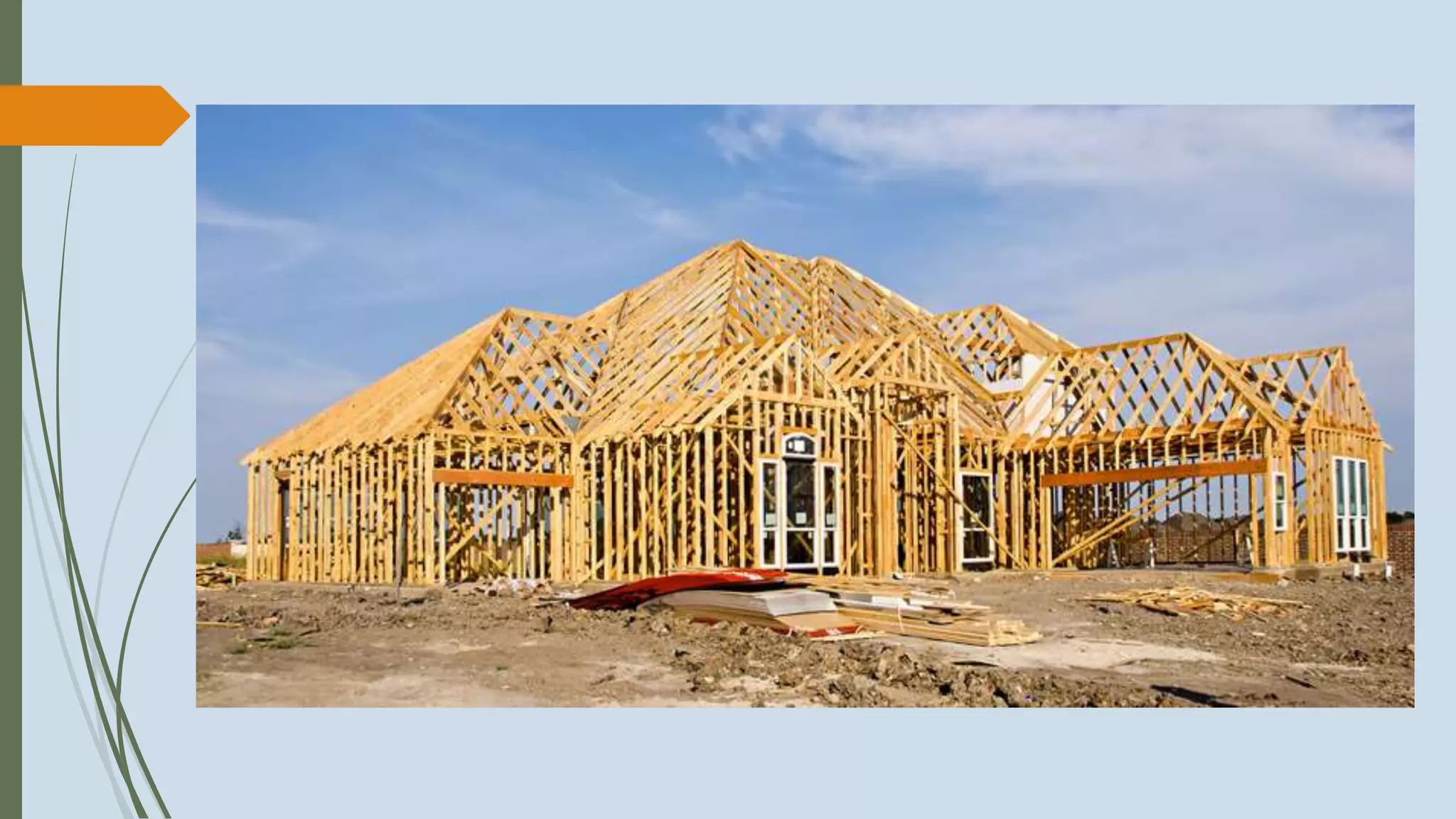
WOODEN FRAME
Light wooden framed construction is one of the most popular types of building
methods for homes in the United States and parts of Europe.
It has the following characteristics:
 It is light, and allows quick construction with no heavy tools or equipment. Every
component can easily be carried by hand - a house essentially becomes a large
carpentry job. The main tool is a handheld nail gun.
 It is able to adapt itself to any geometric shape, and can be clad with a variety of
materials.
 There are a huge variety of products and systems tailored to this type of
construction.
It has these negative characteristics:
 It is not highly fireproof, as it is made of wood.
 It is not strong enough to resist major wind events such as tornadoes and hurricanes.
building construction and material

building construction and material

  • 1.
    FRAME STRUCTURE Post &Lintel Structure, Frame Structure & its types The Simple Frame & Multiple Frame LECTURE # 3
  • 2.
  • 3.
     TENSION: Tensionis a state of Stress in which particles of material are tend to pull apart. For example a steel cable pulling or lowering an elevator tends to pull a part by the weight of elevator. Lengthening is typical of tension. And the elongation of a unit length of cable is called its tensile strain.  COMPRESSION: Compression is a state of stress in which particles of the material are pushed one against the other. For example a column supports a load is under compression, its height shortens under load. The shortening of a unit length or compressive strain is proportional to the load applied unit area of the column or compressive stress
  • 4.
     SIMPLE BENDING:The state in which a stress varies as a straight line from a maximum tension to maximum compression is called simple bending  SHEAR: The sliding action of particles relative to each other in state of stress. One of the essential characteristic of Shear is that it produces sliding action between two planes that are always at right Angle to each other. Punch hole machine is an Example of shear force.
  • 5.
    FRAME STRUCTURE  Initiallythere was no distinction between the supporting structure and the protecting skin. However separation of supporting and protecting function leads to the framed system.  A framed system may be defined as “A framed structure in any material is one that is made stable by a skeleton that is able to stand by itself as a rigid structure without depending on floors or walls to resist deformation. ”  Materials such as wood, steel, and reinforced concrete, which are strong in both tension and compression, make the best members for framing.
  • 6.
    POST & LINTELSYSTEM  Post-and-lintel system, in building construction is a system in which two upright members, the posts, hold up a third member, the lintel, laid horizontally across their top surfaces.  The lintel is a beam that is simply supported on a posts and it carries the roof load. The material used for lintel should have strong tensile and compressive strength  While the posts are vertical struts compressed by the lintels. The materials for post should have strong compressive strength.  The post must also resist some horizontal loads, such as the wind pressure; this resistance comes from a bending capacity in case of wooden and steel posts and from their own weight in stone and masonry piers.
  • 7.
     The foundationof the post carry roofs and the post loads to the ground by means of footings in any case the posts and the foundation are under compression; characteristic of post and lintel system.  Post and Lintel System may be built one over another to frame multistory buildings; In this case the lintels are supported by vertical columns or wall of masonry as high as entire building.  Construction of this type for multistory building can not resist horizontal loads and easily damaged by hurricane and earthquakes due to low bending resistance of stone and masonry.  Strong connection between horizontal and vertical member is not easily built.  All the members of post and lintel system act independently although connected together.
  • 8.
    EXAMPLES OF POSTAND LINTEL SYSTEM  From prehistoric times to the Roman Empire, the post-and-lintel system was the root of architectural design. The interiors of Egyptian temples and the exteriors of Greek temples are delineated by columns covered by stone lintels. The Greeks opened their interior spaces by substituting wooden beams for stone, since the wood required fewer supports. StonehengePARTHENON
  • 9.
    SIMPLE FRAME STRUCTURE The action of the post and lintel system changes substantially, if a rigid connection is developed between the lintel and bending resistant posts.  This structure behaves monolithically and is more stronger to horizontal loads and vertical loads.  This structure system is called single bay rigid frame or simple frame.  Three consequences arises when we rigidly connect the horizontal member with the vertical ones 1. The beam will restrained its end and will become more rigid and would be capable of supporting heavier loads. 2. The columns are not only subjected to compressive loads and their own loads but also to the bending stresses due to continuity with the beam. 3. A new horizontal force would be required to maintain the frame in equilibrium under vertical loads. ( The thrust that bring back the columns to their vertical position).  A thrust may be provided by a tie rod that does not allow the frame to open up.
  • 10.
    SIMPLE FRAME STRUCTURE Frames are stronger against vertical loads than post and lintel system and are more advantageous in resisting lateral loads.  A post loaded by horizontal load acts as a single cantilevered beam while in frame structure horizontal member transfer the lateral load from wind ward column to lee word column.  By this way deflection and bending stresses are reduced.
  • 11.
    MULTIPLE FRAMES  Theadvantage of continuity can be compounded by the use of multiple frames in which a horizontal beam is rigidly supported by 3 or more columns. It is also called multiple bay frame.  Theoretically the two outer columns need to be tied but practically some mean should also be provided to take care of un even loading.  Multiple frames are efficient in absorbing lateral loads. The rigidity of beams against compressive loads makes the lateral deflection of all columns identical; Hence the lateral loads are beard by all columns of the frame.  The multiple frames are used to span large areas as they areas and are often used at he outer side of building to resist lateral loads
  • 12.
    Types of Frames(Simple/ Multiple)  RIGID STRUCTURAL FRAME: the word rigid means ability to resist the deformation. Rigid frame structures can be defined as the structures in which beams & columns are made monolithically and act collectively to resist the moments which are generating due to applied load. Rigid frame structures provide more stability. This type of frame structures resists the shear, moment and torsion more effectively than any other type of frame structures. That's why this frame system is used in world's most astonishing building Burj Al-Arab.
  • 13.
     BRACED FRAMESTRUCTURE: In this frame system, bracing are usually provided between beams and columns to increase their resistance against the lateral forces and side ways forces due to applied load. Bracing is usually done by placing the diagonal members between the beams and columns. This frame system provides more efficient resistance against the earthquake and wind forces. This frame system is more effective than rigid frame system
  • 14.
    CONCRETE FRAME STRUCTURES Concrete frame structures are a very common - or perhaps the most common- type of modern building.  this type of building consists of a frame or skeleton of concrete. Horizontal members of this frame are called beams, and vertical members are called columns. Humans walk on flat planes of concrete called slabs.  the column is the most important, as it is the primary load-carrying element of the building.  If you damage a beam in a building, it will usually affect only one floor, but damage to a column could bring down the entire building.  When we say concrete in the building trade, we actually mean reinforced concrete. Its full name is reinforced cement concrete, or RCC. RCC is concrete that contains steel bars, called reinforcement bars, or rebar. This combination works very well, as concrete is very strong in compression, easy to produce at site, and inexpensive, and steel is very strong in tension
  • 15.
    STEEL FRAME STRUCTURE Most steel construction is done with a type of steel called mild steel. Mild steel is a material that is immensely strong.  The other important feature of steel framing is its flexibility. It can bend without cracking, which is another great advantage, as a steel building can flex when it is pushed to one side by say, wind, or an earthquake.  when subjected to great force, it will not suddenly crack like glass, but slowly bend out of shape.  one important property of steel is that it quickly loses its strength in a fire. At 500 degrees Celsius (930 degrees F), mild steel can lose almost half its strength. This is what happened at the collapse of WTC in 2001.
  • 16.
    Steel construction ismost often used in  High rise buildings because of its strength, low weight, and speed of construction  Industrial buildings because of its ability to create large span spaces at low cost  Warehouse buildings for the same reason  Residential buildings in a technique called light gauge steel construction  Temporary Structures as these are quick to set up and remove
  • 17.
    ADVANTAGES OF STEELSTRUCTURES Steel structures have the following advantages:  They are super-quick to build at site, as a lot of work can be pre-fab at the factory.  They are flexible, which makes them very good at resisting dynamic (changing) forces such as wind or earthquake forces.  A wide range of ready-made structural sections are available, such as I, C, and angle sections  They can be made to take any kind of shape, and clad with any type of material  A wide range of joining methods is available, such as bolting, welding, and riveting
  • 18.
    WOODEN FRAME Light woodenframed construction is one of the most popular types of building methods for homes in the United States and parts of Europe. It has the following characteristics:  It is light, and allows quick construction with no heavy tools or equipment. Every component can easily be carried by hand - a house essentially becomes a large carpentry job. The main tool is a handheld nail gun.  It is able to adapt itself to any geometric shape, and can be clad with a variety of materials.  There are a huge variety of products and systems tailored to this type of construction. It has these negative characteristics:  It is not highly fireproof, as it is made of wood.  It is not strong enough to resist major wind events such as tornadoes and hurricanes.