BUILDING
CONSTRUCTION
SPACE FRAME
DEFINITION:
 A three-dimensional structures.
 The assembled linear elements are arranged to
transfer the load.
 Take a form of a flat surface or curve surface.
 Designed with no intermediate columns to create
large open area.
Load Distribution
TYPES OF SPACE FRAME
1) Two and three-way grids
 Characterized as two way or three way
2) Single, Double and Triple Layered
 Single layer frame has to be singly or doubly
curved.
 Commonly used space frames are double
layered and flat.
 Triple layered is practically used for a large
span building.
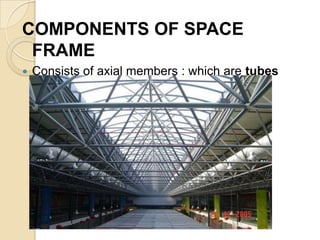
COMPONENTS OF SPACE
FRAME
 Consists of axial members : which are tubes
and connectors
TUBES
1) Circular Hollow Sections
2) Rectangular Hollow Sections
CONNECTORS
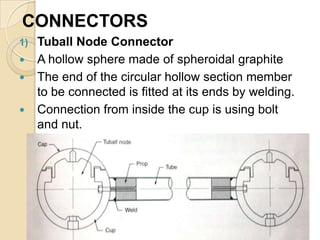
1) Tuball Node Connector
 A hollow sphere made of spheroidal graphite
 The end of the circular hollow section member
to be connected is fitted at its ends by welding.
 Connection from inside the cup is using bolt
and nut.
2) Nodus Connector
 It can accept both rectangular and circular
hollow sections and that the cladding can be
fixed directly to the chords.
 Chord connectors have to be welded to the
ends of the hollow members on site.
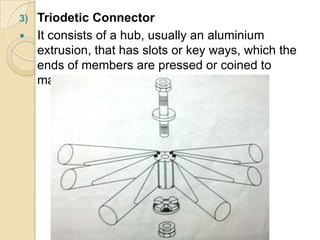
3) Triodetic Connector
 It consists of a hub, usually an aluminium
extrusion, that has slots or key ways, which the
ends of members are pressed or coined to
match the slots.
4) Hemispherical Dome Connector
 Usually use for double layer domes.
 Has a span more than 40m.
 More economical for long span.
 The jointing is connect by sliting the end of the
tube or rod with the joint fin.
 There are 2 types of joint, pentagonal joint and
hexagonal joint.
ADVANTAGES
 Light
 Elegant & Economical
 Carry load by three dimensional action
 High Inherent Stiffness
 Easy to construct
 Save Construction Time & Cost
 Services (such as lighting and air conditioning)
can be integrated with space frames
 Offer the architect unrestricted freedom in
locating supports and planning the subdivision
of the covered space.
EXAMPLES OF BUILDING
SAN SIRO STADIUM, MILAN
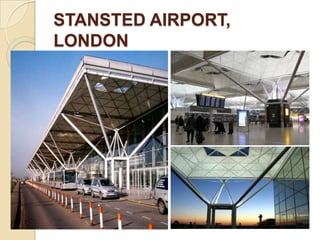
STANSTED AIRPORT,
LONDON
THANK
YOU

Space frame

  • 1.
  • 2.
    DEFINITION:  A three-dimensionalstructures.  The assembled linear elements are arranged to transfer the load.  Take a form of a flat surface or curve surface.  Designed with no intermediate columns to create large open area.
  • 3.
  • 4.
    TYPES OF SPACEFRAME 1) Two and three-way grids  Characterized as two way or three way 2) Single, Double and Triple Layered  Single layer frame has to be singly or doubly curved.  Commonly used space frames are double layered and flat.  Triple layered is practically used for a large span building.
  • 5.
    COMPONENTS OF SPACE FRAME Consists of axial members : which are tubes and connectors
  • 6.
    TUBES 1) Circular HollowSections 2) Rectangular Hollow Sections
  • 7.
    CONNECTORS 1) Tuball NodeConnector  A hollow sphere made of spheroidal graphite  The end of the circular hollow section member to be connected is fitted at its ends by welding.  Connection from inside the cup is using bolt and nut.
  • 9.
    2) Nodus Connector It can accept both rectangular and circular hollow sections and that the cladding can be fixed directly to the chords.  Chord connectors have to be welded to the ends of the hollow members on site.
  • 11.
    3) Triodetic Connector It consists of a hub, usually an aluminium extrusion, that has slots or key ways, which the ends of members are pressed or coined to match the slots.
  • 12.
    4) Hemispherical DomeConnector  Usually use for double layer domes.  Has a span more than 40m.  More economical for long span.  The jointing is connect by sliting the end of the tube or rod with the joint fin.  There are 2 types of joint, pentagonal joint and hexagonal joint.
  • 14.
    ADVANTAGES  Light  Elegant& Economical  Carry load by three dimensional action  High Inherent Stiffness  Easy to construct  Save Construction Time & Cost  Services (such as lighting and air conditioning) can be integrated with space frames  Offer the architect unrestricted freedom in locating supports and planning the subdivision of the covered space.
  • 15.
  • 16.
  • 17.
  • 19.