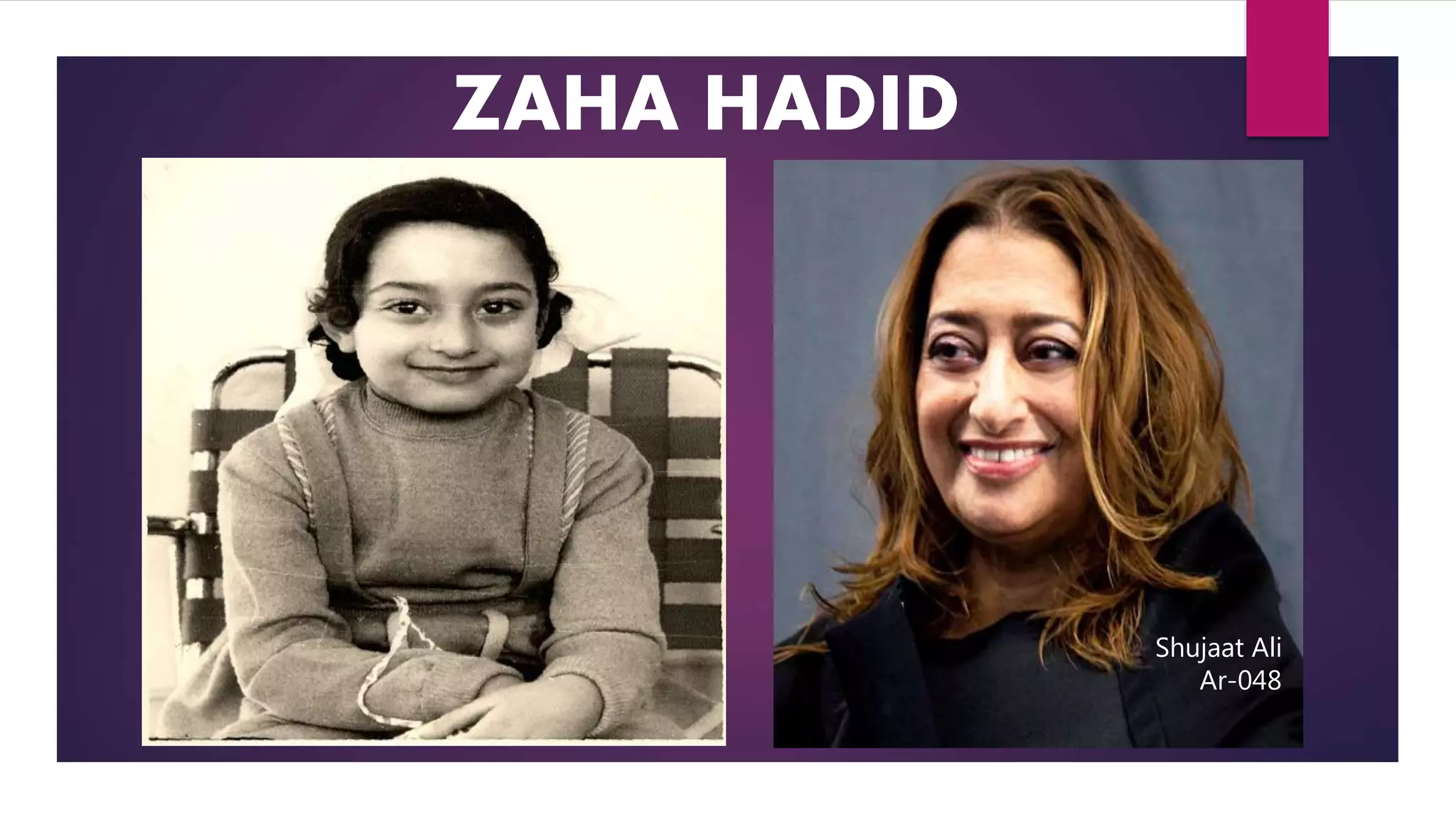
ZAHA HADID
Shujaat Ali
Ar-048
Biography
 Name : Dame Zaha Mohammad Hadid
 Nationality : Iraqi-British
 Birth : October 31, 1950 ,Baghdad
 Death : March 31, 2016, Miami, Florida, United States
 Education : 1968 - 1971 Trained Math's at the American University of Beirut 1972 - 1977
Studied architecture at the Architectural Association school
 Practice : Joined OMA (office of metropolitan architecture) and became a partner
(1977).Own practice 'ZAHA HADID office' (from 1980).
CAREER
After she graduated she worked with Rem Koolhaas
Started her own firm in 1980
Her Ideas were in more of demand than her designs
She won many competitions but a lot of them were never built
Despite her influences, was often dismissed as a dreamer, whose work was unrealizable and impractical
She taught at the Architecture Association
Almost wanted to give up Architecture after facing a huge rejection for her design for the Cardiff Bay Opera
House in Wales.
Her design was chosen but local opinion ran against it so it was rejected basically because it wasn’t traditional
enough. (1994)
She has been known as DIVA and difficult to work with at times, but people who admire her would praise her
for her personal style.
CONCEPT
• "GRAVITY-DEFYING",
• "FRAGMENTARY"
• "REVOLUTIONARY"
A MAIN THEME OF HADID'S DESIGNS EXHIBITS THAT A
BUILDING CAN FLOAT AND DEFY GRAVITY.
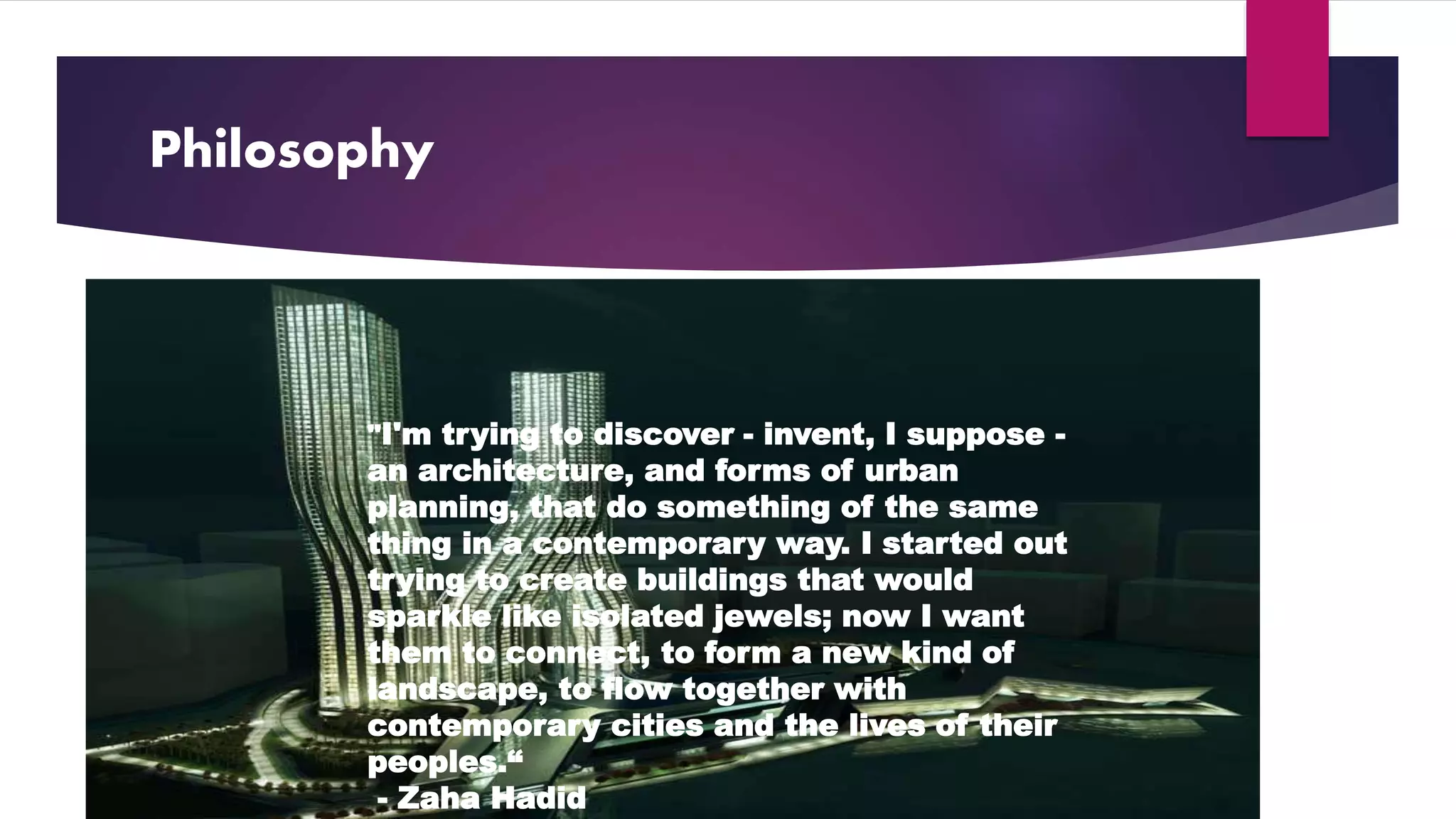
Philosophy
"I'm trying to discover - invent, I suppose -
an architecture, and forms of urban
planning, that do something of the same
thing in a contemporary way. I started out
trying to create buildings that would
sparkle like isolated jewels; now I want
them to connect, to form a new kind of
landscape, to flow together with
contemporary cities and the lives of their
peoples.“
- Zaha Hadid
ARCHITECTURAL STYLE
Zaha Hadid's style is boldly
contemporary, organic and
innovative.
She was inspired by Yohji Yamamoto and his
asymmetry.
Her creations are more to do with
topography and landscape, emulating a
natural form.
WORK’S
VITRA FIRE STATION
1993 she completed what became her
first signature project in Germany for
the Vitra Furniture Compnany.
The angular building is now a
museum.
CENTRE FOR CONTEMPORARY ART
Professional breakthrough came in 2003
with the successful construction of her
challenging design for the museum in
Cincinnati, Ohio.
This was her first building in the United
States.
Which made her become known
internationally.
CHANEL MOIBLE ART PAVILLION
Location: Hong Kong, Tokyo, New
York, Paris
Materials: Fibre Re-inforced Plastic,
Structural Steel
•Chanel Pavilion is a celebration of
the iconic work of Chanel
•the steel structure has been
designed to be built in under one
week, which is essential for an
ephemeral pavilion.
Heydar Aliyev Center
The Heydar Aliyev Center is a 619,000-square-foot
building complex in BAKU designed by ZAHA HADID and
noted for its distinctive architecture and flowing, curved
style that eschews sharp angles.[1] The center is named
for HAIDER ALIYEV, the leader of Soviet-era Azerbaijan
Product designs
1. Limited Edition
LACOSTE shoe (2009)
2. Louis Vittion ICONE
BAG (2006)
3. Skein Sleeve Bracelet
(2009)
4. Zcar II (2008)
END

Zaha hadid

  • 1.
  • 2.
    Biography  Name :Dame Zaha Mohammad Hadid  Nationality : Iraqi-British  Birth : October 31, 1950 ,Baghdad  Death : March 31, 2016, Miami, Florida, United States  Education : 1968 - 1971 Trained Math's at the American University of Beirut 1972 - 1977 Studied architecture at the Architectural Association school  Practice : Joined OMA (office of metropolitan architecture) and became a partner (1977).Own practice 'ZAHA HADID office' (from 1980).
  • 3.
    CAREER After she graduatedshe worked with Rem Koolhaas Started her own firm in 1980 Her Ideas were in more of demand than her designs She won many competitions but a lot of them were never built Despite her influences, was often dismissed as a dreamer, whose work was unrealizable and impractical She taught at the Architecture Association Almost wanted to give up Architecture after facing a huge rejection for her design for the Cardiff Bay Opera House in Wales. Her design was chosen but local opinion ran against it so it was rejected basically because it wasn’t traditional enough. (1994) She has been known as DIVA and difficult to work with at times, but people who admire her would praise her for her personal style.
  • 4.
    CONCEPT • "GRAVITY-DEFYING", • "FRAGMENTARY" •"REVOLUTIONARY" A MAIN THEME OF HADID'S DESIGNS EXHIBITS THAT A BUILDING CAN FLOAT AND DEFY GRAVITY.
  • 5.
    Philosophy "I'm trying todiscover - invent, I suppose - an architecture, and forms of urban planning, that do something of the same thing in a contemporary way. I started out trying to create buildings that would sparkle like isolated jewels; now I want them to connect, to form a new kind of landscape, to flow together with contemporary cities and the lives of their peoples.“ - Zaha Hadid
  • 6.
    ARCHITECTURAL STYLE Zaha Hadid'sstyle is boldly contemporary, organic and innovative. She was inspired by Yohji Yamamoto and his asymmetry. Her creations are more to do with topography and landscape, emulating a natural form.
  • 7.
    WORK’S VITRA FIRE STATION 1993she completed what became her first signature project in Germany for the Vitra Furniture Compnany. The angular building is now a museum.
  • 8.
    CENTRE FOR CONTEMPORARYART Professional breakthrough came in 2003 with the successful construction of her challenging design for the museum in Cincinnati, Ohio. This was her first building in the United States. Which made her become known internationally.
  • 9.
    CHANEL MOIBLE ARTPAVILLION Location: Hong Kong, Tokyo, New York, Paris Materials: Fibre Re-inforced Plastic, Structural Steel •Chanel Pavilion is a celebration of the iconic work of Chanel •the steel structure has been designed to be built in under one week, which is essential for an ephemeral pavilion.
  • 10.
    Heydar Aliyev Center TheHeydar Aliyev Center is a 619,000-square-foot building complex in BAKU designed by ZAHA HADID and noted for its distinctive architecture and flowing, curved style that eschews sharp angles.[1] The center is named for HAIDER ALIYEV, the leader of Soviet-era Azerbaijan
  • 11.
    Product designs 1. LimitedEdition LACOSTE shoe (2009) 2. Louis Vittion ICONE BAG (2006) 3. Skein Sleeve Bracelet (2009) 4. Zcar II (2008)
  • 12.