Decision Trees built in Hadoop
plus more Big Data Analytics
with Revolution R Enterprise
All Rights Reserved, Revolution Analytics 2014
Mario Inchiosa, US Chief Scientist
mario.inchiosa@revolutionanalytics.com
Revolution Webinar – April 17, 2014
2
OUR COMPANY
The leading provider
of advanced analytics
software and services
based on open source R,
since 2007
OUR SOFTWARE
The only Big Data, Big
Analytics software platform
based on the data science
language R
SOME KUDOS
Visionary
Gartner Magic Quadrant
for Advanced Analytics
Platforms, 2014
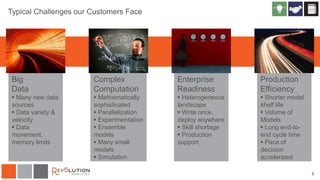
Typical Challenges our Customers Face
Big
Data
 Many new data
sources
 Data variety &
velocity
 Data
movement,
memory limits
3
Production
Efficiency
 Shorter model
shelf life
 Volume of
Models
 Long end-to-
end cycle time
 Pace of
decision
accelerated
Enterprise
Readiness
 Heterogeneous
landscape
 Write once,
deploy anywhere
 Skill shortage
 Production
support
Complex
Computation
 Mathematically
sophisticated
 Parallelization
 Experimentation
 Ensemble
models
 Many small
models
 Simulation
Polling Question:
 What is your current analytics software platform?
– Please select one
• R/RRE
• SAS
• SPSS
• Tibco/Spotfire
• KXEN
• Other
OPEN SOURCE R
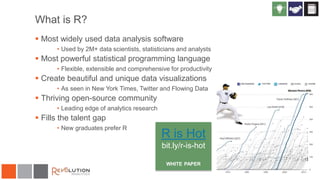
What is R?
 Most widely used data analysis software
• Used by 2M+ data scientists, statisticians and analysts
 Most powerful statistical programming language
• Flexible, extensible and comprehensive for productivity
 Create beautiful and unique data visualizations
• As seen in New York Times, Twitter and Flowing Data
 Thriving open-source community
• Leading edge of analytics research
 Fills the talent gap
• New graduates prefer R
R is Hot
bit.ly/r-is-hot
WHITE PAPER
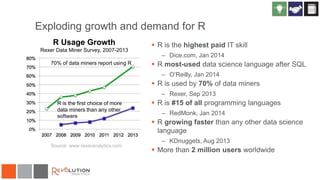
Exploding growth and demand for R
 R is the highest paid IT skill
– Dice.com, Jan 2014
 R most-used data science language after SQL
– O’Reilly, Jan 2014
 R is used by 70% of data miners
– Rexer, Sep 2013
 R is #15 of all programming languages
– RedMonk, Jan 2014
 R growing faster than any other data science
language
– KDnuggets, Aug 2013
 More than 2 million users worldwide
R Usage Growth
Rexer Data Miner Survey, 2007-2013
70% of data miners report using R
R is the first choice of more
data miners than any other
software
Source: www.rexeranalytics.com
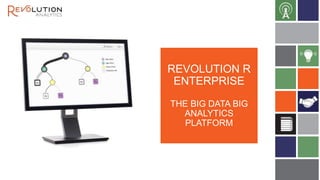
REVOLUTION R
ENTERPRISE
THE BIG DATA BIG
ANALYTICS
PLATFORM
Revolution R Enterprise
 High Performance, Scalable Analytics
 Portable Across Enterprise Platforms
 Easier to Build & Deploy Analytics
is….
the only big data big analytics platform
based on open source R
9
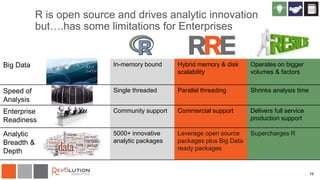
Big Data In-memory bound Hybrid memory & disk
scalability
Operates on bigger
volumes & factors
Speed of
Analysis
Single threaded Parallel threading Shrinks analysis time
Enterprise
Readiness
Community support Commercial support Delivers full service
production support
Analytic
Breadth &
Depth
5000+ innovative
analytic packages
Leverage open source
packages plus Big Data
ready packages
Supercharges R
R is open source and drives analytic innovation
but….has some limitations for Enterprises
10
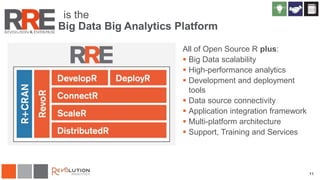
All of Open Source R plus:
 Big Data scalability
 High-performance analytics
 Development and deployment
tools
 Data source connectivity
 Application integration framework
 Multi-platform architecture
 Support, Training and Services
11
is the
Big Data Big Analytics Platform
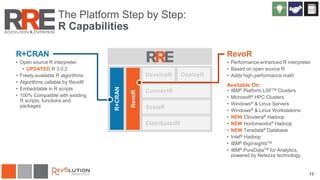
R+CRAN
• Open source R interpreter
• UPDATED R 3.0.2
• Freely-available R algorithms
• Algorithms callable by RevoR
• Embeddable in R scripts
• 100% Compatible with existing
R scripts, functions and
packages
RevoR
• Performance enhanced R interpreter
• Based on open source R
• Adds high-performance math
Available On:
• IBM® Platform LSFTM Clusters
• Microsoft® HPC Clusters
• Windows® & Linux Servers
• Windows® & Linux Workstations
• NEW Cloudera® Hadoop
• NEW Hortonworks® Hadoop
• NEW Teradata® Database
• Intel® Hadoop
• IBM® BigInsightsTM
• IBM® PureDataTM for Analytics,
powered by Netezza technology
12
The Platform Step by Step:
R Capabilities
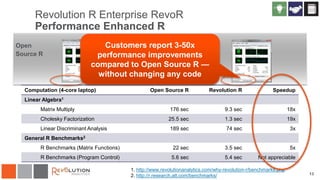
Revolution R Enterprise RevoR
Performance Enhanced R
Open
Source R
Revolution R
Enterprise
Computation (4-core laptop) Open Source R Revolution R Speedup
Linear Algebra1
Matrix Multiply 176 sec 9.3 sec 18x
Cholesky Factorization 25.5 sec 1.3 sec 19x
Linear Discriminant Analysis 189 sec 74 sec 3x
General R Benchmarks2
R Benchmarks (Matrix Functions) 22 sec 3.5 sec 5x
R Benchmarks (Program Control) 5.6 sec 5.4 sec Not appreciable
1. http://www.revolutionanalytics.com/why-revolution-r/benchmarks.php
2. http://r.research.att.com/benchmarks/
Customers report 3-50x
performance improvements
compared to Open Source R —
without changing any code
13
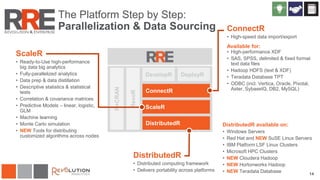
DistributedR
• Distributed computing framework
• Delivers portability across platforms
ConnectR
• High-speed data import/export
Available for:
• High-performance XDF
• SAS, SPSS, delimited & fixed format
text data files
• Hadoop HDFS (text & XDF)
• Teradata Database TPT
• ODBC (incl. Vertica, Oracle, Pivotal,
Aster, SybaseIQ, DB2, MySQL)
ScaleR
• Ready-to-Use high-performance
big data big analytics
• Fully-parallelized analytics
• Data prep & data distillation
• Descriptive statistics & statistical
tests
• Correlation & covariance matrices
• Predictive Models – linear, logistic,
GLM
• Machine learning
• Monte Carlo simulation
• NEW Tools for distributing
customized algorithms across nodes
DistributedR available on:
• Windows Servers
• Red Hat and NEW SuSE Linux Servers
• IBM Platform LSF Linux Clusters
• Microsoft HPC Clusters
• NEW Cloudera Hadoop
• NEW Hortonworks Hadoop
• NEW Teradata Database 14
The Platform Step by Step:
Parallelization & Data Sourcing
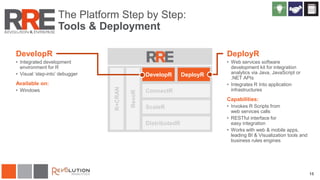
DeployR
• Web services software
development kit for integration
analytics via Java, JavaScript or
.NET APIs
• Integrates R Into application
infrastructures
Capabilities:
• Invokes R Scripts from
web services calls
• RESTful interface for
easy integration
• Works with web & mobile apps,
leading BI & Visualization tools and
business rules engines
DevelopR
• Integrated development
environment for R
• Visual ‘step-into’ debugger
Available on:
• Windows
DevelopR DeployR
15
The Platform Step by Step:
Tools & Deployment
16
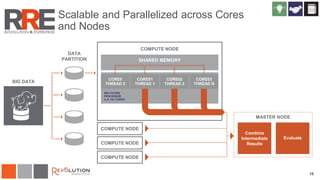
Scalable and Parallelized across Cores
and Nodes
0010
COMPUTE NODE
COMPUTE NODE
MULTICORE
PROCESSOR
4, 8, 16+ CORES
Evaluate
COMPUTE NODE
COMPUTE NODE
0101
0010
1110
1100
01010
DATA
PARTITION
BIG DATA
010101010010101001010010010010100101010101
011010
SHARED MEMORY
100101
101001
111000
01010101001001010011100100100101001010101010101010100100
Combine
Intermediate
Results
MASTER NODE
CORE0
THREAD 0
CORE01
THREAD 1
CORE02
THREAD 2
CORE03
THREAD N
ScaleR Scalability and Performance
 Handles an arbitrarily large number of rows in a fixed amount of memory
 Scales linearly with the number of rows
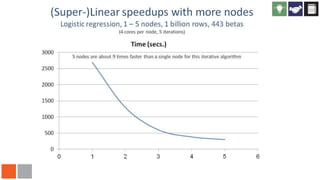
 Scales linearly with the number of nodes
 Scales well with the number of cores per node
 Scales well with the number of parameters
 Extremely high performance
17
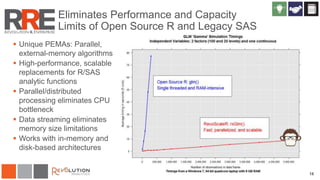
 Unique PEMAs: Parallel,
external-memory algorithms
 High-performance, scalable
replacements for R/SAS
analytic functions
 Parallel/distributed
processing eliminates CPU
bottleneck
 Data streaming eliminates
memory size limitations
 Works with in-memory and
disk-based architectures
18
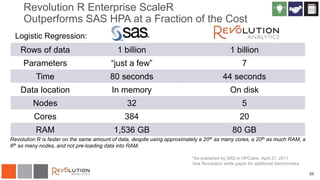
Eliminates Performance and Capacity
Limits of Open Source R and Legacy SAS
Rows of data 1 billion 1 billion
Parameters “just a few” 7
Time 80 seconds 44 seconds
Data location In memory On disk
Nodes 32 5
Cores 384 20
RAM 1,536 GB 80 GB
Revolution R is faster on the same amount of data, despite using approximately a 20th as many cores, a 20th as much RAM, a
6th as many nodes, and not pre-loading data into RAM.
*As published by SAS in HPCwire, April 21, 2011
See Revolution white paper for additional benchmarks.
Logistic Regression:
20
Revolution R Enterprise ScaleR
Outperforms SAS HPA at a Fraction of the Cost
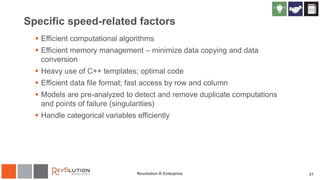
Specific speed-related factors
 Efficient computational algorithms
 Efficient memory management – minimize data copying and data
conversion
 Heavy use of C++ templates; optimal code
 Efficient data file format; fast access by row and column
 Models are pre-analyzed to detect and remove duplicate computations
and points of failure (singularities)
 Handle categorical variables efficiently
Revolution R Enterprise 21
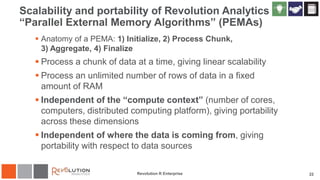
Scalability and portability of Revolution Analytics
“Parallel External Memory Algorithms” (PEMAs)
 Anatomy of a PEMA: 1) Initialize, 2) Process Chunk,
3) Aggregate, 4) Finalize
 Process a chunk of data at a time, giving linear scalability
 Process an unlimited number of rows of data in a fixed
amount of RAM
 Independent of the “compute context” (number of cores,
computers, distributed computing platform), giving portability
across these dimensions
 Independent of where the data is coming from, giving
portability with respect to data sources
Revolution R Enterprise 22
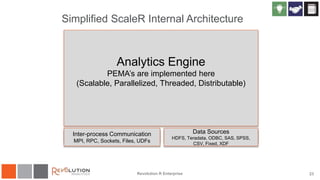
Simplified ScaleR Internal Architecture
Revolution R Enterprise 23
Analytics Engine
PEMA’s are implemented here
(Scalable, Parallelized, Threaded, Distributable)
Inter-process Communication
MPI, RPC, Sockets, Files, UDFs
Data Sources
HDFS, Teradata, ODBC, SAS, SPSS,
CSV, Fixed, XDF
DistributedR
ScaleR
ConnectR
DeployR
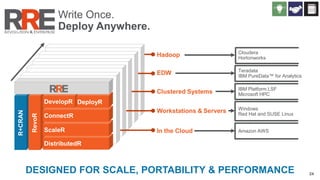
DESIGNED FOR SCALE, PORTABILITY & PERFORMANCE
In the Cloud Amazon AWS
Workstations & Servers Windows
Red Hat and SUSE Linux
Clustered Systems IBM Platform LSF
Microsoft HPC
EDW Teradata
IBM PureData™ for Analytics
Hadoop Cloudera
Hortonworks
24
Write Once.
Deploy Anywhere.
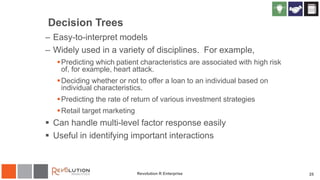
Decision Trees
– Easy-to-interpret models
– Widely used in a variety of disciplines. For example,
Predicting which patient characteristics are associated with high risk
of, for example, heart attack.
Deciding whether or not to offer a loan to an individual based on
individual characteristics.
Predicting the rate of return of various investment strategies
Retail target marketing
 Can handle multi-level factor response easily
 Useful in identifying important interactions
Revolution R Enterprise 25
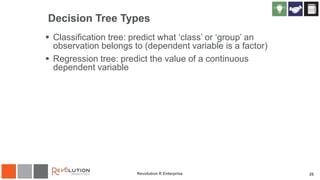
Decision Tree Types
 Classification tree: predict what ‘class’ or ‘group’ an
observation belongs to (dependent variable is a factor)
 Regression tree: predict the value of a continuous
dependent variable
Revolution R Enterprise 26
27
Polling Question:
 What is your “go-to” tree algorithm for predictions in your work?
– Please select one answer
• Single Trees
• Random Forests
• It Depends
• Neither
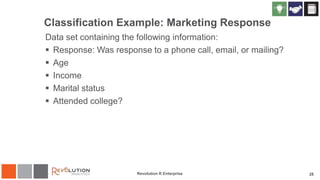
Classification Example: Marketing Response
Data set containing the following information:
 Response: Was response to a phone call, email, or mailing?
 Age
 Income
 Marital status
 Attended college?
Revolution R Enterprise 28
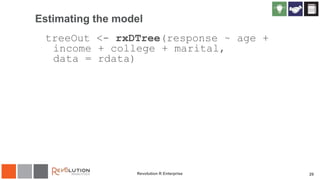
Estimating the model
treeOut <- rxDTree(response ~ age +
income + college + marital,
data = rdata)
Revolution R Enterprise 29
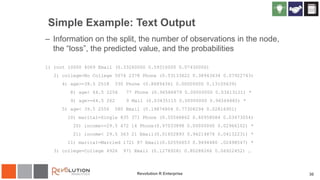
Simple Example: Text Output
– Information on the split, the number of observations in the node,
the “loss”, the predicted value, and the probabilities
1) root 10000 4069 Email (0.33260000 0.59310000 0.07430000)
2) college=No College 5074 2378 Phone (0.53133622 0.38943634 0.07922743)
4) age>=39.5 2518 330 Phone (0.86894361 0.00000000 0.13105639)
8) age< 64.5 2256 77 Phone (0.96586879 0.00000000 0.03413121) *
9) age>=64.5 262 9 Mail (0.03435115 0.00000000 0.96564885) *
5) age< 39.5 2556 580 Email (0.19874804 0.77308294 0.02816901)
10) marital=Single 835 371 Phone (0.55568862 0.40958084 0.03473054)
20) income>=29.5 472 14 Phone(0.97033898 0.00000000 0.02966102) *
21) income< 29.5 363 21 Email(0.01652893 0.94214876 0.04132231) *
11) marital=Married 1721 87 Email(0.02556653 0.9494480 .02498547) *
3) college=College 4926 971 Email (0.12789281 0.80288266 0.06922452) …
Revolution R Enterprise 30
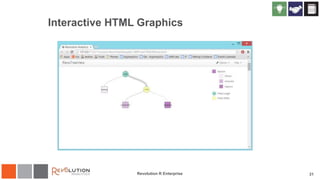
Interactive HTML Graphics
Revolution R Enterprise 31
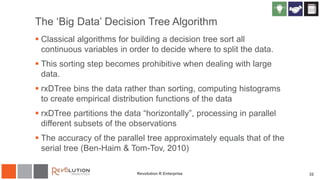
The ‘Big Data’ Decision Tree Algorithm
 Classical algorithms for building a decision tree sort all
continuous variables in order to decide where to split the data.
 This sorting step becomes prohibitive when dealing with large
data.
 rxDTree bins the data rather than sorting, computing histograms
to create empirical distribution functions of the data
 rxDTree partitions the data “horizontally”, processing in parallel
different subsets of the observations
 The accuracy of the parallel tree approximately equals that of the
serial tree (Ben-Haim & Tom-Tov, 2010)
Revolution R Enterprise 32
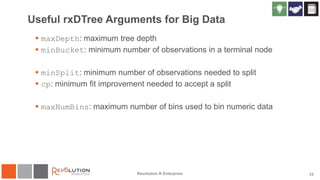
Useful rxDTree Arguments for Big Data
 maxDepth: maximum tree depth
 minBucket: minimum number of observations in a terminal node
 minSplit: minimum number of observations needed to split
 cp: minimum fit improvement needed to accept a split
 maxNumBins: maximum number of bins used to bin numeric data
Revolution R Enterprise 33
34
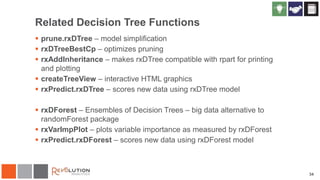
Related Decision Tree Functions
 prune.rxDTree – model simplification
 rxDTreeBestCp – optimizes pruning
 rxAddInheritance – makes rxDTree compatible with rpart for printing
and plotting
 createTreeView – interactive HTML graphics
 rxPredict.rxDTree – scores new data using rxDTree model
 rxDForest – Ensembles of Decision Trees – big data alternative to
randomForest package
 rxVarImpPlot – plots variable importance as measured by rxDForest
 rxPredict.rxDForest – scores new data using rxDForest model
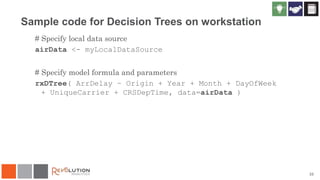
Sample code for Decision Trees on workstation
# Specify local data source
airData <- myLocalDataSource
# Specify model formula and parameters
rxDTree( ArrDelay ~ Origin + Year + Month + DayOfWeek
+ UniqueCarrier + CRSDepTime, data=airData )
35
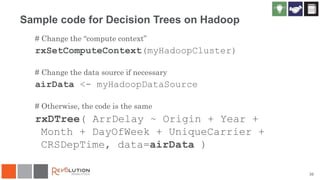
Sample code for Decision Trees on Hadoop
# Change the “compute context”
rxSetComputeContext(myHadoopCluster)
# Change the data source if necessary
airData <- myHadoopDataSource
# Otherwise, the code is the same
rxDTree( ArrDelay ~ Origin + Year +
Month + DayOfWeek + UniqueCarrier +
CRSDepTime, data=airData )
36
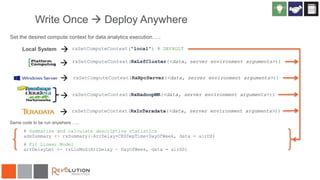
Write Once  Deploy Anywhere
rxSetComputeContext("local") # DEFAULT
rxSetComputeContext(RxHadoopMR(<data, server environment arguments>))
# Summarize and calculate descriptive statistics
adsSummary <- rxSummary(~ArrDelay+CRSDepTime+DayOfWeek, data = airDS)
# Fit Linear Model
arrDelayLm1 <- rxLinMod(ArrDelay ~ DayOfWeek, data = airDS)
rxSetComputeContext(RxHpcServer(<data, server environment arguments>))
rxSetComputeContext(RxLsfCluster(<data, server environment arguments>))
Same code to be run anywhere …..
Local System




Set the desired compute context for data analytics execution…..
rxSetComputeContext(RxInTeradata(<data, server environment arguments>))
38
Polling Question:
 What platforms are you most interested in running tree models on your
data?
– Please select all that apply
• Server
• Grid
• Hadoop
• Teradata
• Other
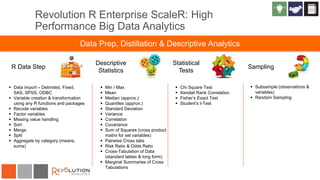
Revolution R Enterprise ScaleR: High
Performance Big Data Analytics
Data Prep, Distillation & Descriptive Analytics
R Data Step
Descriptive
Statistics
Statistical
Tests
Sampling
 Data import – Delimited, Fixed,
SAS, SPSS, ODBC
 Variable creation & transformation
using any R functions and packages
 Recode variables
 Factor variables
 Missing value handling
 Sort
 Merge
 Split
 Aggregate by category (means,
sums)
 Min / Max
 Mean
 Median (approx.)
 Quantiles (approx.)
 Standard Deviation
 Variance
 Correlation
 Covariance
 Sum of Squares (cross product
matrix for set variables)
 Pairwise Cross tabs
 Risk Ratio & Odds Ratio
 Cross-Tabulation of Data
(standard tables & long form)
 Marginal Summaries of Cross
Tabulations
 Chi Square Test
 Kendall Rank Correlation
 Fisher’s Exact Test
 Student’s t-Test
 Subsample (observations &
variables)
 Random Sampling
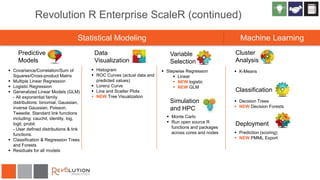
Revolution R Enterprise ScaleR (continued)
Statistical Modeling Machine Learning
Predictive
Models
 Covariance/Correlation/Sum of
Squares/Cross-product Matrix
 Multiple Linear Regression
 Logistic Regression
 Generalized Linear Models (GLM)
- All exponential family
distributions: binomial, Gaussian,
inverse Gaussian, Poisson,
Tweedie. Standard link functions
including: cauchit, identity, log,
logit, probit.
- User defined distributions & link
functions.
 Classification & Regression Trees
and Forests
 Residuals for all models
 Histogram
 ROC Curves (actual data and
predicted values)
 Lorenz Curve
 Line and Scatter Plots
 NEW Tree Visualization
Data
Visualization
Variable
Selection
 Stepwise Regression
 Linear
 NEW logistic
 NEW GLM
 Monte Carlo
 Run open source R
functions and packages
across cores and nodes
Cluster
Analysis
 K-Means
Classification
 Decision Trees
 NEW Decision Forests
 Prediction (scoring)
 NEW PMML Export
Simulation
and HPC
Deployment
41
Resources For You
 Big Data Decision Trees with R
– http://www.revolutionanalytics.com/whitepaper/big-data-decision-trees-r
 Advanced, Big Data Analytics with R and Hadoop
– http://www.revolutionanalytics.com/whitepaper/advanced-big-data-analytics-r-
and-hadoop
 Revolution R Enterprise: Faster than SAS
– http://www.revolutionanalytics.com/whitepaper/revolution-r-enterprise-faster-
sas
 May 13, 2014 – Webinar presenting the results of our RRE vs. SAS
benchmarking
 To Get RRE for yourself, please visit:
– http://www.revolutionanalytics.com/get-revolution-r-enterprise
42
Thank you
Revolution Analytics is the leading commercial
provider of software and support for the
popular open source R statistics language.
mario.inchiosa@revolutionanalytics.com
www.revolutionanalytics.com, 1.855.GET.REVO, Twitter: @RevolutionR
43

Decision trees in hadoop

  • 1.
    Decision Trees builtin Hadoop plus more Big Data Analytics with Revolution R Enterprise All Rights Reserved, Revolution Analytics 2014 Mario Inchiosa, US Chief Scientist mario.inchiosa@revolutionanalytics.com Revolution Webinar – April 17, 2014
  • 2.
    2 OUR COMPANY The leadingprovider of advanced analytics software and services based on open source R, since 2007 OUR SOFTWARE The only Big Data, Big Analytics software platform based on the data science language R SOME KUDOS Visionary Gartner Magic Quadrant for Advanced Analytics Platforms, 2014
  • 3.
    Typical Challenges ourCustomers Face Big Data  Many new data sources  Data variety & velocity  Data movement, memory limits 3 Production Efficiency  Shorter model shelf life  Volume of Models  Long end-to- end cycle time  Pace of decision accelerated Enterprise Readiness  Heterogeneous landscape  Write once, deploy anywhere  Skill shortage  Production support Complex Computation  Mathematically sophisticated  Parallelization  Experimentation  Ensemble models  Many small models  Simulation
  • 4.
    Polling Question:  Whatis your current analytics software platform? – Please select one • R/RRE • SAS • SPSS • Tibco/Spotfire • KXEN • Other
  • 5.
  • 6.
    What is R? Most widely used data analysis software • Used by 2M+ data scientists, statisticians and analysts  Most powerful statistical programming language • Flexible, extensible and comprehensive for productivity  Create beautiful and unique data visualizations • As seen in New York Times, Twitter and Flowing Data  Thriving open-source community • Leading edge of analytics research  Fills the talent gap • New graduates prefer R R is Hot bit.ly/r-is-hot WHITE PAPER
  • 7.
    Exploding growth anddemand for R  R is the highest paid IT skill – Dice.com, Jan 2014  R most-used data science language after SQL – O’Reilly, Jan 2014  R is used by 70% of data miners – Rexer, Sep 2013  R is #15 of all programming languages – RedMonk, Jan 2014  R growing faster than any other data science language – KDnuggets, Aug 2013  More than 2 million users worldwide R Usage Growth Rexer Data Miner Survey, 2007-2013 70% of data miners report using R R is the first choice of more data miners than any other software Source: www.rexeranalytics.com
  • 8.
    REVOLUTION R ENTERPRISE THE BIGDATA BIG ANALYTICS PLATFORM
  • 9.
    Revolution R Enterprise High Performance, Scalable Analytics  Portable Across Enterprise Platforms  Easier to Build & Deploy Analytics is…. the only big data big analytics platform based on open source R 9
  • 10.
    Big Data In-memorybound Hybrid memory & disk scalability Operates on bigger volumes & factors Speed of Analysis Single threaded Parallel threading Shrinks analysis time Enterprise Readiness Community support Commercial support Delivers full service production support Analytic Breadth & Depth 5000+ innovative analytic packages Leverage open source packages plus Big Data ready packages Supercharges R R is open source and drives analytic innovation but….has some limitations for Enterprises 10
  • 11.
    All of OpenSource R plus:  Big Data scalability  High-performance analytics  Development and deployment tools  Data source connectivity  Application integration framework  Multi-platform architecture  Support, Training and Services 11 is the Big Data Big Analytics Platform
  • 12.
    R+CRAN • Open sourceR interpreter • UPDATED R 3.0.2 • Freely-available R algorithms • Algorithms callable by RevoR • Embeddable in R scripts • 100% Compatible with existing R scripts, functions and packages RevoR • Performance enhanced R interpreter • Based on open source R • Adds high-performance math Available On: • IBM® Platform LSFTM Clusters • Microsoft® HPC Clusters • Windows® & Linux Servers • Windows® & Linux Workstations • NEW Cloudera® Hadoop • NEW Hortonworks® Hadoop • NEW Teradata® Database • Intel® Hadoop • IBM® BigInsightsTM • IBM® PureDataTM for Analytics, powered by Netezza technology 12 The Platform Step by Step: R Capabilities
  • 13.
    Revolution R EnterpriseRevoR Performance Enhanced R Open Source R Revolution R Enterprise Computation (4-core laptop) Open Source R Revolution R Speedup Linear Algebra1 Matrix Multiply 176 sec 9.3 sec 18x Cholesky Factorization 25.5 sec 1.3 sec 19x Linear Discriminant Analysis 189 sec 74 sec 3x General R Benchmarks2 R Benchmarks (Matrix Functions) 22 sec 3.5 sec 5x R Benchmarks (Program Control) 5.6 sec 5.4 sec Not appreciable 1. http://www.revolutionanalytics.com/why-revolution-r/benchmarks.php 2. http://r.research.att.com/benchmarks/ Customers report 3-50x performance improvements compared to Open Source R — without changing any code 13
  • 14.
    DistributedR • Distributed computingframework • Delivers portability across platforms ConnectR • High-speed data import/export Available for: • High-performance XDF • SAS, SPSS, delimited & fixed format text data files • Hadoop HDFS (text & XDF) • Teradata Database TPT • ODBC (incl. Vertica, Oracle, Pivotal, Aster, SybaseIQ, DB2, MySQL) ScaleR • Ready-to-Use high-performance big data big analytics • Fully-parallelized analytics • Data prep & data distillation • Descriptive statistics & statistical tests • Correlation & covariance matrices • Predictive Models – linear, logistic, GLM • Machine learning • Monte Carlo simulation • NEW Tools for distributing customized algorithms across nodes DistributedR available on: • Windows Servers • Red Hat and NEW SuSE Linux Servers • IBM Platform LSF Linux Clusters • Microsoft HPC Clusters • NEW Cloudera Hadoop • NEW Hortonworks Hadoop • NEW Teradata Database 14 The Platform Step by Step: Parallelization & Data Sourcing
  • 15.
    DeployR • Web servicessoftware development kit for integration analytics via Java, JavaScript or .NET APIs • Integrates R Into application infrastructures Capabilities: • Invokes R Scripts from web services calls • RESTful interface for easy integration • Works with web & mobile apps, leading BI & Visualization tools and business rules engines DevelopR • Integrated development environment for R • Visual ‘step-into’ debugger Available on: • Windows DevelopR DeployR 15 The Platform Step by Step: Tools & Deployment
  • 16.
    16 Scalable and Parallelizedacross Cores and Nodes 0010 COMPUTE NODE COMPUTE NODE MULTICORE PROCESSOR 4, 8, 16+ CORES Evaluate COMPUTE NODE COMPUTE NODE 0101 0010 1110 1100 01010 DATA PARTITION BIG DATA 010101010010101001010010010010100101010101 011010 SHARED MEMORY 100101 101001 111000 01010101001001010011100100100101001010101010101010100100 Combine Intermediate Results MASTER NODE CORE0 THREAD 0 CORE01 THREAD 1 CORE02 THREAD 2 CORE03 THREAD N
  • 17.
    ScaleR Scalability andPerformance  Handles an arbitrarily large number of rows in a fixed amount of memory  Scales linearly with the number of rows  Scales linearly with the number of nodes  Scales well with the number of cores per node  Scales well with the number of parameters  Extremely high performance 17
  • 18.
     Unique PEMAs:Parallel, external-memory algorithms  High-performance, scalable replacements for R/SAS analytic functions  Parallel/distributed processing eliminates CPU bottleneck  Data streaming eliminates memory size limitations  Works with in-memory and disk-based architectures 18 Eliminates Performance and Capacity Limits of Open Source R and Legacy SAS
  • 20.
    Rows of data1 billion 1 billion Parameters “just a few” 7 Time 80 seconds 44 seconds Data location In memory On disk Nodes 32 5 Cores 384 20 RAM 1,536 GB 80 GB Revolution R is faster on the same amount of data, despite using approximately a 20th as many cores, a 20th as much RAM, a 6th as many nodes, and not pre-loading data into RAM. *As published by SAS in HPCwire, April 21, 2011 See Revolution white paper for additional benchmarks. Logistic Regression: 20 Revolution R Enterprise ScaleR Outperforms SAS HPA at a Fraction of the Cost
  • 21.
    Specific speed-related factors Efficient computational algorithms  Efficient memory management – minimize data copying and data conversion  Heavy use of C++ templates; optimal code  Efficient data file format; fast access by row and column  Models are pre-analyzed to detect and remove duplicate computations and points of failure (singularities)  Handle categorical variables efficiently Revolution R Enterprise 21
  • 22.
    Scalability and portabilityof Revolution Analytics “Parallel External Memory Algorithms” (PEMAs)  Anatomy of a PEMA: 1) Initialize, 2) Process Chunk, 3) Aggregate, 4) Finalize  Process a chunk of data at a time, giving linear scalability  Process an unlimited number of rows of data in a fixed amount of RAM  Independent of the “compute context” (number of cores, computers, distributed computing platform), giving portability across these dimensions  Independent of where the data is coming from, giving portability with respect to data sources Revolution R Enterprise 22
  • 23.
    Simplified ScaleR InternalArchitecture Revolution R Enterprise 23 Analytics Engine PEMA’s are implemented here (Scalable, Parallelized, Threaded, Distributable) Inter-process Communication MPI, RPC, Sockets, Files, UDFs Data Sources HDFS, Teradata, ODBC, SAS, SPSS, CSV, Fixed, XDF
  • 24.
    DistributedR ScaleR ConnectR DeployR DESIGNED FOR SCALE,PORTABILITY & PERFORMANCE In the Cloud Amazon AWS Workstations & Servers Windows Red Hat and SUSE Linux Clustered Systems IBM Platform LSF Microsoft HPC EDW Teradata IBM PureData™ for Analytics Hadoop Cloudera Hortonworks 24 Write Once. Deploy Anywhere.
  • 25.
    Decision Trees – Easy-to-interpretmodels – Widely used in a variety of disciplines. For example, Predicting which patient characteristics are associated with high risk of, for example, heart attack. Deciding whether or not to offer a loan to an individual based on individual characteristics. Predicting the rate of return of various investment strategies Retail target marketing  Can handle multi-level factor response easily  Useful in identifying important interactions Revolution R Enterprise 25
  • 26.
    Decision Tree Types Classification tree: predict what ‘class’ or ‘group’ an observation belongs to (dependent variable is a factor)  Regression tree: predict the value of a continuous dependent variable Revolution R Enterprise 26
  • 27.
    27 Polling Question:  Whatis your “go-to” tree algorithm for predictions in your work? – Please select one answer • Single Trees • Random Forests • It Depends • Neither
  • 28.
    Classification Example: MarketingResponse Data set containing the following information:  Response: Was response to a phone call, email, or mailing?  Age  Income  Marital status  Attended college? Revolution R Enterprise 28
  • 29.
    Estimating the model treeOut<- rxDTree(response ~ age + income + college + marital, data = rdata) Revolution R Enterprise 29
  • 30.
    Simple Example: TextOutput – Information on the split, the number of observations in the node, the “loss”, the predicted value, and the probabilities 1) root 10000 4069 Email (0.33260000 0.59310000 0.07430000) 2) college=No College 5074 2378 Phone (0.53133622 0.38943634 0.07922743) 4) age>=39.5 2518 330 Phone (0.86894361 0.00000000 0.13105639) 8) age< 64.5 2256 77 Phone (0.96586879 0.00000000 0.03413121) * 9) age>=64.5 262 9 Mail (0.03435115 0.00000000 0.96564885) * 5) age< 39.5 2556 580 Email (0.19874804 0.77308294 0.02816901) 10) marital=Single 835 371 Phone (0.55568862 0.40958084 0.03473054) 20) income>=29.5 472 14 Phone(0.97033898 0.00000000 0.02966102) * 21) income< 29.5 363 21 Email(0.01652893 0.94214876 0.04132231) * 11) marital=Married 1721 87 Email(0.02556653 0.9494480 .02498547) * 3) college=College 4926 971 Email (0.12789281 0.80288266 0.06922452) … Revolution R Enterprise 30
  • 31.
  • 32.
    The ‘Big Data’Decision Tree Algorithm  Classical algorithms for building a decision tree sort all continuous variables in order to decide where to split the data.  This sorting step becomes prohibitive when dealing with large data.  rxDTree bins the data rather than sorting, computing histograms to create empirical distribution functions of the data  rxDTree partitions the data “horizontally”, processing in parallel different subsets of the observations  The accuracy of the parallel tree approximately equals that of the serial tree (Ben-Haim & Tom-Tov, 2010) Revolution R Enterprise 32
  • 33.
    Useful rxDTree Argumentsfor Big Data  maxDepth: maximum tree depth  minBucket: minimum number of observations in a terminal node  minSplit: minimum number of observations needed to split  cp: minimum fit improvement needed to accept a split  maxNumBins: maximum number of bins used to bin numeric data Revolution R Enterprise 33
  • 34.
    34 Related Decision TreeFunctions  prune.rxDTree – model simplification  rxDTreeBestCp – optimizes pruning  rxAddInheritance – makes rxDTree compatible with rpart for printing and plotting  createTreeView – interactive HTML graphics  rxPredict.rxDTree – scores new data using rxDTree model  rxDForest – Ensembles of Decision Trees – big data alternative to randomForest package  rxVarImpPlot – plots variable importance as measured by rxDForest  rxPredict.rxDForest – scores new data using rxDForest model
  • 35.
    Sample code forDecision Trees on workstation # Specify local data source airData <- myLocalDataSource # Specify model formula and parameters rxDTree( ArrDelay ~ Origin + Year + Month + DayOfWeek + UniqueCarrier + CRSDepTime, data=airData ) 35
  • 36.
    Sample code forDecision Trees on Hadoop # Change the “compute context” rxSetComputeContext(myHadoopCluster) # Change the data source if necessary airData <- myHadoopDataSource # Otherwise, the code is the same rxDTree( ArrDelay ~ Origin + Year + Month + DayOfWeek + UniqueCarrier + CRSDepTime, data=airData ) 36
  • 37.
    Write Once Deploy Anywhere rxSetComputeContext("local") # DEFAULT rxSetComputeContext(RxHadoopMR(<data, server environment arguments>)) # Summarize and calculate descriptive statistics adsSummary <- rxSummary(~ArrDelay+CRSDepTime+DayOfWeek, data = airDS) # Fit Linear Model arrDelayLm1 <- rxLinMod(ArrDelay ~ DayOfWeek, data = airDS) rxSetComputeContext(RxHpcServer(<data, server environment arguments>)) rxSetComputeContext(RxLsfCluster(<data, server environment arguments>)) Same code to be run anywhere ….. Local System     Set the desired compute context for data analytics execution….. rxSetComputeContext(RxInTeradata(<data, server environment arguments>))
  • 38.
    38 Polling Question:  Whatplatforms are you most interested in running tree models on your data? – Please select all that apply • Server • Grid • Hadoop • Teradata • Other
  • 39.
    Revolution R EnterpriseScaleR: High Performance Big Data Analytics Data Prep, Distillation & Descriptive Analytics R Data Step Descriptive Statistics Statistical Tests Sampling  Data import – Delimited, Fixed, SAS, SPSS, ODBC  Variable creation & transformation using any R functions and packages  Recode variables  Factor variables  Missing value handling  Sort  Merge  Split  Aggregate by category (means, sums)  Min / Max  Mean  Median (approx.)  Quantiles (approx.)  Standard Deviation  Variance  Correlation  Covariance  Sum of Squares (cross product matrix for set variables)  Pairwise Cross tabs  Risk Ratio & Odds Ratio  Cross-Tabulation of Data (standard tables & long form)  Marginal Summaries of Cross Tabulations  Chi Square Test  Kendall Rank Correlation  Fisher’s Exact Test  Student’s t-Test  Subsample (observations & variables)  Random Sampling
  • 40.
    Revolution R EnterpriseScaleR (continued) Statistical Modeling Machine Learning Predictive Models  Covariance/Correlation/Sum of Squares/Cross-product Matrix  Multiple Linear Regression  Logistic Regression  Generalized Linear Models (GLM) - All exponential family distributions: binomial, Gaussian, inverse Gaussian, Poisson, Tweedie. Standard link functions including: cauchit, identity, log, logit, probit. - User defined distributions & link functions.  Classification & Regression Trees and Forests  Residuals for all models  Histogram  ROC Curves (actual data and predicted values)  Lorenz Curve  Line and Scatter Plots  NEW Tree Visualization Data Visualization Variable Selection  Stepwise Regression  Linear  NEW logistic  NEW GLM  Monte Carlo  Run open source R functions and packages across cores and nodes Cluster Analysis  K-Means Classification  Decision Trees  NEW Decision Forests  Prediction (scoring)  NEW PMML Export Simulation and HPC Deployment
  • 41.
    41 Resources For You Big Data Decision Trees with R – http://www.revolutionanalytics.com/whitepaper/big-data-decision-trees-r  Advanced, Big Data Analytics with R and Hadoop – http://www.revolutionanalytics.com/whitepaper/advanced-big-data-analytics-r- and-hadoop  Revolution R Enterprise: Faster than SAS – http://www.revolutionanalytics.com/whitepaper/revolution-r-enterprise-faster- sas  May 13, 2014 – Webinar presenting the results of our RRE vs. SAS benchmarking  To Get RRE for yourself, please visit: – http://www.revolutionanalytics.com/get-revolution-r-enterprise
  • 42.
  • 43.
    Thank you Revolution Analyticsis the leading commercial provider of software and support for the popular open source R statistics language. mario.inchiosa@revolutionanalytics.com www.revolutionanalytics.com, 1.855.GET.REVO, Twitter: @RevolutionR 43