Ufuk Celebi
uce@apache.org
HUG London
October 15, 2015
Streaming Data Flow with
Apache Flink
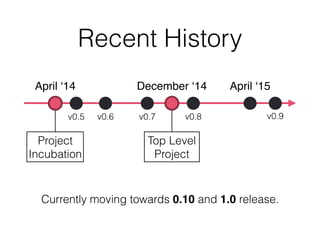
Recent History
April ‘14 December ‘14
v0.5 v0.6 v0.7
April ‘15
Project
Incubation
Top Level
Project
v0.8 v0.9
Currently moving towards 0.10 and 1.0 release.
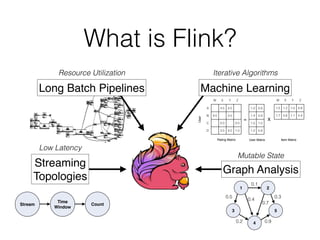
What is Flink?
Streaming
Topologies
Stream
Time
Window
Count
Low Latency
Long Batch Pipelines
Resource Utilization
1.2
1.4
1.5
1.2
0.8
0.9
1.0
0.8
Rating Matrix User Matrix Item Matrix
1.5
1.7
1.2
0.6
1.0
1.1
0.8
0.4
W X Y ZW X Y Z
A
B
C
D
4.0
4.5
5.0
3.5
2.0
3.5
4.0
2.0
1.0
= X
User
Machine Learning
Iterative Algorithms
Graph Analysis
53
1 2
4
0.5
0.2 0.9
0.3
0.1
0.4
0.7
Mutable State
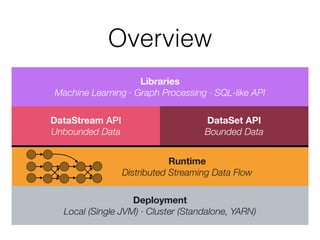
Overview
Deployment

Local (Single JVM) · Cluster (Standalone, YARN)
DataStream API
Unbounded Data
DataSet API
Bounded Data
Runtime
Distributed Streaming Data Flow
Libraries
Machine Learning · Graph Processing · SQL-like API
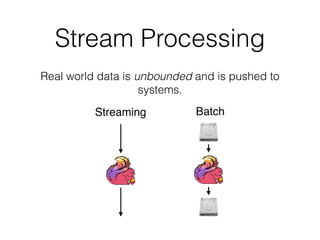
Stream Processing
Real world data is unbounded and is pushed to
systems.
BatchStreaming
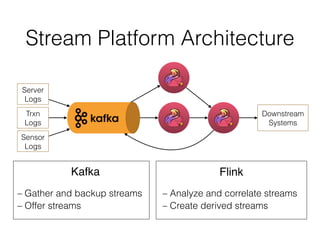
Stream Platform Architecture
Server
Logs
Trxn
Logs
Sensor
Logs
Downstream
Systems
Flink
– Analyze and correlate streams
– Create derived streams
Kafka
– Gather and backup streams
– Offer streams
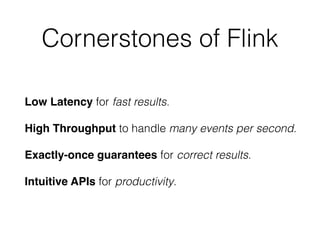
Cornerstones of Flink
Low Latency for fast results.
High Throughput to handle many events per second.
Exactly-once guarantees for correct results.
Intuitive APIs for productivity.
DataStream API
StreamExecutionEnvironment env = StreamExecutionEnvironment

.getExecutionEnvironment()
DataStream<String> data = env.fromElements(
"O Romeo, Romeo! wherefore art thou Romeo?”, ...);
// DataStream Windowed WordCount
DataStream<Tuple2<String, Integer>> counts = data
.flatMap(new SplitByWhitespace()) // (word, 1)
.keyBy(0) // [word, [1, 1, …]] for 10 seconds
.timeWindow(Time.of(10, TimeUnit.SECONDS))
.sum(1); // sum per word per 10 second window
counts.print();
env.execute();
DataStream API
StreamExecutionEnvironment env = StreamExecutionEnvironment

.getExecutionEnvironment()
DataStream<String> data = env.fromElements(
"O Romeo, Romeo! wherefore art thou Romeo?”, ...);
// DataStream Windowed WordCount
DataStream<Tuple2<String, Integer>> counts = data
.flatMap(new SplitByWhitespace()) // (word, 1)
.keyBy(0) // [word, [1, 1, …]] for 10 seconds
.timeWindow(Time.of(10, TimeUnit.SECONDS))
.sum(1); // sum per word per 10 second window
counts.print();
env.execute();
DataStream API
StreamExecutionEnvironment env = StreamExecutionEnvironment

.getExecutionEnvironment()
DataStream<String> data = env.fromElements(
"O Romeo, Romeo! wherefore art thou Romeo?”, ...);
// DataStream Windowed WordCount
DataStream<Tuple2<String, Integer>> counts = data
.flatMap(new SplitByWhitespace()) // (word, 1)
.keyBy(0) // [word, [1, 1, …]] for 10 seconds
.timeWindow(Time.of(10, TimeUnit.SECONDS))
.sum(1); // sum per word per 10 second window
counts.print();
env.execute();
DataStream API
StreamExecutionEnvironment env = StreamExecutionEnvironment

.getExecutionEnvironment()
DataStream<String> data = env.fromElements(
"O Romeo, Romeo! wherefore art thou Romeo?”, ...);
// DataStream Windowed WordCount
DataStream<Tuple2<String, Integer>> counts = data
.flatMap(new SplitByWhitespace()) // (word, 1)
.keyBy(0) // [word, [1, 1, …]] for 10 seconds
.timeWindow(Time.of(10, TimeUnit.SECONDS))
.sum(1); // sum per word per 10 second window
counts.print();
env.execute();
DataStream API
StreamExecutionEnvironment env = StreamExecutionEnvironment

.getExecutionEnvironment()
DataStream<String> data = env.fromElements(
"O Romeo, Romeo! wherefore art thou Romeo?”, ...);
// DataStream Windowed WordCount
DataStream<Tuple2<String, Integer>> counts = data
.flatMap(new SplitByWhitespace()) // (word, 1)
.keyBy(0) // [word, [1, 1, …]] for 10 seconds
.timeWindow(Time.of(10, TimeUnit.SECONDS))
.sum(1); // sum per word per 10 second window
counts.print();
env.execute();
DataStream API
StreamExecutionEnvironment env = StreamExecutionEnvironment

.getExecutionEnvironment()
DataStream<String> data = env.fromElements(
"O Romeo, Romeo! wherefore art thou Romeo?”, ...);
// DataStream Windowed WordCount
DataStream<Tuple2<String, Integer>> counts = data
.flatMap(new SplitByWhitespace()) // (word, 1)
.keyBy(0) // [word, [1, 1, …]] for 10 seconds
.timeWindow(Time.of(10, TimeUnit.SECONDS))
.sum(1); // sum per word per 10 second window
counts.print();
env.execute();
DataStream API
StreamExecutionEnvironment env = StreamExecutionEnvironment

.getExecutionEnvironment()
DataStream<String> data = env.fromElements(
"O Romeo, Romeo! wherefore art thou Romeo?”, ...);
// DataStream Windowed WordCount
DataStream<Tuple2<String, Integer>> counts = data
.flatMap(new SplitByWhitespace()) // (word, 1)
.keyBy(0) // [word, [1, 1, …]] for 10 seconds
.timeWindow(Time.of(10, TimeUnit.SECONDS))
.sum(1); // sum per word per 10 second window
counts.print();
env.execute();
DataStream API
StreamExecutionEnvironment env = StreamExecutionEnvironment

.getExecutionEnvironment()
DataStream<String> data = env.fromElements(
"O Romeo, Romeo! wherefore art thou Romeo?”, ...);
// DataStream Windowed WordCount
DataStream<Tuple2<String, Integer>> counts = data
.flatMap(new SplitByWhitespace()) // (word, 1)
.keyBy(0) // [word, [1, 1, …]] for 10 seconds
.timeWindow(Time.of(10, TimeUnit.SECONDS))
.sum(1); // sum per word per 10 second window
counts.print();
env.execute();
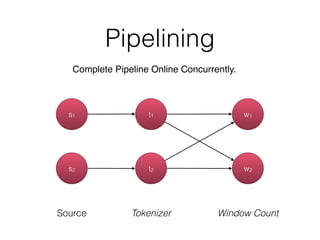
Pipelining
s1 t1 w1
s2 t2 w2
Source Tokenizer Window Count
Complete Pipeline Online Concurrently.
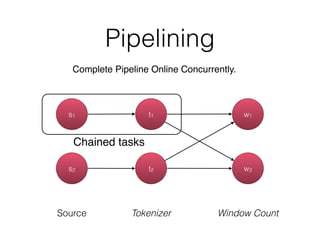
Pipelining
s1 t1 w1
s2 t2 w2
Source Tokenizer Window Count
Complete Pipeline Online Concurrently.
Chained tasks
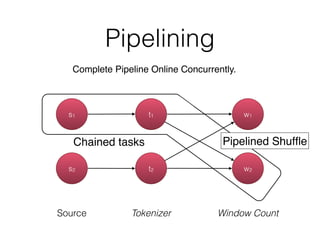
Pipelining
s1
s2 t2 w2
t1 w1
Source Tokenizer Window Count
Complete Pipeline Online Concurrently.
Chained tasks Pipelined Shuffle
Streaming Fault Tolerance
At Least Once
• Ensure that all operators see all events.
Exactly Once
• Ensure that all operators see all events.
• Do not perform duplicates updates to operator state.
Streaming Fault Tolerance
At Least Once
• Ensure that all operators see all events.
Exactly Once
• Ensure that all operators see all events.
• Do not perform duplicates updates to operator state.
Flink guarantees exactly once processing.
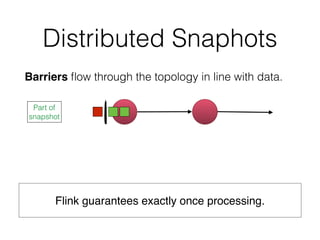
Distributed Snaphots
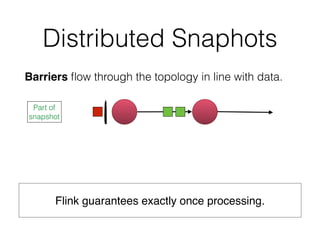
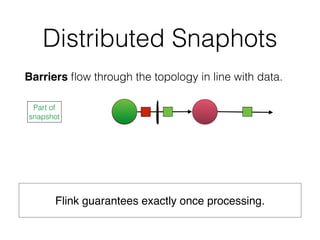
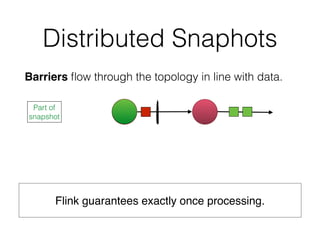
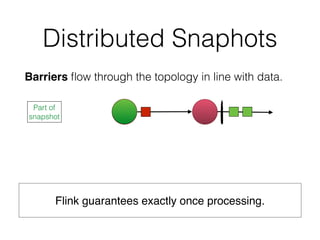
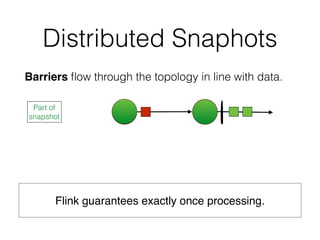
Barriers flow through the topology in line with data.
Flink guarantees exactly once processing.
Part of
snapshot
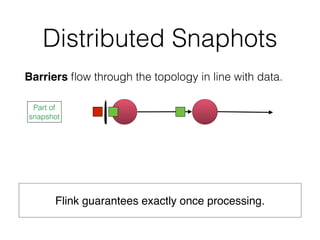
Distributed Snaphots
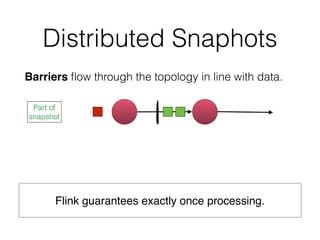
Barriers flow through the topology in line with data.
Flink guarantees exactly once processing.
Part of
snapshot
Distributed Snaphots
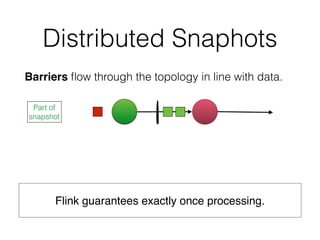
Barriers flow through the topology in line with data.
Flink guarantees exactly once processing.
Part of
snapshot
Distributed Snaphots
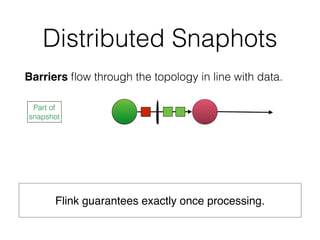
Barriers flow through the topology in line with data.
Flink guarantees exactly once processing.
Part of
snapshot
Distributed Snaphots
Barriers flow through the topology in line with data.
Flink guarantees exactly once processing.
Part of
snapshot
Distributed Snaphots
Barriers flow through the topology in line with data.
Flink guarantees exactly once processing.
Part of
snapshot
Distributed Snaphots
Barriers flow through the topology in line with data.
Flink guarantees exactly once processing.
Part of
snapshot
Distributed Snaphots
Barriers flow through the topology in line with data.
Flink guarantees exactly once processing.
Part of
snapshot
Distributed Snaphots
Barriers flow through the topology in line with data.
Flink guarantees exactly once processing.
Part of
snapshot
Distributed Snaphots
Barriers flow through the topology in line with data.
Flink guarantees exactly once processing.
Part of
snapshot
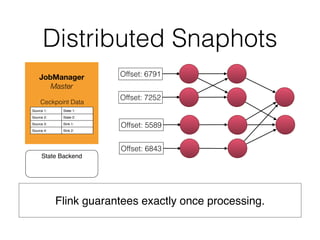
Distributed Snaphots
Flink guarantees exactly once processing.


JobManager
Master
State Backend
Ceckpoint Data
Source 1: State 1:
Source 2: State 2:
Source 3: Sink 1:
Source 4: Sink 2:
Offset: 6791
Offset: 7252
Offset: 5589
Offset: 6843
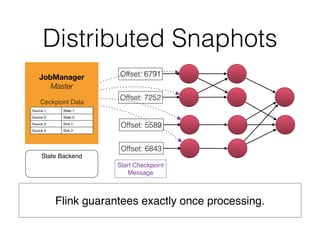
Distributed Snaphots
Flink guarantees exactly once processing.


JobManager
Master
State Backend
Ceckpoint Data
Source 1: State 1:
Source 2: State 2:
Source 3: Sink 1:
Source 4: Sink 2:
Offset: 6791
Offset: 7252
Offset: 5589
Offset: 6843
Start Checkpoint
Message
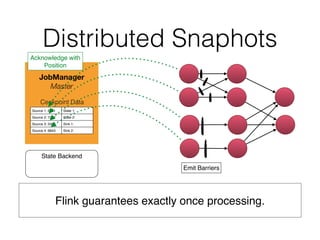
Distributed Snaphots
Flink guarantees exactly once processing.


JobManager
Master
State Backend
Ceckpoint Data
Source 1: 6791 State 1:
Source 2: 7252 State 2:
Source 3: 5589 Sink 1:
Source 4: 6843 Sink 2:
Emit Barriers
Acknowledge with
Position
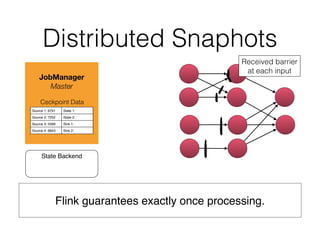
Distributed Snaphots
Flink guarantees exactly once processing.


JobManager
Master
State Backend
Ceckpoint Data
Source 1: 6791 State 1:
Source 2: 7252 State 2:
Source 3: 5589 Sink 1:
Source 4: 6843 Sink 2:
Received barrier
at each input
Distributed Snaphots
Flink guarantees exactly once processing.


JobManager
Master
State Backend
Ceckpoint Data
Source 1: 6791 State 1:
Source 2: 7252 State 2:
Source 3: 5589 Sink 1:
Source 4: 6843 Sink 2:
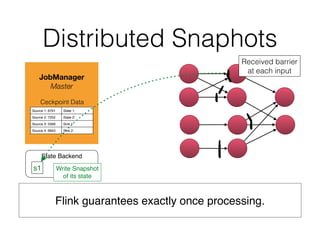
s1 Write Snapshot
of its state
Received barrier
at each input
Distributed Snaphots
Flink guarantees exactly once processing.


JobManager
Master
State Backend
Ceckpoint Data
Source 1: 6791 State 1: PTR1
Source 2: 7252 State 2: PTR2
Source 3: 5589 Sink 1:
Source 4: 6843 Sink 2:
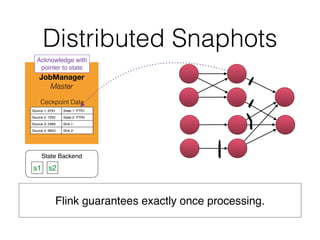
s1
Acknowledge with
pointer to state
s2
Distributed Snaphots
Flink guarantees exactly once processing.


JobManager
Master
State Backend
Ceckpoint Data
Source 1: 6791 State 1: PTR1
Source 2: 7252 State 2: PTR2
Source 3: 5589 Sink 1: ACK
Source 4: 6843 Sink 2: ACK
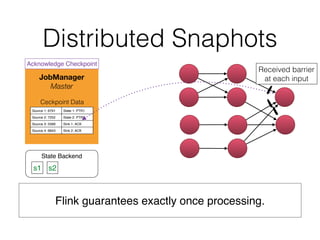
s1 s2
Acknowledge Checkpoint
Received barrier
at each input
Distributed Snaphots
Flink guarantees exactly once processing.


JobManager
Master
State Backend
Ceckpoint Data
Source 1: 6791 State 1: PTR1
Source 2: 7252 State 2: PTR2
Source 3: 5589 Sink 1: ACK
Source 4: 6843 Sink 2: ACK
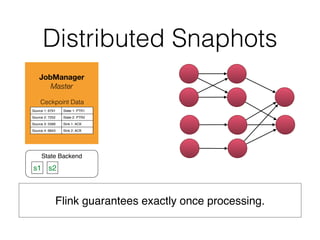
s1 s2
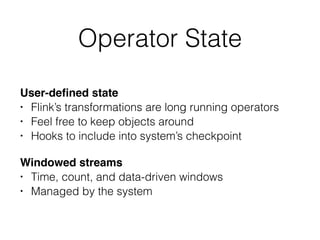
Operator State
User-defined state
• Flink’s transformations are long running operators
• Feel free to keep objects around
• Hooks to include into system’s checkpoint
Windowed streams
• Time, count, and data-driven windows
• Managed by the system
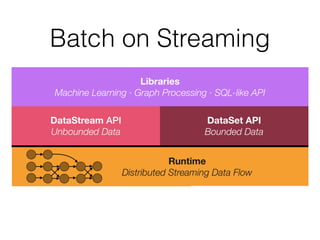
Batch on Streaming
DataStream API
Unbounded Data
DataSet API
Bounded Data
Runtime
Distributed Streaming Data Flow
Libraries
Machine Learning · Graph Processing · SQL-like API
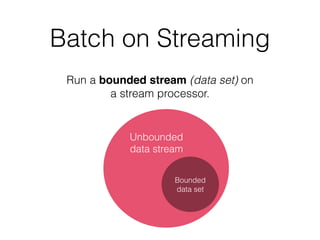
Batch on Streaming
Run a bounded stream (data set) on

a stream processor.
Bounded
data set
Unbounded
data stream
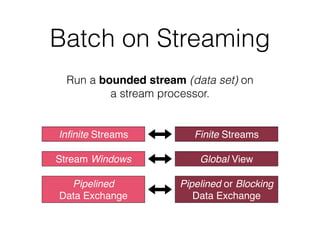
Batch on Streaming
Stream Windows
Pipelined
Data Exchange
Global View
Pipelined or Blocking
Data Exchange
Infinite Streams Finite Streams
Run a bounded stream (data set) on

a stream processor.
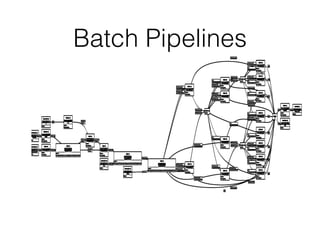
Batch Pipelines
Batch Pipelines
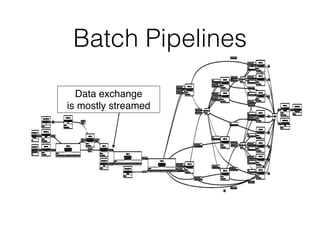
Data exchange

is mostly streamed
Batch Pipelines
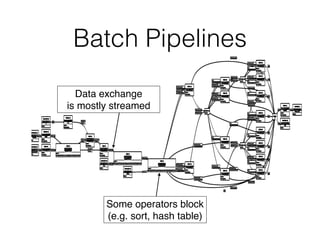
Data exchange

is mostly streamed
Some operators block
(e.g. sort, hash table)
DataSet API
ExecutionEnvironment env = ExecutionEnvironment

.getExecutionEnvironment()
DataSet<String> data = env.fromElements(
"O Romeo, Romeo! wherefore art thou Romeo?”, ...);
// DataSet WordCount
DataSet<Tuple2<String, Integer>> counts = data
.flatMap(new SplitByWhitespace()) // (word, 1)
.groupBy(0) // [word, [1, 1, …]]
.sum(1); // sum per word for all occurrences
counts.print();
DataStream API
ExecutionEnvironment env = ExecutionEnvironment

.getExecutionEnvironment()
DataSet<String> data = env.fromElements(
"O Romeo, Romeo! wherefore art thou Romeo?”, ...);
// DataSet WordCount
DataSet<Tuple2<String, Integer>> counts = data
.flatMap(new SplitByWhitespace()) // (word, 1)
.groupBy(0) // [word, [1, 1, …]]
.sum(1); // sum per word for all occurrences
counts.print();
DataStream API
ExecutionEnvironment env = ExecutionEnvironment

.getExecutionEnvironment()
DataSet<String> data = env.fromElements(
"O Romeo, Romeo! wherefore art thou Romeo?”, ...);
// DataSet WordCount
DataSet<Tuple2<String, Integer>> counts = data
.flatMap(new SplitByWhitespace()) // (word, 1)
.groupBy(0) // [word, [1, 1, …]]
.sum(1); // sum per word for all occurrences
counts.print();
DataStream API
ExecutionEnvironment env = ExecutionEnvironment

.getExecutionEnvironment()
DataSet<String> data = env.fromElements(
"O Romeo, Romeo! wherefore art thou Romeo?”, ...);
// DataSet WordCount
DataSet<Tuple2<String, Integer>> counts = data
.flatMap(new SplitByWhitespace()) // (word, 1)
.groupBy(0) // [word, [1, 1, …]]
.sum(1); // sum per word for all occurrences
counts.print();
DataStream API
ExecutionEnvironment env = ExecutionEnvironment

.getExecutionEnvironment()
DataSet<String> data = env.fromElements(
"O Romeo, Romeo! wherefore art thou Romeo?”, ...);
// DataSet WordCount
DataSet<Tuple2<String, Integer>> counts = data
.flatMap(new SplitByWhitespace()) // (word, 1)
.groupBy(0) // [word, [1, 1, …]]
.sum(1); // sum per word for all occurrences
counts.print();
DataStream API
ExecutionEnvironment env = ExecutionEnvironment

.getExecutionEnvironment()
DataSet<String> data = env.fromElements(
"O Romeo, Romeo! wherefore art thou Romeo?”, ...);
// DataSet WordCount
DataSet<Tuple2<String, Integer>> counts = data
.flatMap(new SplitByWhitespace()) // (word, 1)
.groupBy(0) // [word, [1, 1, …]]
.sum(1); // sum per word for all occurrences
counts.print();
DataStream API
ExecutionEnvironment env = ExecutionEnvironment

.getExecutionEnvironment()
DataSet<String> data = env.fromElements(
"O Romeo, Romeo! wherefore art thou Romeo?”, ...);
// DataSet WordCount
DataSet<Tuple2<String, Integer>> counts = data
.flatMap(new SplitByWhitespace()) // (word, 1)
.groupBy(0) // [word, [1, 1, …]]
.sum(1); // sum per word for all occurrences
counts.print();
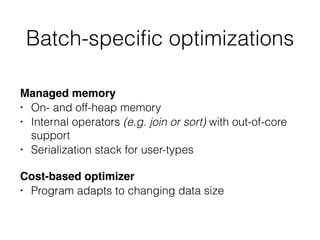
Batch-specific optimizations
Managed memory
• On- and off-heap memory
• Internal operators (e.g. join or sort) with out-of-core
support
• Serialization stack for user-types
Cost-based optimizer
• Program adapts to changing data size
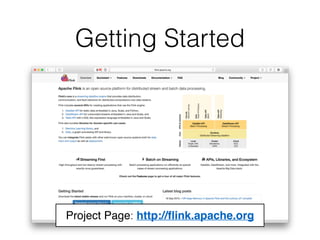
Getting Started
Project Page: http://flink.apache.org
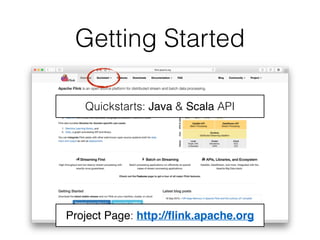
Getting Started
Project Page: http://flink.apache.org
Quickstarts: Java & Scala API
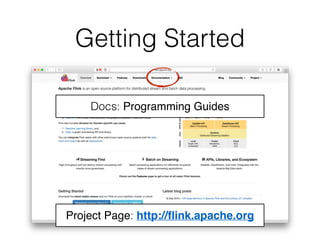
Getting Started
Project Page: http://flink.apache.org
Docs: Programming Guides
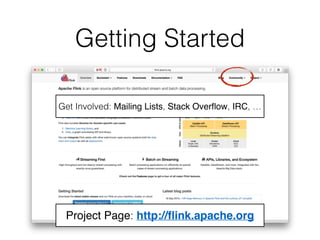
Getting Started
Project Page: http://flink.apache.org
Get Involved: Mailing Lists, Stack Overflow, IRC, …
Blogs
http://flink.apache.org/blog
http://data-artisans.com/blog
Twitter
@ApacheFlink
Mailing lists
(news|user|dev)@flink.apache.org
Apache Flink

Streaming Dataflow with Apache Flink

  • 1.
    Ufuk Celebi uce@apache.org HUG London October15, 2015 Streaming Data Flow with Apache Flink
  • 2.
    Recent History April ‘14December ‘14 v0.5 v0.6 v0.7 April ‘15 Project Incubation Top Level Project v0.8 v0.9 Currently moving towards 0.10 and 1.0 release.
  • 3.
    What is Flink? Streaming Topologies Stream Time Window Count LowLatency Long Batch Pipelines Resource Utilization 1.2 1.4 1.5 1.2 0.8 0.9 1.0 0.8 Rating Matrix User Matrix Item Matrix 1.5 1.7 1.2 0.6 1.0 1.1 0.8 0.4 W X Y ZW X Y Z A B C D 4.0 4.5 5.0 3.5 2.0 3.5 4.0 2.0 1.0 = X User Machine Learning Iterative Algorithms Graph Analysis 53 1 2 4 0.5 0.2 0.9 0.3 0.1 0.4 0.7 Mutable State
  • 4.
    Overview Deployment
 Local (Single JVM)· Cluster (Standalone, YARN) DataStream API Unbounded Data DataSet API Bounded Data Runtime Distributed Streaming Data Flow Libraries Machine Learning · Graph Processing · SQL-like API
  • 5.
    Stream Processing Real worlddata is unbounded and is pushed to systems. BatchStreaming
  • 6.
    Stream Platform Architecture Server Logs Trxn Logs Sensor Logs Downstream Systems Flink –Analyze and correlate streams – Create derived streams Kafka – Gather and backup streams – Offer streams
  • 7.
    Cornerstones of Flink LowLatency for fast results. High Throughput to handle many events per second. Exactly-once guarantees for correct results. Intuitive APIs for productivity.
  • 8.
    DataStream API StreamExecutionEnvironment env= StreamExecutionEnvironment
 .getExecutionEnvironment() DataStream<String> data = env.fromElements( "O Romeo, Romeo! wherefore art thou Romeo?”, ...); // DataStream Windowed WordCount DataStream<Tuple2<String, Integer>> counts = data .flatMap(new SplitByWhitespace()) // (word, 1) .keyBy(0) // [word, [1, 1, …]] for 10 seconds .timeWindow(Time.of(10, TimeUnit.SECONDS)) .sum(1); // sum per word per 10 second window counts.print(); env.execute();
  • 9.
    DataStream API StreamExecutionEnvironment env= StreamExecutionEnvironment
 .getExecutionEnvironment() DataStream<String> data = env.fromElements( "O Romeo, Romeo! wherefore art thou Romeo?”, ...); // DataStream Windowed WordCount DataStream<Tuple2<String, Integer>> counts = data .flatMap(new SplitByWhitespace()) // (word, 1) .keyBy(0) // [word, [1, 1, …]] for 10 seconds .timeWindow(Time.of(10, TimeUnit.SECONDS)) .sum(1); // sum per word per 10 second window counts.print(); env.execute();
  • 10.
    DataStream API StreamExecutionEnvironment env= StreamExecutionEnvironment
 .getExecutionEnvironment() DataStream<String> data = env.fromElements( "O Romeo, Romeo! wherefore art thou Romeo?”, ...); // DataStream Windowed WordCount DataStream<Tuple2<String, Integer>> counts = data .flatMap(new SplitByWhitespace()) // (word, 1) .keyBy(0) // [word, [1, 1, …]] for 10 seconds .timeWindow(Time.of(10, TimeUnit.SECONDS)) .sum(1); // sum per word per 10 second window counts.print(); env.execute();
  • 11.
    DataStream API StreamExecutionEnvironment env= StreamExecutionEnvironment
 .getExecutionEnvironment() DataStream<String> data = env.fromElements( "O Romeo, Romeo! wherefore art thou Romeo?”, ...); // DataStream Windowed WordCount DataStream<Tuple2<String, Integer>> counts = data .flatMap(new SplitByWhitespace()) // (word, 1) .keyBy(0) // [word, [1, 1, …]] for 10 seconds .timeWindow(Time.of(10, TimeUnit.SECONDS)) .sum(1); // sum per word per 10 second window counts.print(); env.execute();
  • 12.
    DataStream API StreamExecutionEnvironment env= StreamExecutionEnvironment
 .getExecutionEnvironment() DataStream<String> data = env.fromElements( "O Romeo, Romeo! wherefore art thou Romeo?”, ...); // DataStream Windowed WordCount DataStream<Tuple2<String, Integer>> counts = data .flatMap(new SplitByWhitespace()) // (word, 1) .keyBy(0) // [word, [1, 1, …]] for 10 seconds .timeWindow(Time.of(10, TimeUnit.SECONDS)) .sum(1); // sum per word per 10 second window counts.print(); env.execute();
  • 13.
    DataStream API StreamExecutionEnvironment env= StreamExecutionEnvironment
 .getExecutionEnvironment() DataStream<String> data = env.fromElements( "O Romeo, Romeo! wherefore art thou Romeo?”, ...); // DataStream Windowed WordCount DataStream<Tuple2<String, Integer>> counts = data .flatMap(new SplitByWhitespace()) // (word, 1) .keyBy(0) // [word, [1, 1, …]] for 10 seconds .timeWindow(Time.of(10, TimeUnit.SECONDS)) .sum(1); // sum per word per 10 second window counts.print(); env.execute();
  • 14.
    DataStream API StreamExecutionEnvironment env= StreamExecutionEnvironment
 .getExecutionEnvironment() DataStream<String> data = env.fromElements( "O Romeo, Romeo! wherefore art thou Romeo?”, ...); // DataStream Windowed WordCount DataStream<Tuple2<String, Integer>> counts = data .flatMap(new SplitByWhitespace()) // (word, 1) .keyBy(0) // [word, [1, 1, …]] for 10 seconds .timeWindow(Time.of(10, TimeUnit.SECONDS)) .sum(1); // sum per word per 10 second window counts.print(); env.execute();
  • 15.
    DataStream API StreamExecutionEnvironment env= StreamExecutionEnvironment
 .getExecutionEnvironment() DataStream<String> data = env.fromElements( "O Romeo, Romeo! wherefore art thou Romeo?”, ...); // DataStream Windowed WordCount DataStream<Tuple2<String, Integer>> counts = data .flatMap(new SplitByWhitespace()) // (word, 1) .keyBy(0) // [word, [1, 1, …]] for 10 seconds .timeWindow(Time.of(10, TimeUnit.SECONDS)) .sum(1); // sum per word per 10 second window counts.print(); env.execute();
  • 16.
    Pipelining s1 t1 w1 s2t2 w2 Source Tokenizer Window Count Complete Pipeline Online Concurrently.
  • 17.
    Pipelining s1 t1 w1 s2t2 w2 Source Tokenizer Window Count Complete Pipeline Online Concurrently. Chained tasks
  • 18.
    Pipelining s1 s2 t2 w2 t1w1 Source Tokenizer Window Count Complete Pipeline Online Concurrently. Chained tasks Pipelined Shuffle
  • 20.
    Streaming Fault Tolerance AtLeast Once • Ensure that all operators see all events. Exactly Once • Ensure that all operators see all events. • Do not perform duplicates updates to operator state.
  • 21.
    Streaming Fault Tolerance AtLeast Once • Ensure that all operators see all events. Exactly Once • Ensure that all operators see all events. • Do not perform duplicates updates to operator state. Flink guarantees exactly once processing.
  • 22.
    Distributed Snaphots Barriers flowthrough the topology in line with data. Flink guarantees exactly once processing. Part of snapshot
  • 23.
    Distributed Snaphots Barriers flowthrough the topology in line with data. Flink guarantees exactly once processing. Part of snapshot
  • 24.
    Distributed Snaphots Barriers flowthrough the topology in line with data. Flink guarantees exactly once processing. Part of snapshot
  • 25.
    Distributed Snaphots Barriers flowthrough the topology in line with data. Flink guarantees exactly once processing. Part of snapshot
  • 26.
    Distributed Snaphots Barriers flowthrough the topology in line with data. Flink guarantees exactly once processing. Part of snapshot
  • 27.
    Distributed Snaphots Barriers flowthrough the topology in line with data. Flink guarantees exactly once processing. Part of snapshot
  • 28.
    Distributed Snaphots Barriers flowthrough the topology in line with data. Flink guarantees exactly once processing. Part of snapshot
  • 29.
    Distributed Snaphots Barriers flowthrough the topology in line with data. Flink guarantees exactly once processing. Part of snapshot
  • 30.
    Distributed Snaphots Barriers flowthrough the topology in line with data. Flink guarantees exactly once processing. Part of snapshot
  • 31.
    Distributed Snaphots Barriers flowthrough the topology in line with data. Flink guarantees exactly once processing. Part of snapshot
  • 32.
    Distributed Snaphots Flink guaranteesexactly once processing. 
 JobManager Master State Backend Ceckpoint Data Source 1: State 1: Source 2: State 2: Source 3: Sink 1: Source 4: Sink 2: Offset: 6791 Offset: 7252 Offset: 5589 Offset: 6843
  • 33.
    Distributed Snaphots Flink guaranteesexactly once processing. 
 JobManager Master State Backend Ceckpoint Data Source 1: State 1: Source 2: State 2: Source 3: Sink 1: Source 4: Sink 2: Offset: 6791 Offset: 7252 Offset: 5589 Offset: 6843 Start Checkpoint Message
  • 34.
    Distributed Snaphots Flink guaranteesexactly once processing. 
 JobManager Master State Backend Ceckpoint Data Source 1: 6791 State 1: Source 2: 7252 State 2: Source 3: 5589 Sink 1: Source 4: 6843 Sink 2: Emit Barriers Acknowledge with Position
  • 35.
    Distributed Snaphots Flink guaranteesexactly once processing. 
 JobManager Master State Backend Ceckpoint Data Source 1: 6791 State 1: Source 2: 7252 State 2: Source 3: 5589 Sink 1: Source 4: 6843 Sink 2: Received barrier at each input
  • 36.
    Distributed Snaphots Flink guaranteesexactly once processing. 
 JobManager Master State Backend Ceckpoint Data Source 1: 6791 State 1: Source 2: 7252 State 2: Source 3: 5589 Sink 1: Source 4: 6843 Sink 2: s1 Write Snapshot of its state Received barrier at each input
  • 37.
    Distributed Snaphots Flink guaranteesexactly once processing. 
 JobManager Master State Backend Ceckpoint Data Source 1: 6791 State 1: PTR1 Source 2: 7252 State 2: PTR2 Source 3: 5589 Sink 1: Source 4: 6843 Sink 2: s1 Acknowledge with pointer to state s2
  • 38.
    Distributed Snaphots Flink guaranteesexactly once processing. 
 JobManager Master State Backend Ceckpoint Data Source 1: 6791 State 1: PTR1 Source 2: 7252 State 2: PTR2 Source 3: 5589 Sink 1: ACK Source 4: 6843 Sink 2: ACK s1 s2 Acknowledge Checkpoint Received barrier at each input
  • 39.
    Distributed Snaphots Flink guaranteesexactly once processing. 
 JobManager Master State Backend Ceckpoint Data Source 1: 6791 State 1: PTR1 Source 2: 7252 State 2: PTR2 Source 3: 5589 Sink 1: ACK Source 4: 6843 Sink 2: ACK s1 s2
  • 40.
    Operator State User-defined state •Flink’s transformations are long running operators • Feel free to keep objects around • Hooks to include into system’s checkpoint Windowed streams • Time, count, and data-driven windows • Managed by the system
  • 41.
    Batch on Streaming DataStreamAPI Unbounded Data DataSet API Bounded Data Runtime Distributed Streaming Data Flow Libraries Machine Learning · Graph Processing · SQL-like API
  • 42.
    Batch on Streaming Runa bounded stream (data set) on
 a stream processor. Bounded data set Unbounded data stream
  • 43.
    Batch on Streaming StreamWindows Pipelined Data Exchange Global View Pipelined or Blocking Data Exchange Infinite Streams Finite Streams Run a bounded stream (data set) on
 a stream processor.
  • 44.
  • 45.
  • 46.
    Batch Pipelines Data exchange
 ismostly streamed Some operators block (e.g. sort, hash table)
  • 47.
    DataSet API ExecutionEnvironment env= ExecutionEnvironment
 .getExecutionEnvironment() DataSet<String> data = env.fromElements( "O Romeo, Romeo! wherefore art thou Romeo?”, ...); // DataSet WordCount DataSet<Tuple2<String, Integer>> counts = data .flatMap(new SplitByWhitespace()) // (word, 1) .groupBy(0) // [word, [1, 1, …]] .sum(1); // sum per word for all occurrences counts.print();
  • 48.
    DataStream API ExecutionEnvironment env= ExecutionEnvironment
 .getExecutionEnvironment() DataSet<String> data = env.fromElements( "O Romeo, Romeo! wherefore art thou Romeo?”, ...); // DataSet WordCount DataSet<Tuple2<String, Integer>> counts = data .flatMap(new SplitByWhitespace()) // (word, 1) .groupBy(0) // [word, [1, 1, …]] .sum(1); // sum per word for all occurrences counts.print();
  • 49.
    DataStream API ExecutionEnvironment env= ExecutionEnvironment
 .getExecutionEnvironment() DataSet<String> data = env.fromElements( "O Romeo, Romeo! wherefore art thou Romeo?”, ...); // DataSet WordCount DataSet<Tuple2<String, Integer>> counts = data .flatMap(new SplitByWhitespace()) // (word, 1) .groupBy(0) // [word, [1, 1, …]] .sum(1); // sum per word for all occurrences counts.print();
  • 50.
    DataStream API ExecutionEnvironment env= ExecutionEnvironment
 .getExecutionEnvironment() DataSet<String> data = env.fromElements( "O Romeo, Romeo! wherefore art thou Romeo?”, ...); // DataSet WordCount DataSet<Tuple2<String, Integer>> counts = data .flatMap(new SplitByWhitespace()) // (word, 1) .groupBy(0) // [word, [1, 1, …]] .sum(1); // sum per word for all occurrences counts.print();
  • 51.
    DataStream API ExecutionEnvironment env= ExecutionEnvironment
 .getExecutionEnvironment() DataSet<String> data = env.fromElements( "O Romeo, Romeo! wherefore art thou Romeo?”, ...); // DataSet WordCount DataSet<Tuple2<String, Integer>> counts = data .flatMap(new SplitByWhitespace()) // (word, 1) .groupBy(0) // [word, [1, 1, …]] .sum(1); // sum per word for all occurrences counts.print();
  • 52.
    DataStream API ExecutionEnvironment env= ExecutionEnvironment
 .getExecutionEnvironment() DataSet<String> data = env.fromElements( "O Romeo, Romeo! wherefore art thou Romeo?”, ...); // DataSet WordCount DataSet<Tuple2<String, Integer>> counts = data .flatMap(new SplitByWhitespace()) // (word, 1) .groupBy(0) // [word, [1, 1, …]] .sum(1); // sum per word for all occurrences counts.print();
  • 53.
    DataStream API ExecutionEnvironment env= ExecutionEnvironment
 .getExecutionEnvironment() DataSet<String> data = env.fromElements( "O Romeo, Romeo! wherefore art thou Romeo?”, ...); // DataSet WordCount DataSet<Tuple2<String, Integer>> counts = data .flatMap(new SplitByWhitespace()) // (word, 1) .groupBy(0) // [word, [1, 1, …]] .sum(1); // sum per word for all occurrences counts.print();
  • 54.
    Batch-specific optimizations Managed memory •On- and off-heap memory • Internal operators (e.g. join or sort) with out-of-core support • Serialization stack for user-types Cost-based optimizer • Program adapts to changing data size
  • 55.
    Getting Started Project Page:http://flink.apache.org
  • 56.
    Getting Started Project Page:http://flink.apache.org Quickstarts: Java & Scala API
  • 57.
    Getting Started Project Page:http://flink.apache.org Docs: Programming Guides
  • 58.
    Getting Started Project Page:http://flink.apache.org Get Involved: Mailing Lists, Stack Overflow, IRC, …
  • 59.