HIVE Data Warehousing & Analytics on Hadoop Facebook Data Team
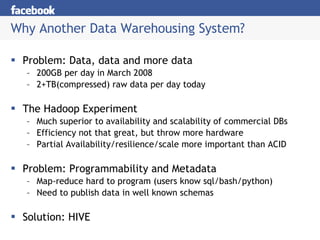
Why Another Data Warehousing System? Problem: Data, data and more data 200GB per day in March 2008  2+TB(compressed) raw data per day today The Hadoop Experiment Much superior to availability and scalability of commercial DBs Efficiency not that great, but throw more hardware Partial Availability/resilience/scale more important than ACID Problem: Programmability and Metadata Map-reduce hard to program (users know sql/bash/python) Need to publish data in well known schemas Solution: HIVE
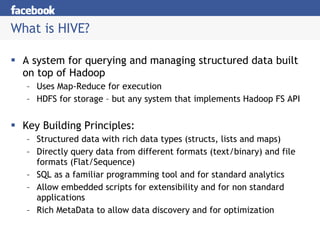
What is HIVE? A system for querying and managing structured data built on top of Hadoop Uses Map-Reduce for execution HDFS for storage – but any system that implements Hadoop FS API Key Building Principles: Structured data with rich data types (structs, lists and maps) Directly query data from different formats (text/binary) and file formats (Flat/Sequence) SQL as a familiar programming tool and for standard analytics Allow embedded scripts for extensibility and for non standard applications Rich MetaData to allow data discovery and for optimization
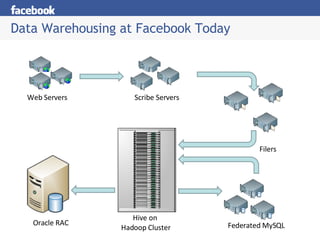
Data Warehousing at Facebook Today Web Servers Scribe Servers Filers Hive on  Hadoop Cluster Oracle RAC Federated MySQL
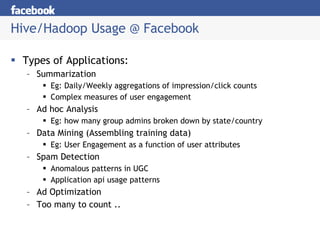
Hive/Hadoop Usage @ Facebook Types of Applications: Summarization  Eg: Daily/Weekly aggregations of impression/click counts Complex measures of user engagement  Ad hoc Analysis Eg: how many group admins broken down by state/country Data Mining (Assembling training data) Eg: User Engagement as a function of user attributes Spam Detection Anomalous patterns in UGC Application api usage patterns Ad Optimization Too many to count ..
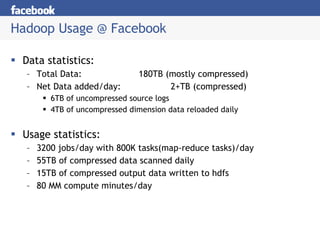
Hadoop Usage @ Facebook Data statistics: Total Data: 180TB (mostly compressed) Net Data added/day: 2+TB (compressed) 6TB of uncompressed source logs 4TB of uncompressed dimension data reloaded daily Usage statistics: 3200 jobs/day with 800K tasks(map-reduce tasks)/day 55TB of compressed data scanned daily 15TB of compressed output data written to hdfs 80 MM compute minutes/day
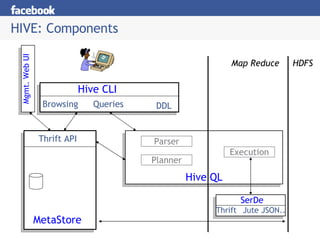
HIVE: Components HDFS Hive CLI DDL Queries Browsing Map Reduce MetaStore Thrift API SerDe Thrift Jute JSON.. Execution Hive QL Parser Planner Mgmt. Web UI
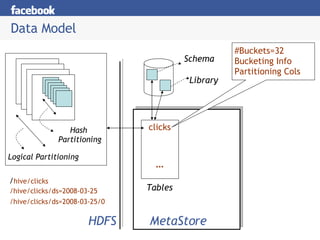
Data Model Logical Partitioning Hash Partitioning Schema Library clicks HDFS MetaStore / hive/clicks /hive/clicks/ds=2008-03-25 /hive/clicks/ds=2008-03-25/0 … Tables #Buckets=32 Bucketing Info Partitioning Cols
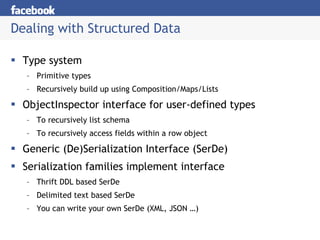
Dealing with Structured Data Type system Primitive types Recursively build up using Composition/Maps/Lists ObjectInspector interface for user-defined types To recursively list schema To recursively access fields within a row object Generic (De)Serialization Interface (SerDe) Serialization families implement interface Thrift DDL based SerDe Delimited text based SerDe You can write your own SerDe (XML, JSON …)
MetaStore Stores Table/Partition properties: Table schema and SerDe library Table Location on HDFS Logical Partitioning keys and types Partition level metadata Other information Thrift API Current clients in Php (Web Interface), Python interface to Hive, Java (Query Engine and CLI) Metadata stored in any SQL backend Future Statistics Schema Evolution
Hive Query Language Basic SQL From clause subquery ANSI JOIN (equi-join only) Multi-table Insert Multi group-by Sampling Objects traversal Extensibility Pluggable Map-reduce scripts using TRANSFORM
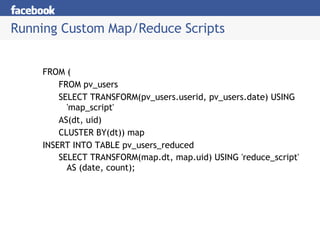
Running Custom Map/Reduce Scripts FROM (  FROM pv_users  SELECT TRANSFORM(pv_users.userid, pv_users.date) USING 'map_script'  AS(dt, uid)  CLUSTER BY(dt)) map  INSERT INTO TABLE pv_users_reduced  SELECT TRANSFORM(map.dt, map.uid) USING 'reduce_script' AS (date, count);
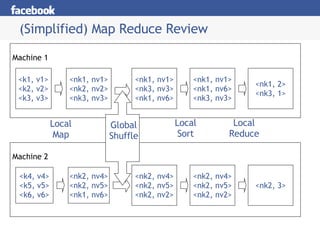
(Simplified) Map Reduce Review Machine 2 Machine 1 <k1, v1> <k2, v2> <k3, v3> <k4, v4> <k5, v5> <k6, v6> <nk1, nv1> <nk2, nv2> <nk3, nv3> <nk2, nv4> <nk2, nv5> <nk1, nv6> Local Map <nk2, nv4> <nk2, nv5> <nk2, nv2> <nk1, nv1> <nk3, nv3> <nk1, nv6> Global Shuffle <nk1, nv1> <nk1, nv6> <nk3, nv3> <nk2, nv4> <nk2, nv5> <nk2, nv2> Local Sort <nk2, 3> <nk1, 2> <nk3, 1> Local Reduce
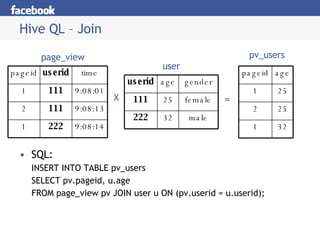
Hive QL – Join SQL: INSERT INTO TABLE pv_users SELECT pv.pageid, u.age FROM page_view pv JOIN user u ON (pv.userid = u.userid); X = page_view user pv_users pageid userid time 1 111 9:08:01 2 111 9:08:13 1 222 9:08:14 userid age gender 111 25 female 222 32 male pageid age 1 25 2 25 1 32
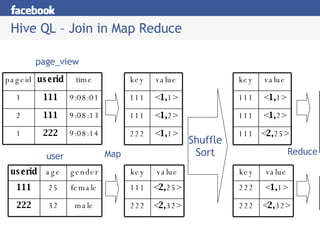
Hive QL – Join in Map Reduce page_view user pv_users Map Shuffle Sort Reduce key value 111 < 1, 1> 111 < 1, 2> 222 < 1, 1> pageid userid time 1 111 9:08:01 2 111 9:08:13 1 222 9:08:14 userid age gender 111 25 female 222 32 male key value 111 < 2, 25> 222 < 2, 32> key value 111 < 1, 1> 111 < 1, 2> 111 < 2, 25> key value 222 < 1, 1> 222 < 2, 32> pageid age 1 25 2 25 pageid age 1 32
Joins Outer Joins INSERT INTO TABLE pv_users  SELECT pv.*, u.gender, u.age  FROM page_view pv FULL OUTER JOIN user u ON (pv.userid = u.id)  WHERE pv.date = 2008-03-03;
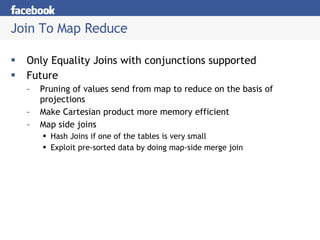
Join To Map Reduce Only Equality Joins with conjunctions supported Future Pruning of values send from map to reduce on the basis of projections Make Cartesian product more memory efficient Map side joins  Hash Joins if one of the tables is very small Exploit pre-sorted data by doing map-side merge join
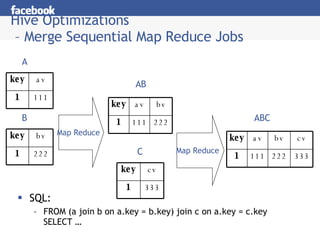
Hive Optimizations  – Merge Sequential Map Reduce Jobs SQL: FROM (a join b on a.key = b.key) join c on a.key = c.key SELECT … A Map Reduce B C AB Map Reduce ABC key av bv 1 111 222 key av 1 111 key bv 1 222 key cv 1 333 key av bv cv 1 111 222 333
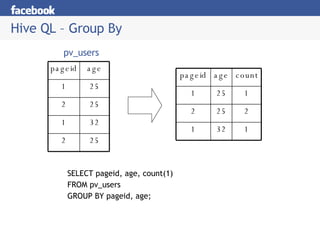
Hive QL – Group By SELECT pageid, age, count(1) FROM pv_users GROUP BY pageid, age; pv_users pageid age 1 25 2 25 1 32 2 25 pageid age count 1 25 1 2 25 2 1 32 1
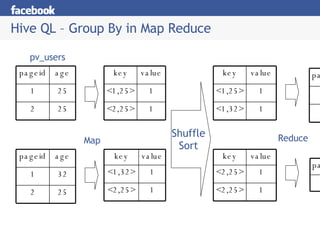
Hive QL – Group By in Map Reduce pv_users Map Shuffle Sort Reduce pageid age 1 25 2 25 pageid age count 1 25 1 1 32 1 pageid age 1 32 2 25 key value <1,25> 1 <2,25> 1 key value <1,32> 1 <2,25> 1 key value <1,25> 1 <1,32> 1 key value <2,25> 1 <2,25> 1 pageid age count 2 25 2
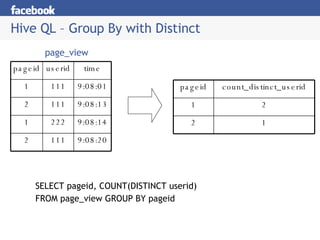
Hive QL – Group By with Distinct SELECT pageid, COUNT(DISTINCT userid) FROM page_view GROUP BY pageid page_view pageid userid time 1 111 9:08:01 2 111 9:08:13 1 222 9:08:14 2 111 9:08:20 pageid count_distinct_userid 1 2 2 1
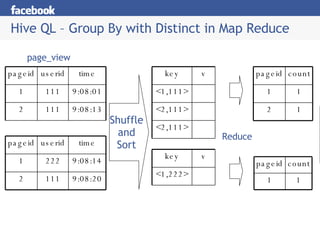
Hive QL – Group By with Distinct in Map Reduce page_view Shuffle and Sort Reduce Map Reduce pageid count 1 1 2 1 pageid count 1 1 pageid userid time 1 111 9:08:01 2 111 9:08:13 pageid userid time 1 222 9:08:14 2 111 9:08:20 key v <1,111> <2,111> <2,111> key v <1,222> pageid count 1 2 pageid count 2 1
Group by Future optimizations Map side partial aggregations Hash Based aggregates Exploit pre-sorted data for distinct counts Partial aggregations in Combiner Be smarter about how to avoid multiple stage Exploit table/column statistics for deciding strategy
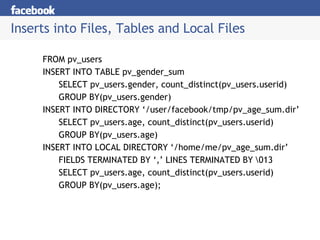
Inserts into Files, Tables and Local Files  FROM pv_users  INSERT INTO TABLE pv_gender_sum  SELECT pv_users.gender, count_distinct(pv_users.userid)  GROUP BY(pv_users.gender)  INSERT INTO DIRECTORY ‘/user/facebook/tmp/pv_age_sum.dir’  SELECT pv_users.age, count_distinct(pv_users.userid)  GROUP BY(pv_users.age)  INSERT INTO LOCAL DIRECTORY ‘/home/me/pv_age_sum.dir’   FIELDS TERMINATED BY ‘,’ LINES TERMINATED BY \013  SELECT pv_users.age, count_distinct(pv_users.userid)  GROUP BY(pv_users.age);
Future Work Cost-based optimization Multiple interfaces (JDBC…) Performance Comparisons with similar work (PIG) SQL Compliance (order by, nested queries…) Integration with BI tools Data Compression Columnar storage schemes  Exploit lazy/functional Hive field retrieval interfaces Better data locality Co-locate hash partitions on same rack Exploit high intra-rack bandwidth for merge joins
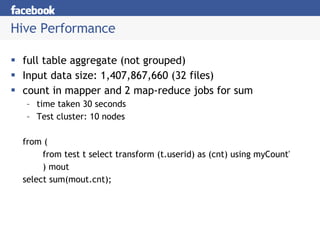
Hive Performance full table aggregate (not grouped)  Input data size: 1,407,867,660 (32 files)  count in mapper and 2 map-reduce jobs for sum time taken 30 seconds Test cluster: 10 nodes from (  from test t select transform (t.userid) as (cnt) using myCount'  ) mout  select sum(mout.cnt);
Hadoop Challenges @ Facebook QOS/Isolation: Big jobs can hog the cluster JobTracker memory as limited resource Limit memory impact of runaway tasks Fair Scheduler (Matei) Protection What if a software bug corrupts the NameNode transaction log/image? HDFS SnapShots (Dhruba) Data Archival Not all data is hot and needs colocation with Compute HDFS Symlinks (Dhruba) Data Archival Performance Really hard to understand what bottlenecks are
Conclusion Available as a contrib project in hadoop http://svn.apache.org/repos/asf/hadoop/core/ Checkout src/contrib/hive from trunk (works against 0.19 onwards) Latest distributions (including for hadoop-0.17) at: http://mirror.facebook.com/facebook/hive/ People: Suresh Anthony Zheng Shao Prasad Chakka Pete Wyckoff Namit Jain Raghu Murthy Joydeep Sen Sarma Ashish Thusoo

HIVE: Data Warehousing & Analytics on Hadoop

  • 1.
    HIVE Data Warehousing& Analytics on Hadoop Facebook Data Team
  • 2.
    Why Another DataWarehousing System? Problem: Data, data and more data 200GB per day in March 2008 2+TB(compressed) raw data per day today The Hadoop Experiment Much superior to availability and scalability of commercial DBs Efficiency not that great, but throw more hardware Partial Availability/resilience/scale more important than ACID Problem: Programmability and Metadata Map-reduce hard to program (users know sql/bash/python) Need to publish data in well known schemas Solution: HIVE
  • 3.
    What is HIVE?A system for querying and managing structured data built on top of Hadoop Uses Map-Reduce for execution HDFS for storage – but any system that implements Hadoop FS API Key Building Principles: Structured data with rich data types (structs, lists and maps) Directly query data from different formats (text/binary) and file formats (Flat/Sequence) SQL as a familiar programming tool and for standard analytics Allow embedded scripts for extensibility and for non standard applications Rich MetaData to allow data discovery and for optimization
  • 4.
    Data Warehousing atFacebook Today Web Servers Scribe Servers Filers Hive on Hadoop Cluster Oracle RAC Federated MySQL
  • 5.
    Hive/Hadoop Usage @Facebook Types of Applications: Summarization Eg: Daily/Weekly aggregations of impression/click counts Complex measures of user engagement Ad hoc Analysis Eg: how many group admins broken down by state/country Data Mining (Assembling training data) Eg: User Engagement as a function of user attributes Spam Detection Anomalous patterns in UGC Application api usage patterns Ad Optimization Too many to count ..
  • 6.
    Hadoop Usage @Facebook Data statistics: Total Data: 180TB (mostly compressed) Net Data added/day: 2+TB (compressed) 6TB of uncompressed source logs 4TB of uncompressed dimension data reloaded daily Usage statistics: 3200 jobs/day with 800K tasks(map-reduce tasks)/day 55TB of compressed data scanned daily 15TB of compressed output data written to hdfs 80 MM compute minutes/day
  • 7.
    HIVE: Components HDFSHive CLI DDL Queries Browsing Map Reduce MetaStore Thrift API SerDe Thrift Jute JSON.. Execution Hive QL Parser Planner Mgmt. Web UI
  • 8.
    Data Model LogicalPartitioning Hash Partitioning Schema Library clicks HDFS MetaStore / hive/clicks /hive/clicks/ds=2008-03-25 /hive/clicks/ds=2008-03-25/0 … Tables #Buckets=32 Bucketing Info Partitioning Cols
  • 9.
    Dealing with StructuredData Type system Primitive types Recursively build up using Composition/Maps/Lists ObjectInspector interface for user-defined types To recursively list schema To recursively access fields within a row object Generic (De)Serialization Interface (SerDe) Serialization families implement interface Thrift DDL based SerDe Delimited text based SerDe You can write your own SerDe (XML, JSON …)
  • 10.
    MetaStore Stores Table/Partitionproperties: Table schema and SerDe library Table Location on HDFS Logical Partitioning keys and types Partition level metadata Other information Thrift API Current clients in Php (Web Interface), Python interface to Hive, Java (Query Engine and CLI) Metadata stored in any SQL backend Future Statistics Schema Evolution
  • 11.
    Hive Query LanguageBasic SQL From clause subquery ANSI JOIN (equi-join only) Multi-table Insert Multi group-by Sampling Objects traversal Extensibility Pluggable Map-reduce scripts using TRANSFORM
  • 12.
    Running Custom Map/ReduceScripts FROM ( FROM pv_users SELECT TRANSFORM(pv_users.userid, pv_users.date) USING 'map_script' AS(dt, uid) CLUSTER BY(dt)) map INSERT INTO TABLE pv_users_reduced SELECT TRANSFORM(map.dt, map.uid) USING 'reduce_script' AS (date, count);
  • 13.
    (Simplified) Map ReduceReview Machine 2 Machine 1 <k1, v1> <k2, v2> <k3, v3> <k4, v4> <k5, v5> <k6, v6> <nk1, nv1> <nk2, nv2> <nk3, nv3> <nk2, nv4> <nk2, nv5> <nk1, nv6> Local Map <nk2, nv4> <nk2, nv5> <nk2, nv2> <nk1, nv1> <nk3, nv3> <nk1, nv6> Global Shuffle <nk1, nv1> <nk1, nv6> <nk3, nv3> <nk2, nv4> <nk2, nv5> <nk2, nv2> Local Sort <nk2, 3> <nk1, 2> <nk3, 1> Local Reduce
  • 14.
    Hive QL –Join SQL: INSERT INTO TABLE pv_users SELECT pv.pageid, u.age FROM page_view pv JOIN user u ON (pv.userid = u.userid); X = page_view user pv_users pageid userid time 1 111 9:08:01 2 111 9:08:13 1 222 9:08:14 userid age gender 111 25 female 222 32 male pageid age 1 25 2 25 1 32
  • 15.
    Hive QL –Join in Map Reduce page_view user pv_users Map Shuffle Sort Reduce key value 111 < 1, 1> 111 < 1, 2> 222 < 1, 1> pageid userid time 1 111 9:08:01 2 111 9:08:13 1 222 9:08:14 userid age gender 111 25 female 222 32 male key value 111 < 2, 25> 222 < 2, 32> key value 111 < 1, 1> 111 < 1, 2> 111 < 2, 25> key value 222 < 1, 1> 222 < 2, 32> pageid age 1 25 2 25 pageid age 1 32
  • 16.
    Joins Outer JoinsINSERT INTO TABLE pv_users SELECT pv.*, u.gender, u.age FROM page_view pv FULL OUTER JOIN user u ON (pv.userid = u.id) WHERE pv.date = 2008-03-03;
  • 17.
    Join To MapReduce Only Equality Joins with conjunctions supported Future Pruning of values send from map to reduce on the basis of projections Make Cartesian product more memory efficient Map side joins Hash Joins if one of the tables is very small Exploit pre-sorted data by doing map-side merge join
  • 18.
    Hive Optimizations – Merge Sequential Map Reduce Jobs SQL: FROM (a join b on a.key = b.key) join c on a.key = c.key SELECT … A Map Reduce B C AB Map Reduce ABC key av bv 1 111 222 key av 1 111 key bv 1 222 key cv 1 333 key av bv cv 1 111 222 333
  • 19.
    Hive QL –Group By SELECT pageid, age, count(1) FROM pv_users GROUP BY pageid, age; pv_users pageid age 1 25 2 25 1 32 2 25 pageid age count 1 25 1 2 25 2 1 32 1
  • 20.
    Hive QL –Group By in Map Reduce pv_users Map Shuffle Sort Reduce pageid age 1 25 2 25 pageid age count 1 25 1 1 32 1 pageid age 1 32 2 25 key value <1,25> 1 <2,25> 1 key value <1,32> 1 <2,25> 1 key value <1,25> 1 <1,32> 1 key value <2,25> 1 <2,25> 1 pageid age count 2 25 2
  • 21.
    Hive QL –Group By with Distinct SELECT pageid, COUNT(DISTINCT userid) FROM page_view GROUP BY pageid page_view pageid userid time 1 111 9:08:01 2 111 9:08:13 1 222 9:08:14 2 111 9:08:20 pageid count_distinct_userid 1 2 2 1
  • 22.
    Hive QL –Group By with Distinct in Map Reduce page_view Shuffle and Sort Reduce Map Reduce pageid count 1 1 2 1 pageid count 1 1 pageid userid time 1 111 9:08:01 2 111 9:08:13 pageid userid time 1 222 9:08:14 2 111 9:08:20 key v <1,111> <2,111> <2,111> key v <1,222> pageid count 1 2 pageid count 2 1
  • 23.
    Group by Futureoptimizations Map side partial aggregations Hash Based aggregates Exploit pre-sorted data for distinct counts Partial aggregations in Combiner Be smarter about how to avoid multiple stage Exploit table/column statistics for deciding strategy
  • 24.
    Inserts into Files,Tables and Local Files FROM pv_users INSERT INTO TABLE pv_gender_sum SELECT pv_users.gender, count_distinct(pv_users.userid) GROUP BY(pv_users.gender) INSERT INTO DIRECTORY ‘/user/facebook/tmp/pv_age_sum.dir’ SELECT pv_users.age, count_distinct(pv_users.userid) GROUP BY(pv_users.age) INSERT INTO LOCAL DIRECTORY ‘/home/me/pv_age_sum.dir’ FIELDS TERMINATED BY ‘,’ LINES TERMINATED BY \013 SELECT pv_users.age, count_distinct(pv_users.userid) GROUP BY(pv_users.age);
  • 25.
    Future Work Cost-basedoptimization Multiple interfaces (JDBC…) Performance Comparisons with similar work (PIG) SQL Compliance (order by, nested queries…) Integration with BI tools Data Compression Columnar storage schemes Exploit lazy/functional Hive field retrieval interfaces Better data locality Co-locate hash partitions on same rack Exploit high intra-rack bandwidth for merge joins
  • 26.
    Hive Performance fulltable aggregate (not grouped) Input data size: 1,407,867,660 (32 files) count in mapper and 2 map-reduce jobs for sum time taken 30 seconds Test cluster: 10 nodes from ( from test t select transform (t.userid) as (cnt) using myCount' ) mout select sum(mout.cnt);
  • 27.
    Hadoop Challenges @Facebook QOS/Isolation: Big jobs can hog the cluster JobTracker memory as limited resource Limit memory impact of runaway tasks Fair Scheduler (Matei) Protection What if a software bug corrupts the NameNode transaction log/image? HDFS SnapShots (Dhruba) Data Archival Not all data is hot and needs colocation with Compute HDFS Symlinks (Dhruba) Data Archival Performance Really hard to understand what bottlenecks are
  • 28.
    Conclusion Available asa contrib project in hadoop http://svn.apache.org/repos/asf/hadoop/core/ Checkout src/contrib/hive from trunk (works against 0.19 onwards) Latest distributions (including for hadoop-0.17) at: http://mirror.facebook.com/facebook/hive/ People: Suresh Anthony Zheng Shao Prasad Chakka Pete Wyckoff Namit Jain Raghu Murthy Joydeep Sen Sarma Ashish Thusoo

Editor's Notes

  • #2 STYLE GUIDELINES The master cannot be changed, if you are going to place another logo on any slide, please place it in the lower right corner. Title sizes may not be tampered with. If your title is too long please shorten it. Please do not center the title and subtitle, everything is made to align with the Facebook logo above them. Always remember to use the correct slide type for what you’re using it for. If you’re looking to use half a slide with bullet points and the other half with a picture, pick the correct slide type.