Respiratory Quotient
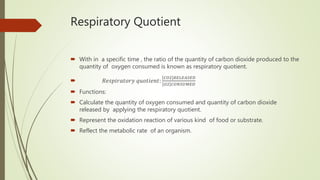
 With in a specific time , the ratio of the quantity of carbon dioxide produced to the
quantity of oxygen consumed is known as respiratory quotient.
 𝑅𝑒𝑠𝑝𝑖𝑟𝑎𝑡𝑜𝑟𝑦 𝑞𝑢𝑜𝑡𝑖𝑒𝑛𝑡:
𝐶𝑂2 𝑅𝐸𝐿𝐸𝐴𝑆𝐸𝐷
𝑂2 𝐶𝑂𝑁𝑆𝑈𝑀𝐸𝐷
 Functions:
 Calculate the quantity of oxygen consumed and quantity of carbon dioxide
released by applying the respiratory quotient.
 Represent the oxidation reaction of various kind of food or substrate.
 Reflect the metabolic rate of an organism.
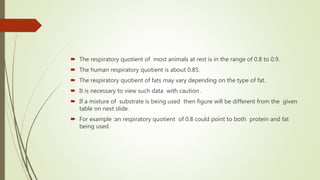
 The respiratory quotient of most animals at rest is in the range of 0.8 to 0.9.
 The human respiratory quotient is about 0.85.
 The respiratory quotient of fats may vary depending on the type of fat.
 It is necessary to view such data with caution .
 If a mixture of substrate is being used then figure will be different from the given
table on next slide.
 For example :an respiratory quotient of 0.8 could point to both protein and fat
being used.
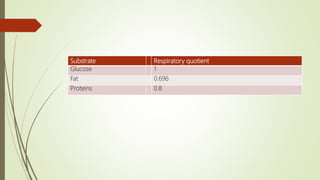
Substrate Respiratory quotient
Glucose 1
Fat 0.696
Proteins 0.8
Respiratory Quotient Represents types of
respiration
 If Respiratory Quotient is smaller than 1 then it will be aerobic respiration.
 If Respiratory Quotient is equal to 1 then it will be aerobic respiration.
 If Respiratory Quotient is greater then 1 then it will be anaerobic respiration.
 Low value of respiratory quotient indicates that:
 Aerobic respiration is being carried out.
 Plants absorb CO2 to carry out photosynthesis.
 Animals utilizes carbon element to manufacture calcareous shell.
 High value of Respiratory quotient indicates:
 Anaerobic respiration is being carried out.
 Conversion of carbohydrates into fats for example for hibernation.
 Process of large quantity of food for storage.


Respiratory quotient

  • 1.
  • 2.
    Respiratory Quotient  Within a specific time , the ratio of the quantity of carbon dioxide produced to the quantity of oxygen consumed is known as respiratory quotient.  𝑅𝑒𝑠𝑝𝑖𝑟𝑎𝑡𝑜𝑟𝑦 𝑞𝑢𝑜𝑡𝑖𝑒𝑛𝑡: 𝐶𝑂2 𝑅𝐸𝐿𝐸𝐴𝑆𝐸𝐷 𝑂2 𝐶𝑂𝑁𝑆𝑈𝑀𝐸𝐷  Functions:  Calculate the quantity of oxygen consumed and quantity of carbon dioxide released by applying the respiratory quotient.  Represent the oxidation reaction of various kind of food or substrate.  Reflect the metabolic rate of an organism.
  • 3.
     The respiratoryquotient of most animals at rest is in the range of 0.8 to 0.9.  The human respiratory quotient is about 0.85.  The respiratory quotient of fats may vary depending on the type of fat.  It is necessary to view such data with caution .  If a mixture of substrate is being used then figure will be different from the given table on next slide.  For example :an respiratory quotient of 0.8 could point to both protein and fat being used.
  • 4.
  • 5.
    Respiratory Quotient Representstypes of respiration  If Respiratory Quotient is smaller than 1 then it will be aerobic respiration.  If Respiratory Quotient is equal to 1 then it will be aerobic respiration.  If Respiratory Quotient is greater then 1 then it will be anaerobic respiration.  Low value of respiratory quotient indicates that:  Aerobic respiration is being carried out.  Plants absorb CO2 to carry out photosynthesis.  Animals utilizes carbon element to manufacture calcareous shell.
  • 6.
     High valueof Respiratory quotient indicates:  Anaerobic respiration is being carried out.  Conversion of carbohydrates into fats for example for hibernation.  Process of large quantity of food for storage. 