Synthesis & Catabolism of Sucrose & Starch
By
N. Sannigrahi, Associate Professor,
Nistarini College, Purulia, (W.B) India
Plant metabolism
CARBOHYDRATES-TYPES
 Carbohydrates are important bio-macromolecules and major
sources of supplying energy to living and also perform
architectural functions. Carbohydrate (hydrates of carbon) are
polyhydroxy aldehydes or ketones or substances that yield one of
these compounds on hydrolysis.
 Carbohydrates are divided into three types-
 MONOSACCHARIDE either aldoses (-CHO) or Ketoses (C=O)
like DHAP, Erythrose, Ribulose, Fructose, Seduoheptulose,
 DISACCHARIDES AND OLIGOSACCHARIDES-two to ten
units of simple sugars joined by glycoside bonds. Maltose and
lactose are reducing sugar while sucrose is non-reducing sugar ,
predominant form of sugar in most vascular plants . “Sucrose is
something of a riddle in plant biochemistry”.
TYPES OF CARBOHYDRATES
 Sucrose is the sugar of commerce abundantly present in ripened
fruits like pineapple, apple, mango, grapes, vegetable , sugarcane,
beet roots, tapioca, sweet potato etc.
 POLYSACCHARIDES- Polymeric anhydrides of simple sugars
hydrolyzed with acids or enzymes to yield monosaccharide . It
may be two types-
 Homo-polysaccharides- only one type of monosaccharide like
starch, inulin, cellulose, glycogen
 Hetero-polysaccharides- Composed of different types of
monosaccharide or on hydrolysis yield a mixture of
monosaccharide and derived products. Hyaluronic acid,
Chondoroitin, vegetable gums, agar-agar. Polysaccharides may be
storage ( Starch, Glycogen) or structural polysaccharides
(Cellulose, Hemicelluloses, pectic compounds, chitin, Mucilage).
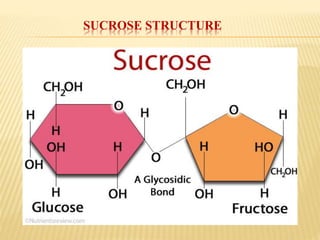
SUCROSE STRUCTURE
WHAT IS SUCCROSE?
 Sucrose is the most abundant disaccharide and the major
product of photosynthesis. It is a non-reducing sugar with
limited chemical reactivity and thus is utilized as a transport
and storage molecule in most plants. Sucrose synthesis is
predominant in leaves, but the ability to synthesize sucrose is
fairly widespread among plant cells. Sucrose is synthesized in
the cytosol by the consecutive activities of two enzymes:
sucrose-phosphate synthetase (SPS) and sucrose phosphatase
(SPP). SPS catalyzes the reversible transfer of glucosyl units
from UDP-glucose to fructose 6-phosphate synthesizing
sucrose 6-phosphate that is dephosphorylated by SPP to yield
sucrose in an irreversible reaction. SPS is the key regulating
step of sucrose biosynthesis. In plants, SPS can be activated
allosterically by glucose 6-phosphate and inhibited by
WHAT IS SUCROSE ?
 inorganic phosphate (Pi). In addition, SPS also contains several
regulatory phosphorylation sites. Sucrose synthase (SucS),
present in both soluble and membrane-bound forms, is
responsible for catalyzing both the synthesis and degradation
of sucrose
 The translocation of synthesized sucrose from source to sink
tissues is essential for proper plant growth and development.
Sucrose can be translocated either symplastically (through
Plasmodesmata) or apoplastically (through apoplasts with the
help of sucrose transporters). In sink tissues, sucrose can be
stored inside cell vacuoles through transporters located at
tonoplasts or can be hydrolyzed by invertase providing glucose
and fructose to the cell. The translocation of sucrose from
source to sink tissues is very active during grain development
when storage carbohydrates are synthesized in the grains
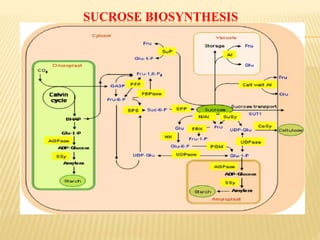
SUCROSE BIOSYNTHESIS
SUCCROSE BIOSYNTHESIS
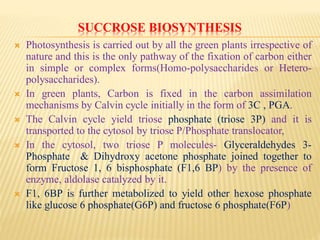
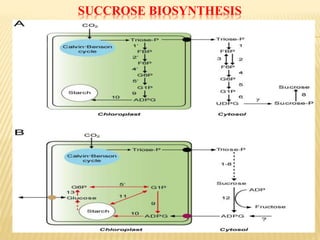
 Photosynthesis is carried out by all the green plants irrespective of
nature and this is the only pathway of the fixation of carbon either
in simple or complex forms(Homo-polysaccharides or Hetero-
polysaccharides).
 In green plants, Carbon is fixed in the carbon assimilation
mechanisms by Calvin cycle initially in the form of 3C , PGA.
 The Calvin cycle yield triose phosphate (triose 3P) and it is
transported to the cytosol by triose P/Phosphate translocator,
 In the cytosol, two triose P molecules- Glyceraldehydes 3-
Phosphate & Dihydroxy acetone phosphate joined together to
form Fructose 1, 6 bisphosphate (F1,6 BP) by the presence of
enzyme, aldolase catalyzed by it.
 F1, 6BP is further metabolized to yield other hexose phosphate
like glucose 6 phosphate(G6P) and fructose 6 phosphate(F6P)
SUCROSE BIOSYNTHESIS
 Glucose 6-phosphate is transformed into Glucose 1-phosphate
with the help of the enzyme, phosphoglucomutase,
 Glucose 1-Phosphate can be used to form UDP-Glucose ( UDP-G)
in the presence of an enzyme UDP-glucose pyrophosphorylase,
 The Pyrophosphate produced in this reaction is removed by the
enzyme pyrophosphatase (2Pi).
 UDP-G is combined with F6P to form Sucrose 6-Phosphate in a
reaction catalyzed by the enzyme Sucrose 6-Phosphate synthetase,
 Sucrose 6-Phosphate is dephosphorylated by Sucrose 6-
phosphate phosphatase to form Sucrose.
 So, with the help of the aforesaid biochemical reaction, Sucrose
synthesis takes place in cytosol of green plants.
SUCROSE CATABOLISM
 Sucrose can be transported by apoplastic or symplstic pathway to
the sink tissues where it can be broken down through catabolism.
 It can be degraded by either sucrose synthase or invertase. Sucrose
synthase catalyses a reversible reaction that can synthesize or
breakdown sucrose. In plant cells, this enzyme associated
primarily with sucrose degradation. The reaction can be catalyzed
by Invertase which is irreversible and so only leads to sucrose
degradation. Breakdown or the hydrolysis of starch to yield its
constituent a-D-Glucose units may take
place :
a. By the presence of diastase
 Starch + H20--------------------------Glucose
SUCCROSE BIOSYNTHESIS
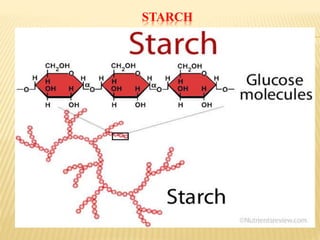
STARCH
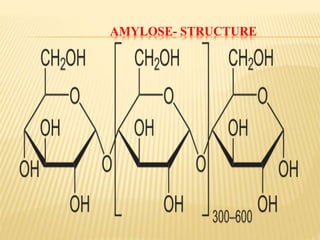
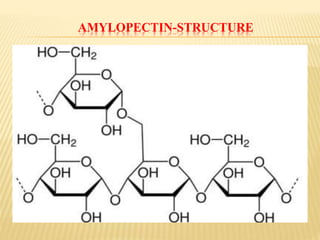
 Starch is an osmotically inert form of carbohydrate, polymer of
glucose; massive, compact, insoluble semi-crystalline granules;
starch granules contain two glucose polymers- Amylose &
amylopectin both of two are the homo-polymers of ⅋-1,4 linked
glucose.
 Why Starch ?
 -If a comparable number of hexose units accumulated as sucrose
in the plastid, the stomatal solution would contain too many solute
particles, and water from the cytosol, would flood in by osmosis
causing the plastid to swell and burst.
 For the said reason, in most of the cases, starch play a very crucial
role as storage products in this regard in plants storage substances.
 Potato, Wheat, Rice are the most common sources of starch in
plants
AMYLOSE- STRUCTURE
AMYLOPECTIN-STRUCTURE
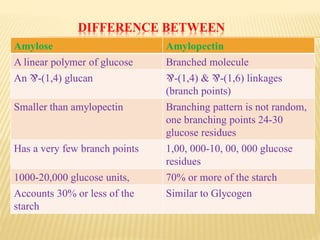
DIFFERENCE BETWEEN
Amylose Amylopectin
A linear polymer of glucose Branched molecule
An ⅋-(1,4) glucan ⅋-(1,4) & ⅋-(1,6) linkages
(branch points)
Smaller than amylopectin Branching pattern is not random,
one branching points 24-30
glucose residues
Has a very few branch points 1,00, 000-10, 00, 000 glucose
residues
1000-20,000 glucose units, 70% or more of the starch
Accounts 30% or less of the
starch
Similar to Glycogen
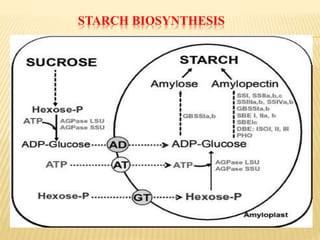
STARCH BIOSYNTHESIS
STARCH BIOSYNTHESIS
 Synthesis of Starch:
 Synthesis of starch involves the simultaneous synthesis of amylose
(with α-(1: 4) glycosidic linkages) and amylopectin (with α-(1: 6)
glycoside linkages), the two important constituents of starch.
 (A) Synthesis of Amylose (Or α-(1: 4) Glycosidic Linkages):
 Synthesis of amylose may take place by any of the following
ways:-
 (1) According to Hanes (1940) amylose can be synthesized in the
presence of the enzyme starch phosphorylase from glucose-1-
phosphate and an acceptor molecule consisting of about 3 to 20
glucose units joined together by α-(1: 4) glycosidic linkages.
STARCH
STARCH BIOSYNTHESIS
 (2) Formation of α-(1 : 4) glycosidic linkages may also take place
in the presence of the enzyme UDPG-transglycosylase (amylose
synthetase) by the transfer of glucose from UDPG (Uridine Di
Phosphate Glucose) to an acceptor molecule consisting of 2 to 4 or
more glucose units joined together by α-(1 : 4) glycosidic linkages
or even a starch molecule.
 (3) According to Akazawa et al (1964) glucose molecule obtained
as a result of the hydrolysis of sucrose in the presence of enzyme
sucrase is transferred to UDP (Uridine Di Phosphate) molecule to
form UDPG. Form UDPG the glucose molecule is transferred to
starch.
 (4) Formation of α-(1: 4) glycosidic linkages leading to the
synthesis of; amylose may also take place in the presence of D-
Enzyme by the transfer of two or more glucose units from
maltodextrins (consisting of more than two glucose units) to a
STARCH BIOSYNTHESIS
 variety of acceptors such as maltotroise, maltotetrose molecules.
 B) Synthesis of Amylopectin (Or α-(1: 6) Glycosidic Linkages):
 It takes place in the presence of Q-Enzyme by the transfer of small
chains of glucose units joined together by α-(1: 4) glycosidic
linkages to an acceptor molecule consisting of at least four α (1:4)
linked glucose units. The α-(1: 6) glycosidic bond is established
between C-1 of the terminal glucose unit of donor molecule and
C-6 of one of the glucose units of the acceptor molecule.
 STARCH CATABOLISM:
 Breakdown or the hydrolysis of starch to yield its constituent a-D-
Glucose units may take place in two ways
 By the enzyme diastase: Starch ---------Glucose ( Diastase + H2O)
CATABOLISM OF STARCH
 In fact, diastase is not a single enzyme; it is comprising of four
enzymes- ⅋ amylase, β-amylase, R-enzyme and Maltase.
 α-amylase and β-amylase attack 1 : 4 linkages of amylose and
amylopectin (which constitute the starch) while R-Enzyme attacks
1 : 6 linkages of amylopectin, so that starch is hydrolyzed to yield
disaccharide units i.e., maltose. Finally, the enzyme maltase
converts maltose into glucose molecules.
 By the enzyme starch phosphorylase.
 Starch + Phosphate---------(Phosphorylase)---Glucose 1,
phosphate
 Glucose 1, phosphate may be converted into glucose by the
enzyme Phosphatase
CONCLUSION
 Carbohydrates , ‘staff of life’ are their most abundant class of bio-
molecules in nature and they are widely distributed in plants and
animals as energy source as well as the molecules for Skelton of
cells. They also serve to lubricate skeletal joints , to provide
adhesion between cells and to confer biological specificity on the
surface of animal cells. Out of the different carbohydrates, sucrose
is a major intermediate product of photosynthesis and it is the
predominant form in which sugar is transported in most plants
from leaves to other organs of plants via their vascular systems.
Starch plays a very important polysaccharides being white , soft
amorphous nature and lacks sweetness. Although it is insoluble in
water, alcohol and ether at ordinary temperature , still it plays a
very important role to extend lot of function in this regards.
THANKS FOR YOUR JOURNEY
 Acknowledgement:
 1. Google for images
 2. Different web pages for content and enrichment,
 3.Plant Physiology- Mukherji & Ghosh
 Applied Plant Physiology- Arup Kumar Mitra
 A text book of Botany- Hait, Bhattacharya & Ghosh
 Plant Physiology-Devlin
 Disclaimer: This presentation has been prepared for online free
study materials for academic domain without any financial
interest.

Starch & sucrose metabolism.pdf

  • 1.
    Synthesis & Catabolismof Sucrose & Starch By N. Sannigrahi, Associate Professor, Nistarini College, Purulia, (W.B) India Plant metabolism
  • 2.
    CARBOHYDRATES-TYPES  Carbohydrates areimportant bio-macromolecules and major sources of supplying energy to living and also perform architectural functions. Carbohydrate (hydrates of carbon) are polyhydroxy aldehydes or ketones or substances that yield one of these compounds on hydrolysis.  Carbohydrates are divided into three types-  MONOSACCHARIDE either aldoses (-CHO) or Ketoses (C=O) like DHAP, Erythrose, Ribulose, Fructose, Seduoheptulose,  DISACCHARIDES AND OLIGOSACCHARIDES-two to ten units of simple sugars joined by glycoside bonds. Maltose and lactose are reducing sugar while sucrose is non-reducing sugar , predominant form of sugar in most vascular plants . “Sucrose is something of a riddle in plant biochemistry”.
  • 3.
    TYPES OF CARBOHYDRATES Sucrose is the sugar of commerce abundantly present in ripened fruits like pineapple, apple, mango, grapes, vegetable , sugarcane, beet roots, tapioca, sweet potato etc.  POLYSACCHARIDES- Polymeric anhydrides of simple sugars hydrolyzed with acids or enzymes to yield monosaccharide . It may be two types-  Homo-polysaccharides- only one type of monosaccharide like starch, inulin, cellulose, glycogen  Hetero-polysaccharides- Composed of different types of monosaccharide or on hydrolysis yield a mixture of monosaccharide and derived products. Hyaluronic acid, Chondoroitin, vegetable gums, agar-agar. Polysaccharides may be storage ( Starch, Glycogen) or structural polysaccharides (Cellulose, Hemicelluloses, pectic compounds, chitin, Mucilage).
  • 4.
  • 5.
    WHAT IS SUCCROSE? Sucrose is the most abundant disaccharide and the major product of photosynthesis. It is a non-reducing sugar with limited chemical reactivity and thus is utilized as a transport and storage molecule in most plants. Sucrose synthesis is predominant in leaves, but the ability to synthesize sucrose is fairly widespread among plant cells. Sucrose is synthesized in the cytosol by the consecutive activities of two enzymes: sucrose-phosphate synthetase (SPS) and sucrose phosphatase (SPP). SPS catalyzes the reversible transfer of glucosyl units from UDP-glucose to fructose 6-phosphate synthesizing sucrose 6-phosphate that is dephosphorylated by SPP to yield sucrose in an irreversible reaction. SPS is the key regulating step of sucrose biosynthesis. In plants, SPS can be activated allosterically by glucose 6-phosphate and inhibited by
  • 6.
    WHAT IS SUCROSE?  inorganic phosphate (Pi). In addition, SPS also contains several regulatory phosphorylation sites. Sucrose synthase (SucS), present in both soluble and membrane-bound forms, is responsible for catalyzing both the synthesis and degradation of sucrose  The translocation of synthesized sucrose from source to sink tissues is essential for proper plant growth and development. Sucrose can be translocated either symplastically (through Plasmodesmata) or apoplastically (through apoplasts with the help of sucrose transporters). In sink tissues, sucrose can be stored inside cell vacuoles through transporters located at tonoplasts or can be hydrolyzed by invertase providing glucose and fructose to the cell. The translocation of sucrose from source to sink tissues is very active during grain development when storage carbohydrates are synthesized in the grains
  • 7.
  • 8.
    SUCCROSE BIOSYNTHESIS  Photosynthesisis carried out by all the green plants irrespective of nature and this is the only pathway of the fixation of carbon either in simple or complex forms(Homo-polysaccharides or Hetero- polysaccharides).  In green plants, Carbon is fixed in the carbon assimilation mechanisms by Calvin cycle initially in the form of 3C , PGA.  The Calvin cycle yield triose phosphate (triose 3P) and it is transported to the cytosol by triose P/Phosphate translocator,  In the cytosol, two triose P molecules- Glyceraldehydes 3- Phosphate & Dihydroxy acetone phosphate joined together to form Fructose 1, 6 bisphosphate (F1,6 BP) by the presence of enzyme, aldolase catalyzed by it.  F1, 6BP is further metabolized to yield other hexose phosphate like glucose 6 phosphate(G6P) and fructose 6 phosphate(F6P)
  • 9.
    SUCROSE BIOSYNTHESIS  Glucose6-phosphate is transformed into Glucose 1-phosphate with the help of the enzyme, phosphoglucomutase,  Glucose 1-Phosphate can be used to form UDP-Glucose ( UDP-G) in the presence of an enzyme UDP-glucose pyrophosphorylase,  The Pyrophosphate produced in this reaction is removed by the enzyme pyrophosphatase (2Pi).  UDP-G is combined with F6P to form Sucrose 6-Phosphate in a reaction catalyzed by the enzyme Sucrose 6-Phosphate synthetase,  Sucrose 6-Phosphate is dephosphorylated by Sucrose 6- phosphate phosphatase to form Sucrose.  So, with the help of the aforesaid biochemical reaction, Sucrose synthesis takes place in cytosol of green plants.
  • 10.
    SUCROSE CATABOLISM  Sucrosecan be transported by apoplastic or symplstic pathway to the sink tissues where it can be broken down through catabolism.  It can be degraded by either sucrose synthase or invertase. Sucrose synthase catalyses a reversible reaction that can synthesize or breakdown sucrose. In plant cells, this enzyme associated primarily with sucrose degradation. The reaction can be catalyzed by Invertase which is irreversible and so only leads to sucrose degradation. Breakdown or the hydrolysis of starch to yield its constituent a-D-Glucose units may take place : a. By the presence of diastase  Starch + H20--------------------------Glucose
  • 11.
  • 12.
    STARCH  Starch isan osmotically inert form of carbohydrate, polymer of glucose; massive, compact, insoluble semi-crystalline granules; starch granules contain two glucose polymers- Amylose & amylopectin both of two are the homo-polymers of ⅋-1,4 linked glucose.  Why Starch ?  -If a comparable number of hexose units accumulated as sucrose in the plastid, the stomatal solution would contain too many solute particles, and water from the cytosol, would flood in by osmosis causing the plastid to swell and burst.  For the said reason, in most of the cases, starch play a very crucial role as storage products in this regard in plants storage substances.  Potato, Wheat, Rice are the most common sources of starch in plants
  • 13.
  • 14.
  • 15.
    DIFFERENCE BETWEEN Amylose Amylopectin Alinear polymer of glucose Branched molecule An ⅋-(1,4) glucan ⅋-(1,4) & ⅋-(1,6) linkages (branch points) Smaller than amylopectin Branching pattern is not random, one branching points 24-30 glucose residues Has a very few branch points 1,00, 000-10, 00, 000 glucose residues 1000-20,000 glucose units, 70% or more of the starch Accounts 30% or less of the starch Similar to Glycogen
  • 16.
  • 17.
    STARCH BIOSYNTHESIS  Synthesisof Starch:  Synthesis of starch involves the simultaneous synthesis of amylose (with α-(1: 4) glycosidic linkages) and amylopectin (with α-(1: 6) glycoside linkages), the two important constituents of starch.  (A) Synthesis of Amylose (Or α-(1: 4) Glycosidic Linkages):  Synthesis of amylose may take place by any of the following ways:-  (1) According to Hanes (1940) amylose can be synthesized in the presence of the enzyme starch phosphorylase from glucose-1- phosphate and an acceptor molecule consisting of about 3 to 20 glucose units joined together by α-(1: 4) glycosidic linkages.
  • 18.
  • 19.
    STARCH BIOSYNTHESIS  (2)Formation of α-(1 : 4) glycosidic linkages may also take place in the presence of the enzyme UDPG-transglycosylase (amylose synthetase) by the transfer of glucose from UDPG (Uridine Di Phosphate Glucose) to an acceptor molecule consisting of 2 to 4 or more glucose units joined together by α-(1 : 4) glycosidic linkages or even a starch molecule.  (3) According to Akazawa et al (1964) glucose molecule obtained as a result of the hydrolysis of sucrose in the presence of enzyme sucrase is transferred to UDP (Uridine Di Phosphate) molecule to form UDPG. Form UDPG the glucose molecule is transferred to starch.  (4) Formation of α-(1: 4) glycosidic linkages leading to the synthesis of; amylose may also take place in the presence of D- Enzyme by the transfer of two or more glucose units from maltodextrins (consisting of more than two glucose units) to a
  • 20.
    STARCH BIOSYNTHESIS  varietyof acceptors such as maltotroise, maltotetrose molecules.  B) Synthesis of Amylopectin (Or α-(1: 6) Glycosidic Linkages):  It takes place in the presence of Q-Enzyme by the transfer of small chains of glucose units joined together by α-(1: 4) glycosidic linkages to an acceptor molecule consisting of at least four α (1:4) linked glucose units. The α-(1: 6) glycosidic bond is established between C-1 of the terminal glucose unit of donor molecule and C-6 of one of the glucose units of the acceptor molecule.  STARCH CATABOLISM:  Breakdown or the hydrolysis of starch to yield its constituent a-D- Glucose units may take place in two ways  By the enzyme diastase: Starch ---------Glucose ( Diastase + H2O)
  • 21.
    CATABOLISM OF STARCH In fact, diastase is not a single enzyme; it is comprising of four enzymes- ⅋ amylase, β-amylase, R-enzyme and Maltase.  α-amylase and β-amylase attack 1 : 4 linkages of amylose and amylopectin (which constitute the starch) while R-Enzyme attacks 1 : 6 linkages of amylopectin, so that starch is hydrolyzed to yield disaccharide units i.e., maltose. Finally, the enzyme maltase converts maltose into glucose molecules.  By the enzyme starch phosphorylase.  Starch + Phosphate---------(Phosphorylase)---Glucose 1, phosphate  Glucose 1, phosphate may be converted into glucose by the enzyme Phosphatase
  • 22.
    CONCLUSION  Carbohydrates ,‘staff of life’ are their most abundant class of bio- molecules in nature and they are widely distributed in plants and animals as energy source as well as the molecules for Skelton of cells. They also serve to lubricate skeletal joints , to provide adhesion between cells and to confer biological specificity on the surface of animal cells. Out of the different carbohydrates, sucrose is a major intermediate product of photosynthesis and it is the predominant form in which sugar is transported in most plants from leaves to other organs of plants via their vascular systems. Starch plays a very important polysaccharides being white , soft amorphous nature and lacks sweetness. Although it is insoluble in water, alcohol and ether at ordinary temperature , still it plays a very important role to extend lot of function in this regards.
  • 23.
    THANKS FOR YOURJOURNEY  Acknowledgement:  1. Google for images  2. Different web pages for content and enrichment,  3.Plant Physiology- Mukherji & Ghosh  Applied Plant Physiology- Arup Kumar Mitra  A text book of Botany- Hait, Bhattacharya & Ghosh  Plant Physiology-Devlin  Disclaimer: This presentation has been prepared for online free study materials for academic domain without any financial interest.