BIOLOGICAL BUFFER SYSTEMS
Gunanidhi Sahoo
Department of Zoology
Utkal University, Bhubaneswar, Odisha, PIN – 751 004
Gunanidhi Sahoo, Department of Zoology, Utkal University 1
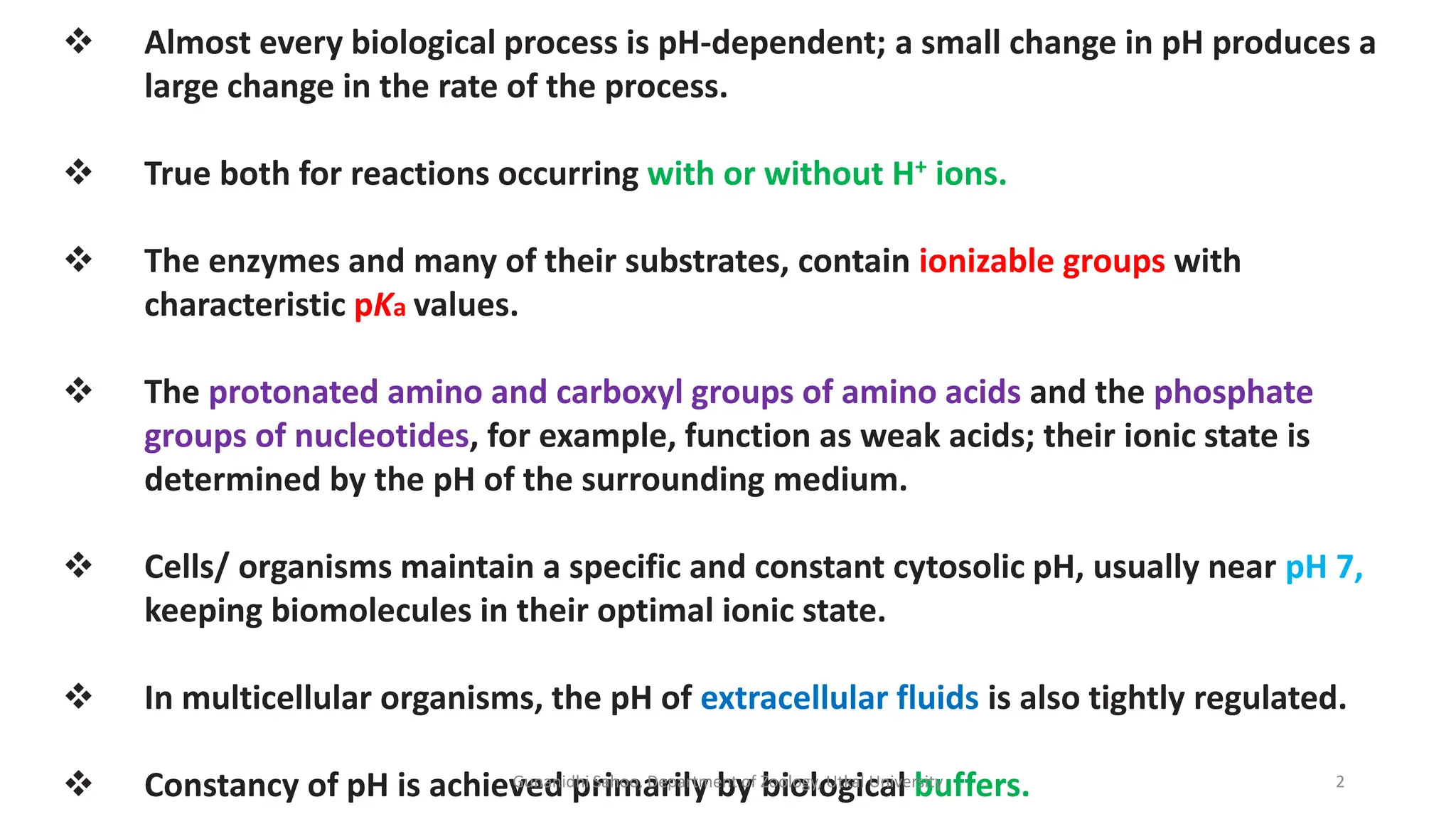
 Almost every biological process is pH-dependent; a small change in pH produces a
large change in the rate of the process.
 True both for reactions occurring with or without H+ ions.
 The enzymes and many of their substrates, contain ionizable groups with
characteristic pKa values.
 The protonated amino and carboxyl groups of amino acids and the phosphate
groups of nucleotides, for example, function as weak acids; their ionic state is
determined by the pH of the surrounding medium.
 Cells/ organisms maintain a specific and constant cytosolic pH, usually near pH 7,
keeping biomolecules in their optimal ionic state.
 In multicellular organisms, the pH of extracellular fluids is also tightly regulated.
 Constancy of pH is achieved primarily by biological buffers.
Gunanidhi Sahoo, Department of Zoology, Utkal University 2
Ionization/Dissociation of Water, Weak Acids, and Weak Bases
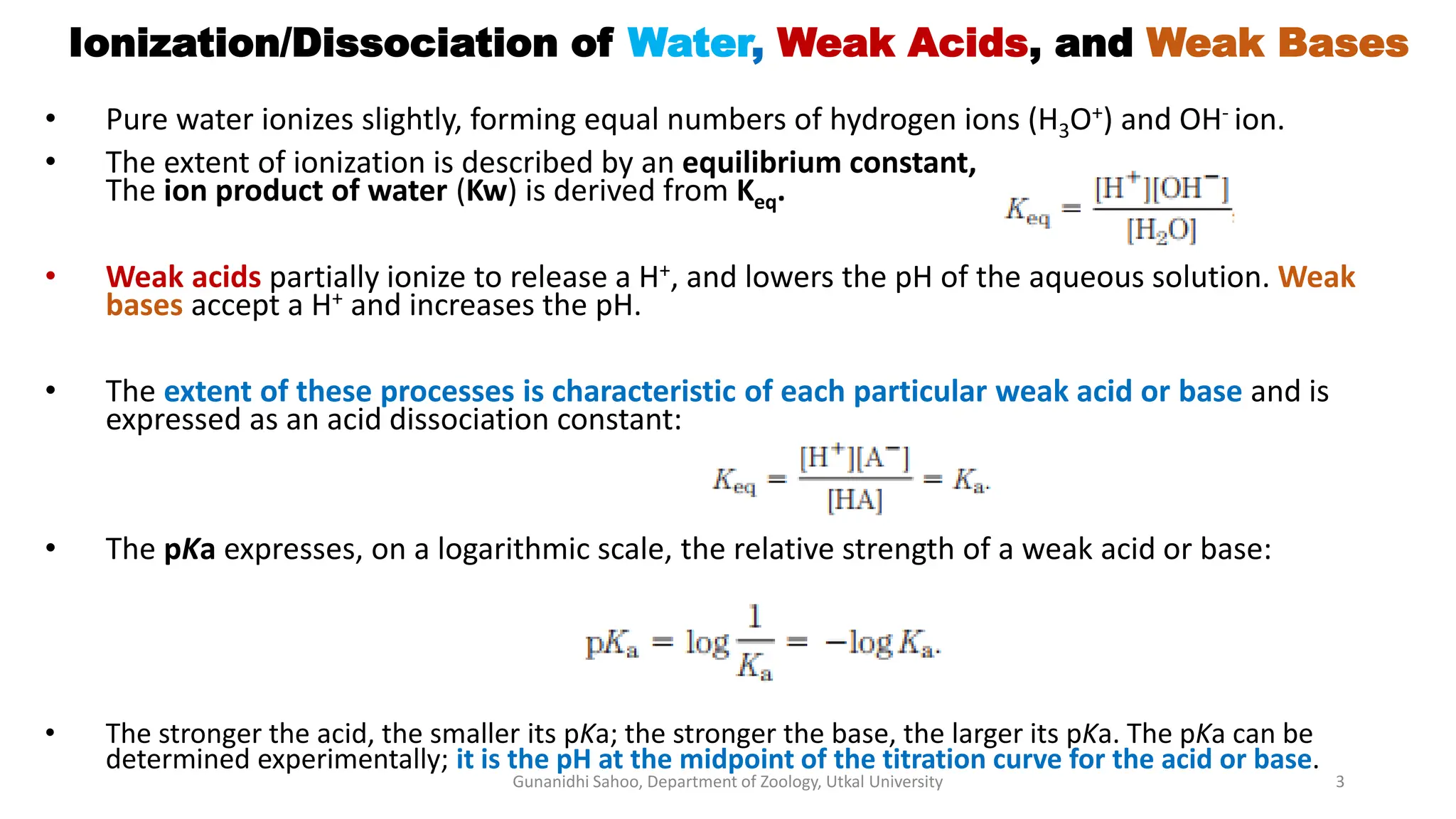
• Pure water ionizes slightly, forming equal numbers of hydrogen ions (H3O+) and OH- ion.
• The extent of ionization is described by an equilibrium constant,
The ion product of water (Kw) is derived from Keq.
• Weak acids partially ionize to release a H+, and lowers the pH of the aqueous solution. Weak
bases accept a H+ and increases the pH.
• The extent of these processes is characteristic of each particular weak acid or base and is
expressed as an acid dissociation constant:
• The pKa expresses, on a logarithmic scale, the relative strength of a weak acid or base:
• The stronger the acid, the smaller its pKa; the stronger the base, the larger its pKa. The pKa can be
determined experimentally; it is the pH at the midpoint of the titration curve for the acid or base.
Gunanidhi Sahoo, Department of Zoology, Utkal University 3
The Henderson-Hasselbalch Equation
• Relates to the dissociation of weak acids in equilibrium.
HA ↔ [H+] + [A-]
Dissociation constant (Ka) = [H+] + [A-]
[HA]
[H+] = Ka x [HA]
[A-]
Taking log on both the sides, log [H+] = log Ka + log [HA]/[A-]
Changing signs on both the sides, -log [H+] = -log Ka - log [HA]/[A-]
pH = pka + log [A-]/[HA] or, pH = pka + log [Proton acceptor] (HH Equation)
[Proton donor]
This equation fits to the titration curve of all weak acids.
Gunanidhi Sahoo, Department of Zoology, Utkal University 4
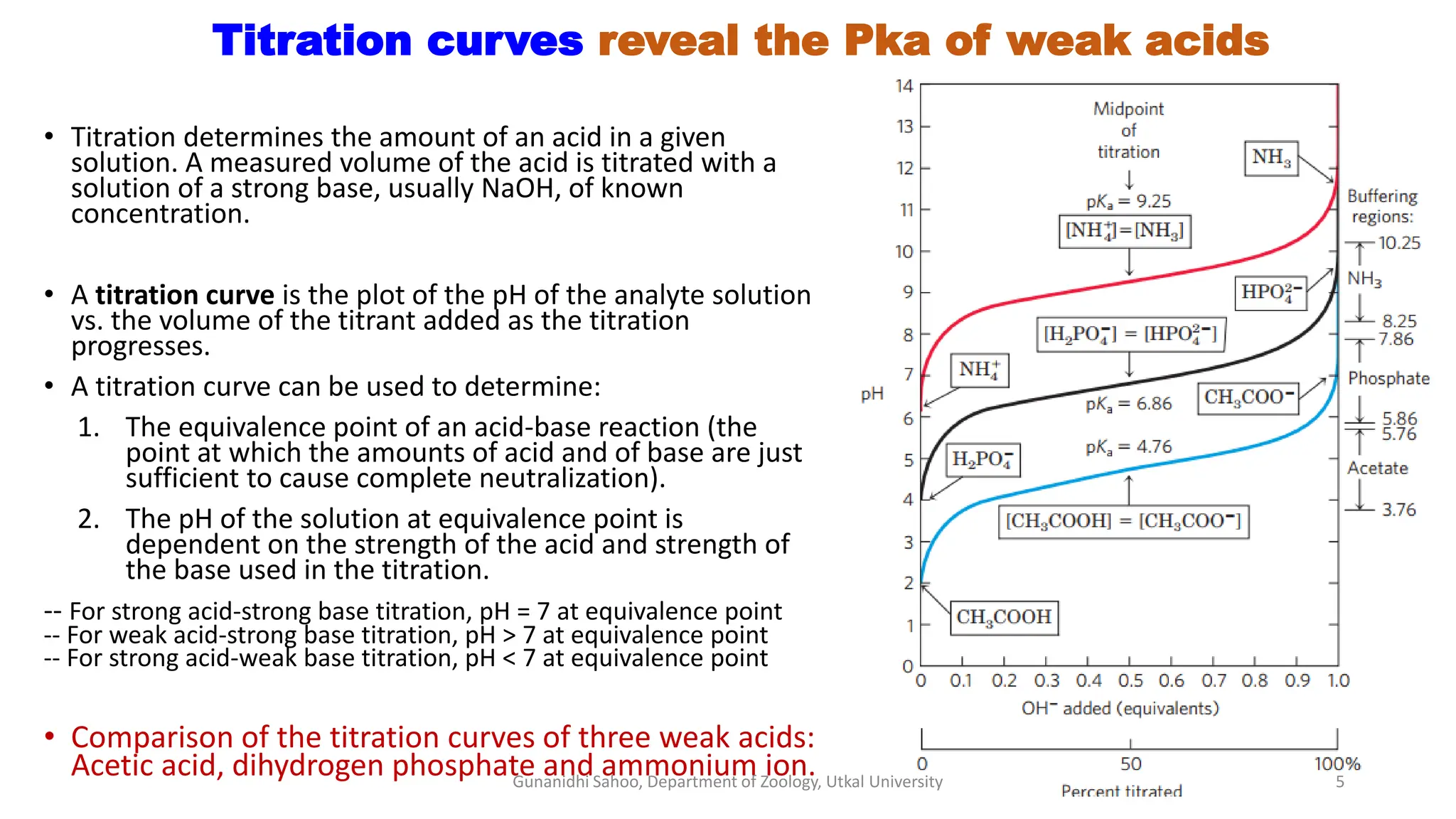
Titration curves reveal the Pka of weak acids
• Titration determines the amount of an acid in a given
solution. A measured volume of the acid is titrated with a
solution of a strong base, usually NaOH, of known
concentration.
• A titration curve is the plot of the pH of the analyte solution
vs. the volume of the titrant added as the titration
progresses.
• A titration curve can be used to determine:
1. The equivalence point of an acid-base reaction (the
point at which the amounts of acid and of base are just
sufficient to cause complete neutralization).
2. The pH of the solution at equivalence point is
dependent on the strength of the acid and strength of
the base used in the titration.
-- For strong acid-strong base titration, pH = 7 at equivalence point
-- For weak acid-strong base titration, pH > 7 at equivalence point
-- For strong acid-weak base titration, pH < 7 at equivalence point
• Comparison of the titration curves of three weak acids:
Acetic acid, dihydrogen phosphate and ammonium ion.
Gunanidhi Sahoo, Department of Zoology, Utkal University 5
Buffer
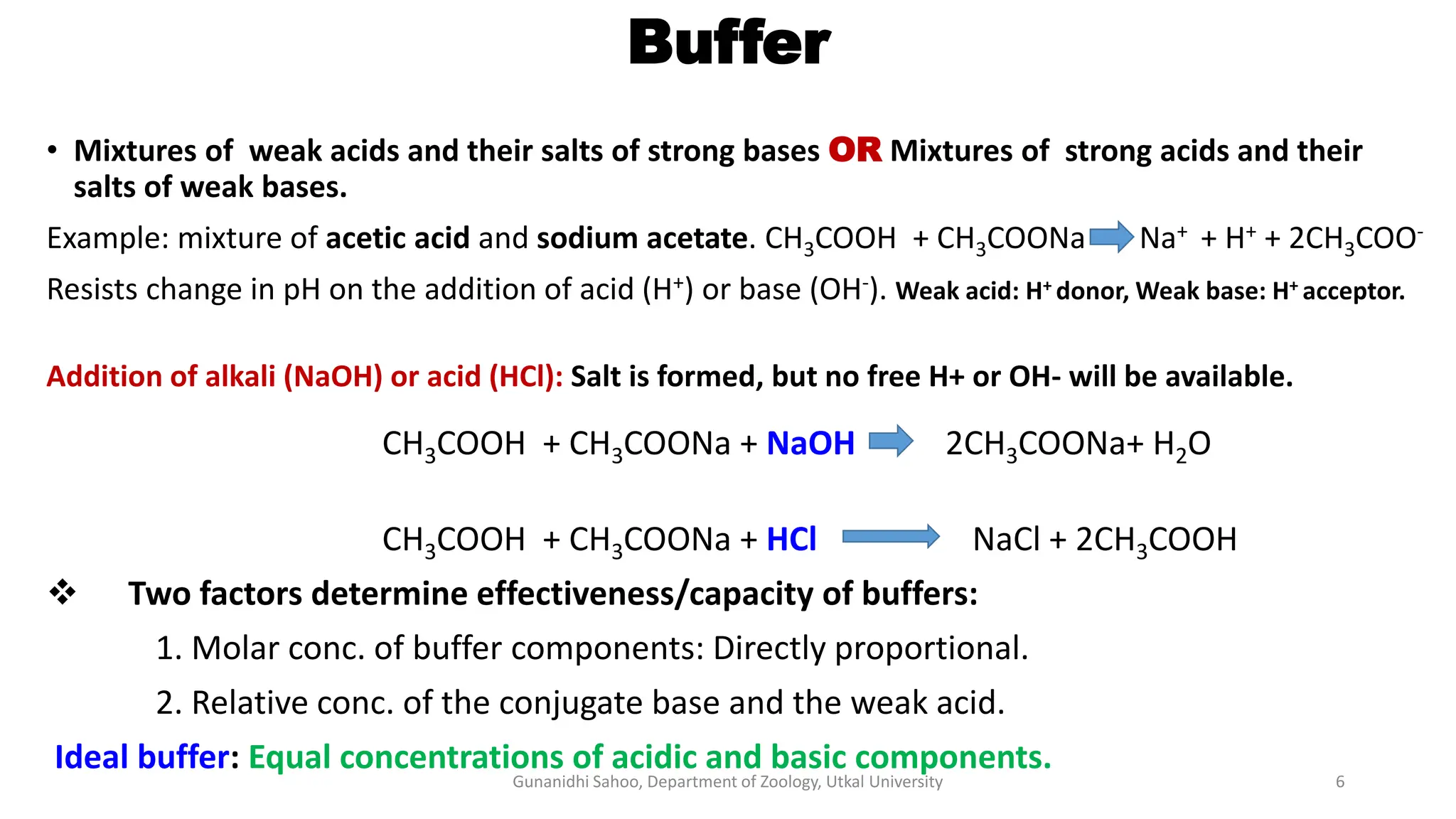
• Mixtures of weak acids and their salts of strong bases OR Mixtures of strong acids and their
salts of weak bases.
Example: mixture of acetic acid and sodium acetate. CH3COOH + CH3COONa Na+ + H+ + 2CH3COO-
Resists change in pH on the addition of acid (H+) or base (OH-). Weak acid: H+ donor, Weak base: H+ acceptor.
Addition of alkali (NaOH) or acid (HCl): Salt is formed, but no free H+ or OH- will be available.
CH3COOH + CH3COONa + NaOH 2CH3COONa+ H2O
CH3COOH + CH3COONa + HCl NaCl + 2CH3COOH
 Two factors determine effectiveness/capacity of buffers:
1. Molar conc. of buffer components: Directly proportional.
2. Relative conc. of the conjugate base and the weak acid.
Ideal buffer: Equal concentrations of acidic and basic components.
Gunanidhi Sahoo, Department of Zoology, Utkal University 6
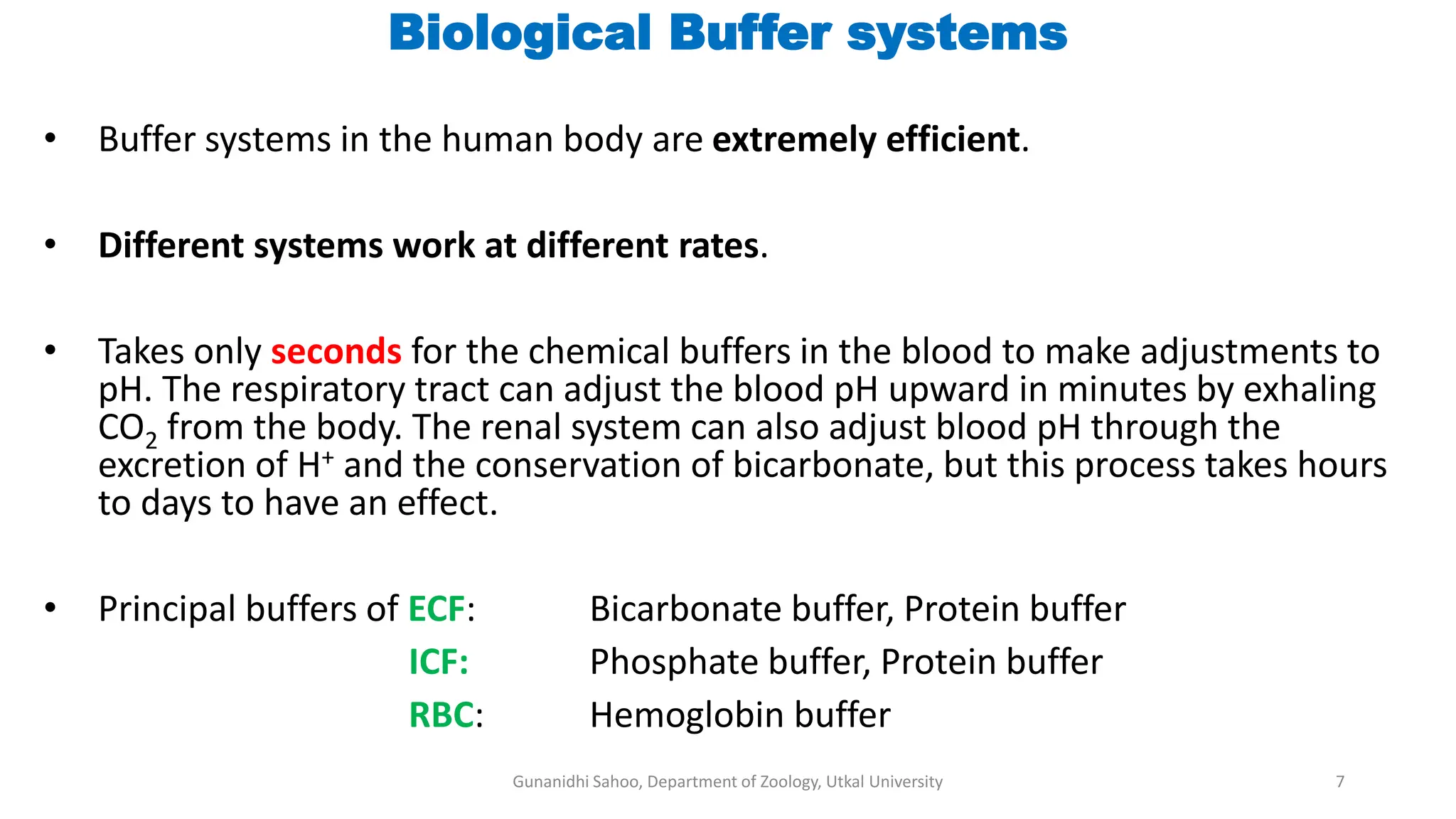
Biological Buffer systems
• Buffer systems in the human body are extremely efficient.
• Different systems work at different rates.
• Takes only seconds for the chemical buffers in the blood to make adjustments to
pH. The respiratory tract can adjust the blood pH upward in minutes by exhaling
CO2 from the body. The renal system can also adjust blood pH through the
excretion of H+ and the conservation of bicarbonate, but this process takes hours
to days to have an effect.
• Principal buffers of ECF: Bicarbonate buffer, Protein buffer
ICF: Phosphate buffer, Protein buffer
RBC: Hemoglobin buffer
Gunanidhi Sahoo, Department of Zoology, Utkal University 7
1. The Bicarbonate buffer system
• Principal buffer in blood plasma.
• Consists of H2CO3 (proton donor) and HCO3
- (proton acceptor).
• Neutralizes stronger dietary acids and metabolic acids (HA) by converting them to weak
bases (A-) and increase in H2CO3.
Strong base (B) Weak acids (BH+) with rise in HCO3
-.
HA + HCO3
- ↔ A- + H2CO3 Formation of H2CO3 depends on dissolved CO2 conc.
B + H2CO3 ↔ BH+ + HCO3
-. which in turn depends on gaseous CO2.
[HCO3
-]/[H2CO3] of 20:1 is required to maintain pH of plasma at 7.4.
 Neutralization of any acid or base and subsequent change in buffer ratio or blood pH is
neutralized by respiratory elimination of H2CO3 as CO2 or urinary elimination of HCO3
-.
 As cells contain much lower amounts of HCO3
-, imp of this buffer in cells is negligible.
Gunanidhi Sahoo, Department of Zoology, Utkal University 8
Acidosis
Accumulation of acids or loss of alkali Fall of [HCO3
-]/[H2CO3] below 20. Ratio in favor of H2CO3.
Two types:
1. Metabolic acidosis: Conc. of plasma HCO3
-. decreased due to excessive loss of bases in renal failure,
diabetic ketosis and severe diarrhea.
2. Respiratory acidosis: Retention of CO2 due to hypoventilation Rise in H2CO3 lowers the ratio.
Occurs due to chronic respiratory obstructive airway disease (asthma),
prolonged anesthesia, unconsciousness, etc.
Alkalosis
Accumulation of alkali or loss of acids Increase in ratio Rise in pH.
1. Metabolic alakalois: High intake of alkaline substances, severe vomiting, indiscriminate use of
antacids, etc.
2. Respiratory alakalosis: Excess removal of CO2 from blood due to hyperventilation
Decrease in H2CO3.
Gunanidhi Sahoo, Department of Zoology, Utkal University 9
2. The Phosphate buffer system
• Consists of H2PO4
- (H+ donor) and HPO4
-2 (H + acceptor).
H2PO4
- (Dihydrogen phosphate) ↔ H+ + HPO4
-2
• Acts in cytoplasm of all cells. More effective in pH range of 5.8 to 7.8.
• pH of ICF = 6.0 – 6.9, close to its pKa (6.86).
• Plasma HPO4
-2 : H2PO4
- is 4.0. Hence, pH = Pka + log [HPO4
-2], pH = 6.86 + log4 = 7.4
[H2PO4
-]
If HPO4
-2 : H2PO4
- tends to be changed by more H2PO4
-, renal elimination of H2PO4
-
occurs and pH remains unchanged.
 Works exactly like acetate buffer system except pH range.
 Conc. of phosphate buffer very low in plasma, hence less effective.
Gunanidhi Sahoo, Department of Zoology, Utkal University 10
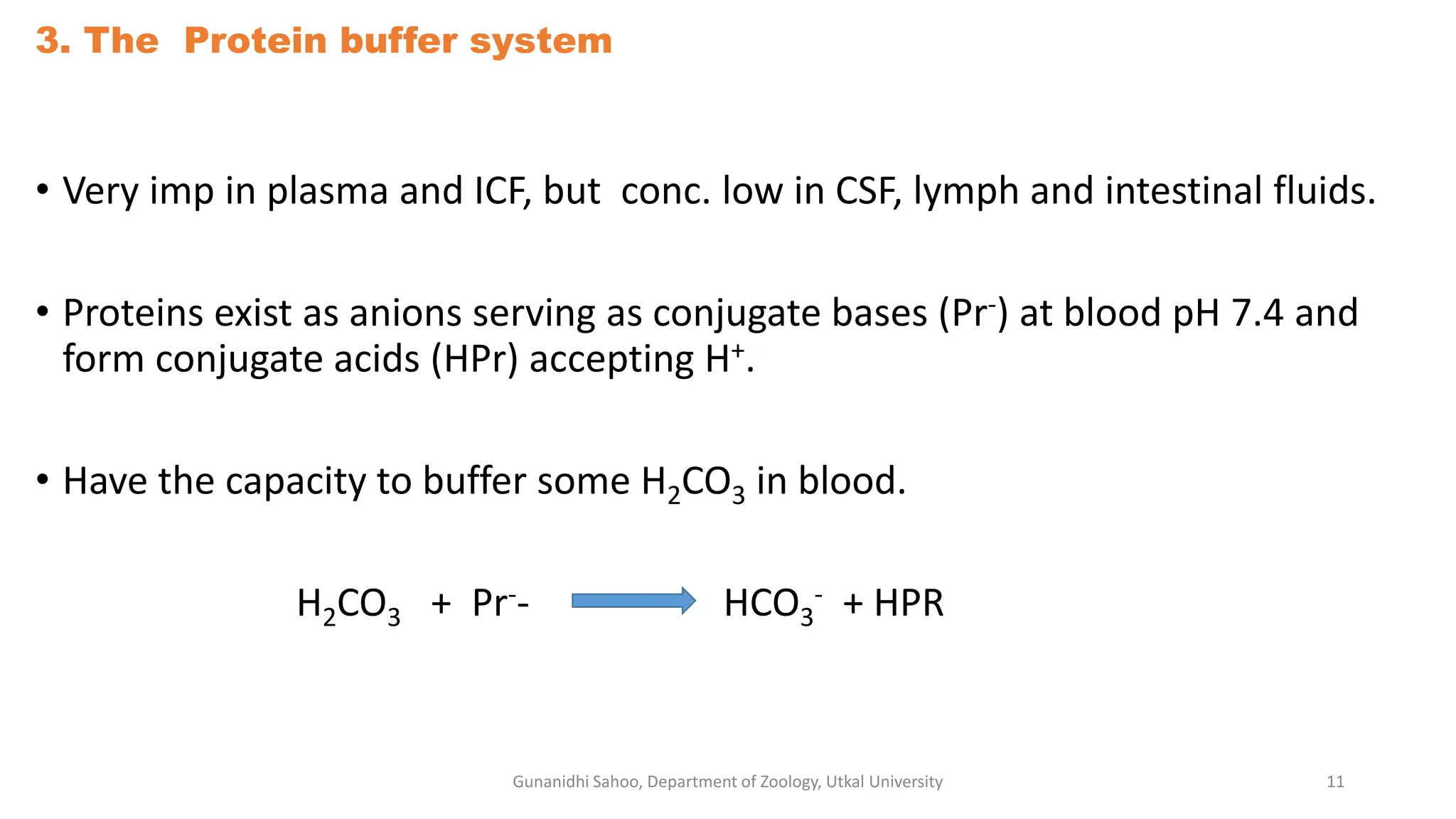
3. The Protein buffer system
• Very imp in plasma and ICF, but conc. low in CSF, lymph and intestinal fluids.
• Proteins exist as anions serving as conjugate bases (Pr-) at blood pH 7.4 and
form conjugate acids (HPr) accepting H+.
• Have the capacity to buffer some H2CO3 in blood.
H2CO3 + Pr-- HCO3
- + HPR
Gunanidhi Sahoo, Department of Zoology, Utkal University 11
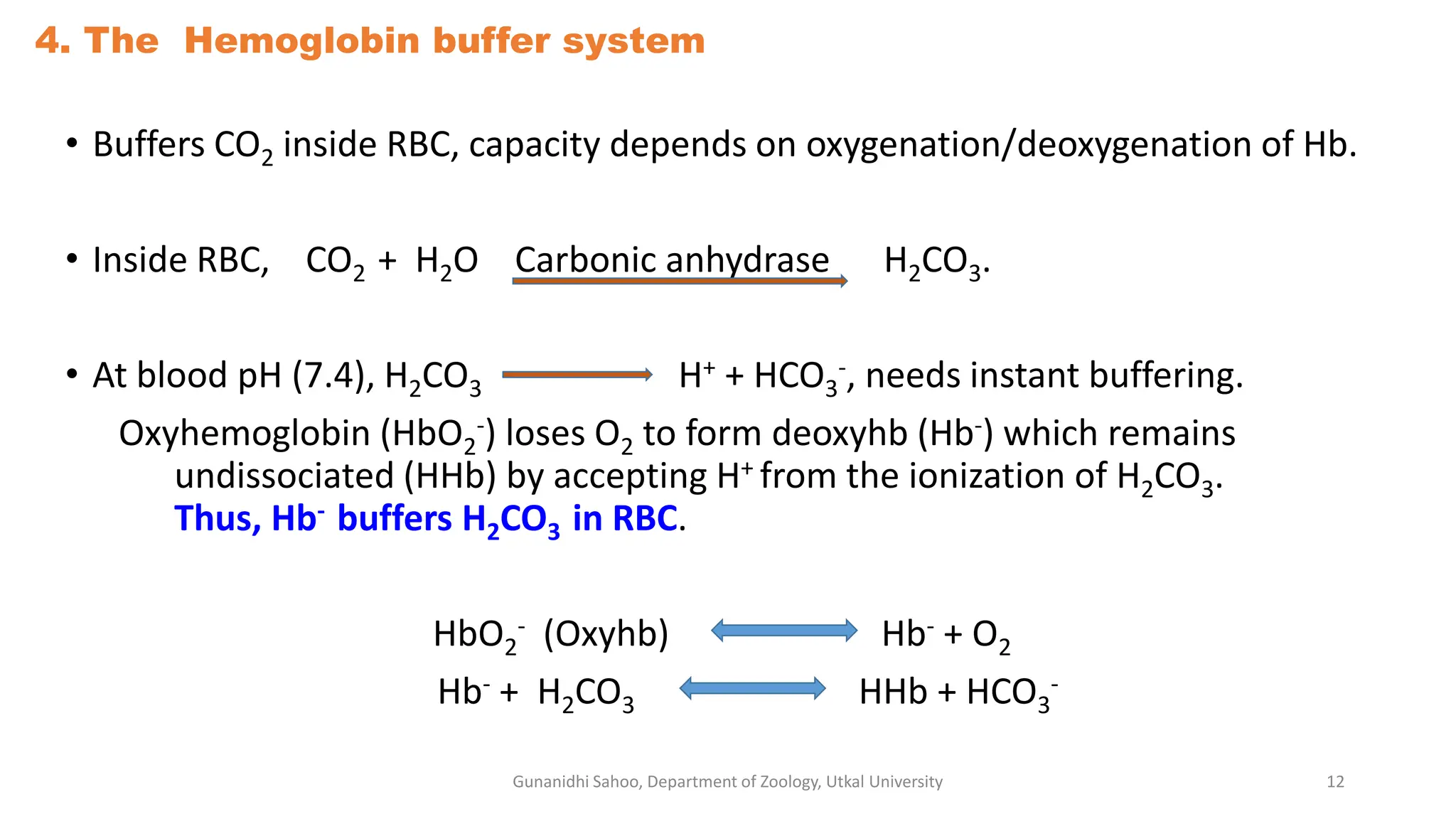
4. The Hemoglobin buffer system
• Buffers CO2 inside RBC, capacity depends on oxygenation/deoxygenation of Hb.
• Inside RBC, CO2 + H2O Carbonic anhydrase H2CO3.
• At blood pH (7.4), H2CO3 H+ + HCO3
-, needs instant buffering.
Oxyhemoglobin (HbO2
-) loses O2 to form deoxyhb (Hb-) which remains
undissociated (HHb) by accepting H+ from the ionization of H2CO3.
Thus, Hb- buffers H2CO3 in RBC.
HbO2
- (Oxyhb) Hb- + O2
Hb- + H2CO3 HHb + HCO3
-
Gunanidhi Sahoo, Department of Zoology, Utkal University 12
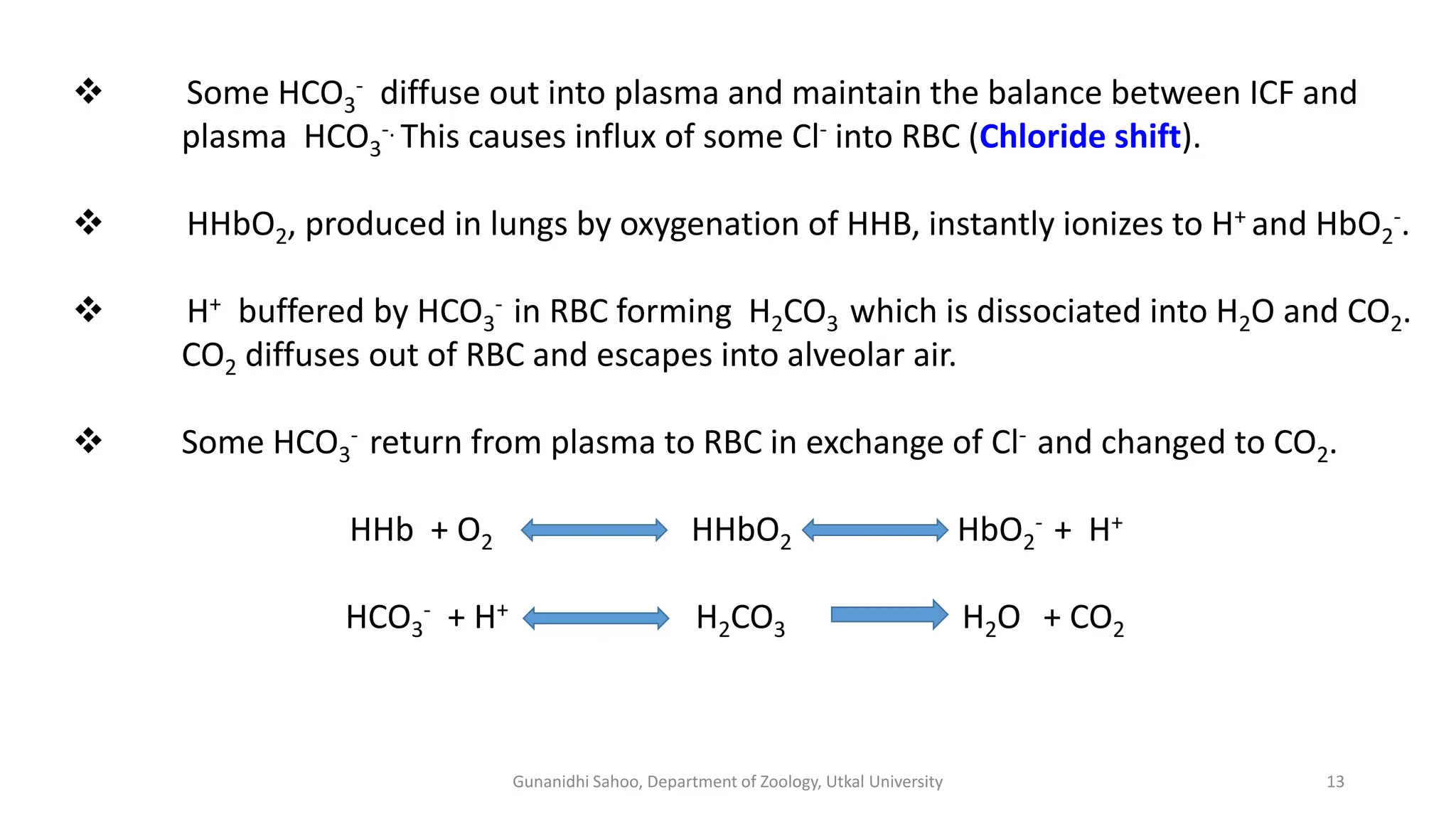
 Some HCO3
- diffuse out into plasma and maintain the balance between ICF and
plasma HCO3
-. This causes influx of some Cl- into RBC (Chloride shift).
 HHbO2, produced in lungs by oxygenation of HHB, instantly ionizes to H+ and HbO2
-.
 H+ buffered by HCO3
- in RBC forming H2CO3 which is dissociated into H2O and CO2.
CO2 diffuses out of RBC and escapes into alveolar air.
 Some HCO3
- return from plasma to RBC in exchange of Cl- and changed to CO2.
HHb + O2 HHbO2 HbO2
- + H+
HCO3
- + H+ H2CO3 H2O + CO2
Gunanidhi Sahoo, Department of Zoology, Utkal University 13
5. The Amino acid buffer system
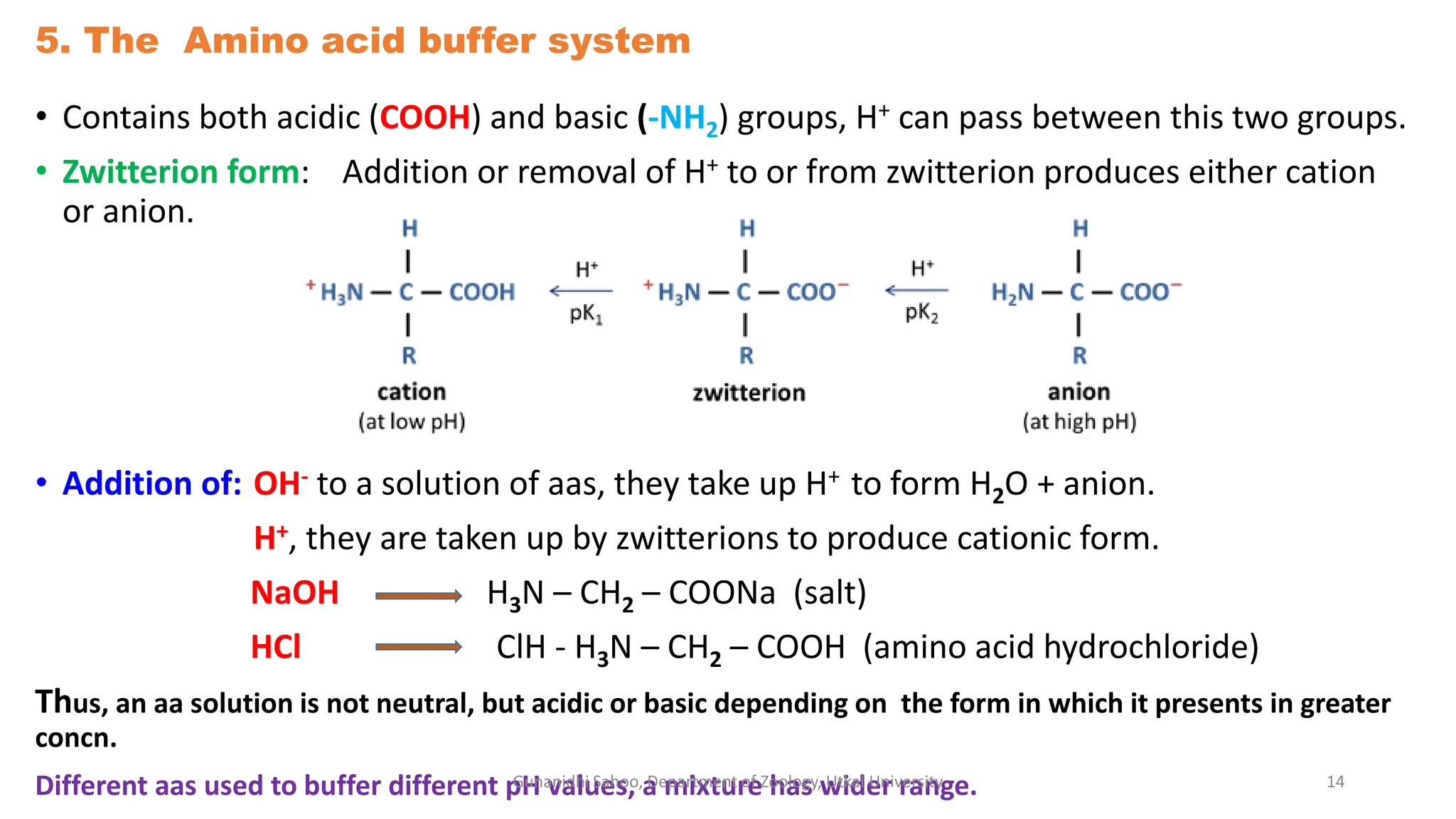
• Contains both acidic (COOH) and basic (-NH2) groups, H+ can pass between this two groups.
• Zwitterion form: Addition or removal of H+ to or from zwitterion produces either cation
or anion.
• Addition of: OH- to a solution of aas, they take up H+ to form H2O + anion.
H+, they are taken up by zwitterions to produce cationic form.
NaOH H3N – CH2 – COONa (salt)
HCl ClH - H3N – CH2 – COOH (amino acid hydrochloride)
Thus, an aa solution is not neutral, but acidic or basic depending on the form in which it presents in greater
concn.
Different aas used to buffer different pH values, a mixture has wider range.
Gunanidhi Sahoo, Department of Zoology, Utkal University 14

Biochemistry BIOLOGICAL-BUFFER-SYSTEMS.

  • 1.
    BIOLOGICAL BUFFER SYSTEMS GunanidhiSahoo Department of Zoology Utkal University, Bhubaneswar, Odisha, PIN – 751 004 Gunanidhi Sahoo, Department of Zoology, Utkal University 1
  • 2.
     Almost everybiological process is pH-dependent; a small change in pH produces a large change in the rate of the process.  True both for reactions occurring with or without H+ ions.  The enzymes and many of their substrates, contain ionizable groups with characteristic pKa values.  The protonated amino and carboxyl groups of amino acids and the phosphate groups of nucleotides, for example, function as weak acids; their ionic state is determined by the pH of the surrounding medium.  Cells/ organisms maintain a specific and constant cytosolic pH, usually near pH 7, keeping biomolecules in their optimal ionic state.  In multicellular organisms, the pH of extracellular fluids is also tightly regulated.  Constancy of pH is achieved primarily by biological buffers. Gunanidhi Sahoo, Department of Zoology, Utkal University 2
  • 3.
    Ionization/Dissociation of Water,Weak Acids, and Weak Bases • Pure water ionizes slightly, forming equal numbers of hydrogen ions (H3O+) and OH- ion. • The extent of ionization is described by an equilibrium constant, The ion product of water (Kw) is derived from Keq. • Weak acids partially ionize to release a H+, and lowers the pH of the aqueous solution. Weak bases accept a H+ and increases the pH. • The extent of these processes is characteristic of each particular weak acid or base and is expressed as an acid dissociation constant: • The pKa expresses, on a logarithmic scale, the relative strength of a weak acid or base: • The stronger the acid, the smaller its pKa; the stronger the base, the larger its pKa. The pKa can be determined experimentally; it is the pH at the midpoint of the titration curve for the acid or base. Gunanidhi Sahoo, Department of Zoology, Utkal University 3
  • 4.
    The Henderson-Hasselbalch Equation •Relates to the dissociation of weak acids in equilibrium. HA ↔ [H+] + [A-] Dissociation constant (Ka) = [H+] + [A-] [HA] [H+] = Ka x [HA] [A-] Taking log on both the sides, log [H+] = log Ka + log [HA]/[A-] Changing signs on both the sides, -log [H+] = -log Ka - log [HA]/[A-] pH = pka + log [A-]/[HA] or, pH = pka + log [Proton acceptor] (HH Equation) [Proton donor] This equation fits to the titration curve of all weak acids. Gunanidhi Sahoo, Department of Zoology, Utkal University 4
  • 5.
    Titration curves revealthe Pka of weak acids • Titration determines the amount of an acid in a given solution. A measured volume of the acid is titrated with a solution of a strong base, usually NaOH, of known concentration. • A titration curve is the plot of the pH of the analyte solution vs. the volume of the titrant added as the titration progresses. • A titration curve can be used to determine: 1. The equivalence point of an acid-base reaction (the point at which the amounts of acid and of base are just sufficient to cause complete neutralization). 2. The pH of the solution at equivalence point is dependent on the strength of the acid and strength of the base used in the titration. -- For strong acid-strong base titration, pH = 7 at equivalence point -- For weak acid-strong base titration, pH > 7 at equivalence point -- For strong acid-weak base titration, pH < 7 at equivalence point • Comparison of the titration curves of three weak acids: Acetic acid, dihydrogen phosphate and ammonium ion. Gunanidhi Sahoo, Department of Zoology, Utkal University 5
  • 6.
    Buffer • Mixtures ofweak acids and their salts of strong bases OR Mixtures of strong acids and their salts of weak bases. Example: mixture of acetic acid and sodium acetate. CH3COOH + CH3COONa Na+ + H+ + 2CH3COO- Resists change in pH on the addition of acid (H+) or base (OH-). Weak acid: H+ donor, Weak base: H+ acceptor. Addition of alkali (NaOH) or acid (HCl): Salt is formed, but no free H+ or OH- will be available. CH3COOH + CH3COONa + NaOH 2CH3COONa+ H2O CH3COOH + CH3COONa + HCl NaCl + 2CH3COOH  Two factors determine effectiveness/capacity of buffers: 1. Molar conc. of buffer components: Directly proportional. 2. Relative conc. of the conjugate base and the weak acid. Ideal buffer: Equal concentrations of acidic and basic components. Gunanidhi Sahoo, Department of Zoology, Utkal University 6
  • 7.
    Biological Buffer systems •Buffer systems in the human body are extremely efficient. • Different systems work at different rates. • Takes only seconds for the chemical buffers in the blood to make adjustments to pH. The respiratory tract can adjust the blood pH upward in minutes by exhaling CO2 from the body. The renal system can also adjust blood pH through the excretion of H+ and the conservation of bicarbonate, but this process takes hours to days to have an effect. • Principal buffers of ECF: Bicarbonate buffer, Protein buffer ICF: Phosphate buffer, Protein buffer RBC: Hemoglobin buffer Gunanidhi Sahoo, Department of Zoology, Utkal University 7
  • 8.
    1. The Bicarbonatebuffer system • Principal buffer in blood plasma. • Consists of H2CO3 (proton donor) and HCO3 - (proton acceptor). • Neutralizes stronger dietary acids and metabolic acids (HA) by converting them to weak bases (A-) and increase in H2CO3. Strong base (B) Weak acids (BH+) with rise in HCO3 -. HA + HCO3 - ↔ A- + H2CO3 Formation of H2CO3 depends on dissolved CO2 conc. B + H2CO3 ↔ BH+ + HCO3 -. which in turn depends on gaseous CO2. [HCO3 -]/[H2CO3] of 20:1 is required to maintain pH of plasma at 7.4.  Neutralization of any acid or base and subsequent change in buffer ratio or blood pH is neutralized by respiratory elimination of H2CO3 as CO2 or urinary elimination of HCO3 -.  As cells contain much lower amounts of HCO3 -, imp of this buffer in cells is negligible. Gunanidhi Sahoo, Department of Zoology, Utkal University 8
  • 9.
    Acidosis Accumulation of acidsor loss of alkali Fall of [HCO3 -]/[H2CO3] below 20. Ratio in favor of H2CO3. Two types: 1. Metabolic acidosis: Conc. of plasma HCO3 -. decreased due to excessive loss of bases in renal failure, diabetic ketosis and severe diarrhea. 2. Respiratory acidosis: Retention of CO2 due to hypoventilation Rise in H2CO3 lowers the ratio. Occurs due to chronic respiratory obstructive airway disease (asthma), prolonged anesthesia, unconsciousness, etc. Alkalosis Accumulation of alkali or loss of acids Increase in ratio Rise in pH. 1. Metabolic alakalois: High intake of alkaline substances, severe vomiting, indiscriminate use of antacids, etc. 2. Respiratory alakalosis: Excess removal of CO2 from blood due to hyperventilation Decrease in H2CO3. Gunanidhi Sahoo, Department of Zoology, Utkal University 9
  • 10.
    2. The Phosphatebuffer system • Consists of H2PO4 - (H+ donor) and HPO4 -2 (H + acceptor). H2PO4 - (Dihydrogen phosphate) ↔ H+ + HPO4 -2 • Acts in cytoplasm of all cells. More effective in pH range of 5.8 to 7.8. • pH of ICF = 6.0 – 6.9, close to its pKa (6.86). • Plasma HPO4 -2 : H2PO4 - is 4.0. Hence, pH = Pka + log [HPO4 -2], pH = 6.86 + log4 = 7.4 [H2PO4 -] If HPO4 -2 : H2PO4 - tends to be changed by more H2PO4 -, renal elimination of H2PO4 - occurs and pH remains unchanged.  Works exactly like acetate buffer system except pH range.  Conc. of phosphate buffer very low in plasma, hence less effective. Gunanidhi Sahoo, Department of Zoology, Utkal University 10
  • 11.
    3. The Proteinbuffer system • Very imp in plasma and ICF, but conc. low in CSF, lymph and intestinal fluids. • Proteins exist as anions serving as conjugate bases (Pr-) at blood pH 7.4 and form conjugate acids (HPr) accepting H+. • Have the capacity to buffer some H2CO3 in blood. H2CO3 + Pr-- HCO3 - + HPR Gunanidhi Sahoo, Department of Zoology, Utkal University 11
  • 12.
    4. The Hemoglobinbuffer system • Buffers CO2 inside RBC, capacity depends on oxygenation/deoxygenation of Hb. • Inside RBC, CO2 + H2O Carbonic anhydrase H2CO3. • At blood pH (7.4), H2CO3 H+ + HCO3 -, needs instant buffering. Oxyhemoglobin (HbO2 -) loses O2 to form deoxyhb (Hb-) which remains undissociated (HHb) by accepting H+ from the ionization of H2CO3. Thus, Hb- buffers H2CO3 in RBC. HbO2 - (Oxyhb) Hb- + O2 Hb- + H2CO3 HHb + HCO3 - Gunanidhi Sahoo, Department of Zoology, Utkal University 12
  • 13.
     Some HCO3 -diffuse out into plasma and maintain the balance between ICF and plasma HCO3 -. This causes influx of some Cl- into RBC (Chloride shift).  HHbO2, produced in lungs by oxygenation of HHB, instantly ionizes to H+ and HbO2 -.  H+ buffered by HCO3 - in RBC forming H2CO3 which is dissociated into H2O and CO2. CO2 diffuses out of RBC and escapes into alveolar air.  Some HCO3 - return from plasma to RBC in exchange of Cl- and changed to CO2. HHb + O2 HHbO2 HbO2 - + H+ HCO3 - + H+ H2CO3 H2O + CO2 Gunanidhi Sahoo, Department of Zoology, Utkal University 13
  • 14.
    5. The Aminoacid buffer system • Contains both acidic (COOH) and basic (-NH2) groups, H+ can pass between this two groups. • Zwitterion form: Addition or removal of H+ to or from zwitterion produces either cation or anion. • Addition of: OH- to a solution of aas, they take up H+ to form H2O + anion. H+, they are taken up by zwitterions to produce cationic form. NaOH H3N – CH2 – COONa (salt) HCl ClH - H3N – CH2 – COOH (amino acid hydrochloride) Thus, an aa solution is not neutral, but acidic or basic depending on the form in which it presents in greater concn. Different aas used to buffer different pH values, a mixture has wider range. Gunanidhi Sahoo, Department of Zoology, Utkal University 14