Cash Flow Analysis and
Management
Real Life Situations
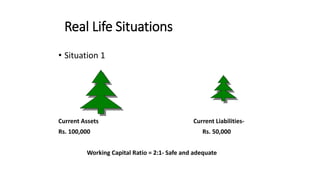
• Situation 1
Current Assets Current Liabilities-
Rs. 100,000 Rs. 50,000
Working Capital Ratio = 2:1- Safe and adequate
Real Life Situations
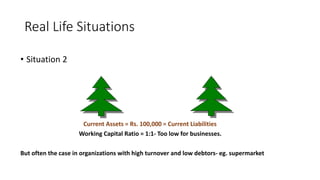
• Situation 2
Current Assets = Rs. 100,000 = Current Liabilities
Working Capital Ratio = 1:1- Too low for businesses.
But often the case in organizations with high turnover and low debtors- eg. supermarket
Real Life Situations
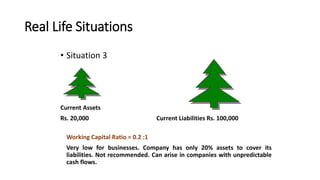
• Situation 3
Current Assets
Rs. 20,000 Current Liabilities Rs. 100,000
Working Capital Ratio = 0.2 :1
Very low for businesses. Company has only 20% assets to cover its
liabilities. Not recommended. Can arise in companies with unpredictable
cash flows.
Cash Flow
• Movement of money in and out of your business
• Cycle of the inflow and outflow of cash determines
your business wealth
• Cash flow analysis:
–To study the inflow and outflow of cash of the business
to maintain adequate cash balance
–Study each component of cash cycle and determine how
to increase efficiency
Statement of Cash Flows
• Provides information about cash inflows and outflows during an
accounting period
• Is developed from Balance Sheet and Income Statement data
• Important as an analytical tool
Preparing Cash Flow Statement
Four parts of a statement of cash flows:
Cash
Operating Activities
Investing Activities
Financing Activities
Cash
Cash includes Cash and Cash-equivalents
 Cash Equivalents
• Treasury bills maturing within 90 days or less.
• Investment Funds
• Foreign Currency on hand
• Checking Account
• Free Savings Account
 Operating Activities
• Cash flows related to selling goods and services; that is, the principle
business of the firm.
• The cash effects of transactions and other events that enter into the
determination of income
Examples of Operating Activities
• Cash received from customers through sale of goods or services
performed;
• Cash payments to suppliers or employees
• Cash payments for taxes and other expenses
 Investing Activities
• Acquiring/disposing of securities that are not cash equivalents
• Cash flows related to the acquisition or sale of non-current assets.
• Lending money/collecting on loans
Examples of Investing Activities
 Cash received from sales of assets that are not held for the regular trading purposes such
as sale of building; marketable securities such as trading and available for sale securities,
and investments
 Cash payments to acquire property, plant, and equipment (PPE), other tangible or
intangible assets, and other long-term assets
 Cash received from sale of, and paid for purchases of derivative instruments
 Loans extended to other companies and collection of such loans
 Financing Activities
• Borrowing from creditors/repaying the principal
• Obtaining resources from owners
• Providing owners with a return on investment
Examples of financing activities
 Cash received from issuing share capital
 Cash proceeds from issuing bonds, loans, notes, mortgages and other short or long-
term borrowings
 Cash payments to shareholders to redeem existing shares- treasury stock
• Cash repayment of loans and other borrowings; and
• Cash payments to shareholders as dividends.
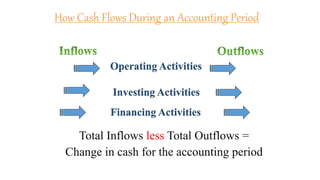
How Cash Flows During an Accounting Period
Total Inflows less Total Outflows =
Change in cash for the accounting period
Operating Activities
Investing Activities
Financing Activities
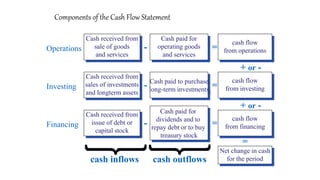
Components of the Cash Flow Statement
Cash received from
sale of goods
and services
Cash paid for
operating goods
and services
cash flow
from operationsOperations - =
Cash received from
sales of investments
and longterm assets
Cash paid to purchase
long-term investments
cash flow
from investingInvesting - =
Cash received from
issue of debt or
capital stock
Cash paid for
dividends and to
repay debt or to buy
treasury stock
cash flow
from financingFinancing - =
Net change in cash
for the period
=
+ or -
+ or -
cash inflows cash outflows
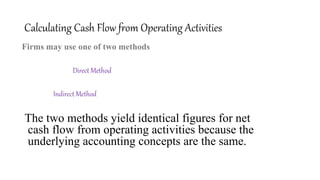
Calculating Cash Flow from Operating Activities
Firms may use one of two methods
Direct Method
Indirect Method
The two methods yield identical figures for net
cash flow from operating activities because the
underlying accounting concepts are the same.
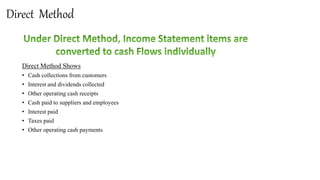
Direct Method
Direct Method Shows
• Cash collections from customers
• Interest and dividends collected
• Other operating cash receipts
• Cash paid to suppliers and employees
• Interest paid
• Taxes paid
• Other operating cash payments
Indirect Method
Indirect Method starts with Net Income and adjusts for
• Deferrals
• Accruals
• Non-cash items, such as depreciation and amortization
• Non-operating items, such as gains and losses on asset sales
Reconciliation of the accrual based and cash based accounting
BT8010: Cash flow analysis and management

BT8010: Cash flow analysis and management

  • 1.
    Cash Flow Analysisand Management
  • 2.
    Real Life Situations •Situation 1 Current Assets Current Liabilities- Rs. 100,000 Rs. 50,000 Working Capital Ratio = 2:1- Safe and adequate
  • 3.
    Real Life Situations •Situation 2 Current Assets = Rs. 100,000 = Current Liabilities Working Capital Ratio = 1:1- Too low for businesses. But often the case in organizations with high turnover and low debtors- eg. supermarket
  • 4.
    Real Life Situations •Situation 3 Current Assets Rs. 20,000 Current Liabilities Rs. 100,000 Working Capital Ratio = 0.2 :1 Very low for businesses. Company has only 20% assets to cover its liabilities. Not recommended. Can arise in companies with unpredictable cash flows.
  • 5.
    Cash Flow • Movementof money in and out of your business • Cycle of the inflow and outflow of cash determines your business wealth • Cash flow analysis: –To study the inflow and outflow of cash of the business to maintain adequate cash balance –Study each component of cash cycle and determine how to increase efficiency
  • 6.
    Statement of CashFlows • Provides information about cash inflows and outflows during an accounting period • Is developed from Balance Sheet and Income Statement data • Important as an analytical tool
  • 7.
    Preparing Cash FlowStatement Four parts of a statement of cash flows: Cash Operating Activities Investing Activities Financing Activities
  • 8.
    Cash Cash includes Cashand Cash-equivalents  Cash Equivalents • Treasury bills maturing within 90 days or less. • Investment Funds • Foreign Currency on hand • Checking Account • Free Savings Account
  • 9.
     Operating Activities •Cash flows related to selling goods and services; that is, the principle business of the firm. • The cash effects of transactions and other events that enter into the determination of income Examples of Operating Activities • Cash received from customers through sale of goods or services performed; • Cash payments to suppliers or employees • Cash payments for taxes and other expenses
  • 10.
     Investing Activities •Acquiring/disposing of securities that are not cash equivalents • Cash flows related to the acquisition or sale of non-current assets. • Lending money/collecting on loans Examples of Investing Activities  Cash received from sales of assets that are not held for the regular trading purposes such as sale of building; marketable securities such as trading and available for sale securities, and investments  Cash payments to acquire property, plant, and equipment (PPE), other tangible or intangible assets, and other long-term assets  Cash received from sale of, and paid for purchases of derivative instruments  Loans extended to other companies and collection of such loans
  • 11.
     Financing Activities •Borrowing from creditors/repaying the principal • Obtaining resources from owners • Providing owners with a return on investment Examples of financing activities  Cash received from issuing share capital  Cash proceeds from issuing bonds, loans, notes, mortgages and other short or long- term borrowings  Cash payments to shareholders to redeem existing shares- treasury stock • Cash repayment of loans and other borrowings; and • Cash payments to shareholders as dividends.
  • 12.
    How Cash FlowsDuring an Accounting Period Total Inflows less Total Outflows = Change in cash for the accounting period Operating Activities Investing Activities Financing Activities
  • 13.
    Components of theCash Flow Statement Cash received from sale of goods and services Cash paid for operating goods and services cash flow from operationsOperations - = Cash received from sales of investments and longterm assets Cash paid to purchase long-term investments cash flow from investingInvesting - = Cash received from issue of debt or capital stock Cash paid for dividends and to repay debt or to buy treasury stock cash flow from financingFinancing - = Net change in cash for the period = + or - + or - cash inflows cash outflows
  • 14.
    Calculating Cash Flowfrom Operating Activities Firms may use one of two methods Direct Method Indirect Method The two methods yield identical figures for net cash flow from operating activities because the underlying accounting concepts are the same.
  • 15.
    Direct Method Direct MethodShows • Cash collections from customers • Interest and dividends collected • Other operating cash receipts • Cash paid to suppliers and employees • Interest paid • Taxes paid • Other operating cash payments
  • 16.
    Indirect Method Indirect Methodstarts with Net Income and adjusts for • Deferrals • Accruals • Non-cash items, such as depreciation and amortization • Non-operating items, such as gains and losses on asset sales Reconciliation of the accrual based and cash based accounting