• CAIIB - Financial Management
• Module B – Study of Financial
Statements
• - Balance Sheet Analysis
• M. Syed Kunmir
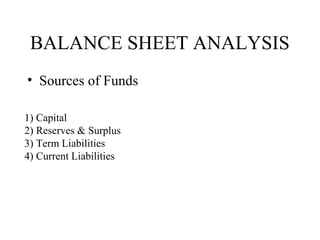
BALANCE SHEET ANALYSIS
• Sources of Funds
1) Capital
2) Reserves & Surplus
3) Term Liabilities
4) Current Liabilities
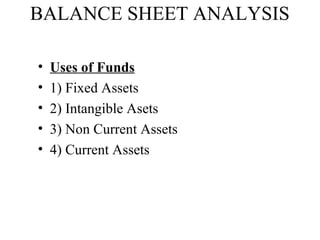
BALANCE SHEET ANALYSIS
• Uses of Funds
• 1) Fixed Assets
• 2) Intangible Asets
• 3) Non Current Assets
• 4) Current Assets
BALANCE SHEET ANALYSIS
• Capital
• 1) Authorised Capital
• 2) Issued Capital
• 3) Subscribed Capital
• 4) Paid-up Capital
BALANCE SHEET ANALYSIS
• Reserves
• 1) Subsidy Received From The Govt
• 2) Development Rebate reserve
• 3) Revaluation of fixed assets
• 4) Issue of Shares at Premium
• 5) General Reserves
• Surplus
• The credit balance in profit and loss account
BALANCE SHEET ANALYSIS
• Tangible Net Worth
• This refers to the total funds arrived by paid-
up capital , Reserves and P&L Surplus
• Less
• Intagible Assets
BALANCE SHEET ANALYSIS
• Term Liabilities
• Redeemable preference shares
• Debentures
• Deferred payment gaurantees
• Public Deposits(Repayable after 12 months)
• Term loans and unsecured loans from friens,
relatives,directors repayable over a period of time
• Remark : The company can raise public deposits
to the extent of 25% of paid up capital plus free
reserves and 10% from share holders for the
maturity period ranging from 6 months to 3 yrs
BALANCE SHEET ANALYSIS
• Current Liabilities
• Working capital bank borrowings
• T.loans deferred credit inst falling due in 12 mths
• public deposits maturing within 12 months
• unsecured loans, unless the repayment is on
deferred terms
• sundry creditors
• advances from dealers and customers
• interest accrued but not paid
• tax provisions
• Dividend declared and payable
BALANCE SHEET ANALYSIS
• Contingent Liabilities
• Tax disputes
• Legal litigations
• Bills and cheques discounted with banks
• Claims against the company not acknowledged
BALANCE SHEET ANALYSIS
• Fixed Assets
• Infrastructure like land & building
• plant & machinery
• Vehicles
• Furniture & fixtures
• Depreciation
• Straight line method
• Written down Value Method
• Remark : Dep added to profit to arrive repayment
obligation especially in term loans
BALANCE SHEET ANALYSIS
• Investments
• 1) Shares And Securities
• 2) Associate Companies
• 3) Fixed deposits with banks/finance companies
• Remark : While analysing bal sheet we can
analyse necessity of such investments
• Remark : While fixed deposits with banks are
considered as fixed assets, the investmetns in
associate concerns are treated as non current
assets.
BALANCE SHEET ANALYSIS
• Non Current Assets
• Deferred recievables/Overdue recievables(like
disputed amounts and Over Due > 6 mths)
• Non moving stocks/inventory/un usable spares
• Investment/Lending to associate concern
• Borrowing of the directors from the company
• Telephone deposits/ ST deposits etc
BALANCE SHEET ANALYSIS
• Intangible Assets
• Preliminary & Preoperative expenses
• Deferred Revenue Expenditure
• Goodwill
• Trade mark
• Patents
• Rem : The o/s balance to be written off every
year by charging P&L account
BALANCE SHEET ANALYSIS
• Current Assets
• Raw materials, work-in-progress,finished
goods,spares and consumables
• Sundry debtors and recievables < 6 mths
• Advances paid to suppliers of raw materials
• Cash and bank balances
• Interest recievables
• Other current assets such as Government
securities, Bank deposits ..etc
BALANCE SHEET ANALYSIS
• Notes
• All expenses or provisions or advances or loans
etc which are accrued and payable within 12
months are current liablities
• When a company makes investments in
unconnected avenues such as shares, securites,
associate concerns are to be treated as non cur ast
• The slow moving and absolete inventory - NCA
BALANCE SHEET ANALYSIS
• Notes
• Bal Sh Analy not only to be quantitative but to be
qualitative
• It is the fin pos on a part date. Min three years bal
sh ana would be more meaningful
• It is a mixture of facts, opinions and conventions
• While opinions are of the company’s management,
the conventions are practiced by the finance
managers of the company.
• ( ex Over due recievable > 6 mths as NCA is a
acccounting convention
BALANCE SHEET ANALYSIS
• Notes
• The valuation of the stock is done as per the
opinion of the management
• Depreciation method may be changed to boost
profit
• It may be silent on key personnel and staff
turnover
• Marginal changes in the classification of certain
items would lead to different results.
BALANCE SHEET ANALYSIS
• Notes
• Management competence
• Investment decision
• Resorting to window dressing
• experience of the promoters
• Board comprises of only family members
• The key personnel of the company
• The structure of the organisation
• The authority and decision making are
decentralised
BALANCE SHEET ANALYSIS
• Notes
• The state of industrial relations
• Financial systems and procedures
• management control
• planning, budgeting, forecasting
• capacity utilisation
• status of the technology
• awareness of the market, competitions ..etc
• for listed co: share prices, EPS, book value,
dividend record, public response ..etc
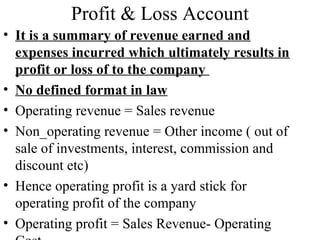
Profit & Loss Account
• It is a summary of revenue earned and
expenses incurred which ultimately results in
profit or loss of to the company
• No defined format in law
• Operating revenue = Sales revenue
• Non_operating revenue = Other income ( out of
sale of investments, interest, commission and
discount etc)
• Hence operating profit is a yard stick for
operating profit of the company
• Operating profit = Sales Revenue- Operating
Profit & Loss Account
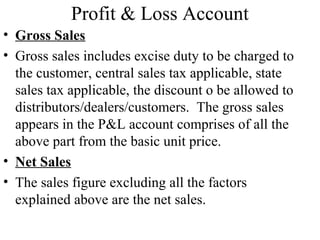
• Gross Sales
• Gross sales includes excise duty to be charged to
the customer, central sales tax applicable, state
sales tax applicable, the discount o be allowed to
distributors/dealers/customers. The gross sales
appears in the P&L account comprises of all the
above part from the basic unit price.
• Net Sales
• The sales figure excluding all the factors
explained above are the net sales.
Profit & Loss Account
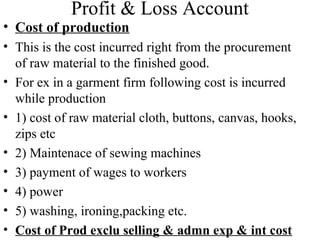
• Cost of production
• This is the cost incurred right from the procurement
of raw material to the finished good.
• For ex in a garment firm following cost is incurred
while production
• 1) cost of raw material cloth, buttons, canvas, hooks,
zips etc
• 2) Maintenace of sewing machines
• 3) payment of wages to workers
• 4) power
• 5) washing, ironing,packing etc.
• Cost of Prod exclu selling & admn exp & int cost
Profit & Loss Account
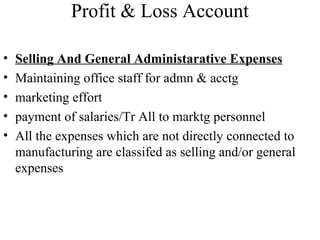
• Selling And General Administarative Expenses
• Maintaining office staff for admn & acctg
• marketing effort
• payment of salaries/Tr All to marktg personnel
• All the expenses which are not directly connected to
manufacturing are classifed as selling and/or general
expenses
Profit & Loss Account
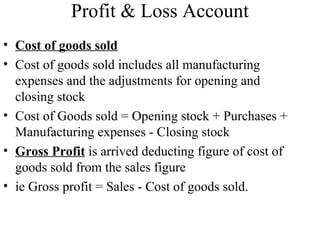
• Cost of goods sold
• Cost of goods sold includes all manufacturing
expenses and the adjustments for opening and
closing stock
• Cost of Goods sold = Opening stock + Purchases +
Manufacturing expenses - Closing stock
• Gross Profit is arrived deducting figure of cost of
goods sold from the sales figure
• ie Gross profit = Sales - Cost of goods sold.
Profit & Loss Account
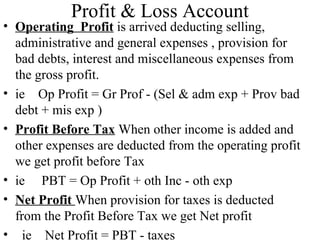
• Operating Profit is arrived deducting selling,
administrative and general expenses , provision for
bad debts, interest and miscellaneous expenses from
the gross profit.
• ie Op Profit = Gr Prof - (Sel & adm exp + Prov bad
debt + mis exp )
• Profit Before Tax When other income is added and
other expenses are deducted from the operating profit
we get profit before Tax
• ie PBT = Op Profit + oth Inc - oth exp
• Net Profit When provision for taxes is deducted
from the Profit Before Tax we get Net profit
• ie Net Profit = PBT - taxes
Profit & Loss Account
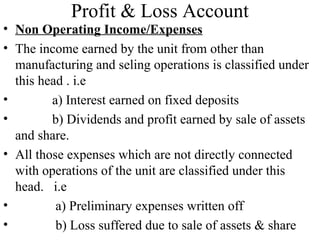
• Non Operating Income/Expenses
• The income earned by the unit from other than
manufacturing and seling operations is classified under
this head . i.e
• a) Interest earned on fixed deposits
• b) Dividends and profit earned by sale of assets
and share.
• All those expenses which are not directly connected
with operations of the unit are classified under this
head. i.e
• a) Preliminary expenses written off
• b) Loss suffered due to sale of assets & share

Balance sheet analysis

  • 1.
    • CAIIB -Financial Management • Module B – Study of Financial Statements • - Balance Sheet Analysis • M. Syed Kunmir
  • 2.
    BALANCE SHEET ANALYSIS •Sources of Funds 1) Capital 2) Reserves & Surplus 3) Term Liabilities 4) Current Liabilities
  • 3.
    BALANCE SHEET ANALYSIS •Uses of Funds • 1) Fixed Assets • 2) Intangible Asets • 3) Non Current Assets • 4) Current Assets
  • 4.
    BALANCE SHEET ANALYSIS •Capital • 1) Authorised Capital • 2) Issued Capital • 3) Subscribed Capital • 4) Paid-up Capital
  • 5.
    BALANCE SHEET ANALYSIS •Reserves • 1) Subsidy Received From The Govt • 2) Development Rebate reserve • 3) Revaluation of fixed assets • 4) Issue of Shares at Premium • 5) General Reserves • Surplus • The credit balance in profit and loss account
  • 6.
    BALANCE SHEET ANALYSIS •Tangible Net Worth • This refers to the total funds arrived by paid- up capital , Reserves and P&L Surplus • Less • Intagible Assets
  • 7.
    BALANCE SHEET ANALYSIS •Term Liabilities • Redeemable preference shares • Debentures • Deferred payment gaurantees • Public Deposits(Repayable after 12 months) • Term loans and unsecured loans from friens, relatives,directors repayable over a period of time • Remark : The company can raise public deposits to the extent of 25% of paid up capital plus free reserves and 10% from share holders for the maturity period ranging from 6 months to 3 yrs
  • 8.
    BALANCE SHEET ANALYSIS •Current Liabilities • Working capital bank borrowings • T.loans deferred credit inst falling due in 12 mths • public deposits maturing within 12 months • unsecured loans, unless the repayment is on deferred terms • sundry creditors • advances from dealers and customers • interest accrued but not paid • tax provisions • Dividend declared and payable
  • 9.
    BALANCE SHEET ANALYSIS •Contingent Liabilities • Tax disputes • Legal litigations • Bills and cheques discounted with banks • Claims against the company not acknowledged
  • 10.
    BALANCE SHEET ANALYSIS •Fixed Assets • Infrastructure like land & building • plant & machinery • Vehicles • Furniture & fixtures • Depreciation • Straight line method • Written down Value Method • Remark : Dep added to profit to arrive repayment obligation especially in term loans
  • 11.
    BALANCE SHEET ANALYSIS •Investments • 1) Shares And Securities • 2) Associate Companies • 3) Fixed deposits with banks/finance companies • Remark : While analysing bal sheet we can analyse necessity of such investments • Remark : While fixed deposits with banks are considered as fixed assets, the investmetns in associate concerns are treated as non current assets.
  • 12.
    BALANCE SHEET ANALYSIS •Non Current Assets • Deferred recievables/Overdue recievables(like disputed amounts and Over Due > 6 mths) • Non moving stocks/inventory/un usable spares • Investment/Lending to associate concern • Borrowing of the directors from the company • Telephone deposits/ ST deposits etc
  • 13.
    BALANCE SHEET ANALYSIS •Intangible Assets • Preliminary & Preoperative expenses • Deferred Revenue Expenditure • Goodwill • Trade mark • Patents • Rem : The o/s balance to be written off every year by charging P&L account
  • 14.
    BALANCE SHEET ANALYSIS •Current Assets • Raw materials, work-in-progress,finished goods,spares and consumables • Sundry debtors and recievables < 6 mths • Advances paid to suppliers of raw materials • Cash and bank balances • Interest recievables • Other current assets such as Government securities, Bank deposits ..etc
  • 15.
    BALANCE SHEET ANALYSIS •Notes • All expenses or provisions or advances or loans etc which are accrued and payable within 12 months are current liablities • When a company makes investments in unconnected avenues such as shares, securites, associate concerns are to be treated as non cur ast • The slow moving and absolete inventory - NCA
  • 16.
    BALANCE SHEET ANALYSIS •Notes • Bal Sh Analy not only to be quantitative but to be qualitative • It is the fin pos on a part date. Min three years bal sh ana would be more meaningful • It is a mixture of facts, opinions and conventions • While opinions are of the company’s management, the conventions are practiced by the finance managers of the company. • ( ex Over due recievable > 6 mths as NCA is a acccounting convention
  • 17.
    BALANCE SHEET ANALYSIS •Notes • The valuation of the stock is done as per the opinion of the management • Depreciation method may be changed to boost profit • It may be silent on key personnel and staff turnover • Marginal changes in the classification of certain items would lead to different results.
  • 18.
    BALANCE SHEET ANALYSIS •Notes • Management competence • Investment decision • Resorting to window dressing • experience of the promoters • Board comprises of only family members • The key personnel of the company • The structure of the organisation • The authority and decision making are decentralised
  • 19.
    BALANCE SHEET ANALYSIS •Notes • The state of industrial relations • Financial systems and procedures • management control • planning, budgeting, forecasting • capacity utilisation • status of the technology • awareness of the market, competitions ..etc • for listed co: share prices, EPS, book value, dividend record, public response ..etc
  • 20.
    Profit & LossAccount • It is a summary of revenue earned and expenses incurred which ultimately results in profit or loss of to the company • No defined format in law • Operating revenue = Sales revenue • Non_operating revenue = Other income ( out of sale of investments, interest, commission and discount etc) • Hence operating profit is a yard stick for operating profit of the company • Operating profit = Sales Revenue- Operating
  • 21.
    Profit & LossAccount • Gross Sales • Gross sales includes excise duty to be charged to the customer, central sales tax applicable, state sales tax applicable, the discount o be allowed to distributors/dealers/customers. The gross sales appears in the P&L account comprises of all the above part from the basic unit price. • Net Sales • The sales figure excluding all the factors explained above are the net sales.
  • 22.
    Profit & LossAccount • Cost of production • This is the cost incurred right from the procurement of raw material to the finished good. • For ex in a garment firm following cost is incurred while production • 1) cost of raw material cloth, buttons, canvas, hooks, zips etc • 2) Maintenace of sewing machines • 3) payment of wages to workers • 4) power • 5) washing, ironing,packing etc. • Cost of Prod exclu selling & admn exp & int cost
  • 23.
    Profit & LossAccount • Selling And General Administarative Expenses • Maintaining office staff for admn & acctg • marketing effort • payment of salaries/Tr All to marktg personnel • All the expenses which are not directly connected to manufacturing are classifed as selling and/or general expenses
  • 24.
    Profit & LossAccount • Cost of goods sold • Cost of goods sold includes all manufacturing expenses and the adjustments for opening and closing stock • Cost of Goods sold = Opening stock + Purchases + Manufacturing expenses - Closing stock • Gross Profit is arrived deducting figure of cost of goods sold from the sales figure • ie Gross profit = Sales - Cost of goods sold.
  • 25.
    Profit & LossAccount • Operating Profit is arrived deducting selling, administrative and general expenses , provision for bad debts, interest and miscellaneous expenses from the gross profit. • ie Op Profit = Gr Prof - (Sel & adm exp + Prov bad debt + mis exp ) • Profit Before Tax When other income is added and other expenses are deducted from the operating profit we get profit before Tax • ie PBT = Op Profit + oth Inc - oth exp • Net Profit When provision for taxes is deducted from the Profit Before Tax we get Net profit • ie Net Profit = PBT - taxes
  • 26.
    Profit & LossAccount • Non Operating Income/Expenses • The income earned by the unit from other than manufacturing and seling operations is classified under this head . i.e • a) Interest earned on fixed deposits • b) Dividends and profit earned by sale of assets and share. • All those expenses which are not directly connected with operations of the unit are classified under this head. i.e • a) Preliminary expenses written off • b) Loss suffered due to sale of assets & share