Cash flow statements
Kaira
Cash flow statement
• A cash flow statèrent présents information
about the cash flow with the oganisation’s
main activity and those associated with its
investing and financing activities of the
period.It shows both inflow and out flow of
the cash during the period
• IAS 7 Cash Flow Statements
• `
cash flow Statement Usage
• This statement shows the dynamics of short-
term liquidity and long-term solvency
• Cash flow information is an essential input for
economic decision models
• It shows how much cash onlow or outflow is
made during the period by operating,investing
or financing activity
Cash conversion cycles
• Cash flows through the company continuously
in a series of short-term and long-term
conversion cycles
• The ST - cash conversion cycle (operating
cycle) relates to the main business operations
– = OPERATING ACTIVITIES
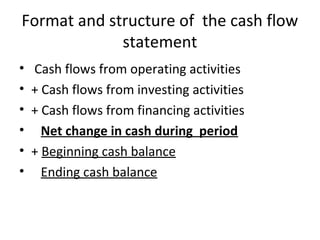
Format and structure of the cash flow
statement
• Cash flows from operating activities
• + Cash flows from investing activities
• + Cash flows from financing activities
• Net change in cash during period
• + Beginning cash balance
• Ending cash balance
Cash flows from operating activities
• Operating activities are primarily the revenue-generating
activities of a organisation
• “Operating cash flow” is conceptually most near to “net
profit”
• Following iteams are added or deducted:
1. Non-cash expenses and non-cash revenues (f.i.
depreciation expense)
2. Non-operating items (f.i. gain on disposal of tangible
fixed assets)
3. Timing differences between net profit and underlying
cash flow (f.i. changes in the level of inventories,
receivables, creditors, etc.)`
Operating cash flows: Examples
• Receipts from sale of goods and rendering of
services (cashing in of receivables included)
• Receipts from taxes on sales and VAT
• Receipts from royalties, fees, commissions,…
• Payments to suppliers (payment of creditors
included)
• Payments to employees
• Payments of taxes, VAT, fines
Operating cash flows –
Direct versus indirect method
2 methods for identifying and presenting the
operating cash flow:
• Direct method: engenders the presentation of
the most important categories of gross
operating cash inflows and cash outflows
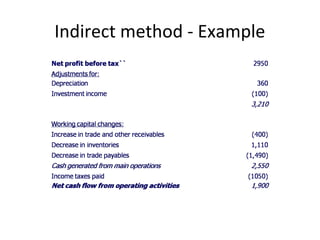
• Indirect method: net operating cash flow is
determined by adjusting the (net) profit figure
for the 3 types of differences
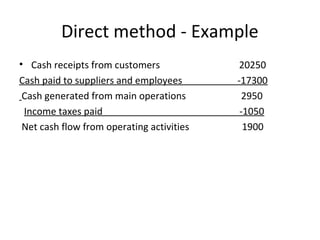
Direct method - Example
• Cash receipts from customers 20250
Cash paid to suppliers and employees -17300
Cash generated from main operations 2950
Income taxes paid -1050
Net cash flow from operating activities 1900
Indirect method - Example
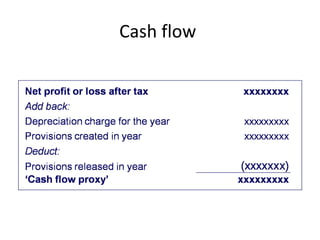
Cash flow
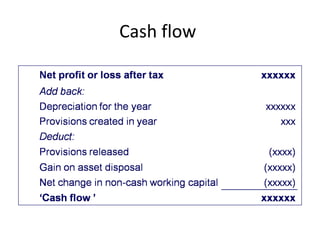
Cash flow
Cash flows from investing activities
• This shows item on the cash flow statement that
reports the aggregate change in a
company's cash position resulting from any gains (or
losses) from investments in the financial markets and
operating subsidiaries and changes resulting from
amounts spent on investments in capital assets
• Examples:
– Payments for newly acquired equipment
– Receipts from the disposal of a building
Cash flows from financing activities
• This catagory shows accounts for external activities
that allow a firm to raise capital and repay investors,
such as issuing stok, devidend etc.
Examples:
– Inflow from issuing stock
– Inflow from new bank loan
– Outflow from buy-back of shares
– Outflow of loans
Constructing a cash flow statement
1. First determine under which method cash
flow is made
2. Now begin with cash flow from operating
activies then Investing and financing
activities
3. Identify all transactions of the period leading
operating,Investing and Financing activities
4. Construct a cash flow statement according
to the formal rules
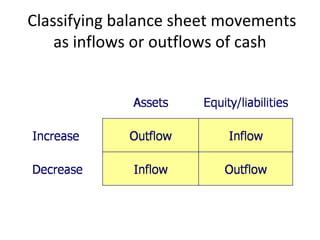
Classifying balance sheet movements
as inflows or outflows of cash

Cash flow statements

  • 1.
  • 2.
    Cash flow statement •A cash flow statèrent présents information about the cash flow with the oganisation’s main activity and those associated with its investing and financing activities of the period.It shows both inflow and out flow of the cash during the period • IAS 7 Cash Flow Statements • `
  • 3.
    cash flow StatementUsage • This statement shows the dynamics of short- term liquidity and long-term solvency • Cash flow information is an essential input for economic decision models • It shows how much cash onlow or outflow is made during the period by operating,investing or financing activity
  • 4.
    Cash conversion cycles •Cash flows through the company continuously in a series of short-term and long-term conversion cycles • The ST - cash conversion cycle (operating cycle) relates to the main business operations – = OPERATING ACTIVITIES
  • 5.
    Format and structureof the cash flow statement • Cash flows from operating activities • + Cash flows from investing activities • + Cash flows from financing activities • Net change in cash during period • + Beginning cash balance • Ending cash balance
  • 6.
    Cash flows fromoperating activities • Operating activities are primarily the revenue-generating activities of a organisation • “Operating cash flow” is conceptually most near to “net profit” • Following iteams are added or deducted: 1. Non-cash expenses and non-cash revenues (f.i. depreciation expense) 2. Non-operating items (f.i. gain on disposal of tangible fixed assets) 3. Timing differences between net profit and underlying cash flow (f.i. changes in the level of inventories, receivables, creditors, etc.)`
  • 7.
    Operating cash flows:Examples • Receipts from sale of goods and rendering of services (cashing in of receivables included) • Receipts from taxes on sales and VAT • Receipts from royalties, fees, commissions,… • Payments to suppliers (payment of creditors included) • Payments to employees • Payments of taxes, VAT, fines
  • 8.
    Operating cash flows– Direct versus indirect method 2 methods for identifying and presenting the operating cash flow: • Direct method: engenders the presentation of the most important categories of gross operating cash inflows and cash outflows • Indirect method: net operating cash flow is determined by adjusting the (net) profit figure for the 3 types of differences
  • 9.
    Direct method -Example • Cash receipts from customers 20250 Cash paid to suppliers and employees -17300 Cash generated from main operations 2950 Income taxes paid -1050 Net cash flow from operating activities 1900
  • 10.
  • 11.
  • 12.
  • 13.
    Cash flows frominvesting activities • This shows item on the cash flow statement that reports the aggregate change in a company's cash position resulting from any gains (or losses) from investments in the financial markets and operating subsidiaries and changes resulting from amounts spent on investments in capital assets • Examples: – Payments for newly acquired equipment – Receipts from the disposal of a building
  • 14.
    Cash flows fromfinancing activities • This catagory shows accounts for external activities that allow a firm to raise capital and repay investors, such as issuing stok, devidend etc. Examples: – Inflow from issuing stock – Inflow from new bank loan – Outflow from buy-back of shares – Outflow of loans
  • 15.
    Constructing a cashflow statement 1. First determine under which method cash flow is made 2. Now begin with cash flow from operating activies then Investing and financing activities 3. Identify all transactions of the period leading operating,Investing and Financing activities 4. Construct a cash flow statement according to the formal rules
  • 16.
    Classifying balance sheetmovements as inflows or outflows of cash