Financial Accounting
1
Lecture – 41
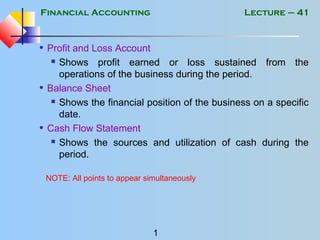
• Profit and Loss Account
 Shows profit earned or loss sustained from the
operations of the business during the period.
• Balance Sheet
 Shows the financial position of the business on a specific
date.
• Cash Flow Statement
 Shows the sources and utilization of cash during the
period.
NOTE: All points to appear simultaneously
Financial Accounting
2
Lecture – 41
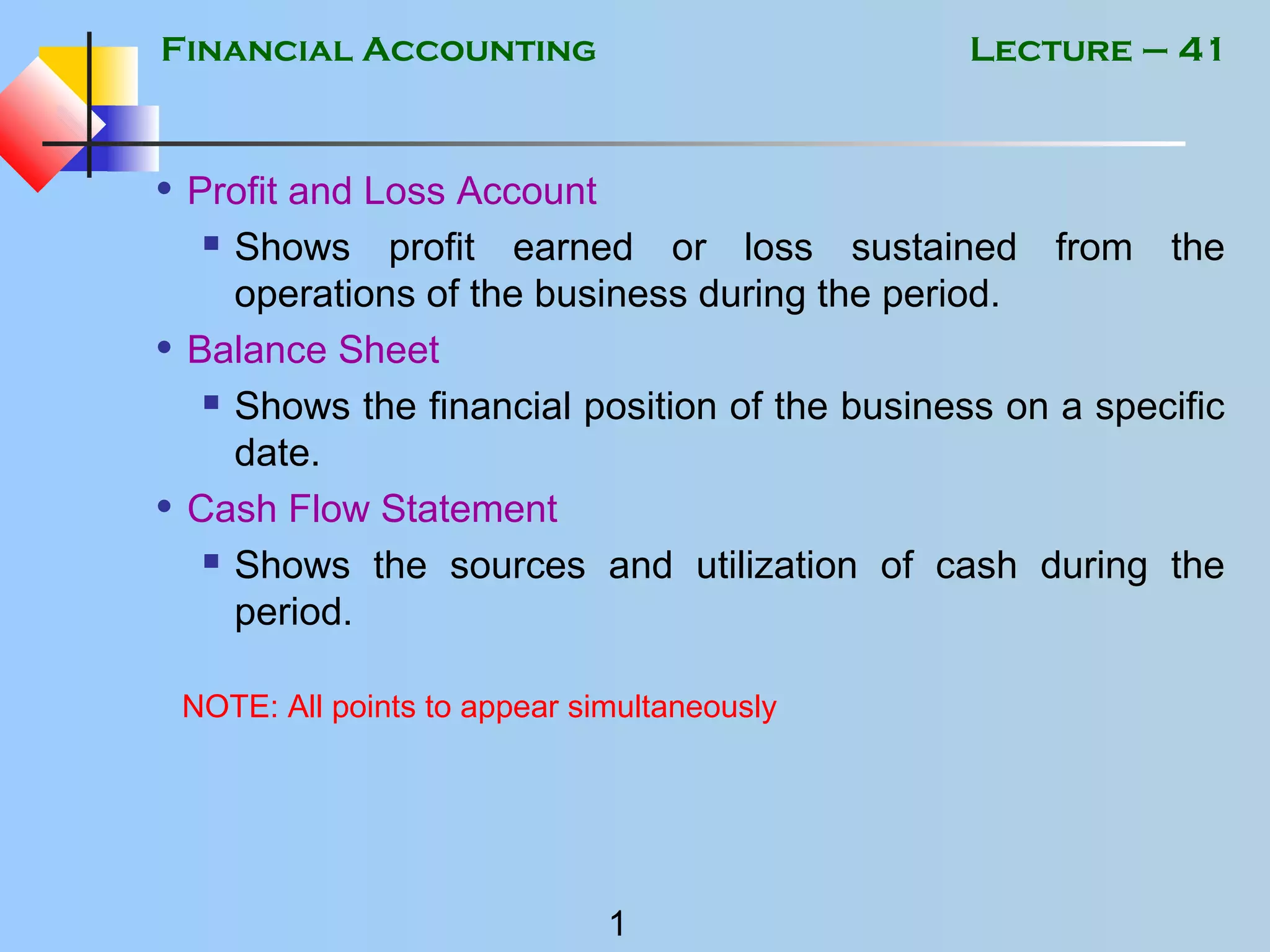
Cash Flow Statement
• Cash Flow Statement shows the sources and utilization of
cash during the period.
Financial Accounting
3
Lecture – 41
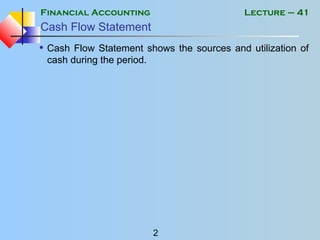
Difference Between Profit and Cash
Example
• A person starts a small business with Rs. 10,000.
• He purchases goods worth Rs. 20,000.
• Rs.10,000 is paid in cash and balance is payable at the end
of the month.
• Same day all the goods are sold on credit of two months for
Rs. 30,000.
• Sales – Cost = Profit
30,000 – 20,000 = 10,000
• Although the trader earned Rs. 10,000 profit but he does not
have any cash at the end of first month to repay the creditor.
Financial Accounting
4
Lecture – 41
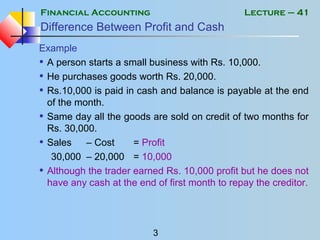
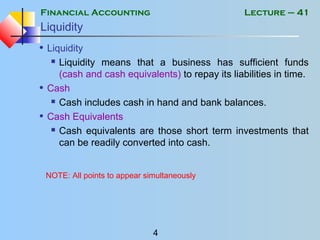
Liquidity
• Liquidity
 Liquidity means that a business has sufficient funds
(cash and cash equivalents) to repay its liabilities in time.
• Cash
 Cash includes cash in hand and bank balances.
• Cash Equivalents
 Cash equivalents are those short term investments that
can be readily converted into cash.
NOTE: All points to appear simultaneously
Financial Accounting
5
Lecture – 41
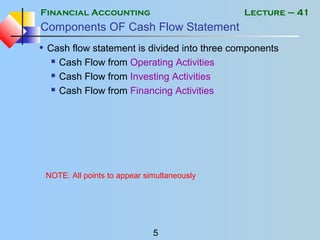
Components OF Cash Flow Statement
• Cash flow statement is divided into three components
 Cash Flow from Operating Activities
 Cash Flow from Investing Activities
 Cash Flow from Financing Activities
NOTE: All points to appear simultaneously
Financial Accounting
6
Lecture – 41
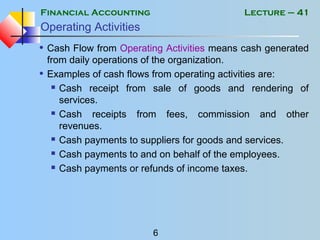
Operating Activities
• Cash Flow from Operating Activities means cash generated
from daily operations of the organization.
• Examples of cash flows from operating activities are:
 Cash receipt from sale of goods and rendering of
services.
 Cash receipts from fees, commission and other
revenues.
 Cash payments to suppliers for goods and services.
 Cash payments to and on behalf of the employees.
 Cash payments or refunds of income taxes.
Financial Accounting
7
Lecture – 41
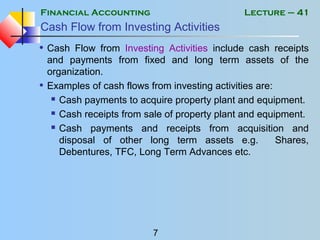
Cash Flow from Investing Activities
• Cash Flow from Investing Activities include cash receipts
and payments from fixed and long term assets of the
organization.
• Examples of cash flows from investing activities are:
 Cash payments to acquire property plant and equipment.
 Cash receipts from sale of property plant and equipment.
 Cash payments and receipts from acquisition and
disposal of other long term assets e.g. Shares,
Debentures, TFC, Long Term Advances etc.
Financial Accounting
8
Lecture – 41
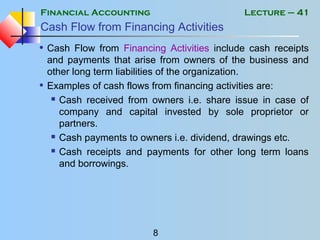
Cash Flow from Financing Activities
• Cash Flow from Financing Activities include cash receipts
and payments that arise from owners of the business and
other long term liabilities of the organization.
• Examples of cash flows from financing activities are:
 Cash received from owners i.e. share issue in case of
company and capital invested by sole proprietor or
partners.
 Cash payments to owners i.e. dividend, drawings etc.
 Cash receipts and payments for other long term loans
and borrowings.
Financial Accounting
9
Lecture – 41
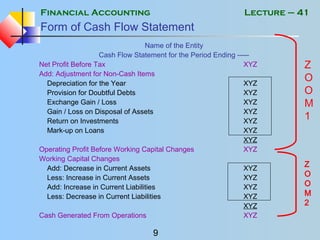
Form of Cash Flow Statement
Name of the Entity
Cash Flow Statement for the Period Ending -----
Net Profit Before Tax XYZ
Add: Adjustment for Non-Cash Items
Depreciation for the Year XYZ
Provision for Doubtful Debts XYZ
Exchange Gain / Loss XYZ
Gain / Loss on Disposal of Assets XYZ
Return on Investments XYZ
Mark-up on Loans XYZ
XYZ
Operating Profit Before Working Capital Changes XYZ
Working Capital Changes
Add: Decrease in Current Assets XYZ
Less: Increase in Current Assets XYZ
Add: Increase in Current Liabilities XYZ
Less: Decrease in Current Liabilities XYZ
XYZ
Cash Generated From Operations XYZ
Z
O
O
M
1
Z
O
O
M
2
Financial Accounting
10
Lecture – 41
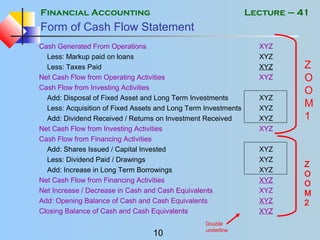
Form of Cash Flow Statement
Cash Generated From Operations XYZ
Less: Markup paid on loans XYZ
Less: Taxes Paid XYZ
Net Cash Flow from Operating Activities XYZ
Cash Flow from Investing Activities
Add: Disposal of Fixed Asset and Long Term Investments XYZ
Less: Acquisition of Fixed Assets and Long Term Investments XYZ
Add: Dividend Received / Returns on Investment Received XYZ
Net Cash Flow from Investing Activities XYZ
Cash Flow from Financing Activities
Add: Shares Issued / Capital Invested XYZ
Less: Dividend Paid / Drawings XYZ
Add: Increase in Long Term Borrowings XYZ
Net Cash Flow from Financing Activities XYZ
Net Increase / Decrease in Cash and Cash Equivalents XYZ
Add: Opening Balance of Cash and Cash Equivalents XYZ
Closing Balance of Cash and Cash Equivalents XYZ
Z
O
O
M
1
Z
O
O
M
2
Double
underline

MGT101 - Financial Accounting- Lecture 41

  • 1.
    Financial Accounting 1 Lecture –41 • Profit and Loss Account  Shows profit earned or loss sustained from the operations of the business during the period. • Balance Sheet  Shows the financial position of the business on a specific date. • Cash Flow Statement  Shows the sources and utilization of cash during the period. NOTE: All points to appear simultaneously
  • 2.
    Financial Accounting 2 Lecture –41 Cash Flow Statement • Cash Flow Statement shows the sources and utilization of cash during the period.
  • 3.
    Financial Accounting 3 Lecture –41 Difference Between Profit and Cash Example • A person starts a small business with Rs. 10,000. • He purchases goods worth Rs. 20,000. • Rs.10,000 is paid in cash and balance is payable at the end of the month. • Same day all the goods are sold on credit of two months for Rs. 30,000. • Sales – Cost = Profit 30,000 – 20,000 = 10,000 • Although the trader earned Rs. 10,000 profit but he does not have any cash at the end of first month to repay the creditor.
  • 4.
    Financial Accounting 4 Lecture –41 Liquidity • Liquidity  Liquidity means that a business has sufficient funds (cash and cash equivalents) to repay its liabilities in time. • Cash  Cash includes cash in hand and bank balances. • Cash Equivalents  Cash equivalents are those short term investments that can be readily converted into cash. NOTE: All points to appear simultaneously
  • 5.
    Financial Accounting 5 Lecture –41 Components OF Cash Flow Statement • Cash flow statement is divided into three components  Cash Flow from Operating Activities  Cash Flow from Investing Activities  Cash Flow from Financing Activities NOTE: All points to appear simultaneously
  • 6.
    Financial Accounting 6 Lecture –41 Operating Activities • Cash Flow from Operating Activities means cash generated from daily operations of the organization. • Examples of cash flows from operating activities are:  Cash receipt from sale of goods and rendering of services.  Cash receipts from fees, commission and other revenues.  Cash payments to suppliers for goods and services.  Cash payments to and on behalf of the employees.  Cash payments or refunds of income taxes.
  • 7.
    Financial Accounting 7 Lecture –41 Cash Flow from Investing Activities • Cash Flow from Investing Activities include cash receipts and payments from fixed and long term assets of the organization. • Examples of cash flows from investing activities are:  Cash payments to acquire property plant and equipment.  Cash receipts from sale of property plant and equipment.  Cash payments and receipts from acquisition and disposal of other long term assets e.g. Shares, Debentures, TFC, Long Term Advances etc.
  • 8.
    Financial Accounting 8 Lecture –41 Cash Flow from Financing Activities • Cash Flow from Financing Activities include cash receipts and payments that arise from owners of the business and other long term liabilities of the organization. • Examples of cash flows from financing activities are:  Cash received from owners i.e. share issue in case of company and capital invested by sole proprietor or partners.  Cash payments to owners i.e. dividend, drawings etc.  Cash receipts and payments for other long term loans and borrowings.
  • 9.
    Financial Accounting 9 Lecture –41 Form of Cash Flow Statement Name of the Entity Cash Flow Statement for the Period Ending ----- Net Profit Before Tax XYZ Add: Adjustment for Non-Cash Items Depreciation for the Year XYZ Provision for Doubtful Debts XYZ Exchange Gain / Loss XYZ Gain / Loss on Disposal of Assets XYZ Return on Investments XYZ Mark-up on Loans XYZ XYZ Operating Profit Before Working Capital Changes XYZ Working Capital Changes Add: Decrease in Current Assets XYZ Less: Increase in Current Assets XYZ Add: Increase in Current Liabilities XYZ Less: Decrease in Current Liabilities XYZ XYZ Cash Generated From Operations XYZ Z O O M 1 Z O O M 2
  • 10.
    Financial Accounting 10 Lecture –41 Form of Cash Flow Statement Cash Generated From Operations XYZ Less: Markup paid on loans XYZ Less: Taxes Paid XYZ Net Cash Flow from Operating Activities XYZ Cash Flow from Investing Activities Add: Disposal of Fixed Asset and Long Term Investments XYZ Less: Acquisition of Fixed Assets and Long Term Investments XYZ Add: Dividend Received / Returns on Investment Received XYZ Net Cash Flow from Investing Activities XYZ Cash Flow from Financing Activities Add: Shares Issued / Capital Invested XYZ Less: Dividend Paid / Drawings XYZ Add: Increase in Long Term Borrowings XYZ Net Cash Flow from Financing Activities XYZ Net Increase / Decrease in Cash and Cash Equivalents XYZ Add: Opening Balance of Cash and Cash Equivalents XYZ Closing Balance of Cash and Cash Equivalents XYZ Z O O M 1 Z O O M 2 Double underline