BY
PARITOSH DUBE
Cash Flow Statement
Importance
Generally Accepted Accounting Principles (GAAP)
call for three principal financial statements from all
firms.
These are
1. Balance Sheet
2.Income Statement or P & L Account
3.Statement of Cash Flows
PURPOSES OF CASH FLOW
STATEMENT
1. Predict future cash flows
2. Evaluate management decisions
3. Determine the ability to pay dividends to
stockholders’ and payments to creditors
4. Show the relationship of net income to the
business’s cash flows
IMPORTANCE
1. To identify the sources from where cash inflows have arisen
within a particular period and also shows the various
activities where in the cash was utilized.
2. It is significant to management for proper cash planning
and maintaining a proper matching between cash inflows
and outflows.
3. Shows efficiency of a firm in generating cash inflows from
its regular operations
4. Reports the amount of cash used during the period in
various long-term investing activities, such as purchase of
fixed assets.
5. Reports the amount of cash received during the period
through various financing activities, such as issue of shares,
debentures and raising long-term loan.
WHAT IS CASH
1. Cash in hand
2. Cash at bank
3. Cash equivalents such as Investments which can be
converted into cash in very short period.
TYPES OF CASH FLOW ACTIVITIES
DEFINITION OF OPERATING
ACTIVITIES
An accounting item indicating the revenue earned by
a company in its normal course of operations
whether it be a manufacturing ,trading or service
business. It includes EBIT plus depreciation minus
taxes. It, however, does not include long-term capital
or investment costs.
DEFINITION OF INVESTMENT
ACTIVITIES
Investing activities are the acquisition and disposal
of long-term assets and other investments not
included in cash equivalents. These activities include
transactions involving purchase and sale of long
term productive assets like machinery, land, etc.,
which are not held for resale.
DEFINITION OF FINANCING
ACTIVITIES
Financing activities are the activities that result in
change in the size and composition of the owner’s
capital (including preference share capital in the case
of a company) and borrowing of the enterprise.
Cash Inflows and Outflows From Operating Activities
Cash Inflows and Outflows From Investing Activities
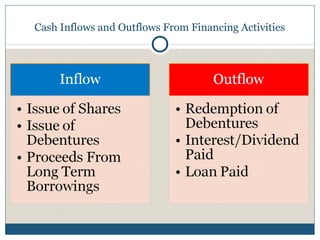
Cash Inflows and Outflows From Financing Activities
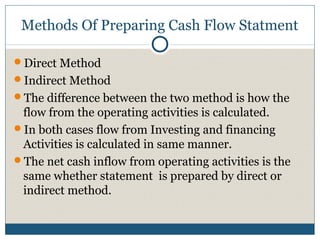
Methods Of Preparing Cash Flow Statment
Direct Method
Indirect Method
The difference between the two method is how the
flow from the operating activities is calculated.
In both cases flow from Investing and financing
Activities is calculated in same manner.
The net cash inflow from operating activities is the
same whether statement is prepared by direct or
indirect method.
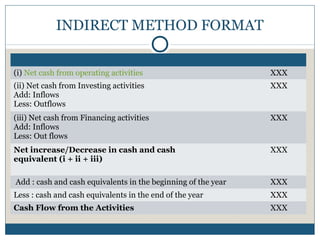
INDIRECT METHOD FORMAT
(i) Net cash from operating activities XXX
(ii) Net cash from Investing activities
Add: Inflows
Less: Outflows
XXX
(iii) Net cash from Financing activities
Add: Inflows
Less: Out flows
XXX
Net increase/Decrease in cash and cash
equivalent (i + ii + iii)
XXX
Add : cash and cash equivalents in the beginning of the year XXX
Less : cash and cash equivalents in the end of the year XXX
Cash Flow from the Activities XXX
INDIRECT METHOD FORMAT
Cash Flow from Operating Activities Amount
Net Profit(Loss) before tax XXX
Add: Deductions Made on account of Non Cash Items Such as Depreciation XXX
Add: Deductions made on account of Non operating Expenses such as Interest XXX
Less: Additions Made on account of Non operating Income received such as Dividend,
rent, Interest, Profit on sale of fixed assets
XXX
OPERATING PROFIT BEFORE WORKING CAPITAL CHANGES XXX
Add: Increase in current Liability/Decrease in Current Asset XXX
Less: Increase in Current Asset/Increase in Current Liability XXX
Cash Flows from Operating Activities before Tax and Extraordinary Items XXX
-Income Tax Paid XXX
+/– Effects of Extraordinary Items XXX
Net Cash From Operating Activities XXX
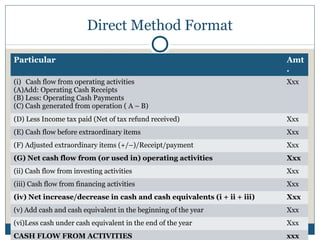
Direct Method Format
Particular Amt
.
(i) Cash flow from operating activities
(A)Add: Operating Cash Receipts
(B) Less: Operating Cash Payments
(C) Cash generated from operation ( A – B)
Xxx
(D) Less Income tax paid (Net of tax refund received) Xxx
(E) Cash flow before extraordinary items Xxx
(F) Adjusted extraordinary items (+/–)/Receipt/payment Xxx
(G) Net cash flow from (or used in) operating activities Xxx
(ii) Cash flow from investing activities Xxx
(iii) Cash flow from financing activities Xxx
(iv) Net increase/decrease in cash and cash equivalents (i + ii + iii) Xxx
(v) Add cash and cash equivalent in the beginning of the year Xxx
(vi)Less cash under cash equivalent in the end of the year Xxx
CASH FLOW FROM ACTIVITIES xxx
Problem with Solution
From the following Information, you are required to
prepare the cash flow statement of Shine Ltd. for the year
ended 31st March (both methods) :
Balance Sheet as on 31st March
Liability 2016 2017 Asset 2016 2017
Share Capital 100000 101000 Fixed Asset 80000 121000
Secured Loan 30000 70000 Inventory 45000 70000
Creditors 44000 69000 Debtors 35000 50000
Tax Payable 31000 33000 Cash 50000 37000
Profit & Loss A/c 37000 39000 Prepaid Expenses 32000 34000
242000 312000 242000 312000
Profit andAccount
for the year ended 31st March loss 2017
Particular Amount Particular Amount
Opening Stock 25000 Sales 110000
Purchase 108000 Closing Stock 50000
Gross profit C/d 27000
160000 160000
General Expenses 13000 Gross Profit B/d 27000
Depreciation 8000
Provision for tax 4000
Net Profit C/d 2000
40000 40000
Net Profit b/d 2000
Balance c/d 39000 Balance b/d 37000
Working Notes
Debtors A/c
Particular Amount Particular Amount
To Balance b/d 35000 By Balance c/d 50000
To sales 110000 By Cash
(Balancing Figure)
95000
145000 145000
Creditors A/c
Particular Amount Particular Amount
To Balance C/d 69000 By Balance b/d 44000
To Cash a/c (balancing figure) 83000 By Purchase 108000
142000 152000
Working Notes
Fixed Asset A/c
Particular Amount Particular Amount
To Balance b/d 80000 By Depreciation 8000
To Purchase 49000 By Balance c/d 121000
129000 129000
Provision for taxation A/c
Particular Amount Particular Amount
To Balance b/d 33000 By P& L A/c 4000
To Cash (balancing
Figure
2000 By Balance c/d
(given)
31000
36000 35000
Cash Flow Statement (Direct Method)
for the year ended, March 31, 2017
Cash Flow from Operating Activities Amount
(A)Operating Income :- Cash receipts (see debtors A/c) 95000
(B) Less Operating Expenses: Payments in cash ( see creditors a/c) (83000)
General expenses (13000)
(c)Income from operating activities(A-B) (1000)
Less taxes paid (see Provision for tax A/c) (2000)
(i) Net Cash from operating Activities (3000)
(ii) Cash from Investing activities
Less:-Purchase of Fixed asset(see fixed asset account) 48000 (48000)
(iii) Cash flow from Financing activities
Add: issue of Loans (70000-30000) 40000
Add: Issue of share capital (101000-100000) 1000 41000
Net decrease in cash (-3000-48000+41000) (10000)
Cash flow Statement (Indirect Method)
For the year ended march, 31, 2017
Particular Amount
Net Profit as per profit and loss A/c 4000
Add Provision for tax ( see provision for tax Account) 4000
Net profit Before tax 8000
Add:- depreciation 8000
Operating profit before working capital Changes 16000
Add: Increase in creditors(69000-44000) 25000
Less: Increase in debtors(50000-35000) (15000)
Increase in Inventory(70000-45000) (25000)
Increase in prepaid expenses(34000-32000) (2000) (17000)
(1000)
Less : Taxes Paid (2000)
(i) Net Cash from operating Activities----Carried down (3000)
Cash flow Statement (Indirect Method)
For the year ended march, 31, 2017
(i) Net Cash from operating Activities----bought down (3000)
(ii) Cash from Investing activities
Less:-Purchase of Fixed asset(see fixed asset account) 48000 (48000)
(iii) Cash flow from Financing activities
Add: issue of Loans (70000-30000) 40000
Add: Issue of share capital (101000-100000) 1000 41000
Net decrease in cash (-3000-48000+41000) (10000)

Cash flow statement

  • 1.
  • 2.
    Importance Generally Accepted AccountingPrinciples (GAAP) call for three principal financial statements from all firms. These are 1. Balance Sheet 2.Income Statement or P & L Account 3.Statement of Cash Flows
  • 3.
    PURPOSES OF CASHFLOW STATEMENT 1. Predict future cash flows 2. Evaluate management decisions 3. Determine the ability to pay dividends to stockholders’ and payments to creditors 4. Show the relationship of net income to the business’s cash flows
  • 4.
    IMPORTANCE 1. To identifythe sources from where cash inflows have arisen within a particular period and also shows the various activities where in the cash was utilized. 2. It is significant to management for proper cash planning and maintaining a proper matching between cash inflows and outflows. 3. Shows efficiency of a firm in generating cash inflows from its regular operations 4. Reports the amount of cash used during the period in various long-term investing activities, such as purchase of fixed assets. 5. Reports the amount of cash received during the period through various financing activities, such as issue of shares, debentures and raising long-term loan.
  • 5.
    WHAT IS CASH 1.Cash in hand 2. Cash at bank 3. Cash equivalents such as Investments which can be converted into cash in very short period.
  • 6.
    TYPES OF CASHFLOW ACTIVITIES
  • 7.
    DEFINITION OF OPERATING ACTIVITIES Anaccounting item indicating the revenue earned by a company in its normal course of operations whether it be a manufacturing ,trading or service business. It includes EBIT plus depreciation minus taxes. It, however, does not include long-term capital or investment costs.
  • 8.
    DEFINITION OF INVESTMENT ACTIVITIES Investingactivities are the acquisition and disposal of long-term assets and other investments not included in cash equivalents. These activities include transactions involving purchase and sale of long term productive assets like machinery, land, etc., which are not held for resale.
  • 9.
    DEFINITION OF FINANCING ACTIVITIES Financingactivities are the activities that result in change in the size and composition of the owner’s capital (including preference share capital in the case of a company) and borrowing of the enterprise.
  • 10.
    Cash Inflows andOutflows From Operating Activities
  • 11.
    Cash Inflows andOutflows From Investing Activities
  • 12.
    Cash Inflows andOutflows From Financing Activities
  • 13.
    Methods Of PreparingCash Flow Statment Direct Method Indirect Method The difference between the two method is how the flow from the operating activities is calculated. In both cases flow from Investing and financing Activities is calculated in same manner. The net cash inflow from operating activities is the same whether statement is prepared by direct or indirect method.
  • 14.
    INDIRECT METHOD FORMAT (i)Net cash from operating activities XXX (ii) Net cash from Investing activities Add: Inflows Less: Outflows XXX (iii) Net cash from Financing activities Add: Inflows Less: Out flows XXX Net increase/Decrease in cash and cash equivalent (i + ii + iii) XXX Add : cash and cash equivalents in the beginning of the year XXX Less : cash and cash equivalents in the end of the year XXX Cash Flow from the Activities XXX
  • 15.
    INDIRECT METHOD FORMAT CashFlow from Operating Activities Amount Net Profit(Loss) before tax XXX Add: Deductions Made on account of Non Cash Items Such as Depreciation XXX Add: Deductions made on account of Non operating Expenses such as Interest XXX Less: Additions Made on account of Non operating Income received such as Dividend, rent, Interest, Profit on sale of fixed assets XXX OPERATING PROFIT BEFORE WORKING CAPITAL CHANGES XXX Add: Increase in current Liability/Decrease in Current Asset XXX Less: Increase in Current Asset/Increase in Current Liability XXX Cash Flows from Operating Activities before Tax and Extraordinary Items XXX -Income Tax Paid XXX +/– Effects of Extraordinary Items XXX Net Cash From Operating Activities XXX
  • 16.
    Direct Method Format ParticularAmt . (i) Cash flow from operating activities (A)Add: Operating Cash Receipts (B) Less: Operating Cash Payments (C) Cash generated from operation ( A – B) Xxx (D) Less Income tax paid (Net of tax refund received) Xxx (E) Cash flow before extraordinary items Xxx (F) Adjusted extraordinary items (+/–)/Receipt/payment Xxx (G) Net cash flow from (or used in) operating activities Xxx (ii) Cash flow from investing activities Xxx (iii) Cash flow from financing activities Xxx (iv) Net increase/decrease in cash and cash equivalents (i + ii + iii) Xxx (v) Add cash and cash equivalent in the beginning of the year Xxx (vi)Less cash under cash equivalent in the end of the year Xxx CASH FLOW FROM ACTIVITIES xxx
  • 17.
    Problem with Solution Fromthe following Information, you are required to prepare the cash flow statement of Shine Ltd. for the year ended 31st March (both methods) : Balance Sheet as on 31st March Liability 2016 2017 Asset 2016 2017 Share Capital 100000 101000 Fixed Asset 80000 121000 Secured Loan 30000 70000 Inventory 45000 70000 Creditors 44000 69000 Debtors 35000 50000 Tax Payable 31000 33000 Cash 50000 37000 Profit & Loss A/c 37000 39000 Prepaid Expenses 32000 34000 242000 312000 242000 312000
  • 18.
    Profit andAccount for theyear ended 31st March loss 2017 Particular Amount Particular Amount Opening Stock 25000 Sales 110000 Purchase 108000 Closing Stock 50000 Gross profit C/d 27000 160000 160000 General Expenses 13000 Gross Profit B/d 27000 Depreciation 8000 Provision for tax 4000 Net Profit C/d 2000 40000 40000 Net Profit b/d 2000 Balance c/d 39000 Balance b/d 37000
  • 19.
    Working Notes Debtors A/c ParticularAmount Particular Amount To Balance b/d 35000 By Balance c/d 50000 To sales 110000 By Cash (Balancing Figure) 95000 145000 145000 Creditors A/c Particular Amount Particular Amount To Balance C/d 69000 By Balance b/d 44000 To Cash a/c (balancing figure) 83000 By Purchase 108000 142000 152000
  • 20.
    Working Notes Fixed AssetA/c Particular Amount Particular Amount To Balance b/d 80000 By Depreciation 8000 To Purchase 49000 By Balance c/d 121000 129000 129000 Provision for taxation A/c Particular Amount Particular Amount To Balance b/d 33000 By P& L A/c 4000 To Cash (balancing Figure 2000 By Balance c/d (given) 31000 36000 35000
  • 21.
    Cash Flow Statement(Direct Method) for the year ended, March 31, 2017 Cash Flow from Operating Activities Amount (A)Operating Income :- Cash receipts (see debtors A/c) 95000 (B) Less Operating Expenses: Payments in cash ( see creditors a/c) (83000) General expenses (13000) (c)Income from operating activities(A-B) (1000) Less taxes paid (see Provision for tax A/c) (2000) (i) Net Cash from operating Activities (3000) (ii) Cash from Investing activities Less:-Purchase of Fixed asset(see fixed asset account) 48000 (48000) (iii) Cash flow from Financing activities Add: issue of Loans (70000-30000) 40000 Add: Issue of share capital (101000-100000) 1000 41000 Net decrease in cash (-3000-48000+41000) (10000)
  • 22.
    Cash flow Statement(Indirect Method) For the year ended march, 31, 2017 Particular Amount Net Profit as per profit and loss A/c 4000 Add Provision for tax ( see provision for tax Account) 4000 Net profit Before tax 8000 Add:- depreciation 8000 Operating profit before working capital Changes 16000 Add: Increase in creditors(69000-44000) 25000 Less: Increase in debtors(50000-35000) (15000) Increase in Inventory(70000-45000) (25000) Increase in prepaid expenses(34000-32000) (2000) (17000) (1000) Less : Taxes Paid (2000) (i) Net Cash from operating Activities----Carried down (3000)
  • 23.
    Cash flow Statement(Indirect Method) For the year ended march, 31, 2017 (i) Net Cash from operating Activities----bought down (3000) (ii) Cash from Investing activities Less:-Purchase of Fixed asset(see fixed asset account) 48000 (48000) (iii) Cash flow from Financing activities Add: issue of Loans (70000-30000) 40000 Add: Issue of share capital (101000-100000) 1000 41000 Net decrease in cash (-3000-48000+41000) (10000)