BRIDGE ENGINEERING
Dr. K.SIVASAKTHIVEL , M. E, M.B.A, Ph. D
Bridge
 A bridge is a structure providing passage over an obstacle without closing the way
beneath.
 The required passage may be for a road, a railway pedestrian or a canal of a
pipeline. The obstacle to be crossed may be river, a road, a railway or a valley.
 Bridges are a critical component of a nation’s infrastructure, making it possible to
ship raw materials and finished goods to factories, warehouses, suppliers,
distributors, stores, and end-consumers.
 Reduce travelling time.
 Leads easy trade.
Types of Loads for Design of Bridge
 Dead load
 Live load
 Impact load
 Wind load
 Longitudinal forces
 Centrifugal forces
 Buoyancy effect
 Effect of water current
 Thermal effects
 Deformation and horizontal effects
 Erection stresses
 Seismic loads
Components of bridge
Bridge can be divided into two major parts.
1. Sub structure
2. Super structure
SUB STRUCTURE
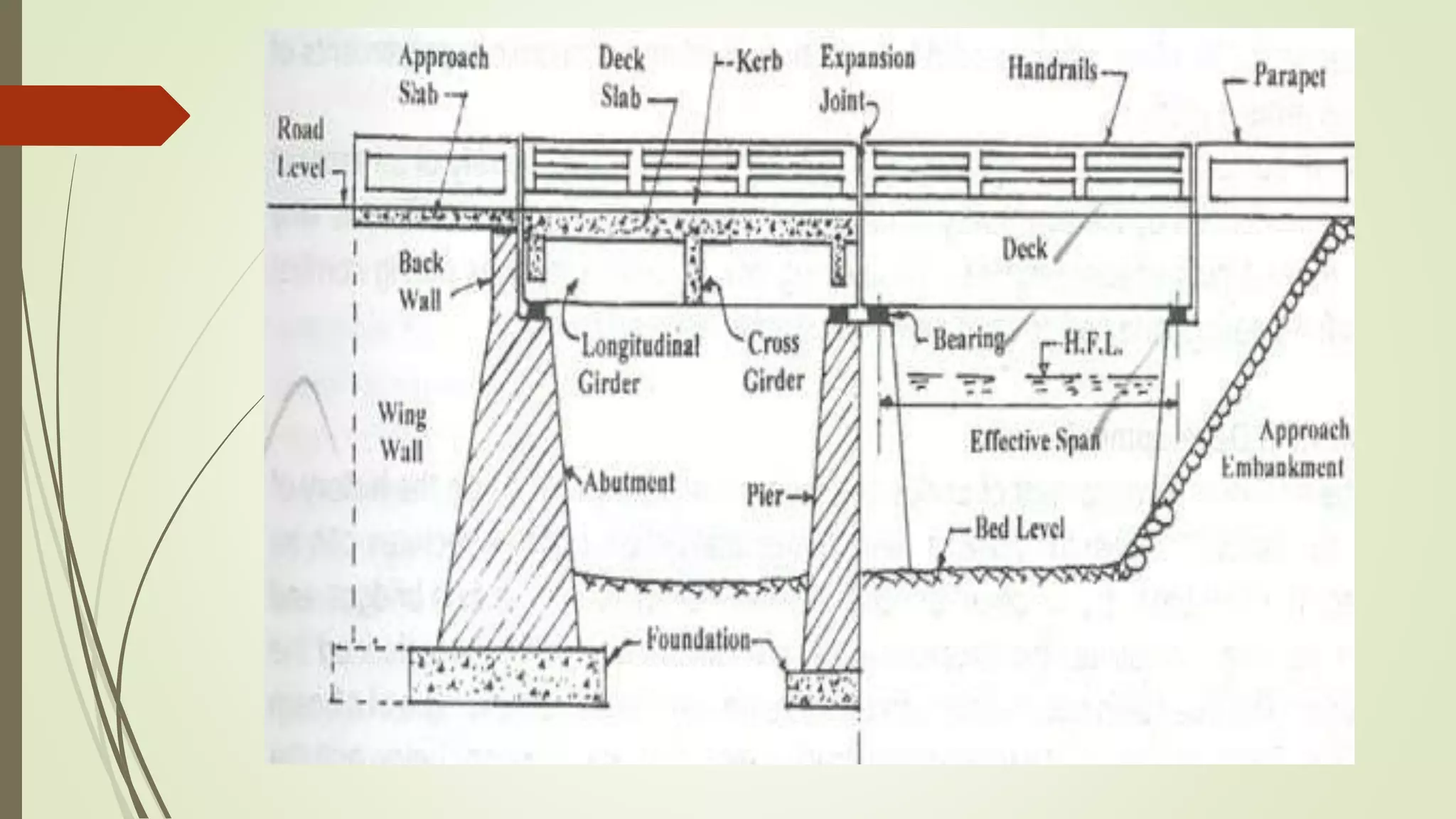
 The function of the sub structure is similar to that of foundations, columns and walls of
a buildings, because it supports the super structure of the bridges and transmits the
load safely to the ground
The substructure consists of the following
a. Abutments
b. Piers
c. Wing walls
d. Approaches
e. Foundations for the piers and abutments
 Abutments: The end of superstructure of a bridge is called abutments.
Its main functions are
 To laterally support the earth work of the embankment of the approaches.
 To transmit the load from the bridge superstructure.
 To give final formation level to the bridge.
Piers
 Piers are the intermediate supports for the superstructure. Piers transmit the loads
from the superstructure of the bridge to the foundations. A pier essentially consists
of a column or shat and a foundation. They may have different configurations as
shown in figure. These piers may be constructed with stone masonry or concrete
 Wing walls : These are the walls provided at both ends of the abutments to retain
the earth filling of the approach road. They are constructed of the same material as
those of the main abutment.
 Approaches: The portion of the road constructed to reach the bridge from their
general route or height is known as approach of the bridge. The alignment and the
level of the approaches mainly depend on the design and layout of the bridge
 Foundations for the Piers and Abutments : The foundation of a bridge structure
distributes the load from the piers and abutments over the larger area of sub soil. It
prevents the tilting and over-turning of the piers and abutments and settlement of
the sub soil.
Super structure
The super structure is that part of the bridge over which the traffic moves with safely. It
consists of
a. Decking
b. Parapet or hand rails, guard stones etc.
c. Bearing
 Decking : It is provided to allow the road surface to be built in over it. It may
consist of a slab, trusses, arches etc.
 Parapet or Hand rails, guard stones: These are the protective works provided on
both sides of the deck along the roadway in order to safe guard the moving
vehicles and the passengers on a bridge. Foot paths are also provided for
pedestrians to walk along the bridge. In order to prevent a vehicle from striking the
parapet wall of the hand rails, guard stones painted white are provided at the ends
of the road surfaces.
 Bearing: It is part of the bearing structure provided to distribute the load coming
from the superstructure and also to allow for longitudinal and angular movements.
Classification of bridges
 Materials used for construction
 Function of purpose
 Life
 Types of superstructure
 Span length
 Loading
Based on construction material
 Reinforced concrete
 Steel
 Timber
 Pre stressed
 Masonry
 Composite
Function of purpose
 Highway bridge
 Railway bridge
 Foot bridge
 Viaduct
 Aqueduct
Life
a) Permanent bridge
b) Temporary bridge
Based on span
 Length ≤ 6 M Culvert
 7M ≤ Length≤ 15M Small span
 16 M ≤ Length ≤50M Medium
 50 M ≤ Length 150M Large span
 L≥ 150 m Extra long span
Based on loading
 Class AA bridges
 Class A bridges
 Class B bridges according to the loadings they are designed to carry.
Based on structure
 Truss
 Cable
 Suspension
 Arch
 Beam
 cantilever
Beam bridge
Beam bridge or girder bridge is the simplest and oldest bridge type. It generally
consists of one or more spans which are supported by an abutment or pier at each
end.
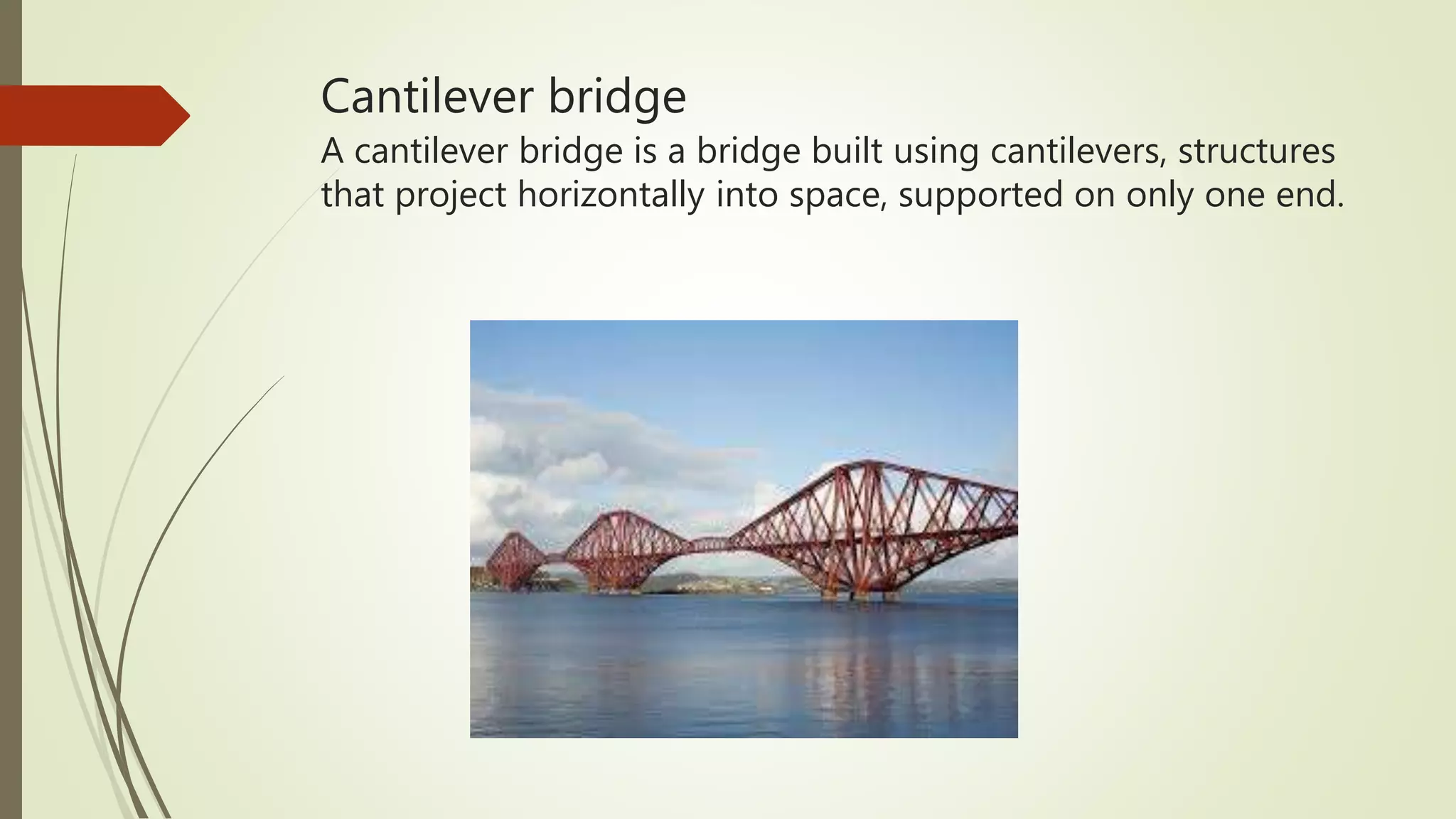
Cantilever bridge
A cantilever bridge is a bridge built using cantilevers, structures
that project horizontally into space, supported on only one end.
Arch bridge
The basic principle of arch bridge is its curved design, which does not
push load forces straight down, but instead they are conveyed along the
curve of the arch to the supports on each end.
Truss bridge
A truss bridge is a bridge whose load-bearing superstructure is composed
of a truss, a structure of connected elements usually forming triangular
units
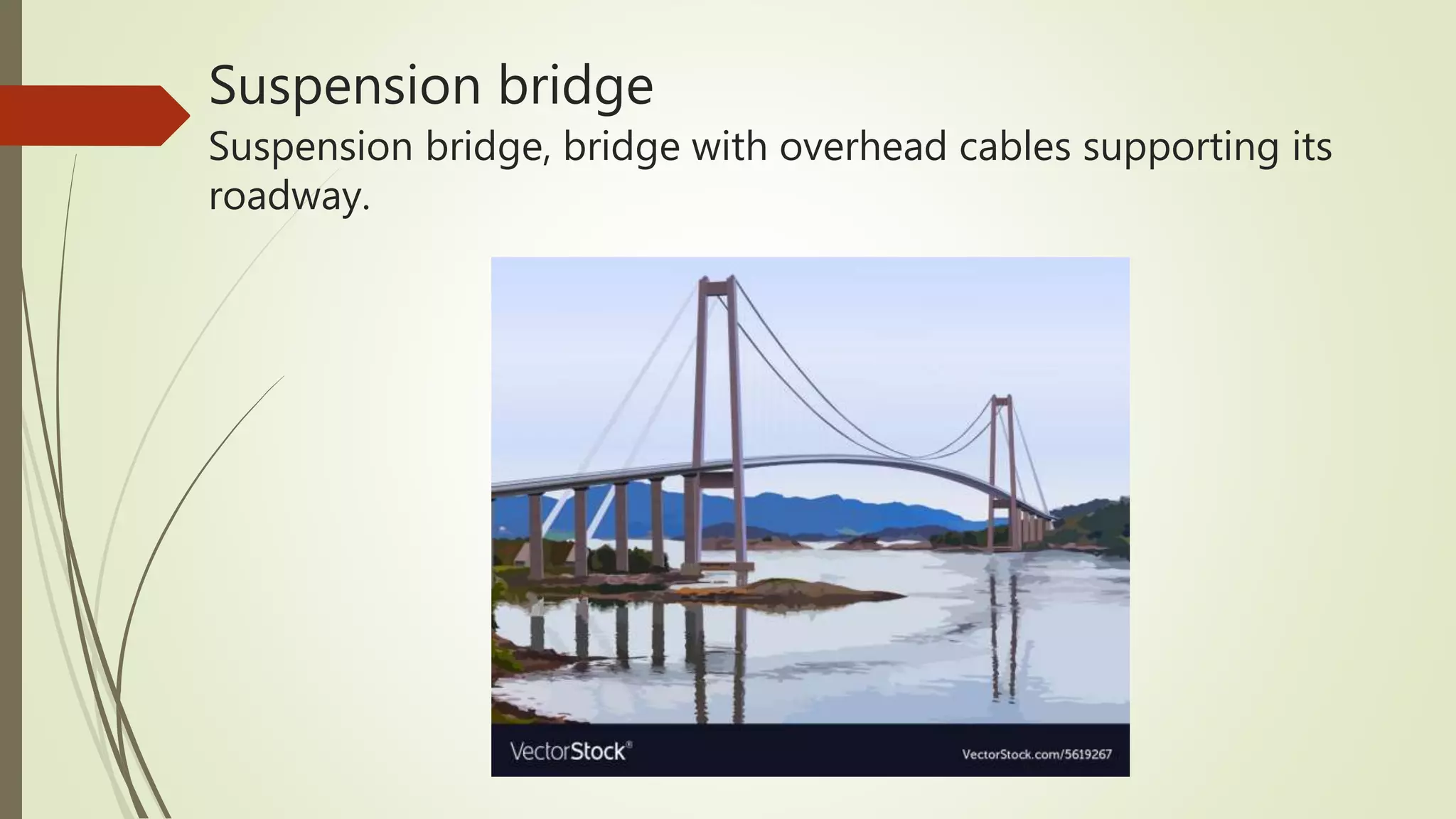
Suspension bridge
Suspension bridge, bridge with overhead cables supporting its
roadway.
Cable stayed bridge
A cable-stayed bridge is a bridge that has one or more columns (called
towers or pylons), with cables directly supporting the bridge deck.
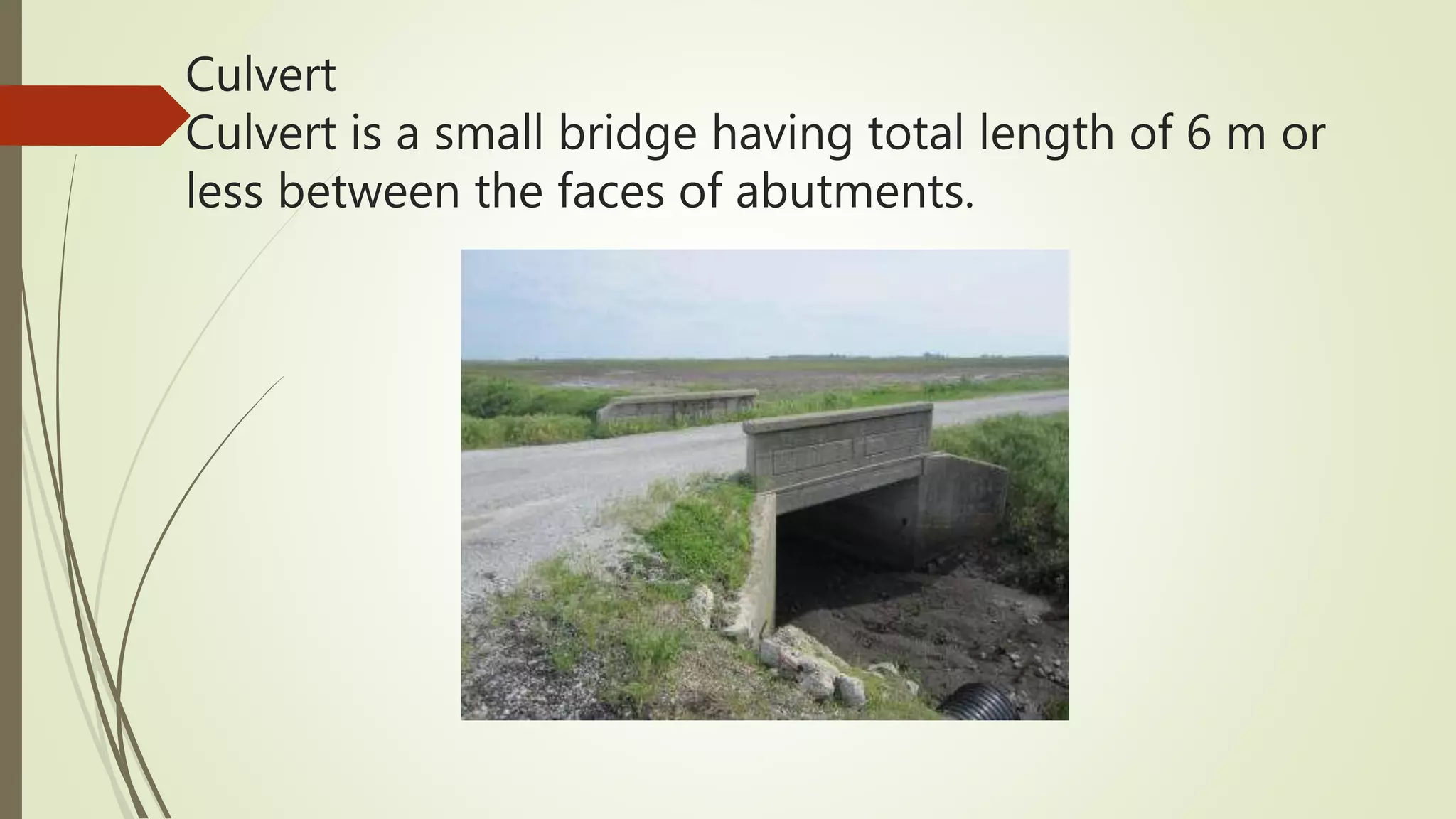
Culvert
Culvert is a small bridge having total length of 6 m or
less between the faces of abutments.
Landmark Bridges in India
Dhola Sadiya bridge 9.15 KM Length
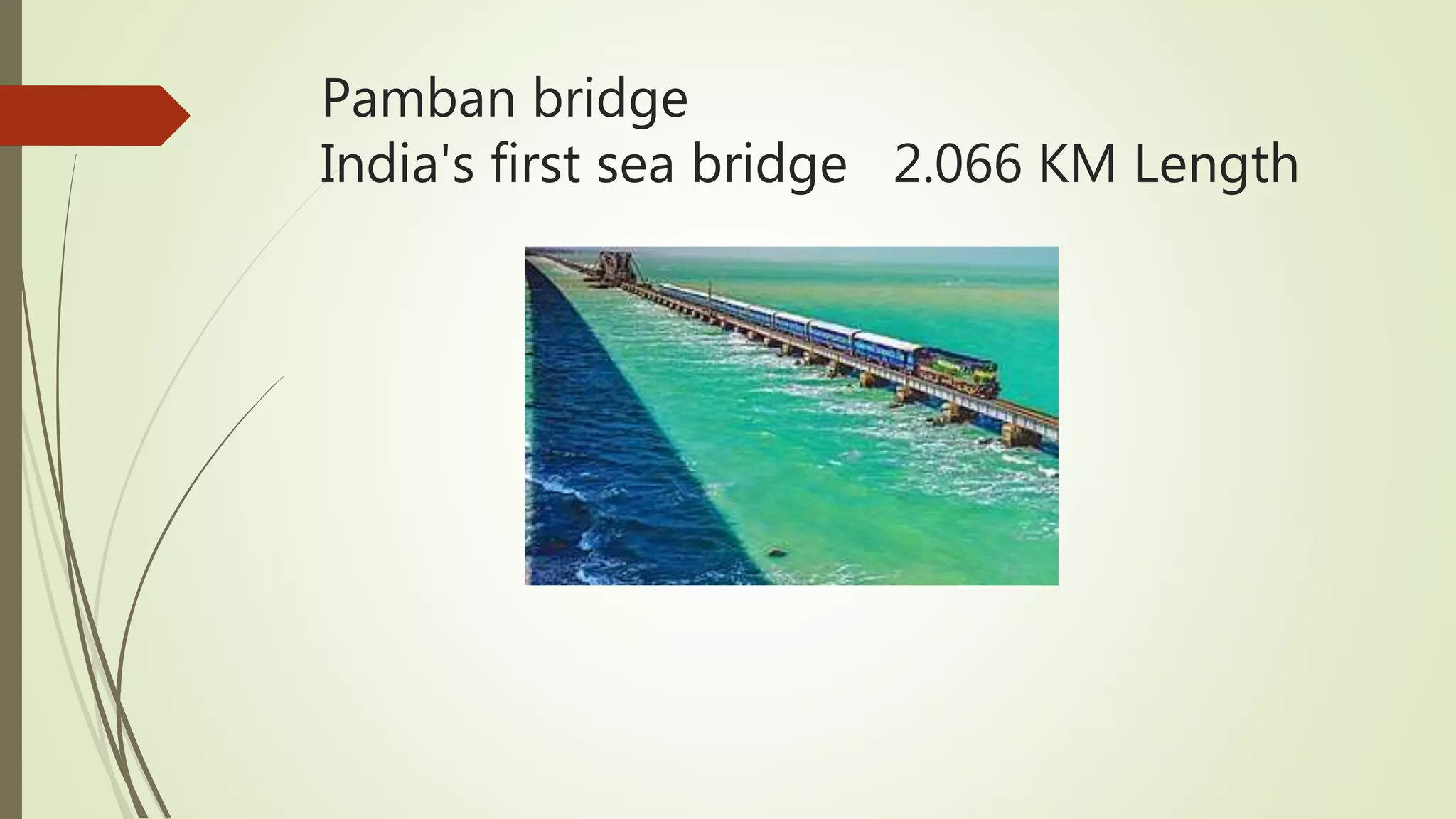
Pamban bridge
India's first sea bridge 2.066 KM Length
Bandra–Worli sea link
5.6 KM Length and 8 lane of traffic
Thanks

Bridge engineering

  • 1.
  • 2.
    Bridge  A bridgeis a structure providing passage over an obstacle without closing the way beneath.  The required passage may be for a road, a railway pedestrian or a canal of a pipeline. The obstacle to be crossed may be river, a road, a railway or a valley.  Bridges are a critical component of a nation’s infrastructure, making it possible to ship raw materials and finished goods to factories, warehouses, suppliers, distributors, stores, and end-consumers.  Reduce travelling time.  Leads easy trade.
  • 3.
    Types of Loadsfor Design of Bridge  Dead load  Live load  Impact load  Wind load  Longitudinal forces  Centrifugal forces  Buoyancy effect  Effect of water current  Thermal effects  Deformation and horizontal effects  Erection stresses  Seismic loads
  • 4.
  • 5.
    Bridge can bedivided into two major parts. 1. Sub structure 2. Super structure
  • 6.
    SUB STRUCTURE  Thefunction of the sub structure is similar to that of foundations, columns and walls of a buildings, because it supports the super structure of the bridges and transmits the load safely to the ground The substructure consists of the following a. Abutments b. Piers c. Wing walls d. Approaches e. Foundations for the piers and abutments  Abutments: The end of superstructure of a bridge is called abutments. Its main functions are  To laterally support the earth work of the embankment of the approaches.  To transmit the load from the bridge superstructure.  To give final formation level to the bridge.
  • 7.
    Piers  Piers arethe intermediate supports for the superstructure. Piers transmit the loads from the superstructure of the bridge to the foundations. A pier essentially consists of a column or shat and a foundation. They may have different configurations as shown in figure. These piers may be constructed with stone masonry or concrete
  • 9.
     Wing walls: These are the walls provided at both ends of the abutments to retain the earth filling of the approach road. They are constructed of the same material as those of the main abutment.  Approaches: The portion of the road constructed to reach the bridge from their general route or height is known as approach of the bridge. The alignment and the level of the approaches mainly depend on the design and layout of the bridge  Foundations for the Piers and Abutments : The foundation of a bridge structure distributes the load from the piers and abutments over the larger area of sub soil. It prevents the tilting and over-turning of the piers and abutments and settlement of the sub soil.
  • 11.
    Super structure The superstructure is that part of the bridge over which the traffic moves with safely. It consists of a. Decking b. Parapet or hand rails, guard stones etc. c. Bearing  Decking : It is provided to allow the road surface to be built in over it. It may consist of a slab, trusses, arches etc.  Parapet or Hand rails, guard stones: These are the protective works provided on both sides of the deck along the roadway in order to safe guard the moving vehicles and the passengers on a bridge. Foot paths are also provided for pedestrians to walk along the bridge. In order to prevent a vehicle from striking the parapet wall of the hand rails, guard stones painted white are provided at the ends of the road surfaces.  Bearing: It is part of the bearing structure provided to distribute the load coming from the superstructure and also to allow for longitudinal and angular movements.
  • 12.
    Classification of bridges Materials used for construction  Function of purpose  Life  Types of superstructure  Span length  Loading
  • 13.
    Based on constructionmaterial  Reinforced concrete  Steel  Timber  Pre stressed  Masonry  Composite
  • 14.
    Function of purpose Highway bridge  Railway bridge  Foot bridge  Viaduct  Aqueduct
  • 15.
  • 16.
    Based on span Length ≤ 6 M Culvert  7M ≤ Length≤ 15M Small span  16 M ≤ Length ≤50M Medium  50 M ≤ Length 150M Large span  L≥ 150 m Extra long span Based on loading  Class AA bridges  Class A bridges  Class B bridges according to the loadings they are designed to carry.
  • 17.
    Based on structure Truss  Cable  Suspension  Arch  Beam  cantilever
  • 18.
    Beam bridge Beam bridgeor girder bridge is the simplest and oldest bridge type. It generally consists of one or more spans which are supported by an abutment or pier at each end.
  • 19.
    Cantilever bridge A cantileverbridge is a bridge built using cantilevers, structures that project horizontally into space, supported on only one end.
  • 20.
    Arch bridge The basicprinciple of arch bridge is its curved design, which does not push load forces straight down, but instead they are conveyed along the curve of the arch to the supports on each end.
  • 21.
    Truss bridge A trussbridge is a bridge whose load-bearing superstructure is composed of a truss, a structure of connected elements usually forming triangular units
  • 22.
    Suspension bridge Suspension bridge,bridge with overhead cables supporting its roadway.
  • 23.
    Cable stayed bridge Acable-stayed bridge is a bridge that has one or more columns (called towers or pylons), with cables directly supporting the bridge deck.
  • 24.
    Culvert Culvert is asmall bridge having total length of 6 m or less between the faces of abutments.
  • 25.
    Landmark Bridges inIndia Dhola Sadiya bridge 9.15 KM Length
  • 26.
    Pamban bridge India's firstsea bridge 2.066 KM Length
  • 27.
    Bandra–Worli sea link 5.6KM Length and 8 lane of traffic
  • 28.