1
BRIDGES AND THEIR TYPES
By
Prof. A. Balasubramanian
Centre for Advanced Studies in Earth
Science,
University of Mysore, Mysore
2
1. Introduction:
A bridge is a man-made structure built to avoid
physical obstacles without closing the way
underneath such as a body of water, valley, or
road. It is constructed for the purpose of
providing passage over the obstacle. The first
bridges made by humans were probably spans
of cut wooden logs or planks and eventually
stones, using a simple support
and crossbeam arrangement.
3
The Romans built arch bridges and aqueducts.
The Romans also used cement, which reduced
the variation of strength found in natural stone.
Designs of bridges vary depending on the
function of the bridge, the nature of the terrain
where the bridge is constructed and anchored,
the material used to make it, and the funds
available to build it.
4
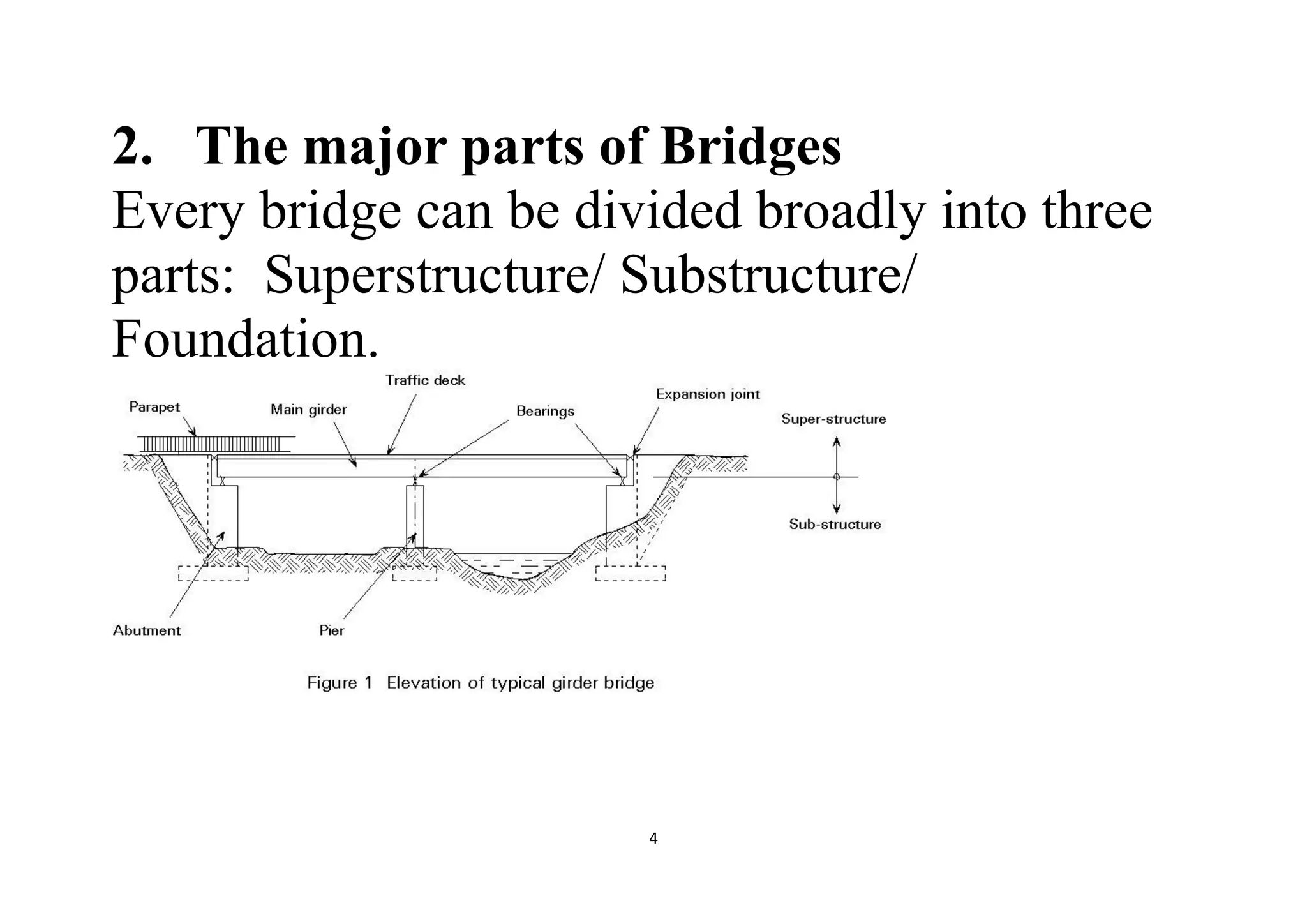
2. The major parts of Bridges
Every bridge can be divided broadly into three
parts: Superstructure/ Substructure/
Foundation.
5
Superstructure: Superstructure that part of
the structure which supports traffic and includes
deck, slab and girders. All the parts of the
bridge which is mounted on a supporting
system can be classified as a Super structure.
Substructure: Substructure that part of the
structure, ie piers and abutments, which
supports the superstructure and which transfers
the structural load to the foundations.
6
Foundation: Foundation is the component
which transfers loads from the substructure to
the bearing strata.
Depending on the geotechnical properties of the
bearing strata, shallow or deep foundations are
adopted. Usually, piles and well foundations are
adopted for bridge foundations.
7
Span - the distance between two bridge
supports, whether they are columns, towers or
the wall of a canyon.
Deck is bridge floor directly carrying traffic
loads.
Deck transfers loads to the Girders depending
on the decking material.
Beam - a rigid, usually horizontal, structural
element.
8
Beam / Girder:
Beam or girder is that part of superstructure
which is under bending along the span. It is the
load bearing part which supports the deck.
Bearing : Bearing transfers loads from the
girders to the pier caps.
Pier - a vertical supporting structure, such as a
pillar.
9
Pier Cap / Headstock:
Pier Cap / Headstock is the component which
transfers loads from the superstructure to the
piers. Pier cap provide sufficient seating for the
Bridge girders.
Cantilever - a projecting structure supported
only at one end, like a shelf bracket or a diving
board.
10
Truss - a rigid frame composed of short,
straight pieces joined to form a series of
triangles or other stable shapes.
Pile cap and Piles:
Pile foundation is the most commonly used
foundation system for bridges. Pile is a slender
compression member driven into or formed in
the ground to resist loads.
11
A reinforced concrete mass cast around the head
of a group of piles to ensure they act together
and distribute the load among them it is known
as pile cap.
3. Factors which will affect bridge
structure are:
Forces/ Loads/Materials/Shapes .
Force - any action that tends to maintain or
alter the position of a structure.
12
Compression - a force which acts to compress
or shorten the thing it is acting on.
Tension - a force which acts to expand or
lengthen the thing it is acting on.
Load - weight distribution throughout a
structure.
Stable - (adj.) ability to resist collapse and
deformation; stability (n.) characteristic of a
structure that is able to carry a realistic load
without collapsing or deforming significantly.
13
Deform - to change shape.
Buckling is what happens when the force of
compression overcomes an object's ability to
handle compression.
4. Types of Bridges:
All bridges are designed to allow loads to cross
obstacles. These obstacles may rivers, valleys or
lakes. Generally the loads will either be
vehicular traffic, pedestrians or animals.
14
There are four basic types of bridges.
These are Beam bridges, Arch bridges,
Cantilever bridges and Suspension bridges.
Bridges can twist or bend under severe weather
conditions which can have disastrous
consequences. In order to prevent this from
happening bridges must be stiff enough to resist
this movement and each member from which
the bridge is made must be strong enough to
withstand the load which is placed upon it.
15
Bridges can be categorized in several different
ways. Common categories include the type of
structural elements used, by what they carry,
whether they are fixed or movable, and by the
materials used.
Fixed or moveable bridges
Fixed –
Most bridges are fixed bridges, meaning they
have no moving parts and stay in one place until
they fail or are demolished.
16
They are designed to stay where they are made
to the point they are deemed unusable or
demolished.
Temporary bridges –
Bridges made from modular basic components
that can be moved by medium or light
machinery. They are usually used in military
engineering or in circumstances when fixed
bridges are repaired.
17
Moveable –
They have moveable decks, most often powered
by electricity.
Classification of bridges based on structures:
Bridges may be classified by how the forces of
tension, compression, bending, torsion and
shear are distributed through their structure.
18
ARCH
BEAM TRUSS
CANTILEVER SUSPENSION
BRIDGE
ROVING
BRIDGE
19
Bridges by Structure
1. Arch bridges –
Arch bridges have abutments at each end. The
weight of the bridge is thrust into the abutments
at either side.
The earliest known arch bridges were built by
the Greeks.
20
These bridges uses arch as a main structural
component (arch is always located below the
bridge, never above it). They are made with one
or more hinges, depending of what kind of load
and stress forces they must endure.
The arch bridge has great natural strength.
Thousands of years ago, Romans built arches
out of stone.
21
Today, most arch bridges are made of steel or
concrete, and they can span up to 800 feet.
They are often chosen for their strength and
appearance.
Forces: the compressive forces created by the
load are transferred down through the arch and
resisted by the supports, or abutments, at its
base. Abutment support prevents the arch
spreading under load.
22
Advantages: they are very strong and can be
built from a wide range of materials.
Disadvantages: limited spans unless multiple
arches (or viaducts) are used and uneconomical
use of materials.
2. Beam bridges are the oldest and simplest
bridge design consisting of vertical piers and
horizontal beams - e.g. just a simple plank or
stone slab.
23
They are suitable only for short spans but can
used for larger crossings by adding additional
piers.
Forces: As the bridge is loaded, by traffic for
example, the beam bends which causes the top
surface to be compressed and the bottom
surface to be stretched or put in tension.
24
Advantages: they are easy to build and
inexpensive relative to other bridge types so are
very common.
Disadvantages: they have a limited span and
do not allow large boats or vehicles to pass
underneath.
3. The truss bridge consists of an assembly of
triangles. Truss bridges are commonly made
from a series of straight, steel bars.
25
Rigid arms extend from both sides of two piers.
Diagonal steel tubes, projecting from the top
and bottom of each pier, hold the arms in place.
The arms that project toward the middle are
only supported on one side, like really strong
diving boards. These "diving boards," called
cantilever arms, support a third, central span.
26
Truss Bridges are structures built up by
jointing together lengths of material to form an
open framework - based mainly on triangles
because of their rigidity. They are very strong
and can support heavy loads.
Forces: As with a Beam Bridge the top of a
loaded truss is placed in compression and
bottom in tension. These forces are shared
among the angled members.
27
Advantages:They are very strong and make
efficient use of materials.
Disadantages:They are more complex to
construct and need a high level of maintenance.
4. Cantilever bridges are based on structures
that project horizontally into space, supported at
only one end - like a spring board.
Forces: if two cantilevers project out from a
central pier the forces are balanced.
28
Advantages: more easily constructed at
difficult crossings by virtue of using little or no
falsework.
Disadvantages: complex structures and can be
dificult to maintain.
Tied arch bridges
Arch bridges have abutments at each end. The
weight of the bridge is thrust into the abutments
at either side.
29
The earliest known arch bridges were built by
the Greeks.
These are similar to arch bridges, but they
transfer weight of the bridge and traffic load to
the top chord that is connected to the bottom
cords in bridge foundation.
They are often called bowstring arches or
bowstring bridges.
30
5. Suspension bridges main elements are a pair
of main suspension cables stretching over two
towers and attached at each end to an anchor
buried deep in the ground.
Smaller vertical suspender cables are attached
to the main cables to support the deck below.
Forces: any load applied to the bridge is
transformed into a tension in the main cables
which have to be firmly anchored to resist it.
31
Advantages: strong and can span long
distances such as across rivers.
Disadvantages: expensive and complex to
build.
6. Cable-stayed bridges may appear to be
similar to suspension bridges, but in fact they
are quite different in principle and in their
construction.
32
There are two major classes of cable-stayed
bridges: Fan type, which are the most efficient,
and Harp or parallel type, which allow more
space for the fixings.
Forces: As traffic pushes down on the roadway,
the cables, to which the roadway is attached,
transfer the load to the towers, putting them in
compression. Tension is constantly acting on
the cables, which are stretched because they are
attached to the roadway.
33
Advantages: good for medium spans, greater
stiffness than the suspension bridge, can be
constructed by cantilevering out from the tower,
horizontal forces balance so large ground
anchorages are not required.
Disadvantages: typically more expensive than
other types of bridge, except suspension
bridges.
34
7. ROVING BRIDGE
A roving bridge, changeline bridge
or turnover bridge is a bridge over a canal
constructed to allow a horse towing a boat to
cross the canal when the towpath changes
sides.
35
Types of Bridges by use :
 Car Traffic bridge– The most common type
of bridge, with two or more lanes designed to
carry car and truck traffic of various
intensities.
 Pedestrian bridge – Usually made in urban
environments, or in terrain where car
transport is inaccessible (rough mountainous
terrain, forests, etc.).
36
 Double-decked bridge– Built to provide best
possible flow of traffic across bodies of water
or rough terrain. Most offen they have large
amount of car lanes, and sometimes have
dedicated area for train tracks.
 Train bridges – Bridges made specifically to
carry one or multiple lane of train tracks.
 Pipelines – Bridges made to carry pipelines
across water or inaccessible terrains.
37
Pipelines can carry water, air, gas and
communication cables.
 Viaducts – A viaduct is made up of multiple
bridges connected into one longer
structure. Ancient structures created to carry
water from water rich areas to dry cities.
 Commercial bridges – Modern bridges that
host commercial buildings such as restaurants
and shops.
38
Types of Bridges by materials used:
 Natural materials
 Wood
 Stone
 Concrete and Steel
 Advanced materials

Bridges and their types

  • 1.
    1 BRIDGES AND THEIRTYPES By Prof. A. Balasubramanian Centre for Advanced Studies in Earth Science, University of Mysore, Mysore
  • 2.
    2 1. Introduction: A bridgeis a man-made structure built to avoid physical obstacles without closing the way underneath such as a body of water, valley, or road. It is constructed for the purpose of providing passage over the obstacle. The first bridges made by humans were probably spans of cut wooden logs or planks and eventually stones, using a simple support and crossbeam arrangement.
  • 3.
    3 The Romans builtarch bridges and aqueducts. The Romans also used cement, which reduced the variation of strength found in natural stone. Designs of bridges vary depending on the function of the bridge, the nature of the terrain where the bridge is constructed and anchored, the material used to make it, and the funds available to build it.
  • 4.
    4 2. The majorparts of Bridges Every bridge can be divided broadly into three parts: Superstructure/ Substructure/ Foundation.
  • 5.
    5 Superstructure: Superstructure thatpart of the structure which supports traffic and includes deck, slab and girders. All the parts of the bridge which is mounted on a supporting system can be classified as a Super structure. Substructure: Substructure that part of the structure, ie piers and abutments, which supports the superstructure and which transfers the structural load to the foundations.
  • 6.
    6 Foundation: Foundation isthe component which transfers loads from the substructure to the bearing strata. Depending on the geotechnical properties of the bearing strata, shallow or deep foundations are adopted. Usually, piles and well foundations are adopted for bridge foundations.
  • 7.
    7 Span - thedistance between two bridge supports, whether they are columns, towers or the wall of a canyon. Deck is bridge floor directly carrying traffic loads. Deck transfers loads to the Girders depending on the decking material. Beam - a rigid, usually horizontal, structural element.
  • 8.
    8 Beam / Girder: Beamor girder is that part of superstructure which is under bending along the span. It is the load bearing part which supports the deck. Bearing : Bearing transfers loads from the girders to the pier caps. Pier - a vertical supporting structure, such as a pillar.
  • 9.
    9 Pier Cap /Headstock: Pier Cap / Headstock is the component which transfers loads from the superstructure to the piers. Pier cap provide sufficient seating for the Bridge girders. Cantilever - a projecting structure supported only at one end, like a shelf bracket or a diving board.
  • 10.
    10 Truss - arigid frame composed of short, straight pieces joined to form a series of triangles or other stable shapes. Pile cap and Piles: Pile foundation is the most commonly used foundation system for bridges. Pile is a slender compression member driven into or formed in the ground to resist loads.
  • 11.
    11 A reinforced concretemass cast around the head of a group of piles to ensure they act together and distribute the load among them it is known as pile cap. 3. Factors which will affect bridge structure are: Forces/ Loads/Materials/Shapes . Force - any action that tends to maintain or alter the position of a structure.
  • 12.
    12 Compression - aforce which acts to compress or shorten the thing it is acting on. Tension - a force which acts to expand or lengthen the thing it is acting on. Load - weight distribution throughout a structure. Stable - (adj.) ability to resist collapse and deformation; stability (n.) characteristic of a structure that is able to carry a realistic load without collapsing or deforming significantly.
  • 13.
    13 Deform - tochange shape. Buckling is what happens when the force of compression overcomes an object's ability to handle compression. 4. Types of Bridges: All bridges are designed to allow loads to cross obstacles. These obstacles may rivers, valleys or lakes. Generally the loads will either be vehicular traffic, pedestrians or animals.
  • 14.
    14 There are fourbasic types of bridges. These are Beam bridges, Arch bridges, Cantilever bridges and Suspension bridges. Bridges can twist or bend under severe weather conditions which can have disastrous consequences. In order to prevent this from happening bridges must be stiff enough to resist this movement and each member from which the bridge is made must be strong enough to withstand the load which is placed upon it.
  • 15.
    15 Bridges can becategorized in several different ways. Common categories include the type of structural elements used, by what they carry, whether they are fixed or movable, and by the materials used. Fixed or moveable bridges Fixed – Most bridges are fixed bridges, meaning they have no moving parts and stay in one place until they fail or are demolished.
  • 16.
    16 They are designedto stay where they are made to the point they are deemed unusable or demolished. Temporary bridges – Bridges made from modular basic components that can be moved by medium or light machinery. They are usually used in military engineering or in circumstances when fixed bridges are repaired.
  • 17.
    17 Moveable – They havemoveable decks, most often powered by electricity. Classification of bridges based on structures: Bridges may be classified by how the forces of tension, compression, bending, torsion and shear are distributed through their structure.
  • 18.
  • 19.
    19 Bridges by Structure 1.Arch bridges – Arch bridges have abutments at each end. The weight of the bridge is thrust into the abutments at either side. The earliest known arch bridges were built by the Greeks.
  • 20.
    20 These bridges usesarch as a main structural component (arch is always located below the bridge, never above it). They are made with one or more hinges, depending of what kind of load and stress forces they must endure. The arch bridge has great natural strength. Thousands of years ago, Romans built arches out of stone.
  • 21.
    21 Today, most archbridges are made of steel or concrete, and they can span up to 800 feet. They are often chosen for their strength and appearance. Forces: the compressive forces created by the load are transferred down through the arch and resisted by the supports, or abutments, at its base. Abutment support prevents the arch spreading under load.
  • 22.
    22 Advantages: they arevery strong and can be built from a wide range of materials. Disadvantages: limited spans unless multiple arches (or viaducts) are used and uneconomical use of materials. 2. Beam bridges are the oldest and simplest bridge design consisting of vertical piers and horizontal beams - e.g. just a simple plank or stone slab.
  • 23.
    23 They are suitableonly for short spans but can used for larger crossings by adding additional piers. Forces: As the bridge is loaded, by traffic for example, the beam bends which causes the top surface to be compressed and the bottom surface to be stretched or put in tension.
  • 24.
    24 Advantages: they areeasy to build and inexpensive relative to other bridge types so are very common. Disadvantages: they have a limited span and do not allow large boats or vehicles to pass underneath. 3. The truss bridge consists of an assembly of triangles. Truss bridges are commonly made from a series of straight, steel bars.
  • 25.
    25 Rigid arms extendfrom both sides of two piers. Diagonal steel tubes, projecting from the top and bottom of each pier, hold the arms in place. The arms that project toward the middle are only supported on one side, like really strong diving boards. These "diving boards," called cantilever arms, support a third, central span.
  • 26.
    26 Truss Bridges arestructures built up by jointing together lengths of material to form an open framework - based mainly on triangles because of their rigidity. They are very strong and can support heavy loads. Forces: As with a Beam Bridge the top of a loaded truss is placed in compression and bottom in tension. These forces are shared among the angled members.
  • 27.
    27 Advantages:They are verystrong and make efficient use of materials. Disadantages:They are more complex to construct and need a high level of maintenance. 4. Cantilever bridges are based on structures that project horizontally into space, supported at only one end - like a spring board. Forces: if two cantilevers project out from a central pier the forces are balanced.
  • 28.
    28 Advantages: more easilyconstructed at difficult crossings by virtue of using little or no falsework. Disadvantages: complex structures and can be dificult to maintain. Tied arch bridges Arch bridges have abutments at each end. The weight of the bridge is thrust into the abutments at either side.
  • 29.
    29 The earliest knownarch bridges were built by the Greeks. These are similar to arch bridges, but they transfer weight of the bridge and traffic load to the top chord that is connected to the bottom cords in bridge foundation. They are often called bowstring arches or bowstring bridges.
  • 30.
    30 5. Suspension bridgesmain elements are a pair of main suspension cables stretching over two towers and attached at each end to an anchor buried deep in the ground. Smaller vertical suspender cables are attached to the main cables to support the deck below. Forces: any load applied to the bridge is transformed into a tension in the main cables which have to be firmly anchored to resist it.
  • 31.
    31 Advantages: strong andcan span long distances such as across rivers. Disadvantages: expensive and complex to build. 6. Cable-stayed bridges may appear to be similar to suspension bridges, but in fact they are quite different in principle and in their construction.
  • 32.
    32 There are twomajor classes of cable-stayed bridges: Fan type, which are the most efficient, and Harp or parallel type, which allow more space for the fixings. Forces: As traffic pushes down on the roadway, the cables, to which the roadway is attached, transfer the load to the towers, putting them in compression. Tension is constantly acting on the cables, which are stretched because they are attached to the roadway.
  • 33.
    33 Advantages: good formedium spans, greater stiffness than the suspension bridge, can be constructed by cantilevering out from the tower, horizontal forces balance so large ground anchorages are not required. Disadvantages: typically more expensive than other types of bridge, except suspension bridges.
  • 34.
    34 7. ROVING BRIDGE Aroving bridge, changeline bridge or turnover bridge is a bridge over a canal constructed to allow a horse towing a boat to cross the canal when the towpath changes sides.
  • 35.
    35 Types of Bridgesby use :  Car Traffic bridge– The most common type of bridge, with two or more lanes designed to carry car and truck traffic of various intensities.  Pedestrian bridge – Usually made in urban environments, or in terrain where car transport is inaccessible (rough mountainous terrain, forests, etc.).
  • 36.
    36  Double-decked bridge–Built to provide best possible flow of traffic across bodies of water or rough terrain. Most offen they have large amount of car lanes, and sometimes have dedicated area for train tracks.  Train bridges – Bridges made specifically to carry one or multiple lane of train tracks.  Pipelines – Bridges made to carry pipelines across water or inaccessible terrains.
  • 37.
    37 Pipelines can carrywater, air, gas and communication cables.  Viaducts – A viaduct is made up of multiple bridges connected into one longer structure. Ancient structures created to carry water from water rich areas to dry cities.  Commercial bridges – Modern bridges that host commercial buildings such as restaurants and shops.
  • 38.
    38 Types of Bridgesby materials used:  Natural materials  Wood  Stone  Concrete and Steel  Advanced materials