Level 0 Diploma in Enter Title Here
© 2013 City and Guilds of London Institute. All rights reserved. 1 of 12
Level 1 Diploma in Bricklaying
PowerPointpresentation
Tools
Unit 102: Contribute to setting out and building
masonry structures up to damp proof course
Level 0 Diploma in Enter Title Here
© 2013 City and Guilds of London Institute. All rights reserved. 2 of 12
Level 1 Diploma in Bricklaying
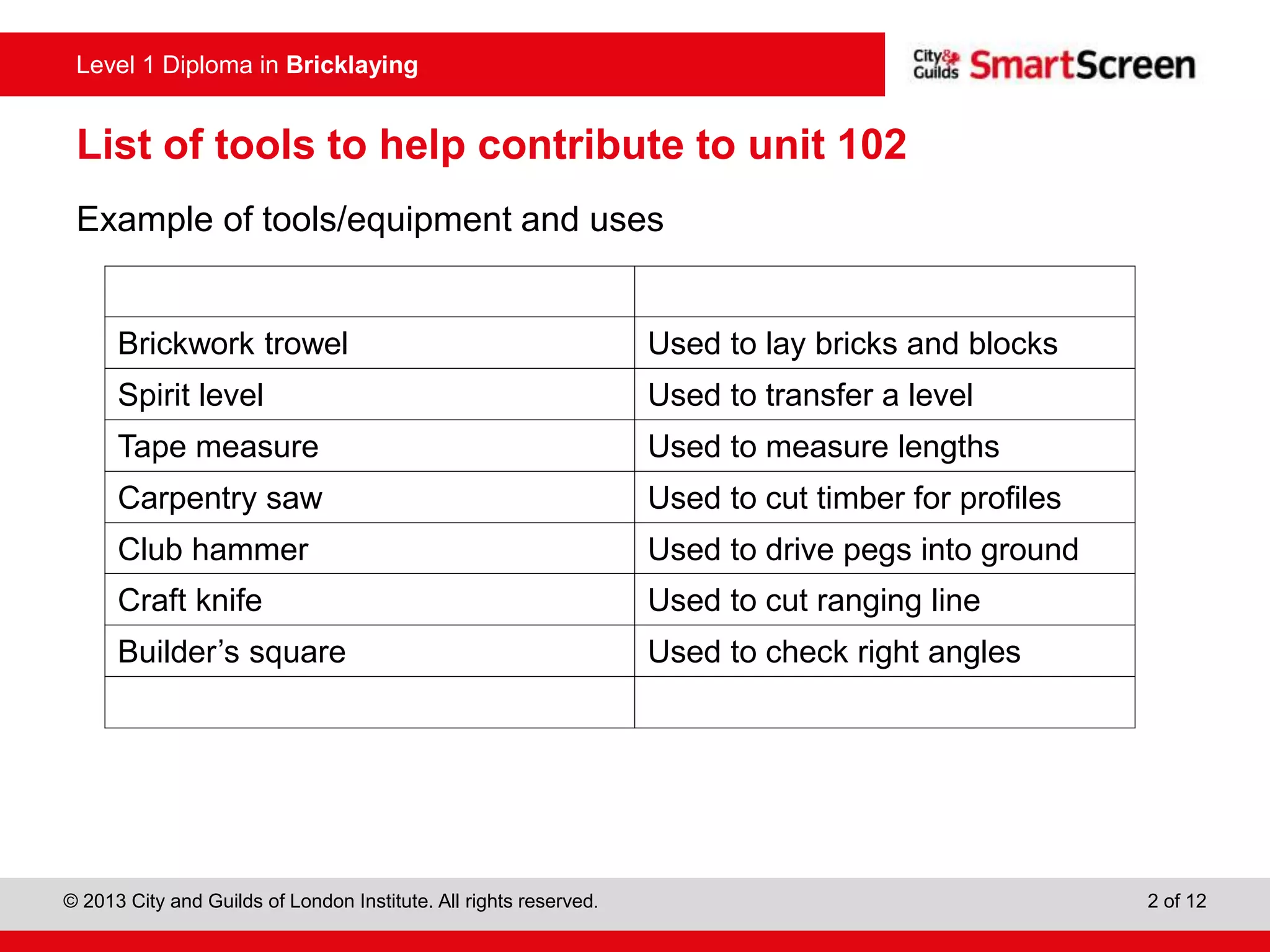
List of tools to help contribute to unit 102
Example of tools/equipment and uses
Brickwork trowel
Brickwork trowel Used to lay bricks and blocks
Spirit level Used to transfer a level
Tape measure Used to measure lengths
Carpentry saw Used to cut timber for profiles
Club hammer Used to drive pegs into ground
Craft knife Used to cut ranging line
Builder’s square Used to check right angles
Level 0 Diploma in Enter Title Here
© 2013 City and Guilds of London Institute. All rights reserved. 3 of 12
Level 1 Diploma in Bricklaying
Bricklaying and blocklaying trowel
The most common form of
laying trowel is the 250mm
long-bladed.
This trowel is suitable for
laying the bed and perpend
for all brickwork and
blockwork.
Level 0 Diploma in Enter Title Here
© 2013 City and Guilds of London Institute. All rights reserved. 4 of 12
Level 1 Diploma in Bricklaying
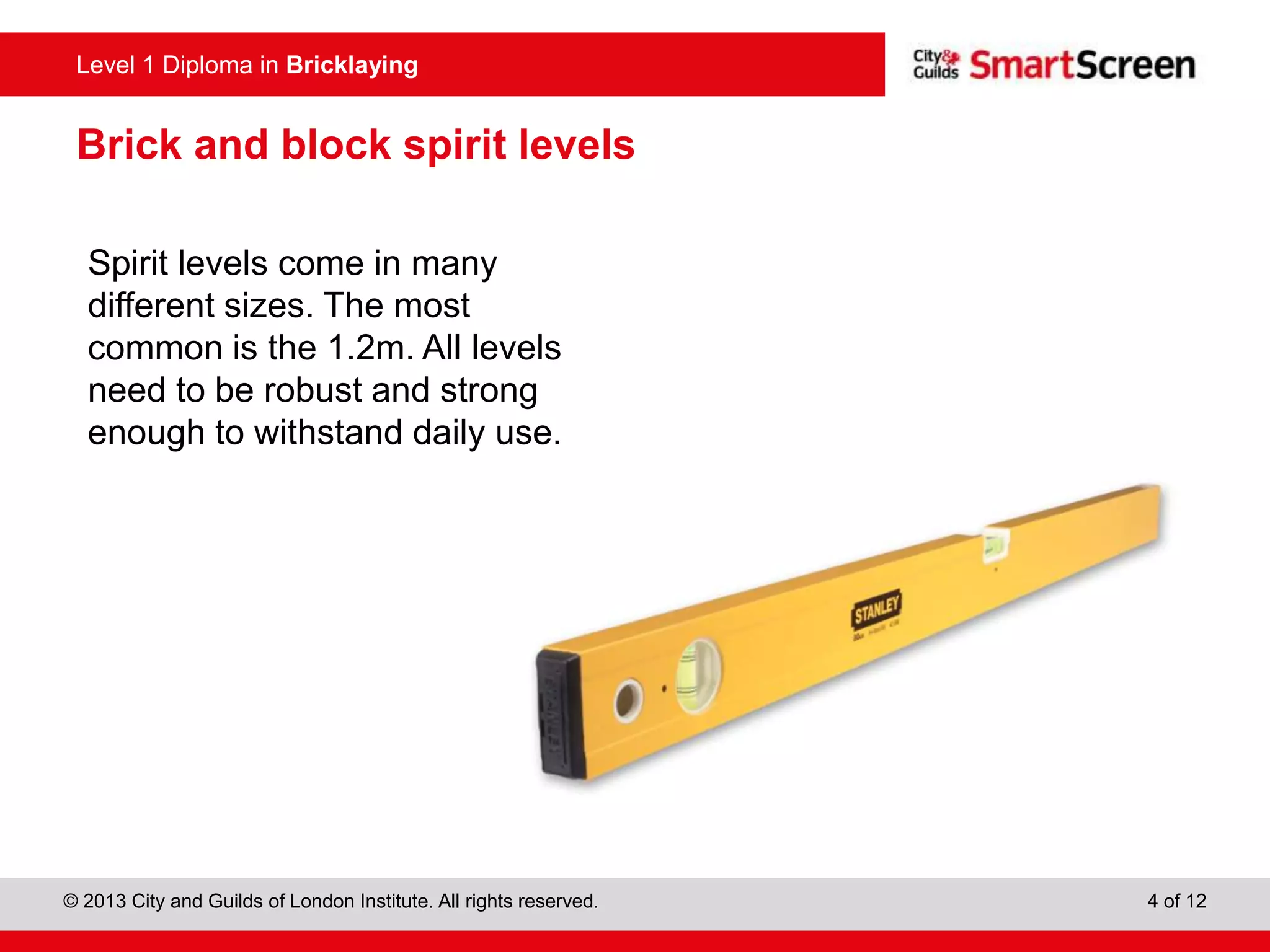
Brick and block spirit levels
Spirit levels come in many
different sizes. The most
common is the 1.2m. All levels
need to be robust and strong
enough to withstand daily use.
Level 0 Diploma in Enter Title Here
© 2013 City and Guilds of London Institute. All rights reserved. 5 of 12
Level 1 Diploma in Bricklaying
Brick and block hammers (1)
A club hammer is the one
hammer that will provide enough
weight to cut both bricks and
blocks.
Club hammers must be used in
conjunction with a brick bolster.
Level 0 Diploma in Enter Title Here
© 2013 City and Guilds of London Institute. All rights reserved. 6 of 12
Level 1 Diploma in Bricklaying
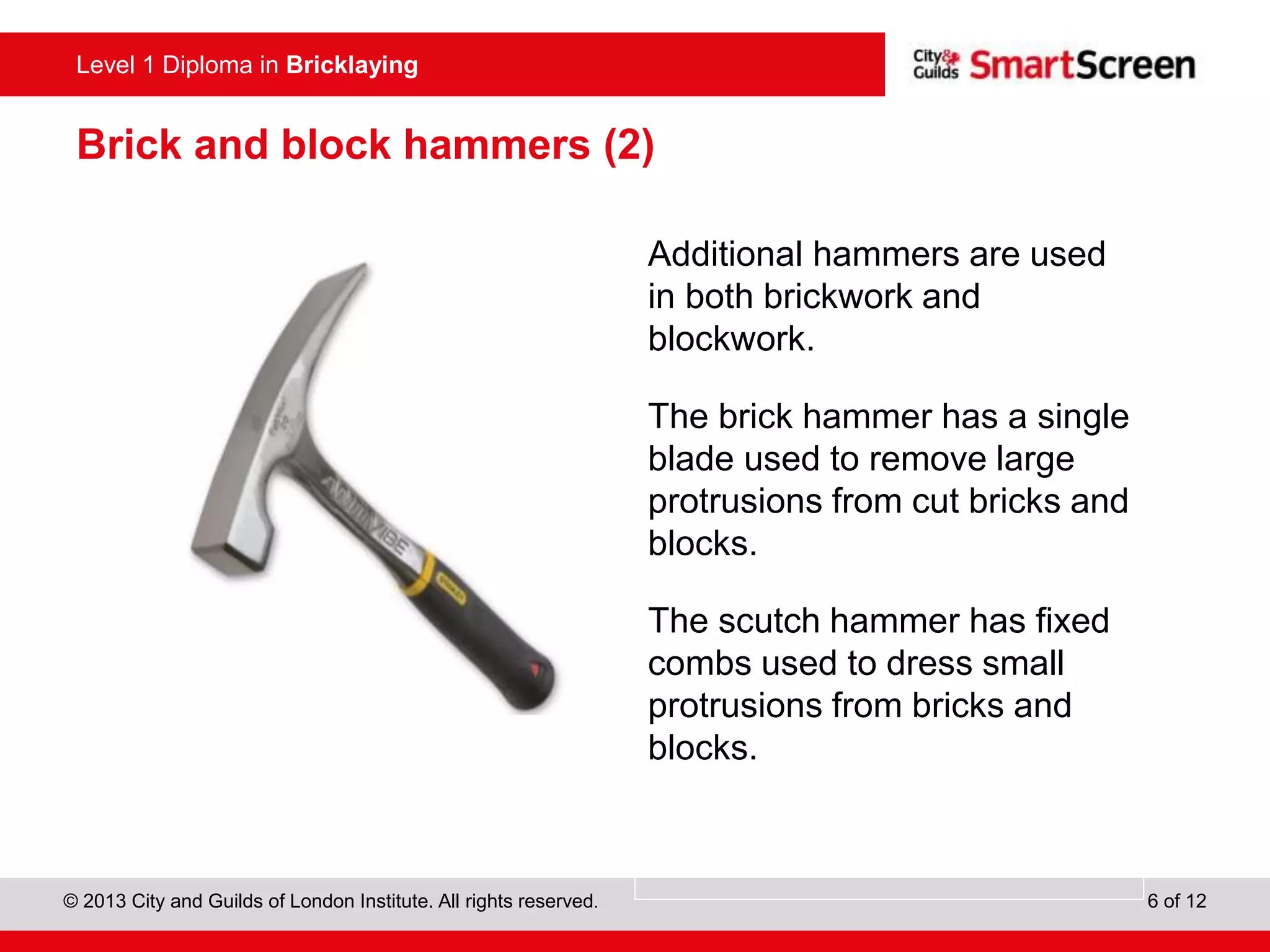
Brick and block hammers (2)
Additional hammers are used
in both brickwork and
blockwork.
The brick hammer has a single
blade used to remove large
protrusions from cut bricks and
blocks.
The scutch hammer has fixed
combs used to dress small
protrusions from bricks and
blocks.
Level 0 Diploma in Enter Title Here
© 2013 City and Guilds of London Institute. All rights reserved. 7 of 12
Level 1 Diploma in Bricklaying
Tape measure and craft knife
Tape measures come in
many different sizes.
Setting out, on the whole,
is carried out using 5m,
8m, and up to 30m tapes.
Craft knives must be
retractable for safety. This
knife is used to cut
ranging lines.
Level 0 Diploma in Enter Title Here
© 2013 City and Guilds of London Institute. All rights reserved. 8 of 12
Level 1 Diploma in Bricklaying
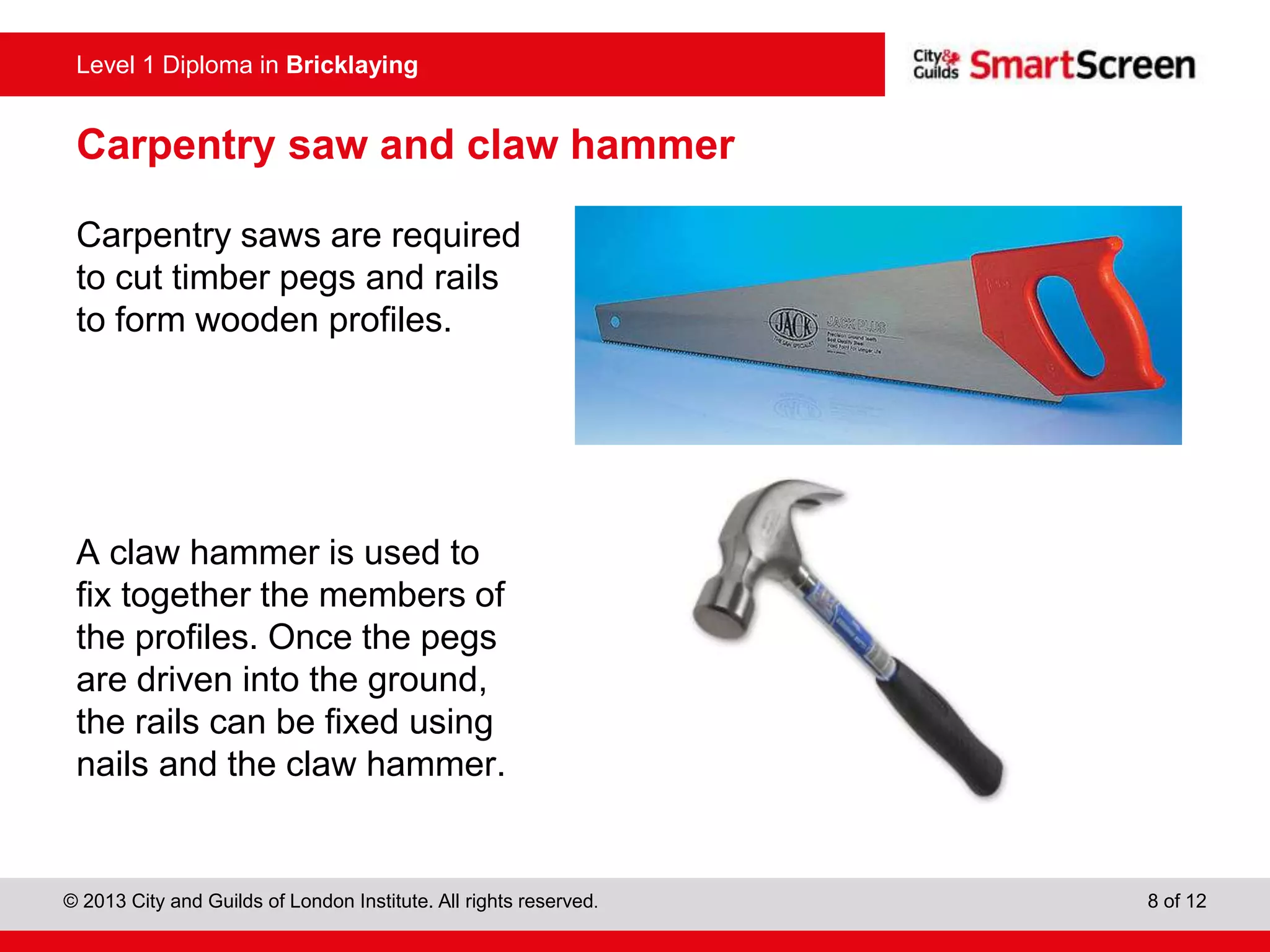
Carpentry saw and claw hammer
Carpentry saws are required
to cut timber pegs and rails
to form wooden profiles.
A claw hammer is used to
fix together the members of
the profiles. Once the pegs
are driven into the ground,
the rails can be fixed using
nails and the claw hammer.
Level 0 Diploma in Enter Title Here
© 2013 City and Guilds of London Institute. All rights reserved. 9 of 12
Level 1 Diploma in Bricklaying
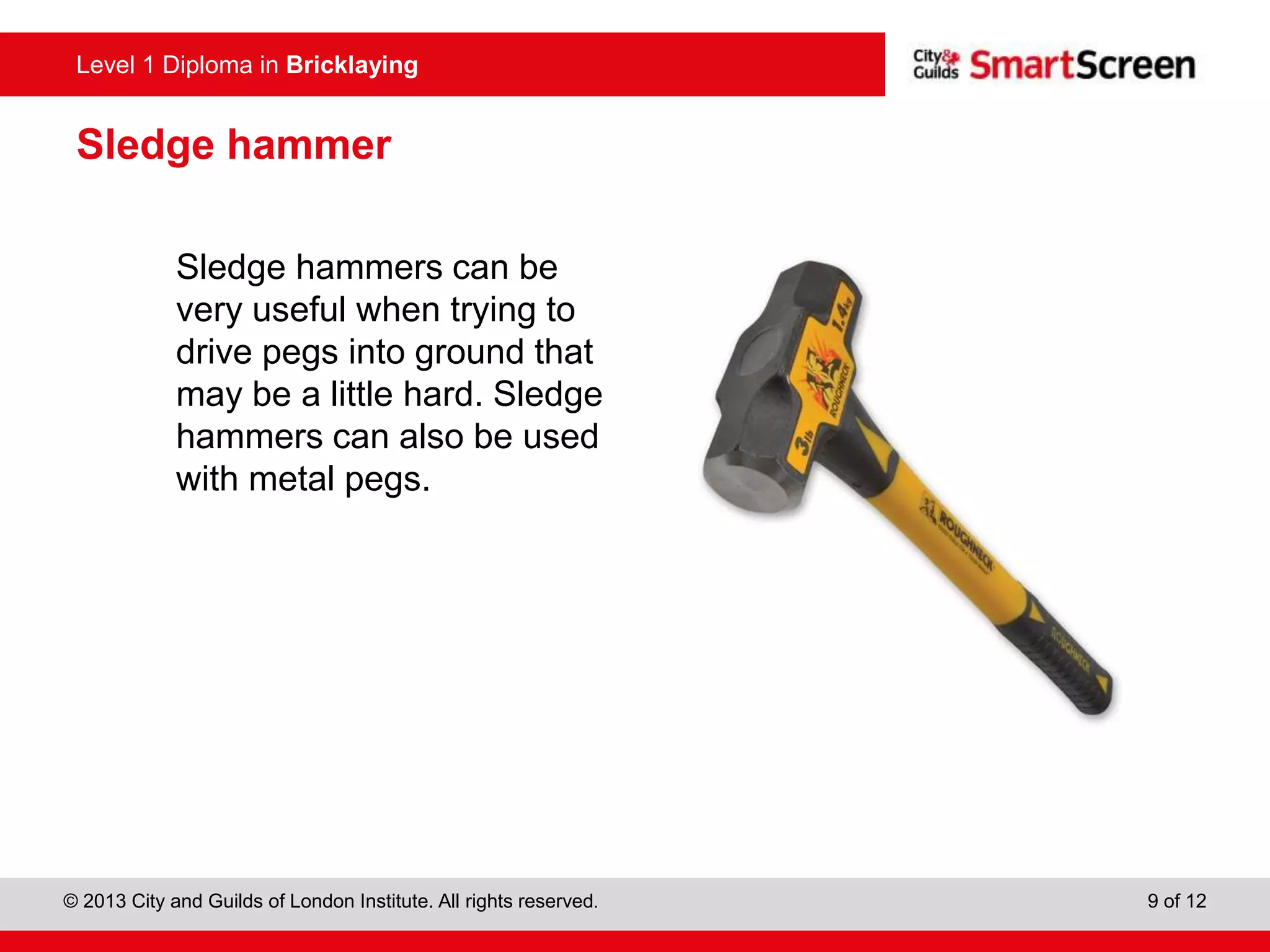
Sledge hammer
Sledge hammers can be
very useful when trying to
drive pegs into ground that
may be a little hard. Sledge
hammers can also be used
with metal pegs.
Level 0 Diploma in Enter Title Here
© 2013 City and Guilds of London Institute. All rights reserved. 10 of 12
Level 1 Diploma in Bricklaying
Bolster
A brick or block bolster is
used to cut both items.
The bolster is used with
a club hammer. A tip to
remember is that the
blade must be the same
width as the bricks or
blocks it is cutting.
Level 0 Diploma in Enter Title Here
© 2013 City and Guilds of London Institute. All rights reserved. 11 of 12
Level 1 Diploma in Bricklaying
Line and pins
A line and pins are very useful
to help maintain level.
Plastic corner blocks are great
for fixing a ready at hand line
on a wall.
Level 0 Diploma in Enter Title Here
© 2013 City and Guilds of London Institute. All rights reserved. 12 of 12
Level 1 Diploma in Bricklaying
Any questions?

Bricklaying Tools

  • 1.
    Level 0 Diplomain Enter Title Here © 2013 City and Guilds of London Institute. All rights reserved. 1 of 12 Level 1 Diploma in Bricklaying PowerPointpresentation Tools Unit 102: Contribute to setting out and building masonry structures up to damp proof course
  • 2.
    Level 0 Diplomain Enter Title Here © 2013 City and Guilds of London Institute. All rights reserved. 2 of 12 Level 1 Diploma in Bricklaying List of tools to help contribute to unit 102 Example of tools/equipment and uses Brickwork trowel Brickwork trowel Used to lay bricks and blocks Spirit level Used to transfer a level Tape measure Used to measure lengths Carpentry saw Used to cut timber for profiles Club hammer Used to drive pegs into ground Craft knife Used to cut ranging line Builder’s square Used to check right angles
  • 3.
    Level 0 Diplomain Enter Title Here © 2013 City and Guilds of London Institute. All rights reserved. 3 of 12 Level 1 Diploma in Bricklaying Bricklaying and blocklaying trowel The most common form of laying trowel is the 250mm long-bladed. This trowel is suitable for laying the bed and perpend for all brickwork and blockwork.
  • 4.
    Level 0 Diplomain Enter Title Here © 2013 City and Guilds of London Institute. All rights reserved. 4 of 12 Level 1 Diploma in Bricklaying Brick and block spirit levels Spirit levels come in many different sizes. The most common is the 1.2m. All levels need to be robust and strong enough to withstand daily use.
  • 5.
    Level 0 Diplomain Enter Title Here © 2013 City and Guilds of London Institute. All rights reserved. 5 of 12 Level 1 Diploma in Bricklaying Brick and block hammers (1) A club hammer is the one hammer that will provide enough weight to cut both bricks and blocks. Club hammers must be used in conjunction with a brick bolster.
  • 6.
    Level 0 Diplomain Enter Title Here © 2013 City and Guilds of London Institute. All rights reserved. 6 of 12 Level 1 Diploma in Bricklaying Brick and block hammers (2) Additional hammers are used in both brickwork and blockwork. The brick hammer has a single blade used to remove large protrusions from cut bricks and blocks. The scutch hammer has fixed combs used to dress small protrusions from bricks and blocks.
  • 7.
    Level 0 Diplomain Enter Title Here © 2013 City and Guilds of London Institute. All rights reserved. 7 of 12 Level 1 Diploma in Bricklaying Tape measure and craft knife Tape measures come in many different sizes. Setting out, on the whole, is carried out using 5m, 8m, and up to 30m tapes. Craft knives must be retractable for safety. This knife is used to cut ranging lines.
  • 8.
    Level 0 Diplomain Enter Title Here © 2013 City and Guilds of London Institute. All rights reserved. 8 of 12 Level 1 Diploma in Bricklaying Carpentry saw and claw hammer Carpentry saws are required to cut timber pegs and rails to form wooden profiles. A claw hammer is used to fix together the members of the profiles. Once the pegs are driven into the ground, the rails can be fixed using nails and the claw hammer.
  • 9.
    Level 0 Diplomain Enter Title Here © 2013 City and Guilds of London Institute. All rights reserved. 9 of 12 Level 1 Diploma in Bricklaying Sledge hammer Sledge hammers can be very useful when trying to drive pegs into ground that may be a little hard. Sledge hammers can also be used with metal pegs.
  • 10.
    Level 0 Diplomain Enter Title Here © 2013 City and Guilds of London Institute. All rights reserved. 10 of 12 Level 1 Diploma in Bricklaying Bolster A brick or block bolster is used to cut both items. The bolster is used with a club hammer. A tip to remember is that the blade must be the same width as the bricks or blocks it is cutting.
  • 11.
    Level 0 Diplomain Enter Title Here © 2013 City and Guilds of London Institute. All rights reserved. 11 of 12 Level 1 Diploma in Bricklaying Line and pins A line and pins are very useful to help maintain level. Plastic corner blocks are great for fixing a ready at hand line on a wall.
  • 12.
    Level 0 Diplomain Enter Title Here © 2013 City and Guilds of London Institute. All rights reserved. 12 of 12 Level 1 Diploma in Bricklaying Any questions?