


BAR BENDING SCHEDULE
26th July , 2018
2
CONTENTS
SECTIONS
● Introduction
● Terminologies
● Important Points
● Q & A
3
WHY STEEL IS USED?
● As we all know, in the construction industry, steel is used on a larger scale
● This is because steel is stronger than iron and it has better tension and compression
properties
● Steel R/F is used in concrete to fulfill a number of functions which are paramount to
the efficiency of the concrete member, giving rise to concrete reinforced structure.
4
COMPONENTS OF STEEL
● Steel comprises of iron and carbon
● However in steel, Iron content is on the higher side.
● Carbon content is less than 2%
● In addition to this, several other metals can be added to have different properties
● For example: if chromium is added to steel, stainless steel is the product
● It is durable and doesn’t rust easily
5
DIFFERENCE BETWEEN STEEL AND IRON
What is the difference between steel and iron?
● Iron is an element while steel is an alloy
● Iron was known to the humans from the beginning of civilization; however steel was discovered
much later
● Steel is derivative of iron
6
WHAT IS FE415, Fe 500 & Fe 550?
Fe stands for Ferrum
415, 500 & 550 stands for yield strength for HYSD bars
HYSD stands for High Yield Strength Deformed bars
7
TERMINOLOGIES
Shear R/F:
The R/F provided in an RCC member to take care of the shear stress
Grade of steel:
It is a number which represents the yield characteristic strength of steel
Anchorage:
Additional length of steel of one structure required to be inserted in other at the
junction.
Example: Main bars of beam in column at beam column junction
Splicing:
The process of joining two bars to transfer the force from one bar to another bar in
an RCC element. It can be done by lapping, welding or other mechanical means.
8
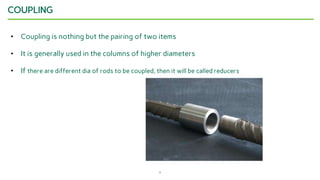
COUPLING
• Coupling is nothing but the pairing of two items
• It is generally used in the columns of higher diameters
• If there are different dia of rods to be coupled, then it will be called reducers
9
TERMINOLOGIES
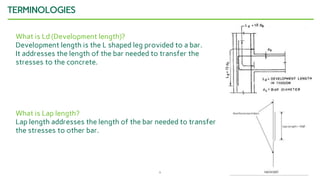
What is Ld (Development length)?
Development length is the L shaped leg provided to a bar.
It addresses the length of the bar needed to transfer the
stresses to the concrete.
What is Lap length?
Lap length addresses the length of the bar needed to transfer
the stresses to other bar.
10
TERMINOLOGIES
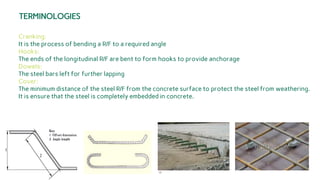
Cranking:
It is the process of bending a R/F to a required angle
Hooks:
The ends of the longitudinal R/F are bent to form hooks to provide anchorage
Dowels:
The steel bars left for further lapping
Cover:
The minimum distance of the steel R/F from the concrete surface to protect the steel from weathering.
It is ensure that the steel is completely embedded in concrete.
11
STEEL REINFORCEMENT
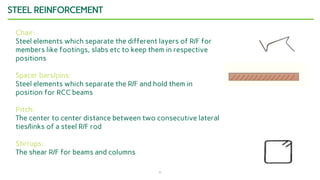
Chair:
Steel elements which separate the different layers of R/F for
members like footings, slabs etc to keep them in respective
positions
Spacer bars/pins:
Steel elements which separate the R/F and hold them in
position for RCC beams
Pitch:
The center to center distance between two consecutive lateral
ties/links of a steel R/F rod
Stirrups:
The shear R/F for beams and columns
12
ROLLING MARGIN
It is the tolerance percentage within which the diameter and weight per running
meter of the rolled steel can vary w.r.t standards mentioned in IS code (SP 34)
8-10 dia - +-7%
12-16 dia - +-5%
20 and above - +-3%
13
WHAT ARE THE TYPES OF STEEL BARS?
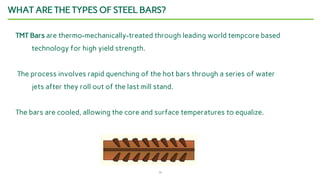
TMT Bars are thermo-mechanically-treated through leading world tempcore based
technology for high yield strength.
The process involves rapid quenching of the hot bars through a series of water
jets after they roll out of the last mill stand.
The bars are cooled, allowing the core and surface temperatures to equalize.
14
WHAT ARE THE TYPES OF STEEL BARS?
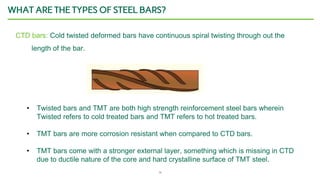
CTD bars: Cold twisted deformed bars have continuous spiral twisting through out the
length of the bar.
• Twisted bars and TMT are both high strength reinforcement steel bars wherein
Twisted refers to cold treated bars and TMT refers to hot treated bars.
• TMT bars are more corrosion resistant when compared to CTD bars.
• TMT bars come with a stronger external layer, something which is missing in CTD
due to ductile nature of the core and hard crystalline surface of TMT steel.
15
WEIGHT PER METER
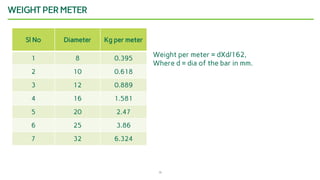
Weight per meter = dXd/162,
Where d = dia of the bar in mm.
Sl No Diameter Kg per meter
1 8 0.395
2 10 0.618
3 12 0.889
4 16 1.581
5 20 2.47
6 25 3.86
7 32 6.324
16
IMPORTANT POINTS
• Lapping of R/F should not occur at the column beam junction
• Cover blocks made of CM 1:2 should be used (after 7 days of curing)
• The binding wire ends should be turned inside after tying and it should not stick to
the surface
• The lapping should be staggered
17
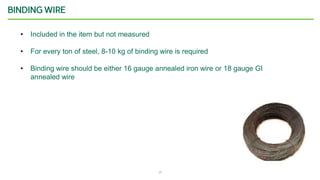
BINDING WIRE
• Included in the item but not measured
• For every ton of steel, 8-10 kg of binding wire is required
• Binding wire should be either 16 gauge annealed iron wire or 18 gauge GI
annealed wire
18
Thumb rules
• Slab / Lintel – 0.7 to 1.0% (55.00 to 78.50 kg/cum)
• Columns – 0.8 to 6.0% (62.80 to 471 kg/cum)
• Beam – 1.0 to 2.0% (78.50 to 157 kg/cum)
• Foundation – 0.5 to 0.8% (39.25 to 62.80 kg/cum)
In most of cases, we do not go beyond 4% as it will become difficult to pour concrete
and compact it.
19
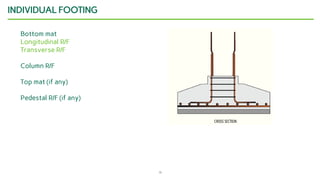
INDIVIDUAL FOOTING
Bottom mat
Longitudinal R/F
Transverse R/F
Column R/F
Top mat (if any)
Pedestal R/F (if any)
20
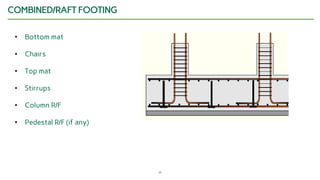
COMBINED/RAFT FOOTING
• Bottom mat
• Chairs
• Top mat
• Stirrups
• Column R/F
• Pedestal R/F (if any)
21
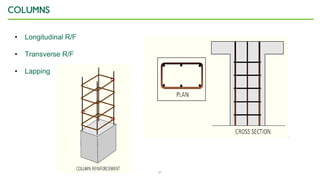
COLUMNS
• Longitudinal R/F
• Transverse R/F
• Lapping
22
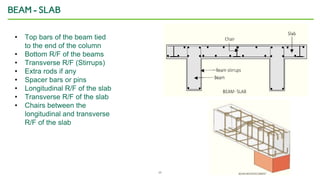
BEAM - SLAB
• Top bars of the beam tied
to the end of the column
• Bottom R/F of the beams
• Transverse R/F (Stirrups)
• Extra rods if any
• Spacer bars or pins
• Longitudinal R/F of the slab
• Transverse R/F of the slab
• Chairs between the
longitudinal and transverse
R/F of the slab
23
IMPORTANT TAKEAWAYS
• UoM for steel – MT
• Steel is either supplied by client or contractor.
• Material reconciliation statement needs to be prepared every month.
• Wastage percentage for steel - 2 to 3%
• Wastage is divided into two types: Visible wastages and invisible wastages
• Visible wastages is nothing but the scrap
• Invisible wastage is nothing but the chairs, pins etc
24
Q & A
When is lapping not allowed? And what shall be used in place of lapping?
What should be the minimum dia of the rod for dowels and chairs?
What are the minimum number of rods used in square and circular column?
What are the conditions for using the suitable dia of bars in slab?
How much binding wire required per MT of steel?
What is the difference between steel and iron?
What is TMT bar?
What are the components of steel?
What is the difference between mild steel and HYSD steel?
THANK YOU

BBS training

  • 1.
  • 2.
  • 3.
    3 WHY STEEL ISUSED? ● As we all know, in the construction industry, steel is used on a larger scale ● This is because steel is stronger than iron and it has better tension and compression properties ● Steel R/F is used in concrete to fulfill a number of functions which are paramount to the efficiency of the concrete member, giving rise to concrete reinforced structure.
  • 4.
    4 COMPONENTS OF STEEL ●Steel comprises of iron and carbon ● However in steel, Iron content is on the higher side. ● Carbon content is less than 2% ● In addition to this, several other metals can be added to have different properties ● For example: if chromium is added to steel, stainless steel is the product ● It is durable and doesn’t rust easily
  • 5.
    5 DIFFERENCE BETWEEN STEELAND IRON What is the difference between steel and iron? ● Iron is an element while steel is an alloy ● Iron was known to the humans from the beginning of civilization; however steel was discovered much later ● Steel is derivative of iron
  • 6.
    6 WHAT IS FE415,Fe 500 & Fe 550? Fe stands for Ferrum 415, 500 & 550 stands for yield strength for HYSD bars HYSD stands for High Yield Strength Deformed bars
  • 7.
    7 TERMINOLOGIES Shear R/F: The R/Fprovided in an RCC member to take care of the shear stress Grade of steel: It is a number which represents the yield characteristic strength of steel Anchorage: Additional length of steel of one structure required to be inserted in other at the junction. Example: Main bars of beam in column at beam column junction Splicing: The process of joining two bars to transfer the force from one bar to another bar in an RCC element. It can be done by lapping, welding or other mechanical means.
  • 8.
    8 COUPLING • Coupling isnothing but the pairing of two items • It is generally used in the columns of higher diameters • If there are different dia of rods to be coupled, then it will be called reducers
  • 9.
    9 TERMINOLOGIES What is Ld(Development length)? Development length is the L shaped leg provided to a bar. It addresses the length of the bar needed to transfer the stresses to the concrete. What is Lap length? Lap length addresses the length of the bar needed to transfer the stresses to other bar.
  • 10.
    10 TERMINOLOGIES Cranking: It is theprocess of bending a R/F to a required angle Hooks: The ends of the longitudinal R/F are bent to form hooks to provide anchorage Dowels: The steel bars left for further lapping Cover: The minimum distance of the steel R/F from the concrete surface to protect the steel from weathering. It is ensure that the steel is completely embedded in concrete.
  • 11.
    11 STEEL REINFORCEMENT Chair: Steel elementswhich separate the different layers of R/F for members like footings, slabs etc to keep them in respective positions Spacer bars/pins: Steel elements which separate the R/F and hold them in position for RCC beams Pitch: The center to center distance between two consecutive lateral ties/links of a steel R/F rod Stirrups: The shear R/F for beams and columns
  • 12.
    12 ROLLING MARGIN It isthe tolerance percentage within which the diameter and weight per running meter of the rolled steel can vary w.r.t standards mentioned in IS code (SP 34) 8-10 dia - +-7% 12-16 dia - +-5% 20 and above - +-3%
  • 13.
    13 WHAT ARE THETYPES OF STEEL BARS? TMT Bars are thermo-mechanically-treated through leading world tempcore based technology for high yield strength. The process involves rapid quenching of the hot bars through a series of water jets after they roll out of the last mill stand. The bars are cooled, allowing the core and surface temperatures to equalize.
  • 14.
    14 WHAT ARE THETYPES OF STEEL BARS? CTD bars: Cold twisted deformed bars have continuous spiral twisting through out the length of the bar. • Twisted bars and TMT are both high strength reinforcement steel bars wherein Twisted refers to cold treated bars and TMT refers to hot treated bars. • TMT bars are more corrosion resistant when compared to CTD bars. • TMT bars come with a stronger external layer, something which is missing in CTD due to ductile nature of the core and hard crystalline surface of TMT steel.
  • 15.
    15 WEIGHT PER METER Weightper meter = dXd/162, Where d = dia of the bar in mm. Sl No Diameter Kg per meter 1 8 0.395 2 10 0.618 3 12 0.889 4 16 1.581 5 20 2.47 6 25 3.86 7 32 6.324
  • 16.
    16 IMPORTANT POINTS • Lappingof R/F should not occur at the column beam junction • Cover blocks made of CM 1:2 should be used (after 7 days of curing) • The binding wire ends should be turned inside after tying and it should not stick to the surface • The lapping should be staggered
  • 17.
    17 BINDING WIRE • Includedin the item but not measured • For every ton of steel, 8-10 kg of binding wire is required • Binding wire should be either 16 gauge annealed iron wire or 18 gauge GI annealed wire
  • 18.
    18 Thumb rules • Slab/ Lintel – 0.7 to 1.0% (55.00 to 78.50 kg/cum) • Columns – 0.8 to 6.0% (62.80 to 471 kg/cum) • Beam – 1.0 to 2.0% (78.50 to 157 kg/cum) • Foundation – 0.5 to 0.8% (39.25 to 62.80 kg/cum) In most of cases, we do not go beyond 4% as it will become difficult to pour concrete and compact it.
  • 19.
    19 INDIVIDUAL FOOTING Bottom mat LongitudinalR/F Transverse R/F Column R/F Top mat (if any) Pedestal R/F (if any)
  • 20.
    20 COMBINED/RAFT FOOTING • Bottommat • Chairs • Top mat • Stirrups • Column R/F • Pedestal R/F (if any)
  • 21.
    21 COLUMNS • Longitudinal R/F •Transverse R/F • Lapping
  • 22.
    22 BEAM - SLAB •Top bars of the beam tied to the end of the column • Bottom R/F of the beams • Transverse R/F (Stirrups) • Extra rods if any • Spacer bars or pins • Longitudinal R/F of the slab • Transverse R/F of the slab • Chairs between the longitudinal and transverse R/F of the slab
  • 23.
    23 IMPORTANT TAKEAWAYS • UoMfor steel – MT • Steel is either supplied by client or contractor. • Material reconciliation statement needs to be prepared every month. • Wastage percentage for steel - 2 to 3% • Wastage is divided into two types: Visible wastages and invisible wastages • Visible wastages is nothing but the scrap • Invisible wastage is nothing but the chairs, pins etc
  • 24.
    24 Q & A Whenis lapping not allowed? And what shall be used in place of lapping? What should be the minimum dia of the rod for dowels and chairs? What are the minimum number of rods used in square and circular column? What are the conditions for using the suitable dia of bars in slab? How much binding wire required per MT of steel? What is the difference between steel and iron? What is TMT bar? What are the components of steel? What is the difference between mild steel and HYSD steel?
  • 25.