Level 1 Diploma in Bricklaying
© 2013 City and Guilds of London Institute. All rights reserved. 1 of 7
Session 1
Unit 104: Carrying out bricklaying activities
Level 1 Diploma in Bricklaying
© 2013 City and Guilds of London Institute. All rights reserved. 2 of 7
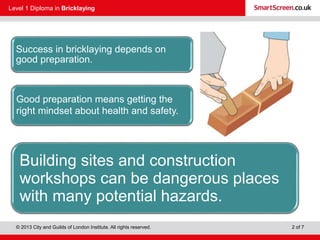
Success in bricklaying depends on
good preparation.
Good preparation means getting the
right mindset about health and safety.
Building sites and construction
workshops can be dangerous places
with many potential hazards.
Level 1 Diploma in Bricklaying
© 2013 City and Guilds of London Institute. All rights reserved. 3 of 7
When preparing for your brickwork tasks in the
workshop or the workplace, the first step is to get
familiar with exactly what it is that you are building …
… you will need to refer to a working drawing and
a specification
The drawing and specification will tell you
what types of materials are to be used and
may tell you something about the methods of
work to be employed.
Level 1 Diploma in Bricklaying
© 2013 City and Guilds of London Institute. All rights reserved. 4 of 7
Preparation of resources is
all about thinking ahead and
planning carefully.
The drawing and
specification will also
help you to select the
right tools and
equipment for the
task in hand.
Level 1 Diploma in Bricklaying
© 2013 City and Guilds of London Institute. All rights reserved. 5 of 7
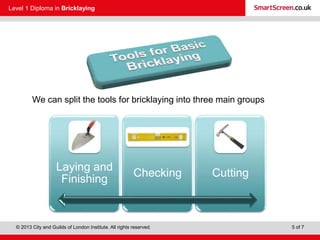
We can split the tools for bricklaying into three main groups
Laying and
Finishing
Checking Cutting
Level 1 Diploma in Bricklaying
© 2013 City and Guilds of London Institute. All rights reserved. 6 of 7
Bricks are manufactured in a vast range
of colours and textures.
They vary in hardness or compressive strength
and resistance to moisture penetration according
to the materials used in manufacture.
Mortar is the material we use to
bed and joint the bricks together. It
should be composed of well
graded building sand and
cement/lime powder mixed to a
specified ratio.
Level 1 Diploma in Bricklaying
© 2013 City and Guilds of London Institute. All rights reserved. 7 of 7
Any questions?

Session 1

  • 1.
    Level 1 Diplomain Bricklaying © 2013 City and Guilds of London Institute. All rights reserved. 1 of 7 Session 1 Unit 104: Carrying out bricklaying activities
  • 2.
    Level 1 Diplomain Bricklaying © 2013 City and Guilds of London Institute. All rights reserved. 2 of 7 Success in bricklaying depends on good preparation. Good preparation means getting the right mindset about health and safety. Building sites and construction workshops can be dangerous places with many potential hazards.
  • 3.
    Level 1 Diplomain Bricklaying © 2013 City and Guilds of London Institute. All rights reserved. 3 of 7 When preparing for your brickwork tasks in the workshop or the workplace, the first step is to get familiar with exactly what it is that you are building … … you will need to refer to a working drawing and a specification The drawing and specification will tell you what types of materials are to be used and may tell you something about the methods of work to be employed.
  • 4.
    Level 1 Diplomain Bricklaying © 2013 City and Guilds of London Institute. All rights reserved. 4 of 7 Preparation of resources is all about thinking ahead and planning carefully. The drawing and specification will also help you to select the right tools and equipment for the task in hand.
  • 5.
    Level 1 Diplomain Bricklaying © 2013 City and Guilds of London Institute. All rights reserved. 5 of 7 We can split the tools for bricklaying into three main groups Laying and Finishing Checking Cutting
  • 6.
    Level 1 Diplomain Bricklaying © 2013 City and Guilds of London Institute. All rights reserved. 6 of 7 Bricks are manufactured in a vast range of colours and textures. They vary in hardness or compressive strength and resistance to moisture penetration according to the materials used in manufacture. Mortar is the material we use to bed and joint the bricks together. It should be composed of well graded building sand and cement/lime powder mixed to a specified ratio.
  • 7.
    Level 1 Diplomain Bricklaying © 2013 City and Guilds of London Institute. All rights reserved. 7 of 7 Any questions?